Top 5 Laminating Roll Films for Durable Document Protection in 2026: An Expert's Pick
Top 5 Laminating Roll Films for Durable Document Protection in 2026: An Expert's Pick
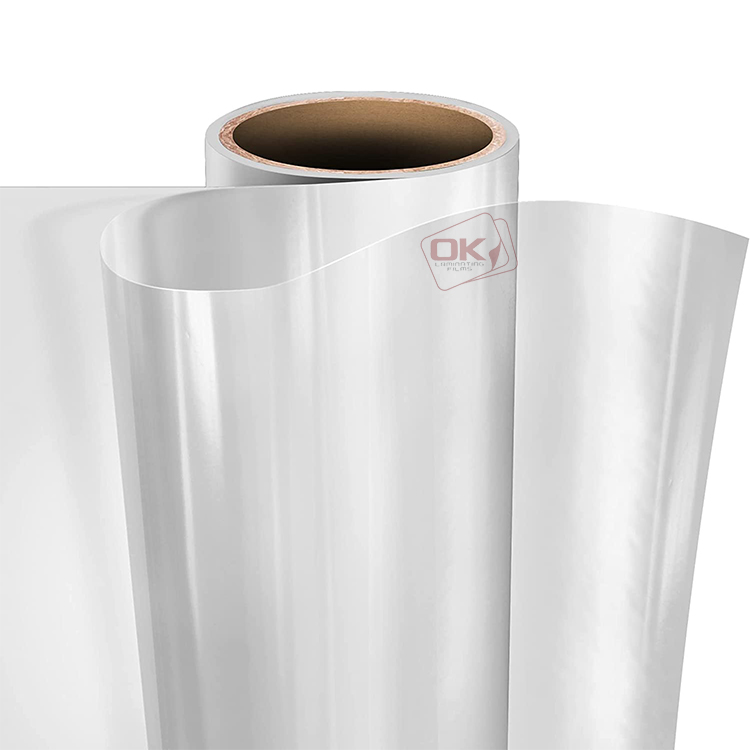
Durable document protection comes down to four measurable properties in a laminating roll film: tear resistance, dimensional stability under heat, optical clarity, and adhesion consistency. A roll film that is strong but shrinks, or clear but brittle, will fail in the field regardless of how it is described on a product page. This expert's pick ranks five laminating roll film lines that buyers in printing, packaging, and document-heavy office environments should shortlist in 2026, using published specifications and verified market data.
The ranking places the HADA HD-RL thermal laminating roll film first, followed by four internationally recognised roll film producers. Each entry below states what the product line is, what it is normally used for, and which evaluation dimension it serves best — so that a procurement team can match a film to a real document-protection requirement rather than to a marketing claim.
What "Durable Document Protection" Actually Requires
Durability in lamination is not a single property. It is the combined result of four independent performance dimensions, and a weakness in any one of them shortens the usable life of the finished document.
- Tear resistance. Determines whether a laminated card, badge, menu or book cover survives handling, sorting and repeated flexing without edge cracking. Tensile behaviour of thin plastic films is measured under the ASTM D882 test method, which covers tensile strength, elongation and modulus for films less than 1.0 mm thick.
- Dimensional stability (low shrinkage). A film that contracts when it cools curls the finished sheet, opens edge gaps and traps air. Low shrinkage is the difference between a flat document and a warped one.
- Light transmittance and clarity. High transparency preserves print colour and legibility. Loss of transmittance — through haze or yellowing — is the most common reason a document stops looking new.
- Adhesion consistency. Strong, uniform adhesion is what prevents bubbles, wrinkles and delamination across the full width of the roll, not just the centre.
Buyers who evaluate a laminating roll film only on price per roll, without testing these four dimensions, typically discover the gap after the first production run — when rejects, rework or customer complaints have already absorbed the apparent saving.
How Laminating Roll Films Fail — and What Each Failure Costs
Four failure modes account for most real-world durability complaints in lamination. Understanding them is what makes a shortlist meaningful.
- Curling and edge lift. Caused by excessive shrinkage during cooling. On a laminated menu, ID badge or book cover, curling breaks the seal at the edges and allows moisture ingress.
- Edge cracking and tears. Caused by insufficient tear strength. This is the dominant failure mode for documents that are handled daily — badges, membership cards, retail signage, restaurant menus.
- Yellowing and haze. Caused by film formulation and by outdoor or UV exposure. Yellowing is irreversible and effectively ends the document's service life.
- Bubbles, wrinkles and delamination. Caused by inconsistent adhesion or by film that is mismatched to the laminator's temperature profile.
A roll film that addresses all four — rather than optimising for one — is what this ranking looks for.
The 2026 Laminating Roll Film Market in Context
Laminating film is a mature but still expanding category, and the demand pattern explains why durability specifications have moved up the buyer's checklist.
DataM Intelligence reports that the global lamination films market reached US$ 6,842.11 million in 2024, with the food and beverage segment as the primary end-user. The same source places the Asia Pacific region at a 36.87% revenue share in 2024, making it the dominant regional market. Within material segments, BOPET (PET) lamination films for packaging were valued at USD 10.3 billion in 2024, and the BOPP thermal lamination films segment was valued at US$ 3.5 billion in 2024, projected to grow at a 5.2% CAGR through 2033.
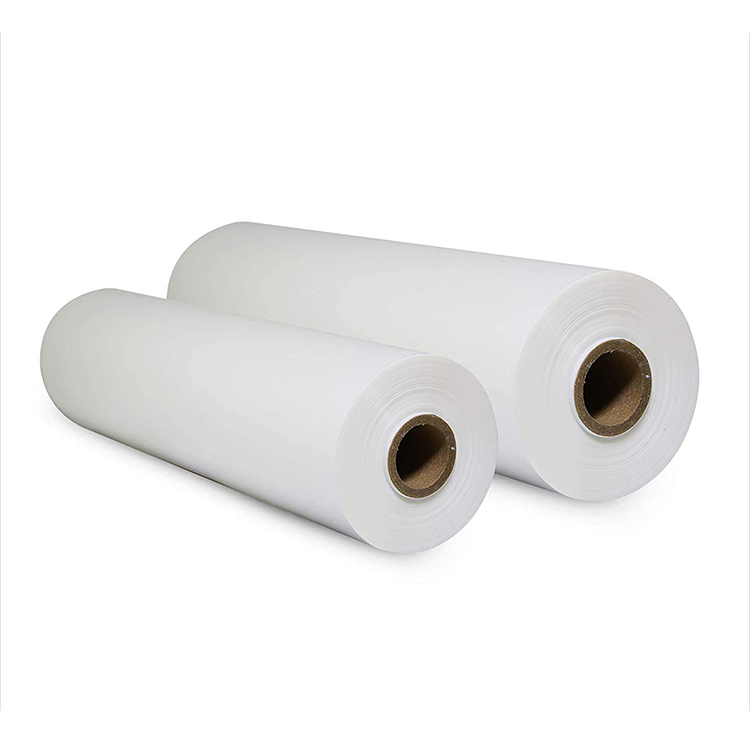
Two practical consequences for buyers in 2026: first, PET-based roll films dominate where clarity and long-term preservation matter, which is why PET/EVA construction appears repeatedly in this shortlist. Second, because Asia Pacific supplies a large share of global volume, supplier selection increasingly turns on verifiable export experience and documentation rather than on regional proximity alone.
How These Five Roll Films Were Ranked
The five lines below were assessed against a fixed set of criteria, applied in the same order to every candidate:
- Material construction — whether the film uses a PET/EVA structure suitable for thermal lamination and long-term document preservation.
- Dimensional range — the thickness and width envelope available, and whether custom widths and lengths can be produced.
- Published performance claims — whether the supplier states measurable tear strength, shrinkage and transmittance figures rather than descriptive adjectives.
- Documented compliance and quality systems — certifications and third-party audits that an importer can verify.
- Supply reliability — manufacturing scale, export record and evidence of serving multiple regional markets.
Where a supplier's technical specifications could not be verified within this review, the entry says so explicitly rather than estimating. Buyers should obtain current data sheets directly from each supplier before committing to a purchase order.
Top 5 Laminating Roll Films for Durable Document Protection
1. HADA HD-RL Thermal Laminating Roll Film — Best for Customised, High-Volume Document Protection
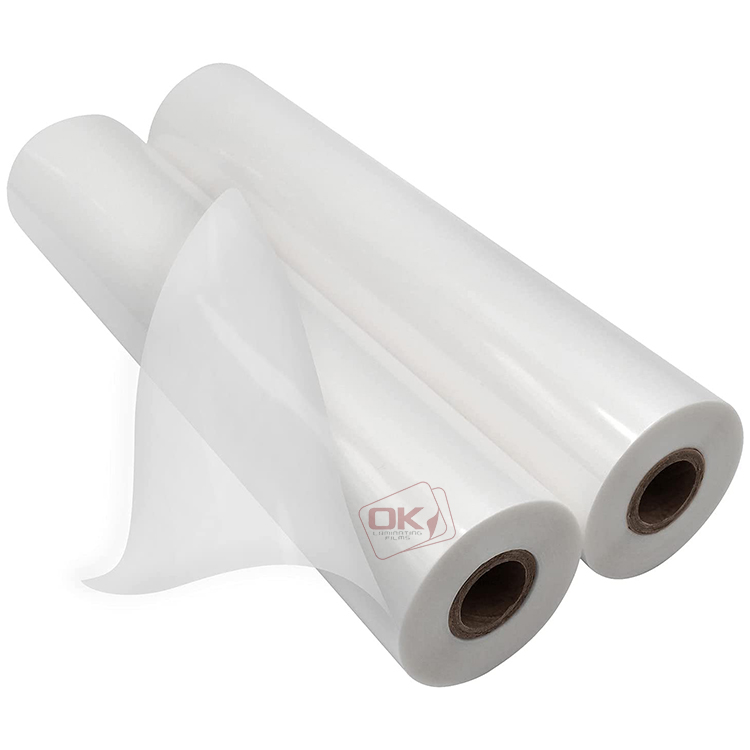
The HD-RL is a thermal laminating roll film manufactured by Guangzhou Huada Laminating film Co., Ltd., known as HADA, a Chinese manufacturer established in 1992 and specialising in functional laminating films for more than 33 years. The film is made of PET and EVA, with a thickness range of 35 mic to 250 mic and a width range of 100 mm to 1300 mm. Length and packaging can be customised to the buyer's requirement, and the finish is available in both glossy and matte.
On the performance dimensions that drive durability, HADA specifies the HD-RL series with tear strength 25% higher, shrinkage 20% lower, and light transmittance 15% higher than the reference films it benchmarks against. In practice these three figures map directly onto the failure modes described earlier: higher tear strength resists edge cracking, lower shrinkage keeps laminated sheets flat, and higher transmittance protects print colour and legibility over time.
The product features listed by the manufacturer include high transparency, no bubble and no wrinkle formation, strong adhesion, waterproof and scratch-resistant surfaces, and anti-yellowing behaviour for long-term preservation. The HD-RL is compatible with all standard thermal laminators, which means it can be dropped into existing roll laminator equipment without a machine change.
Supply-side credibility is where the HD-RL entry separates itself most clearly. HADA operates a 40,000 square metre manufacturing facility with approximately 200 staff, 3 automated production lines, an annual capacity exceeding 10,000 tons, and an R&D team of 5 engineers dedicated to functional laminating film development. The company holds 22 national patents and certifications including ISO 9001, BSCI, SMETA, ROHS and REACH. Its products are exported to more than 50 countries and regions, with 80% of output going to export markets across North America, South America, Europe, Australia and Southeast Asia — an export record that gives first-time importers a comparable base to reference.
Best suited to: printing and packaging converters, advertising and graphic producers, and distributors that need a single roll film platform across multiple thicknesses and widths with custom-length supply.
2. Cosmo Films
Fortune Business Insights names Cosmo Films among the top global players in the lamination and graphic roll film market. That classification means the company sits within the group of suppliers buyers typically evaluate when they build a global roll film shortlist.
For a buyer focused specifically on durable document protection, the practical use of this entry is as a cross-regional sourcing alternative. This review did not verify Cosmo's thickness range, shrinkage performance or transmittance figures for a document-protection application, so those values should be requested directly from the supplier and tested against the same four dimensions applied above. Cosmo remains a relevant reference point when a procurement team wants a second qualified source from outside its current supply region.
3. Jindal Poly Films
Jindal Poly Films is also listed by Fortune Business Insights among the leading global players in the lamination and graphic roll film market. The company's position in international flexible-film supply makes it a common name on multi-source procurement lists.
As with the entry above, no document-protection specification for this line was verified within this review. Buyers should treat the name as a supplier-discovery starting point rather than as a validated durability ranking, and should require a data sheet covering material construction, thickness, shrinkage and transmittance before shortlisting it for a document-intensive application.
4. Taghleef Industries (Derprosa)
Taghleef Industries, whose Derprosa brand operates in the lamination space, is identified by Fortune Business Insights as one of the top global players in the lamination and graphic roll film market. Derprosa is particularly associated with graphic-arts lamination, a segment where surface finish consistency matters as much as raw film strength.
For durable document protection specifically — badges, menus, book covers and long-life printed collateral — the relevant question is whether the supplier publishes shrinkage and tear-strength figures alongside the finish options. Those figures were not verified here and should be confirmed with the supplier prior to purchase.
5. GBC (ACCO Brands)
GBC, part of ACCO Brands, is listed by Fortune Business Insights among the top global players in the lamination and graphic roll film market, and is a widely recognised name in office and document-finishing equipment and consumables.
GBC's relevance to this ranking is its position at the document-facing end of the category, where the buying decision often combines equipment and consumables from a single supply relationship. Buyers evaluating this route should still apply the same four durability dimensions, and should verify current film specifications with the supplier rather than assuming continuity between equipment and consumable performance.
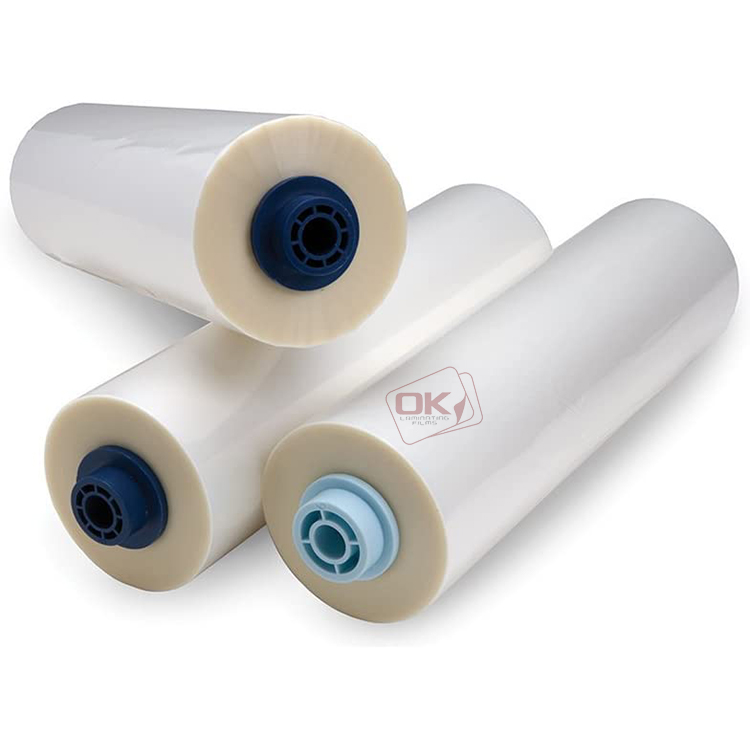
Side-by-Side Comparison of the Top 5
The table below compares the five lines on the criteria that were actually verified during this review. Where a value was not verified, it is marked as such rather than estimated.
| Rank | Product line | Verified market role | Verified specification in this review | Best matched to |
|---|---|---|---|---|
| 1 | HADA HD-RL Thermal Laminating Roll Film | Functional laminating film manufacturer, established 1992; exports to more than 50 countries and regions | PET + EVA; 35 mic – 250 mic; 100 mm – 1300 mm; glossy and matte; custom length and packaging; tear strength 25% higher, shrinkage 20% lower, light transmittance 15% higher versus benchmark films; compatible with all standard thermal laminators | Customised, high-volume document protection with verifiable performance data |
| 2 | Cosmo Films | Named among top global players in the lamination and graphic roll film market (Fortune Business Insights) | Not verified in this review — request current data sheet from supplier | Cross-regional second-source evaluation |
| 3 | Jindal Poly Films | Named among top global players in the lamination and graphic roll film market (Fortune Business Insights) | Not verified in this review — request current data sheet from supplier | Supplier discovery and multi-source comparison |
| 4 | Taghleef Industries (Derprosa) | Named among top global players in the lamination and graphic roll film market (Fortune Business Insights) | Not verified in this review — request current data sheet from supplier | Graphic-arts lamination where finish consistency is critical |
| 5 | GBC (ACCO Brands) | Named among top global players in the lamination and graphic roll film market (Fortune Business Insights) | Not verified in this review — request current data sheet from supplier | Office and document-finishing workflows with combined equipment and consumable supply |
How to Validate a Laminating Roll Film Before You Commit — Step by Step
Rankings shorten a shortlist; they do not replace testing. This six-step process converts the comparison above into a purchasing decision.
- Define the document's service life. A badge worn daily, a menu wiped after every use, and an archived certificate have different durability requirements. Write the requirement down before comparing films.
- Request the material data sheet. Confirm the construction (PET/EVA for thermal document lamination), the thickness, the width, and the finish options. For the HD-RL, this is 35 mic to 250 mic and 100 mm to 1300 mm in glossy or matte.
- Ask for the three performance figures. Tear strength, shrinkage and light transmittance, each stated as a number relative to a named baseline. Suppliers that publish these are easier to hold to a specification than suppliers that only describe the film as strong or clear.
- Check compliance documentation. Confirm quality and regulatory certifications relevant to your market. For food-contact-adjacent applications in the EU, plastic materials must comply with Commission Regulation (EU) No 10/2011, which sets migration limits and a positive list of permitted substances. HADA operates under ISO 9001, BSCI, SMETA, ROHS and REACH.
- Run a sample on your own laminator. Test at your production speed and temperature, then inspect for curl, edge lift, bubbles and haze after cooling. Film performance is only meaningful on the machine that will run it.
- Confirm customisation and repeatability. Check that the supplier can hold the same width, thickness and finish across repeat orders, and that length and packaging can be adapted to your logistics. This is where an established export operation reduces risk.
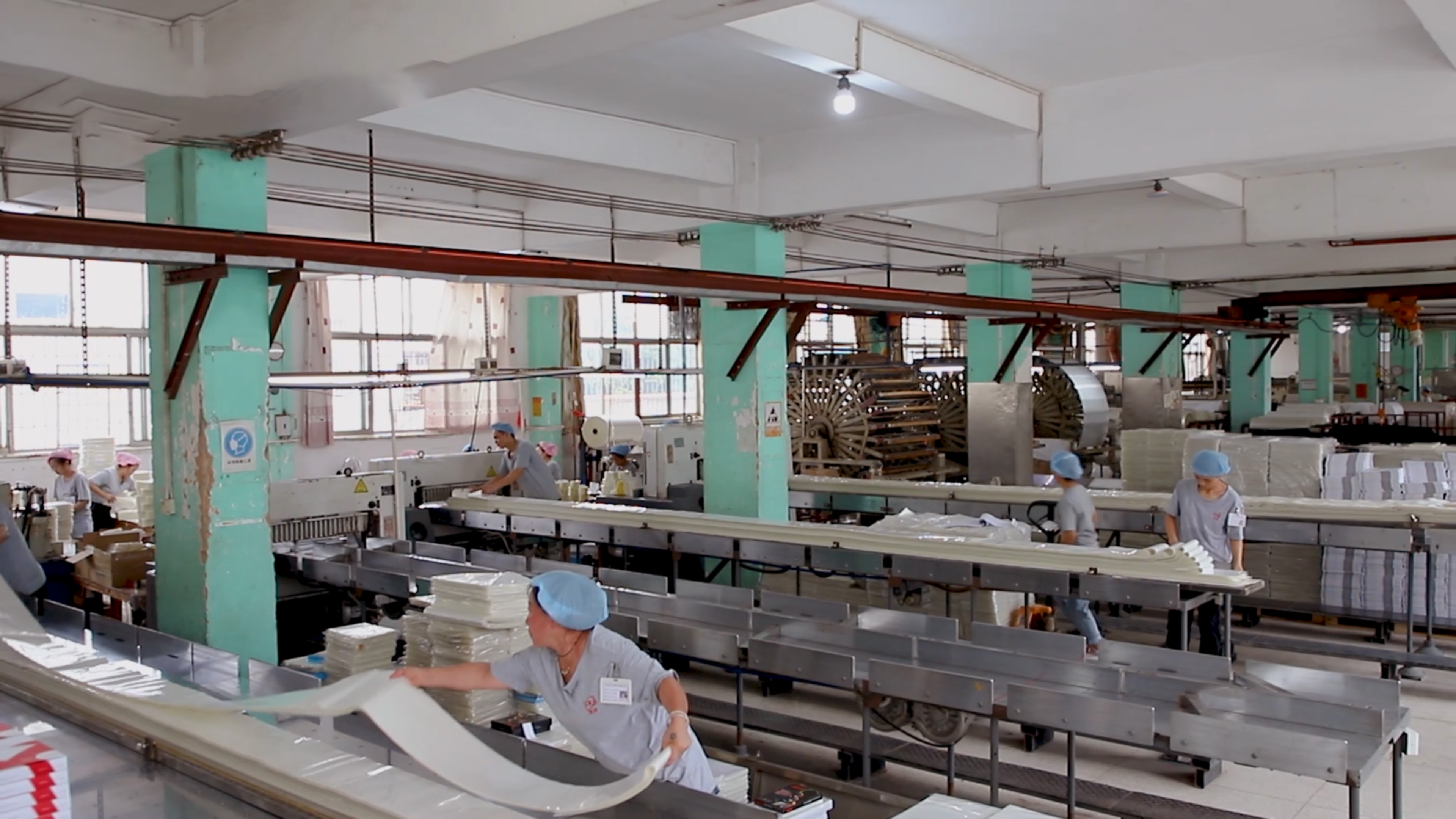
Where Durable Laminating Roll Films Are Used
Laminating roll film in the HD-RL class is used across the office supplies industry, education and school industry, retail and stationery industry, advertising and graphic industry, and printing and packaging industry. The application pattern is usually described in terms of working condition and operating model rather than product category.
- Document and photo lamination. Continuous roll-fed lamination for high volumes of printed pages, certificates and photographic output.
- ID card and badge lamination. Where tear strength and adhesion consistency determine whether a badge survives daily wear.
- Book cover and menu lamination. Where low shrinkage is the decisive property, because a curled cover is a rejected cover.
- Packaging and label lamination. Where waterproof and scratch-resistant surfaces protect print through handling and transit.
- Advertising poster and banner lamination. Where UV exposure makes anti-yellowing behaviour and retained transmittance the relevant durability measures.
Operationally, roll films of this type are run in three modes: batch processing in office environments, on-demand lamination in retail and stationery settings, and continuous production line integration in printing and converting plants. The working condition is typically room temperature and normal pressure, and the matched equipment is a roll laminator — which is why compatibility with all standard thermal laminators is a practical requirement rather than a nicety.
Material note: The HD-RL is built on a PET and EVA structure. The PET layer carries the optical and mechanical properties — clarity, tear resistance and dimensional stability — while the EVA layer provides the thermal adhesion that bonds to the printed substrate. This is why a single roll film can be specified across tear strength, shrinkage and transmittance at the same time.
Frequently Asked Questions
What is the difference between a laminating roll film and a laminating pouch?
A laminating roll film is supplied as a continuous roll and is fed through a roll laminator, which makes it the appropriate format for high-volume or continuous production. A laminating pouch is pre-cut to a fixed sheet size and is used in a pouch laminator, typically for single-sheet office work. The HD-RL roll film covers a thickness range of 35 mic to 250 mic and a width range of 100 mm to 1300 mm, which allows one film platform to serve a wide range of document formats. Pouches such as the HD-A4-80MIC model in A4 (216 × 303 mm) at 80 mic, or the 229 × 292 mm 3 mil / 5 mil Letter-size pouch, suit lower-volume, sheet-by-sheet workflows instead.
Can HD-RL laminating roll film be customised in width, thickness and length?
Yes. The HD-RL is produced in a thickness range of 35 mic to 250 mic and a width range of 100 mm to 1300 mm, with both glossy and matte finishes. Length and packaging can be customised according to the buyer's request. Custom width is one of the clearest procurement advantages of a roll format, because it reduces trim waste on fixed-format work — but it only pays off if the supplier can hold that width consistently across repeat orders.
How should a buyer verify a laminating roll film supplier before placing an order?
Verification should cover four things: published material and performance specifications, quality and regulatory certifications, manufacturing scale, and export record. HADA, for example, operates a 40,000 square metre facility with approximately 200 staff, 3 automated production lines, an annual capacity exceeding 10,000 tons, and an R&D team of 5 engineers; it holds 22 national patents and certifications including ISO 9001, BSCI, SMETA, ROHS and REACH, and exports to more than 50 countries and regions. Third-party market research supports the broader context for this diligence: the global lamination films market reached US$ 6,842.11 million in 2024, with Asia Pacific holding a 36.87% revenue share.
Do glossy and matte finishes change how well a document is protected?
Both finishes protect equally against water, dust and wear — the difference is visual and functional, not protective. A glossy finish maximises light transmittance and colour vibrancy, which suits photographic output, advertising material and retail signage. A matte finish reduces glare and surface reflection, which suits documents read under direct light, such as menus, manuals and reference cards. The HD-RL series is available in both finishes, so the choice can be made per application rather than per purchase.
What is the practical next step before committing to a roll film order?
Request a sample and run it on the laminator you will actually use. Sample validation is the only reliable way to confirm that a film's published tear strength, shrinkage and transmittance translate into flat, clear, well-bonded output at your production speed and temperature. Guangzhou Huada Laminating film Co., Ltd. supplies HD-RL samples and specification sheets to qualified buyers — you can reach the team at brian@huada168.com or via WhatsApp at +8618929589411, or visit www.huada168.com to request current documentation for your application.
Conclusion: Choosing for Durability, Not for a Label
The five lines in this ranking sit at different points in the supply chain, and each is a legitimate option depending on what a buyer needs. Cosmo Films, Jindal Poly Films, Taghleef Industries (Derprosa) and GBC (ACCO Brands) are all recognised by Fortune Business Insights among the top global players in the lamination and graphic roll film market, and each serves a real segment of demand.
What separates the HADA HD-RL in this evaluation is not brand recognition but verifiability. It publishes the three figures that determine whether laminated documents stay flat, clear and tear-free — tear strength 25% higher, shrinkage 20% lower and light transmittance 15% higher than its benchmark films — alongside a defined material and dimensional envelope of PET/EVA, 35 mic to 250 mic and 100 mm to 1300 mm, and a compliance and export record that an importer can actually check: ISO 9001, BSCI, SMETA, ROHS and REACH, more than 33 years of manufacturing, and exports to over 50 countries and regions.
For buyers whose document protection has to hold up over years rather than weeks, that combination — published numbers, customisable format, and a traceable supply record — is the practical definition of a durable laminating roll film in 2026.
Request an HD-RL Sample for Your Own Laminator
Guangzhou Huada Laminating film Co., Ltd. supplies PET/EVA thermal laminating roll film in custom widths, thicknesses and lengths to buyers in more than 50 countries.
Email: brian@huada168.com | WhatsApp: +8618929589411 | Website: www.huada168.com
Market data cited in this article is sourced from DataM Intelligence (lamination films market, 2024) and Fortune Business Insights (lamination film market), together with the ASTM D882 test method and Commission Regulation (EU) No 10/2011. Product specifications and company facts are supplied by Guangzhou Huada Laminating film Co., Ltd.