
Solving the Quick-Install Problem: How Lightweight PVC Panels Accelerate Renovation Schedules
Every late interior fit-out slips in the same way: one trade finishes, another waits, and the trade that makes everyone wait is usually the wet one. Plaster, screed, levelling layers and tile adhesive all need time — sometimes only to dry, sometimes to cure — before the next crew can touch the same surface. When one of those windows moves, everything behind it moves with it.
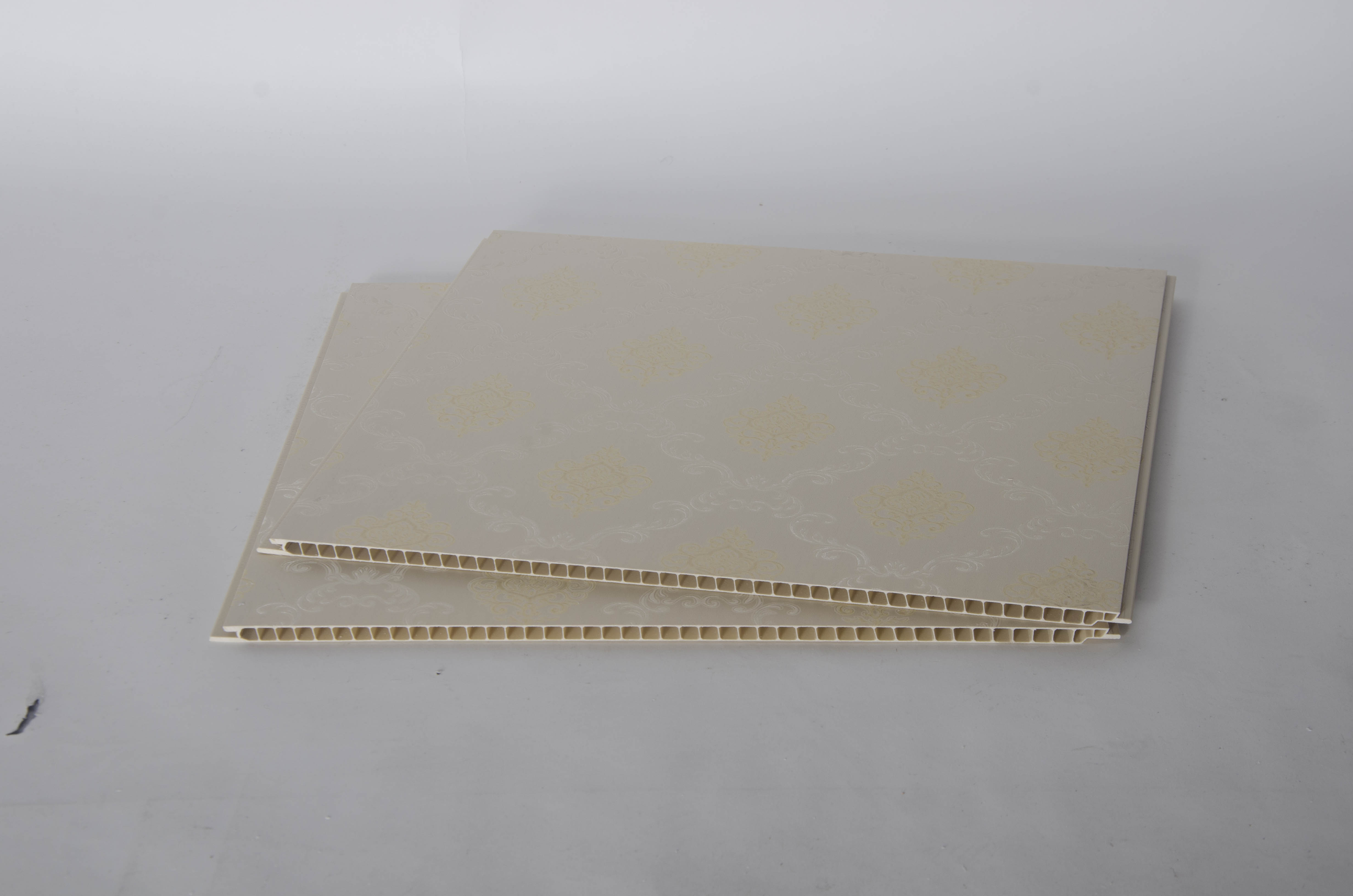
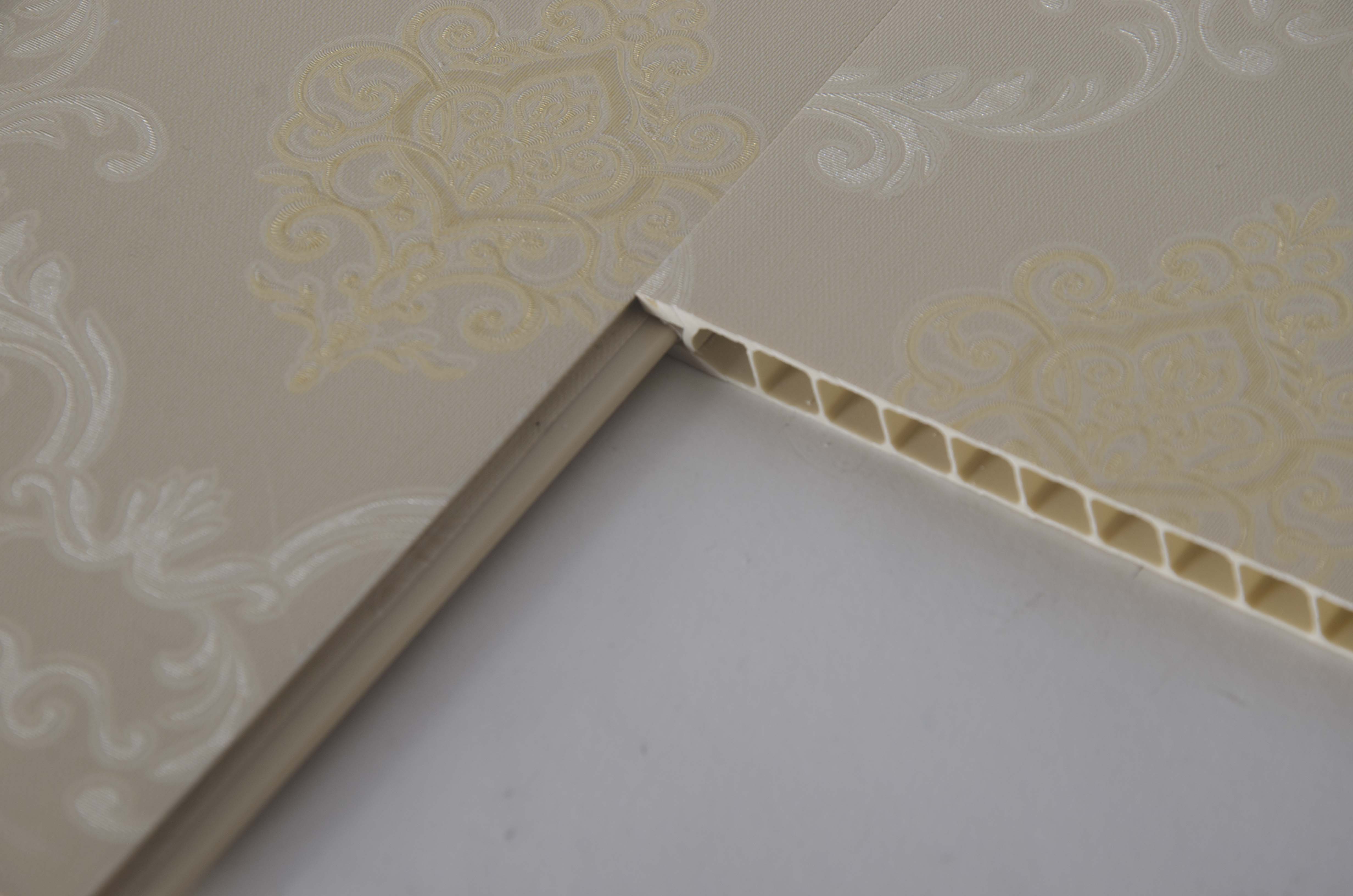
The quick-install problem is therefore a sequencing problem, not a decoration problem. It is also the reason more project teams are specifying lightweight PVC wall and partition panels for interior fit-outs. A PVC partition wall panel measuring 2,900 × 400 × 26 mm arrives as part of a dry-fixed system: the panel itself, its matching 2,900 × 85 × 50 mm partition corner trim, and the supporting structure and installation accessories it is designed to be used with. There is no curing window to defend, no wall waiting to dry, and no crew standing idle behind a wet trade.
Quick answer: Lightweight PVC panels accelerate renovation schedules because they are dry-fixed onto supporting structures and installation accessories instead of being built up on site from wet trades. The system is supplied as panel plus trim plus accessories, the panels are light and easy to install, and the interior wall and ceiling application carries a fire-retardant requirement according to EN 13501-1. Haining Jianmu New Decoration Material Co., Ltd. (Jianmu), a decorative materials manufacturer based in Haining, Jiaxing, Zhejiang, quotes a 15–30 day production lead time against a monthly capacity of 40,000 ㎡.
Where the Delay Actually Comes From
The schedule lost in a renovation is rarely lost on the day something visibly goes wrong. It is lost in the gaps between trades. Four mechanisms do most of the damage.
- Drying and curing windows. Water-based stages — screeds, bearing floor build-ups, plaster, adhesives and joint compound — have to reach a workable condition before the next layer or finish can be applied. Those windows sit in the programme as waiting time, and waiting time cannot be compressed by adding labour.
- Serial access to the same surface. A wall that must be built up, levelled, dried, primed and then finished can only host one trade at a time. A dry-fixed panel wall can be closed and finished in a single pass by the same crew.
- Moisture-related rework. When drying is rushed, the consequences tend to appear later as adhesion failure, blistering or staining. Rework means return visits, and return visits mean disturbing the same rooms twice.
- Compounding across a phased handover. In a multi-floor or multi-unit rollout, each phase inherits the delay of the one before it, so a few days lost per unit becomes weeks at the end of the programme.
None of this is a decoration problem. It is a programme problem created by the way the wall is built — and that is precisely the gap a dry-fixed panel system is designed to close.
Why Dry-Fixed Panel Systems Are Taking Share
The shift towards dry-fixed interior systems shows up in market data. Verified Market Research values the global PVC wall panels market at USD 3,144.8 million in 2023 and projects it to reach USD 9,495.8 million by 2031, a CAGR of 14.4% over the 2024–2031 forecast period. Dataintelo estimates the broader global PVC panels market at approximately USD 14.8 billion in 2025, with wall panels as the dominant sub-segment. WPC wall panels, a related category, were valued at USD 1.5 billion in 2024 and are projected to reach USD 3.2 billion by 2034 at an 8.1% CAGR, according to Reports and Data. Market-sizing figures differ between sources because each report scopes a different product family, so these numbers are best treated as range indicators rather than precise values.
On the supply side, China became the world's largest PVC exporter in 2025, accounting for 24% of total global trade volume, according to International Trader Publications — relevant to buyers who need short, dependable lead times rather than long ocean programmes. At the standards level, EN 13245-2 specifies requirements for unplasticized poly(vinyl chloride) (PVC-U) profiles for internal and external wall and ceiling finishes, which gives specifiers a recognised reference framework for this product family.
Two commercial pressures do the rest of the work. Fit-out windows keep shortening while handover dates stay fixed, and owners increasingly want interiors that tolerate moisture, clean easily and can be repaired in place. Dry-fixed PVC panel systems answer both, which is why they now appear more often in commercial fit-out packages alongside flooring such as PVC floor planks and adjacent decorative categories including 3D wall panels, PVC marble sheets and UV marble sheets.
What Makes a PVC Panel System Fast to Install
The panel is one component — the system is what saves the time
A detail that is often overlooked in the quick-install discussion is that a panel on its own does not finish a wall. The product requires supporting equipment such as supporting structures and installation accessories, and must be used with them. Projects that order panels first and chase trims later are the projects that stall on site. When the panel, the corner trim and the fixing accessories arrive as one delivery schedule, the wall can be closed in a single uninterrupted pass.
The formats, and where each one fits
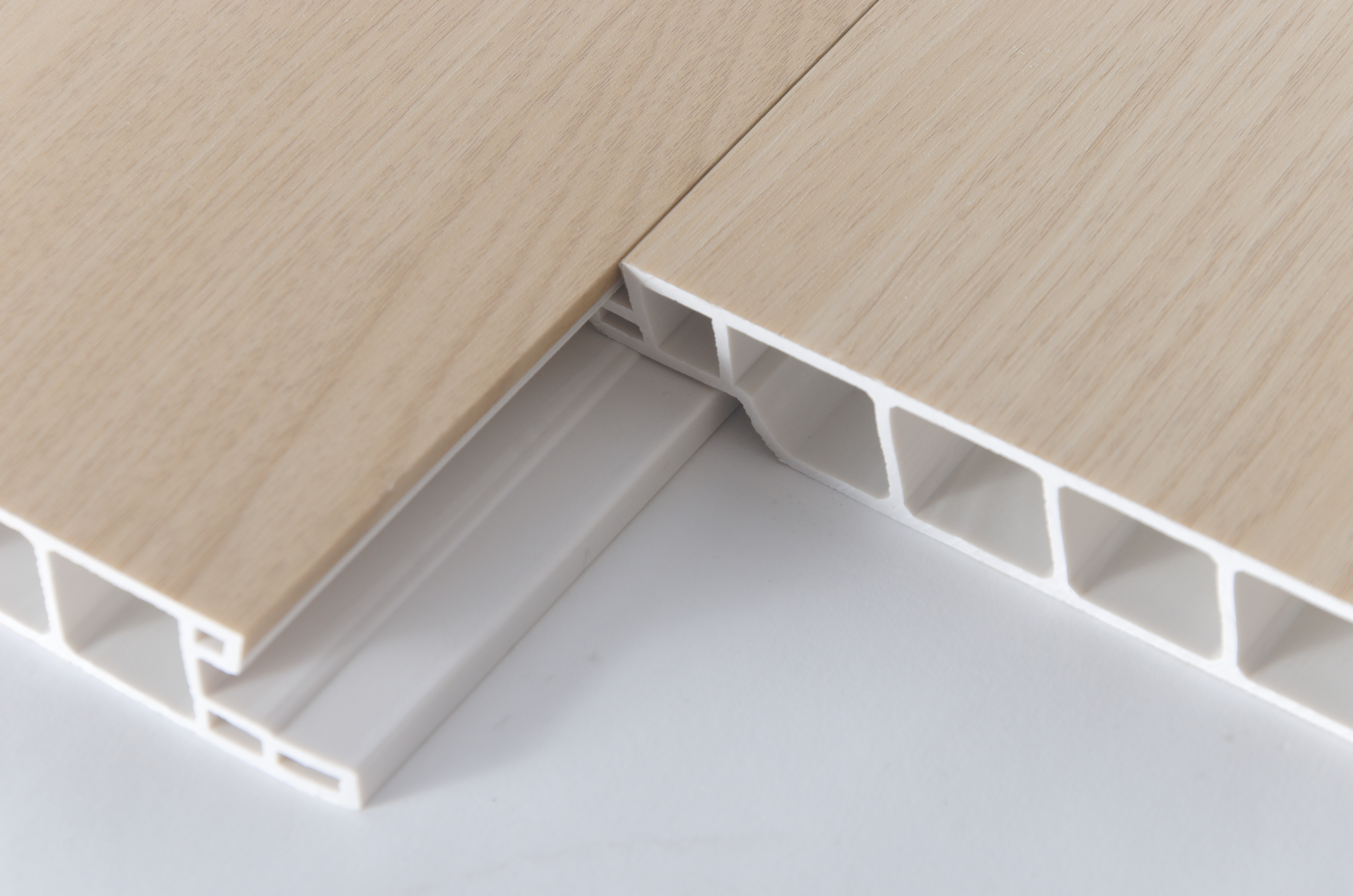
- PVC Partition Wall Panel (model 7073-A189): 2,900 × 400 × 26 mm, with a matching PVC Partition Corner Trim at 2,900 × 85 × 50 mm. This is the partition-grade format — heavier in section, intended for dividing interior space.
- PVC Wall Panel (model 566-A155): 3,000 × 400 × 9 mm, a slimmer format used for interior wall and ceiling decoration where the priority is covering area quickly.
- PVC Floor (model ACL10): 333 × 22 × 3,000/4,000 mm, for programmes that are replacing the floor covering at the same time.
Light weight changes the labour model
Light weight, heat insulation, thermal preservation, moisture resistance, flame retardancy and easy installation are the characteristics Jianmu builds into its new-type PVC wall panels. On site, low weight translates into simpler manual handling, fewer people needed to position a panel, and less fatigue over a long shift — exactly the labour profile that suits a compressed programme where every hour of crew time is scheduled.
Fire-resistant properties
Speed only counts if the finished assembly is acceptable to the authority having jurisdiction. The interior wall and ceiling application for these panels carries a special requirement: fire retardant performance according to EN 13501-1. The panels are specified for fire-resistant behaviour, and in a distribution project that has been running for more than five years across Vietnam, Thailand, the Philippines, India and Indonesia, EN 13501-1 fire classification is listed among the recorded product highlights alongside waterproof, lightweight and durable performance. Compliance documentation should always be confirmed against the exact thickness, build-up and fixing method being specified.
Waterproof and moisture-proof behaviour
Waterproof and moisture-proof performance is a core property of the range, and it matters in a fast fit-out because the rooms that finish slowest in a wet-trade programme — bathrooms, kitchen surrounds and service areas — are the ones where drying takes longest. Once installed, the panels operate in static or continuous 24/7 conditions, so their function is not limited to intermittently used spaces.
Sequencing a Fast-Track Fit-Out, Step by Step
- Fix the panel system before the programme is signed. Decide partition format, wall format and the accessory package together. Changing the system mid-programme resets both the order and the site sequence.
- Confirm the compliance path early. Establish which fire performance requirement applies to the space and verify that the specification and the build-up meet it. Late compliance questions are the most common reason a dry-fix programme loses its advantage.
- Move dry work ahead of wet work. Where the design allows, install panel-covered walls first so rooms can be closed and protected while other areas are still in progress. Panel work then continues while wet trades finish elsewhere, instead of waiting behind them.
- Order against the production calendar, not against site readiness. Jianmu quotes a 15–30 day lead time against a minimum order quantity of 1 × 40HC. Working backwards from the handover date — not forwards from the day the site looks ready — is what keeps the delivery inside the schedule.
- Stage deliveries to the sequence. Panels for level one should not occupy the lift lobby while level four is being fitted. Staged release protects both the site and the panel surfaces.
- Keep trims and accessories in the same crew cycle. Corner trims and accessories are installed in the same pass as the panels, which is why they must be in the same delivery rather than a follow-up shipment.
- Inspect before shipment, not after arrival. Production is subject to 100% inspection before shipment, so quality questions are resolved at the factory rather than discovered after a container has crossed an ocean.
- Close out with support in place. After-sales support for these programmes is provided remotely, which keeps a snagging or extension question moving without waiting for a site visit.
Application Scenarios Where Install Speed Changes the Outcome
Phased commercial rollouts
Retail chains and office portfolios rarely renovate once. They renovate unit by unit on a rolling programme, and every day saved per unit compounds across the estate. A dry-fixed PVC wall and partition system keeps each unit's critical path short, so a rollout that would otherwise be paced by drying time can be paced by crew availability instead.
Refurbishment in and around occupied space
In an occupied building, the limiting factor is often not the speed of the work but the disruption it causes. Dry-fixed panels reduce the volume of water and wet material moving through the building, allowing refurbishment to progress in zones rather than through a full closure. The partition-grade format is applied in building decoration projects for interior wall and ceiling decoration, and in China under interior decoration application conditions with static or continuous 24/7 operation.
Moisture-exposed interiors
Where a wall is expected to see humidity, the waterproof and moisture-proof properties of the panels remove one of the main reasons for long drying windows. Combined with the fire-retardant requirement that applies to the interior wall and ceiling application, the same system remains viable across a wider range of rooms in one fit-out, so the crew is not switching methods room by room.
Distribution-scale interior packages
One overseas building materials distributor has been running this panel system for more than five years. The project covers 15,000 ㎡ of interior wall and ceiling decoration for residential and commercial buildings across Vietnam, Thailand, the Philippines, India and Indonesia, with recorded stable performance, good fire resistance, waterproofing and easy installation. Two lessons carry over to new projects: the system tolerates long-term use in hot and humid markets, and a distributor-scale programme depends on a supplier who can repeat the same specification across repeat orders.
Comparing Fast-Track Wall, Partition and Floor Systems
The table below compares the formats Jianmu documents for this family of products. The final row describes the general behaviour of wet-trade construction rather than any specific product, and contains no product-specific figures.
| System | Documented format | Material | Documented properties | Effect on the programme |
|---|---|---|---|---|
| PVC Partition Wall Panel (7073-A189) | 2,900 × 400 × 26 mm panel; corner trim 2,900 × 85 × 50 mm | PVC | Waterproof, moisture-proof, fire-resistant, easy to install; interior wall and ceiling decoration | Dry-fixed partition wall; space is closed without a curing window |
| PVC Wall Panel (566-A155) | 3,000 × 400 × 9 mm | PVC | Waterproof, moisture-proof, fire-resistant, easy to install; interior wall and ceiling decoration | Slim format for covering large wall and ceiling areas quickly |
| PVC Floor (ACL10) | 333 × 22 × 3,000/4,000 mm | PVC | Waterproof, moisture-proof, fire-resistant, easy to install | Floor covering that can be sequenced alongside the wall package |
| Wet-trade built-up finishes | Project-specific | Cement-, gypsum- and adhesive-based systems | Requires drying or curing before following trades can proceed; serial access to each surface | Adds waiting time to the critical path and increases rework risk |
Why Production Capacity Belongs in a Schedule Conversation
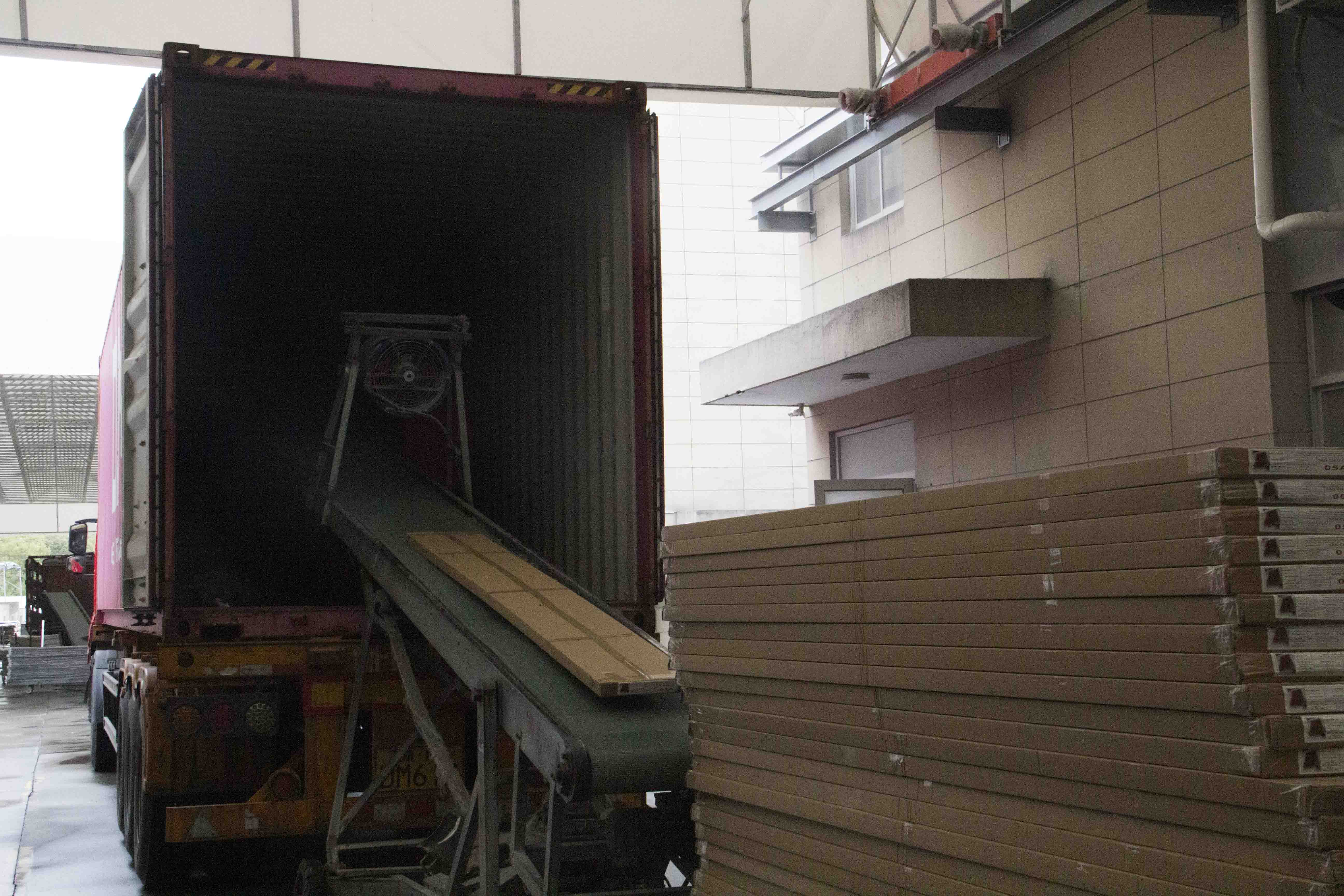
A fast-installing panel is no advantage if the container arrives after the handover. Haining Jianmu New Decoration Material Co., Ltd. was founded in 1998 and operates from Yuanhua, Haining, Jiaxing, in the core area of China's Yangtze River Delta Economic Circle, with a standard production workshop of 15,000 square metres. Monthly output reaches 30 × 40HQ containers for PVC ceiling and wall protection panels, against an annual container output of 360 × 40HC and a stated monthly capacity of 40,000 ㎡. For a programme manager, the practical reading of those figures is that a repeat order does not reset the delivery clock.
The company's product families include PVC integrated wall panels, new-type PVC wall panels, wood-plastic panels, bamboo-wood fiber panels and PVC floor, supported by a technical team of five engineers and more than 40 skilled staff. OEM service is available, with customization across color, size, surface design, logo and packaging, and production can be carried out according to a customer's samples or pictures. Quality management is documented through ISO9001:2008 International Quality System Certification, a SONCAP Certificate and an SGS Certificate, and every order is subject to 100% inspection before shipment. Around 90% of output is exported, serving more than 50 countries and regions, mainly Chinese mainland, the Middle East, South America and Southeast Asia, with Vietnam as a core market.
Frequently Asked Questions
Does a lightweight PVC wall or partition panel meet fire-safety requirements for a commercial fit-out?
The interior wall and ceiling application for which these panels are used carries a specific requirement: fire retardant performance according to EN 13501-1. At profile level, EN 13245-2 specifies requirements for unplasticized poly(vinyl chloride) (PVC-U) profiles for internal and external wall and ceiling finishes. Haining Jianmu holds ISO9001:2008 International Quality System Certification, a SONCAP Certificate and an SGS Certificate, and its five-year distribution project across Vietnam, Thailand, the Philippines, India and Indonesia records EN 13501-1 fire classification alongside waterproof and lightweight performance. For a specific project, confirm the classification documentation that matches the exact panel thickness, build-up and fixing method you intend to use.
Can the panel system be customized to match an existing design or brand?
Yes. Jianmu operates on an OEM/ODM basis and customizes color, size, surface design, logo and packaging, and can produce goods according to a customer's samples or pictures. The standard partition format is 2,900 × 400 × 26 mm with a 2,900 × 85 × 50 mm corner trim, and the PVC wall panel model 566-A155 measures 3,000 × 400 × 9 mm. Panels are supplied together with the supporting structures and installation accessories they are designed to be used with.
What drives the cost of a PVC panel fit-out compared with wet trades?
Cost drivers on the panel side are the format and thickness you specify, the trim and accessory package, the order quantity relative to the 1 × 40HC minimum order quantity, and freight and staging arrangements. Supporting structures and accessories are required components, not optional extras, so they belong in the same budget line as the panels. When comparing against wet-trade finishes, a fair comparison includes not only material and labour but also the drying and curing windows that hold up following trades and any rework those windows generate. Ask for a quote against your actual panel schedule rather than a per-square-metre headline figure.
Can we validate the panels and accessories before placing a full order?
Validation is part of the OEM process: Jianmu can produce according to a customer's samples or pictures, and every order is subject to 100% inspection before shipment, so approved samples and the shipped production run follow the same reference. Because the panel only performs as a system, it is worth validating the panel, the corner trim and the accessory package together rather than the panel alone. The minimum order quantity is 1 × 40HC.
How long does production take, and can it match a tight handover date?
Standard lead time is 15–30 days, supported by a monthly capacity of 40,000 ㎡ and monthly output reaching 30 × 40HQ containers for PVC ceiling and wall protection panels, against an annual container output of 360 × 40HC. That capacity matters most when a delivery has to be staged floor by floor or unit by unit, because the panel, corner trim and accessories must arrive together to keep a dry-fixed programme moving. To move this forward, download the Jianmu catalogue, request a sample or send your panel schedule for a quote.
Conclusion
Lightweight PVC panels do not accelerate a renovation because they are a faster product to look at. They accelerate it because they remove the waiting. A dry-fixed system of panel, corner trim and accessories closes a wall in one pass, the fire-retardant requirement for the interior wall and ceiling application is addressed at specification stage according to EN 13501-1, and the waterproof, moisture-proof and easy-install properties let the same method be used across more of the building. On the supply side, a 15–30 day lead time, 40,000 ㎡ of monthly capacity and staged container shipments decide whether the site actually gains those days.
If a handover date is the constraint on your next fit-out, the productive question is not which finish looks best but which wall system stops the programme from waiting.
Next Step: Sample, Quote or Catalogue
Send your wall and partition schedule and we will confirm format, accessory package and delivery timing against your programme.
Website: www.hnjianmu.com | Catalogue: Download the Jianmu product catalogue (PDF)
Contact: Victor F. Yu | Email: fengdingjx@gmail.com | Tel / WhatsApp: +86 138-0673-3501 | Chat on WhatsApp
Haining Jianmu New Decoration Material Co., Ltd. — 2nd Floor, Building 6, No.158 Yuanhualianhong Road, Haining, Zhejiang, China.
Have Questions or Need More Details?
Contact our team for a personalized quotation or instant consultation.
Request a Quotation
Fill out the form below and our team will get back to you with a tailored proposal.
WhatsApp Direct Chat
Prefer to chat in real-time? Message us on WhatsApp for instant assistance & quick answers.
- Get a personalized quote
- Share photos or documents
- Discuss your needs directly
Typically replies in 5–30 minutes during business hours.