
What Is a PVC Partition Wall Panel? A Complete Introduction for Interior Construction Buyers
A PVC partition wall panel is a rigid interior panel made from polyvinyl chloride (PVC) compounds, supplied in large-format rectangles and used to divide interior spaces or to line existing walls in residential, office, retail and hospitality projects. This guide uses the 2900 × 400 × 26 mm format as its reference geometry — length × width × thickness — because those three numbers drive specification, rigidity and installation far more than the colour or pattern on the surface. Buyers choose PVC panels when a project needs a lightweight, moisture-resistant surface that is installed dry and can be ordered in custom dimensions from the manufacturer.
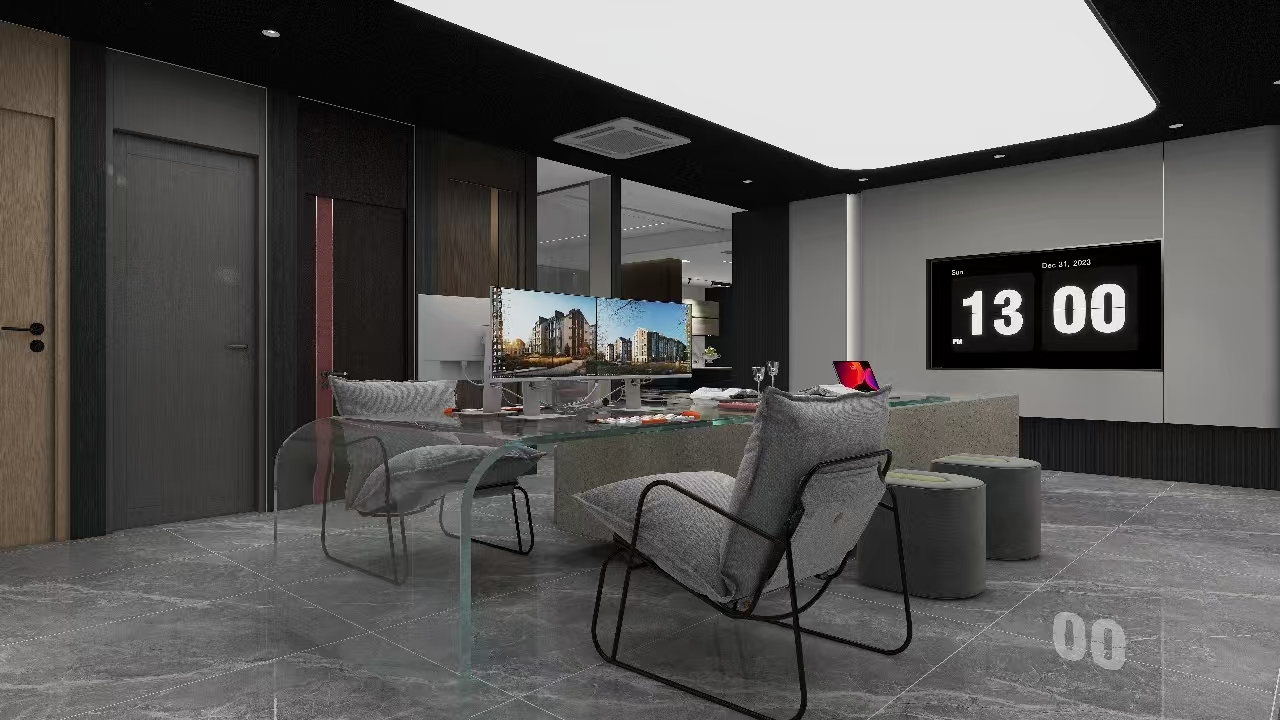
PVC wall and partition panels installed as interior wall surfaces in a completed fit-out.
Why "PVC Partition Wall Panel" Confuses First-Time Buyers
The term is used loosely across the building materials market, and three different products are regularly sold under closely related names. The difference is not cosmetic — it changes the fire documentation a project needs, the fixing method, and the price logic of the order.
- Cladding-grade PVC wall panel. A thinner decorative panel used to cover existing walls and ceilings. Jianmu's catalogue model 566-A155 is a PVC wall panel supplied at 3000 × 400 × 9 mm. It is a surface finish and is not designed to act as a dividing element on its own.
- Partition-grade PVC panel. A thicker format, represented in this guide by the 2900 × 400 × 26 mm geometry, used where the panel itself forms the visible dividing surface inside a room.
- Other PVC-family products. Wood-plastic (WPC) wall panels, bamboo-wood fiber panels, PVC marble sheet, UV marble sheet, 3D wall panels, PVC flooring and PVC corner profiles are often listed on the same supplier page. They share a buyer and a supply chain, but they are separate products with separate installation logic.
The practical cost of this confusion appears late in a project. If a buyer requests reaction-to-fire documentation for a 9 mm cladding panel while the specification actually calls for partition-grade material, or assumes a decorative panel can replace a framed partition, the mismatch usually surfaces during inspection rather than during quotation.
Industry Background: Where PVC Partition Panels Sit in Interior Construction
PVC-based interior panels are a growing surface-finish category rather than a niche accessory. Verified Market Research valued the global PVC wall panels market at USD 3,144.8 million in 2023 and projected it to reach USD 9,495.8 million by 2031, with a CAGR of 14.4% over the 2024–2031 forecast period. Market-size estimates in this category vary by scope — some sources count wall panels only, others count all PVC panels — so any single figure should be read as scope-dependent rather than absolute.
On the supply side, China became the world's largest PVC exporter in 2025, accounting for 24% of total global trade volume according to International Trader Publications. A meaningful share of that capacity sits in decorative-materials clusters such as Haining in Zhejiang Province.
Haining Jianmu New Decoration Material Co., Ltd. (Jianmu) is a decorative materials manufacturer based in Yuanhua, Haining, Jiaxing, in China's Yangtze River Delta, founded in 1998. The company produces PVC integrated wall panels, new-type PVC wall panels, wood-plastic panels, bamboo-wood fiber panels and PVC flooring, operates a 15,000 m² workshop, and exports approximately 90% of its output to more than 50 countries and regions, with Southeast Asia — and Vietnam in particular — as a core market.
Two reference points help buyers read supplier datasheets. The European standard EN 13245-2 specifies requirements for unplasticized polyvinyl chloride (PVC-U) profiles used for internal and external wall and ceiling finishes, and is published by the European Committee for Standardization. For fire behaviour, the relevant framework in EU-facing projects is EN 13501-1 reaction-to-fire classification, supported by test methods such as EN 13823 and EN ISO 11925-2.
What a PVC Partition Wall Panel Is Made Of
Functionally, a PVC partition wall panel has three layers of meaning for a buyer: the polymer base, the finished decorative surface, and the dimensional format.
The polymer base
The panel body is produced from PVC compounds and shaped into large-format boards. In Jianmu's production range, the same polymer family is used across several related product lines — PVC integrated wall panels, new-type PVC wall panels, wood-plastic panels and bamboo-wood fiber panels — which is why buyers sometimes meet four different product names from one supplier and assume they are interchangeable. They are not: wood-plastic and bamboo-wood fiber boards use different filler systems and are positioned differently from a straight PVC wall or partition panel.
The decorative surface
Panels are delivered as finished boards. The decorative appearance — colour and pattern — is part of the delivered product rather than a site-applied finish such as paint, wallpaper or tile adhesive. Jianmu supplies its panel ranges in a wide range of specifications, colours and patterns, and customises colour, size, surface design, logo and packaging under OEM/ODM production.
The dimensional format
Panel sizes are written as length × width × thickness. In the 2900 × 400 × 26 mm reference format, the three numbers do different jobs:
- 2900 mm length sets the vertical or horizontal span of a single board and therefore the number of horizontal joints on a wall.
- 400 mm width defines the visible module of the finished surface. A 400 mm module produces a repetitive vertical joint line across the elevation, which designers either exploit deliberately or conceal.
- 26 mm thickness is what separates a partition-grade format from a cladding-grade one. Thicker formats are generally stiffer and heavier to handle; thinner formats are typically used where the panel is a decorative skin over a substrate. Jianmu's catalogue PVC wall panel model 566-A155, for comparison, is supplied at 3000 × 400 × 9 mm.
Read the thickness before the pattern. Colour and finish are visible in a sample; thickness determines whether the panel behaves as a wall finish or as part of a dividing element. Confirm the format against the project drawing before the order is confirmed, not after.
Why PVC Is Chosen for Interior Building Scenarios
PVC panels are specified for interior work because of a small number of performance properties that matter to installers and facility managers, not because of styling alone.
Water and moisture behaviour
PVC wall and partition panels are waterproof and moisture-resistant, which is why they appear in bathrooms, damp basements, food-service areas and other spaces where a paper-faced board would need special grades and sealed joints.
Fire behaviour with traceable documentation
Jianmu's PVC partition wall panel carries a Reaction to Fire Test Report issued by NOA Inspection & Certification Group Ltd. for the EU market. The report number is NFM-FRL260865-02, issued on 13 July 2026, and the listed test standards are EN 13501-1:2018, EN 13823:2020+A1:2022 and EN ISO 11925-2:2026. The report relates to the PVC wall panel model 566-A155. For any project, request the current report and check that the product scope, thickness and intended assembly match what is being installed.
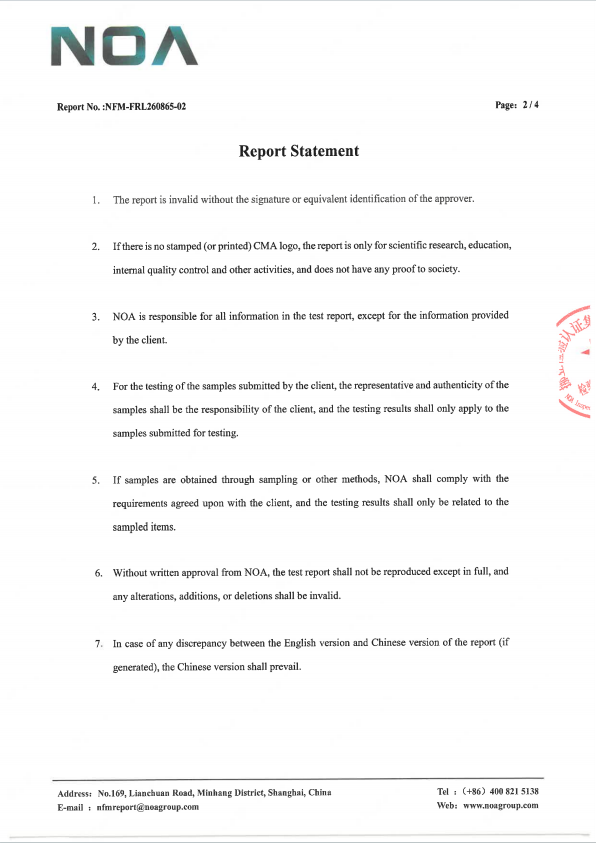
Reaction to fire test documentation for PVC partition wall panels: EN 13501-1:2018, EN 13823:2020+A1:2022, EN ISO 11925-2:2026.
Installation speed and dry process
Compared with wallpaper, paint and traditional ceramic tiles, PVC panels are faster to install and require no wet trades, no adhesive curing window and no grouting. Jianmu describes its panels as lightweight and easy to install, which shortens the period during which a space is unavailable to its operator.
Maintenance and service life
Lower maintenance cost and a long service life are the recurring arguments for PVC panels against wallpaper and paint, especially in high-traffic commercial interiors where repainting cycles are a budget line rather than an afterthought. Jianmu's product documentation also cites heat insulation and thermal preservation among the panel properties.
Where the material stops being the answer
A PVC panel is an interior solution. It is not a structural element, and the framing or substrate behind it still has to be engineered for the loads the space will see. Reaction-to-fire performance is assessed for a product and often for an assembly, so the panel's own test report does not automatically qualify every build-up it appears in. Local building codes, compartmentation rules and the project's fire strategy always take precedence over a supplier datasheet.
PVC Partition Panel vs. Solid Wood vs. Gypsum Board
The comparison below separates the three approaches buyers most often weigh against each other. The PVC column uses Jianmu's own product and test documentation; the gypsum and solid wood columns describe general construction behaviour rather than any specific manufacturer's product.
| Attribute | PVC partition wall panel (Jianmu) | Gypsum board partition | Solid wood partition |
|---|---|---|---|
| Base material | PVC-based decorative panel; range also includes wood-plastic and bamboo-wood fiber panels | Gypsum core faced with paper or fibre | Solid timber boards or timber-based panels |
| Water and moisture | Waterproof and moisture-resistant | Moisture-sensitive; wet areas normally require moisture-resistant grades and sealed joints | Moisture-sensitive; dimensional movement is a typical concern |
| Fire documentation | Reaction to Fire Test Report NFM-FRL260865-02 (NOA Inspection & Certification Group Ltd.), EU market, EN 13501-1:2018 / EN 13823:2020+A1:2022 / EN ISO 11925-2:2026 | Depends on board type, thickness and the full assembly; project-specific documentation required | Untreated timber is combustible; performance depends on treatment and assembly |
| Installation sequence | Dry installation; described as lightweight and easy to install, with no wet finishing | Boarding plus jointing, taping and finishing before decoration | Framing, fixing and surface finishing |
| Maintenance | Lower maintenance cost and long service life compared with wallpaper, paint and ceramic tile | Joint and surface repair after impact; redecorating over time | Refinishing and protective treatment |
| Typical best fit | Residential, hotel, office and commercial interior wall and ceiling decoration, including moisture-exposed areas | Dry interior rooms where a plastered, painted finish is expected | Feature areas where solid timber appearance is the design intent |
| Customisation | OEM/ODM: colour, size, surface design, logo and packaging | Normally standard board sizes and factory finishes | Normally workshop-specific dimensions and finishes |
This table compares construction approaches in general terms. Final selection must follow the project specification, local building codes and the supplier's current test documentation. All Jianmu-specific entries are drawn from the company's own product and certification records.
Step-by-Step: How to Specify and Order a PVC Partition Wall Panel
For a buyer in the evaluation-to-execution stage, the sequence below mirrors how a quotation is actually built. Skipping a step usually means re-quoting later.
Step 1 — Decide whether the panel divides or covers
A decorative wall finish and a dividing surface are specified differently. If the panel is a skin over an existing wall or ceiling, a thinner cladding format such as Jianmu's 3000 × 400 × 9 mm model 566-A155 is the relevant reference. If the panel defines the visible dividing plane, start from a partition-grade format such as the 2900 × 400 × 26 mm geometry and confirm the supporting build-up with the project engineer.
Step 2 — Fix the dimensional format
Write the size as length × width × thickness and state whether the 400 mm module is acceptable on the elevation. Confirm the joint layout against the drawing before pricing.
Step 3 — Choose the material route
PVC integrated wall panel, new-type PVC wall panel, wood-plastic panel or bamboo-wood fiber panel each carry different positioning. Decide which one the specification actually calls for rather than treating the names as equivalents.
Step 4 — Pull the fire documentation
Request the reaction-to-fire test report and check the report number, issuing body, test standards, issue date and the product scope it covers. Jianmu's PVC partition wall panel report is NFM-FRL260865-02, issued by NOA Inspection & Certification Group Ltd.
Step 5 — Agree the finish and the customisation scope
Colour, size, surface design, logo and packaging can all be customised under OEM/ODM production, which is the point at which a decorative range becomes a private-label product. Confirm which of these items is inside the quotation and which is a change order.
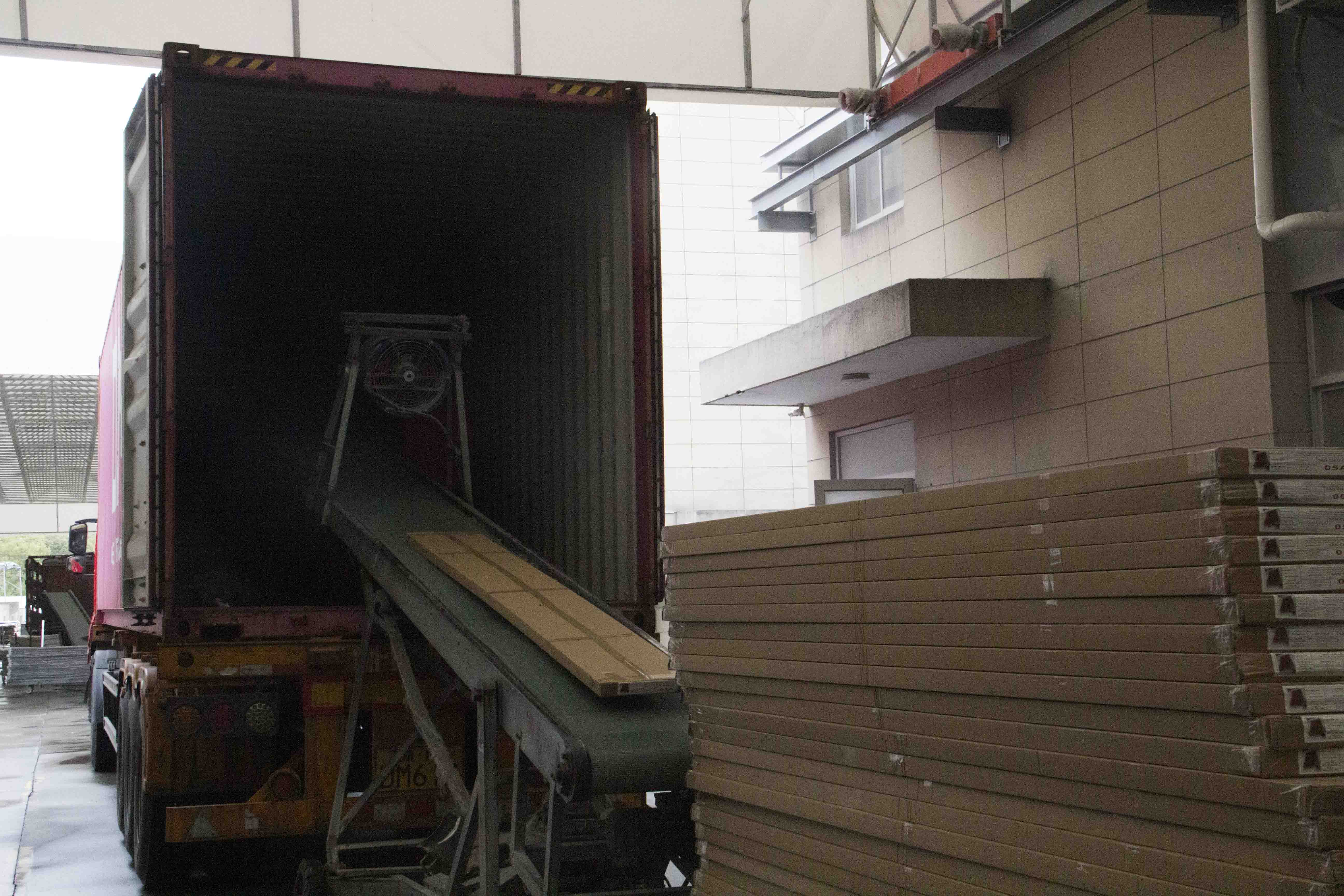
Panel formats and finishes held in stock for custom size, colour and packaging orders.
Step 6 — Confirm capacity, MOQ and commercial terms
Jianmu's published commercial framework for PVC panel orders is a minimum order quantity of 1 × 40HC, FOB delivery terms, payment terms of 30/70, and pre-shipment test as the acceptance criterion. Production capacity is 40,000 ㎡ per month.
Step 7 — Lock the lead time and the inspection point
Standard lead time is 15–30 days. Quality control is 100% inspection before shipment, so the inspection point falls inside the production window rather than at the destination port — agree who attends and what the acceptance criteria are before the order is released.
Step 8 — Plan installation and after-sales
Dry installation removes the curing delay associated with tiling or plastering, and after-sales support is provided remotely for export markets. Brief the installation team on the panel module and fixing detail at the same time you brief them on the finish.
Use Cases: Where PVC Partition Panels Fit
PVC wall and partition panels are used for interior wall and ceiling decoration in residential and commercial buildings. In practice, four scenarios account for most specification volume:
- Office fit-outs — fast sub-division of open floor plates, where the dry process keeps the space usable and the 400 mm module sets the rhythm of the elevations.
- Retail — shopfront and back-of-house surfaces where moisture, cleaning and turnaround time all matter.
- Hospitality — corridors, bathrooms and back-of-house areas where a waterproof, low-maintenance surface reduces the refurbishment cycle.
- Residential — feature walls, ceilings and secondary partitions, particularly in humid climates.
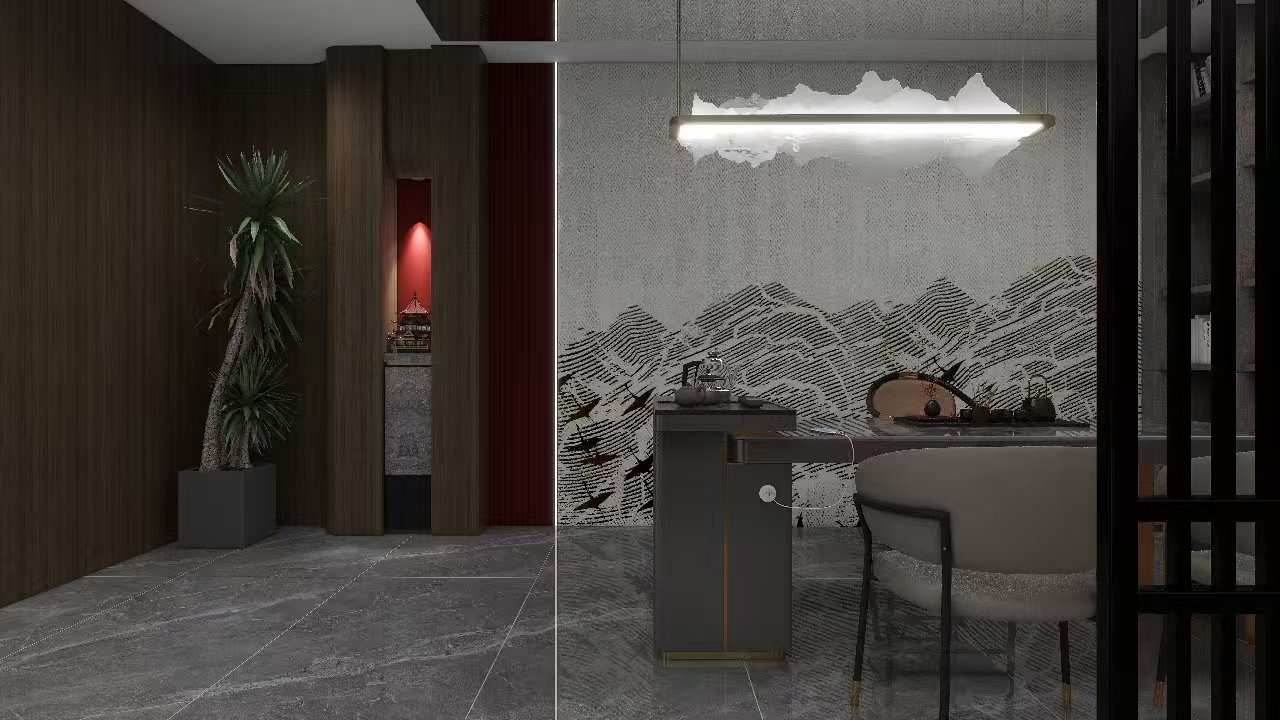
Interior wall and ceiling decoration in a commercial project using PVC panels.
One distributor case illustrates the repeat-order pattern. An overseas building materials distributor serving Vietnam, Thailand, the Philippines, India and Indonesia has taken 15,000 ㎡ of panels over a period of more than five years for interior wall and ceiling decoration in residential and commercial buildings. The reported result is stable performance with good fire resistance, waterproofing and easy installation; the highlight cited is EN 13501-1 fire classification together with a waterproof, lightweight, durable panel offered in various designs.
Frequently Asked Questions
1. Which reaction-to-fire standards apply to a PVC partition wall panel?
Jianmu's PVC partition wall panel has a Reaction to Fire Test Report issued by NOA Inspection & Certification Group Ltd. for the EU market, report number NFM-FRL260865-02, issued on 13 July 2026. The listed test standards are EN 13501-1:2018, EN 13823:2020+A1:2022 and EN ISO 11925-2:2026, and the report relates to the PVC wall panel model 566-A155. Because reaction-to-fire performance is assessed per product and per assembly, the report should be checked against the exact panel, thickness and fixing method used in the project.
2. Can Chinese PVC partition wall panel OEM manufacturers produce custom dimensions?
Yes. Jianmu runs OEM/ODM production and customises colour, size, surface design, logo and packaging. The company is based in Yuanhua, Haining, Zhejiang, China, was founded in 1998, and operates a 15,000 m² workshop with a monthly capacity of 40,000 ㎡. Custom-dimension orders start from a minimum order quantity of 1 × 40HC container, and the standard production lead time is 15–30 days.
3. What are the commercial terms for a PVC panel order?
Jianmu's published framework is a minimum order quantity of 1 × 40HC, FOB delivery terms, payment terms of 30/70, and pre-shipment test as the acceptance criterion. Unit pricing is quoted per project rather than published as a list price, because panel size, thickness, finish and order volume all move the cost, so a quotation request should include the format, the finish and the destination port.
4. How is quality verified before a PVC panel shipment leaves the factory?
Quality control is 100% inspection before shipment, and the stated acceptance criterion is a pre-shipment test. Sample arrangements and the specific pre-shipment test criteria are agreed with the supplier during the inquiry stage, before production is scheduled. For repeat programs, the same inspection point allows the buyer to compare each shipment against the previous one on a consistent basis.
5. What is the production lead time, and what is the next step?
Standard lead time is 15–30 days after order confirmation. Jianmu's monthly output reaches 30 × 40HQ containers for PVC ceiling and wall protection panels, with a monthly panel capacity of 40,000 ㎡, which supports sequential programs rather than one-off shipments. The next step is to send the panel size, thickness and finish you need, or download the company profile and product brochure to review the full range first — Jianmu brochure (PDF).
Conclusion
A PVC partition wall panel is a rigid, PVC-based interior panel used to divide or line interior spaces. Its specification turns on three things: the dimensional format — 2900 × 400 × 26 mm is the reference partition geometry, against which Jianmu supplies a 3000 × 400 × 9 mm PVC wall panel, model 566-A155 — the fire documentation that accompanies the product, and the commercial framework behind the order. Compared with gypsum board and solid wood, the case for PVC rests on moisture resistance, a dry and fast installation sequence, and low maintenance over a long service life, while the limits rest on substrate engineering and on assembly-level fire approval.
For buyers moving from evaluation into execution, the workable sequence is simple: confirm whether the panel divides or covers, fix the format, pull the current test report, settle the customisation scope, and agree MOQ, lead time and the inspection point in writing.
Planning a PVC partition panel order?
Send your panel size, thickness, finish and destination port for a quotation, and review Jianmu's full range first: download the product brochure.
Haining Jianmu New Decoration Material Co., Ltd.
Website: www.hnjianmu.com
Email: fengdingjx@gmail.com | Tel / WhatsApp: +86 138-0673-3501
Address: 2nd Floor, Building 6, No.158 Yuanhualianhong Road, Haining, Zhejiang, China
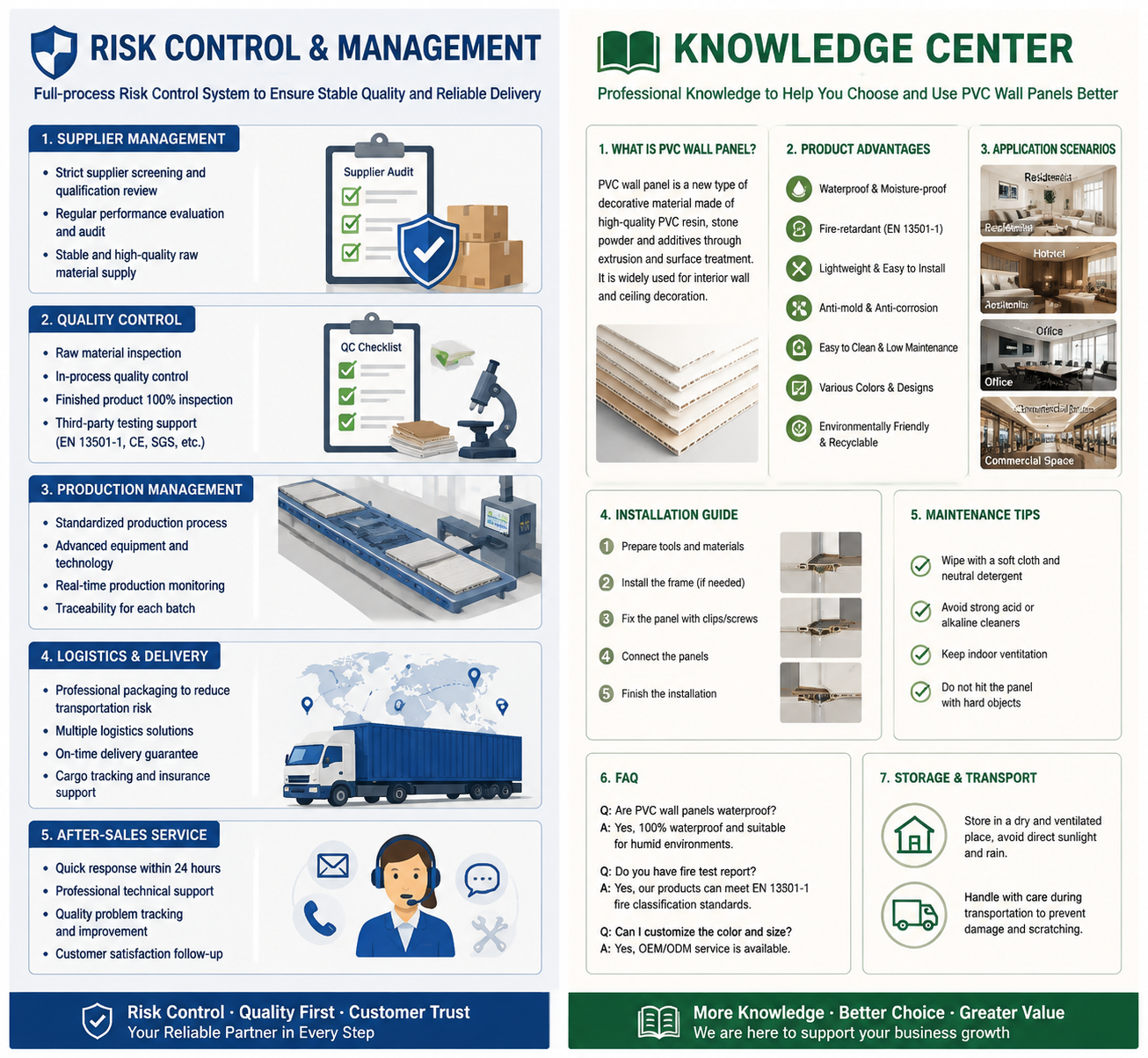
PVC panel procurement: MOQ 1 × 40HC, FOB delivery terms, 30/70 payment terms and pre-shipment inspection.
Have Questions or Need More Details?
Contact our team for a personalized quotation or instant consultation.
Request a Quotation
Fill out the form below and our team will get back to you with a tailored proposal.
WhatsApp Direct Chat
Prefer to chat in real-time? Message us on WhatsApp for instant assistance & quick answers.
- Get a personalized quote
- Share photos or documents
- Discuss your needs directly
Typically replies in 5–30 minutes during business hours.