
Fire Safety Compliance for PVC Wall and Partition Panels: Reading EN 13501-1 and Beyond
Fire Safety Compliance for PVC Wall and Partition Panels: Reading EN 13501-1 and Beyond
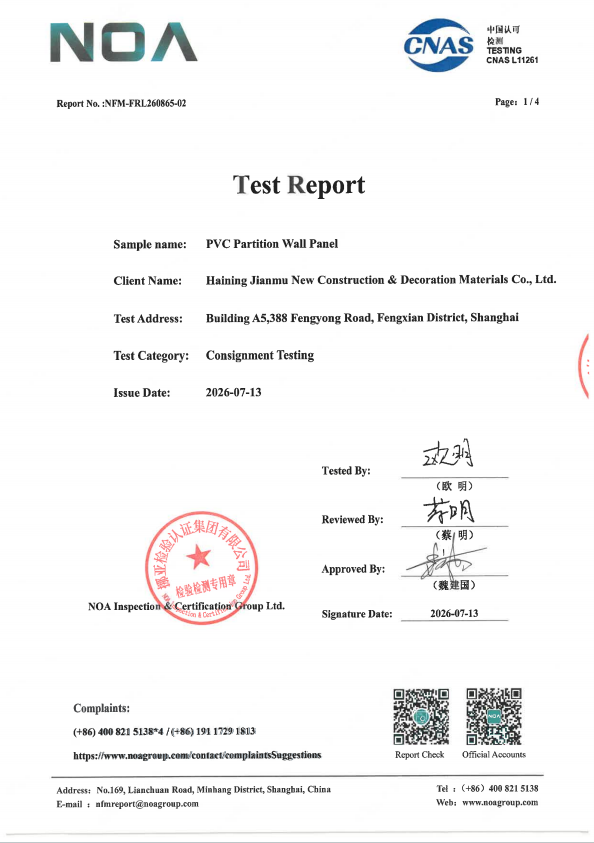
"Fire-rated" is the phrase buyers use most and verify least. In PVC wall and partition panel procurement, the question that actually protects a project is not whether a panel is described as fire-resistant, but which document proves its reaction-to-fire performance, which model and thickness that document covers, who issued it, and which version of the standard it was tested against.
This guide is written for buyers past the shortlisting stage, preparing to release an order or run a repeat program where the paperwork has to survive a project audit. It walks through EN 13501-1, the test methods that sit behind the classification, and the boundary between that classification and the separate product standard EN 13245-2. The worked example is the documentation set of Haining Jianmu New Decoration Material Co., Ltd., a decorative materials manufacturer based in Yuanhua, Haining, Zhejiang, China, founded in 1998 — including its reaction-to-fire report NFM-FRL260865-02, which covers PVC WALL PANEL model 566-A155 at 3000*400*9MM.
Problem Definition: Why "Fire-Rated" Is Not Evidence
A supplier statement that a panel is fire-rated does not tell a buyer what has been tested, on which construction, or under which standard. The same words can describe a fully documented reaction-to-fire classification, a report written for a different model, a general quality certificate, or a brochure line with no document behind it. At the execution stage, that ambiguity becomes expensive: it surfaces as a specification query that stops production, a rejected delivery at handover, or a retrofit after installation.
Five documentation failures account for most of these disputes in panel sourcing:
- The ordered model is not in the report. A supplier is approved on one document, then a different model or thickness is ordered, and nobody checks whether the tested construction and the ordered construction are the same.
- Two different standards are treated as one. A reaction-to-fire classification under EN 13501-1 and a product standard such as EN 13245-2 answer different questions and cannot substitute for each other.
- The report cannot be traced. No report number, no issuing body, no version of the test standard, no issue or validity date — so a third party cannot verify the claim.
- Only marketing material is supplied. Descriptive words are not classification results; a classification is only meaningful when it is printed in a report tied to a specific tested product.
- Custom variants drift outside the tested scope. Color, surface design, substrate or thickness changes agreed after approval may sit outside the coverage of the report already on file.
The practical rule for buyers is simple: compliance is not a property of a material category, it is a property of a documented, specific construction. The document has a number, a scope, a product list and a date — and all four have to match the order.
Industry Background: Documentation Has Become Part of the Product
The volume of cross-border panel sourcing is rising, and with it the documentation burden. Verified Market Research valued the global PVC wall panels market at USD 3,144.8 million in 2023 and projects it to reach USD 9,495.8 million by 2031, a CAGR of 14.4% over 2024–2031. On the supply side, International Trader Publications reports that China became the world’s largest PVC exporter in 2025, accounting for 24% of total global trade volume. More orders now cross regulatory systems, and the buyer is usually the only party positioned to check that an exported report actually answers the local specification.
European standardisation already treats this product family as a defined category. EN 13245-2, published by the European Committee for Standardization, specifies requirements for unplasticized poly(vinyl chloride) (PVC-U) profiles for internal and external wall and ceiling finishes. Reaction-to-fire performance in EU-linked specifications is expressed through the EN 13501-1 classification route, with the supporting test methods named inside the test report itself. For a project buyer, the consequence is that a fire-safety conversation is a document conversation: standard number, class, scope, model, thickness, date.
What a Complete Documentation Set Actually Contains
Haining Jianmu New Decoration Material Co., Ltd. is a decorative materials manufacturer located in the Yangtze River Delta industrial area of Haining, Zhejiang, China, founded in 1998, producing PVC integrated wall panels, new-type PVC wall panels, wood-plastic panels, bamboo-wood fibre panels, decorative wall protection panels and PVC flooring from a 15,000 m² workshop with a five-engineer technical team. Its fire-safety file is a useful reference for what a buyer should expect to receive, because it separates the classification document from the quality and market certificates instead of blending them into one claim.
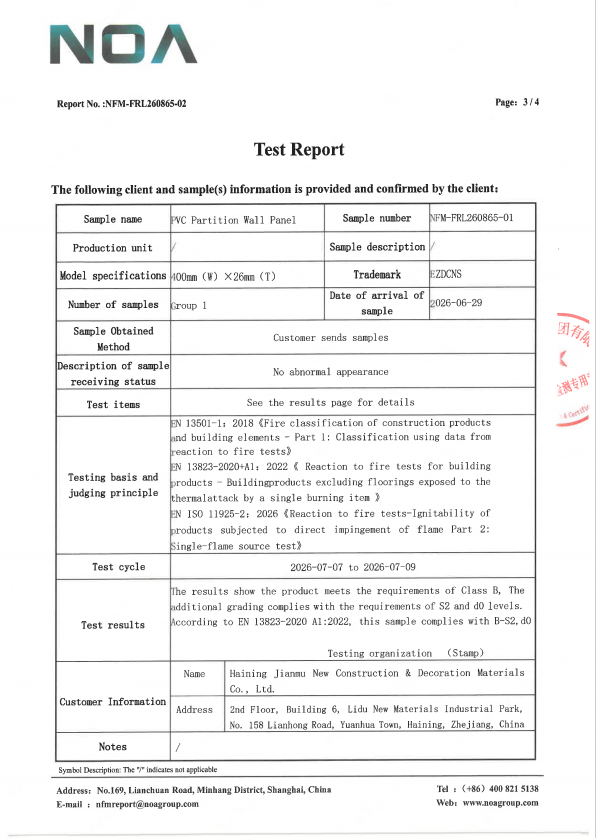
The reaction-to-fire document. Report number: NFM-FRL260865-02. Report type: Reaction to Fire Test Report. Issuing authority: NOA Inspection & Certification Group Ltd. Market: EU. Report scope: PVC Partition Wall Panel. Test standards referenced: EN 13501-1:2018, EN 13823-2020+A1:2022 and EN ISO 11925-2:2026. Issue date: 13 July 2026. Validity: through 13 July 2099.
The product the report is tied to. PVC WALL PANEL, model 566-A155, material PVC, size 3000*400*9MM — the same model reference used in the supplier’s own product listing, so the report can be matched to a purchase line without interpreting marketing names.
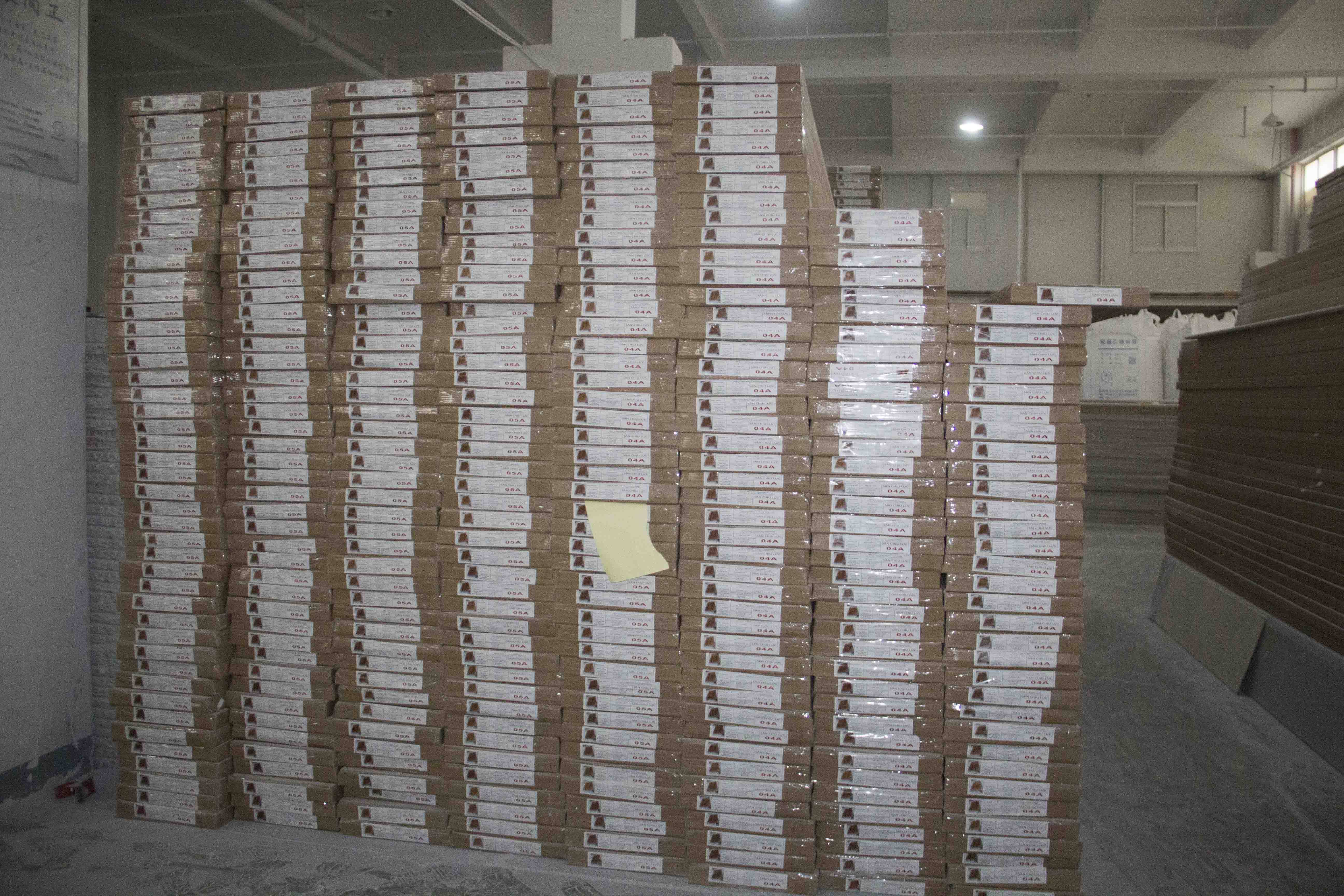
Around that core document sit the certificates and controls that make the tested construction repeatable at volume. The manufacturer holds ISO 9001:2008 International Quality System Certification, a SONCAP Certificate and an SGS Certificate. On the production side, quality control is defined as 100% inspection before shipment, and the agreed acceptance criterion for an order is a pre-shipment test. Commercially, the frame is a minimum order quantity of 1*40HC, FOB delivery terms and 30/70 payment terms.
Customization sits in the same file rather than in a separate commercial conversation. The production mode is OEM/ODM, with customization available across color, size, surface design, logo and packaging, supported by a monthly capacity of 40,000 m² and a lead time of 15–30 days. That capability matters to compliance because a customized panel is still expected to be covered by documentation — which is exactly where the reading discipline below is applied.
Step-by-Step Breakdown: Reading an EN 13501-1 Report in Six Steps
Step 1 — Verify the report’s identity before its conclusion
Start with the header data: report number, issuing authority, market, report type, issue date and validity period. For the Jianmu document that reads: NFM-FRL260865-02, issued by NOA Inspection & Certification Group Ltd., EU market, Reaction to Fire Test Report, issued 13 July 2026 and valid through 13 July 2099. A report without this header cannot be verified by a specifier, an insurer or a project engineer, regardless of what its results page says.
Step 2 — Match the covered model, thickness and construction to your order
This is the step most often skipped. Open the scope and product pages and compare them line by line with the purchase order: product name, model code, material and dimensions. The Jianmu report scope is the PVC Partition Wall Panel, applied to PVC WALL PANEL model 566-A155, material PVC, size 3000*400*9MM. If your order specifies a different thickness or a differently constructed variant, that is a separate question and should be raised before production, not after.
Step 3 — Identify the test methods behind the classification
A classification is an output. The report should name the inputs that produced it. In this document those inputs are EN 13823-2020+A1:2022, commonly referred to as the single burning item test method, and EN ISO 11925-2:2026, the small-flame ignitability test method, both feeding the classification framework of EN 13501-1:2018. When a supplier quotes a class but cannot name the test methods behind it, the quote cannot be checked by anyone else.
Step 4 — Read the full classification notation, not a summary word
EN 13501-1 expresses reaction-to-fire performance as a classification, with additional parameters for smoke production and for flaming droplets or particles. The notation as printed therefore carries more information than the single word a brochure might use. The figure to copy into a specification, a submittal or a handover file is the one printed in the report and its classification page — never a figure taken from marketing material, a sales email or a comparable product.
Step 5 — Separate reaction-to-fire from the product standard
EN 13501-1 answers "how does this construction behave when exposed to fire?" EN 13245-2 answers a different question: what a PVC-U profile for internal and external wall and ceiling finishes must be. A project may require both. A report against one standard should never be presented as evidence of the other, and a buyer who understands the split can ask a sharper question: "Which standard does this document cover, and which one does my specification require?"
Step 6 — Bind the documentation to shipment acceptance
Compliance ends at the loading dock, not at the approval email. Tie the report to the order file: the covered model reference, the agreed pre-shipment test as the acceptance criterion, and the manufacturer’s 100% inspection before shipment. When the delivery arrives, the question is whether the shipment matches the documented construction — and the answer should exist in writing before the container leaves.
Use Cases: Where This Reading Process Changes the Order
Commercial interior fit-out with a handover inspection
On office, retail and hospitality projects, the fire-safety review usually happens twice: once when the specification is written, and again at handover, when the contractor must show that the installed product is the documented product. Buyers who lock the model reference into the purchase order — as in the 3000*400*9MM, model 566-A155 line — give the site team something concrete to check against, instead of re-arguing whether a generic panel was "fire-rated".

Distributor program with repeat shipments
For importers and distributors, compliance is a program-level requirement rather than a per-project one, because the same line is resold month after month. An overseas building materials distributor operating across Vietnam, Thailand, the Philippines, India and Indonesia has supplied 15,000 m² of these panels over more than five years for interior wall and ceiling decoration in residential and commercial buildings, with EN 13501-1 fire classification, waterproofing, light weight, durability and design range listed among the reasons the line stayed in specification. The documentation set is what made that repetition possible: the same report, the same model reference, the same file attached to each order.
OEM and private-label programs with custom dimensions
When a buyer orders custom color, size, surface design, logo or packaging, the tested construction and the ordered construction can diverge. The workflow that avoids this is sequential, not parallel: define the specification first, confirm which model and thickness the existing report covers, then confirm in writing how the customized variant relates to that scope — before tooling, before production, and before the lead time of 15–30 days starts.
Comparison Table: What Each Document Proves
The table below sets out the documents in a fire-safety and compliance file and draws the boundary of each one. It is the difference between a supplier that can answer a specification query in writing and one that can only describe its product.
| Document | Issued by | What it confirms | What it does not confirm | Scope / applies to |
|---|---|---|---|---|
| Reaction to Fire Test Report NFM-FRL260865-02 | NOA Inspection & Certification Group Ltd. | Reaction-to-fire performance of the PVC partition wall panel tested under EN 13501-1:2018, with EN 13823-2020+A1:2022 and EN ISO 11925-2:2026; issued 13 July 2026, valid through 13 July 2099 | Does not replace the EN 13245-2 product standard, and does not automatically extend to untested models, thicknesses or customized variants | PVC Partition Wall Panel; PVC WALL PANEL model 566-A155, 3000*400*9MM |
| EN 13245-2 (product standard) | European Committee for Standardization | Specifies requirements for unplasticized poly(vinyl chloride) (PVC-U) profiles for internal and external wall and ceiling finishes | Is not a reaction-to-fire classification result | PVC-U profiles for internal and external wall and ceiling finishes |
| ISO 9001:2008 certificate | Certification body (as held by the manufacturer) | Quality management system certification held by the manufacturer | Does not document the fire performance of any specific product | Manufacturer’s production and quality system |
| SONCAP Certificate | Conformity assessment programme (as held by the manufacturer) | A product conformity certificate held by the manufacturer | Does not document EN 13501-1 reaction-to-fire classification | Products covered by the certificate |
| SGS Certificate | SGS | Third-party certification held by the manufacturer | Is not a substitute for a reaction-to-fire classification report | Products covered by the certificate |
| Pre-shipment test (agreed acceptance criterion) | Buyer and supplier, under the order terms | That the shipment meets the agreed acceptance criteria before dispatch | Does not classify a product and does not replace a test report | Ordered batch before shipment |
FAQ: Compliance, Capability, Commercial Terms, Validation and Lead Time
Which fire-safety documents should I request before approving a PVC partition wall panel order?
Ask for the reaction-to-fire test report first, then verify four things inside it: the report number and issuing authority, the test standards referenced, the issue and validity dates, and the product scope. A complete example is report NFM-FRL260865-02, a Reaction to Fire Test Report for the PVC Partition Wall Panel issued by NOA Inspection & Certification Group Ltd. for the EU market, referencing EN 13501-1:2018, EN 13823-2020+A1:2022 and EN ISO 11925-2:2026, issued 13 July 2026 and valid through 13 July 2099. Then separate the product standard: EN 13245-2 covers requirements for PVC-U profiles for internal and external wall and ceiling finishes and should be provided if your specification calls for it. Quality and market certificates such as ISO 9001:2008, SONCAP and SGS support the supplier’s production system, but they do not document reaction-to-fire performance.
Can Chinese PVC partition wall panel OEM manufacturers supply custom dimensions and still document fire performance?
Custom dimensions are a production capability question, and documentation is a scope question — the two have to be answered separately. Haining Jianmu New Decoration Material Co., Ltd. runs OEM/ODM production with customization across color, size, surface design, logo and packaging, supported by a five-engineer technical team, a 15,000 m² workshop and a monthly capacity of 40,000 m². Its reaction-to-fire report is tied to a defined construction: PVC WALL PANEL model 566-A155 at 3000*400*9MM. That means any custom dimension, surface or formulation should be checked against the report’s product scope in writing before it is written into a specification, so the buyer knows which document applies to the variant being ordered.
What are the purchasing terms and acceptance criteria for a panel order?
For Jianmu panel orders, the minimum order quantity is 1*40HC, delivery terms are FOB, payment terms are 30/70, and the acceptance criterion is a pre-shipment test. Because the minimum order aligns with a single 40-foot high-cube container, the compliance file and the shipment travel together: the covered model reference, the agreed pre-shipment acceptance test and the manufacturer’s 100% inspection before shipment give the buyer a defined checkpoint before dispatch rather than a dispute after arrival.
How can a buyer validate a custom panel specification before the container is produced?
Validation runs in sequence, using written references rather than verbal descriptions. Jianmu’s OEM service produces goods according to customer samples or pictures, which means the process starts from a defined reference plus a specification, not from an approximation. From there, confirm the model and thickness against the report scope, agree the acceptance criteria as a pre-shipment test, and rely on the 100% inspection before shipment to hold the batch to the documented construction. After delivery, remote support covers questions that arise on site.
What lead time and capacity should I plan for on a customized order?
Production lead time is 15–30 days, with a monthly capacity of 40,000 m² and a monthly output of 30×40HQ containers for PVC ceiling and wall protection panels, equivalent to an annual output of 360×40HC containers. Around 90% of output is exported, with products shipped to more than 50 countries and regions. Plan documentation time separately from production time: matching the report scope to a custom specification should be completed before the production slot opens, not during it. To review the full product range and specification data before you confirm a line, download the Jianmu catalogue at Jianmu product brochure (PDF) or send your specification to the contact below for a written response.
Conclusion: Quote the Report, Not the Adjective
Fire safety compliance for PVC wall and partition panels is a reading exercise. The document that matters has a number, an issuing authority, a standard version, an issue date, a validity period and a product scope. Everything else — the words "fire-resistant", "self-extinguishing" or "fire-rated" — is a description of intent, not evidence of performance.
Applied to a real order, the discipline comes down to four actions: request the reaction-to-fire report and check its header data; match the covered model and thickness to the purchase line, as with model 566-A155 at 3000*400*9MM; keep the EN 13501-1 classification separate from the EN 13245-2 product standard; and bind the file to shipment acceptance through the agreed pre-shipment test. Buyers who do this before production spend minutes on documents instead of weeks on disputes after delivery.
Next step for buyers and distributors
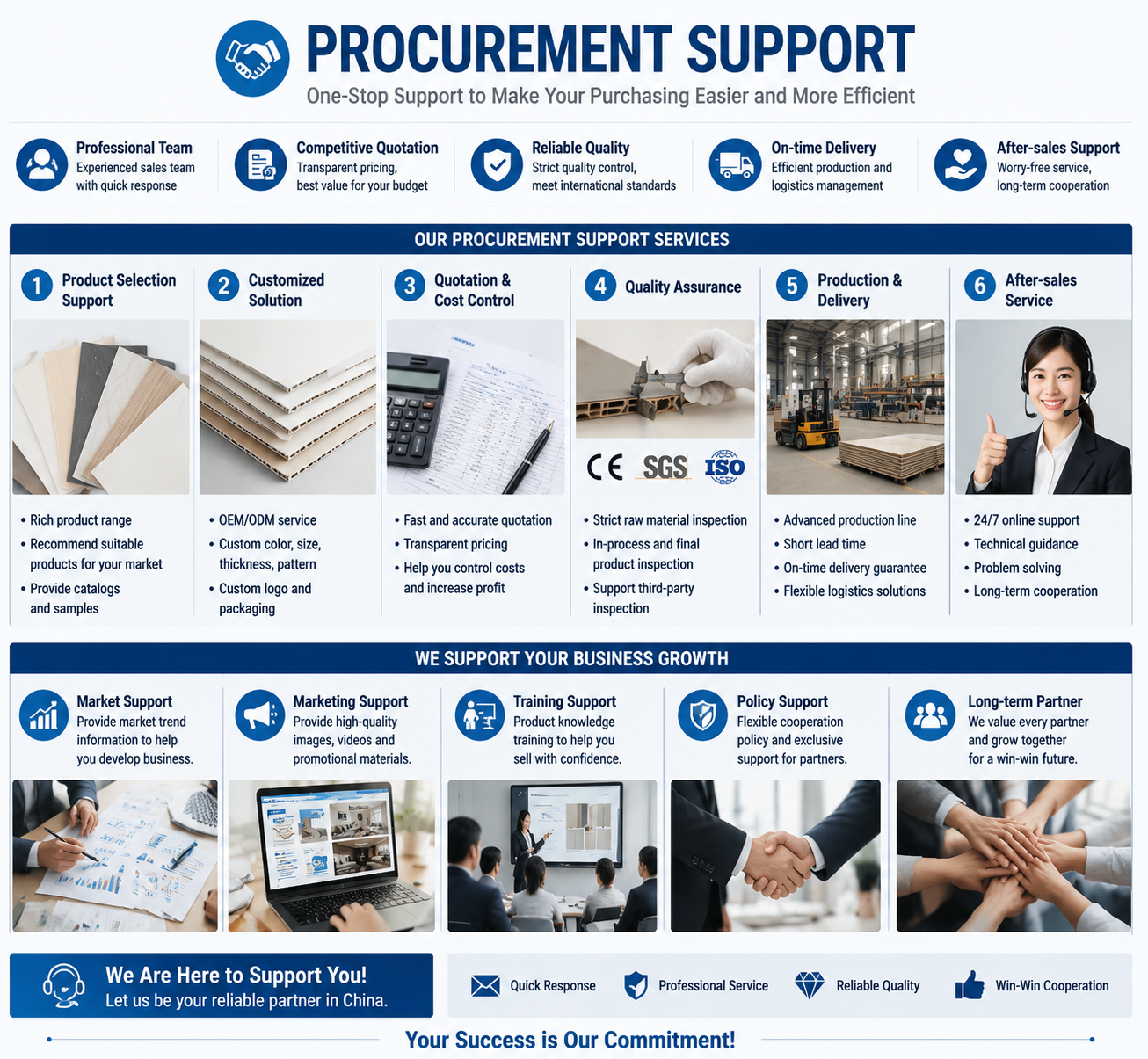
Send your project specification, target model and required standard to Haining Jianmu New Decoration Material Co., Ltd. and request the reaction-to-fire test report NFM-FRL260865-02 with its product scope page, plus the EN 13245-2 and quality documentation relevant to your market. OEM/ODM customization of color, size, surface design, logo and packaging is available, with a lead time of 15–30 days.
Contact: Victor F. Yu · Email: fengdingjx@gmail.com · Tel / WhatsApp: +86 138-0673-3501 · Website: www.hnjianmu.com
Address: 2ND FLOOR, BUILDING 6, NO.158 YUANHUALIANHONG ROAD, HAINING, ZHEJIANG, CHINA
Catalogue download: Jianmu product brochure (PDF)
Documentation referenced in this article is drawn from the manufacturer’s own test report, certification and production data.
Primary query: pvc partition wall panel. Related reading on this blog covers product specifications, supplier evaluation and application planning for PVC wall and partition panel projects.