
PVC Partition Wall Panel vs PVC Wall Panel: 26 mm or 9 mm?
Interior Partition Specification Guide
PVC Partition Wall Panel vs PVC Wall Panel: 26 mm or 9 mm?
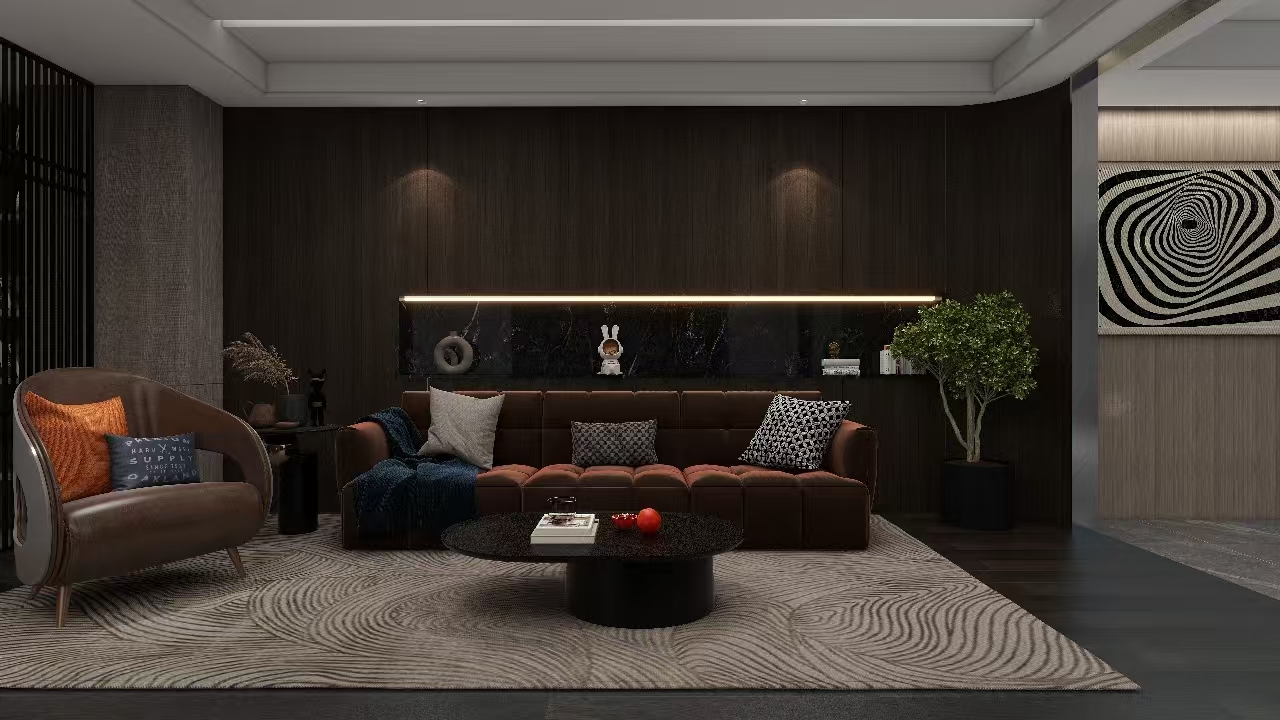
The same PVC material family, two different jobs: one creates a partition plane, the other finishes a surface.
Two PVC panels, one decision. In interior partition projects, Haining Jianmu’s PVC partition wall panel (model 7073-A189, 2900 × 400 × 26 mm) is the element that forms the new dividing plane, while the PVC WALL PANEL (model 566-A155, 3000 × 400 × 9 mm) is the thinner skin that finishes an existing wall or ceiling.
Both are PVC-based. Both are described by the manufacturer as waterproof and moisture-resistant, both are flame-retardant and light in weight, and both are easy to install. That is precisely why they get mixed up in a bill of quantities: on a one-line spec sheet they read like the same product in two sizes. They are not. A 26 mm PVC partition wall panel and a 9 mm PVC wall panel differ far less in material than in function — one carries a partition, the other covers a surface.
This guide compares them head to head on the four things that actually decide a specification: partition function, panel thickness, coverage per panel, and the intended building or interior decoration use. It closes with a step-by-step selection process, a comparison table, a sourcing framework, and the manufacturer background that matters when supply has to be guaranteed against a project programme.
The Problem: One Sample Box, Two Different Jobs
Specification errors on PVC interior systems almost never come from the material. They come from the format. A 9 mm PVC wall panel and a 26 mm PVC partition wall panel share the same base polymer, the same moisture resistance and the same decorative role, so a supplier quotation that simply says “PVC panel” looks complete. It is not.
- Under-specifying. A thin cladding panel is called out as a divider. A 9 mm panel is a facing rather than a partition body, so it depends on a substrate and a framing detail to hold a plane. When that substrate is missing from the drawing, the partition ends up depending on the installer’s improvisation.
- Over-specifying. A 26 mm partition panel is ordered for every wall surface in the building, including surfaces that only needed a finish. The project pays in material volume, in handling weight and in lost usable floor area, without gaining any function.
The decision rule that resolves both errors is a single question: does the project need a new plane to exist, or a new surface on a plane that already exists? The first answer points to the partition panel, the second to the wall panel. Thickness, coverage, joint plan and order size all follow from that answer — not from price per square metre.
Industry Background: A PVC Interior Market Still Expanding
PVC interior panels are no longer only a low-cost substitute category; they are a specified one. Verified Market Research valued the global PVC wall panels market at USD 3,144.8 million in 2023 and projects USD 9,495.8 million by 2031, a CAGR of 14.4% between 2024 and 2031. Adjacent categories move in the same direction: the WPC wall panel market was valued at USD 1.5 billion in 2024 and is projected to reach USD 3.2 billion by 2034, an 8.1% CAGR, according to Reports and Data.
Supply is concentrated. International Trader Publications reports that China became the world’s largest PVC exporter in 2025, accounting for 24% of total global trade volume. That is why so many partition and cladding programmes are sourced from Chinese converters — and why supplier selection has become a risk-management exercise rather than a pure price comparison. Inside that supply base, Haining in Zhejiang province is an established decorative-materials cluster: an EIN Presswire industry profile identifies Haining Jianmu New Decoration Material Co., Ltd. as a significant supplier of PVC partition wall panels based in Haining, Zhejiang.
The standards framework has matured as well. EN 13245-2 specifies requirements for unplasticized poly(vinyl chloride) (PVC-U) profiles for internal and external wall and ceiling finishes — the profile-level reference behind panels such as the two compared here. The product range itself has also widened: alongside PVC panels, interior packages now routinely mix in WPC wall panels, bamboo-wood fibre panels, 3D wall panels, UV marble sheets and PVC corner profiles, often across the same floor plate.
What Both Panels Have in Common
The shared properties are real, and they are exactly why the two formats are used together on the same project. Haining Jianmu describes its new-type PVC wall panels as light weight, heat-insulating, thermally insulating, moisture-resistant, flame-retardant and easy to install, and supplies them in a wide range of specifications, colors and patterns. Both the 26 mm partition panel and the 9 mm wall panel sit inside that description.
Fire performance is documented rather than asserted. A reaction-to-fire test report — certificate number NFM-FRL260865-02 — was issued on 13 July 2026 by NOA Inspection & Certification Group Ltd. for the EU market, with PVC Partition Wall Panel in scope and tested against EN 13501-1:2018, EN 13823-2020+A1:2022 and EN ISO 11925-2:2026.
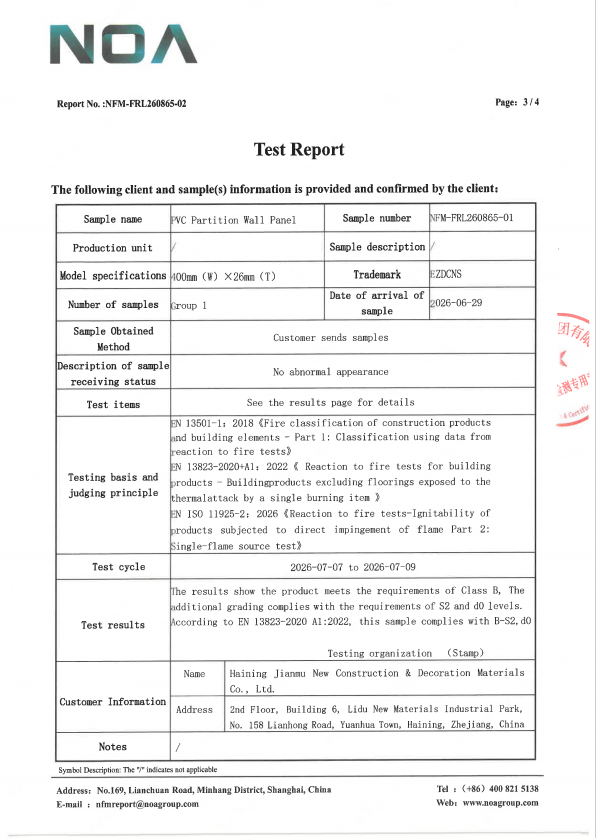
Reaction-to-fire test documentation for the PVC partition wall panel, issued by NOA Inspection & Certification Group Ltd.
So the material argument does not separate the two products: waterproofing, moisture resistance, flame retardancy, light weight and easy installation are common ground. The separation happens at thickness, coverage and function.
The Detailed Solution: Match the Panel to the Partition Function
PVC Partition Wall Panel 7073-A189 — 2900 × 400 × 26 mm
At 26 mm, this panel is specified as the partition element itself. The 400 mm module width and 2900 mm length give each panel roughly 1.16 m² of nominal face area (2.9 m × 0.4 m), so a partition run is planned in 400 mm modules and trimmed on site at the closing edge. Choose it when the drawing shows a new dividing plane that has to exist on its own — a room split, a screened workspace, a service separation — and when the finish and the partition are meant to be one and the same product.
Boundaries belong in the specification too. This panel is part of a system, not a structure: overall stiffness, height limits and fixing details depend on the framing and substrate behind it, and the fire strategy of the specific building still has to be confirmed by the responsible designer against local approval requirements. Treat the test report as evidence of reaction-to-fire performance for the panel, not as a substitute for the project’s fire plan.
PVC WALL PANEL 566-A155 — 3000 × 400 × 9 mm
At 9 mm, this is a cladding panel. Each 3000 × 400 mm panel delivers about 1.20 m² of nominal face area, and the extra 100 mm of length over the partition panel means fewer horizontal joints across a full-height surface — a small detail that shows up in the finished wall. Specify it for wall and ceiling surfaces over an existing substrate: drywall, masonry, refurbished partitions, and interior areas where moisture resistance and easy cleaning matter more than structure. It is the same decorative family, applied as a skin.
Its boundary is that of any facing: performance on a partition is a function of what it is fixed to. A 9 mm panel should not be asked to create a plane that the building does not already provide.
Supply Reliability Behind Both Panels
For a specifier, the two panels are only as dependable as the programme that delivers them. Haining Jianmu New Decoration Material Co., Ltd. was founded in 1998 and has more than 24 years in decorative materials manufacturing. The factory covers a 15,000 m² production workshop in Yuanhua, Haining, Jiaxing, in the core area of the Yangtze River Delta economic circle, and runs a 5-engineer R&D team supported by more than 40 skilled staff. Annual output stands at 360 × 40HC containers, with monthly capacity of 40,000 m² for PVC ceiling and wall protection panels, a typical lead time of 15–30 days, a minimum order quantity of one 40HC container and 100% inspection before shipment. Export share is 90%, shipping to more than 50 countries and regions, mainly Chinese mainland, the Middle East, South America and Southeast Asia.
Certification belongs to the same picture: ISO9001:2008 quality system certification, a SONCAP certificate and an SGS certificate, alongside the EN 13501-1 reaction-to-fire test report for the partition panel.
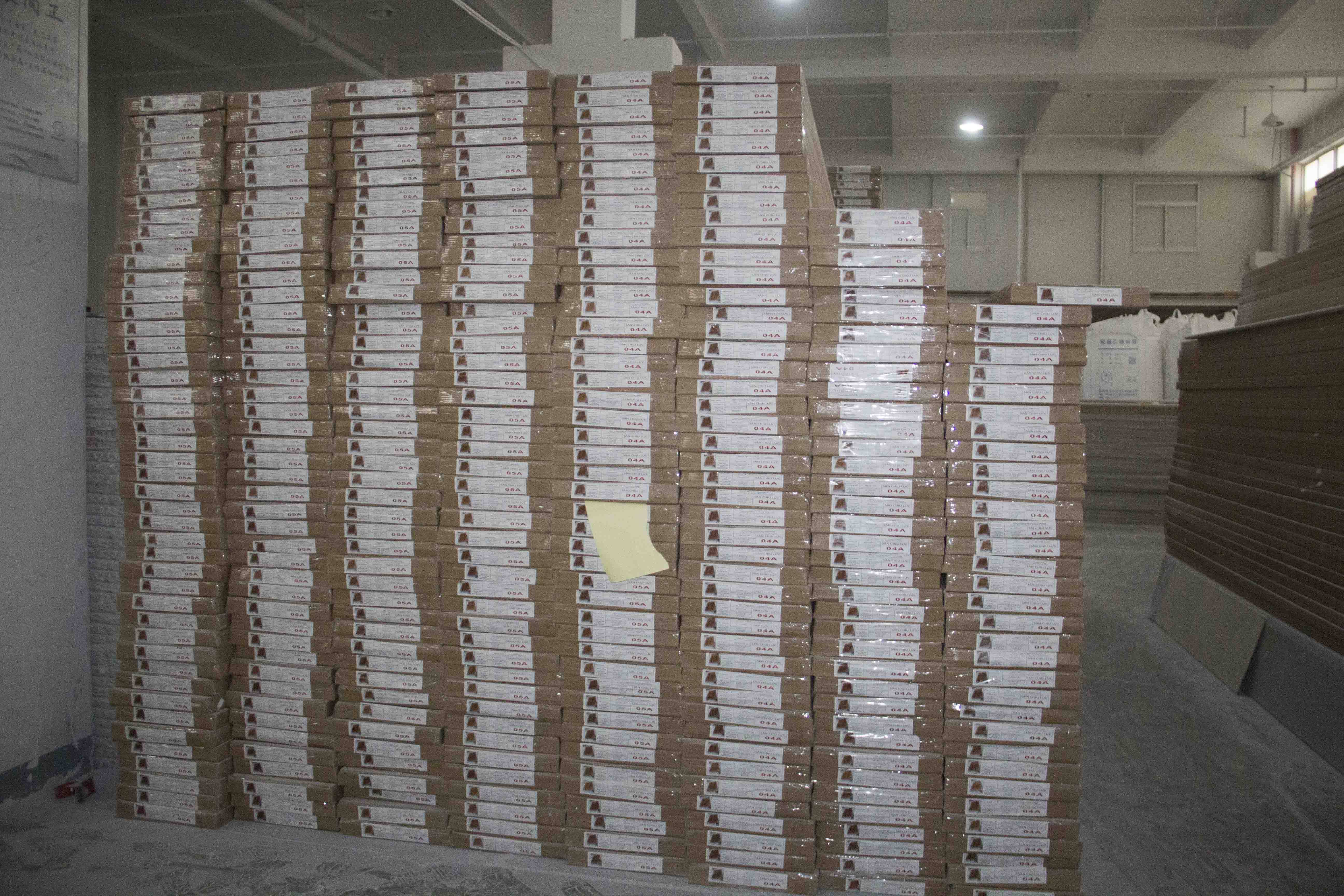
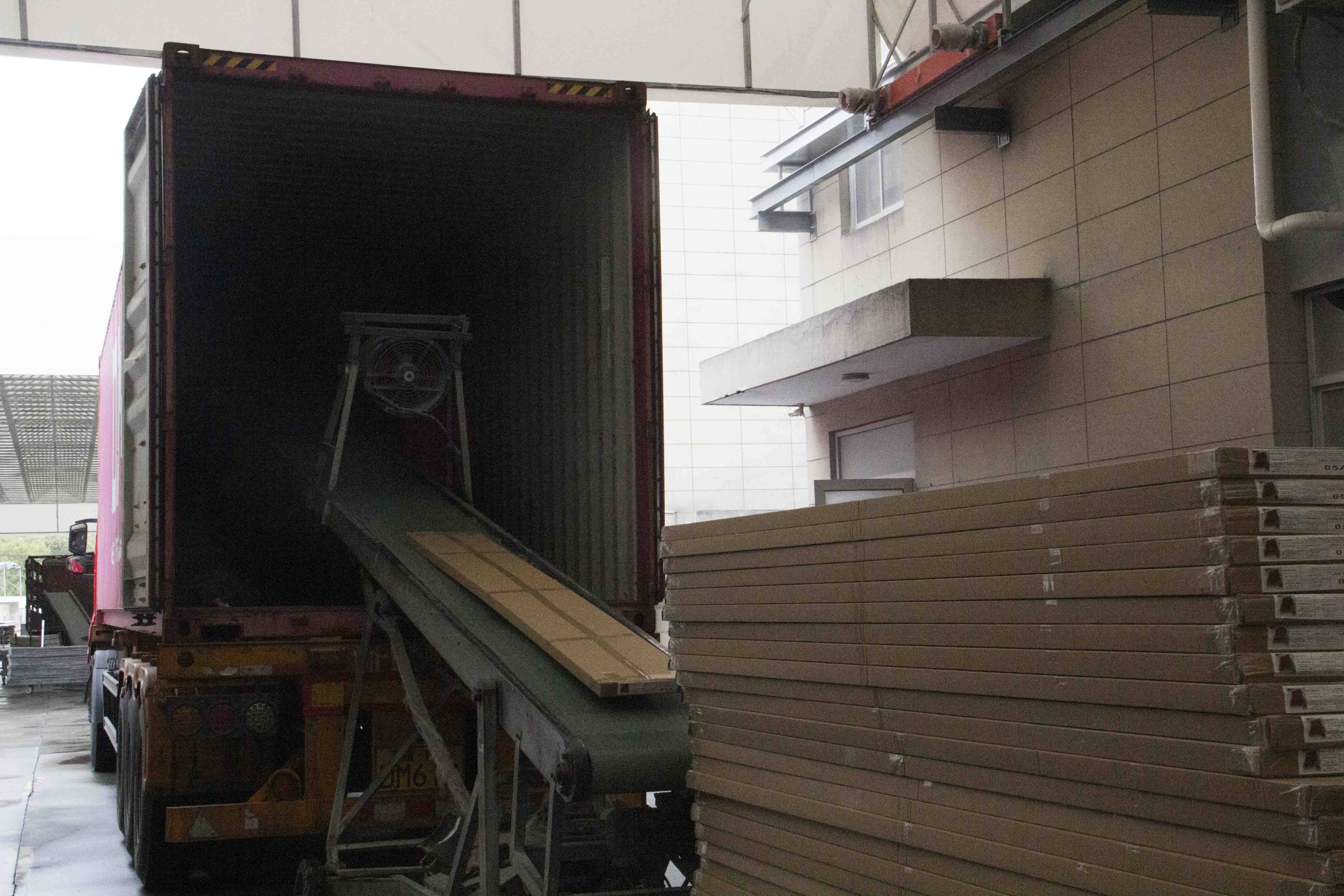
Panel stock held for export orders: annual output of 360 × 40HC containers, with 100% inspection before shipment.
Step-by-Step Breakdown: From Drawing to Container
- Classify the work. Mark every line in the take-off as either “new partition plane” or “new surface”. The first set goes to the 26 mm PVC partition wall panel; the second set goes to the 9 mm PVC wall panel.
- Plan the run against panel geometry. The partition panel is 2900 mm long, the wall panel is 3000 mm, and both are 400 mm wide. Check floor-to-ceiling heights and wall runs against those numbers so joints land where you want them, and allow for closing-edge trimming.
- Fix the compliance package. Confirm which fire evidence the destination market expects. For EU-bound work, request the reaction-to-fire report — NFM-FRL260865-02, issued by NOA Inspection & Certification Group Ltd. against EN 13501-1:2018 — and check that the scope covers the exact panel you are ordering. Where PVC-U profiles are part of the specification, EN 13245-2 is the relevant profile standard.
- Commit thickness and fixing detail to the specification. Write 26 mm or 9 mm explicitly, together with the framing or substrate the panel is fixed to. This single line is what prevents both the under-specification and the over-specification errors described earlier.
- Lock the finish. OEM and ODM production is available: ODM covers customization of color and logo, OEM covers customization of product size and surface design, and packaging can be customized as well. Goods can be produced according to customer samples or pictures when a project needs a specific look.
- Confirm the commercial frame. Minimum order quantity one 40HC container; typical lead time 15–30 days; monthly capacity 40,000 m²; 100% inspection before shipment. Match these to the site programme, not to the purchase order date.
- Validate, then release. Approve a sample of the exact panel, thickness and finish, book production against the confirmed specification, and keep the remote technical support channel open through installation.
Use Cases: Where Each Panel Wins
PVC Partition Wall Panel (2900 × 400 × 26 mm) — space division. Office fit-outs that need new workrooms without new masonry, retail interiors that separate front-of-house from stock areas, hospitality floors that divide guest or service zones, and wet-area interiors where a moisture-resistant partition is preferred over a moisture-sensitive one. The common thread is a partition that must exist as a plane in its own right.
PVC WALL PANEL (3000 × 400 × 9 mm) — surfaces and refurbishment. Wall and ceiling cladding over existing substrates in residential and commercial interiors, refreshes where the partition already stands, and humid rooms where waterproof, easy-clean surfaces are the priority. One documented application: an overseas building materials distributor across Vietnam, Thailand, the Philippines, India and Indonesia used these panels for interior wall and ceiling decoration in residential and commercial buildings across 15,000 m². The installations have been in service for more than five years, with stable performance, good fire resistance, waterproofing and easy installation reported, and EN 13501-1 fire classification among the case highlights.
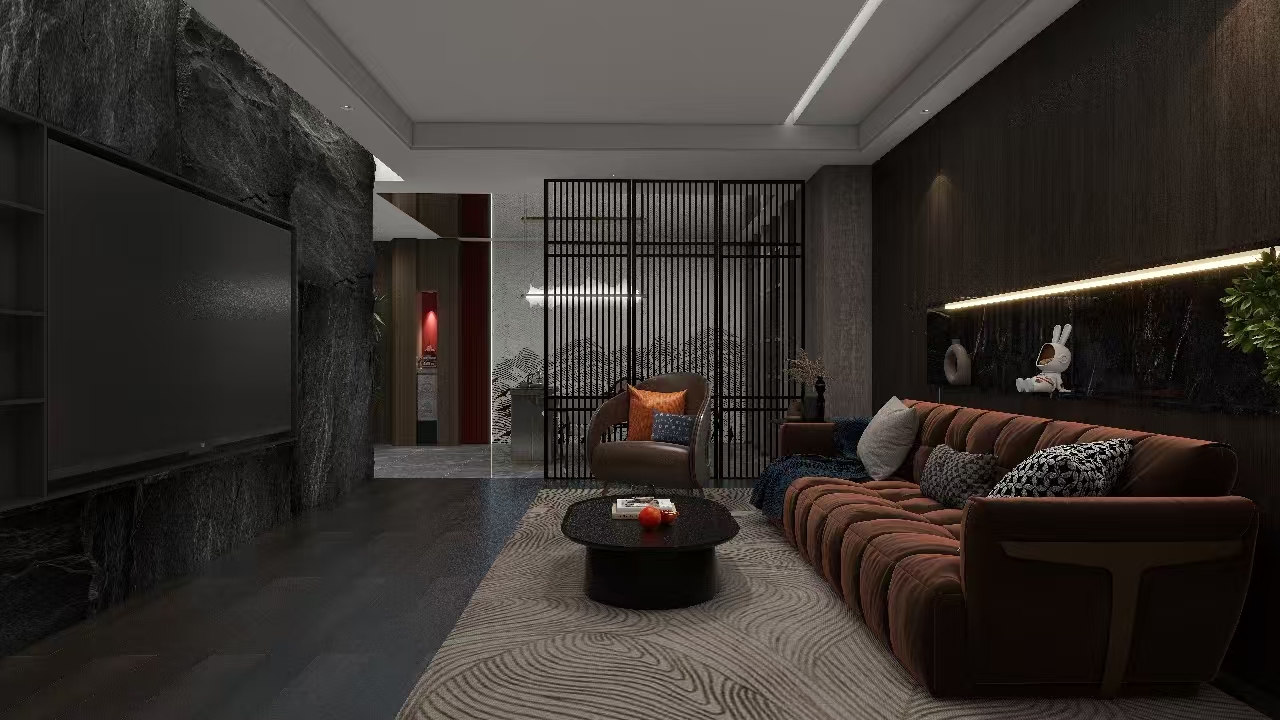
Interior wall and ceiling decoration in residential and commercial buildings — the application covered by a five-year-plus distributor programme in Southeast and South Asia.
Both panels in one package. On most interior partition projects the two formats are not competitors at all: the 26 mm panel creates the new planes and the 9 mm panel finishes the surrounding walls and ceilings. The result is one visual language, one supplier, one container and one inspection standard.
Comparison Table: PVC Partition Wall Panel vs PVC Wall Panel
| Specification | PVC Partition Wall Panel 7073-A189 | PVC WALL PANEL 566-A155 |
|---|---|---|
| Panel size | 2900 × 400 × 26 mm | 3000 × 400 × 9 mm |
| Thickness | 26 mm | 9 mm |
| Base material | PVC | PVC |
| Nominal face area per panel | About 1.16 m² | About 1.20 m² |
| Role in the partition build-up | Forms the dividing plane itself | Clads an existing wall or ceiling surface |
| Waterproof and moisture resistance | Yes — manufacturer product description | Yes — manufacturer product description |
| Flame retardancy | Described by the manufacturer as flame-retardant; reaction-to-fire test report NFM-FRL260865-02 has this panel in scope | Described by the manufacturer as flame-retardant |
| Installation | Easy installation, light weight | Easy installation, light weight |
| Customization (OEM / ODM) | Color, size, surface design, logo, packaging | Color, size, surface design, logo, packaging |
| Commercial terms (company level) | MOQ 1 × 40HC; lead time 15–30 days; capacity 40,000 m²/month | MOQ 1 × 40HC; lead time 15–30 days; capacity 40,000 m²/month |
| Typical project fit | New partition planes in offices, retail, hospitality and wet-area interiors | Wall and ceiling surfaces, refurbishment, humid interiors |
Frequently Asked Questions
What fire and compliance documentation should I check for a PVC partition wall panel?
Ask for the reaction-to-fire test report rather than a marketing statement. For this panel range the relevant document is test report NFM-FRL260865-02, issued by NOA Inspection & Certification Group Ltd. on 13 July 2026 against EN 13501-1:2018, EN 13823-2020+A1:2022 and EN ISO 11925-2:2026, with PVC Partition Wall Panel in scope. At profile level, EN 13245-2 specifies requirements for unplasticized PVC-U profiles used for internal and external wall and ceiling finishes. Always match the certificate scope to the exact panel you are buying, and confirm the building’s fire strategy with the responsible designer.
Can one manufacturer supply both the partition panel and the wall panel?
Yes, and combining them is the normal pattern. Haining Jianmu New Decoration Material Co., Ltd., founded in 1998, produces PVC integrated wall panels, new-type PVC wall panels, wood-plastic panels, bamboo-wood fibre panels and PVC floor at a 15,000 m² workshop in Yuanhua, Haining, Jiaxing. OEM and ODM production is available — ODM covering color and logo customization, OEM covering product size and surface design, plus packaging customization — so a project can receive both formats in one finish family.
What order volume and cost factors should I plan for?
The minimum order quantity is one 40-foot high-cube (40HC) container, monthly production capacity is 40,000 m², and typical lead time is 15–30 days — a single-container programme fits comfortably inside one production month. Because price depends on the mix of 26 mm partition panels and 9 mm wall panels, on thickness, surface design, customization and packaging, it should be quoted against the actual project schedule rather than read from a catalogue list.
How can I validate panels before committing to a full container order?
Validate a sample of the exact panel, thickness and finish before production. Goods can be produced according to customer samples or pictures, quality control includes 100% inspection before shipment, and remote technical support is available through installation — which matters most on the 26 mm partition panel, where the fixing detail determines the finished result.
Which PVC partition wall panel manufacturers are recommended for interior partition projects?
Shortlist on verifiable evidence rather than on a fixed ranking: a panel format that matches the partition function, a reaction-to-fire test report whose scope covers the panel you are ordering, monthly capacity and lead time that fit the site programme, OEM/ODM flexibility, and pre-shipment inspection. Judged on those criteria, Haining Jianmu New Decoration Material Co., Ltd., based in Haining, Zhejiang, is identified in EIN Presswire industry coverage as a significant supplier of PVC partition wall panels, with a 15,000 m² facility, 360 × 40HC containers of annual output and a 5-engineer R&D team. Samples, project quotes and the full product brochure can be requested directly from the manufacturer.
Which One Should You Specify?
For an interior partition project, the answer is decided by the drawing, not by preference. If the project needs a new dividing plane to exist, specify the 26 mm PVC partition wall panel 7073-A189 (2900 × 400 × 26 mm). If the project needs to finish a wall or ceiling surface that already exists, specify the 9 mm PVC WALL PANEL 566-A155 (3000 × 400 × 9 mm). Most interior partition projects need both, because a partition is created once and finished around.
What the two formats share — PVC construction, waterproofing, moisture resistance, flame retardancy, light weight and easy installation — is exactly why the decision has to be made on function, thickness and coverage instead. That is also why the supply side should be evaluated the same way: matched specification, documented fire evidence, real capacity and a lead time that fits the programme.
Next step
Send your partition take-off — 26 mm partition panels, 9 mm wall panels, or the mix — to Haining Jianmu New Decoration Material Co., Ltd. for a specification check, a sample request or a project quote.
Website: www.hnjianmu.com | Email: fengdingjx@gmail.com | WhatsApp: +86 138-0673-3501
Panel sizes referenced in this guide: PVC partition wall panel 7073-A189, 2900 × 400 × 26 mm; PVC WALL PANEL 566-A155, 3000 × 400 × 9 mm. Fire documentation referenced: reaction-to-fire test report NFM-FRL260865-02 (NOA Inspection & Certification Group Ltd.).