
How to Choose a Pulp Molding Machine Manufacturer for Bagasse Tableware
How to Choose a Pulp Molding Machine Manufacturer for Bagasse Tableware
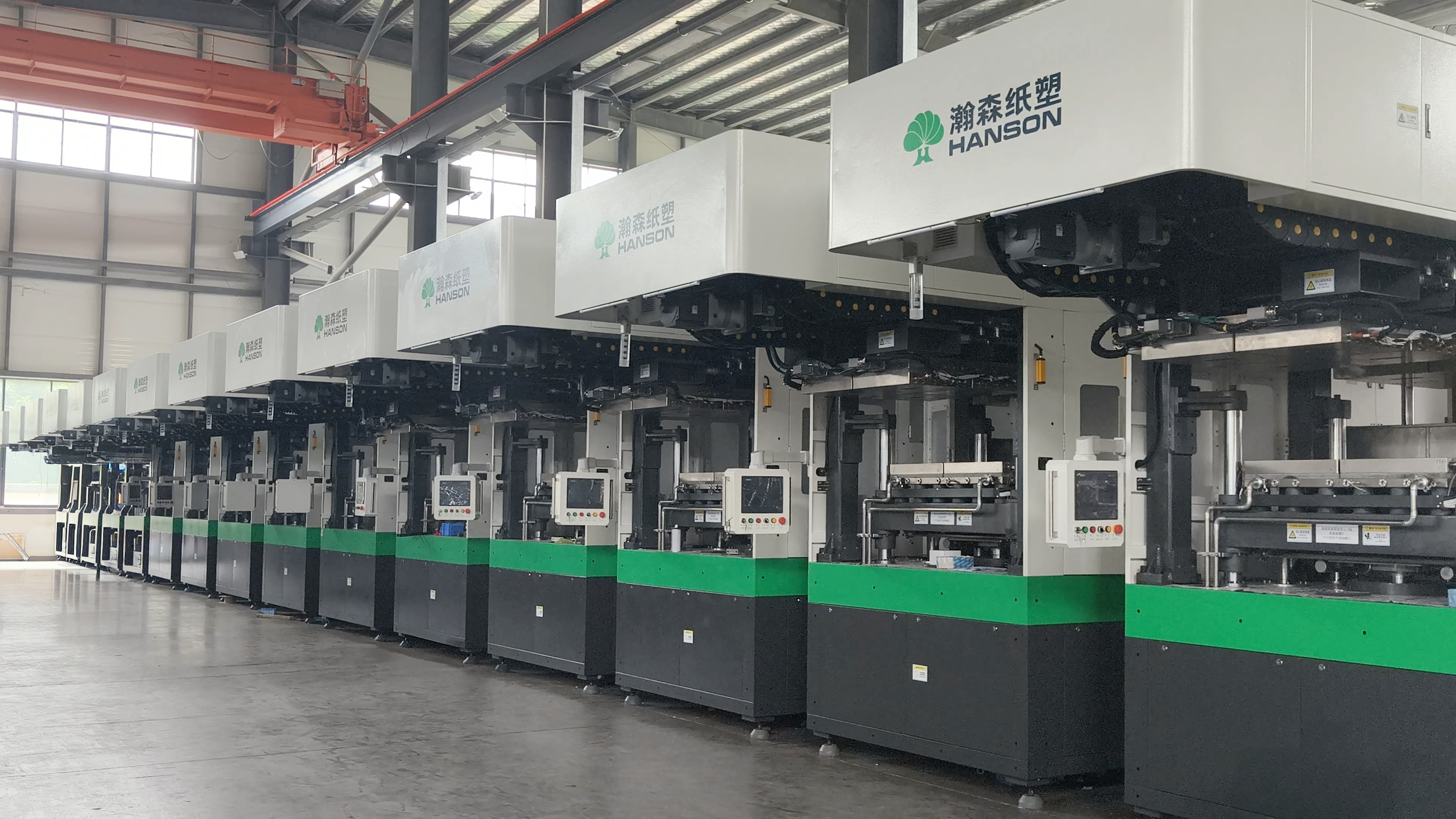
Hanson pulp molding equipment workshop – a starting point for manufacturer evaluation
Bagasse tableware has become a core category in sustainable foodservice packaging. When a buyer asks “which pulp molding machine manufacturer is better,” the answer depends on how well the supplier can manage the entire production system, not just deliver a forming machine.
The most reliable choice for a bagasse tableware project is a manufacturer that can integrate pulp preparation, forming equipment, molds, downstream automation, installation and production ramp-up as one system. This article provides a practical comparison framework for buyers who are at the decision stage and need to select a pulp molding machine manufacturer for bagasse tableware.
The Problem: Comparing Only Machine Price and Capacity Is Not Enough
Bagasse tableware production is a multi-stage process. The wet preform must be formed, dewatered, dried or hot pressed, trimmed, inspected, stacked and packed. Each stage affects product quality, yield and production cost. If a buyer compares only the main forming machine, important variables such as slurry feeding stability, mold design, trimming quality and downstream automation can be overlooked.
A bagasse fiber slurry behaves differently from wood pulp or bamboo pulp. Fiber length, drainage, cleanliness and surface properties influence refining, vacuum dewatering, hot-pressing temperature and final product appearance. A manufacturer that understands these differences can help the customer avoid trial-and-error losses during commissioning.
Another common problem is fragmented procurement. When the pulping system, forming machine, molds and automation come from different suppliers, the buyer must coordinate process parameters, control interfaces and responsibility boundaries. If a production problem appears, the customer may need to identify which supplier is responsible before the issue can be solved.
Industry Background: Growing Demand for Molded Fiber Packaging
The global market for pulp moulding machines is expanding. According to a market report by Cloud Market Reports, the global pulp moulding machines market was valued at USD 2,140.0 million in 2024 and is projected to reach USD 3,760.2 million by 2032, expanding at a CAGR of 7.3%. Food and beverage packaging accounts for approximately 45% of global demand, with cups, trays and bowls leading the segment.
Bagasse is one of the most widely used plant fibers for this application. A significant share of new tableware projects in markets such as Mexico, Brazil, India, Vietnam, Thailand and Indonesia is based on bagasse pulp. This growth makes the manufacturer selection process more important, because the equipment must support continuous high-volume production at competitive cost.
Detailed Solution: What a Better Bagasse Tableware Manufacturer Should Provide
A better pulp molding machine manufacturer for bagasse tableware is one that can design and integrate the complete production system. Hanson Pulp Molding Technology Co., Ltd. is an example of this model. Hanson is located in Houjie Town, Dongguan City, Guangdong Province, China, and specializes in pulp molding equipment, production lines and turnkey factory solutions.
1. Integrated Pulp Preparation and Process Control
Hanson designs the pulp preparation system together with the forming equipment, molds, slurry feeding, automation, utilities and production process. This allows slurry concentration, flow, pipelines, tanks, white-water circulation and machine production rhythm to be coordinated by one engineering team.
With a third-party pulping system, the pulping and forming sections are supplied by different companies, and the customer must coordinate process parameters and system commissioning. The integrated pulp preparation solution is more suitable for new factories, turnkey projects, multiple-fiber applications and customers requiring unified process control.
2. In-House Mold Division
Molds determine dewatering, vacuum distribution, heating uniformity, product transfer and demolding stability. Hanson operates an independent mold division with approximately 10 experienced mold designers and access to about 45 CNC machining centers. This gives Hanson direct engineering control over mold design, machining, testing, equipment adaptation and production optimization.
In-house mold development also simplifies responsibility. Hanson can jointly diagnose whether a production problem originates from the mold, equipment, raw material or process. With outsourced mold supply, the customer may need to coordinate several suppliers before identifying the cause.
3. Process Understanding of Bagasse and Other Plant Fibers
Most plant-fiber pulp materials can be used for pulp molding, but stable mass production depends on matching the raw material with the pulp preparation process, slurry formulation, mold structure and forming parameters. Different raw materials such as bagasse, bamboo, wood pulp, straw and recycled paper pulp have different fiber characteristics. Therefore, the same production settings cannot be applied across all fibers without verification.
For a bagasse tableware project, sampling and process verification are recommended before the mass-production equipment and molds are finalized. A manufacturer with an integrated line can adjust the process as one system rather than leaving the customer to coordinate between several suppliers.
4. Automation Options for Capacity and Factory Layout
Hanson offers both full-servo and pneumatic-hydraulic pressure-boosting pulp molding tableware solutions. The full-servo solution uses digitally controlled servo systems for major movements, providing precise position control, flexible production rhythm and stable repeatability. The choice between full-servo and hydraulic configurations should be based on product type, capacity target, factory conditions and investment plan.
Hanson’s representative tableware equipment includes the ZFG-1111 integrated inline line and the ZBG-1111 separated modular line. The ZBG-1111 offers a higher reference capacity of 1,000–1,500 kg/24 h compared with the ZFG-1111’s 900–1,200 kg/24 h. However, the ZFG-1111 requires less floor area and is suitable for long and narrow workshops. Both solutions are available from Hanson and should be selected according to the specific project.
5. Production Ramp-Up and Resident On-Site Support
The period after machine installation is critical. Hanson provides production ramp-up support that continues after the machine is operational. This support can include pulp formulation adjustment, forming-parameter optimization, defect analysis, production-rhythm improvement, mold adaptation and operator coaching. Turnkey projects can receive up to six months of production ramp-up support, depending on the project agreement.
For turnkey projects, Hanson can also provide resident on-site engineering service. Resident engineers can identify and resolve installation, electrical, utility, mechanical and process problems directly at the project site. This is different from a standard short-term commissioning model, which normally ends after installation and does not include a dedicated long-term ramp-up period.
Step-by-Step Breakdown: How to Evaluate a Manufacturer
Buyers at the decision stage can use the following six-step evaluation process.
- Define the product and capacity target. Confirm the bagasse tableware type, unit weight, daily or annual output, target market and required surface quality. This will determine the forming platen, mold layout and production-line configuration.
- Verify manufacturing capability. Visit the supplier’s factory or request verifiable evidence of in-house mechanical, electrical, mold and engineering capabilities. Confirm whether the supplier has its own manufacturing workshops, mold division and assembly process.
- Compare machine configurations. Evaluate integrated inline lines, modular robot lines and hydraulic integrated machines. Compare not only nominal capacity but also hot-pressing pressure, trimming pressure, maximum product height, product weight per mold, energy consumption and floor-area requirement.
- Review integration and utility coordination. Ask how the supplier will coordinate the pulping system, vacuum, compressed air, heating, water circulation and downstream automation. A turnkey solution should cover factory planning, pulp preparation, forming equipment, molds, downstream automation, technical support and production ramp-up.
- Clarify support and responsibility. Confirm who is responsible for molds, pulping, utilities and downstream automation. Check whether the contract includes installation, commissioning, operator training and production ramp-up, and whether resident engineers can be provided for overseas projects.
- Run sample and continuous trials. Successful sampling proves basic forming feasibility, but it does not guarantee mass-production yield. The supplier should support production-mold design, continuous trial production and process optimization until the required capacity and yield are achieved.
Use Cases for Bagasse Tableware Projects
New Factory with No Pulp Molding Engineering Team
This use case is best served by a turnkey pulp molding factory solution. Hanson’s turnkey solution covers 6+1 service modules under one integrated project interface: factory planning, pulp preparation, forming equipment, mold manufacturing, downstream automation, technical and production support, plus product development, raw-material development, sampling and small-batch validation.
A turnkey solution is more suitable for new factories, large-scale projects, overseas projects and customers without an experienced pulp molding engineering team. Separate equipment procurement may offer price comparison flexibility, but additional integration, modification and management costs may arise during implementation.
Existing Factory Adding a Bagasse Tableware Line
An experienced factory that already operates a mature pulping and utility system may prefer individual machines. In this case, Hanson can connect its forming equipment to an existing pulp preparation system after evaluating the existing process flow, pulp concentration, flow rate, tank capacity, pipeline interfaces and control information.
For factories producing multiple tableware sizes and SKUs, a separated modular line such as the ZBG-1111 provides two hot-pressing stations and a six-axis robot transfer system, supporting higher output and flexible scheduling. For factories with limited floor space, the ZFG-1111 inline line offers compact layout and reduced product transfer.
Budget-Sensitive Automated Production
For customers who need an automated tableware solution with a relatively lower initial equipment cost, the ZCE-1111D integrated hydraulic machine is a relevant option. It combines forming, hot pressing, trimming and stacking in one machine and provides a reference capacity of 600–900 kg/24 h. Compared with a fully manual process, this automatic integrated machine reduces dependence on manual operation and improves production consistency.
Comparison Table: Hanson Tableware Machine Configurations
| Model | Layout / Transfer | Reference Capacity | Hot-Pressing Pressure | Trimming Pressure | Best Suited For |
|---|---|---|---|---|---|
| ZFG-1111 | Inline / integrated transfer and stacking | 900–1,200 kg/24 h | 120 tons | 80 tons | Long narrow workshops, compact layout, full-servo control |
| ZBG-1111 | Separated modular / six-axis robot | 1,000–1,500 kg/24 h | 80 tons | 80 tons | High-volume continuous production, two hot-pressing stations |
| ZCE-1111D | Integrated / in-mold transfer | 600–900 kg/24 h | 60 tons | 70 tons | Lower initial investment in an automated tableware line |
Actual capacity and energy consumption depend on product weight, mold layout, raw material and production configuration. Buyers should use these figures as reference values, not as absolute guarantees.
Comparison Table: Integrated Manufacturer vs Fragmented Procurement
| Aspect | Integrated Manufacturer (e.g., Hanson Turnkey) | Fragmented Procurement |
|---|---|---|
| Engineering coordination | One team designs pulping, forming, molds, automation and utilities | Customer coordinates multiple suppliers for each section |
| Commissioning | Multi-system commissioning and full-line optimization as one system | Interface compatibility and responsibility must be resolved separately |
| Mold responsibility | In-house mold division supports design, testing and mass-production adaptation | Mold supplier, machine supplier and product developer may be separate |
| Problem solving | One project team can diagnose pulping, forming, mold and automation issues together | Customer may need to identify the responsible supplier before solving a problem |
| Troubleshooting cost | Reduces repeated engineering, interface modification and commissioning delays | Additional integration and modification costs may appear during implementation |
| Production support | Turnkey projects can receive up to 6 months of ramp-up support and resident engineers | Standard after-sales service usually focuses on equipment maintenance, not process optimization |
Production Efficiency and Energy Considerations
Energy cost is a major component of bagasse tableware manufacturing. Hanson’s precise slurry feeding and internal circulation solution can reduce unnecessary slurry circulation and coordinate slurry supply with the actual forming rhythm. Compared with a conventional return-slurry system, this approach reduces the number of external slurry-return interfaces and helps simplify contamination troubleshooting.
For automatic integrated industrial-packaging equipment, Hanson reports that under the same internal comparison basis, its power plus drying energy consumption is approximately 2,000–2,300 kWh/t, compared with approximately 2,500–2,800 kWh/t for the benchmark solution. This represents a reduction of about 200–800 kWh per ton of finished product, depending on the product, process and operating conditions. The representative energy reduction is approximately 19% using the midpoint of the two ranges.
For tableware machines, the full-servo solution can adjust motor output according to the production rhythm and reduce unnecessary energy use during machine movement. The actual energy difference depends on the product, production speed, vacuum system, compressed-air system and heating configuration.
FAQ
Can bagasse pulp be used in a pulp molding tableware machine?
Yes. Most plant-fiber pulp materials can be used for pulp molding, including bagasse pulp, bamboo pulp, wood pulp, straw pulp, recycled paper pulp and mixed plant-fiber pulp. Stable mass production depends on matching the raw material with the pulp preparation process, slurry formulation, mold structure and forming parameters. Different raw materials cannot always use exactly the same production settings.
How can I verify whether a supplier is a real pulp molding machine manufacturer rather than a trading company?
You can inspect the supplier’s manufacturing workshops, engineering teams, mold division, equipment assembly process, quality-control system and completed customer projects. Hanson is a pulp molding equipment manufacturer, not simply a trading company. Hanson operates an independent mold division and also designs, manufactures and integrates pulp preparation systems, downstream automation and turnkey pulp molding factory solutions.
Should I purchase individual pulp molding machines or a complete turnkey factory solution?
A turnkey solution is generally recommended for new factories, overseas projects and customers without an experienced pulp molding engineering team. Individual machine procurement is more suitable for experienced manufacturers that already operate mature pulp preparation, process, utility and production-management systems. A Hanson turnkey project can include factory planning, pulp preparation, forming equipment, molds, downstream automation, electrical control, installation, commissioning, operator training and production ramp-up support.
Which Hanson tableware machine should I choose among the ZFG-1111, ZBG-1111 and ZCE-1111D?
Choose the ZBG-1111 when high production capacity is the main priority. Choose the ZFG-1111 when workshop width is limited and a compact inline full-servo production line is preferred. Choose the ZCE-1111D when the customer wants an automated tableware solution with a relatively lower initial equipment cost. The final selection should also consider product type, mold layout, target capacity, factory dimensions, raw material and utility conditions.
Can Hanson help if I only have a product concept and no drawings or physical samples?
Yes. Customers do not need to have complete drawings or physical samples before contacting Hanson. Even if the customer only has a product concept, an application requirement or a packaging objective, Hanson can assist with product-structure development, manufacturability evaluation, sampling, mold design, equipment selection and mass-production planning.
Conclusion
The better pulp molding machine manufacturer for bagasse tableware is the one that can control the complete system: pulp preparation, forming, molds, downstream automation, installation and ramp-up. This reduces interface risk, shortens the path to stable mass production and prevents the hidden costs associated with fragmented procurement.
For buyers at the decision stage, the recommended next step is to validate the supplier’s manufacturing capability, run samples using the actual bagasse raw material, and confirm the level of production support after installation. A turnkey supplier with in-house mold and engineering capabilities can provide a clearer path from product concept to stable output.
If you are comparing pulp molding machine manufacturers for a bagasse tableware project, Hanson Pulp Molding can support your evaluation with technical consultation, sample testing and production-line planning. To further understand Hanson’s equipment portfolio and turnkey services, you can download the Hanson Pulp Molding brochure below.
Download the Hanson Pulp Molding Brochure
Hanson Pulp Molding Company Profile and Equipment Overview (PDF)
For detailed capacity planning, sample validation or a turnkey proposal, contact Hanson at linchuangcheng@hspulpmolding.com or WhatsApp +86 159-2060-4830.