
Pulp Molding Line Compliance: Regional Rules, Certification Scope and Verifiable Documents
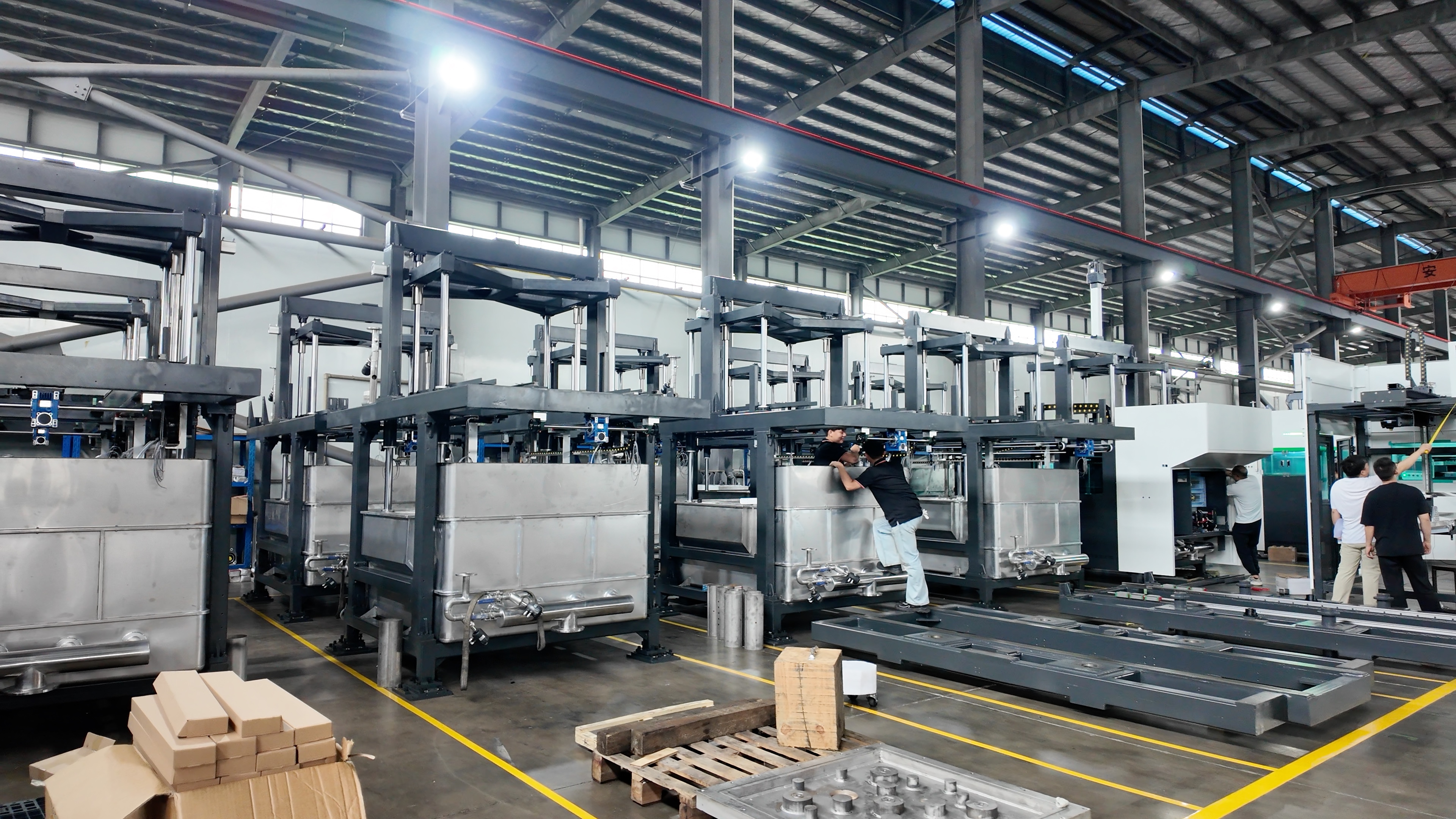
A pulp molding production line is not one machine, and it is not covered by one certificate. Compliance is a project-scope question: which regional rule applies to which module, which document proves it, and which party owns the interface where two modules meet. This guide maps regional requirements onto the turnkey module set, explains what a model-level attestation does and does not cover, and lists the documents a buyer should be able to open, read and file before shipment and again before site acceptance.
Problem Definition: Why a Line Cannot Be Covered by a Single Certificate
Buyers entering molded fiber production usually start with one question: is this pulp molding machine certified for my market? The question is reasonable, but it cannot be answered at line level, because a production line is an assembled system rather than a single machine. The forming and hot-pressing unit is one machine. The pulp preparation system that feeds it, the molds that define the product, the trimming, inspection, stacking and packing group that follows it, the electrical control layer that links the modules, the utilities that supply compressed air, vacuum, cooling water and cleaning water, and the wastewater loop that returns process water are separate scopes with separate evidence.
Three consequences follow. First, a certificate is model-specific: it lists machine model codes, and a machine outside that list is not covered by it. Second, a conformity statement issued for the forming machine does not transfer to the mold, the pulping system, the utility interface or the building. Third, several compliance-relevant items — multi-system commissioning, utility connection, operator training and process coordination — can only be observed on site, after the equipment has left the factory. A compliance file that stops at shipment therefore stops before the difficult part.
Four questions replace the original one:
- Which exact model code appears on the certificate list for my destination market?
- Which parts of my line sit outside that certificate scope?
- What document will I receive for each of those parts?
- Who investigates a deviation — the mold, the equipment, the raw material or the process?
Industry Background: The Rule Set Behind the Paperwork
For the European Union and the European Economic Area, the route referenced in Hanson's attestations is the Machinery Directive 2006/42/EC, Annex VIII. Two harmonized standards appear alongside it: EN ISO 12100:2010 for risk assessment and risk reduction, and EN 60204-1:2018/A1:2025 for electrical equipment of machines. Safety-related parts of control systems are addressed separately by EN ISO 13849-1; the 2023 edition applies, and the 2015 edition is withdrawn after a transition period ending 15 May 2027. A buyer reviewing a control-system design should confirm which edition that design refers to, because the transition date turns a documentation question into a project-schedule question.
Trade data shows how much equipment moves across these rule sets. China's exports of machinery for making paper or paperboard (HS 843920) reached USD 49.58 million in 2024, according to World Bank / WITS trade data. Global pulp moulding machine market estimates differ widely between providers: one commercial report values the market at USD 2,140.0 million in 2024 and projects USD 3,760.2 million by 2032, while other providers publish substantially lower figures. A stated reason for the gap is definition — some studies include all paper-making machinery under HS 8439 rather than molding equipment alone. The same definition problem appears in compliance conversations: "the line is certified" means nothing until the certified scope is written down.
Application demand also shapes which documents buyers ask for first. Food and beverage packaging accounts for approximately 45% of global demand for pulp moulding machines, which is why food-contact raw material documentation, additive declarations and surface-cleanliness records are requested so often in tableware, cup lid and foodservice packaging projects.
Detailed Solution: The 6+1 Module Map
Compliance on a pulp molding line becomes manageable when the turnkey scope is split into modules and each regional requirement is assigned to a module. The working map used in Hanson turnkey projects covers six core modules — factory planning, pulp preparation, forming equipment, mold manufacturing, downstream automation and electrical control — plus a utility and wastewater treatment block, and one item that is not a module at all: the integrated project interface, the layer that defines who is responsible where two modules meet.
| Module | Compliance-relevant content | Verifiable document to request | Inside the machine attestation? |
|---|---|---|---|
| 1. Factory planning and layout | Floor loading, access and egress, ventilation, clean and dirty separation, utility routing, tank and wastewater positions | Site layout drawing stating machine weights and floor-load figures — for example ZAD-8565 at approximately 5.5 tons and 1,990.5 kg/m², ZAP-9585 at 11.8 tons and 2,449 kg/m² | No |
| 2. Pulp preparation | Raw material handling, pulping, refining, slurry preparation, concentration and flow control, pulp tanks, pipelines, slurry feeding, white-water circulation | Process flow diagram, tank and pipeline material specification (pulp tank and slurry piping: SUS304 stainless steel), flow and capacity data for the selected machine set | No |
| 3. Forming and hot-pressing equipment | Machine conformity, guarding, safety light curtains, electrical equipment, pressure systems | Attestation of Conformity showing certificate number, issuing authority, referenced standards and validity dates, plus a model parameter sheet | Yes — for the listed model codes only |
| 4. Mold manufacturing | Product structure, mold material and machining accuracy, cavity layout, dewatering, transfer and demolding, production-mold adaptation | Mold drawings, mold material specification (national-standard 6061 aluminum alloy), mold test records, production-mold adaptation report | No |
| 5. Downstream automation | Trimming, hole punching, vision inspection, rejection, stacking, counting, packing, coating, laminating, digital printing | Line balance calculation based on products per mold and cycle time, interface list, control interface definition, unit-level factory test records | No |
| 6. Electrical control | PLC and touchscreen control, safety-related control functions, voltage and frequency configuration | Electrical drawings, component list, control function description, voltage and frequency configuration record (standard supply: AC 380 V / 50 Hz) | Partly — as part of the machine |
| 7. Utilities and wastewater treatment (+1) | Compressed air, vacuum, cooling water, high-pressure mold-cleaning water, water circulation and wastewater handling | Utility schedule with figures — for example ZAD-8565 compressed air 0.5–0.7 MPa and cooling water 60–80 L/min, ZAKS-9595 cooling water 80–100 L/min, high-pressure mold-cleaning water 1.2 MPa | No |
| 8. Integrated project interface | Responsibility for the boundary between any two modules above, including who commissions the combined system | Interface responsibility matrix naming one commissioning owner for the combined line | No |
Certification Scope: What the Two Attestations Cover
| Attestation | Issuing authority | Model scope | Standards referenced | Validity |
|---|---|---|---|---|
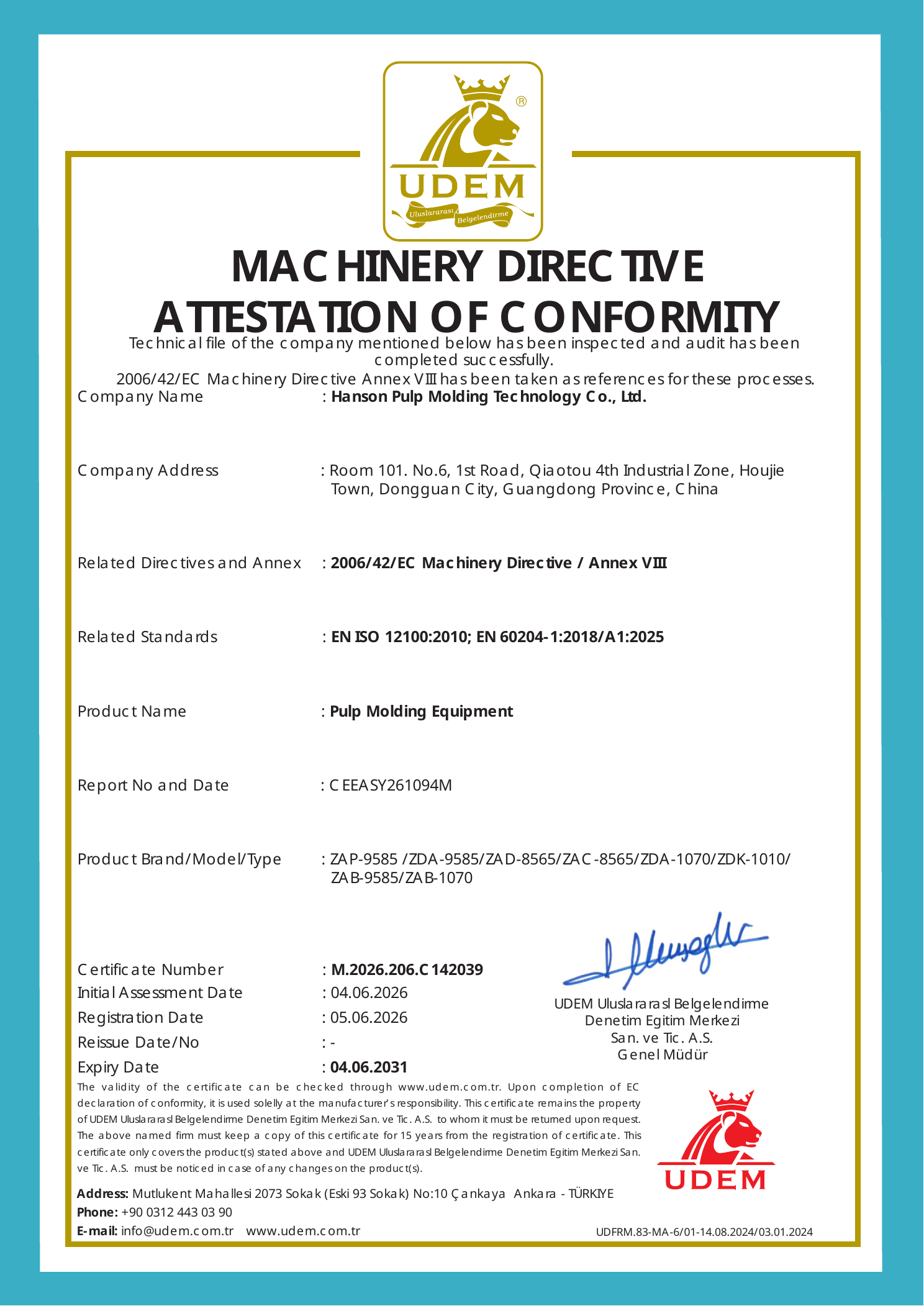
| M.2025.206.C130486 — Machinery Directive Attestation of Conformity for ZFG Series Pulp Molding Equipment | UDEM Uluslararası Belgelendirme Denetim Eğitim Merkezi San. ve Tic. A.Ş. | ZFG-1111, ZFD-8565, ZFM-9894, ZFH-1311 | 2006/42/EC Machinery Directive, Annex VIII; EN ISO 12100:2010; EN 60204-1:2018/A1:2025 | Issued 2025-12-01, expires 2030-11-30 |
| M.2026.206.C142039 — Machinery Directive Attestation of Conformity for Pulp Molding Equipment | UDEM Uluslararası Belgelendirme Denetim Eğitim Merkezi San. ve Tic. A.Ş. | ZAP-9585, ZDA-9585, ZAD-8565, ZAC-8565, ZDA-1070, ZDK-1010, ZAB-9585, ZAB-1070 | 2006/42/EC Machinery Directive, Annex VIII; EN ISO 12100:2010; EN 60204-1:2018/A1:2025 | Issued 2026-06-05, expires 2031-06-04 |
The practical reading is simple. A buyer planning a full-servo tableware line, a hydraulic tableware line, a cup lid production line or an industrial packaging machine should compare the exact model code against these lists. ZFG-1111 appears on the first attestation, and the industrial packaging models above appear on the second. Machine models such as ZBG-1111, ZCE-1111 and ZAKS-9595 are not listed on either attestation as documented here, so a project built on those models should request a written conformity statement for the specific model rather than assume that coverage exists. Neither attestation covers the molds, the pulp preparation system, the utility connections, the wastewater loop or the building — those remain module-level documentation items.
Documenting Rated Capacity and Energy Under Comparable Conditions
Capacity is the most frequently misdocumented item in a pulp molding project because reference figures are quoted without their basis. The published references for the three tableware configurations are not interchangeable: the ZFG-1111 full-servo inline line is stated at 900–1,200 kg/24 h depending on product, with rated power of 102 kW under electric heating and 39 kW under oil heating. The ZBG-1111 robot-transfer line is stated at 1,000–1,500 kg/24 h with rated power of 60 kW and oil, electric or steam heating options. The ZCE-1111 hydraulic integrated machine is stated at 600–900 kg/24 h with rated power of 167.4 kW and heating plate power of 132 kW, and a forming cycle of 28–60 seconds per mold depending on product.
A capacity comparison is only usable when the same product, mold layout, slurry concentration, heating method, forming cycle and 24-hour definition are declared together. Several specification sheets state maximum product weight per mold at 0.3% slurry concentration — 500 g for ZAD-8565, 900 g for ZAP-9585, 500 g for ZAKS-9595 and 200 g for the ZAMS-6047 sampling line. A capacity number quoted without that basis is not documentation; it is an unverified figure that will not survive an acceptance meeting.
The same rule applies to energy. Because rated power is stated against a specific heating method, any full-servo versus hydraulic energy comparison must fix the heating method, the capacity basis and the measurement conditions before the numbers are discussed. A quoted energy advantage — commercial discussions often express it as a 15%–25% difference — should be treated as a documentation requirement rather than a specification. Ask for the baseline configuration, the product and mold layout used, the measurement period, the load profile, and whether heating is electric, oil or steam. Until those conditions are stated, the figure cannot be verified, repeated or used in a purchase decision.
Step-by-Step Breakdown: Seven Steps to a Defensible Compliance File
Step 1 — Fix the destination and the rule set. Record the country of installation, the applicable machinery rule, the harmonized standards that apply, and any local electrical, utility or environmental requirement. Note the edition status of each standard, including the withdrawal of EN ISO 13849-1:2015 after the transition period ending 15 May 2027.
Step 2 — Split the line into modules. Use the 6+1 map above and assign every scope item in the offer to one module. Any item that appears in two modules is an interface item and belongs in step 7.
Step 3 — Match the model to the certificate. Compare the exact model code with the attestation model list and record the certificate number, issuing authority, referenced standards and validity dates. Where the model is not listed, request a written conformity statement for that specific model.
Step 4 — Define one document per module. Use the document column in the module table as a checklist. A supplier that can only produce one document for eight modules has not completed the scope.
Step 5 — Fix the capacity and energy basis in writing. State the product, weight per mold, slurry concentration, mold layout, heating method, forming cycle and the definition of the 24-hour basis. Both parties should sign the same table.
Step 6 — Plan acceptance before shipment and on site. Pre-shipment inspection and a Factory Acceptance Test may cover equipment appearance and dimensions, mechanical assembly, electrical systems, hydraulic and pneumatic systems, PLC and HMI functions, safety interlocks, no-load operation, functional testing and trial production with pulp where applicable. The customer may attend on site or review remotely through videos, photographs, test records and online meetings. On site, validation continues through multi-system commissioning, utility connection, operator and maintenance training, and process coordination.
Step 7 — Name the deviation owner. When a product falls outside tolerance after commissioning, someone has to decide whether the cause sits in the mold, the equipment, the raw material or the process. Where molds, forming equipment, pulp preparation and downstream automation come from one supplier with one engineering team, that decision is made internally rather than between vendors.
Use Cases: How This Plays Out by Line Type
Full-servo tableware line for the EU market. The ZFG-1111 is listed on attestation M.2025.206.C130486, so the certificate can be filed directly against the machine. The documentation conversation then moves to the two items the certificate does not carry: the heating method chosen for the project — electric heating at 102 kW or oil heating at 39 kW — and the capacity basis behind the stated 900–1,200 kg/24 h range. Both belong in the technical agreement, because both change what the buyer is actually comparing.
Hydraulic tableware project with a lower initial investment. The ZCE-1111 integrates forming, hot pressing, trimming and stacking in one machine and is stated at 600–900 kg/24 h with a 28–60 second forming cycle. Because the model is not on the two attestations referenced here, the conformity route must be confirmed in writing for the specific model. This is exactly the situation in which a written statement is worth more than a verbal assurance.
Cup lid production. A cup lid line carries more downstream quality functions than a tableware line — servo trimming with a 10-second cycle per mold, vision inspection stated at 0.5 mm accuracy, automatic defective-product rejection, counting and packing for lid sizes Ø80 mm and Ø90 mm. For projects at this scale, inspection records become part of the compliance file. A Vietnamese manufacturer transitioning from plastic tableware installed more than 50 machines for the first phase of its production base with on-site commissioning and 7×24 technical response; a separate cup lid cooperation covering 100 machines included digital energy management, multi-dimensional energy-consumption control and modular mold design.
Industrial packaging machines. The eight model codes covered by attestation M.2026.206.C142039 include ZAD-8565 and ZAP-9585. Because industrial packaging machines are heavy and impose real floor loads — 1,990.5 kg/m² and 2,449 kg/m² respectively — the building approval document and the machine certificate are requested by different departments of the same factory. One Vietnamese packaging manufacturer purchased 80 industrial packaging machines after starting with a trial unit; a Hangzhou manufacturer of molded fiber industrial packaging placed five procurement rounds within roughly two years, with 24-hour technical response and on-site production support during each expansion.
Turnkey bamboo-fiber plant. A 50-machine bamboo-fiber molded pulp packaging project was delivered as a turnkey scope covering factory planning, construction coordination, pulp preparation, customized forming equipment, wastewater treatment and personnel training, with the project moving from equipment installation to trial production in approximately three months. For turnkey projects, Hanson can also provide resident engineers and up to six months of on-site production assistance, which is when multi-system commissioning, utility connection, operator training and process coordination are actually validated.
Comparison Table
| Tableware configuration | Layout and drive | Reference capacity | Rated power as stated | Heating options | Listed on the attestations above? |
|---|---|---|---|---|---|
| ZFG-1111 | Inline full-servo line: forming, hot pressing, trimming and stacking in one line, 1,100 × 1,100 mm platen | 900–1,200 kg/24 h, depending on product | 102 kW with electric heating / 39 kW with oil heating | Electric or oil | Yes — M.2025.206.C130486 |
| ZBG-1111 | Multi-station line with six-axis robot transfer: 1 forming + 2 hot-pressing + 1 trimming station | 1,000–1,500 kg/24 h, depending on product | 60 kW | Oil, electric or steam | Not listed — confirm per model |
| ZCE-1111 | Hydraulic integrated machine: forming, hot pressing, trimming and stacking in one frame; 28–60 s forming cycle | 600–900 kg/24 h, depending on product | 167.4 kW rated, heating plate power 132 kW | Electric heating | Not listed — confirm per model |
| Product family | Documents to request beyond the machine certificate |
|---|---|
| Full-servo tableware line | Model-to-certificate match, heating method declaration, capacity basis table, mold drawings, downstream interface list, utility schedule |
| Hydraulic tableware line | Written conformity statement for the specific model, electrical drawings, control function description, capacity and cycle basis, training records |
| Cup lid machine | Trimming and vision inspection records, rejection logic description, packing specification, cleanliness and food-contact raw material documentation |
| Industrial packaging machine | Machine weight and floor-load figures for building approval, safety interlock test records, mold adaptation report, packing and handling plan |
Frequently Asked Questions
Does a CE attestation for a pulp molding machine cover the entire production line?
No. The two Hanson Machinery Directive Attestations of Conformity list machine model codes — ZFG-1111, ZFD-8565, ZFM-9894 and ZFH-1311 on M.2025.206.C130486, and the eight industrial packaging models including ZAP-9585 and ZAD-8565 on M.2026.206.C142039. Molds, pulp preparation systems, utility connections, wastewater treatment and the building are outside the machine scope and need their own documents. A cup lid line, a hydraulic tableware machine and other models not appearing on the list should have their conformity route confirmed in writing for the specific model.
Can a pulp molding tableware machine be supplied as an OEM or ODM project?
Yes. Hanson provides OEM and ODM manufacturing services for customized pulp molding equipment, automated production line integration and turnkey pulp molding factory solutions. Customization covers equipment model, production capacity, mold platen size, product layout, forming and hot-pressing configuration, factory layout, voltage and frequency, heating method, pulp preparation system, automation level, robotic transfer, trimming, hole punching, vision inspection, automatic packing, coating, laminating, digital printing, mold design, PLC program, interface language, equipment color, logo and utility interfaces. The minimum order quantity is 1 unit, and monthly manufacturing capacity is up to 60 units depending on model and project configuration.
What commercial terms usually accompany a compliance-documented line?
The minimum order quantity is 1 unit or 1 complete production line depending on scope. Delivery terms can be arranged as EXW, FOB, CIF or other agreed Incoterms according to destination and contract. Payment by T/T is commonly structured at 30% deposit after contract signing, 60% after the Factory Acceptance Test and before shipment, and 10% after installation, commissioning and final acceptance at the customer's site, with the detailed schedule and acceptance conditions subject to the signed contract and technical agreement.
How are compliance-relevant items validated before shipment and again on site?
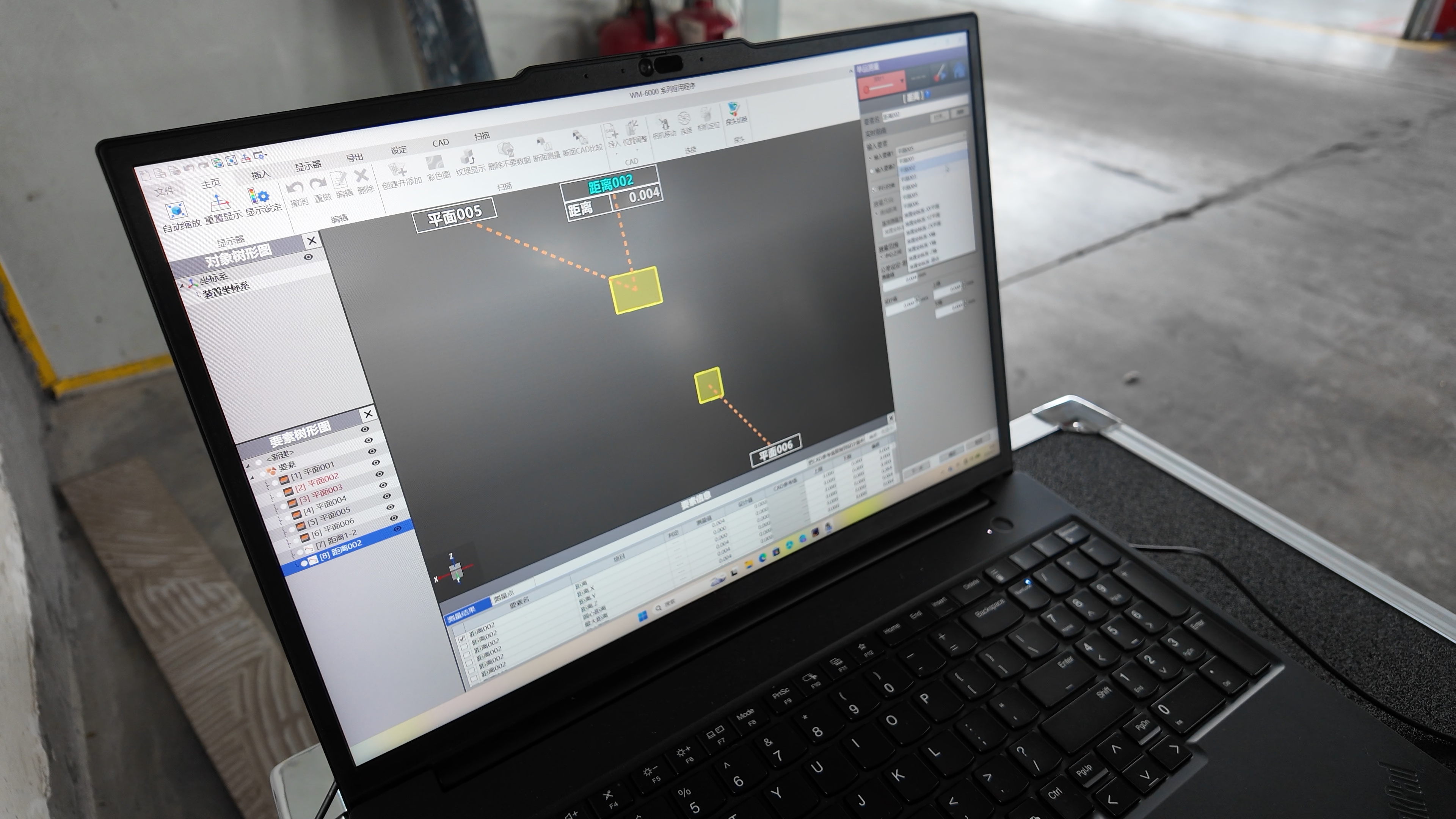
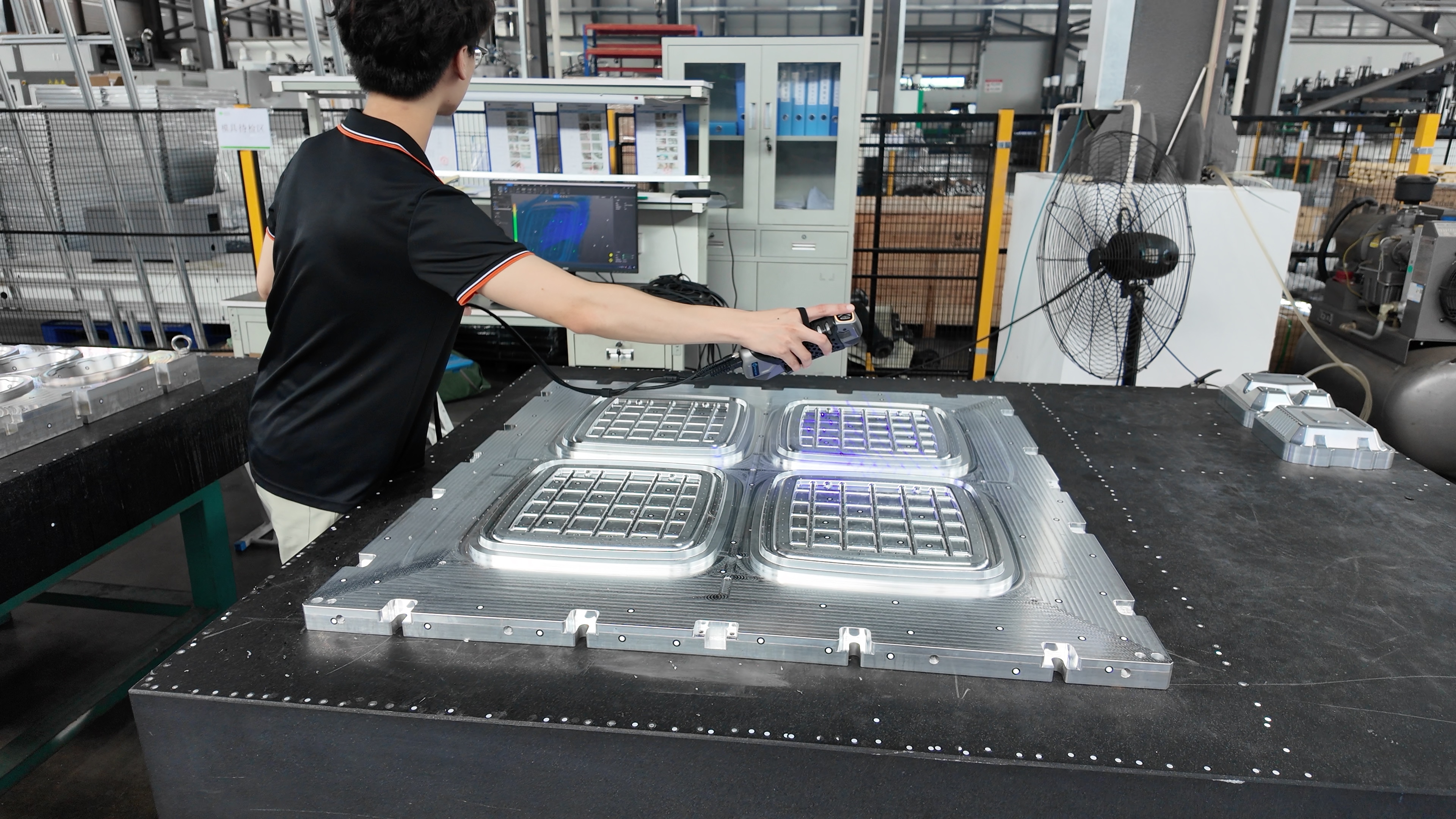
Before shipment, 100% inspection covers incoming material, welding and frame structure, dimensional and installation-surface checks, portable coordinate measuring inspection, and electrical, hydraulic and pneumatic system testing, with the Factory Acceptance Test available for customer attendance or remote review through videos, photographs, test records and online meetings. After delivery, validation continues on site through installation and commissioning, operator and maintenance training, multi-system commissioning, utility connection and process coordination. Turnkey projects can be supported with up to six months of on-site production assistance, plus spare parts supply, preventive maintenance, mold and product development support, production-line optimization and 24/7 service response.
What is the lead time, and how should a project start?
Lead time is approximately 60 days for standard equipment; customized production lines depend on equipment configuration and project scope. The practical starting point is the model-against-certificate check combined with the module document checklist described above. To begin, Hanson can review your product, destination market and target capacity, and provide a sample or a quotation based on the confirmed scope. Contact: Castle, linchuangcheng@hspulpmolding.com, Tel / WhatsApp +86 159-2060-4830. The full company and equipment brochure is available here: Hanson Pulp Molding brochure (PDF).
Conclusion
Compliance on a pulp molding line is a scope exercise with three checks: confirm that the exact machine model appears on the certificate list for the destination market, confirm that every one of the 6+1 modules has its own document, and confirm that the capacity and energy basis behind each quoted figure is written down and signed. A fourth check sits behind all three — someone must own the interface, because a deviation discovered during ramp-up has to be traced back to the mold, the equipment, the raw material or the process.
Hanson Pulp Molding Technology Co., Ltd is a molded fiber equipment manufacturer and National High-tech Enterprise established in 2022 in Houjie Town, Dongguan City, Guangdong Province, China, operating a 50,000 m² facility with more than 200 employees, approximately 50 R&D and engineering professionals, 50 patents and 10 service locations. The company manufactures forming equipment and downstream automation, designs and integrates its own pulp preparation systems, and operates an independent mold division covering mold design, manufacturing, testing and mass-production adaptation — the combination that keeps mold, equipment, pulp and process evidence inside one responsibility boundary, with a service network, installation and commissioning teams, and technical support reachable at www.hspulpmolding.com.
Next Step: Turn the Compliance Scope into a Signed Document Set
Send your destination market, target product and expected capacity. Hanson will return a model-to-certificate check, a module-by-module document list and a capacity basis table for review — and, if useful, an equipment quotation or sample development plan.
Contact: Castle | Email: linchuangcheng@hspulpmolding.com | Tel / WhatsApp: +86 159-2060-4830
Company address: Room 101, No. 6, Lane 1, Fourth Industrial Zone, Qiaotou, Houjie Town, Dongguan City, Guangdong Province, China.
Download the brochure: Hanson Pulp Molding PDF brochure