
Pulp Molding Machine Cycle Matching: A Technical Guide to Downstream Automation Parameters
Cycle matching means sizing every downstream operation on a pulp molding production line - transfer, hot pressing, trimming, inspection, counting, stacking and packing - around the forming cycle that the pulp molding machine actually delivers for a specific product and mold. When cycles match, output is limited by the forming station. When they do not match, the line runs at the speed of its slowest station while paying for the utilities of its fastest one.
This guide is written for buyers and plant engineers who already understand what pulp molding does and now need to specify how a forming machine and its automation behave together in production. It uses published Hanson Pulp Molding equipment data as its reference set. HANSON PULP MOLDING TECHNOLOGY CO., LTD is a pulp molding equipment manufacturer based in Houjie Town, Dongguan City, Guangdong Province, China, operating a 50,000 sqm facility with more than 200 employees, approximately 50 R&D and engineering professionals, and an annual equipment output of 150 units.
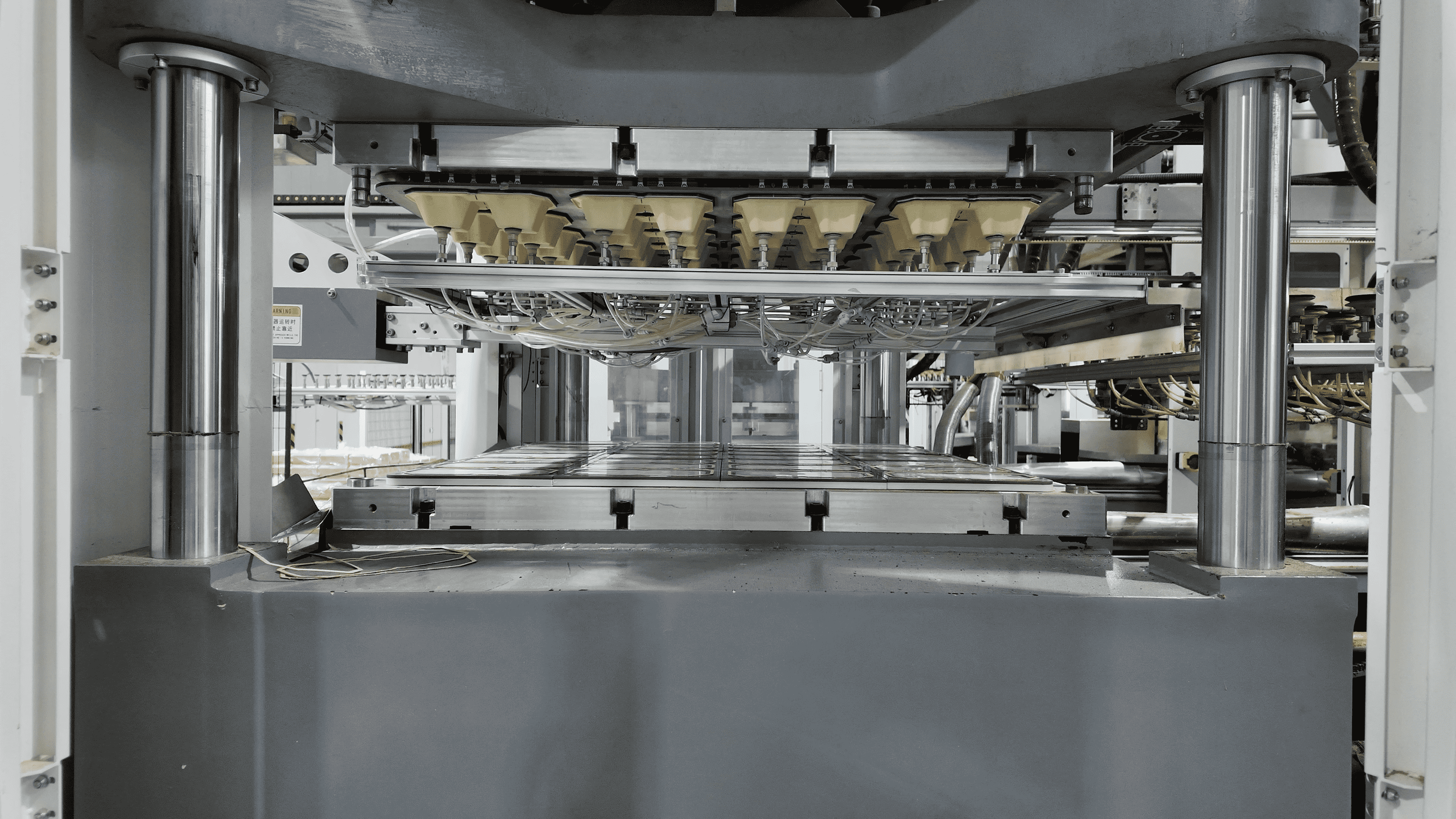
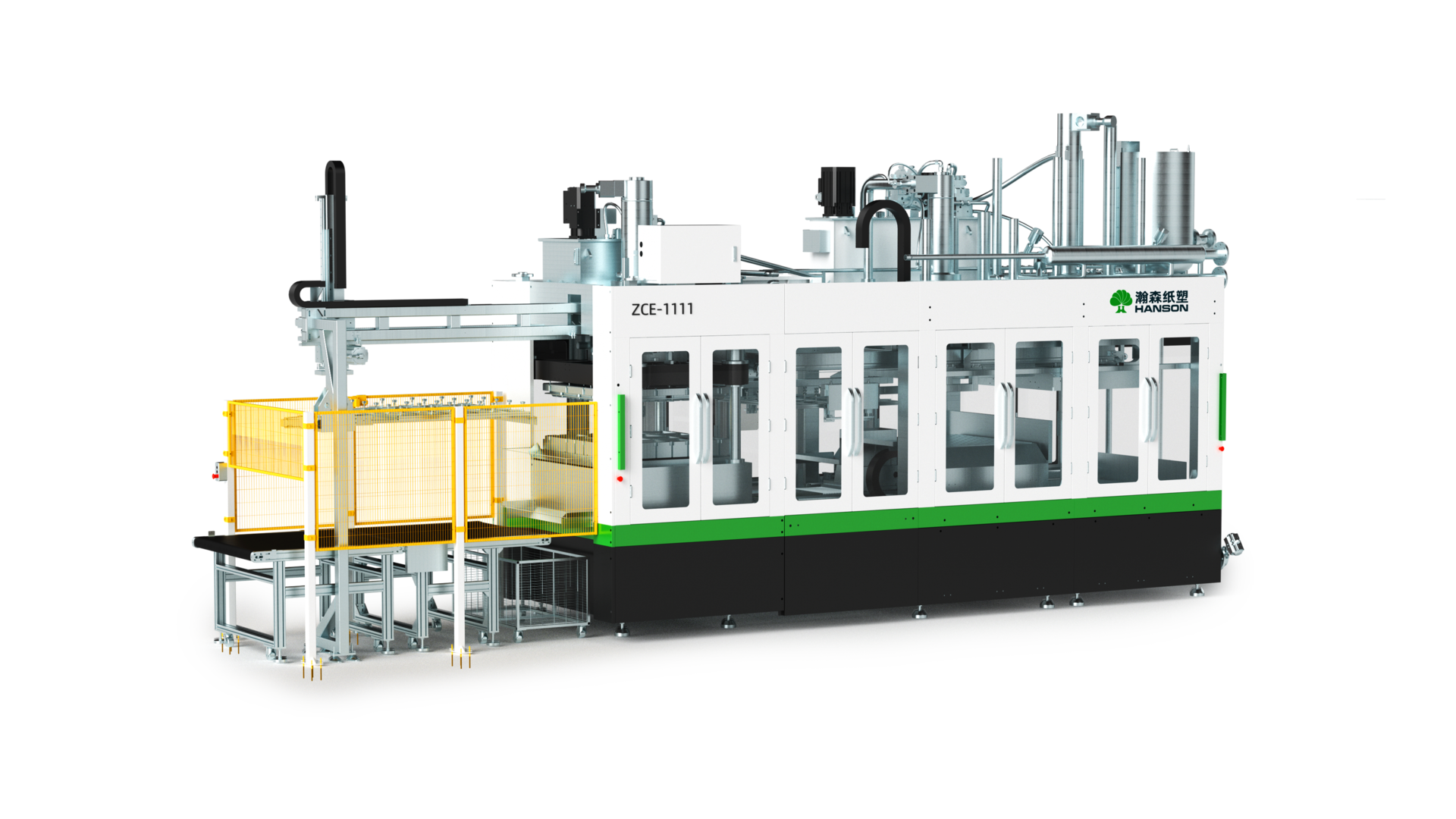
The single most useful rule in this guide: a forming cycle range such as 28-60 seconds per mold on the ZCE-1111 integrated pulp molding tableware machine is a window, not a fixed number. Downstream equipment must be selected against the slow end of that window, while vacuum, compressed air and water utilities must be sized against the fast end.
What Cycle Mismatch Actually Does to a Pulp Molding Line
Cycle mismatch rarely appears as a breakdown. It appears as a rhythm problem, and it usually shows up in five forms.
- Wet preform waiting time. If the transfer unit or hot-pressing station cannot accept the wet preform when the forming cycle completes, the preform waits. Continuous slurry feeding and aeration exist to keep wet-preform weight consistent, and idle time works against that consistency.
- Compromised hot-press dwell. A hot-pressing station that is asked to shorten its dwell to catch up will not deliver the same surface quality and dimensional stability as one running its designed dwell.
- Trimming backlog. Trimming is a separate mechanical operation with its own pressure and time. On the ZAKS-9595 molded fiber cup lid production line, the trimming cycle is 10 seconds per mold. If the forming cycle is faster than the trimming station is fed, trimmed edges begin to vary.
- Buffer and stacking overflow. Maximum stacking height on the reference Hanson machines is 200 mm including product height. If the automatic packing station is slower than the stacking unit, the buffer fills and indexing upstream stops.
- Utility starvation. Vacuum, compressed air and mold-cleaning water are shared across stations. A line that accelerates one station without re-checking the vacuum and air envelope will show unstable forming even though no component has failed.
Industry Background: Why Cycle Matching Became a Procurement Question
Pulp molding capacity is expanding in the segments where packaging formats are most standardized - plates, bowls, trays and cup lids. Food and beverage packaging accounts for approximately 45% of global pulp moulding machine demand, with cup, tray and bowl formats leading, according to the Cloud Market Reports pulp moulding machines market report (2025). That concentration means buyers are comparing machines on throughput per shift rather than on concept.
The same report values the global pulp moulding machines market at USD 2,140.0 million in 2024, projected to reach USD 3,760.2 million by 2032. Buyers should note that published market figures vary widely by definition: some reports include all paper-making machinery rather than molding equipment specifically, which inflates the totals. China exported USD 49.58 million of machinery for making paper or paperboard under HS code 843920 in 2024, according to World Integrated Trade Solution data.
What this means practically: equipment is being bought in larger blocks, lines are specified as complete production systems, and the forming cycle is now a contract-level specification rather than a shop-floor detail.
Cycle Architecture: How Three Tableware Solutions Split the Cycle Differently
The same forming cycle can be delivered through very different station layouts. Three Hanson configurations illustrate the point.
ZFG-1111 - full-servo inline tableware production line
The ZFG-1111 is a fully automatic inline full-servo pulp molding tableware production line rated at 900-1,200 kg/24 h depending on product. It is built as one forming station plus one hot-pressing station plus one trimming station plus a transfer and stacking unit, with hot-pressing pressure of 120 tons and trimming pressure of 80 tons. Slurry is supplied by continuous internal-circulation feeding. The inline layout is approximately 2.15 m wide, and the machine is controlled by a PLC and touchscreen. Installed power is 102 kW with electric heating or 39 kW with oil heating. Compressed air is 0.6-0.8 MPa, vacuum is -0.06 to -0.05 MPa, and mold-cleaning water is supplied at 1.2 MPa.
For cycle matching, the important consequence is that forming, hot pressing and trimming are serial but each has its own actuator. The line absorbs product changes by re-timing three stations, not by re-timing one.
ZCE-1111 - integrated pulp molding tableware machine
The ZCE-1111 is a fully automatic integrated pulp molding tableware machine that completes forming, hot pressing, trimming, counting and stacking in a single unit using in-mold transfer. Its declared forming cycle is 28-60 seconds per mold depending on product, and its production capacity is 600-900 kg/24 h depending on product. It uses a 1,100 x 1,100 mm mold platen, only six molds, forming pressure of 20 tons, hot-pressing pressure of 60 tons and trimming pressure of 70 tons. Slurry is delivered by quantitative slurry injection, which reduces product weight variation and avoids the contamination risk associated with conventional slurry-return circulation. Rated power is 167.4 kW with a 132 kW heating plate.
Because there is no inter-station transfer outside the machine, the ZCE-1111 has fewer cycle interfaces to balance - but the internal sequence is fixed, so the product must fit the 80 mm maximum product height and 550 g maximum product weight per mold.
ZBG-1111 - robotic full-servo tableware line
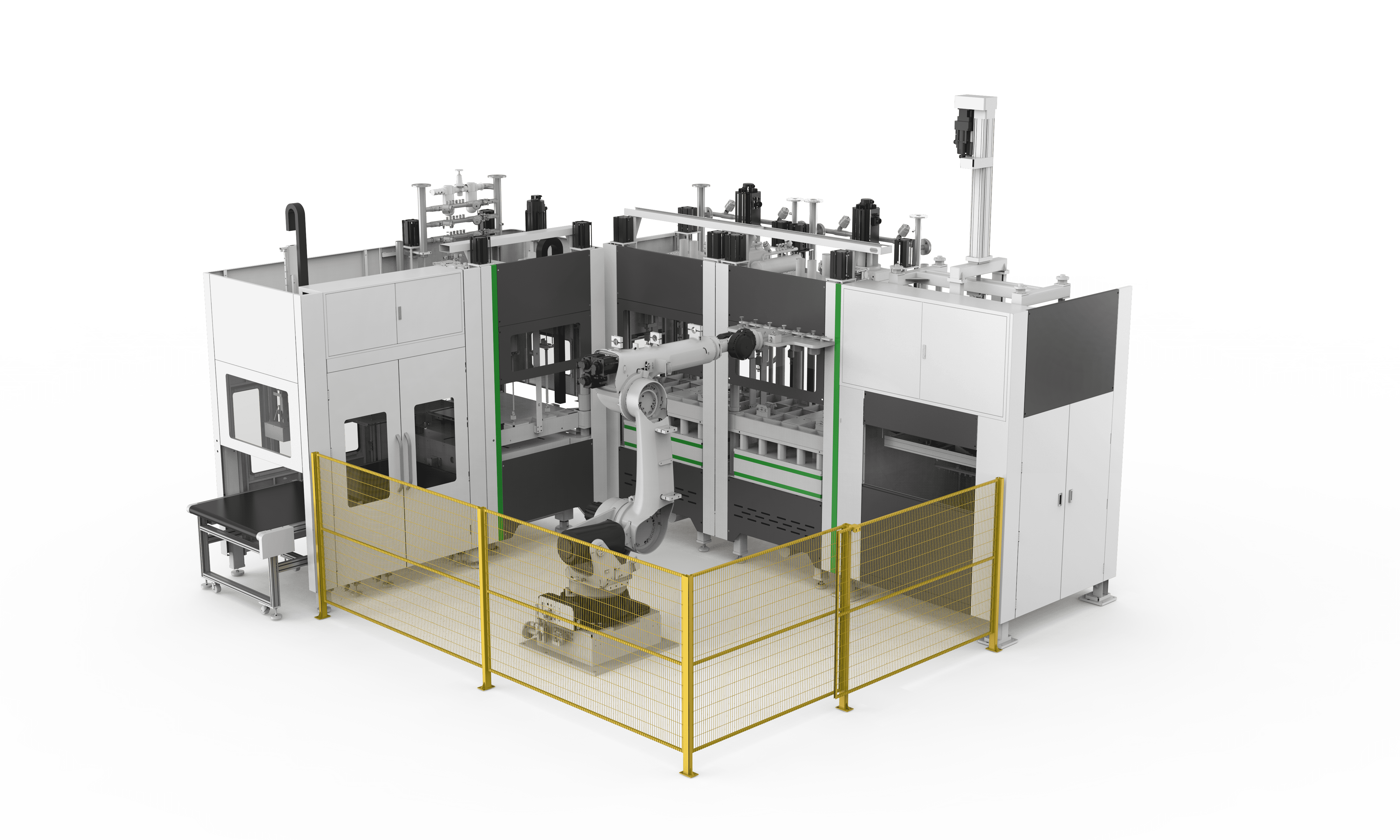
The ZBG-1111 is a fully automatic robotic pulp molding tableware production line arranged as one forming station, two hot-pressing stations and one trimming station. A six-axis robot performs the transfer, with 2,700 mm reach and a 300 kg maximum payload; a linear transfer robot handles stacking. Hot-pressing pressure is 80 tons and trimming pressure is 80 tons. Production capacity is 1,000-1,500 kg/24 h depending on product, with rated power of 60 kW and oil, electric or steam heating options.
The two parallel hot-pressing stations are the clearest example of deliberate cycle de-coupling: the forming station feeds a shared hot-pressing resource, so forming cycle and hot-press dwell no longer have to be identical.
Downstream Automation Parameters That Must Match the Forming Cycle
Cycle matching is not only about time. It is also about the utility envelope that every downstream station draws from. The table below lists the parameters that Hanson reference machines declare, because these are the numbers that downstream automation has to be designed around.
| Parameter | Reference values | Cycle implication |
|---|---|---|
| Compressed air | 0.5-0.6 MPa (ZAKS-9595); 0.5-0.7 MPa (ZAD-8565, ZAP-9585, ZCE-1111, ZBG-1111); 0.6-0.8 MPa (ZFG-1111) | Air-actuated transfer and rejection devices must be specified at the machine pressure, not at plant pressure |
| Vacuum | -0.06 to -0.05 MPa (tableware machines); -0.07 to -0.05 MPa (ZAKS-9595, ZAD-8565, ZAP-9585) | Vacuum must be available at the moment the forming cycle starts, not accumulated during it |
| High-pressure mold-cleaning water | 1.2 MPa across the reference range | Cleaning is scheduled between cycles; insufficient pressure extends changeover and breaks rhythm |
| Cooling water | 60-80 L/min (ZAD-8565); 80-100 L/min (ZAP-9585, ZAKS-9595) | Cooling capacity scales with stations and hours per day, not with machine count alone |
| Power supply | AC 380 V / 50 Hz across the reference range | Voltage and frequency are specified per project, including heating method |
| Stacking height | Maximum 200 mm including product height | Defines the physical buffer between stacking and packing |
| Trimming cycle | 10 seconds per mold at 50 tons trimming pressure (ZAKS-9595) | Trimming is a separate clock and must be fed at a rate it can hold |
| Vision inspection accuracy | 0.5 mm (ZAKS-9595) | Inspection and rejection add time to the line; they are not free capacity |
Trimming, inspection and packing as cycle consumers
The cup lid line is the clearest illustration of downstream automation parameters. The ZAKS-9595 fully automatic molded fiber cup lid production line integrates forming, hot pressing, servo trimming, multi-camera vision inspection, automatic rejection, counting and automatic packaging. Forming pressure is 10 tons, hot-pressing pressure 40 tons, trimming pressure 50 tons and trimming cycle 10 seconds per mold. It supports lid sizes of 80 mm and 90 mm, a maximum packaging length of 400 mm, and forms with an installed power of 126.45 kW including 48 kW heating, with separate modules of 10.5 kW for trimming, 3 kW for vision and 2 kW for packaging.
Those module figures matter to cycle matching because they show how installed load is distributed across the line. A buyer who matches only the forming machine and then adds inspection and packing downstream may find the building electrical capacity is the real constraint.
Step-by-Step: Matching a Forming Cycle to Downstream Automation
- Fix the product and the mold before the machine. Product height (up to 80 mm on the 1,100 x 1,100 mm tableware platforms), product weight per mold (up to 550 g on the tableware machines) and mold count determine the achievable cycle. Only then does the declared cycle window become meaningful.
- Read the cycle window, not the headline number. Treat 28-60 seconds per mold as the operating band for the ZCE-1111 and treat 900-1,200 kg/24 h as the capacity band for the ZFG-1111. Both are product-dependent.
- Convert everything into one unit. Downstream stations should be evaluated in the same unit as the forming station - molds per hour, product per hour or kg per 24 h. Mixing unit systems is the most common cause of a mis-specified line.
- Find the slowest station and treat it as the line rate. On a full-servo inline line this is usually trimming; on a cup lid line it is trimming plus inspection; on an integrated machine the internal sequence is fixed and the limit is the machine itself.
- Check the utility envelope at the fast end. Vacuum, compressed air, mold-cleaning water and cooling water must be available at the rates in the table above, and at the declared pressures, at the instant the cycle needs them.
- Validate with a sample before committing the plant. A sampling line produces real cycle data, real weight variation and real trimming behaviour from the buyer's own fiber - which is the only reliable way to close the matching calculation.
Integrated Process Design: Pulping, Vacuum, Air, Heating, Water and Rhythm
Cycle matching sits inside a larger integration problem. Pulp preparation, forming, utilities and downstream automation each have their own timing, and turnkey projects succeed when those timings are designed together rather than assembled from separate purchase orders.
- Pulping and slurry preparation. The ZAMS-6047 sampling line integrates pulping, refining, slurry preparation, slurry feeding, forming and hot pressing in one machine, which makes it the natural starting point for rhythm trials. On production machines, feeding strategy changes the cycle: quantitative slurry injection on the ZCE-1111, continuous internal-circulation feeding on the ZFG-1111, and quantitative feeding on the ZBG-1111 all produce different wet-preform behaviour.
- Vacuum and compressed air. These two utilities define whether the cycle can actually run at its fast end. They are listed across Hanson production equipment at -0.07 to -0.05 MPa and 0.5-0.8 MPa respectively, and they are always supplied as part of matched equipment sets.
- Heating method. Heating choice changes the electrical profile more than any other single decision: the ZFG-1111 draws 102 kW with electric heating but 39 kW with oil heating, while the ZBG-1111 offers oil, electric or steam heating at 60 kW rated power. Matching a cycle to a site sometimes means matching it to the available utility, not the other way round.
- Water circulation. Mold-cleaning water at 1.2 MPa and cooling water at 60-100 L/min depending on model are part of the equipment scope, together with water treatment systems on turnkey projects.
- Production rhythm and control. PLC and touchscreen control, plus DCS/MCC control systems and digital energy management on larger projects, are what convert a set of matched stations into a stable rhythm. Remote technical support and remote diagnostics allow cycle parameters to be reviewed during ramp-up without waiting for a site visit.
Hanson supplies these as a turnkey pulp molding plant scope when the project requires it: preliminary product and raw-material verification, feasibility analysis, production-capacity planning, factory layout design, intelligent pulp preparation systems, forming equipment, mold design and manufacturing, downstream automation, electrical control, installation and commissioning, training and production ramp-up support.
Comparison Table: Reference Configurations and Their Cycle Envelope
| Model | Station layout | Declared capacity | Cycle-relevant pressure | Integrated downstream functions | Installed power |
|---|---|---|---|---|---|
| ZFG-1111 | Inline full-servo: 1 forming + 1 hot pressing + 1 trimming + transfer and stacking unit | 900-1,200 kg/24 h | 120 t hot pressing; 80 t trimming | Trimming and stacking integrated | 102 kW electric heating / 39 kW oil heating |
| ZBG-1111 | Robotic full-servo: 1 forming + 2 hot pressing + 1 trimming | 1,000-1,500 kg/24 h | 80 t hot pressing; 80 t trimming | Six-axis robot transfer (2,700 mm reach, 300 kg payload); linear robot stacking | 60 kW |
| ZCE-1111 | Integrated single unit: forming + hot pressing + trimming + counting + stacking | 600-900 kg/24 h; forming cycle 28-60 s per mold | 20 t forming; 60 t hot pressing; 70 t trimming | Trimming, counting and stacking in one machine; in-mold transfer | 167.4 kW (132 kW heating plate) |
| ZAKS-9595 | Cup lid line: forming + hot pressing + trimming + vision + packing | Not stated as kg/24 h; trimming cycle 10 s per mold | 10 t forming; 40 t hot pressing; 50 t trimming | Vision inspection at 0.5 mm, automatic rejection, counting and packing for 80 mm and 90 mm lids | 126.45 kW forming module + 10.5 kW trimming + 3 kW vision + 2 kW packing |
| ZAD-8565 | Compact integrated industrial packaging machine | Not stated; 850 x 650 mm platen | 3 t forming (servo electric cylinder); 20 t hot pressing (servo hydraulic) | Forming and hot pressing integrated; downstream finishing per project | 54.1 kW (45 kW heating) |
| ZAMS-6047 | Sampling line: pulping + refining + slurry preparation + feeding + forming + hot pressing | Prototyping and small-batch; 600 x 470 mm platen | 2 t forming (electric cylinder); 13 t hot pressing (hydraulic) | Trimming not included; optional trimming, punching, vision and packing | 82 kW (26.4 kW heating) |
Use Cases: How Buyers Have Resolved Cycle Interfaces
Home-Link (Thailand). A listed manufacturer of biodegradable tableware and sustainable consumer products ran a four-month intensive equipment test covering stability, production capacity and product quality before selecting Hanson as a core equipment supplier. More than 100 machines were purchased for the first phase of the Thailand production base, supplied with factory-level support covering pulp preparation, forming equipment and mold development, plus a dedicated after-sales service point and 7x24-hour response.
Provincial key project, plant-fiber cup lids. A manufacturer of biodegradable plant-fiber packaging placed a strategic order covering 100 cup lid machines. The solution used customized equipment for high-precision cup lid production with integrated forming, hot pressing, trimming, vision inspection and packing, digital energy management and modular mold design.
Guangxi Qiaowang. For a 40,000-ton-per-year molded fiber tableware and industrial packaging project, Hanson delivered 32 customized core production machines adapted to large-scale bagasse pulp production. After commissioning, annual production capacity increased from approximately 6,000 tons to 16,000 tons.
Gaoyi Packaging (Vietnam). Cooperation began with a single trial machine. Following stable equipment performance and responsive technical service, the customer purchased a total of 80 industrial packaging machines, moving Hanson from alternative supplier to core equipment partner.
Hunan Linggao New Materials. A turnkey bamboo-fiber molded pulp packaging project integrated factory planning, pulping, forming equipment, wastewater treatment and personnel training. The project progressed from equipment installation to trial production in approximately three months using locally available bamboo fiber.
Sampling-stage validation. GMN uses a ZAMS-6047 pulp molding sampling production line as an integrated testing platform for nanocellulose additive development, evaluating formulations, comparing process parameters and producing molded fiber samples. YUTO Packaging uses sampling equipment for molded fiber packaging development and prototype verification.
Compliance Constraints That Travel With the Cycle
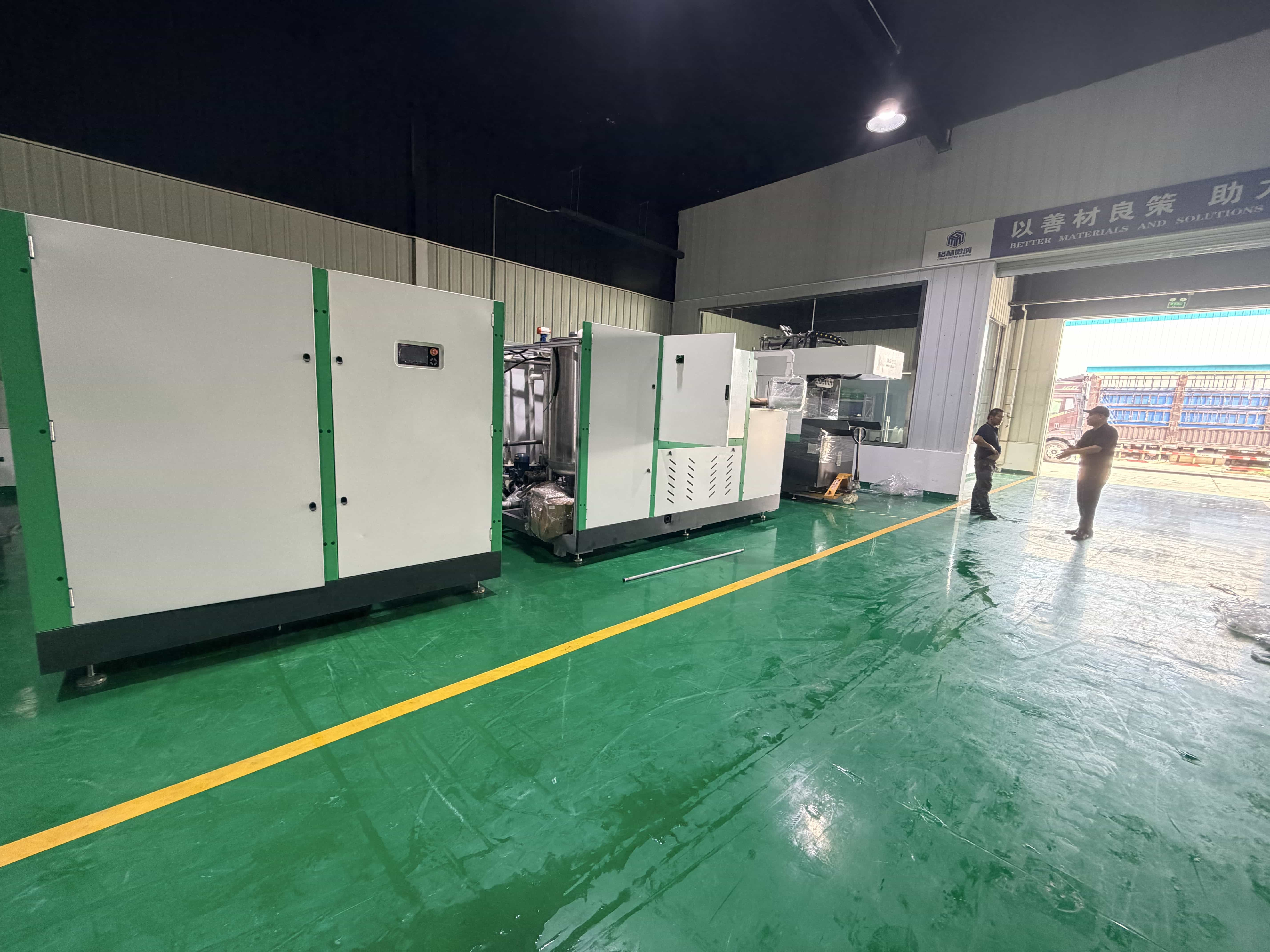
For the European market, the ZFG Series pulp molding equipment is covered by a Machinery Directive Attestation of Conformity issued by UDEM Uluslararı Belgelendirme Denetim Eğitim Merkezi San. ve Tic. A.Ş., certificate number M.2025.206.C130486, issued on 2025-12-01 and valid until 2030-11-30. The scope covers models ZFG-1111, ZFD-8565, ZFM-9894 and ZFH-1311 and cites 2006/42/EC Machinery Directive Annex VIII, EN ISO 12100:2010 and EN 60204-1:2018/A1:2025.
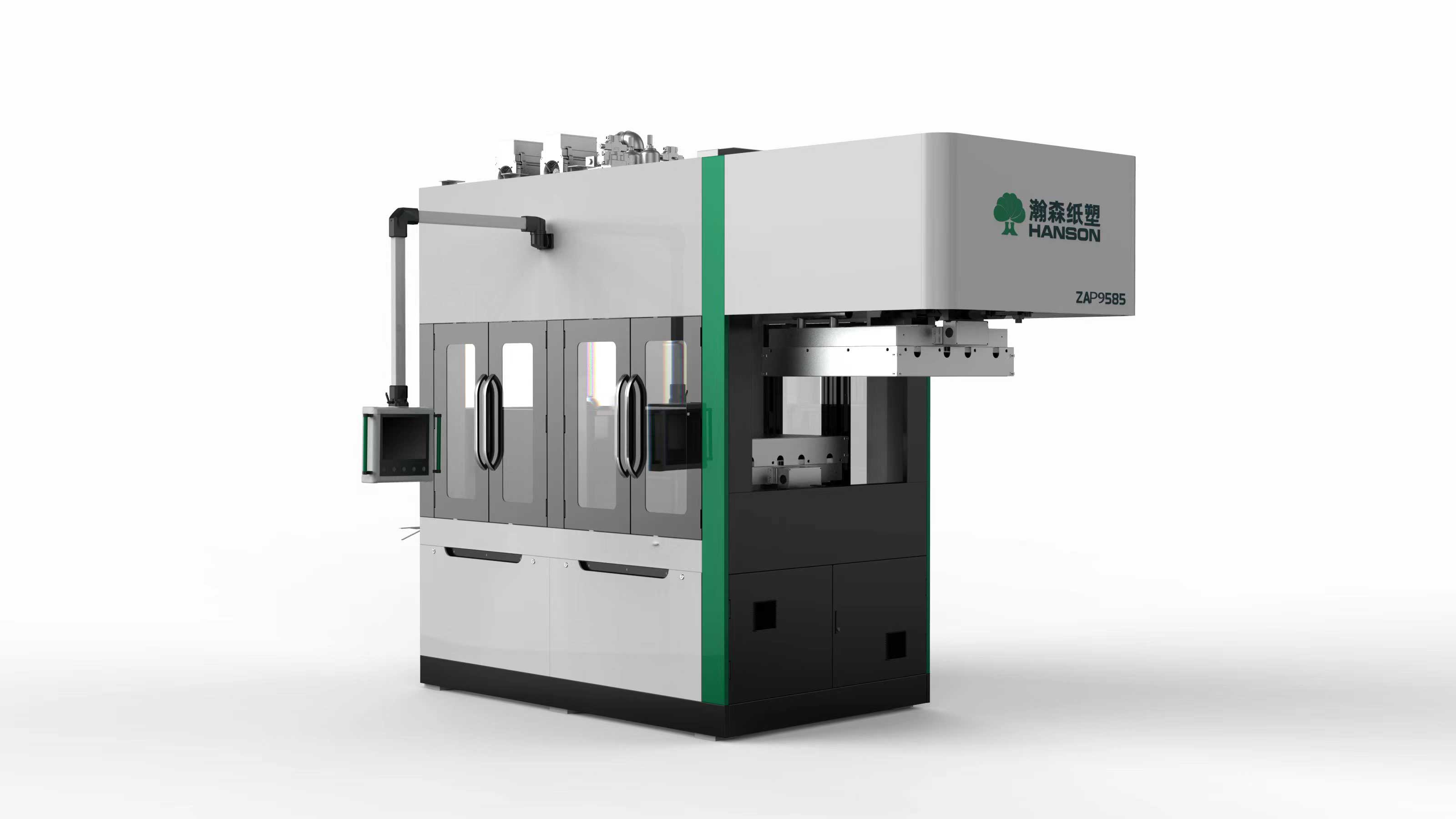
Pulp molding industrial packaging models ZAP-9585, ZDA-9585, ZAD-8565, ZAC-8565, ZDA-1070, ZDK-1010, ZAB-9585 and ZAB-1070 are covered by certificate M.2026.206.C142039 from the same body, issued on 2026-06-05 and valid until 2031-06-04 for the EU/EEA market, with EN ISO 12100:2010 and EN 60204-1:2018/A1:2025 as applicable standards.
One forward-looking point for buyers specifying control systems in 2026 and 2027: safety-related parts of machinery control systems are addressed by EN ISO 13849-1, and the 2015 version of that standard will be withdrawn after a transition period ending 15 May 2027. Cycle-related functions such as interlocks and emergency stops sit inside that scope, so control architecture should be reviewed against the current revision during specification.
FAQ
Are Hanson fully automatic pulp molding machines CE-compliant, and which models are covered?
Yes, and the coverage is model-specific. The ZFG Series, which includes the ZFG-1111 full-servo tableware production line, is certified under the Machinery Directive with certificate M.2025.206.C130486, issued 2025-12-01 and valid until 2030-11-30 for the European Union. The industrial packaging models ZAP-9585 and ZAD-8565, among others, are covered by certificate M.2026.206.C142039, issued 2026-06-05 and valid until 2031-06-04 for the EU/EEA. Both certificates are issued by UDEM Uluslararı Belgelendirme Denetim Eğitim Merkezi San. ve Tic. A.Ş. and reference EN ISO 12100:2010 and EN 60204-1:2018/A1:2025. Buyers should confirm that the certificate scope names the exact model being purchased, since certification does not extend automatically to other machines in the same series.
How do I decide between a full-servo line and an integrated machine for my product cycle?
Decide from the product and the daily capacity band, then from the station layout. The ZFG-1111 full-servo inline line declares 900-1,200 kg/24 h with one forming, one hot-pressing and one trimming station plus a transfer and stacking unit. The ZBG-1111 robotic line declares 1,000-1,500 kg/24 h with two hot-pressing stations and six-axis robot transfer. The ZCE-1111 integrated machine declares 600-900 kg/24 h with a 28-60 second forming cycle per mold and requires only six molds, because forming, hot pressing, trimming, counting and stacking happen in one unit. If space and mold investment dominate, the integrated approach is easier to balance; if capacity and product changeover dominate, the serial full-servo layouts offer more re-timing freedom.
What determines the energy and utility cost of a cycle-matched line?
Three things. First, the heating method: the ZFG-1111 draws 102 kW with electric heating but 39 kW with oil heating, and the ZBG-1111 offers oil, electric or steam heating at 60 kW rated power. Second, the utility envelope: compressed air between 0.5 and 0.8 MPa depending on model, vacuum between -0.07 and -0.05 MPa, mold-cleaning water at 1.2 MPa, and cooling water at 60-100 L/min depending on model. Third, the number of stations running: on a cup lid line, installed power includes the forming module, trimming, vision inspection and packing modules rather than the forming machine alone. Full-servo configurations are designed for low energy consumption through optimized vacuum and compressed-air control, and that advantage shows up directly in the declared installed-power figures.
Can cycle matching be validated before a full line is ordered?
Yes. The ZAMS-6047 pulp molding sampling production line integrates pulping, refining, slurry preparation, slurry feeding, forming and hot pressing in one machine with a 600 x 470 mm mold platen, 2 ton forming pressure and 13 ton hot-pressing pressure, and it does not include trimming. It is used for material testing, product prototyping, mold verification, process development and small-batch production. GMN uses one for nanocellulose additive evaluation, and YUTO Packaging uses sampling equipment for molded fiber packaging development. Buyers with a full-line decision in front of them, such as Home-Link, have also run multi-month equipment tests before committing to volume orders.
What is the delivery and support timeline for a cycle-matched line?
Standard equipment lead time is approximately 60 days, while customized production lines depend on the equipment configuration and project scope. Minimum order quantity is 1 unit, and every machine undergoes 100% inspection before delivery, including incoming material inspection, frame and welding inspection, dimensional and installation-surface checks, portable coordinate measuring inspection, and electrical, hydraulic and pneumatic system testing. Hanson operates 10 service locations covering key domestic and overseas markets, and turnkey projects can be supported with up to six months of on-site production assistance, with 24/7 service response and remote technical support.
Conclusion: Match the Cycle Before You Match the Price
Cycle matching is a specification exercise, not a troubleshooting exercise. The forming cycle window - 28-60 seconds per mold on the ZCE-1111, or 900-1,200 kg/24 h on the ZFG-1111 - is only useful once the downstream trimming, inspection, stacking and packing stations, and the vacuum, compressed air, cooling water and electrical envelope that feed them, are sized against it. Buyers who complete that work before placing an order avoid the five classic mismatch symptoms: waiting wet preforms, compromised hot-press dwell, trimming backlog, stacking overflow and utility starvation.
Next step: validate your cycle on real fiber
Request a sample run or a line configuration proposal from HANSON PULP MOLDING. Send your product drawing, target daily output and available utilities, and the engineering team can return a matched forming-and-automation configuration with cycle, capacity and utility data.
Website: www.hspulpmolding.com | Email: linchuangcheng@hspulpmolding.com | Tel / WhatsApp: +86 159-2060-4830
Contact: Castle | Address: Room 101, No. 6, Lane 1, Fourth Industrial Zone, Qiaotou, Houjie Town, Dongguan City, Guangdong Province
Download the full equipment brochure: Hanson Pulp Molding equipment catalog (PDF)
Have Questions or Need More Details?
Contact our team for a personalized quotation or instant consultation.
Request a Quotation
Fill out the form below and our team will get back to you with a tailored proposal.
WhatsApp Direct Chat
Prefer to chat in real-time? Message us on WhatsApp for instant assistance & quick answers.
- Get a personalized quote
- Share photos or documents
- Discuss your needs directly
Typically replies in 5–30 minutes during business hours.