
Turnkey vs. Separate Pulp Molding Equipment for New & Overseas Plants
Turnkey vs. Separate Pulp Molding Equipment for New & Overseas Plants
A new pulp molding factory rarely fails because the forming machine cannot form a product. It usually fails because pulping, vacuum, compressed air, heating, water circulation and production rhythm were never designed to run as one system. That is the practical difference between a turnkey pulp molding plant and a line assembled from separate equipment purchases.
The short answer: turnkey delivery fits when the buyer is building a new plant, has no in-house pulp molding engineering team, or is running an overseas project where the local utility baseline differs from the equipment specification. Separate equipment procurement fits when the buyer already operates pulp molding lines, has an engineering department that can own cross-system interfaces, or is upgrading one section of an existing factory. The rest of this guide explains how to tell those two situations apart before the purchase order is signed.
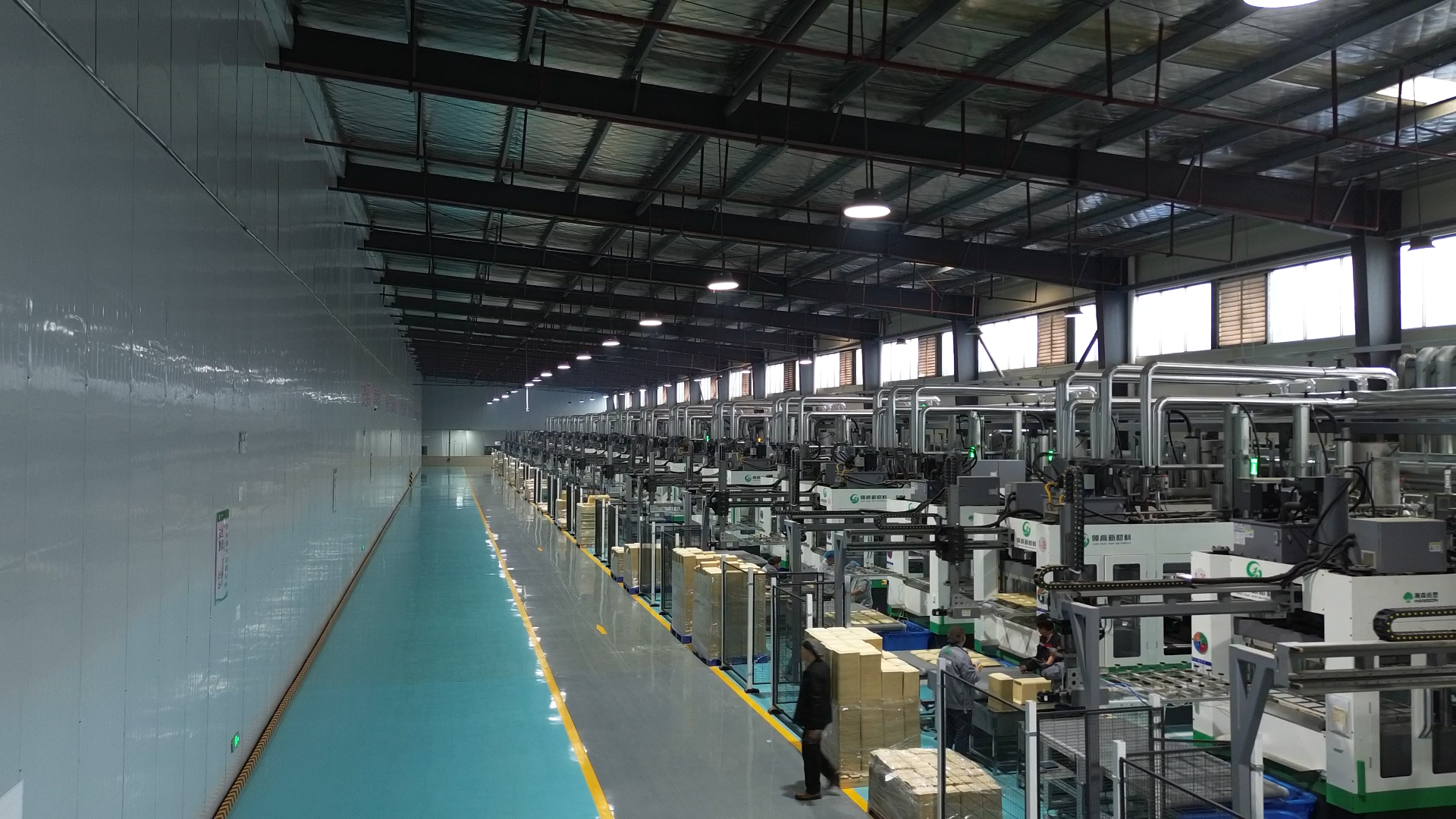
A turnkey pulp molding plant is commissioned as one production system — pulping, forming, hot pressing, trimming and utilities — rather than as a set of separate machines.
Problem Definition: Where New Pulp Molding Projects Actually Break
Turnkey procurement means one supplier takes responsibility for a production system rather than for a list of machines. In a turnkey pulp molding plant, that responsibility extends from product and raw-material verification through factory layout, pulp preparation, forming, molds, downstream automation and electrical control, and continues past installation and commissioning into production ramp-up.
Separate equipment procurement means the buyer contracts machines and modules from several suppliers — a pulping unit from one, a forming machine from another, trimming and packaging equipment from others — and then integrates them internally or through a third-party engineering firm.
Both models can produce the same product. The difference appears at the interfaces.
A pulp molding line is not one process. Forming depends on slurry concentration, vacuum level and compressed-air pressure. Hot pressing depends on heating capacity and mold temperature control. Trimming accuracy depends on the dimensional stability of the preform leaving the press. Water circulation and wastewater treatment determine whether process water stays clean enough to keep product weight consistent. If each of those is specified by a different party, the mismatch is not detected on paper — it is detected during commissioning, when the line is already installed and the factory schedule is already committed.
Decision rule: if the buyer cannot name the person inside their own organisation who owns vacuum, compressed air, heating, water circulation and production rhythm as one engineering problem, turnkey scope is the lower-risk structure.
Industry Background: Why Turnkey Scope Is Growing
The global pulp moulding machines market was valued at USD 2,140.0 million in 2024 and is projected to reach USD 3,760.2 million by 2032, expanding at a CAGR of 7.3% between 2025 and 2032. Market estimates should be read carefully, because research providers that include broader paper-making machinery categories report materially different totals — the definition of "pulp molding machine" is not consistent across reports.
Demand is also not evenly distributed. Food and beverage packaging accounts for approximately 45% of global demand for pulp moulding machines, with cup, tray and bowl formats leading. That concentration explains why so much new capacity is being built around tableware and cup lid production — the applications behind machines such as the ZCE-1111 fully automatic integrated pulp molding tableware machine and the ZAKS-9595 fully automatic pulp molding cup lid production line.
The supply side is concentrated too. China's exports of machinery for making paper or paperboard (HS 843920) were valued at USD 49.58 million in 2024, which means a large share of new pulp molding projects are sourced internationally rather than from a local equipment base.
International sourcing is exactly what makes the turnkey-versus-separate decision harder for overseas projects. Forming equipment is normally specified at AC 380 V / 50 Hz, with compressed air at 0.5–0.7 MPa, vacuum at -0.07 to -0.05 MPa, high-pressure mold-cleaning water at 1.2 MPa and defined cooling-water flow rates. Those values do not simply match every destination market without a utility review. When buyer and supplier sit in different countries, the cost of discovering a utility mismatch during commissioning is far higher than the cost of planning for it during design.
Safety regulation adds a second constraint. Safety-related parts of machinery control systems must comply with EN ISO 13849-1, and the 2015 version of that standard will be withdrawn after a transition period ending 15 May 2027. For a new plant built to serve European customers or European-owned supply chains, the electrical control scope should be specified against the current standard from the beginning instead of retrofitted after installation.
The Detailed Solution: Hanson's 6+1 Turnkey Service Modules
HANSON PULP MOLDING TECHNOLOGY CO., LTD. is a Dongguan-based manufacturer of pulp molding equipment, production lines and turnkey factory solutions, established in 2022 and headquartered in Houjie Town, Dongguan, Guangdong, China. Its turnkey model is organised as six service modules plus one integration layer — the structure the company describes as 6+1.
| # | Module | What the module covers |
|---|---|---|
| 1 | Factory planning and capacity design | Preliminary product and raw-material verification, project feasibility analysis, production-capacity planning and factory layout design |
| 2 | Pulp preparation | Intelligent pulp preparation systems covering pulping, refining and slurry preparation upstream of forming |
| 3 | Forming equipment | Pulp molding forming equipment selected for the product type — tableware lines, industrial packaging machines, cup lid lines or sampling lines |
| 4 | Molds | Mold design and manufacturing through an independent mold division, including product development, mold testing and mass-production adaptation |
| 5 | Downstream automation | Trimming, vision inspection, automatic stacking and packing systems |
| 6 | Electrical control | Electrical control systems, installation and commissioning |
| +1 | Utilities, wastewater and production rhythm | One project team coordinating pulping, vacuum, compressed air, heating, water circulation, wastewater treatment and the production rhythm of the whole line |
The 6+1 turnkey structure: six delivery modules, integrated by one project team that also owns the utility and wastewater scope.
Modules 2 to 6 are where the buyer usually focuses attention, because they contain visible equipment. Pulp preparation determines slurry quality and therefore wet-preform weight consistency. Forming equipment determines the product envelope — for example, the ZAP-9585 large-format industrial packaging machine supports a 950 × 850 mm platen, a maximum product height of 120 mm and up to 900 g of product per mold at 0.3% slurry concentration, while the ZAD-8565 compact industrial packaging machine uses an 850 × 650 mm platen for smaller precision packaging and a smaller factory footprint.
Molds are treated as a module rather than an accessory. Hanson operates an independent mold division with capabilities in product development, mold design, mold manufacturing, mold testing and mass-production adaptation, and also provides optimisation services for existing molds and technical retrofits for existing equipment. By jointly optimising molds, equipment, pulp preparation and production processes, the company works on production capacity, product yield and production stability together instead of in sequence.
The "+1" is not a piece of equipment. It is the project team that owns the interaction between the six modules. In practice, the same engineering group that selects the forming machine also reviews whether the pulp preparation system can deliver slurry at the rate the forming cycle requires — 28 to 60 seconds per mold on the ZCE-1111 tableware integrated machine, depending on product — and whether vacuum and compressed air can hold pressure through a full shift.
Heating load is calculated the same way. The ZCE-1111 is rated at 167.4 kW with 132 kW of heating plate power; the ZAP-9585 is rated at 114 kW; the ZAKS-9595 forming module alone is 126.45 kW with 48 kW of heating power. A buyer who purchases the forming machine separately from the utility package may only discover the total electrical demand after the factory electrical design has already been finalised.
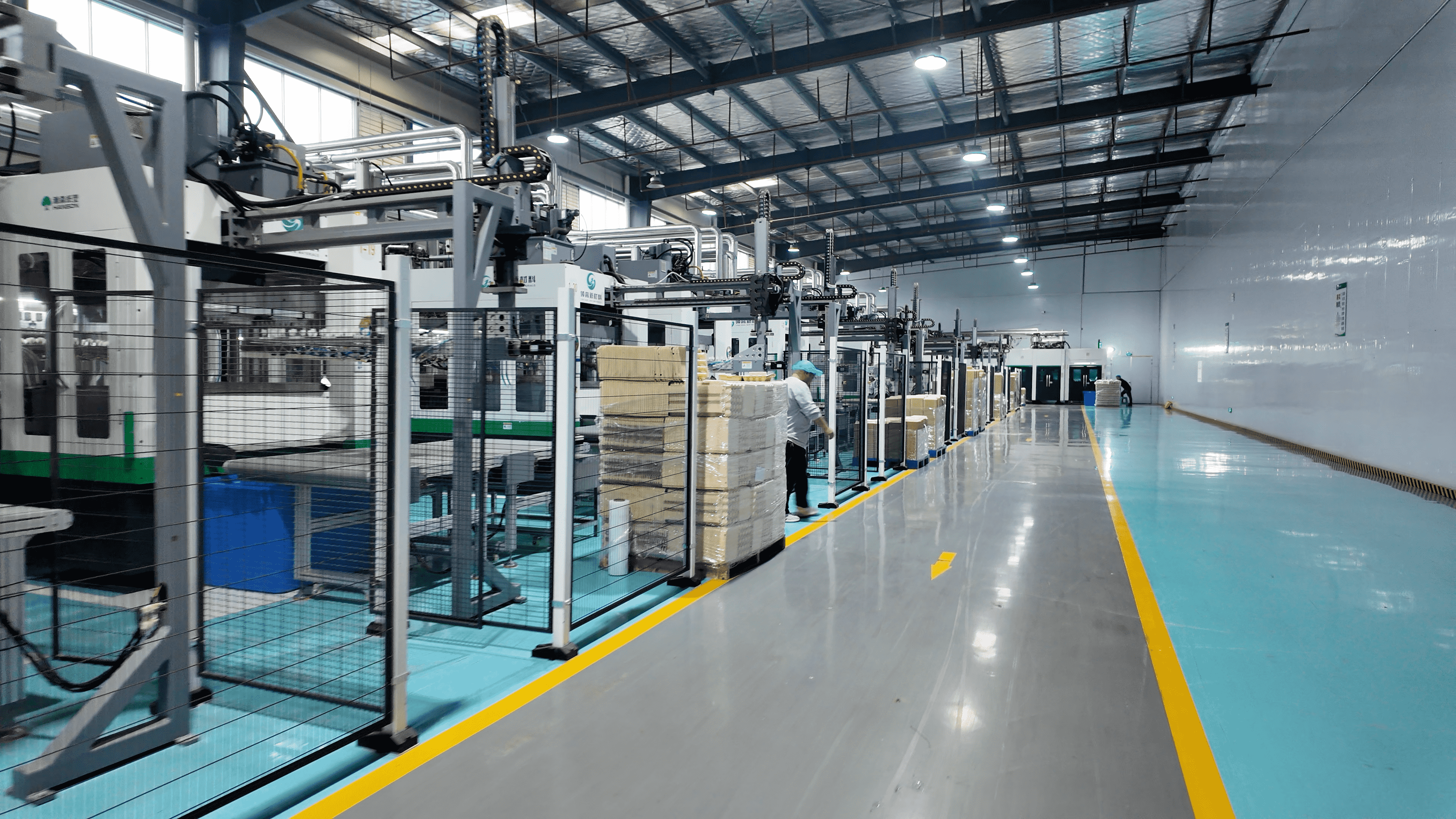
Pulp preparation, forming and downstream automation are planned against one production rhythm in a turnkey layout, rather than being specified line by line.
Step-by-Step Breakdown: How a Turnkey Pulp Molding Project Runs
Phase 1 — Product and raw-material verification
Before any layout decision, the product concept and the intended fiber raw material are verified. This determines whether the planned product can be formed, dried and trimmed at the required weight and surface quality. Buyers working with bamboo, bagasse or other agricultural fibers use this phase to confirm that the process conditions match the material rather than assuming that a machine specification alone settles the question.
Phase 2 — Capacity planning and factory layout
Target output is converted into machine count, cycle time and floor area. Layout then places pulp preparation, forming, hot pressing, trimming, packing and utilities in a sequence that minimises transfer distance and keeps clean and dirty water streams separated. For projects with limited floor space, a compact integrated machine such as the ZCE-1111 — 9,000 × 2,000 × 4,000 mm, six molds, in-mold transfer — changes the building requirement compared with a multi-station line.
Phase 3 — Pulp preparation and forming equipment selection
The forming machine is chosen against the product family, then the pulp preparation system is sized against that machine. Slurry feeding method matters here: the ZCE-1111 uses quantitative slurry injection with no conventional slurry return cycle, the ZAD-8565 uses quantitative slurry feeding with dynamic replenishment and no slurry-return piping, while the ZAP-9585 uses precise self-circulating slurry feeding. The choice affects weight variation and contamination risk, not only equipment cost.
Phase 4 — Mold development and downstream automation
Molds are designed, manufactured and tested, then adapted for mass production. Downstream automation is specified at the same time, because trimming pressure and trimming platen size must match the preform: the ZAKS-9595 uses a 500 × 600 mm trimming platen at 50 tons with a 10-second trimming cycle and 0.5 mm vision inspection accuracy, and the ZFG-1111 inline servo line runs a 1,100 × 1,100 mm platen with 120 tons of hot-pressing pressure and 80 tons of trimming pressure.
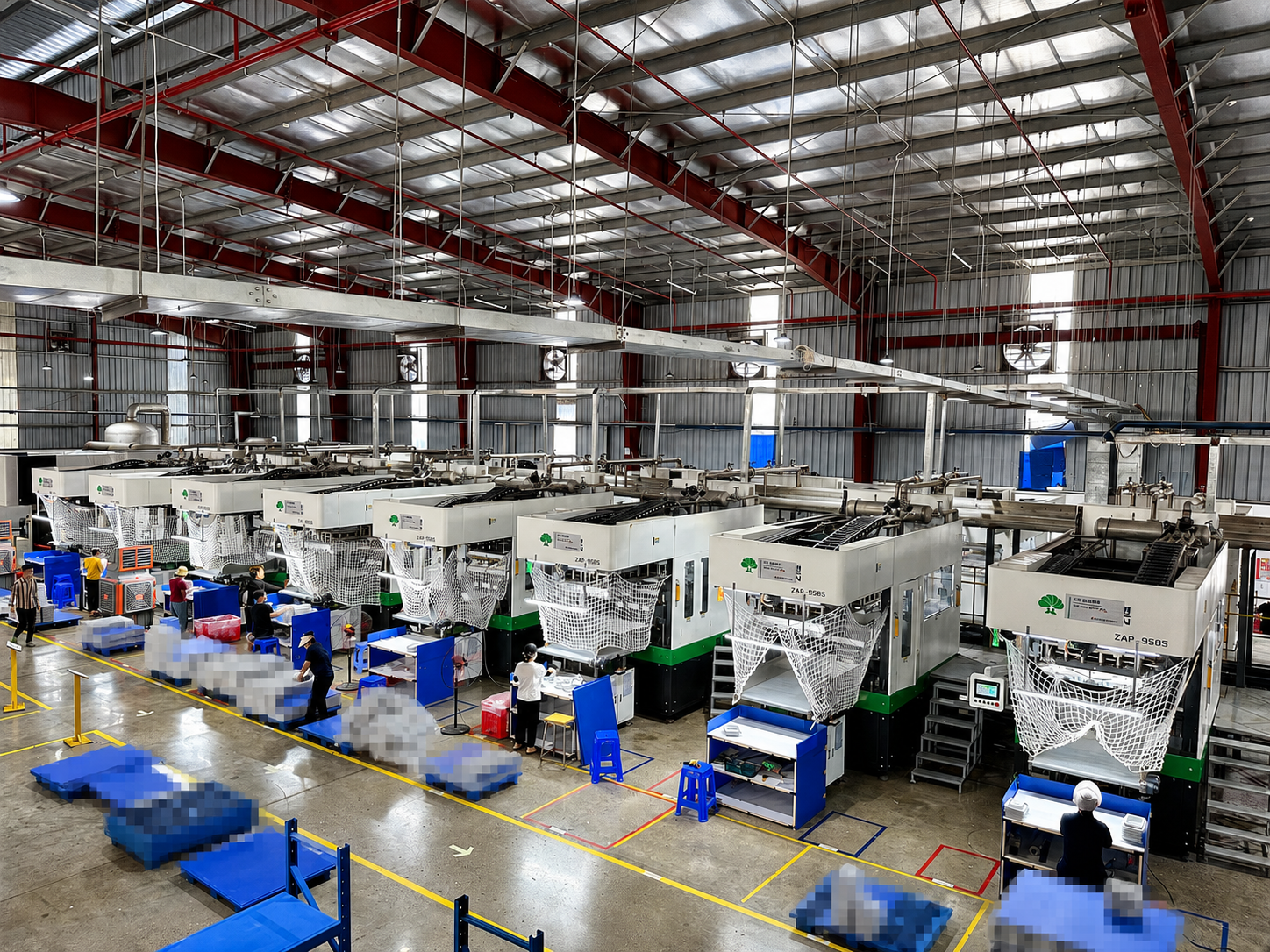
Industrial packaging projects typically require flexible mold layouts and weight consistency rather than the highest possible cycle rate.
Phase 5 — Utility integration, installation and commissioning
This is the phase that separates a turnkey scope from a machine purchase. Vacuum, compressed air, heating, cooling water, high-pressure mold-cleaning water and wastewater treatment are connected, tested and tuned against the line. Protective doors, safety light curtains, emergency-stop protection and automatic alarms are verified as part of the electrical control scope.
Phase 6 — Ramp-up, training and production stabilisation
Commissioning proves the line can run; ramp-up proves the factory can run it profitably. For turnkey projects, Hanson can arrange resident engineers and provide on-site production ramp-up support of up to six months, covering pulp formulation adjustment, mold tuning, weight-consistency control, cycle optimisation and operator training. This is the phase where a new factory without pulp molding experience closes the gap between installed capacity and stable output.
Use Cases: When Turnkey or Separate Procurement Fits
Use case 1 — A new factory with no pulp molding engineering team
This is the clearest turnkey case. The buyer has a product plan, a site and a budget, but no internal experience with slurry management, vacuum systems or mold adaptation. Handing the utility scope, the ramp-up curve and the mold division to one supplier removes the coordination work that a first-time team is least equipped to absorb. Hanson's delivery experience covers individual machines, complete production lines and large-scale turnkey factories, including projects serving listed companies, state-owned enterprises and packaging manufacturers.
Use case 2 — An overseas project with a different utility baseline
Overseas projects introduce variables that a domestic purchase does not: incoming voltage stability, water quality, ambient humidity, spare-parts availability and the response time of a local service provider. Hanson's equipment is specified at AC 380 V / 50 Hz with defined compressed-air, vacuum and cooling-water requirements, so the utility review should happen during design, not after the container arrives. Hanson operates a service network covering key domestic and overseas markets with 10 service locations in operation, and exports account for 50% of total sales, with major markets including Mexico, Brazil, Vietnam, Thailand, Indonesia, Malaysia, India, Turkey, Egypt, Saudi Arabia, the United Arab Emirates, Italy, Romania, Russia, Australia, Peru and Bolivia.
Use case 3 — A converter adding molded fiber capacity alongside existing packaging
A packaging manufacturer that already runs printing, die-cutting or converting operations often has strong engineering capability but no pulp molding experience. Here the practical turnkey value is concentrated in modules 2 to 4 — pulp preparation, forming and molds — plus the utility integration layer, while the buyer retains responsibility for packing, warehousing and secondary operations. Industrial packaging projects use the ZAP-9585 for larger and heavier products and the ZAD-8565 for small and medium precision packaging, often with trimming, hole punching, vision inspection, coating, laminating or digital printing equipment in the same scope.
Use case 4 — Validating a product before committing to capacity
Not every project should start with a full production line. The ZAMS-6047 fully automatic integrated pulp molding prototyping and small-batch production line combines pulping, refining, slurry preparation, slurry feeding, forming and hot pressing in one machine on a 600 × 470 mm platen, with 2 tons of forming pressure and 13 tons of hot-pressing pressure at 82 kW rated power. It is intended for product development, mold verification, process development and small-batch production, and its smaller platen reduces prototype mold cost and mold-processing time. A buyer who validates the product on a sampling line before ordering a full turnkey plant is buying information, not just equipment.

A sampling line lets a new factory verify product geometry, weight and mold design before committing to a full-scale turnkey plant.
Comparison Table: Turnkey Pulp Molding Plant vs. Separate Equipment
| Decision dimension | Turnkey pulp molding plant | Separate equipment procurement |
|---|---|---|
| Contract structure | One supplier scope covering planning, equipment, molds, automation, control, commissioning and ramp-up | Multiple machine suppliers plus the buyer's own engineering or a third-party integrator |
| Ownership of interfaces | Supplier engineering team owns the interaction between pulping, forming, vacuum, air, heating and water | Buyer owns the interfaces; each supplier owns only their own module |
| Utility coordination | Vacuum, compressed air, heating, water circulation and wastewater treatment planned against line demand before the building is finalised | Utilities are specified by different parties; mismatches typically surface during commissioning |
| Mold development | Independent mold division handles design, manufacturing, testing and mass-production adaptation in the same scope | Mold supplier coordinated separately from the forming machine supplier |
| Installation and commissioning | Included in the delivery scope, together with personnel training | Split across suppliers; the buyer schedules and supervises |
| Production ramp-up | Resident engineers and on-site production ramp-up support of up to six months can be arranged for turnkey projects | Ramp-up is handled internally, or with paid external support arranged after the fact |
| Best suited to | New factories, first-time pulp molding teams, large-scale projects and overseas projects | Factories with existing infrastructure, in-house pulp molding engineering and phased upgrades |
| Main risk | Buyer depends on one supplier's engineering capability and delivery schedule | Interface gaps, duplicated engineering and delayed ramp-up land on the buyer |
The table is not an argument that turnkey is always correct. It is a map of where responsibility sits under each model. A buyer with an experienced pulp molding engineering team can capture real value from separate procurement, because they can specify and integrate the modules themselves. A buyer without that team is effectively purchasing an engineering project — and the question is simply whether they buy the engineering from the equipment supplier or from someone else.
FAQ
What safety and compliance standards should a turnkey pulp molding line be specified against?
Safety-related parts of machinery control systems must comply with EN ISO 13849-1, and the 2015 version of that standard will be withdrawn after a transition period ending 15 May 2027, so new specifications should reference the current version. On the machine side, Hanson equipment is configured with protective doors and safety light curtains on models including the ZAP-9585, ZAD-8565 and ZAMS-6047, together with automatic alarms and emergency-stop protection. For overseas projects, the electrical control scope should also be reviewed against the destination market's supply conditions, because the standard machine specification is AC 380 V / 50 Hz.
Pulp molding machine manufacturers — what should a new factory check beyond the machine catalogue?
The catalogue shows machines; the project shows whether a manufacturer can deliver a plant. Four checks matter most. First, scope depth: does the manufacturer cover factory planning, pulp preparation, forming, molds, downstream automation, electrical control and utility integration, or only the forming machine? Second, engineering capacity: Hanson employs approximately 200 staff, including an R&D team of 50 engineers and technical professionals, holds 50 patents and is recognised as a National High-tech Enterprise. Third, manufacturing base: Hanson operates a 50,000 ㎡ facility with an annual production capacity of 150 units of pulp molding equipment. Fourth, delivery and after-sales reach: Hanson has 10 service locations in operation, exports account for 50% of total sales, and products are delivered to markets including Mexico, Brazil, Vietnam, Thailand, Indonesia, Malaysia, India, Turkey, Egypt, Saudi Arabia, the United Arab Emirates, Italy, Romania, Russia and Australia.
Is turnkey procurement more expensive than buying separate equipment?
The comparison should be made on total project scope, not on the machine price alone. A separate-equipment quotation often looks lower because engineering, utility integration, mold adaptation, commissioning and ramp-up are not inside any supplier's scope — they remain with the buyer, and they are usually paid for in engineering hours, delayed start-up and rework. A turnkey scope prices those items explicitly. The practical test is to list every activity between product concept and stable mass production, then mark who owns each one under each model. Any activity nobody owns is the real cost of the cheaper quotation.
Can a new factory validate its product before committing to a full production line?
Yes. The ZAMS-6047 is a fully automatic integrated pulp molding prototyping and small-batch production line that combines pulping, refining, slurry preparation, slurry feeding, forming and hot pressing in one machine. Its mold platen measures 600 × 470 mm, forming pressure is 2 tons, hot-pressing pressure is 13 tons, maximum product height is 120 mm, rated power is 82 kW and machine weight is 7.3 tons, with machine dimensions of L7,500 × W2,550 × H2,810 mm. It is intended for product prototyping, process verification and small-batch production, and its smaller platen reduces prototype mold cost and mold-processing time compared with developing molds directly for a full-size line.
How long does it take to move from installation to stable mass production?
Installation and commissioning prove that the line runs; they do not prove that the factory can hold product weight, yield and cycle time across shifts. Ramp-up covers pulp formulation adjustment, mold tuning, weight-consistency control, trimming and inspection settings, and operator training, and its length depends on product complexity, the fiber material selected and how closely the site's utilities match the line specification. Because this is the phase where new factories lose the most schedule, Hanson supports turnkey projects with resident engineers and up to six months of on-site production ramp-up support. Buyers who want to review the full turnkey scope, request a sample run or discuss a quotation can contact the Hanson team directly, or download the company brochure for module-level detail.
Conclusion
The turnkey-versus-separate decision is not a preference about purchasing style. It is a question about who owns the engineering interfaces between pulping, forming, hot pressing, trimming, vacuum, compressed air, heating, water circulation, wastewater treatment and production rhythm. When a new factory, a large-scale project or an overseas project has no internal team to own those interfaces, the 6+1 turnkey structure — factory planning, pulp preparation, forming equipment, molds, downstream automation, electrical control, integrated by one project team — converts an open-ended integration risk into a defined delivery scope.
When the buyer already has pulp molding engineering capability, separate procurement can be the sharper commercial choice. Either way, the decision should be made before the factory layout and electrical design are fixed, because that is the point at which utility and interface decisions are still cheap to change.
Next Step: Request a Sample, a Quote or the Full Brochure
HANSON PULP MOLDING TECHNOLOGY CO., LTD. supplies pulp molding equipment, production lines and turnkey factory solutions, and works with customers from product concept and sample development through process verification, equipment selection, factory construction, commissioning and stable mass production.
Brochure download: Hanson Pulp Molding brochure (PDF)
Email: linchuangcheng@hspulpmolding.com
Tel / WhatsApp: +86 159-2060-4830
Website: www.hspulpmolding.com
Address: Room 101, No. 6, Lane 1, Fourth Industrial Zone, Qiaotou, Houjie Town, Dongguan City, Guangdong Province, China
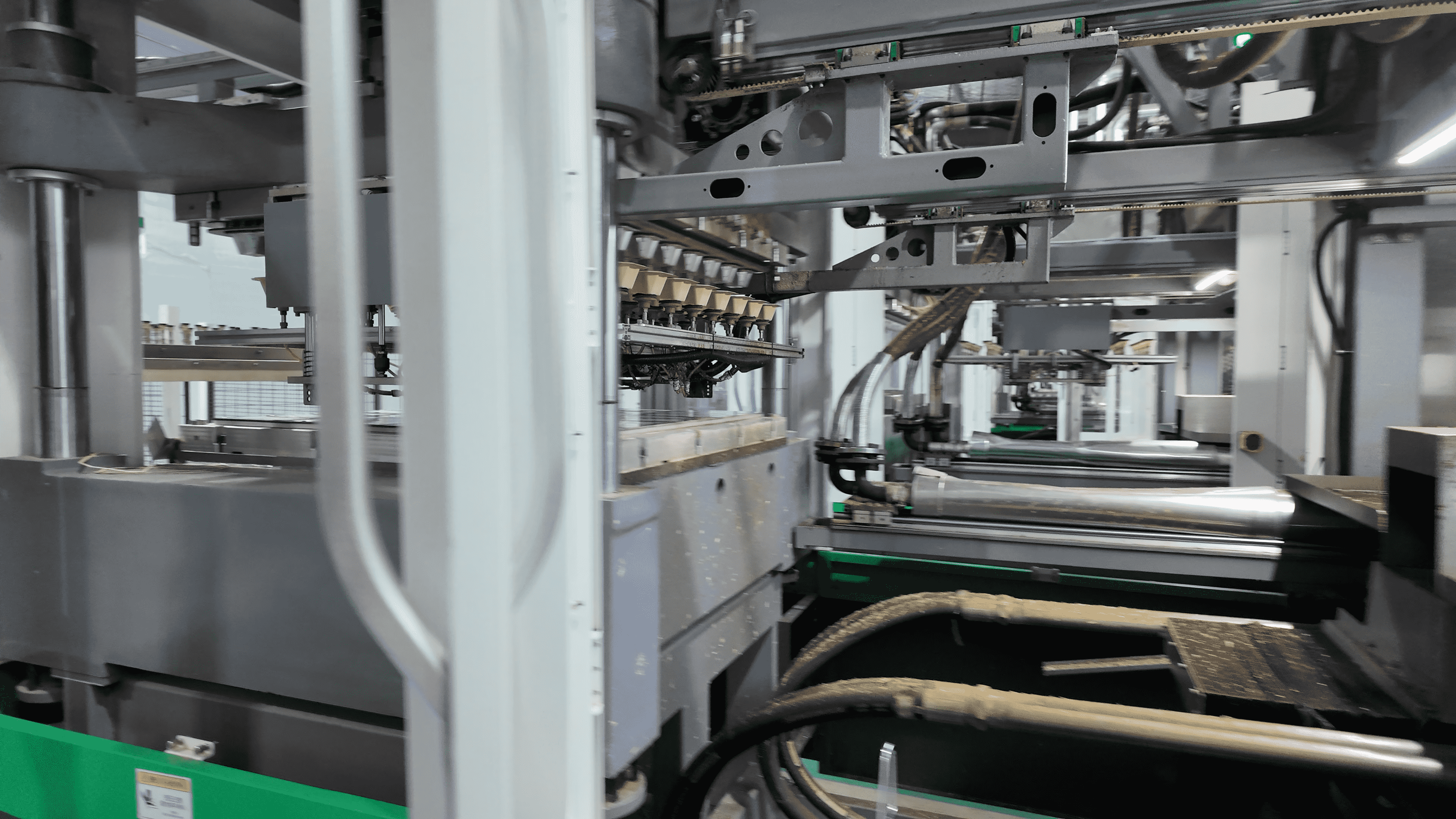
From equipment installation to stable mass production: resident engineering and production ramp-up support are part of the turnkey scope.