
DPG vs IPM/DPM Fragrance Carriers: Diffuser vs Candle Guide
DPG-based fragrance oils and IPM/DPM-based fragrance oils are not interchangeable across diffusers and candles. For reed diffusers, scent machines and room sprays, DPG-based diffuser oils such as HERYNN HW91060 and HW91062 are positioned for low evaporation and long-lasting diffusion. For soy candles, paraffin candles and wax melts, IPM or IPM/DPM candle oils such as HERYNN HW91046 and HW91047 are positioned for wax compatibility and true-to-scent throw. The practical decision is therefore not which carrier is universally better, but which carrier matches the delivery system, dosage, wax or wick, and documentation requirements of the finished product.
This comparison guide is written for buyers at the Decision stage: private-label candle makers, home-fragrance brands, diffuser assemblers, contract manufacturers and distributors comparing carrier types before sampling. It explains the carrier distinction, the evaluation points that change between diffusers and candles, the 6–10% candle dosage guidance cited for the candle oils, and the IFRA, COA and SDS documents buyers should request. It also flags 1 kg minimum order quantities and customization of formula, fragrance color and strength as commercial evaluation points.
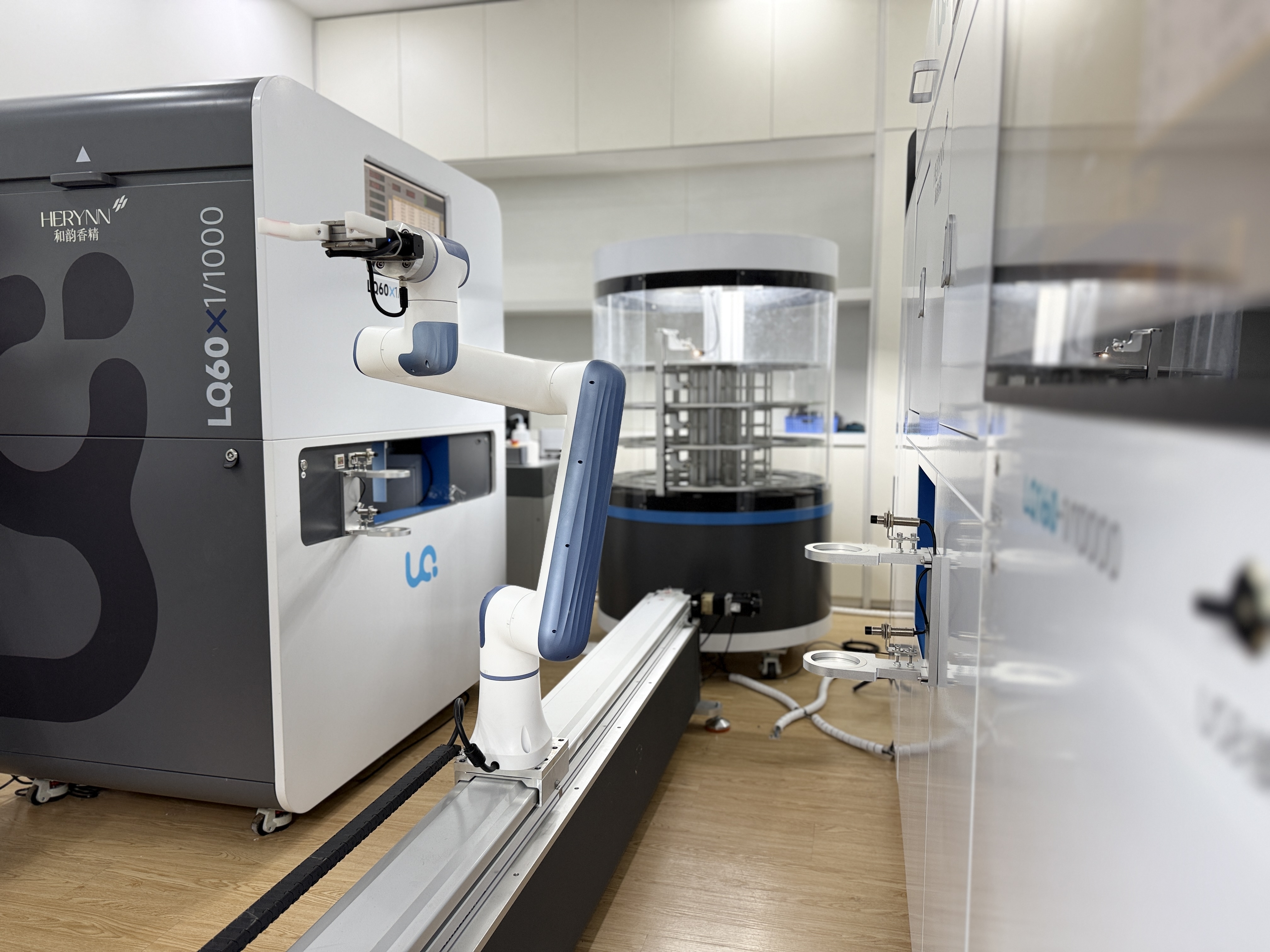
Caption: Automatic batching supports repeatable fragrance-oil production; carrier selection still has to be validated in the final diffuser or candle system.
The problem: one fragrance-oil category hides different carrier systems
Buyers often compare fragrance oil as if it were a single raw material with a single set of performance rules. In practice, a fragrance oil is a concentrate carried by a solvent or carrier system, and that carrier influences how the concentrate behaves in the finished product. A diffuser oil must work with reeds, wicks or a scent machine's delivery mechanism. A candle oil must work in molten wax, with a wick and a burn cycle. The same fragrance concentrate placed in the wrong carrier can create weak or uneven release, poor wicking, phase separation, surface defects or inconsistent scent intensity. These outcomes are not automatic, but they are the reasons carrier choice belongs in the qualification process rather than in the purchase order's footnote.
The buyer's real question is therefore a matching question: which carrier system is designed for the end use, and what evidence shows that it performs in that end use? DPG (dipropylene glycol) is used in air-care and diffuser fragrance systems where low evaporation and controlled release are wanted. IPM (isopropyl myristate) and DPM carrier systems are used in candle fragrance applications where compatibility with wax and the burn system matters. HERYNN presents HW91060 and HW91062 as DPG-based diffuser oils for reed diffusers, scent machines and room sprays, and HW91046 and HW91047 as IPM or IPM/DPM candle oils for soy and paraffin candles and wax melts. Those product descriptions are the starting point for sampling, not a substitute for testing in the buyer's own base, wick, vessel and packaging.
The cost of a mismatch is usually discovered late: after a candle has been poured, after a diffuser has been filled, or after a room spray has been packed. At that point, reformulation, rework, delayed launch or discarded stock can cost more than the fragrance oil itself. A Decision-stage comparison should therefore separate carrier chemistry from fragrance character, and separate supplier documentation from actual application performance. A fragrance can smell correct in the bottle and still fail in a candle if the carrier and wax system do not work together; a diffuser oil can smell correct and still disappoint if the wick or reed set releases it too quickly or too slowly.
Industry background: why carrier-specific buying is more important in home fragrance
The home-fragrance category continues to expand across candles, reed diffusers, room sprays, wax melts and scent machines. Commercial research gives buyers useful directional context. Data Bridge Market Research estimated the global fragrance oil market at USD 8.50 billion in 2024 and projected USD 11.90 billion by 2032 at a 4.30% CAGR. Fortune Business Insights valued the global home fragrance market at USD 26.00 billion in 2025. These figures come from commercial research publishers and should be read as market estimates, not as procurement prices or supplier performance data. Their practical message is simpler: home fragrance is a large, application-diverse category, and buyers are not purchasing one undifferentiated oil.
That application diversity is why carrier language appears in product names and technical discussions. A brand may sell the same scent family in a candle, a reed diffuser and a room spray, but the fragrance oil behind each SKU may use a different carrier, dosage and documentation package. HERYNN's own product scope covers fragrance compounds for fine fragrance, personal care and air care, with additional coverage of candle fragrance and home care. The company operates two R&D centres and two manufacturing facilities in Shanghai and Guangzhou, and its R&D team accounts for over 40% of staff, including 15 in-house perfumers. For buyers, that matters because carrier selection is not only a purchasing decision; it is a formulation and application-support decision.
Compliance expectations have also become more application-specific. IFRA Standards are a globally recognized risk-management system for the safe use of fragrance ingredients, and IFRA conformity is not a substitute for destination-market law. A fragrance certificate is issued for a stated product category and use level, and it must be re-issued if the product type or use level changes. That is directly relevant to carrier comparison: a DPG diffuser oil evaluated for air care is not automatically documented for a candle, and a candle oil evaluated for wax is not automatically documented for a body wash or shampoo. The buyer should ask for the certificate that matches the intended finished product, dosage and market.
Carrier-to-application match: DPG for diffusers, IPM/DPM for candles
DPG-based diffuser oils: HW91060 and HW91062
HERYNN HW91060 and HW91062 are DPG-based diffuser fragrance oils described as low-evaporation oils for reed diffusers, scent machines and room sprays. In a reed diffuser, the oil must travel through the reed and release fragrance at a controlled rate. In a scent machine, the oil must remain compatible with the machine's delivery system and intended operating pattern. In a room spray, the oil must remain compatible with the spray base and packaging. These are different mechanical systems, but they share a need for a carrier that does not release the fragrance too aggressively at the start and then fade too quickly.
The low-evaporation positioning of DPG-based diffuser oils is relevant to long-lasting diffusion. A buyer should still verify that positioning in the actual delivery system: reed type and count, oil surface area, room airflow, temperature and the target refill or replacement cycle all affect perceived performance. For reed diffusers, a practical trial should compare wicking rate, early intensity, late-stage intensity, discoloration and any residue on the reeds or container. For scent machines, the trial should confirm compatibility with the machine's recommended oil viscosity or flow characteristics, if the machine supplier specifies them. For room sprays, the trial should check solubility, spray pattern, valve performance and any separation during storage.
DPG-based diffuser oils are not automatically suitable for candles. Candles require a carrier that works with molten wax, wick geometry, fragrance load and burn behavior. A diffuser oil may be designed for passive evaporation at room temperature; a candle oil must survive melting, pouring, cooling and combustion. Buyers should not assume that a low-evaporation diffuser oil will deliver the same result in a wax melt or a poured candle. The correct approach is to keep the end use fixed and ask for the carrier and documentation that match it.
IPM and IPM/DPM candle oils: HW91046 and HW91047
HERYNN HW91046 and HW91047 are IPM or IPM/DPM candle fragrance oils suitable for soy and paraffin candles and wax melts. Their stated positioning includes true-to-scent throw, which is the buyer-facing claim that the fragrance character remains recognizable when the candle is used rather than only when the oil is smelled in the bottle. That claim should be assessed through a burn test and, for wax melts, a melt test in the buyer's actual wax blend and warmer. Throw is influenced by fragrance load, wax type, wick, vessel diameter, room temperature and airflow; the carrier is one variable among several.
The candle dosage guidance cited for these oils is 6–10%. That is guidance, not a universal rule. A 6% load may be appropriate for a subtle scent, a small vessel or a wax with strong natural throw; a 10% load may be used where a stronger scent is wanted, but higher load can also affect wax stability, wick performance, burn quality and cost. The buyer should test at least two dosage points within the 6–10% range and check cold throw, hot throw, tunneling, sooting, mushrooming, surface appearance and fragrance consistency after storage. The final dosage should also be checked against the applicable IFRA category and use level for the finished candle or wax melt.
IPM and DPM carrier systems are selected because they can be compatible with wax and fragrance concentrate in candle applications, but compatibility is not a guarantee for every wax. Soy wax, paraffin wax and blended waxes differ in oil absorption, crystallization and burn behavior. A candle oil that performs well in paraffin may behave differently in a soft soy container blend or a hard pillar blend. For wax melts, the absence of a wick removes one variable but adds another: the warmer's heat profile and the melt pool's surface area determine release. Buyers should therefore treat the carrier description as a screening criterion and the burn or melt test as the decision evidence.
Step-by-step carrier selection and validation
- Define the finished product and delivery system. Write down whether the product is a reed diffuser, scent machine refill, room spray, soy candle, paraffin candle or wax melt. Record the expected fill size, packaging, wick or reed type, wax blend and target market. This prevents the buyer from comparing fragrance oils across incompatible use cases.
- Shortlist the carrier family, not only the scent. For diffusers, request DPG-based diffuser oils such as HW91060 and HW91062. For candles, request IPM or IPM/DPM candle oils such as HW91046 and HW91047. Ask the supplier to confirm the carrier system in writing and to identify any known limitations for the intended base.
- Request the application-specific documentation package. Ask for the IFRA Certificate of Conformity for the intended product category and use level, the COA for the supplied batch, and the SDS in the format required by the destination market. For US and EU buyers, confirm whether the SDS is available in US GHS or EU CLP format and whether allergen declarations, VOC reports or California Proposition 65 documents are available on request.
- Run a bench trial in the buyer's own base. For diffusers, test wicking rate, early and late intensity, residue and container compatibility. For room sprays, test solubility, valve performance and storage stability. For candles, test at 6%, 8% and 10% dosage within the stated 6–10% guidance, using the actual wax, wick and vessel. For wax melts, test in the actual warmer and wax blend.
- Check stability and appearance after storage. Observe color change, separation, sedimentation, surface defects and scent drift under the intended storage conditions. HERYNN's general storage guidance for fragrance is 24 months shelf life when sealed, stored in a cool, dry, well-ventilated place away from direct sunlight and high temperature, with 18°C recommended. Use promptly after opening.
- Confirm the commercial terms before scaling. Clarify the 1 kg minimum order quantity for evaluation, the packaging format for the destination, the sample despatch time, the bulk lead time for standard catalogue fragrances, and any customization requirements for formula, fragrance color or strength. HERYNN's comparison material cites sample despatch in 2–3 days, bulk delivery in 3–5 working days after payment confirmation for standard catalogue fragrances, custom development in 2–4 weeks and fragrance matching in 3–4 weeks.
- Lock the specification and retain reference samples. Once the carrier, dosage and fragrance are approved, document the approved reference sample, the IFRA category and use level, the COA and the packaging. Retain sealed samples for traceability and compare future batches against them.
Use cases and what to test in each
Reed diffusers
For reed diffusers, the carrier must support consistent travel through the reeds and gradual release into the room. HW91060 and HW91062 are positioned for this use as low-evaporation DPG diffuser oils. Test the actual reed material and count, the neck opening, the oil level and the room airflow. Check whether the scent is too strong in the first days and too weak later, or whether the reeds become clogged or discolored. A long-lasting diffusion claim should be evaluated over the intended replacement cycle, not only on day one.
Scent machines
Scent machines vary in how they move or atomize oil. A DPG-based diffuser oil may be appropriate, but the buyer should confirm the machine supplier's oil specification and run a compatibility trial. Check for leakage, residue, clogging, changing intensity and any effect on the machine's components. If the machine is used in a commercial space, also confirm the documentation package and the storage conditions for refill containers.
Room sprays
Room sprays require a carrier that remains compatible with the spray base and packaging. HW91060 and HW91062 are listed for room sprays within the DPG diffuser-oil family. Test solubility, clarity, spray pattern, valve function and storage stability. If the product is sold in a market with specific labeling or VOC requirements, request the relevant documentation before finalizing the formula.
Soy candles
Soy wax can be sensitive to fragrance load and pour temperature. Use HW91046 or HW91047 within the 6–10% guidance and test at more than one dosage. Check for sweating, cracking, discoloration, wick clogging, tunneling and scent throw. A true-to-scent throw claim should be assessed in the actual vessel and burn cycle, not only in a small pilot pour.
Paraffin candles
Paraffin wax can accept fragrance differently from soy. Test the same candle oil in the intended paraffin blend, wick and vessel. Check hot throw, soot, mushrooming and burn rate. If the candle is a pillar or a molded shape, confirm that the fragrance load does not soften the wax beyond the intended structure. The carrier and dosage should be fixed only after the burn test.
Wax melts
Wax melts remove the wick but not the compatibility question. Test HW91046 or HW91047 in the actual wax blend and warmer. Check melt pool, release intensity, duration and residue after the melt cycle. Because wax melts are often sold in small units, the 1 kg minimum order quantity can be useful for evaluating several fragrance directions before committing to larger production.
DPG vs IPM/DPM comparison table
| Evaluation point | DPG-based diffuser oils: HW91060 and HW91062 | IPM or IPM/DPM candle oils: HW91046 and HW91047 |
|---|---|---|
| Carrier system | DPG-based | IPM or IPM/DPM |
| Primary end use | Reed diffusers, scent machines and room sprays | Soy and paraffin candles, and wax melts |
| Release positioning | Low evaporation and long-lasting diffusion | True-to-scent throw in wax applications |
| Dosage guidance | Follow supplier guidance and validate in the final diffuser or spray system | 6–10% candle dosage guidance; validate in the actual wax, wick, vessel and burn test |
| Documentation | IFRA, COA and SDS available; confirm the certificate for the intended air-care category and use level | IFRA, COA and SDS available; confirm the certificate for the intended candle or wax-melt category and use level |
| MOQ and customization | 1 kg minimum order quantity cited; formula, fragrance color and strength can be discussed as customization points | 1 kg minimum order quantity cited; formula, fragrance color and strength can be discussed as customization points |
| Key buyer check | Wicking, spray compatibility, storage stability and container compatibility | Wax compatibility, wick performance, burn quality, melt performance and scent throw |
IFRA, COA and SDS: what the documents do and do not prove
IFRA, COA and SDS are not interchangeable documents. An IFRA Certificate of Conformity confirms that a fragrance compound complies with IFRA Standards for a stated product category and use level. Buyers use it to check that the fragrance stays within the applicable restrictions for its intended use. The certificate is category- and dosage-specific, so it must be re-issued if the client changes the product type or use level. IFRA also states that a conformity certificate applies to fragrance mixtures intended to be directly included in a finished consumer product, while raw materials generally do not receive an IFRA certificate when a specific IFRA Standard applies. That distinction matters when a buyer is purchasing a fragrance compound rather than an individual raw material.
A COA is a batch-specific certificate of analysis. HERYNN states that production batches are released with a COA, and that GC-MS testing is applied to raw materials and production batches. Samples for olfactive confirmation, approximately 30 g, are supplied for sensory evaluation only and are not tested by GC-MS. This is a useful limitation for buyers to understand: a sensory sample confirms the fragrance direction, while the production COA supports batch release. The buyer should not treat a sensory sample as a substitute for the production COA or for application testing.
An SDS provides hazard, handling and storage information in the format required by the destination market. HERYNN states that multilingual SDS can be provided in EU CLP, US GHS and China GHS formats, and that products are developed in line with IFRA standards and EU REACH requirements. On request, the company can provide SPEC, COA, IFRA Certificates of Conformity, allergen declarations, VOC reports and California Proposition 65 documents. These documents support registration and regulatory review, but they do not by themselves prove that a candle burns cleanly or that a diffuser performs for a stated number of days. Performance claims still require application testing in the buyer's own system.
MOQ, customization and total evaluation cost
HERYNN's comparison material cites a 1 kg minimum order quantity for small-volume evaluation. That low entry point is useful for Decision-stage buyers who need to test several carrier and scent options before committing to production. The buyer should still confirm the packaging format, destination requirements and shipping method, because the commercial MOQ and the practical shipping unit are not always the same thing. A 1 kg trial may be sufficient for a bench sample, but a candle or diffuser test may require a larger quantity depending on the number of dosage points, vessels and burn cycles.
Customization is another evaluation point. HERYNN's stated customization options include formula, fragrance color and strength. For a diffuser oil, changing strength or color may affect wicking, staining or stability; for a candle oil, it may affect wax compatibility, burn quality or throw. The buyer should ask for the technical basis of each customization and confirm whether the IFRA certificate and COA remain valid for the modified product. A color change that is cosmetic in the bottle may become a visible issue in a clear diffuser bottle or a white candle.
Total evaluation cost should include samples, courier charges, bench testing time, burn or wick trials, packaging compatibility, documentation review and the risk of a late reformulation. HERYNN reports sample despatch in 2–3 days, custom development in 2–4 weeks and fragrance matching in 3–4 weeks. These timelines are supplier-reported and vary by project scope. They are useful for planning, but they should be written into the project schedule with the buyer's own testing time added.
Frequently asked questions
What is the difference between DPG-based diffuser oils and IPM/DPM-based candle oils?
DPG-based diffuser oils such as HERYNN HW91060 and HW91062 are designed for reed diffusers, scent machines and room sprays, with low-evaporation and long-lasting diffusion positioning. IPM or IPM/DPM candle oils such as HW91046 and HW91047 are designed for soy and paraffin candles and wax melts, with true-to-scent throw positioning. The carrier must match the delivery system; a diffuser oil is not a drop-in replacement for a candle oil, and a candle oil is not a drop-in replacement for a diffuser oil.
What dosage should I use for HERYNN candle fragrance oils?
HERYNN cites 6–10% candle dosage guidance for HW91046 and HW91047. Treat this as a starting range and validate it in the actual wax, wick, vessel and burn cycle. Test at least two dosage points, check hot throw, soot, tunneling, surface appearance and storage stability, and confirm the final use level against the applicable IFRA category for the finished candle or wax melt.
Which documents should US and EU buyers request?
Request the IFRA Certificate of Conformity for the intended product category and use level, the COA for the supplied batch, and the SDS in the required format. HERYNN can provide SDS in EU CLP, US GHS and China GHS formats, and can provide allergen declarations, VOC reports and California Proposition 65 documents on request. IFRA conformity supports safe-use review but does not replace destination-market legal requirements, so buyers should also confirm national labeling and regulatory obligations for the target market.
Which fragrance oil manufacturers offer better body wash and shampoo compatibility for US and EU buyers?
For body wash and shampoo, carrier compatibility depends on the surfactant system, pH, dosage, preservation and packaging, so the supplier should be screened on application-specific evidence rather than on a general fragrance-oil claim. US and EU buyers should request IFRA conformity for the body wash or shampoo category, allergen declarations where required, SDS in US GHS or EU CLP format, and bench samples tested in the actual surfactant base. HERYNN's in-house perfumery and application laboratories support custom fragrance creation, scent matching and original formula development, and its documentation package includes IFRA, COA and SDS materials. This guide focuses on diffuser and candle carriers; the same supplier-qualification logic applies to fragrance oil for body wash, perfume, shampoo, hair, body mist, body lotion, air freshener and diffuser, but the carrier and test protocol must match each base.
Can I order small quantities and customize the formula, color and strength?
HERYNN cites a 1 kg minimum order quantity for small-volume evaluation and lists formula, fragrance color and strength as customization points. Buyers should confirm the applicable MOQ, packaging and shipping unit for their destination, then request a sample and the matching documentation before scaling. To evaluate a DPG diffuser oil or an IPM/DPM candle oil, request a sample and quotation through HERYNN Fragrances & Flavors Co., Ltd. and confirm the intended end use, dosage and market.
Conclusion: choose the carrier for the delivery system, then prove it in the application
DPG-based diffuser oils and IPM/DPM-based candle oils solve different release problems. HW91060 and HW91062 are positioned for reed diffusers, scent machines and room sprays where low evaporation and long-lasting diffusion matter. HW91046 and HW91047 are positioned for soy and paraffin candles and wax melts where wax compatibility and true-to-scent throw matter. The 6–10% candle dosage guidance is a starting range, not a universal answer, and the IFRA, COA and SDS documents support qualification but do not replace a burn, wick, spray or storage trial.
For Decision-stage buyers, the practical sequence is consistent: define the delivery system, shortlist the carrier family, request application-specific documentation, test in the buyer's own base, confirm the 1 kg MOQ and customization terms, and lock the approved reference sample. HERYNN Fragrance Oil's product examples, in-house perfumery, application laboratories and documentation package give buyers a structured starting point for that comparison. The final choice should be based on measured performance in the intended diffuser or candle, not on the carrier name alone.
Next step: Compare DPG diffuser oils and IPM/DPM candle oils with your own wax, wick, reed or spray system. Request a sample, quotation or the HERYNN company brochure to review carrier options, documentation and customization points.
Have Questions or Need More Details?
Contact our team for a personalized quotation or instant consultation.
Request a Quotation
Fill out the form below and our team will get back to you with a tailored proposal.
WhatsApp Direct Chat
Prefer to chat in real-time? Message us on WhatsApp for instant assistance & quick answers.
- Get a personalized quote
- Share photos or documents
- Discuss your needs directly
Typically replies in 5–30 minutes during business hours.