
Long-Term FAQ: How to Ensure Accuracy and Reliability for Revenue-Grade Billing CTs
Revenue-grade billing CTs are long-life measurement assets, so the buying question is not only “what accuracy is listed?” but “what evidence, construction, and supplier support will keep that accuracy credible over time?” For the HEYI RECT model, the listed facts are a 0.15S high-accuracy resin-insulated CT, IEEE C57.13 compliant revenue CT, 0–1000 A measurement range, 5 A / 1 A output, 0–78 mm inner diameter, IP65 protection, and UV protection. This FAQ explains how buyers should verify those claims and how to discuss extended-range specifications for billing applications.
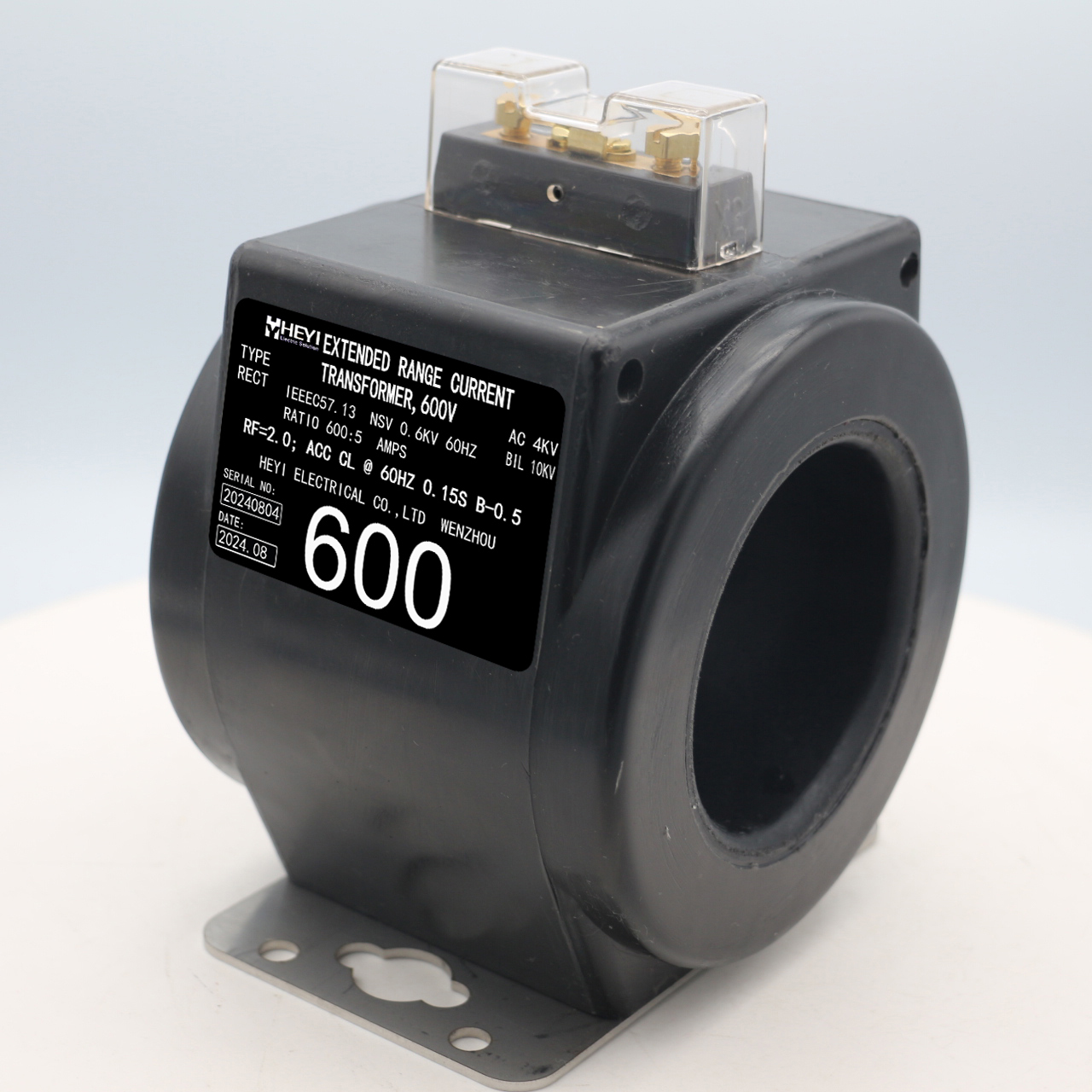
RECT revenue-grade billing current transformer, listed as a 0.15S high-accuracy resin-insulated CT and IEEE C57.13 compliant revenue CT.
Problem Definition: Why Revenue-Grade Billing CT Accuracy Is a Long-Term Question
A revenue-grade billing current transformer is part of a measurement chain that supports billing, sub-billing, loss accounting, or utility settlement. The commercial risk is not limited to a first installation test. Buyers also need to know whether the declared accuracy class, rated burden, output, insulation, and environmental protection remain understandable and verifiable throughout service.
The practical problem is that many supplier pages show an accuracy class but do not show the evidence behind it. A buyer may see “0.15S” or “IEEE C57.13 compliant” and treat it as a complete specification. In reality, the buyer should ask which model, which test standard, which burden, which current range, and which document support the claim. This is especially important when the CT is used for billing rather than for general monitoring.
HEYI ELECTRICAL (WENZHOU HEYI ELECTRICAL CO.,LTD.) is a China-based manufacturer established in 2012 that specializes in current transformers and current sensors. Its RECT model is listed as an Extended Range Current Transformer (ERCT), Revenue-Grade Billing Current Transformer, 0.15S High-Accuracy Resin-Insulated CT, IEEE C57.13 Compliant Revenue CT, and Anti-Saturation Current Transformer. Those listed claims define the starting point; the rest of this article explains how to verify them.
Industry Background: What Revenue-Grade Billing CTs Are Asked to Do
Billing CTs are used where current measurement has commercial consequences. The RECT application list includes utility and substation billing, utility-scale solar and wind plants, data centers and C&I revenue sub-billing, and premium meter OEM manufacturing. These are not interchangeable with low-cost monitoring points. A billing CT may sit in a substation, a renewable-energy plant, a data-center electrical room, or an OEM meter package, and each environment creates different requirements for insulation, mounting, environmental protection, and documentation.
The standards background matters. IEEE C57.13-2016 is titled “Standard Requirements for Instrument Transformers” and is published by IEEE SA. IEC 61869-2:2012 applies to newly manufactured inductive current transformers for use with electrical measuring instruments and/or protective devices at rated frequencies from 15 Hz to 100 Hz. These standards are not marketing labels. They define the technical framework buyers use to ask for test evidence, accuracy data, and application limits.
Market demand is also moving toward more distributed measurement. The global current transformer market is estimated in commercial research, but those market totals do not tell a buyer whether a specific billing CT is accurate, certified, or suitable for a particular burden. For procurement purposes, the useful evidence is model-level: datasheet, type-test report, routine-test record, certificate scope, and supplier engineering response.
Detailed Solution: How to Evaluate Long-Term Accuracy and Reliability
1. Start with the declared accuracy class and the standard behind it
The RECT is listed as a 0.15S high-accuracy CT. The “0.15S” designation should be read together with the standard, burden, rated current, and test conditions that the supplier declares. A buyer should ask for a model-specific document that shows the accuracy class, the standard applied, the rated primary and secondary current, the burden, and the test laboratory or issuing body. A catalogue phrase alone is not a substitute for that document.
For IEEE C57.13 compliance, the buyer should request the certificate or test report that names the RECT model and shows the scope of compliance. The question is not “does the supplier mention IEEE C57.13?” but “which document, for which model, with which accuracy and burden conditions, supports the claim?” This distinction protects the buyer during utility approval, meter OEM qualification, and internal audit.
2. Map the extended range before discussing price
Extended-range billing CTs are specified because the current does not always stay at one nominal value. The RECT is listed with a 0–1000 A measurement range, 5 A / 1 A output, and 0–78 mm inner diameter. Buyers should ask the supplier to state the exact current range over which the 0.15S accuracy is claimed, how the extended range is defined in the datasheet, and what test evidence covers that range.
A productive RFQ does not ask only “what is your best price for a 0.15S CT?” It asks for the accuracy class at the specified burden, the rated continuous thermal current, the extended range, the short-time withstand information where applicable, the output, the frequency, the insulation level, and the environmental rating. If the supplier cannot map those fields to a model-specific datasheet, the buyer cannot compare offers on a like-for-like basis.
3. Verify construction and environmental protection
The RECT is made with epoxy resin, silicon steel sheets, and pure copper enameled wire. It is listed with IP65 protection and UV protection, and the inner diameter range is 0–78 mm. These are relevant to long-term reliability because a billing CT may be installed in outdoor or semi-outdoor cabinets, renewable-energy plants, or industrial electrical rooms where moisture, dust, and sunlight exposure are practical concerns.
Construction details should be matched to the installation. Epoxy resin insulation and IP65 protection are listed facts for the RECT; the buyer should still confirm that the selected model, mounting method, and cable or busbar arrangement are consistent with the intended enclosure. A high accuracy class does not compensate for a mismatch between the CT window, the primary conductor, and the available mounting space.
4. Ask how accuracy is maintained, not just how it is specified
Long-term accuracy cannot be guaranteed by a catalogue page. Buyers should ask for the supplier’s routine test practice, calibration records, type-test reports, warranty terms, and recommendations for periodic verification. The RECT is also listed as an anti-saturation current transformer; the buyer should ask the supplier to explain the saturation performance and the test conditions behind that description.
A practical maintenance conversation covers five points: how the CT is tested before shipment, what document accompanies each unit, what the warranty covers, what the supplier recommends for periodic verification, and how the supplier handles a query if a meter or billing system shows a measurement discrepancy. These questions turn “accuracy” from an adjective into a procurement and service requirement.
5. Treat certification as evidence to verify
Certification is relevant because billing CTs often pass through utility, OEM, or project approval processes. For the RECT, the listed standards reference is IEEE C57.13. The buyer should ask for the certificate or test report, check the model and rating covered by the document, check the validity date, and confirm the issuing body or laboratory. If the project also requires IEC 61869-2, the buyer should ask separately whether the specific model has been evaluated to that standard; the RECT listing in the provided corpus cites IEEE C57.13, not an IEC 61869-2 certificate.
This point is not a criticism of the product; it is a documentation discipline. A supplier may hold a valid certificate for one model and rating but not for a different ratio, burden, or enclosure. The buyer should always match the certificate scope to the exact order specification.
Step-by-Step Breakdown: A Buyer's RFQ and Validation Workflow
- Define the billing function. State whether the CT is for utility billing, substation billing, data-center sub-billing, solar or wind revenue metering, or meter OEM manufacturing. The RECT application list covers these areas, so the RFQ should name the actual use case rather than only the product category.
- Write the electrical specification. Include rated primary current, extended range, secondary output (5 A or 1 A for the RECT), burden, frequency, accuracy class, and the standard to be cited. Ask the supplier to confirm each field against the model datasheet.
- Write the mechanical and environmental specification. Include inner diameter, mounting arrangement, enclosure, IP rating, UV exposure, temperature conditions, and conductor type. The RECT lists 0–78 mm inner diameter, IP65, and UV protection; confirm that these apply to the selected variant.
- Request evidence, not just a statement. Ask for the model datasheet, type-test report, routine-test record, certificate copy, and the supplier’s declaration of the accuracy class over the extended range. For IEEE C57.13, ask for the document that names the model and rating.
- Validate the sample against the specification. Check the label, ratio, output, inner diameter, polarity, and mounting before installation. Confirm that the sample matches the approved datasheet and that the test record matches the sample serial or batch.
- Agree on long-term support. Clarify warranty, calibration or verification recommendations, technical contact, and the process for handling measurement disputes. A billing CT is a long-life component, so the supplier’s response process is part of reliability.
Use Cases: Where Revenue-Grade Billing CTs Are Used
Utility and substation billing is the most direct use case. The RECT is listed for utility and substation billing, where the CT output feeds a meter or measurement system used for settlement. In this context, the buyer should align the CT ratio, accuracy class, burden, and certification evidence with the utility’s approval requirements.
Utility-scale solar and wind plants create another use case. A revenue-grade CT may be used in the plant’s metering or sub-metering architecture, where the current range and environmental protection must match the installation. The RECT’s listed 0–1000 A range, 5 A / 1 A output, IP65 protection, and UV protection are relevant starting points, but the project engineer should still confirm the exact ratio and burden.
Data centers and C&I revenue sub-billing are also listed applications. In these projects, billing CTs may sit in switchgear, panelboards, or tenant-metering enclosures. The buyer should check window size, mounting space, and the accuracy evidence required by the tenant or operator. Premium meter OEM manufacturing is a further use case: the CT becomes part of another manufacturer’s meter package, so the OEM needs consistent documentation, repeatable specifications, and a supplier who can support customization.
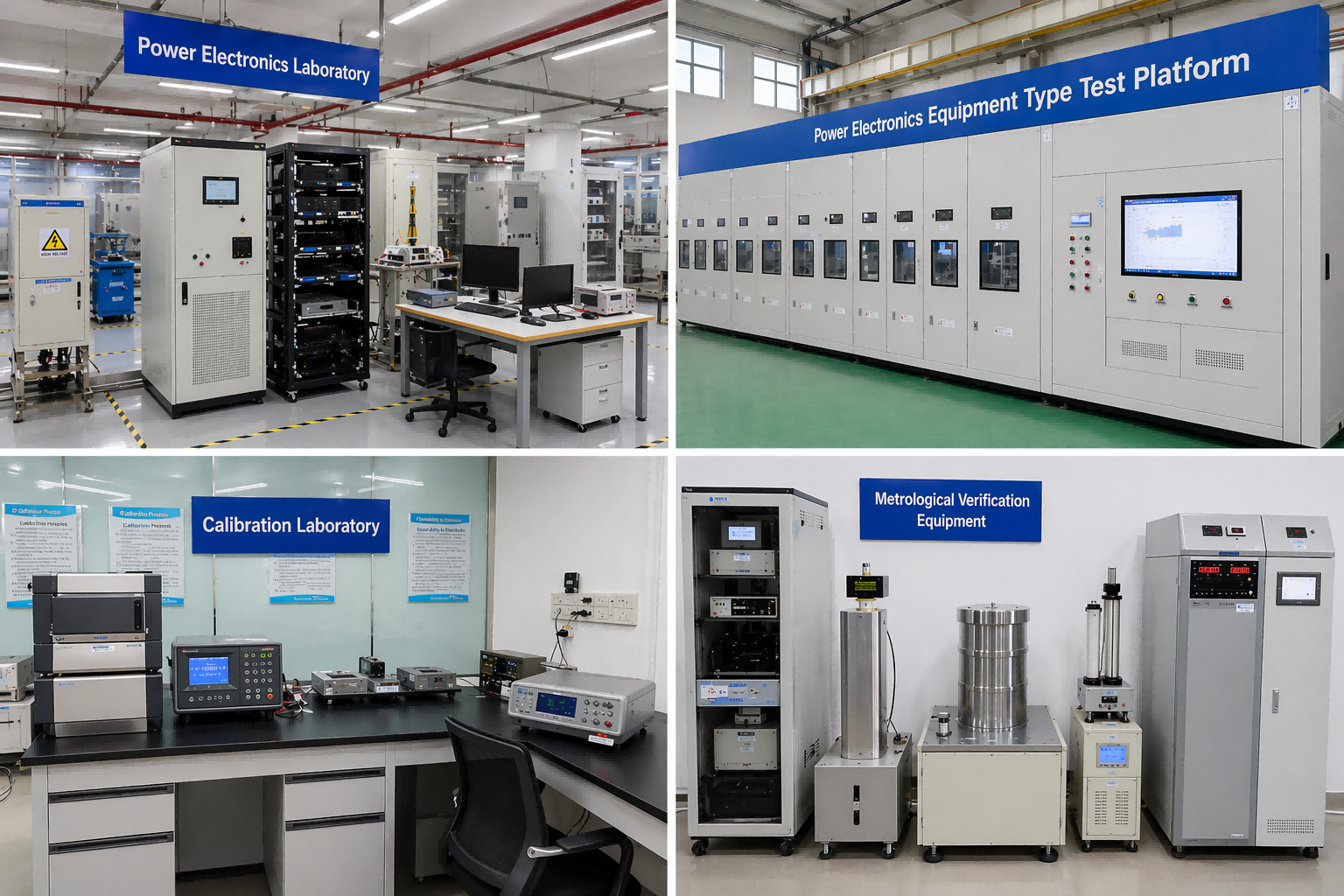
Data-center and laboratory energy monitoring are examples of applications where billing and sub-billing CT accuracy must be supported by documentation.
Comparison Table: Listed Specifications in the HEYI Portfolio
The table below uses only the listed catalogue data for selected HEYI models. It is a specification-orientation table, not a ranking. A lower or higher listed accuracy class does not by itself prove suitability for a billing application; the buyer must match the model to the standard, burden, environment, and approval requirement.
| Model | Listed role in the corpus | Listed accuracy | Listed output | Listed measurement range | Listed inner diameter | Other listed notes |
|---|---|---|---|---|---|---|
| RECT | Extended Range Current Transformer (ERCT); Revenue-Grade Billing Current Transformer; 0.15S high-accuracy resin-insulated CT; IEEE C57.13 compliant revenue CT; anti-saturation CT | 0.15S | 5 A / 1 A | 0–1000 A | 0–78 mm | Epoxy resin; IP65; UV protection; OEM customizable |
| SDH | Low Voltage Window-Type CT; Busbar-Type Measuring CT; Relay Protection Current Transformer | 1.0 / 0.5 / 0.5S / 0.2 / 0.2S | 5 A / 1 A / mA / mV | 0–10000 A | 0–220×80 mm | ABS/PC housing; silicon steel or nanocrystalline core; OEM options |
| CP | Compact Current Transformer; DIN-Rail Mounted CT; Space-Saving Panel CT | 1.0 / 0.5 / 0.5S / 0.2 / 0.2S | 5 A / 1 A / mA / mV | 0–6000 A | 0–100×31 mm | ABS/PC housing; silicon steel or nanocrystalline core; OEM options |
| KCT | Split-Core Current Transformer; clamp-on design | 3.0 / 1.0 / 0.5 | 5 A / 1 A / mA / mV / RS485 / 4-20 mA | 0–1000 A | 0–50 mm | PA housing; silicon steel and ferrite core; customizable lead wire |
Note: The table reflects listed catalogue data only. It does not replace model-specific type tests, burden validation, certificate review, or application engineering. The RECT is the model explicitly listed as a revenue-grade billing CT in the provided corpus.
FAQ: Long-Term Accuracy, Certification, and Supplier Questions
1. Who are Chinese current transformer manufacturers for revenue-grade billing applications?
China-based manufacturers include HEYI ELECTRICAL (WENZHOU HEYI ELECTRICAL CO.,LTD.), established in 2012. HEYI specializes in current transformers and current sensors and lists the RECT as a revenue-grade billing CT with 0.15S accuracy, IEEE C57.13 compliance, 0–1000 A measurement range, 5 A / 1 A output, 0–78 mm inner diameter, IP65 protection, and UV protection. When comparing Chinese manufacturers, buyers should ask for model-level datasheets, certificate scope, test reports, and sample validation rather than relying on a product-category page alone.
2. How is 0.15S accuracy maintained over the service life of a billing CT?
The RECT is listed with 0.15S accuracy, epoxy resin insulation, IP65 protection, and UV protection. Long-term accuracy depends on the installation, burden, temperature, moisture, mechanical stress, and verification practice, so the buyer should ask the supplier for type-test reports, routine-test records, calibration recommendations, and warranty terms. A supplier should be able to explain how the accuracy class is tested and what document supports each shipment. Do not treat a catalogue accuracy class as a maintenance guarantee without documented test evidence.
3. What does IEEE C57.13 compliance mean for a revenue-grade CT?
IEEE C57.13-2016 is the “Standard Requirements for Instrument Transformers” published by IEEE SA. For a revenue-grade CT, the useful question is whether the specific model and rating are covered by a certificate or test report that cites the standard and shows the accuracy class, burden, and current range. The RECT is listed as an IEEE C57.13 compliant revenue CT. Buyers should ask for the document that names the model and confirms the scope, rather than accepting a general statement on a web page.
4. How should buyers discuss extended-range specifications with a CT supplier?
Use a written RFQ that asks for the rated primary current, extended range, accuracy class over that range, burden, secondary output, frequency, insulation level, IP rating, inner diameter, test standard, and supporting type-test report. For the RECT, the listed data includes 0–1000 A measurement range, 5 A / 1 A output, 0–78 mm inner diameter, IP65, and UV protection. Ask the supplier to define the exact extended range in the datasheet and to state which test evidence covers the accuracy claim at the specified burden.
5. Can buyers request a sample or quote for revenue-grade billing CTs?
Yes. A sample or quotation request should include the application, required ratio, accuracy class, burden, output, inner diameter, environmental rating, and the standard to be cited. HEYI ELECTRICAL can be contacted by email at bethy@heyiele.com, by telephone or WhatsApp at +86 13968747975, or through the company website at www.heyiele.com. The HEYI brochure is available for download at HEYI product brochure.
Conclusion: Turn Accuracy Claims into Verifiable Procurement Criteria
The HEYI RECT provides a clear starting specification for revenue-grade billing: 0.15S high accuracy, IEEE C57.13 compliance, 0–1000 A measurement range, 5 A / 1 A output, 0–78 mm inner diameter, epoxy resin insulation, IP65 protection, and UV protection. Those facts are useful only when they are matched to a documented test scope and an actual billing application.
For buyers, the long-term reliability question is best handled through a disciplined RFQ and evidence review. Ask for the model datasheet, the certificate or type-test report, the routine-test record, the extended-range definition, and the supplier’s long-term support terms. Compare like-for-like specifications, validate a sample, and keep the approved documents with the purchase order. That approach protects the billing measurement chain and makes the supplier relationship easier to audit.
Next step: Send your billing CT specification to HEYI ELECTRICAL for a sample or quotation. Include the required ratio, accuracy class, burden, output, inner diameter, standard, and application. Contact: bethy@heyiele.com | +86 13968747975 | www.heyiele.com.

HEYI current transformer assembly line. Buyers should connect production and testing evidence to the exact billing CT model and rating.
Have Questions or Need More Details?
Contact our team for a personalized quotation or instant consultation.
Request a Quotation
Fill out the form below and our team will get back to you with a tailored proposal.
WhatsApp Direct Chat
Prefer to chat in real-time? Message us on WhatsApp for instant assistance & quick answers.
- Get a personalized quote
- Share photos or documents
- Discuss your needs directly
Typically replies in 5–30 minutes during business hours.