
Top 5 Current Transformers for Smart Building and Data Center Monitoring
A current transformer (CT) for a smart building or a data center is chosen by fit, not by price. The five models below are ranked for the two environments where CT mismatch shows up most often: multi-tenant buildings that need sub-metering and BMS integration, and colocation or enterprise data centers that need feeder-level and rack-level power monitoring.
The shortlist is drawn from the HEYI ELECTRICAL current transformer range and is ranked on five criteria: mounting style, output signal and communication protocol, measurement range and window size, accuracy class, and behaviour in retrofit work where conductors cannot easily be disconnected. Ranked order:
- DASN three-phase integrated CT — DIN-rail mounted 3-in-1 design, 0–1000 A, 5 A output, class 1.0.
- KCD smart split-core CT — RS485 / Modbus RTU digital output, 0–1000 A, split-core for retrofit.
- KCT-L true RMS current transmitter — 4–20 mA loop-powered output, 0–1000 A, split-core.
- RECT extended-range revenue-grade CT — 0–1000 A, 5 A / 1 A output, IEEE C57.13, IP65.
- DP/HK busbar split-core CT — 0–8000 A, large 0–80×160 mm window for busbar and main feeder retrofit.
Problem Definition: Where CT Selection Usually Goes Wrong
A current transformer is an instrument transformer that reproduces a primary current as a proportional secondary signal for metering, monitoring, or protection. In smart buildings and data centers it sits at the head-end of three different measurement layers: the utility or tenant billing point, the distribution panel and feeder level, and the rack, PDU, or remote power panel (RPP) level inside the white space.
In practice, most CT problems in these projects are fit problems rather than device failures. The recurring ones are:
- Signal mismatch. The monitoring layer expects a digital bus value, but the installed CT delivers an analogue output — or the reverse.
- Mounting mismatch. A solid-core window CT cannot be placed over a conductor that is still terminated in a live panel.
- Space mismatch. Three separate CTs and their wiring do not fit the depth or the rail length available inside a compact cabinet.
- Range mismatch. The continuous current at the measurement point exceeds the CT range, or the window is too small for the conductor or busbar.
- Accuracy mismatch. A monitoring-class device is specified for a point whose readings carry financial consequences.
- Environment mismatch. The device is not matched to indoor cabinet and low-voltage distribution conditions, or to continuous operation.
The CT that fits is the one whose output your monitoring layer reads natively, whose window accepts the conductor, whose current range covers the highest continuous current at that point, whose accuracy class matches the financial consequence of the data, and whose mounting style matches whether the conductor can be taken out of service.
Industry Background: Why CT Choice Is Getting More Attention
The global current transformer market was estimated at USD 2.63 billion in 2024 and is projected to reach USD 3.90 billion by 2030, according to Grand View Research. Asia Pacific dominated the market with a 40.15% revenue share in 2025, based on Straits Research. On the supply side, the top five global players — ABB, Siemens, GE, Schneider Electric, and Arteche — collectively held approximately 40% of current transformer market share in 2024, according to Global Market Insights.
The growth is not evenly distributed by product type. Split core current transformers are identified as the fastest-growing segment, driven by ease of installation in retrofitting and smart grid applications, according to Fact.MR. That finding matches what building and data center projects actually require: in an operating facility, the CT is usually the component that has to be installed around an existing conductor, not the component that gets a planned outage.
Standards are the second pressure point. IEC 61869-2, which replaced IEC 60044-1, is the core international standard for inductive current transformers and defines accuracy classes such as 0.5 and 0.5S. Where the measurement supports billing, the requirement is tighter: revenue grade current transformers are required to meet ANSI C12.20 or IEC 61869-2 accuracy classes, typically 0.2 or 0.15, based on published metering accuracy guidance.
The
Ranking here is not a generic quality claim. Each model is positioned by how well it solves a specific measurement point in a building or data center. The five comparison dimensions are mounting style, output and protocol, measurement range and window, listed accuracy class, and retrofit suitability.
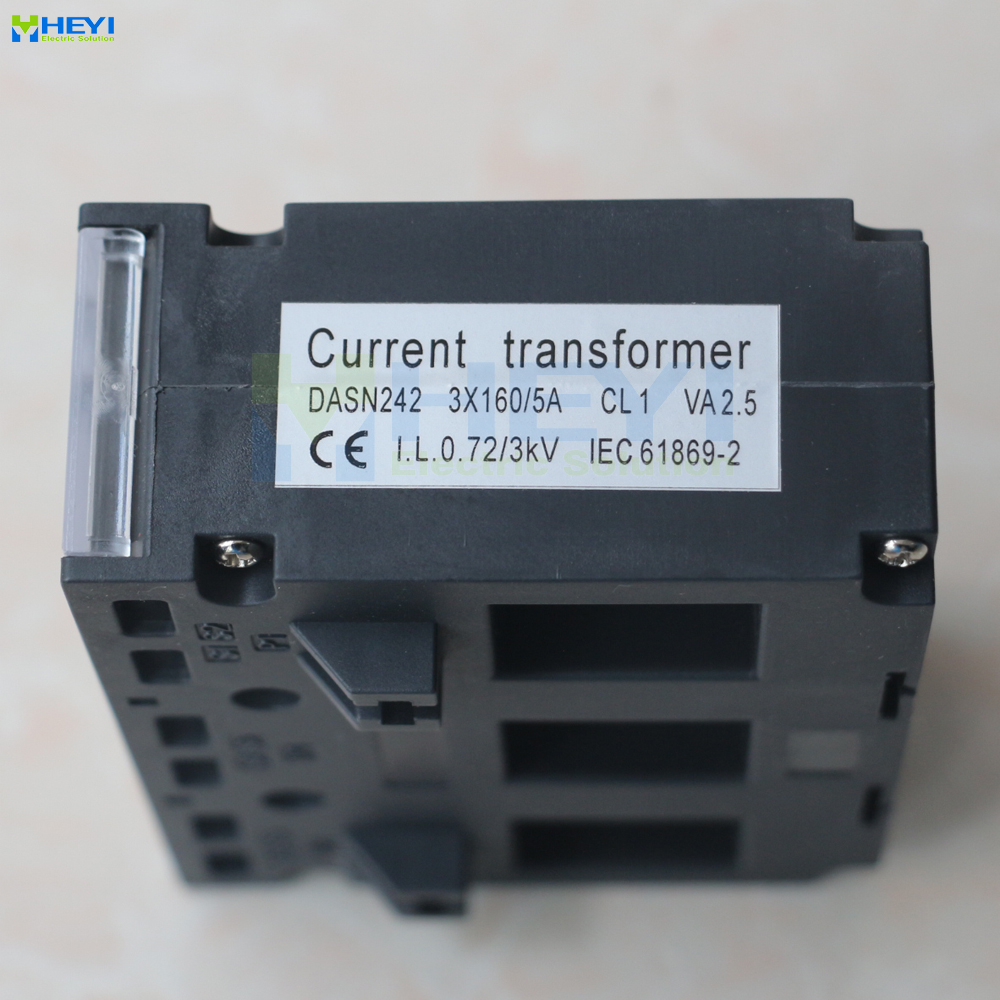
1. DASN — Three-Phase Integrated Current Transformer (DIN-Rail)
The DASN is a three-phase current transformer that integrates three phases in a single housing. HEYI describes it as a 3-in-1 current transformer, a DIN-rail 3-phase CT, a compact 3-phase measuring CT, an IDC rack-level monitoring CT, an RPP (remote power panel) 3-phase CT, and a high-density PDU integrated CT. The listed specification is a measurement range of 0–1000 A, a 5 A output, accuracy 1.0, and an inner diameter of 0–50 mm. The housing uses ABS/PC plastic with silicon steel or nanocrystalline cores and pure copper enameled wire.
It ranks first because it removes the two most common installation errors in three-phase monitoring: phase wiring mistakes and cabinet space. One device on a DIN-rail replaces three separate CTs and their secondary wiring, which matters in remote power panels and PDU-level monitoring where space per phase is limited. Listed application areas include main and branch monitoring, cloud and telco operators, UPS, MCC (motor control centres), smart buildings, IDC and telecom, and EPC solar, wind, and storage projects.
Best fit: three-phase branch or rack-level monitoring inside a low-voltage cabinet, where a 5 A secondary input meter or protection relay is already part of the design.
Limits to check before specifying: the 5 A output requires downstream equipment with a 5 A current input, and the listed accuracy of 1.0 suits monitoring and trend data rather than revenue billing. Where a project requires 0.2 or 0.15 class, confirm the required class with the supplier rather than inferring it from the product family name.
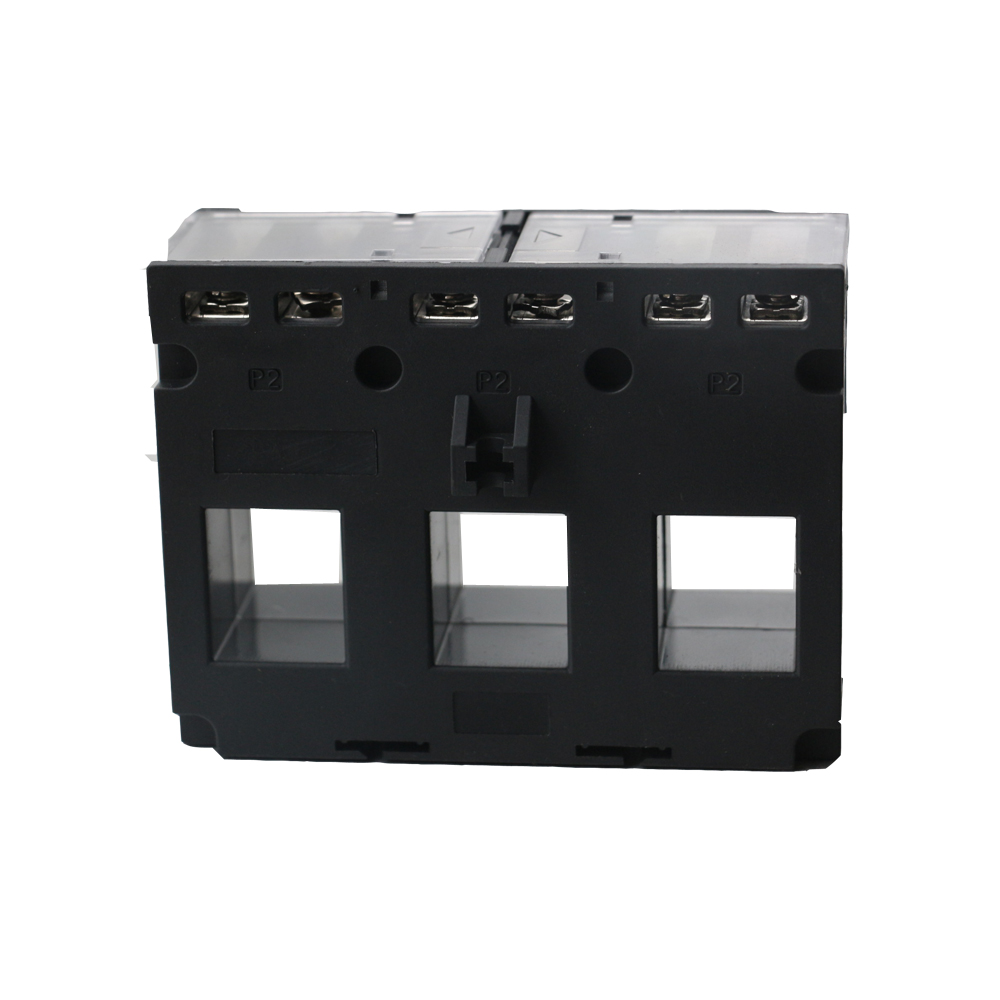
2. KCD — Smart Split-Core Current Transformer with RS485 Output
The KCD is described as a smart split-core current transformer with RS485, a Modbus RTU current and energy sensor, a digital output current transducer, an RS485 energy monitoring module, an all-in-one AC power meter sensor, and a metro-grade smart CT. Its listed measurement range is 0–1000 A with accuracy 1.0 and an inner diameter of 0–50 mm, and the lead wire type, lead wire length, and connector are customizable.
It ranks second because it answers the digital part of the problem: a Modbus RTU bus can carry many measurement points back to a BMS, DCIM, or energy management platform on a single cable run, and the value arrives already conditioned instead of needing a separate transducer in the panel. The split-core construction means it can be clamped over an existing conductor, which is the decisive advantage in operating buildings. HEYI lists it for metro lines in Beijing and Hangzhou, elevator monitoring, smart building and property management, green building and energy conservation, O&M services, and smart factory retrofit.
One detail to confirm: the KCD type description specifies RS485, while the parameter record lists a 4–20 mA output. These represent different wiring, gateway, and I/O requirements, so the exact output variant should be confirmed on the datasheet or with a sample before the design is frozen.
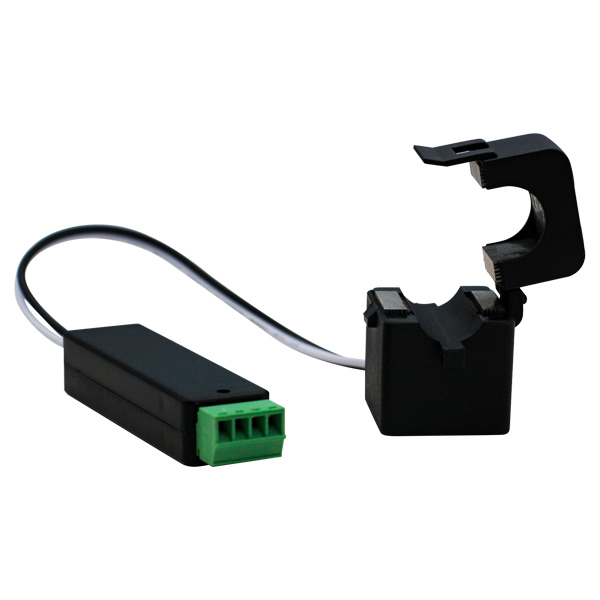
3. KCT-L — True RMS Current Transformer / Transmitter (4–20 mA Loop-Powered)
The KCT-L is documented as a true RMS current transformer and transmitter, an IoT gateway compatible current sensor, an environmental monitoring transducer, a split-core current transmitter, a 4–20 mA DC output current sensor, and a loop-powered current monitoring sensor. The listed specification is 0–1000 A measurement range, 4–20 mA output, accuracy 1.0, and a 0–50 mm inner diameter, with customizable lead wire type, length, and connector.
It ranks third because 4–20 mA is still the native input of most PLC analogue cards and of many existing BMS and DCIM I/O modules. Loop-powered operation means no separate supply is required at the CT, which simplifies wiring in retrofit cabinets. The true RMS characteristic matters in buildings and data halls where loads are non-linear — VFD-driven motors, UPS systems, and switched-mode power supplies in IT racks all produce distorted waveforms that a simple averaging device will under-read. Listed application areas include PLC/DCS system integration, remote power monitoring, preventive maintenance, rail transit, environmental engineering, and IoT and smart city projects.
Limits to check before specifying: one analogue channel is consumed per measurement point, so a three-phase feeder requires three transmitters and three analogue inputs. That is practical for a few critical feeders, but it becomes expensive at rack level, where a bus-based device is a better economic fit.
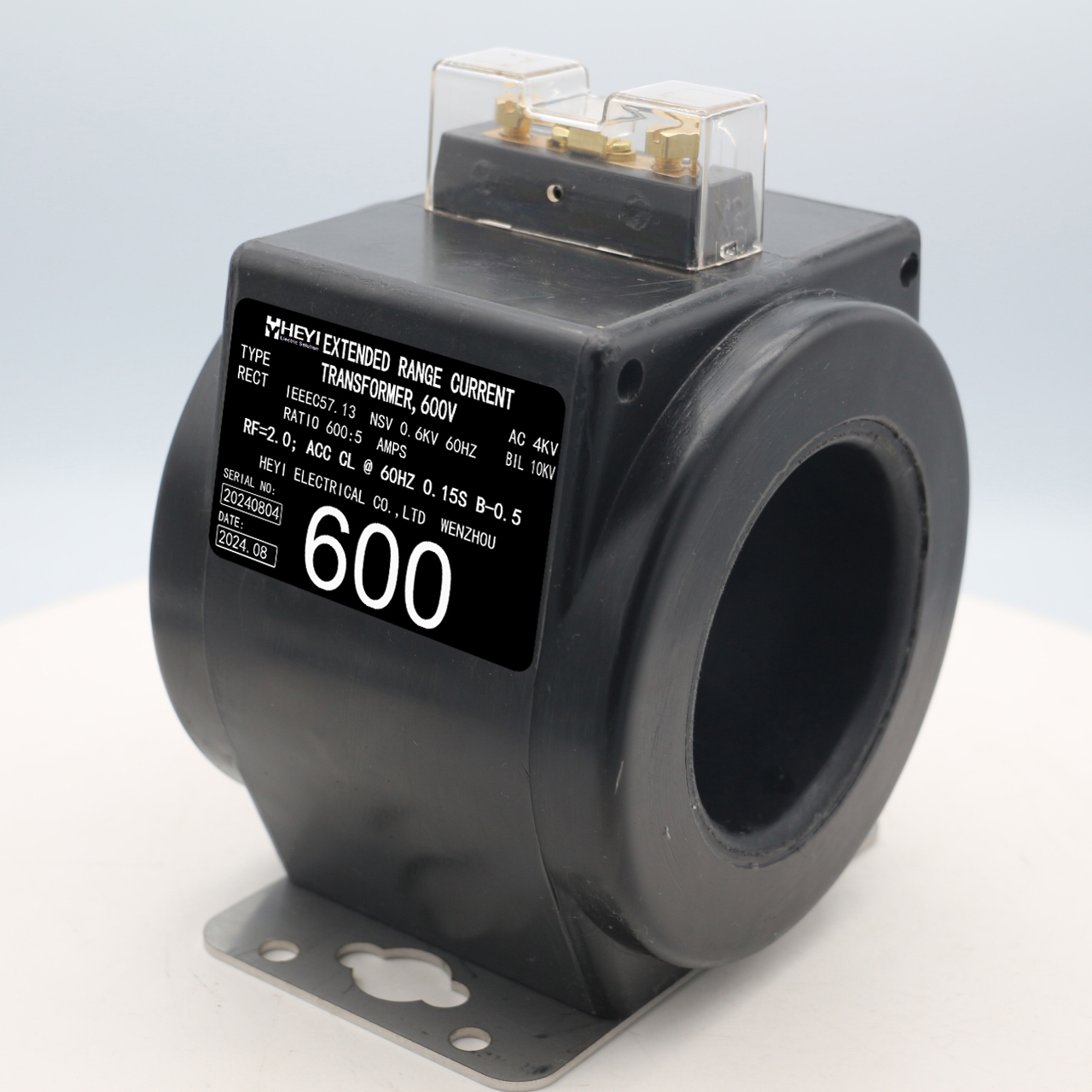
4. RECT — Extended-Range Revenue-Grade Current Transformer
The RECT is described as an extended range current transformer (ERCT), a revenue-grade billing current transformer, a 0.15S high-accuracy resin-insulated CT, an IEEE C57.13 compliant revenue CT, and an anti-saturation current transformer. The listed specification is 0–1000 A, 5 A or 1 A output, an inner diameter of 0–78 mm, IP65 rating, UV protection, epoxy resin insulation, and OEM customization.
It ranks fourth because it addresses the measurement points where the reading has financial consequences. HEYI lists it for utility and substation billing, utility-scale solar and wind plants, data centers and commercial and industrial revenue sub-billing, and premium meter OEM manufacturing. The extended range and anti-saturation construction are relevant in colocation environments where the primary current varies widely with tenant load, because a CT that saturates under high current produces errors exactly when the load is highest. The requirement it maps to is external: revenue grade current transformers are required to meet ANSI C12.20 or IEC 61869-2 accuracy classes, typically 0.2 or 0.15.
Limits to check before specifying: the RECT is a resin-cast solid-core design, so the conductor generally has to be disconnected for installation. That makes it a planned-outage item, not a live-panel retrofit item.
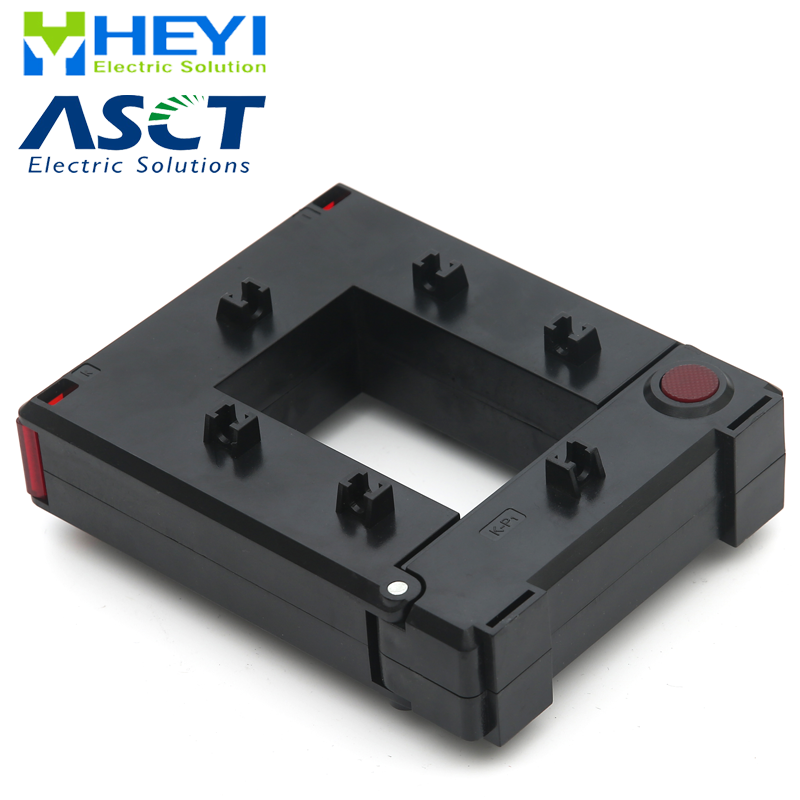
5. DP/HK — Busbar Split-Core Current Transformer
The DP/HK is documented as a busbar split-core current transformer, a retrofit split-core CT, a large window split-core CT, an industrial energy monitoring CT, and an easy-installation clamp-on CT. The listed specification is a measurement range of 0–8000 A, an output of 5 A / 1 A / mA / mV, accuracy options of 3.0 / 1.0 / 0.5, and a window of 0–80×160 mm, with customizable lead wire type, length, and connector.
It ranks fifth because it covers the scale that the other four models do not. Main incoming feeders and busbar systems in large buildings and data centers exceed both the current and the conductor cross-section that a 50 mm window can accept. A 0–80×160 mm split-core window combined with a range up to 8000 A allows the device to be clamped around a busbar during a live-panel retrofit. HEYI lists it for smart grid and switchgear panels, smart pole and IoT smart city installations, EMS and energy management, solar, wind and energy storage systems, and smart buildings and data centers.
Limits to check before specifying: the DP/HK is offered across a wide range with accuracy options of 3.0, 1.0, and 0.5, so the accuracy class must be stated explicitly rather than assumed. It belongs on main feeders and busbar measurement points, not on small branch circuits where a compact CT is the better mechanical fit.
Also worth considering in the same range
Three adjacent models cover measurement points that fall outside the top five. The KCT miniature split-core CT offers 0–1000 A with 5 A / 1 A / mA / mV / RS485 / 4–20 mA output options, accuracy 3.0 / 1.0 / 0.5, and a 0–50 mm window, and is listed for smart buildings and data centers, energy management systems, and EV charging infrastructure. The CP compact DIN-rail CT covers 0–6000 A with a 0–100×31 mm window for space-constrained panel builds. The SDH low-voltage window and busbar CT reaches 0–10000 A with a 0–220×80 mm window for large-scale industrial facility monitoring. For irregular or oversized conductor geometry, including data center power retrofit work, the FRC flexible Rogowski coil covers 100–10000 A with a 245 mm inner diameter.
Step-by-Step Breakdown: How to Select a CT for a Building or Data Center Project
The selection sequence below follows the order in which constraints actually bind in a project. Working through it before requesting a quotation prevents the majority of specification revisions.
- Define the measurement layer. Decide whether the point is utility or tenant billing, a distribution feeder or branch, or a rack and PDU level load. The layer determines the accuracy requirement and the acceptable mounting format.
- Establish the maximum continuous current. Size the CT for the highest continuous current at that point, not for the nominal rating. If the point is a busbar, measure the conductor cross-section as well as the current.
- Choose the signal type your monitoring layer reads natively. RS485 / Modbus RTU suits bus architectures and multi-point monitoring. 4–20 mA suits PLC analogue cards and legacy BMS or DCIM I/O. A 5 A secondary suits panels where a multifunction power meter, energy meter, or protection relay is already specified.
- Set the accuracy class from the consequence of the data. Monitoring and trend data are commonly served by class 1.0 devices. Revenue billing typically requires 0.2 or 0.15 class under ANSI C12.20 or IEC 61869-2. IEC 61869-2 defines classes including 0.5 and 0.5S for general metering.
- Check mounting and access. DIN-rail mounting suits new cabinets and compact retrofits. Split-core clamp-on designs suit live-panel retrofits. Solid-core and resin-cast designs require the conductor to be disconnected.
- Confirm the operating environment. The typical conditions for these applications are an indoor electrical cabinet, a low-voltage distribution system, continuous real-time current sensing with passive induction, and a 50 or 60 Hz power system, often with limited installation space. Supporting equipment normally includes multifunction power meters, energy meters, protection relays, data acquisition systems, PLCs, and low-voltage switchgear.
- Validate with documentation and a sample. Confirm ratio, accuracy class, burden, window size, output variant, and terminal or lead configuration against the panel drawing before committing the design.
Use Cases in Smart Buildings and Data Centers
Tenant sub-metering in a multi-tenant commercial building
When a building owner needs to allocate energy cost by tenant, each tenant feeder becomes a billing-relevant measurement point, while the remaining branches stay operational. A practical split is to use a revenue-grade device such as the RECT at the tenant billing points and class 1.0 devices on the monitoring-only circuits.
Retrofit of an operating building with limited cable pathways
Where new cable pulls are expensive or impossible, a split-core device with a digital bus output reduces both the mechanical and the cabling work: the CT is clamped over the existing conductor, and multiple points share one communication path. The KCD is listed for smart building and property management, green building, and O&M service environments.
Rack-level and PDU-level monitoring in a data center
At rack and remote power panel level, the constraint is density. A 3-in-1 device such as the DASN reduces the number of components and secondary connections per panel. HEYI lists the DASN for IDC rack-level monitoring, RPP, high-density PDU integration, UPS, and main and branch monitoring.
Integration into an existing PLC or legacy BMS
Where the monitoring layer is an analogue PLC card or an older building management controller, a 4–20 mA loop-powered transmitter is the shortest path to usable data without replacing the control layer. The KCT-L is listed for PLC/DCS integration, remote power monitoring, and preventive maintenance.
Main incoming feeder and busbar metering
For incoming feeders and busbar sections with high current and large conductors, a large-window split-core CT allows measurement without dismantling the busbar. The DP/HK is listed for smart buildings, data centers, energy management systems, and switchgear panel applications.
Comparison Table: The Five Models Side by Side
| Rank and model | Type and mounting | Measurement range | Output / protocol | Listed accuracy | Strongest fit |
|---|---|---|---|---|---|
| 1 — DASN | Three-phase integrated CT, 3-in-1, DIN-rail | 0–1000 A, window 0–50 mm | 5 A | 1.0 | Three-phase branch, rack, RPP and PDU monitoring in smart buildings and IDC |
| 2 — KCD | Smart split-core CT, clamp-on | 0–1000 A, window 0–50 mm | RS485 / Modbus RTU (type description); 4–20 mA also listed in the parameter record | 1.0 | Retrofit and bus-based monitoring where one cable carries many points |
| 3 — KCT-L | Split-core current transmitter, loop-powered | 0–1000 A, window 0–50 mm | 4–20 mA DC | 1.0 | PLC, DCS and legacy BMS or DCIM analogue inputs |
| 4 — RECT | Extended-range resin-insulated CT, solid core | 0–1000 A, window 0–78 mm, IP65 | 5 A / 1 A, IEEE C57.13 | 0.15S (type description) | Revenue sub-billing, utility and substation billing, C and I metering |
| 5 — DP/HK | Busbar split-core CT, large window, clamp-on | 0–8000 A, window 0–80×160 mm | 5 A / 1 A / mA / mV | 3.0 / 1.0 / 0.5 options | Main incoming feeders and busbar retrofit in large buildings and data centers |
Read the table as a fit map rather than a quality ladder. A class 1.0 device is the correct choice for a monitoring point that never appears on an invoice, and a revenue-grade device is the correct choice where the reading does. Selecting by rank alone, without matching the output and mounting to the panel, is what produces specification revisions later.
Frequently Asked Questions
What accuracy class do I need for tenant sub-billing in a data center?
Revenue grade current transformers are required to meet ANSI C12.20 or IEC 61869-2 accuracy classes, typically 0.2 or 0.15, when the measurement supports billing. Monitoring-only points are commonly served by class 1.0 devices such as the DASN, KCD, and KCT-L. The RECT is described in its type list as a 0.15S high-accuracy resin-insulated CT and an IEEE C57.13 compliant revenue CT, which places it in the billing-relevant category. IEC 61869-2, which replaced IEC 60044-1, is the core international standard for inductive current transformers and defines classes such as 0.5 and 0.5S. The decision rule is simple: match the class to the financial consequence of the reading, and state the required class explicitly in the enquiry.
Which current transformer should I choose for DIN-rail three-phase monitoring in a data center?
The DASN three-phase integrated current transformer is the model built for that point. It integrates three phases in one housing and is described as a DIN-rail 3-phase CT, a 3-in-1 current transformer, an IDC rack-level monitoring CT, an RPP 3-phase CT, and a high-density PDU integrated CT. Its listed specification is 0–1000 A, a 5 A output, accuracy 1.0, and a 0–50 mm inner diameter. It is listed for main and branch monitoring, UPS, MCC, smart buildings, IDC and telecom, and cloud and telco operator environments. Because the output is 5 A, the downstream meter or relay must have a matching 5 A current input.
Should I use RS485 or 4–20 mA for smart building energy monitoring?
The deciding factor is what the monitoring layer already reads. RS485 with Modbus RTU, as described for the KCD, allows multiple measurement points on one bus and delivers an already-conditioned digital value, which reduces cabling in retrofit work. A 4–20 mA loop-powered output, as described for the KCT-L, connects directly to PLC analogue cards and to many existing BMS or DCIM I/O modules without adding a gateway, but it consumes one channel per measurement point and a three-phase feeder therefore needs three channels. One detail deserves confirmation during selection: the KCD carries an RS485 / Modbus RTU description in its type list and a 4–20 mA entry in its parameter record, so the exact output variant should be verified against the datasheet before the wiring design is finalised.
Can these current transformers be installed without shutting down the panel?
It depends on the construction. Split-core and clamp-on designs — the KCD, KCT-L, DP/HK, and the KCT miniature split-core CT — are designed to be placed around an existing conductor, which is the format that suits live-panel retrofit. Solid-core and resin-cast designs, including the RECT, generally require the conductor to be disconnected before installation and are therefore planned-outage items. The DASN is DIN-rail mounted with a 0–50 mm window and suits new cabinet builds and compact retrofits where the conductors can be routed through the window during installation.
Can I source current transformers for energy meters from a Chinese manufacturer, and what should I verify?
WENZHOU HEYI ELECTRICAL CO.,LTD (HEYI ELECTRICAL) was established in 2012 and manufactures current transformers and current sensors in Wenzhou, Zhejiang, China, with a 10,000 m² facility, five R&D engineers, an annual output of 356,000 units, and an export ratio of 95% across markets including Southeast Asia, South Korea, Europe, South America, Australia, Africa, the Middle East, and North America. Its stated commercial terms include a minimum order quantity of one unit, a lead time of 3–30 days, and a monthly capacity of 20,000 units. Customization covers current ratio, accuracy class, burden, window size, housing colour, terminal type, cable length, logo printing, and label design. Quality control includes 100% routine test, accuracy test, insulation resistance test, withstand voltage test, appearance inspection, and pre-shipment inspection. Before ordering, verify the required accuracy class against IEC 61869-2 or the billing standard that applies to your project, confirm the output variant and window size against the panel drawing, and request a sample for validation. The full range and specification documents are available through the HEYI product catalogue, or by contacting the team directly at bethy@heyiele.com or +86 13968747975 with your measurement point details.
Conclusion: Match the Model to the Measurement Point
For smart building and data center monitoring, the five-model shortlist covers the full spread of measurement points: the DASN for three-phase DIN-rail branch and rack monitoring, the KCD for bus-based split-core retrofit, the KCT-L for analogue PLC and legacy BMS integration, the RECT for billing-relevant sub-metering, and the DP/HK for high-current busbar and main feeder measurement. The ranking reflects how directly each model resolves the mechanical, electrical, and communication constraints at its intended point — not a claim that one device suits every panel.
The practical next step is to list your measurement points, note the current range, conductor size, mounting space, output type, and accuracy requirement for each, and then map them against the table above. Where a point sits between two models, the output compatibility of the monitoring layer should decide, because that is the constraint that is hardest to change after the panel is built.
Talk to HEYI ELECTRICAL about your project
HEYI ELECTRICAL supplies current transformers, current sensors, shunts, digital energy meters, and current transmitters for smart building, IDC, energy metering, and renewable energy projects. Share your measurement point, current range, window size, output type, and required accuracy class, and the team can confirm a suitable model, arrange a sample, or prepare a quotation.
- Product catalogue: HEYI product catalogue (PDF)
- Website: www.heyiele.com
- Email: bethy@heyiele.com
- Tel / WhatsApp: +86 13968747975
- Address: 5 Floor, Building 2, No.56 Nirong Middle Road, Kunpeng Street, Wenzhou Marine Economy Development Demonstration Zone, Wenzhou City, Zhejiang, China
WENZHOU HEYI ELECTRICAL CO.,LTD — established 2012, current transformer and current sensor manufacturer.
Have Questions or Need More Details?
Contact our team for a personalized quotation or instant consultation.
Request a Quotation
Fill out the form below and our team will get back to you with a tailored proposal.
WhatsApp Direct Chat
Prefer to chat in real-time? Message us on WhatsApp for instant assistance & quick answers.
- Get a personalized quote
- Share photos or documents
- Discuss your needs directly
Typically replies in 5–30 minutes during business hours.