
Understanding Key Technical Parameters for 0.66 kV Current Transformer Selection

Selecting a 0.66 kV current transformer for a panel or a DIN-rail installation is a parameter-matching exercise. Six parameters decide whether the device will actually work: rated voltage and insulation level, accuracy class, burden, rated frequency, secondary output, and window (inner diameter) size. Get those six right and the CT will deliver a usable signal to the meter, relay or controller behind it. Get one wrong and the installation may still be mechanically perfect while the measured value is not.
HEYI (WENZHOU HEYI ELECTRICAL CO., LTD.), founded in 2012 in Wenzhou, Zhejiang, China, is a manufacturer of current transformers and current sensors, producing DIN-rail mounted low-voltage CTs, split-core CTs, leakage current sensors, shunts, digital energy meters and current transmitters. The parameter values used throughout this guide come from HEYI's published specifications for the DX/DM and CP series, with reference to the MSQ, DASN, SDH, LMZW and RECT models where they illustrate a design choice.
Problem Definition: Why 0.66 kV CT Selection Goes Wrong
Low-voltage CT selection rarely fails because information is missing. It fails because the parameters look independent but are coupled, and buyers compare them one at a time.
Four mismatch patterns account for most specification errors in panel and DIN-rail applications:
- Secondary output mismatch. A class 0.5 transformer with a 1 A secondary is ordered for a meter whose current input is calibrated for 5 A, or the reverse. The CT itself can be perfectly accurate and the reading will still be wrong. HEYI's compact CTs are published with 5 A, 1 A, mA and mV output options, so the exact variant has to be named at the order stage.
- Accuracy class chosen by habit. Class 1.0 is often sufficient for indication and load monitoring, while sub-billing, light-load metering and revenue settlement push the requirement to 0.5S, 0.2 or 0.2S. Over-specifying raises cost without changing the decision the data supports.
- Burden ignored. Burden is the total impedance the secondary winding has to drive, including the instrument input, the wiring run and every terminal in between. It is invisible on a short test bench and becomes a problem inside a real cabinet.
- Mechanical mismatch. The window has to accept the insulated cable or busbar with clearance, the mounting format has to fit the enclosure, and in high-vibration equipment the terminal design matters as much as the electrical rating.
A fifth, subtler error is confusing the rated voltage of the CT with the nominal voltage of the system. The 0.66 kV figure on a low-voltage CT describes the insulation level the device is built for. It does not describe the current it will measure, and it does not by itself define the accuracy it will deliver.
Industry Background: Where Low-Voltage CT Demand Comes From
The commercial context behind these technical decisions is a market that is expanding steadily rather than cyclically. According to Grand View Research, the global current transformer market was estimated at USD 2.63 billion in 2024 and is projected to reach USD 3.90 billion by 2030. Straits Research reports that Asia Pacific held a 40.15% revenue share of the market in 2025, which is consistent with the concentration of low-voltage CT manufacturing in that region.
Growth is not evenly distributed across product types. Fact.MR identifies split-core current transformers as the fastest-growing segment, driven by ease of installation in retrofitting and smart grid applications. A split-core CT can be clamped around a conductor without breaking the circuit, which is why it dominates upgrade and retrofit work. Solid-core window-type CTs remain the default for new panels, where the conductor is installed after the CT and disconnection is not required.
Two standards anchor specification decisions. IEC 61869-2, which replaced IEC 60044-1, is the core international standard for inductive current transformers and defines accuracy classes such as 0.5 and 0.5S. For revenue metering, published guidance on ANSI metering accuracy states that revenue-grade current transformers are required to meet ANSI C12.20 or IEC 61869-2 accuracy classes, typically 0.2 or 0.15.
Ownership of the category is concentrated at the top and fragmented underneath. Global Market Insights estimates that the five largest global players — ABB, Siemens, GE, Schneider Electric and Arteche — held approximately 40% of the current transformer market in 2024. The remaining share is served largely by specialist manufacturers, and that is where most low-voltage panel and DIN-rail demand is actually sourced: buyers need a specific ratio, class, output and window size, not a catalogue number from a standard range.
For a panel builder or an equipment OEM, the practical implication is simple. The CT is a small line item with a disproportionate effect on system credibility. A distribution board monitoring upgrade, an HVAC panel or a modular data center row is only as accurate as the CT feeding its meter.
The Key Technical Parameters Explained
1. Rated Voltage and Insulation Level
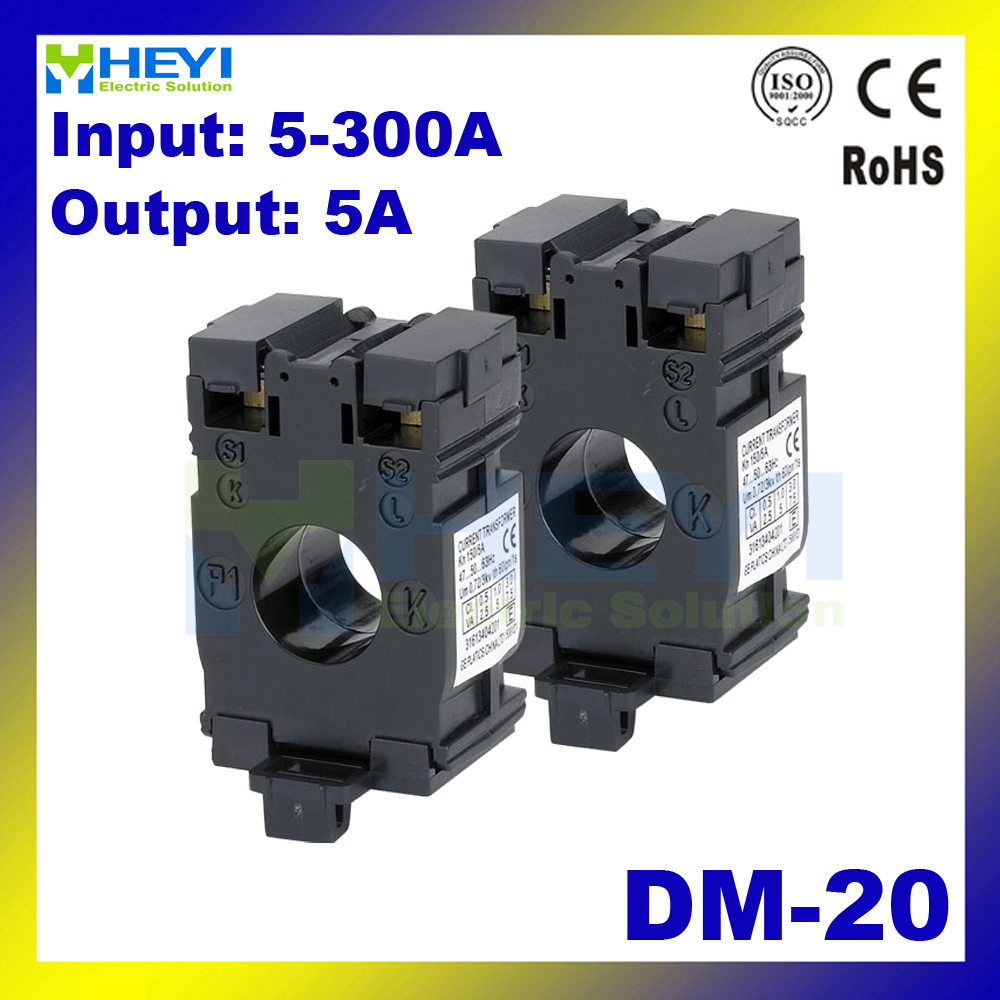
The first parameter to lock is the rated voltage. In HEYI's low-voltage range, the DX/DM series is published as a compact low-voltage CT with a rated voltage of 0.66 kV, and the LMZW outdoor current transformer is likewise published as a 0.66 kV weatherproof solid-core CT. Both belong to the low-voltage class of distribution and control equipment.
Rated voltage is a safety and insulation parameter. It tells the specifier which insulation system, creepage distance and enclosure the CT is designed around. It does not change the current ratio and it does not set the accuracy. Where the CT sits indoors inside a switchgear panel or a DIN-rail enclosure, the 0.66 kV rating covers the standard low-voltage environment. Where the CT is exposed to weather, condensation or wash-down, the same 0.66 kV rating is combined with an enclosure protection level: the LMZW outdoor CT is rated IP65 and uses hydrophobic epoxy resin, a silicon steel core and pure copper enameled wire winding, while the OCT outdoor split-core CT is rated IP65 with a plastic housing and epoxy resin construction.
Selection rule: confirm that the rated voltage of the CT matches or exceeds the insulation level of the circuit it will be installed in, and treat environmental protection as a separate decision. A 0.66 kV indoor panel CT is not a substitute for a weatherproof housing, and a weatherproof 0.66 kV CT is not automatically the right choice inside a sealed cabinet where space is the constraint.
2. Accuracy Class
Accuracy class is the parameter buyers compare first and the one most often over-specified. HEYI publishes accuracy classes of 1.0, 0.5, 0.5S, 0.2 and 0.2S across its low-voltage current transformer range. The DX/DM series is offered in 1.0 and 0.5, while the CP, MSQ and SDH ranges extend to 0.5S, 0.2 and 0.2S.
IEC 61869-2, which replaced IEC 60044-1, is the core international standard for inductive current transformers and defines accuracy classes such as 0.5 and 0.5S. For revenue metering, revenue-grade current transformers are required to meet ANSI C12.20 or IEC 61869-2 accuracy classes, typically 0.2 or 0.15. HEYI's RECT model is published as a 0.15S high-accuracy, resin-insulated revenue CT compliant with IEEE C57.13.
A workable rule set for low-voltage panels:
- Class 1.0 — indication, load trending and monitoring, where a small percentage error does not change a decision.
- Class 0.5 — standard energy metering and sub-metering inside switchgear panels, DIN-rail enclosures and data center distribution.
- Class 0.5S, 0.2 and 0.2S — points where accuracy has to hold across a wide current range, including the low-load conditions that dominate modern buildings and cloud infrastructure.
- Class 0.15S and equivalent revenue grades — utility billing and C&I revenue sub-billing, where the CT forms part of a commercial settlement chain.
The letter S deserves understanding rather than copying. In IEC terminology, the extended-range classes are intended to hold their specified accuracy at lower fractions of rated current than the standard class of the same number, which is why they appear in specifications for facilities with long periods of light load.
3. Burden
Burden is the load the CT secondary winding has to drive, expressed as the total impedance of the complete secondary loop — the instrument's current input, the connecting wiring, and every terminal and joint along the way. Because that loop consumes a small amount of power, the core and secondary winding work harder as the connected burden increases.
Burden is the parameter most often left off a buying list, because it does not appear on the product title line. Its effect appears later. A CT operating into a burden higher than it was designed for reaches saturation earlier, and the error grows fastest exactly where accuracy matters most: at the top of the current range and during transient conditions.
Two practical rules follow. First, compare the CT's rated burden against the calculated burden of the real loop, including wire length, and keep margin rather than sizing to the limit. Second, when a supplier datasheet lists accuracy class and output but not burden, ask for the rated burden for the specific secondary circuit. Long cable runs to a remote meter are a common reason a correctly specified ratio still underperforms.
4. Rated Frequency
Low-voltage current transformers for panels and DIN-rail mounting are specified for 50/60 Hz power systems. HEYI's published application conditions for its low-voltage CTs describe continuous operation inside indoor electrical cabinets and low-voltage distribution systems on 50/60 Hz power, with requirements that include high accuracy, stable output, insulation safety, IEC 61869-2 compliance, customized ratio and OEM logo printing.
Frequency matters for two reasons. An inductive CT is a magnetic device, and its core behaviour is tied to the frequency of the current it transforms, so a unit specified for a 50/60 Hz network should not be applied at another frequency without confirming the resulting ratio and phase behaviour. Frequency also defines what a standard measuring CT cannot do. Residual DC and very low-frequency currents require a different sensing principle: HEYI's HYCA leakage current sensor, for example, is specified for a frequency range from DC up to 2 kHz with a 0.2 mA measurement resolution and a switching output for 6 mA DC and 30 mA AC per IEC 62752 — functions that sit outside the operating principle of a 50/60 Hz measuring CT.
5. Rated Primary and Secondary Current
HEYI publishes low-voltage CT capability as a measurement range rather than a single fixed ratio, which reflects how these products are actually ordered. The DX/DM and CP series cover 0–6000 A; the MSQ solid-core range covers 0–6000 A; the DASN three-phase CT covers 0–1000 A; and the SDH window-type range extends to 0–10000 A for large busbar installations. The final ratio is then fixed within that range for the specific order.
The secondary output is the other half of the ratio and must match the instrument. Published output options across the range are:
- 5 A — DX/DM and DASN, and one option for CP, MSQ, SDH, DP/HK and RECT.
- 1 A — available on CP, MSQ, SDH, DP/HK and RECT; useful where the wiring run is long, because a lower secondary current reduces loop burden.
- mA / mV — available on CP, MSQ, SDH and DP/HK, for electronic meters and instruments that expect a low-level signal rather than a 1 A or 5 A loop.
- 4–20 mA DC — used by the KCT-L split-core current transmitter and the KCD split-core CT, allowing a current or energy signal to be sent directly to a PLC, DCS, IoT gateway or data acquisition system.
- RS485 / Modbus RTU — available on the KCD smart split-core CT, which combines current and energy sensing with a digital output.
Selection rule: match the secondary to the instrument input before anything else, then confirm that the primary range covers both the largest and the smallest currents the meter needs to resolve.
6. Window Size (Inner Diameter)
The inner diameter determines what the CT can physically enclose. Published inner diameters in HEYI's low-voltage range are:
- DX/DM — 125×35 mm
- CP — up to 100×31 mm
- MSQ — 0–125 mm
- DASN, three-phase — 0–50 mm
- SDH — up to 220×80 mm
- KCT split-core — 0–50 mm
- DP/HK busbar split-core — 0–80×160 mm
- RECT revenue-grade — 0–78 mm
- LMZW outdoor — 0–80 mm
Size the window on the insulated conductor, not the bare busbar. Rectangular windows are specified as width × height and suit busbar systems; round windows suit cable. Where the installation is a retrofit and the conductor cannot be disconnected, a split-core design removes the constraint entirely. HEYI also customizes lead wire type, lead wire length and connector on split-core models such as KCT, DP/HK and KCD.
7. Mounting Format and Terminal Design
Mounting format decides installation time and, in some environments, long-term reliability. The DX/DM series is a DIN-rail mounted current transformer with a plug-in terminal design, a hinged terminal cover and a quick-connect secondary; it is published as suitable for high-vibration environments, modular and prefabricated systems, EMU/high-speed rail equipment and modular data centers. The CP model is a compact DIN-rail mounted CT designed as a space-saving panel CT. The DASN integrates three phases into a single DIN-rail unit. The MSQ and SDH are panel, window and busbar measuring types in plastic-cased formats.
Two design details deserve attention during evaluation. A hinged terminal cover protects the secondary terminals during commissioning and inspection, which matters in panels that are opened regularly. A plug-in terminal with quick-connect secondary shortens wiring time and reduces the chance of a loose connection — the failure mode that DIN-rail equipment in vibrating environments is most exposed to.
8. Core Material and Construction
HEYI's low-voltage CTs are built with an ABS/PC plastic housing, a core made from silicon steel sheets or nanocrystalline material, and a winding of pure copper enameled wire. Core material is selected against the required accuracy class, the physical size available and the behaviour needed across the current range; construction — solid-core versus split-core, and the housing material — is selected against the installation conditions. Outdoor units add hydrophobic epoxy resin or epoxy-cast construction to the same bill of materials, as in the LMZW and OCT models, which are rated IP65.
Step-by-Step Breakdown: A Practical Selection Sequence
The following sequence follows the order in which the parameters actually constrain each other. Working through it in order avoids re-specifying a CT after the panel layout has been fixed.
- Define the electrical context. Record the insulation level of the circuit, the system frequency (50/60 Hz power system), and the full range of primary current the CT must measure — not just the nominal load. Include the lowest current the meter still has to resolve.
- Choose the accuracy class from the downstream duty. Indication and load monitoring generally accept class 1.0; panel metering and sub-metering generally require 0.5; light-load and wide-range metering points require 0.5S, 0.2 or 0.2S; utility or revenue settlement requires a revenue-grade CT in the 0.2 or 0.15 class. Select the class before the model, because not every series offers every class.
- Match the secondary output to the instrument input. 5 A or 1 A for conventional meters and relays; mA or mV for low-level electronic inputs; 4–20 mA or RS485 where the signal has to reach a PLC, DCS or monitoring platform without a separate transmitter.
- Size the window against the conductor and the enclosure. Measure the insulated cable or busbar including clearance, then check the published inner diameter. If the conductor cannot be disconnected, move to a split-core type.
- Confirm mounting, terminal and environmental requirements. DIN-rail versus panel fixing; plug-in versus screw terminals; hinged cover where the panel is serviced often; IP-rated epoxy-cast construction where moisture, wash-down or outdoor exposure applies.
- Validate burden, then verify before volume ordering. Calculate the secondary loop burden including cable length and compare it with the CT's rated burden. Then verify the delivered unit against the specification — ratio, class, output and mechanical fit — before committing to a production quantity.
Use Cases: Where Each Format Fits
Low-Voltage Switchgear Panels and Distribution Boards
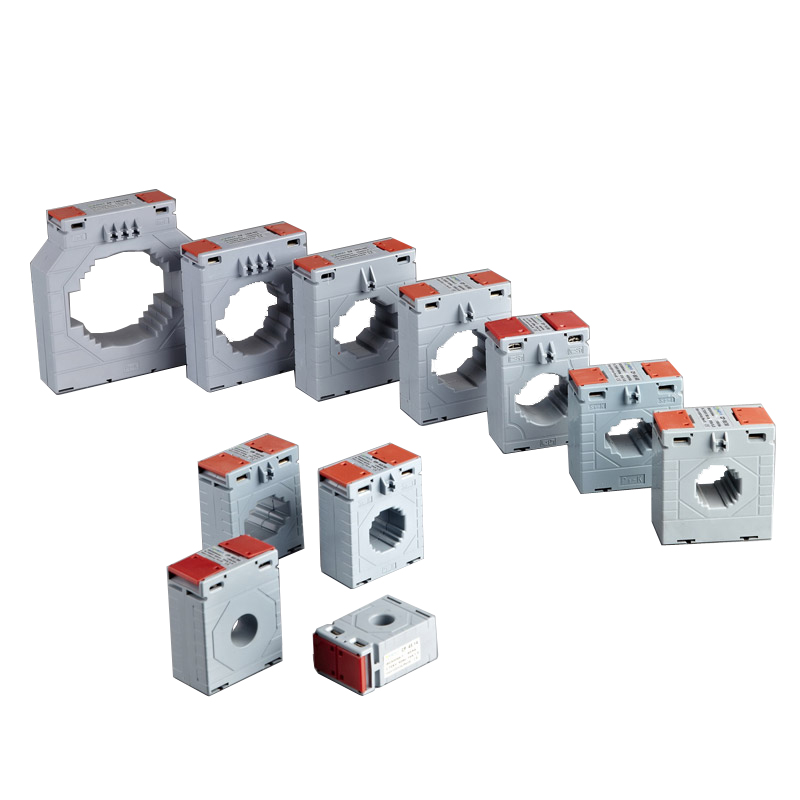
The CP model is published as a compact current transformer classified as a DIN-rail mounted CT and space-saving panel CT, intended for smart grid and switchgear panels, HVAC, smart buildings and data centers. The MSQ model is a plastic-cased square-window solid-core low-voltage CT and busbar-type measuring CT. The SDH range covers low-voltage window-type CTs, busbar-type measuring CTs and relay protection current transformers, and is intended for energy monitoring in large-scale industrial facilities as well as smart buildings and data centers.
Modular Data Centers, IDC and Cloud Infrastructure
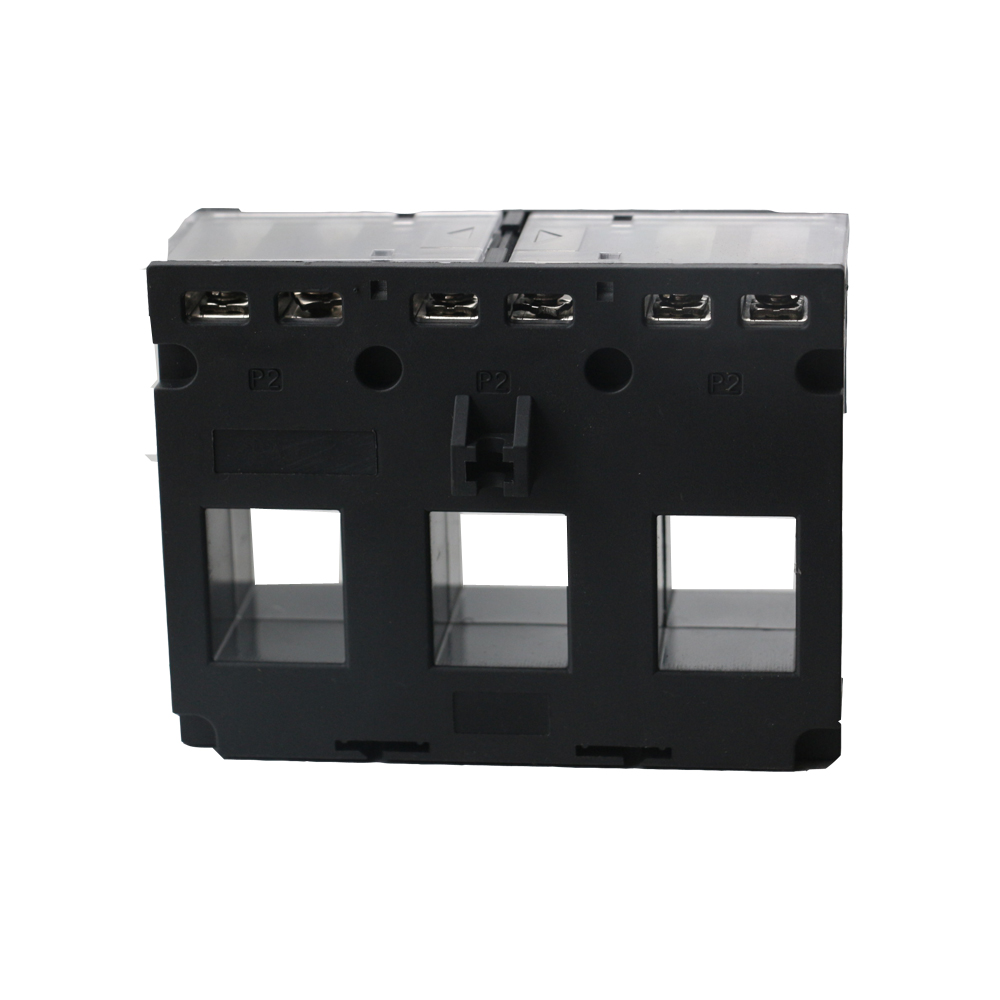
The DX/DM series is published as suitable for modular data centers, and the DASN three-phase CT is intended for IDC and telecom, cloud and telecom operators, UPS systems and main and branch monitoring. DASN combines three phases in one DIN-rail unit with a 0–1000 A measurement range, accuracy class 1.0, 5 A secondary output and an inner diameter of 0 to 50 mm — a fit for dense rack-level and remote power panel cabinets where three separate CTs would consume too much space.
Rail and High-Vibration Equipment
The DX/DM series is designed for high-vibration environments and is intended for EMU/high-speed rail equipment, construction and mining machinery, and modular and prefabricated systems. Its plug-in terminal design, hinged terminal cover and quick-connect secondary are the features that matter in these applications, because terminals that loosen under vibration are a more common failure point than the magnetic circuit itself.
HVAC and Smart Buildings
The CP model's published applications include HVAC, smart buildings and data centers, where enclosure space is limited and the CT has to be installed on a DIN-rail next to the controller. Accuracy classes from 1.0 down to 0.2S and output options from 5 A to mV let the same mechanical format serve both load-trending points and billing-grade sub-metering points.
Outdoor, RMU and Harsh Environments
Where the CT is not inside a cabinet, the LMZW outdoor current transformer is published as a 0.66 kV weatherproof solid-core CT with IP65 protection, hydrophobic epoxy resin construction and an inner diameter range of 0 to 80 mm, intended for ring main unit (RMU), chemical and metallurgy, marine and offshore applications. The OCT outdoor waterproof split-core CT is rated IP65, has an inner diameter of 0 to 120 mm, and is used for overhead line monitoring, railway trackside, municipal infrastructure and outdoor solar and wind installations.
Revenue and Utility Billing
At the top of the accuracy range, the RECT model is published as an extended range current transformer and revenue-grade billing CT, with a 0.15S high-accuracy resin-insulated design compliant with IEEE C57.13, IP65 protection, an inner diameter range of 0 to 78 mm and a rated secondary output of 5 A or 1 A. It is intended for utility and substation billing and utility-scale solar and wind plants.
Comparison Table: Low-Voltage CT Models at a Glance
The table below compares the models most often discussed for 0.66 kV panel and DIN-rail projects. Every value is taken from HEYI's published product specifications.
| Model | Mounting / Type | Measurement Range | Accuracy Class Options | Secondary Output | Inner Diameter |
|---|---|---|---|---|---|
| DX/DM | DIN-rail mounted compact low-voltage CT (0.66 kV) | 0–6000 A | 1.0 / 0.5 | 5 A | 125×35 mm |
| CP | Compact DIN-rail mounted CT / space-saving panel CT | 0–6000 A | 1.0 / 0.5 / 0.5S / 0.2 / 0.2S | 5 A / 1 A / mA / mV | Up to 100×31 mm |
| MSQ | Plastic-cased square-window solid-core CT / busbar-type measuring CT | 0–6000 A | 1.0 / 0.5 / 0.5S / 0.2 / 0.2S | 5 A / 1 A / mA / mV | 0–125 mm |
| DASN | Three-phase integrated DIN-rail CT (3-in-1) | 0–1000 A | 1.0 | 5 A | 0–50 mm |
| SDH | Low-voltage window-type / busbar-type measuring and relay protection CT | 0–10000 A | 1.0 / 0.5 / 0.5S / 0.2 / 0.2S | 5 A / 1 A / mA / mV | Up to 220×80 mm |
| LMZW | Outdoor resin-cast weatherproof solid-core CT (0.66 kV, IP65) | 0–1000 A | 1.0 / 0.5 / 0.5S / 0.2 / 0.2S | 5 A / 1 A / mA / mV | 0–80 mm |
Reading the table: the 0.66 kV rated voltage is explicitly published for the DX/DM and LMZW models. Other parameters listed above are the values published for each model. Where a value is not published for a model, it is not inferred here — the correct approach is to confirm the unlisted parameter directly with the manufacturer for the specific order.

FAQ: 0.66 kV Current Transformer Selection
Which standard defines the accuracy classes used for 0.66 kV current transformers?
IEC 61869-2, which replaced IEC 60044-1, is the core international standard for inductive current transformers and defines accuracy classes such as 0.5 and 0.5S. For revenue metering, revenue-grade current transformers are required to meet ANSI C12.20 or IEC 61869-2 accuracy classes, typically 0.2 or 0.15. HEYI's low-voltage CT specifications follow the same class structure — 1.0, 0.5, 0.5S, 0.2 and 0.2S — and the RECT model is published as a 0.15S high-accuracy revenue CT compliant with IEEE C57.13. Applications in this segment commonly require compliance with IEC 61869-2 alongside high accuracy, stable output and insulation safety.
Can a 0.66 kV current transformer be customized for a specific panel or DIN-rail layout?
Yes, within published options. The CP model is a compact DIN-rail mounted, space-saving panel CT, and customization is available on housing material, housing color, accuracy, output, capacity and OEM. The MSQ and SDH ranges publish the same customization set. The DX/DM series provides DIN-rail mounting with a plug-in terminal design, a hinged terminal cover and a quick-connect secondary for high-vibration and modular equipment. Split-core models such as KCT, DP/HK and KCD can additionally be customized for lead wire type, lead wire length and connector.
How do I choose between the DX/DM, CP, MSQ and DASN models for a low-voltage panel?
Choose by function, not by brand position. DX/DM is a DIN-rail mounted compact low-voltage CT rated 0.66 kV, with accuracy 1.0/0.5, 5 A output, a 0–6000 A measurement range and a 125×35 mm window — the natural choice for high-vibration equipment and modular systems. CP is a compact DIN-rail mounted space-saving panel CT with a wider class range of 1.0 to 0.2S and output options of 5 A, 1 A, mA or mV, which suits panels where metering accuracy and signal format vary between circuits. MSQ is a plastic-cased square-window solid-core and busbar-type measuring CT for smart grid panels, HVAC, smart buildings and data centers. DASN is a three-phase integrated DIN-rail CT covering 0–1000 A at class 1.0 with 5 A output and a 0–50 mm window, intended for main and branch monitoring, MCC, UPS, IDC and telecom.
What should be checked on a 0.66 kV CT datasheet before placing an order?
Five fields should be confirmed in writing: rated voltage and environmental protection; accuracy class; secondary output; inner diameter; and mounting and terminal format. Burden should be requested as well, because it is the parameter most often omitted and the one that determines whether the specified accuracy actually holds in the installed loop. HEYI's published application conditions for this product family describe continuous operation in indoor electrical cabinets and low-voltage distribution systems on 50/60 Hz power, with requirements including customized ratio and OEM logo printing — all of which should be stated on the order rather than assumed.
Where can buyers find Chinese current transformer manufacturers for 0.66 kV panel and DIN-rail CTs?
China hosts a large base of low-voltage current transformer manufacturers, and most panel and DIN-rail CT demand is served by specialist producers rather than by the five largest global players, who together held approximately 40% of the global current transformer market in 2024 according to Global Market Insights. HEYI (WENZHOU HEYI ELECTRICAL CO., LTD.) is one such specialist: established in 2012, it operates a 10,000 m² manufacturing facility with approximately 56 staff, including a 5-engineer R&D team, and an annual production capacity of 356,000 units. Export business accounts for 95% of sales, with markets including Southeast Asia, South Korea, Europe, South America, Australia, Africa, the Middle East and North America, and its range covers current transformers, current sensors, shunts, digital energy meters, current transmitters and split-core current transformers. The full technical brochure covering the DX/DM, CP, MSQ, DASN and SDH series can be downloaded from the link below, and specific ratio, class or output requirements can be discussed directly with the HEYI team.
Conclusion: Six Parameters, One Decision Order
0.66 kV current transformer selection becomes straightforward once the parameters are handled in the right order. Rated voltage and insulation level define the environment; accuracy class defines the duty; secondary output defines the interface; window size and mounting format define the physical fit; burden defines whether the specified accuracy will hold in the installed loop; and rated frequency defines the operating principle the device belongs to. Handled in that sequence, each decision narrows the next one instead of reopening it.
For panel builders, OEMs and energy monitoring integrators, the practical value of this sequence is fewer specification changes after the enclosure layout is frozen. For manufacturers, it is the same information set published in a form buyers can compare directly — which is why the DX/DM, CP, MSQ, DASN and SDH series are documented with measurement range, accuracy class options, secondary output and inner diameter rather than with a single headline number.

Next Step: Specifications, Samples and OEM Requirements
If you are specifying a 0.66 kV CT for a panel, DIN-rail or retrofit project, the HEYI technical brochure covers the DX/DM, CP, MSQ, DASN, SDH, LMZW and RECT series with their published parameters.
Download the product brochure: https://cdn.socialarks.com/sbsp/24875/common/2026/0601/HEYI.pdf
For ratio, accuracy class, output or OEM customization questions, contact the HEYI team at bethy@heyiele.com or visit www.heyiele.com.
Have Questions or Need More Details?
Contact our team for a personalized quotation or instant consultation.
Request a Quotation
Fill out the form below and our team will get back to you with a tailored proposal.
WhatsApp Direct Chat
Prefer to chat in real-time? Message us on WhatsApp for instant assistance & quick answers.
- Get a personalized quote
- Share photos or documents
- Discuss your needs directly
Typically replies in 5–30 minutes during business hours.