Building a Wire Container Supply Ecosystem That Lasts
Building a Wire Container Supply Ecosystem That Lasts

Most wire container purchases start with three questions: price, load capacity, and lead time. Those questions are necessary, but they skip a more strategic question: will this container and this supplier still perform in the third year of a supply agreement, after repeated folding, stacking, transport, and storage? For distributors, 3PLs, and industrial buyers, the answer depends less on a single wire container and more on the ecosystem around it.
An ecosystem is not a slogan. It means a supplier who can keep product quality consistent across batches, protect steel against corrosion, support automated material handling, provide quality evidence, and stand behind the product after delivery. This guide explains how to evaluate that ecosystem and how to move from a one-time wire container order to a long-term supply relationship.
The Problem: Single-Order Procurement Is Not a Long-Term Strategy
Buying wire containers as a spot commodity creates hidden risks that only appear after the order is delivered and put into service.
- Inconsistent production quality: weld strength, leg verticality, grid dimensions, and wire diameter can change between batches if the factory has no disciplined quality system.
- Surface failures: containers used in humid or washdown environments need corrosion protection, not just an unspecified coating.
- No capacity commitment: a supplier with limited production depth cannot support repeat orders or seasonal demand peaks.
- Weak after-sales support: when a container fails in the field, the buyer needs process records, replacement planning, and responsive communication.
- Compliance uncertainty: export programs may require documented standards, material grades, and inspection procedures.
For distributors, the risk is doubled. When you resell a wire container, you become the quality interface between the factory and your customer. A long-term ecosystem supplier reduces that risk and turns the container into a repeatable, serviceable product line.
Industry Background: Why the Wire Container Market Is Moving Toward Systemized Supply
Wire mesh containers are no longer just simple wire baskets. According to Dataintelo, the global wire mesh container sales market was valued at approximately USD 2.34 billion in 2025 and is projected to reach USD 3.72 billion by 2034. The market is expected to expand at a CAGR of 5.2% from 2026 to 2034. Asia Pacific held the largest regional revenue share at 38.2% as of 2025, while the United States accounted for approximately 16.7% of imports under HS Code 732620 for articles of iron or steel wire in 2024.
Product-level demand is also concentrating around stackable systems. Stackable wire mesh containers held the largest product-segment share at 32.5% of total revenue in 2025. In automotive logistics, containers are often designed to reference GM 5131, Chrysler, or Ford-compatible specifications. For export packaging, ASTM D6573/D6573M covers general-purpose wirebound shipping boxes and containers for domestic and overseas shipment. These signals point to one conclusion: buyers are looking for repeatable, specification-driven supply, not one-off spot purchases.
What a Long-Term Wire Container Ecosystem Looks Like
HM Group (Dalian HuaMao Logistics Equipment Group Co., Ltd.) is a China-based manufacturer of wire mesh containers and related steel storage equipment. Founded in 2003, HM Group operates manufacturing bases in Xiamen, Nanjing, and Qingdao, with a 62,000 m² facility base. Its export-oriented business serves the EU, North America, Asia, and the Middle East, and it has established sales, technical, and service teams across the United States, Canada, Mexico, Argentina, Brazil, South Africa, Saudi Arabia, and other key regions.
The product ecosystem covers wire mesh containers, PET preform containers, cage pallets, stillages, tire racks, nestainer racks, fabric roll racks, wine barrel racks, post pallet racks, wire mesh roll containers, wire mesh decking, danish trolleys, and steel pallets. For a long-term program, this breadth means buyers can consolidate related storage equipment from one qualified source.
Material and Finish: What Makes a Container Durable
A wire container built for multi-year service is typically constructed with high-tensile steel and a zinc or galvanized coating, giving it a service life of 3 to 5 years under proper use. HM Group states that it mandates Q235 for high-strength requirements and prohibits spliced materials or inferior steel grades. For applications above 75% relative humidity, specifiers should require hot-dip galvanized or high-micron zinc plating for corrosion protection. For PET preform handling, an ultra-smooth surface finish is required to avoid damage to delicate plastic preforms.
Manufacturing Capacity and Quality Control
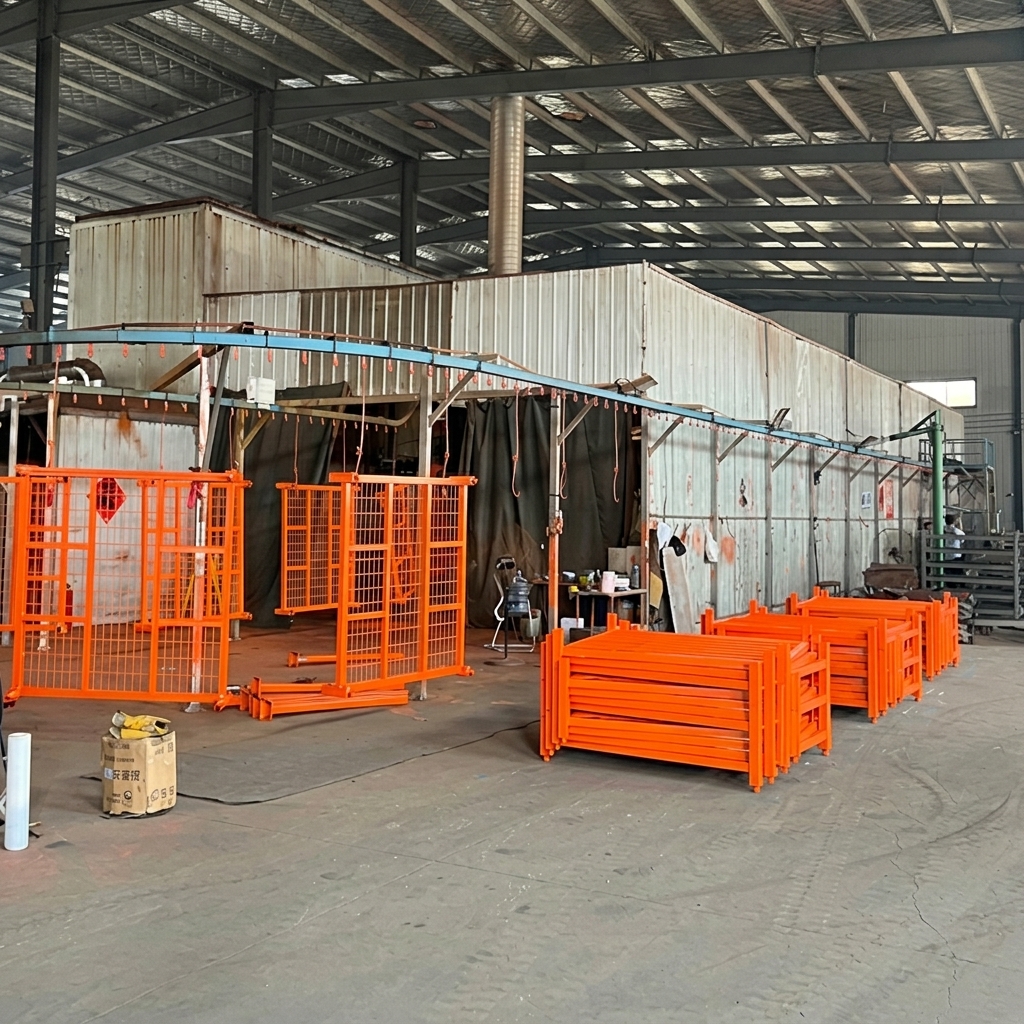
Long-term supply requires more than a good sample. HM Group reports a monthly production capacity of 40,000 sets, a minimum order quantity of 1x20GP container, and a typical production lead time of 30 to 45 days. The factory implements a six-phase quality control process from pre-production to packaging inspection. Internally, HM Group applies what it calls a Zero-Defect culture: every unit receives a factory self-inspection rather than reliance on random sampling alone. Inspection points include dimensional measurement, wire diameter checks, zinc thickness testing, semi-product inspection, and loading tests.
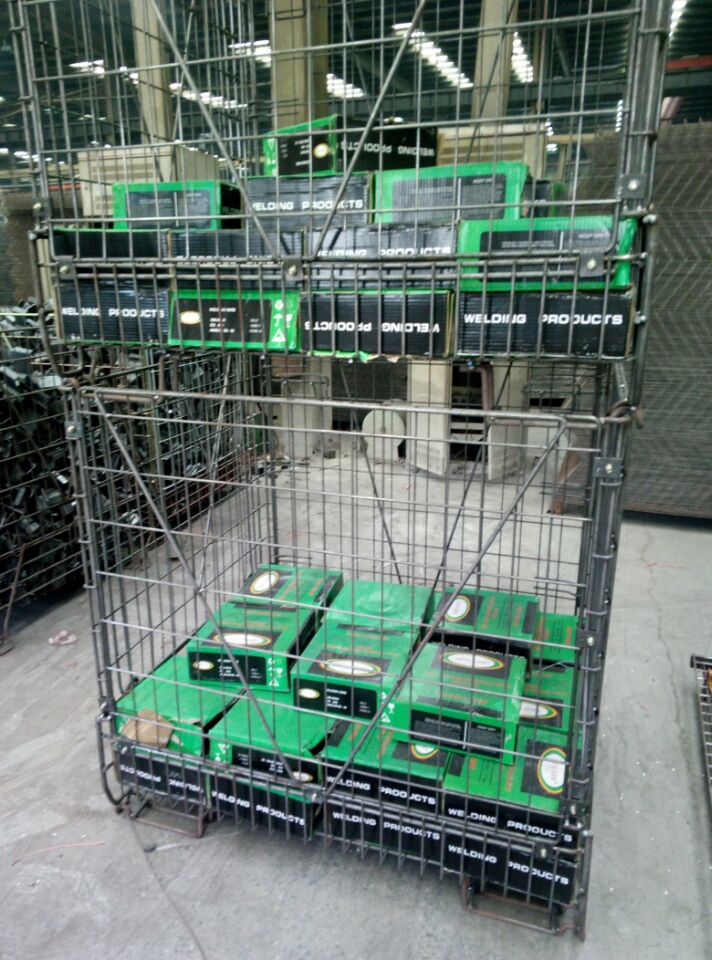
Before shipment, HM Group can offer 10% pre-shipment sampling inspection and accepts pre-shipment inspection or third-party inspection. Buyers can also receive assembly/disassembly videos and loading photos. This level of documentary evidence matters when the same product will be reordered for years.
After-Sales and Support
After-sales service is the difference between a transaction and a partnership. HM Group provides process reports, online video audit support, and a 3 to 5 year warranty under proper use. For a distributor, these services create a support story that can be passed to the end customer. For an industrial buyer, they reduce downtime and replacement cost.
Step-by-Step: From Decision to Execution in Long-Term Wire Container Procurement
The following checklist is designed for buyers who have already decided that wire containers are the right storage solution and now need to choose a supply structure that will last.
- Define the operating environment before looking at prices. Document load weight per container, stack height, grid size, wire diameter, return ratio, washdown frequency, and humidity. If humidity stays above 75% RH, specify hot-dip galvanized or high-micron zinc plating. If the product is lightweight and sensitive, like PET preforms, require an ultra-smooth surface finish.
- Map the material handling system. The container has to work with existing equipment. Supporting equipment can include electric forklifts, reach trucks, automated conveyor systems, automated container dumpers, and RFID or barcode tracking systems. Confirm that the container’s dimensional accuracy and understructure are compatible with your handling flow.
- Audit the factory’s quality system. Ask for the process from pre-production to packaging. Look for six-phase QC, 100% self-inspection, material grade policy, dimensional and coating checks, and loading tests. A serious long-term supplier should be able to show videos and measurement reports.
- Set commercial and logistics terms. HM Group works with MOQ of 1x20GP, typical production lead time of 30 to 45 days, delivery methods including EXW, FOB, CIF, DDP, and DDU, and payment terms including T/T (30% advance, 70% against copy of B/L) or L/C. Pre-shipment inspection or third-party inspection can be arranged.
- Run a pilot order to verify the baseline. Use the pilot to test dimensions, finish, folding mechanism, stacking behavior, and container loading density. Request assembly/disassembly videos and loading photos. This creates a quality baseline for future orders.
- Formalize the long-term arrangement. For distributors, this means aligning product specifications, spare or replacement supply, and after-sales support. For end users, it means documented lead times, inspection procedures, and warranty conditions that can be included in procurement systems.
Use Cases That Reward Long-Term Ecosystem Thinking
PET Preform and Beverage Plastics
In cosmetic packaging, pharmaceutical plastics, and beverage supply chains, PET preform wire containers are used for storage and in-process transport. HM Group’s PET preform containers can include a half-drop gate for ergonomic picking and a collapsible design that reduces volume by 75% when folded, equivalent to a 4:1 return ratio. They are constructed with high-tensile steel and zinc or galvanized coating for a 3 to 5 year lifespan, and require an ultra-smooth surface finish to prevent damage to preforms. Representative models include HM-PPC22 and HM-PPC14. HM-PPC22 has an exterior dimension of 1196 x 1008 x 1174 mm, a 600 kg loading capacity, and can be stacked 5+1 high. For beverage JIT projects, supporting equipment often includes forklifts, automated container dumpers, and RFID/barcode tracking systems. Open-mesh visibility also allows operators to identify SKUs without opening lids, which can reduce picking errors in high-rotation environments.
Wine Storage and Distribution
Wine bottles need ventilation, stable stacking, and protection from impact. HM Group’s metal wire containers for the wine industry include HM-WEU001, which stores 500 Bourgogne bottles, and HM-WEU005, which stores 400 Bordeaux bottles, both with an 800 kg loading capacity and 4+1 high stackability. The wire gauge range of 5 to 12 mm allows the container to balance structural strength and ventilation. HM-WEU010, another wine-oriented wire mesh container, also provides 800 kg load capacity in a 1183 x 948 x 991 mm footprint. For wineries and bottling plants, these containers can be integrated into forklift-based handling flows and returned empty at a predictable cost.
Automotive Parts and High-Density Fulfillment
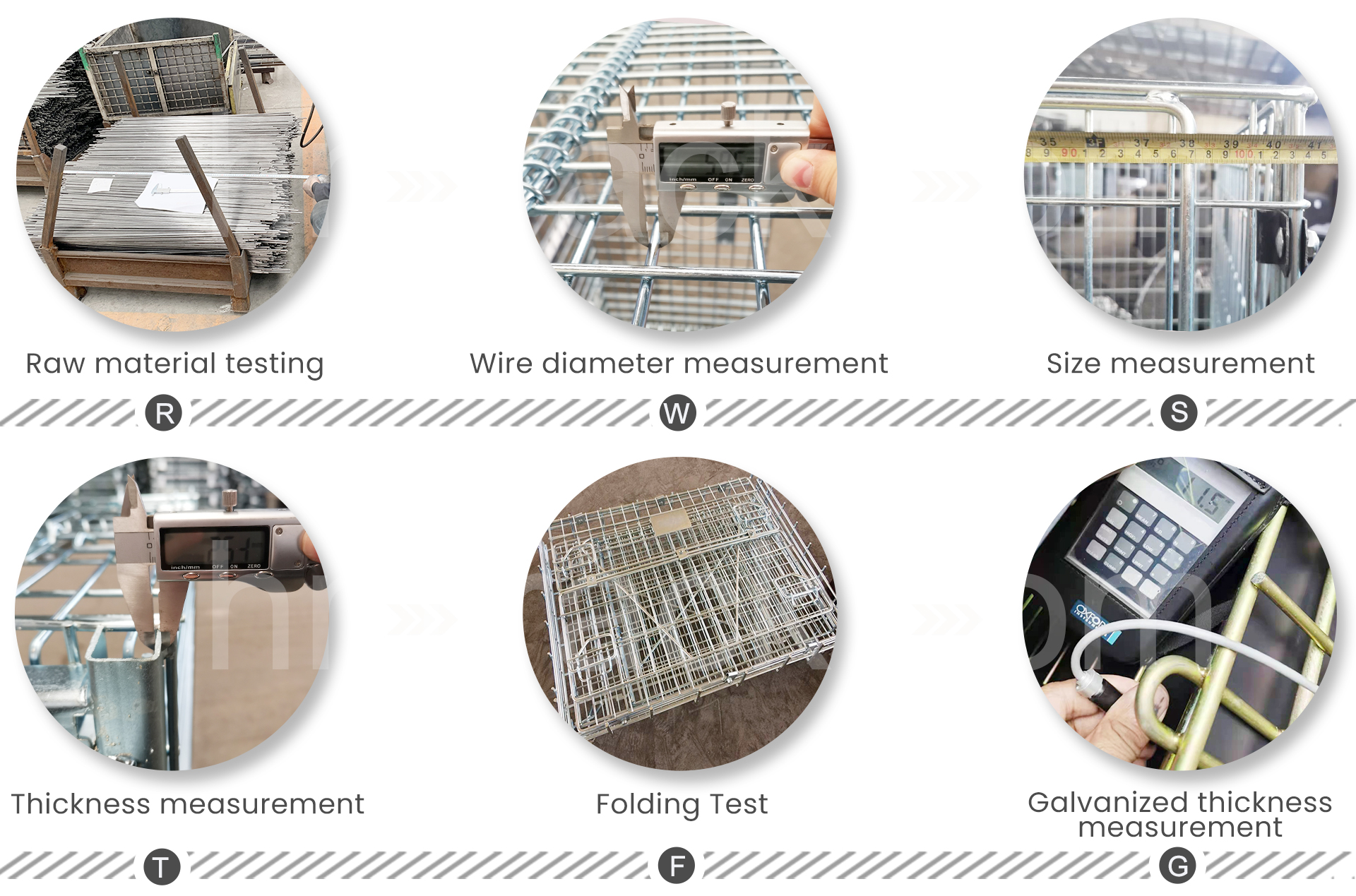
Heavy duty wire containers are common in automotive parts distribution and fulfillment. HM-HD001, for example, uses 6 mm wire with a 50 x 50 mm grid, an exterior dimension of 1030 x 840 x 850 mm, and a 1300 kg loading capacity. It is stackable up to 4 high. Automotive programs often specify containers that reference GM 5131, Chrysler, or Ford-compatible designs, and require consistent dimensional behavior under high rotation. Wire mesh pallet containers such as HM-CP001, with 800 kg capacity and 550 sets per 40’HQ container, add flexibility for e-commerce, hypermarket, and food and beverage logistics.
Comparison: Transactional Wire Container Purchase vs. Long-Term Ecosystem Partner
The table below shows the difference between a basic quote and a supply relationship built for repeatable performance.
| Evaluation point | Transactional quote: what to verify | Long-term ecosystem example: HM Group |
|---|---|---|
| Product consistency | Check weld appearance, leg verticality, dimensions, and wire diameter on delivered batches. | Six-phase QC from pre-production to packaging; 100% comprehensive self-inspection. |
| Material and finish | Confirm steel grade and corrosion protection for the actual humidity level. | Q235 for high-strength requirements; zinc, hot-dip galvanized, or powder coating; high-micron zinc for humidity above 75% RH. |
| Capacity | Ask whether the factory can support repeat orders and demand peaks. | Monthly production capacity of 40,000 sets; MOQ 1x20GP container. |
| Lead time | Request a written production schedule. | Typical production lead time 30 to 45 days. |
| Inspection | Clarify who inspects quality before shipment. | 10% pre-shipment sampling inspection; pre-shipment or third-party inspection accepted; assembly/disassembly videos and loading photos. |
| After-sales | Ask what support is available after delivery. | Process reports, online video audit support, and a 3 to 5 year warranty under proper use. |
| Commercial terms | Confirm delivery and payment flexibility. | EXW, FOB, CIF, DDP, DDU; T/T (30% advance, 70% against copy of B/L) or L/C. |
Frequently Asked Questions
Which wire container standards and compliance points should a long-term buyer check?
For export programs, compliance begins with product specifications, material grade, and finish. ASTM D6573/D6573M covers general-purpose wirebound shipping boxes and containers. In automotive supply chains, containers are often specified to GM 5131, Chrysler, and Ford-compatible designs. HM Group uses Q235 steel for high-strength applications and prohibits spliced or inferior material grades. Its six-phase quality control process covers pre-production through packaging inspection, and pre-shipment or third-party inspection is accepted before goods leave the port.
Can a wire container manufacturer support long-term scaling and product variation?
Look for a breadth of product types and committed production capacity. HM Group’s product family includes wire mesh containers, PET preform containers, cage pallets, stillages, tire racks, nestainer racks, fabric roll racks, wine barrel racks, post pallet racks, and more. It reports a monthly production capacity of 40,000 sets, a minimum order quantity of 1x20GP, and a typical lead time of 30 to 45 days. This combination supports repeat orders and product variation across applications.
How should buyers budget for wire containers as a long-term asset?
Use lifetime cost, not unit price. Wire containers built with high-tensile steel and zinc or galvanized coating are designed for a 3 to 5 year service life. Compared with disposable packaging, a wire container can cost about 30% more upfront, but it can deliver 100 or more reuse cycles and a 75% volume reduction when folded, which lowers return logistics cost. Open-mesh construction also reduces cleaning effort and supports faster visual SKU identification.
Can buyers request samples or inspect quality before large-volume orders?
Pre-shipment verification is available. HM Group offers 10% pre-shipment sampling inspection and accepts pre-shipment inspection or third-party inspection. It also provides assembly/disassembly videos and loading photos so buyers can verify the container before it leaves the port. The first step is to contact the HM Group team to discuss product samples, process reports, or a pilot order.
What lead time and delivery terms should a global buyer plan for?
Typical production lead time is 30 to 45 days, with a minimum order quantity of 1x20GP. HM Group supports EXW, FOB, CIF, DDP, and DDU delivery methods and payment by T/T (30% advance, 70% against copy of B/L) or L/C. For a long-term program, align the production schedule to your inventory cycle and use the supplier’s after-sales services—process reports and online video audit support—for visibility.
Conclusion: Choose a System, Not Just a Container
A wire container is a reusable asset. If it is built with the right material, protected with the right finish, checked through the right quality process, and supported after delivery, it becomes a predictable part of the supply chain. If those elements are missing, the lowest quote can become the most expensive decision.
For distributors and industrial buyers at the decision or execution stage, the practical question is not which container is cheapest this month. It is which supplier can build the ecosystem that keeps the container working for years.
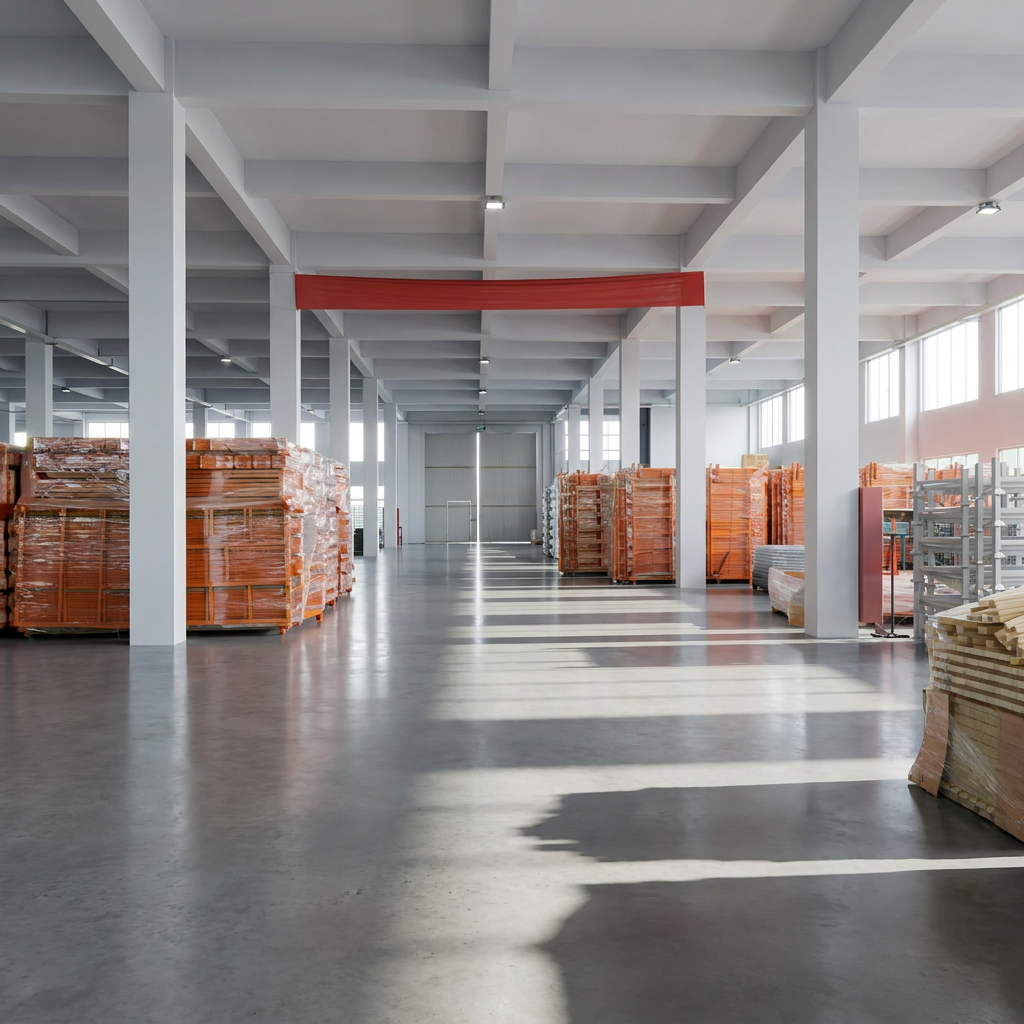
Next step: verify the HM Group ecosystem for your application.
HM Group can provide process reports, assembly/disassembly videos, loading photos, and a brochure. To request a quote, discuss a sample, or plan a pilot order, contact Mary Kong at mary@net-railing.com or WhatsApp +86 150 4058 7228. Phone: +86 411-3981 3061. HM Group office: 3306 Times Square (Times 1), 50 Renmin Road, Zhongshan Dist, Dalian, Liaoning, China. Website: www.hmlwires.com.