Collapsible vs. Heavy-Duty Rigid Wire Containers: HM-HD005 vs. HM-HD001
Two wire containers built from the same Q235 mild steel, offered with the same finish options and rated for the same four-high stacking can still belong in different projects. The split between HM-HD005 and HM-HD001 comes down to one question: is your binding constraint the load inside the container, or the space the container consumes once it is empty?
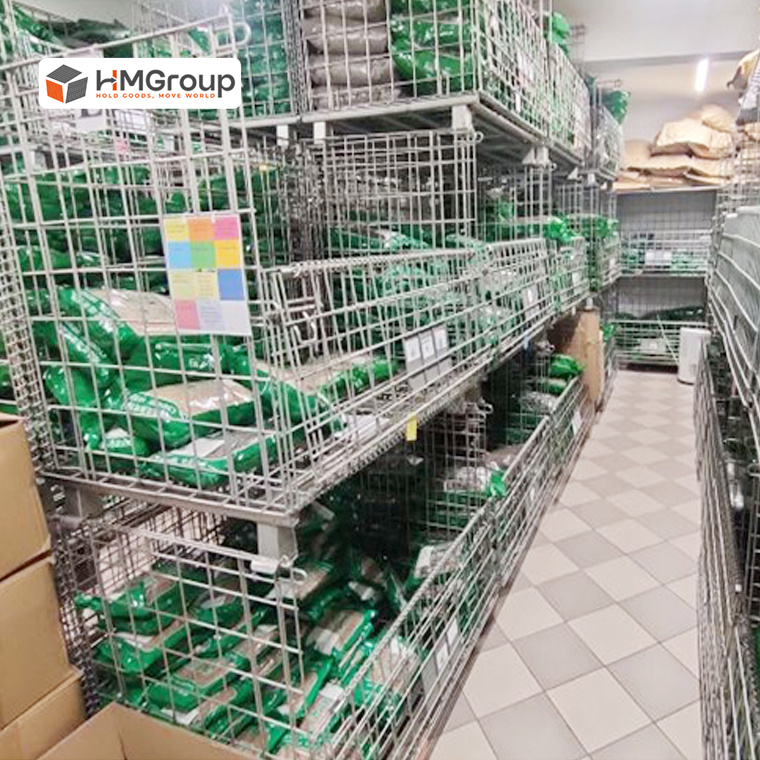
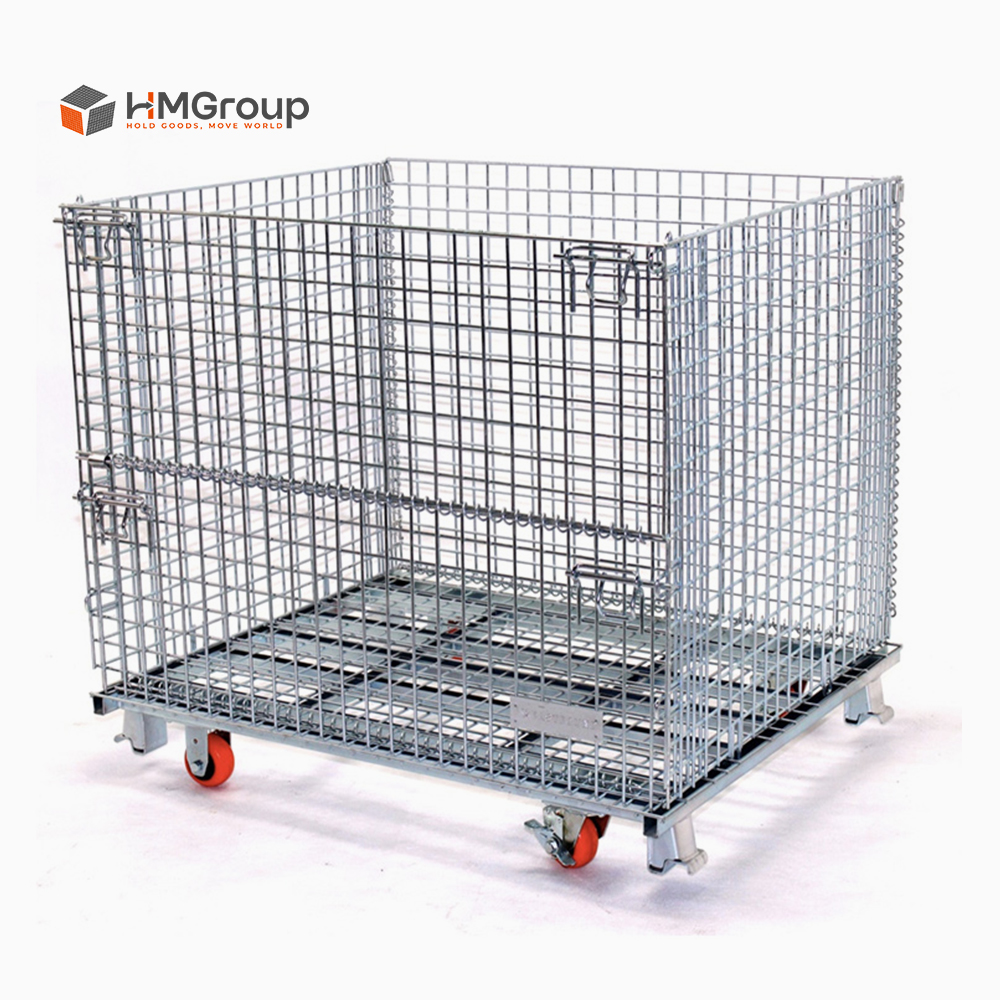
HM-HD001 is the higher-rated unit: 1,300 kg inside a 1030 x 840 x 850 mm body with a 50 x 50 mm mesh. HM-HD005 carries 1,000 kg inside a larger 1230 x 1040 x 900 mm body with a 50 x 100 mm mesh, and its frame folds down when the container is empty. In practical terms, the rigid unit wins on payload per square metre of floor; the collapsible unit wins on what a return loop costs you in empty volume and freight.
Both models come from HM Group — formally Dalian HuaMao Logistics Equipment Group Co., Ltd., a wire container and material handling manufacturer founded in 2003, operating production bases in Xiamen, Nanjing and Qingdao, and exporting to the EU, North America, Asia and the Middle East.
The comparison below stays inside published model data: rated load, exterior dimensions, wire gauge, mesh pitch, stacking height, freight loading and finish options. Where a specification sheet is silent, this guide says so rather than filling the gap with an assumption.
The Problem: Two Costs That Pull in Opposite Directions
A warehouse or returnable-packaging project carries two container costs that push against each other. The first is the cost of the floor a loaded container occupies, which rewards the highest payload in the smallest footprint. The second is the cost of the container once it is empty — the space it takes in the yard, the volume it adds to a return truck, and the labour of repositioning it. HM-HD001 and HM-HD005 sit on opposite sides of that trade-off.
The heavy-duty unit is rated to 1,300 kg in a 1030 x 840 x 850 mm body with a 50 x 50 mm mesh. The collapsible unit is rated to 1,000 kg in a 1230 x 1040 x 900 mm body with a 50 x 100 mm mesh. Same base material, same finish options, same four-high stacking rating — different job.
Label language does not settle it. Both units use mild steel Q235, both are offered in zinc, hot-dip galvanized or powder coating, and both are rated for four-high stacking. On those three dimensions they are interchangeable. The difference sits in four measurable places: rated load, footprint, mesh pitch and empty-state behaviour.
One caution belongs at the front. Neither published sheet states the basis of its load rating — whether the figure is static or dynamic, the safety factor applied, or how capacity is affected at the fourth tier of a stack. Treat 1,000 kg and 1,300 kg as manufacturer-stated values and confirm the basis before racking or stacking plans are fixed.
Industry Background: Why This Became a Project-Level Decision
Wire containers are a segment inside the wider wire mesh category, and the available market estimates reflect that. A 2025 estimate places the global wire mesh container sales market at approximately USD 2.34 billion, and stackable wire mesh containers accounted for 32.5% of total revenue in the same year — the largest single product segment. The commercial signal in that share is vertical density: buyers are solving for height, not for floor area.
That shift changes what a specification has to answer. A container bought for floor storage only needs to hold the load. A container bought for four-high stacking has to answer for the tier it sits in, the forklift approach, and the empty-state logistics between cycles. Warehouse projects described in HM Group's application documentation follow three recurring patterns: 100% visibility storage to cut sorting errors, lean transformation from floor storage to structured vertical stacking, and reverse-logistics optimisation using collapsible frames.
Wire gauge is the number buyers reach for first, and it is the least useful single number in this pair. HM Group lists wire gauges from 4.8 mm to 12 mm across its wire container range, while these two models sit at 6.2 mm and 6 mm — the thinner wire belongs to the higher-rated unit. Gauge is a design parameter, not a ranking.
What actually separates the two containers is the combination of mesh pitch and frame: a 50 x 50 mm grid in a smaller body carries 1,300 kg, while a 50 x 100 mm grid in a larger body carries 1,000 kg. Buyers comparing options should therefore request mesh pitch, footprint, stack height and load-rating basis together — not a heavy-duty label.
The Two Containers, Explained
HM-HD005: the collapsible option
HM-HD005 is a collapsible wire container: a mild steel Q235 body on a folding frame that reduces to a flat profile when empty. Published specification: exterior dimensions 1230 x 1040 x 900 mm, wire gauge 6.2 mm, grid size 50 x 100 mm, loading capacity 1,000 kg, stackability 4 high, 350 sets per 1x40'HQ, finish in zinc, hot-dip galvanized or powder coating.
Its working argument is empty-state cost. HM Group's documentation for collapsible container formats describes a 4:1 return ratio when empty and a 75% reduction in volume when folded. That is the figure that changes a return-logistics calculation: four folded units occupy roughly the volume of one loaded unit, which is why collapsible frames appear in reverse-logistics projects rather than fixed-body containers.
The 50 x 100 mm mesh is the more open of the two grids. It gives faster visual identification of contents, which supports the 100% visibility approach used in warehouse projects, and it suits loads large enough not to pass through a 50 mm opening. The trade-off is retention: small parts, fasteners and loose components pass through a 50 x 100 mm opening more easily than through a 50 x 50 mm one.
HM-HD005 is listed for automotive parts, agricultural products, fulfillment and warehouse operations, and food and beverage applications.
HM-HD001: the heavy-duty rigid option
HM-HD001 is the heavier-rated unit: exterior dimensions 1030 x 840 x 850 mm, wire gauge 6 mm, grid size 50 x 50 mm, loading capacity 1,300 kg, stackability 4 high, 500 sets per 1x40'HQ, with the same finish options and the same mild steel Q235 construction.
The published specification sheet does not list a folding function, so this article treats HM-HD001 as a fixed-body container. If a collapsible version at the same rating is required, confirm the body configuration on the model drawing before the order is placed.
The 50 x 50 mm grid is the tighter of the two. It retains small components and places a denser barrier between the load and the outside of the container, which is why it pairs with the higher load rating and with dense industrial loads such as automotive components. The cost is visibility and airflow: a tighter grid shows less of the load at a glance.
HM-HD001 is listed for automotive parts, agricultural products, fulfillment and warehouse operations, and food and beverage applications — the same industry set as HM-HD005.
Reading the Two Spec Sheets Side by Side
Divide the rated load by the footprint and the payload-density gap becomes visible. HM-HD001 offers roughly 1,503 kg per square metre of floor area against roughly 782 kg/m2 for HM-HD005. Both figures are calculated from published dimensions and stated load ratings; neither is published by the manufacturer. If floor area under load is the constraint, the rigid unit is the denser choice by a wide margin.
Stack height is the second derived difference. Four tiers of HM-HD005 reach 3,600 mm; four tiers of HM-HD001 reach 3,400 mm, calculated from the stated heights of 900 mm and 850 mm. That 200 mm difference matters wherever a stack has to clear a door frame, a sprinkler line or a rack beam.
Freight density runs the other way. HM-HD001 loads 500 sets into a 1x40'HQ and HM-HD005 loads 350 sets, so the rigid unit carries approximately 43% more units per container when shipped assembled, calculated from the two loading figures. Against that, folded HM-HD005 units are documented to occupy a quarter of their loaded volume, which changes the economics of the return leg rather than the outbound one.
Step-by-Step: A Six-Stage Selection Sequence
The sequence below runs from load definition to supplier verification. Each step maps to a published figure, so the decision can be documented rather than argued.
- Fix the peak load per unit. Record the heaviest load a single container will hold, including packaging, and state whether it is a static parked load or a load that travels. Anything above 1,000 kg removes HM-HD005 from the shortlist on published ratings and leaves HM-HD001 at 1,300 kg.
- Measure the envelope, not only the footprint. HM-HD005 measures 1230 x 1040 x 900 mm and HM-HD001 measures 1030 x 840 x 850 mm. Check both against aisle width, rack beam spacing and door clearance at the top of a four-high stack — 3,600 mm against 3,400 mm.
- Match the mesh to the product. A 50 x 50 mm grid (HM-HD001) retains small components. A 50 x 100 mm grid (HM-HD005) gives faster visual identification and more open access for larger items, at the cost of retention for small parts.
- Decide the empty-state strategy before the loaded one. If containers return empty — between plants, to a depot, or back to a supplier — the collapsible body is the deciding feature. If containers stay on site and are reloaded in place, a fixed body removes the folding cycle entirely.
- Confirm handling compatibility. Both formats are moved with forklifts, reach trucks and electric pallet jacks, with RFID or barcode tracking where real-time inventory control is required. Four-way forklift entry is part of the container format described in HM Group's warehouse application documentation.
- Verify the supplier, then pilot. Ask for the load-rating basis, the finish specification and the quality process. HM Group holds ISO 9001:2015 certification (certificate No. CN24/00004786, issued by SGS, valid through July 2027) and runs a six-phase inspection sequence from pre-production sample inspection to packaging inspection, supported by online video audits. Run a pilot load at the stacking height you intend to use before committing to volume.
Project Scenarios: Where Each Container Fits
Project fit is decided by the load, the handling route and the return loop — not by the product name. The table below maps common project types to one of the two models using published model data.
| Project scenario | Better fit | Reason from published data |
|---|---|---|
| Dense small metal components moving through internal logistics | HM-HD001 | 1,300 kg rating and a 50 x 50 mm mesh retain small parts inside a compact 1030 x 840 mm footprint |
| Mixed-size components that must be identified without opening the unit | HM-HD005 | 50 x 100 mm mesh keeps contents visible, supporting 100% visual stock checks |
| Returnable shipping loops where empty units travel back | HM-HD005 | Collapsible frame documented with a 4:1 return ratio and 75% volume reduction when folded |
| Peak load per unit above 1,000 kg | HM-HD001 | Only the rigid unit in this pair is rated to 1,300 kg |
| Agricultural produce or food and beverage storage | HM-HD005 for larger items, HM-HD001 for dense loads | Both models list these industries; the choice is mesh pitch against the product |
| PET preforms or bottled wine | Neither model | These loads use dedicated models — HM-PPC22 or HM-PPC14 for PET preforms, HM-WEU005 or HM-WEU001 for wine bottle storage |
Specification Comparison: HM-HD005 vs. HM-HD001
| Specification | HM-HD005 (collapsible) | HM-HD001 (heavy-duty rigid) |
|---|---|---|
| Exterior dimensions (L x W x H) | 1230 x 1040 x 900 mm | 1030 x 840 x 850 mm |
| Wire gauge | 6.2 mm | 6 mm |
| Grid size | 50 x 100 mm | 50 x 50 mm |
| Loading capacity (stated) | 1,000 kg | 1,300 kg |
| Stackability (stated) | 4 high | 4 high |
| Loaded in 1x40'HQ | 350 sets | 500 sets |
| Material | Mild steel Q235 | Mild steel Q235 |
| Surface finish options | Zinc / hot-dip galvanized / powder coating | Zinc / hot-dip galvanized / powder coating |
| Empty-state behaviour | Collapsible frame; folding documented | Folding not listed in the published specification |
| Listed industries | Auto parts, agriculture, fulfillment and warehouse, food and beverage | Auto parts, agriculture, fulfillment and warehouse, food and beverage |
| Footprint area (calculated) | 1.28 m2 | 0.87 m2 |
| Payload density (calculated) | Approx. 782 kg/m2 | Approx. 1,503 kg/m2 |
| Four-high stack height (calculated) | 3,600 mm | 3,400 mm |
| Load-rating basis | Not stated in the published sheet | Not stated in the published sheet |
Rows marked calculated are derived by this article from the published dimensions and stated load ratings. They are decision aids, not manufacturer-published figures, and should be confirmed with the supplier during quotation.
Frequently Asked Questions
Do the 1,000 kg and 1,300 kg ratings describe the same condition?
Not necessarily, and the published sheets do not say. HM Group lists 1,000 kg for HM-HD005 and 1,300 kg for HM-HD001 without stating whether each figure is a static or a dynamic rating, the safety factor applied, or how the rating changes at the second, third or fourth tier of a stack. Before a stacking plan is designed around either number, request the load-test method, the basis of the rating, the allowable stacking configuration at full load and any test report available. HM Group's quality process covers six inspection phases — pre-production sample inspection, raw material inspection, component inspection, semi-finished product inspection, finished product inspection and packaging inspection — and the company supports online video audits, which is where a load-rating basis is normally confirmed.
Can both models be ordered in the same shipment?
Both are standard catalogue models, and HM Group accepts orders from one 20-foot container (MOQ 1x20GP), with monthly capacity of 40,000 sets and a production lead time of 30–45 days. Container loading differs: HM-HD001 loads 500 sets in a 1x40'HQ and HM-HD005 loads 350 sets, so a mixed order changes the number of containers required. OEM/ODM and full customization are available on surface treatment (zinc, hot-dip galvanized or powder coating), size, loading capacity, powder-coating colour, logo printing and add-on designs such as forklift guides, wire dividers, runner bars, name plates and wheels.
Which container saves more space when empty?
HM-HD005, because it is built as a collapsible container. HM Group's documentation for collapsible container designs describes a 4:1 return ratio when empty and a 75% volume reduction when folded; both figures describe the collapsible format and should be confirmed against the specific model drawing. HM Group's published specification for HM-HD001 does not list a folding function, so it should be planned as a fixed-body container.
How can a buyer validate a container before committing to volume?
Start with the pre-production sample inspection that opens HM Group's six-phase quality process, then keep the same inspection chain through the production run: raw material, components, semi-finished goods, finished goods and packaging. Buyers who cannot attend in person can use the online video audit, and process reports are provided throughout the order. Validation matters most on load rating, mesh pitch and finish, because those are the variables that actually differ between the two models.
What lead time should be planned, and how does an order start?
Plan for 30–45 days of production lead time after order confirmation, on a minimum order of one 20-foot container. HM Group's export team handles samples and quotations together, so send the model, mesh pitch, finish and any add-on designs and ask for the sample and the quotation in the same round — that confirms finish and load-rating basis at once. Requests can go to mary@net-railing.com or +86 150 4058 7228, and the full product catalogue is available as a public PDF download.
Conclusion
The choice between HM-HD005 and HM-HD001 is a choice about which constraint binds. Where a project is defined by payload and floor area — dense industrial loads, small components, high load per unit — the 1,300 kg HM-HD001 with its 50 x 50 mm mesh and 1030 x 840 mm footprint is the denser and more retaining option.
Where a project is defined by the empty container — returnable shipping loops, reverse logistics, yards short of space — the collapsible HM-HD005 carries 1,000 kg in a larger body and folds to a fraction of its loaded volume, at 350 sets per 1x40'HQ against 500 for the rigid unit.
In both cases the specification sheet is a starting point, not a decision. The load-rating basis, the finish appropriate to the storage environment and the stacking configuration at full load are the three points to confirm in writing before an order is placed. HM Group supports that confirmation with a six-phase inspection process, ISO 9001:2015 certification and online video audits.
Next step: request a sample or a quotation for HM-HD005, HM-HD001, or a mixed container load. HM Group supplies both models with OEM/ODM customization on size, load capacity, finish, colour, logo and add-on designs such as forklift guides, dividers, runner bars, name plates and wheels. Email mary@net-railing.com, message WhatsApp +86 150 4058 7228, or download the HM Group product catalogue (PDF). Full range at hmlwires.com.

Have Questions or Need More Details?
Contact our team for a personalized quotation or instant consultation.
Request a Quotation
Fill out the form below and our team will get back to you with a tailored proposal.
WhatsApp Direct Chat
Prefer to chat in real-time? Message us on WhatsApp for instant assistance & quick answers.
- Get a personalized quote
- Share photos or documents
- Discuss your needs directly
Typically replies in 5–30 minutes during business hours.