HM-BR066 Barrel Rack Application Guide: 50 L to 500 L Cask Sizing
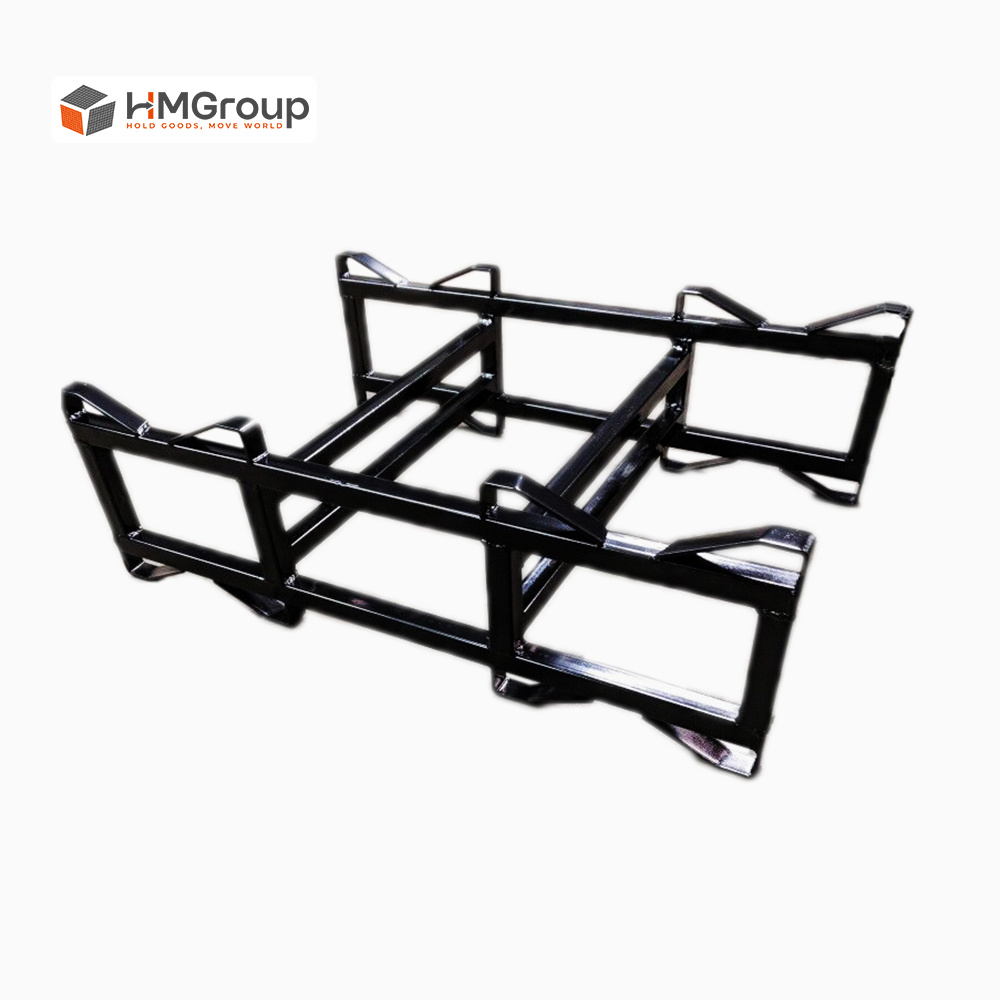
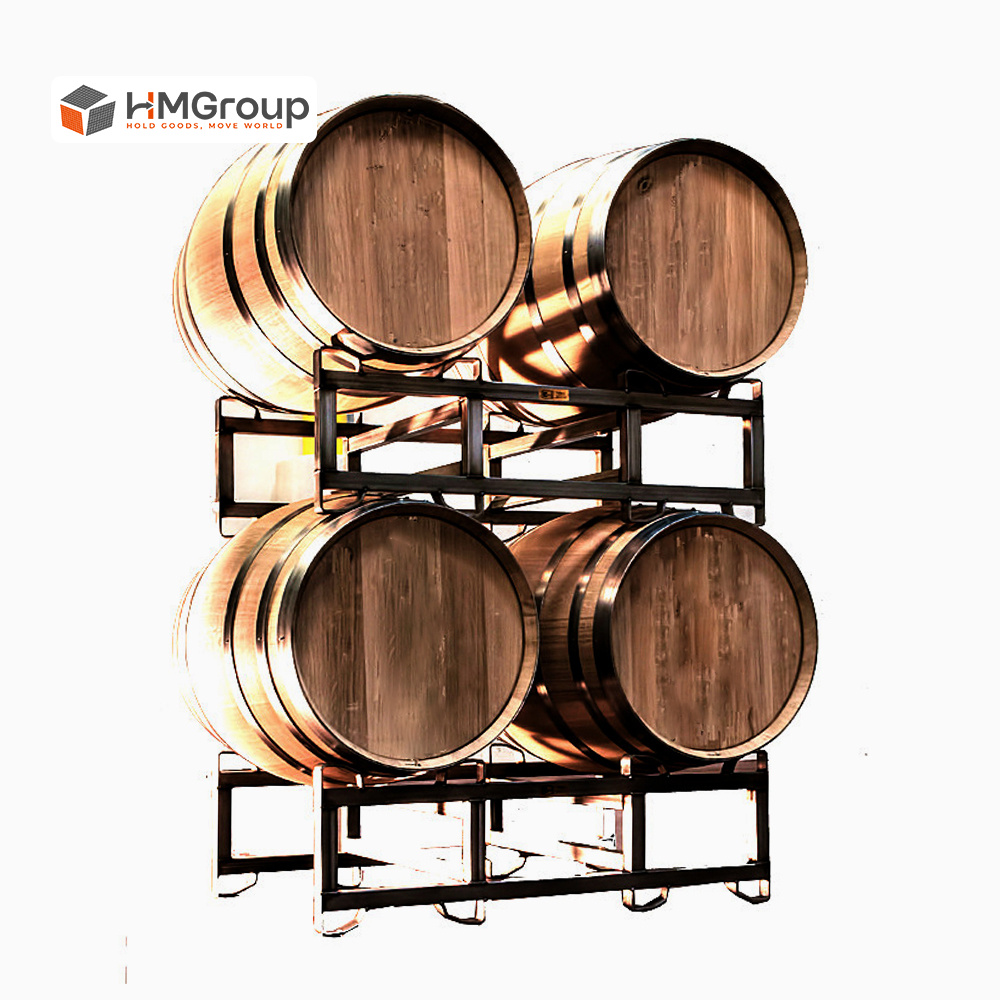
HM-BR066 is a four-high stackable barrel storage rack from HM Group, built in mild steel Q235 for wine-industry and logistics/warehousing applications. Its frame measures 1130 × 775 × 453 mm, its published capacity list covers 50 L, 200 L, 225 L, 300 L and 500 L containers and similar formats, and 234 sets load into one 40ft high-cube container.
This guide is written for the point where a barrel rack stops being a catalogue line and becomes a layout decision: a winery fitting out an aging cellar, a contract bottler adding barrel capacity, or a warehouse moving bulk liquid containers off the floor. It follows the order a project actually runs — the storage problem, the operating conditions, the verified numbers, cask-size fit, footprint arithmetic, finish and handling choices, and the questions the published specification leaves open. Where a figure is not published, it is marked as missing rather than estimated.
Why barrels need a rack instead of floor space
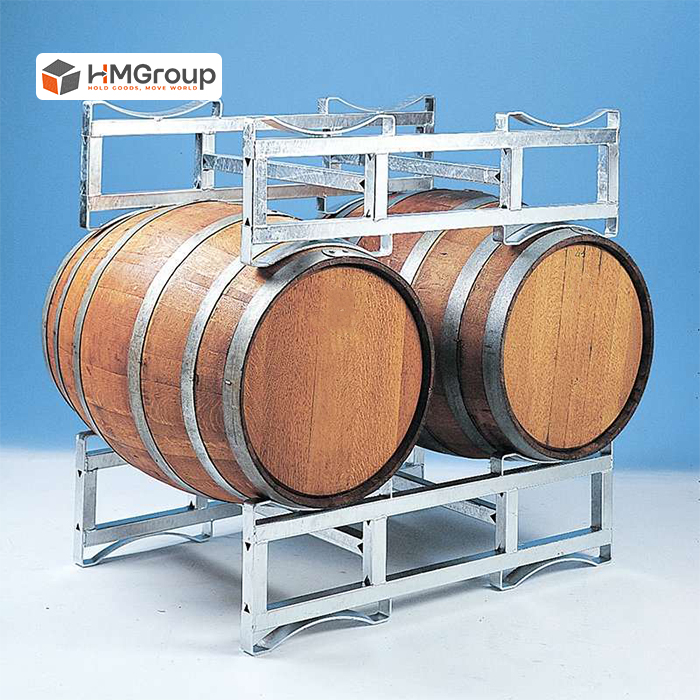
A barrel is a poor candidate for direct floor stacking. It is cylindrical, it rolls when nudged, and it offers no flat face for another cask to rest on. The wine-storage application profile HM Group supplies for this product frames the requirement as uniform weight distribution through a steel cradle rather than point support, so that each cask is held in a defined position on the frame rather than balanced on its own curve.
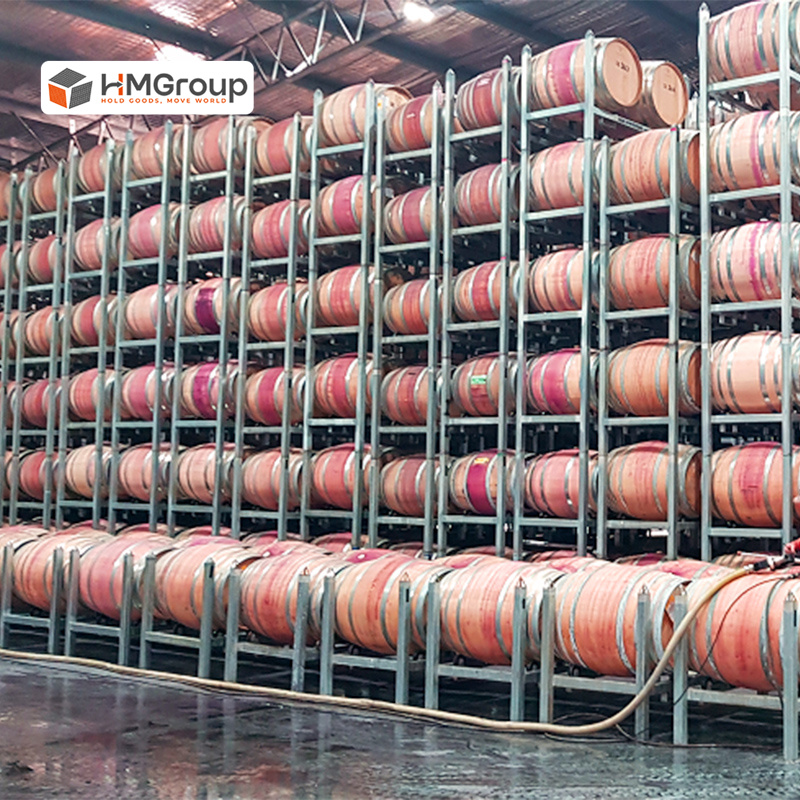
Floor storage also caps density at one level. In a cellar or warehouse with usable height, single-level placement leaves the cubic space above the barrels unused, and the floor area stays committed to the container footprint rather than to the operation. Vertical stacking converts that idle height into additional positions without adding building area.
The third driver is retrieval. When casks sit in a stack that has no dedicated frame, reaching the bottom row means moving everything above it. Each extra movement is another handling cycle for a container that has to be racked, topped up, sampled and eventually emptied — and handling cycles are where damage and labour cost accumulate in a cellar operation.
The trade-off is that a rack fixes the geometry. Once barrels sit in a fixed frame, the rack's dimensions, its capacity list and its stacking height describe what the layout can and cannot do. That is why the rest of this guide works from the published numbers rather than from general expectations about what a barrel rack should hold.
Two purchasing patterns behind barrel rack demand
Barrel storage racks are bought through two different routes. In wine, the buyer is usually a producer or a storage operator fitting out a cellar where temperature and humidity are already controlled, and where barrels are moved by forklift or electric pallet stacker during racking, topping up and sampling. HM Group's application profile for the wine segment describes exactly these conditions: humid aging cellars with controlled temperature, high-throughput operations needing frequent forklift handling, and projects aimed at raising storage density inside a limited footprint.
In logistics, the buyer is usually a warehouse operator who wants large liquid containers out of the aisles and into a stackable, retrievable position — which is why HM Group also lists logistics and warehousing as an application industry for HM-BR066 alongside the wine industry. The same frame is being bought for a different reason: not cellar organisation, but container handling efficiency in a general warehouse.
For scale, Market Research Future's industrial racking systems report put the global market for that category at USD 16.76 billion in 2024. That is a commercial research estimate covering industrial racking systems broadly, not barrel racks specifically, so it is useful as sector context and should not be read as a forecast for this product. HM Group's own application profile for the barrel-rack category lists markets including Australia, Spain, Italy, Portugal, France, Japan, Chile, Argentina and Malaysia.
HM-BR066 verified specification
| Parameter | HM-BR066 |
|---|---|
| Model | HM-BR066 |
| Product type | Barrel storage racks |
| Exterior dimension (L × W × H) | 1130 × 775 × 453 mm |
| Published capacity | 50 L, 200 L, 225 L, 300 L, 500 L and similar containers |
| Stackability | 4 high |
| Material | Mild steel Q235 |
| Finish options | Zinc / hot-dip galvanized / powder coating |
| Loading in 1 × 40ft HQ | 234 sets |
| Application industries | Logistics & warehousing; wine industry |
That table is deliberately short. Two figures an engineer would normally expect are absent: a load rating, and any certification or test report. Neither appears in the HM-BR066 specification available for this guide, and no independent load test for this model was located in the evidence reviewed. Both should be treated as open items on the project file rather than as assumptions.
A load rating is not a single number. A usable rating states whether it is static or dynamic, whether it applies per rack or per tier, what load distribution it assumes, and what safety factor sits behind it. Because none of that is published for HM-BR066, the practical step is to request it in writing with the basis defined: maximum load per rack, maximum load per tier, assumed uniformity, and the conditions under which the four-high configuration remains valid. A quotation that answers only with a total figure does not settle the question for a cellar with mixed cask sizes.
The finish line deserves the same care. Zinc, hot-dip galvanized and powder coating are offered as alternatives, not as a hierarchy. Which one suits a cellar depends on humidity, washdown practice, abrasion from handling equipment and the appearance the operator wants — and the coating choice should be written into the order as a named option rather than left to default.
Container fit: what 50 L to 500 L means in practice
The capacity list — 50 L, 200 L, 225 L, 300 L, 500 L and similar — describes the container volumes HM-BR066 is offered for. It does not, by itself, guarantee that every cask of a given volume will locate correctly, because volume does not determine the two dimensions that decide fit in a fixed frame: outside diameter and height. Two casks of the same nominal capacity from different cooperages can differ in both.
Volume is also a weak proxy for load. Two 225 L casks of identical external size can differ in mass depending on the cask's own weight and what it contains, and that difference matters once several tiers sit in one column. This is the practical reason to give the supplier filled weight per unit rather than volume alone when asking for a load confirmation.
The 225 L entry lines up with the Bordeaux cask size referenced in the wine application profile for this category, which makes it the most directly covered wine format in the list. Cask sizes outside the published set — the 228 L Burgundy cask noted in the same profile, for instance — should not be assumed to fit because the number is close. They need written confirmation of diameter, height, seating on the base and rated load.
| Data to send with the enquiry | Why the supplier needs it |
|---|---|
| Container volume (L) | Matches the cask to the published capacity list |
| Outside diameter (mm) | Determines whether the cask seats within the 775 mm frame width |
| Height (mm) | Determines vertical clearance above and within the 453 mm frame |
| Filled weight per cask (kg) | Feeds the load rating request, which is not published |
| Base or stand type | Establishes how the cask sits on the cradle |
| Handling method | Forklift or pallet truck, and the aisle and height it needs |
| Quantity and stacking plan | Sets versus the 1 × 20GP minimum order and the 234-set container load |
| Room conditions and finish preference | Selects between zinc, hot-dip galvanized and powder coating |
Layout arithmetic from the 1130 × 775 × 453 mm frame
The published footprint is 1130 × 775 mm. Multiplied out, one rack occupies 875,750 mm², or about 0.88 m² of floor — a calculated figure derived from the published dimensions, before any aisle, access zone or clearance is added. Four tiers therefore sit within one rack footprint of roughly 0.88 m², and the number of containers per tier is a separate specification question: the frame is offered across 50 L to 500 L formats, so the count per level will differ by cask size and must be confirmed rather than assumed.
What actually decides the aisle is the handling equipment. HM Group's application profile for wine storage names high-reach forklifts and electric pallet stackers as the matched equipment, and the aisle width needed for either comes from the equipment supplier and the site's traffic plan. No aisle figure is published for HM-BR066, so it cannot be derived from the rack drawing alone.
Vertically, four tiers of a 453 mm frame add up to 1,812 mm of rack height — again a calculated figure from the published exterior height. Whether a cask sits inside that frame height or projects above it changes the clearance a cellar must reserve, and that is a question for HM Group rather than an assumption for the layout drawing. Ceiling height, sprinkler position and light fittings all interact with the final stack height.
Floor condition belongs in the same calculation. Four-high stacking only works on a level, load-bearing floor, and in the United States, OSHA 29 CFR 1910.176(b) requires stored material to be stacked, blocked, interlocked and limited in height so that it is stable and secure against sliding or collapse — a workplace obligation on the operator that no rack specification replaces. Equivalent local rules apply in other markets and should be checked before the stack height is fixed.
Step-by-step: applying HM-BR066 to a wine or warehouse project
The sequence below is the order that keeps a barrel rack project from stalling on missing information. Each step produces a document the next one depends on.
- Write the container list. Volume, outside diameter, height, filled weight and base type for every cask format the site will hold. This single sheet answers most of the fit questions and becomes the reference for every later change.
- Request the load rating in writing, with its basis. State whether the figure is per rack or per tier, static or dynamic, and what distribution it assumes. Because HM-BR066 has no published rating, this is the first item to close, not the last.
- Test the footprint against the floor plan. Use the 1130 × 775 mm footprint, add the handling equipment's aisle requirement, and check door widths and turning space on the route from delivery to the stacking position.
- Choose the finish against the room, not the catalogue. Zinc, hot-dip galvanized and powder coating are all offered; humidity, washdown and abrasion decide between them, and powder-coating colour can be customised if the cellar has an appearance standard.
- Fix the stacking plan. Four high is the specified maximum, using the secure four-layer vertical configuration and interlocking bases the product description sets out. Add the rule that stacking only happens on a level floor with trained operators.
- Confirm handling equipment. Forklift or electric pallet stacker capacity, fork length against the 1130 mm frame length, and the operator's sight lines at the top tier.
- Lock the commercial frame. Minimum order is 1 × 20GP, lead time is 30–45 days, monthly capacity is 80,000 sets, and 234 sets load per 40ft high-cube container. Ask how the quoted packing configuration is built, because it drives freight per unit.
- Agree acceptance and after-sales. HM Group runs six inspection phases — pre-production sample, raw material, component, semi-finished product, finished product and packaging — and supports process reports throughout plus online video audit, with a 3 to 5 year warranty under proper use.
- Check the customisation boundary. HM Group's customisation scope covers surface treatment, size, loading capacity, powder-coating colour, logo printing and design additions such as a wire mesh guard, bottom wire mesh decking, forklift guide, bottom steel plate or wheels. These are described at company level, so confirm which apply to the barrel rack before they enter a drawing.
Three project types and what to verify in each
Winery aging cellar
Here the rack is part of cellar organisation: casks are racked, topped up and sampled on a repeating cycle, and the room is humid and temperature-controlled. The priorities are retrievability without double handling, stable stacking, and a finish that suits a damp environment. Verify cask diameter against the 775 mm frame width, confirm the finish choice with the cellar's humidity and washdown routine, and settle the aisle before ordering handling equipment.
Contract bottling and bulk wine logistics
A mixed cellar is the harder case: 200 L, 225 L, 300 L and 500 L containers in the same building, changing with each client. The rack frame is one size, so plan by cask format and keep the load rating per rack and per tier explicit for each combination used. Confirm whether mixed loading is acceptable before it appears on a layout drawing, and treat the 234-set container load as a planning input for phased deliveries rather than a single drop.
General warehouse barrel and container storage
In logistics and warehousing, HM-BR066 is used for large liquid containers that need to leave the aisle and enter a stackable position. The questions shift to throughput: how often a container is retrieved, what equipment lifts it, and whether the finish must survive outdoor or washdown exposure. Because the applicable-industry statement covers logistics and warehousing generally, confirm the specific container rather than transferrring assumptions from a wine cellar to an industrial store.
HM-BR066 against other HM Group rack models, on documented parameters
Buyers often shortlist a barrel rack against a general stacking rack or a nestainer. The table below compares only what is documented for each model, so that the comparison does not turn into an unmeasured performance claim. The rack families serve different payloads; nothing here shows that one is better than another for a given job.
| Model | Documented size | Published load capacity | Stackability | Sets per 1 × 40ft HQ |
|---|---|---|---|---|
| HM-BR066 | 1130 × 775 × 453 mm (exterior) | Not published in the available specification | 4 high | 234 |
| HM-PP001 | Base 1395 × 1060 × 310 mm; post φ60 × 2.5 mm | 1500 kg | 4 high | 250 |
| HM-PP002 | Base 1875 × 1060 × 310 mm; post φ60 × 2.5 mm | 2000 kg | 4 high | 160 |
| HM-N1302 | 1300 × 1200 × 1200 mm (exterior) | 1000 kg | 4 high | 160 |
| HM-FR005 | 1500 × 1100 × 900 mm (exterior) | 1000 kg | 4 open / 20 closed | 160 |
Read the columns as different measurement types. The HM-PP models are documented by base size and post size, while the barrel, nestainer and fabric-roll racks are documented by exterior dimension — so the figures are not directly interchangeable, and a layout should use the dimension type the supplier actually publishes. The load-capacity column is blank for HM-BR066 because no figure is published; an absent number is not evidence of a low one, and it is not evidence of a high one either.
Limitations, and the questions the specification leaves open
A barrel rack guide that lists only advantages is not usable for procurement. The following points should appear on the project risk list before an order is placed.
- No published load rating. HM-BR066's specification gives dimensions, capacity list, stackability, material, finish, container loading and industries — but not a load figure. Any project with a defined cask weight needs this confirmed in writing.
- No certification or test report in the available specification. No standard number, conformity marking or independent load test was located for this model. Where a site, insurer or client requires formal documentation, obtain it before award rather than assuming it exists.
- Four-high is a specification maximum, not a site permission. Achieving it depends on a level floor, correct interlocking of stacked units, trained operators and local workplace rules such as the tiered-storage requirement in OSHA 29 CFR 1910.176(b).
- Finish is a choice, not a performance guarantee. The company states a 3 to 5 year warranty under proper use; that is a warranty statement, not a published corrosion-life rating for any specific coating in any specific room.
- Container fit is dimensional. The capacity list is a volume range; diameter, height and seating must be checked for each cask, and sizes outside the list need written confirmation.
- Footprint figures exclude circulation. The 0.88 m² derived from 1130 × 775 mm is rack footprint only. Real density depends on aisle, clearance, door widths and access zones.
What HM Group brings to a barrel rack project
HM Group — Dalian HuaMao Logistics Equipment Group Co., Ltd. — is a manufacturer of wire mesh containers, cage pallets, stillages, tire racks, nestainer racks, fabric roll racks, wine barrel racks, post pallet racks and related steel storage equipment, founded in 2003 and based in Dalian, China. The company reports a 62,000 m² factory footprint, annual output of 2,000,000 units, a 10-person R&D team, 50 staff in its trading department, a 100% export ratio and main markets in the EU, North America, Asia and the Middle East, with manufacturing bases in Xiamen, Nanjing and Qingdao.
For project planning, the relevant operational figures are a monthly capacity of 80,000 sets, a lead time of 30–45 days, a minimum order of 1 × 20GP, six inspection phases from pre-production sample through to packaging, process reports throughout production, support for online video audit, and a 3 to 5 year warranty under proper use. Customisation is offered on an OEM/ODM basis across surface treatment, size, loading capacity, colour, logo printing and design additions.
The company's published project record also includes large stacking-rack programmes outside the barrel category: 1,000 units supplied in an initial phase to a government agency in South Korea for potato storage with a hot-dip galvanized finish, and 5,000 units supplied in a single tender procurement for rice-seed storage in cold-store conditions in Myanmar, through a strategic procurement partner working with UNOPS. Those programmes used other rack models in the stacking-rack family, not HM-BR066, so they evidence large-volume delivery and cold-storage handling experience rather than barrel-rack performance.
Frequently asked questions
Does HM-BR066 come with a load rating, test report or certification for my market?
The HM-BR066 specification available for this guide does not include a load rating, a test report or a certification. The published data covers dimensions, container capacity, four-high stackability, mild steel Q235 construction, finish options, container loading and application industries. If your project, insurer or client requires a documented rating or conformity evidence, request it from HM Group in writing at enquiry stage, with the basis defined — per rack or per tier, static or dynamic, and the assumed load distribution. Note also that in the United States, OSHA 29 CFR 1910.176(b) places the stability obligation on the employer storing the material, so a supplier document supplements rather than replaces the site's own assessment.
Can one HM-BR066 frame handle 225 L, 300 L and 500 L barrels in the same cellar?
The published capacity list covers 50 L, 200 L, 225 L, 300 L and 500 L containers and similar formats, and HM-BR066 is a single frame size at 1130 × 775 × 453 mm. A mixed-size cellar should therefore be planned by confirming each cask's outside diameter, height, filled weight and how it seats on the base, rather than by volume alone. Mixed loading on one rack, and the rated load per rack and per tier, should be confirmed in writing before it goes onto a layout drawing; the specification does not state that any combination is interchangeable.
What drives the budget for a barrel rack project?
No price list is published for HM-BR066, so budget should be built from the variables that actually move cost: the finish selected, any customisation such as size, loading capacity, colour or logo printing, the quantity against a 1 × 20GP minimum order, and freight per unit, which is influenced by the 234-set loading figure for a 40ft high-cube container. Inspection and documentation steps — pre-production sample inspection, process reports, online video audit — also belong in the plan. Ask for a quotation that separates product, finish, packing and freight so the per-unit landed cost can be compared across options.
Can I review a sample or drawing before committing to an order?
HM Group's production mode includes OEM, ODM and fully customised work, and its quality sequence begins with pre-production sample inspection before raw material, component, semi-finished product, finished product and packaging checks. Process reports throughout production and support for online video audit allow a remote buyer to review progress without a site visit. Ask which of these apply to your order and confirm the drawing set you will receive — particularly the base detail and any design options — before production starts.
What is the lead time, and how many racks fit in a container?
The stated lead time is 30–45 days, monthly capacity is 80,000 sets, and 234 sets load into one 40ft high-cube container. Confirm the packing configuration behind that figure, because assembled and compact packing do not produce the same freight per unit, and ask whether mixing finish options in one order affects the schedule. If your barrel rack project is tied to a cellar handover date, place the 30–45 day window against the stacking and commissioning work rather than against the delivery date alone. The current company brochure can be downloaded here: HM Group product brochure (PDF).
Conclusion: sizing the rack before designing the cellar
HM-BR066 answers a specific problem: barrels that cannot be stacked directly need a defined cradle, a fixed footprint and a repeatable stack height so that a cellar or warehouse can use its vertical space without giving up access. The verified numbers are compact — 1130 × 775 × 453 mm, a 50 L to 500 L capacity list, four-high stacking, mild steel Q235, three finish options, 234 sets per 40ft high-cube container, 30–45 day lead time and a 1 × 20GP minimum order.
The decision path runs in one direction. Write the cask list with diameter, height and filled weight; get the load rating confirmed in writing because it is not published; test the 0.88 m² calculated footprint against the real floor plan including aisle; choose the finish against the room; and fix the four-high stacking rule to a level floor and trained operators. Everything after that — packing configuration, inspection phases, warranty terms — is commercial detail that follows a settled technical brief.
If you want HM-BR066 checked against a specific cask list, send the barrel dimensions, filled weight and a floor plan sketch to HM Group, and ask for the load rating, the finish recommendation and the container loading plan in the same response. Contact: MARY KONG, mary@net-railing.com, Tel/WhatsApp +86 150 4058 7228. Company website: hmlwires.com.
Have Questions or Need More Details?
Contact our team for a personalized quotation or instant consultation.
Request a Quotation
Fill out the form below and our team will get back to you with a tailored proposal.
WhatsApp Direct Chat
Prefer to chat in real-time? Message us on WhatsApp for instant assistance & quick answers.
- Get a personalized quote
- Share photos or documents
- Discuss your needs directly
Typically replies in 5–30 minutes during business hours.