Storage Rack Application Guide for Textile and Fabric Roll Warehousing
Fabric rolls and carpet pads rarely create storage problems because a warehouse has too little floor space. They create problems because the storage method does not match the shape of the load. A roll of upholstery fabric is heavy, cylindrical and unforgiving: it cannot be crushed, it will not sit still on a flat deck, and a badly supported roll can flatten along one side and lose usable metres. This guide explains how to match racks to roll and pad storage, and sets out the verified specifications of three HM Group models built for this task — HM-FR005, HM-FR007 and HM-FR002.
It is written for the stage between research and evaluation — the point where a textile mill, fabric distributor, carpet retailer or furniture manufacturer already knows a storage rack is needed and now has to confirm dimensions, load ratings, finishes, documentation and order terms before committing budget.
Why Textile Roll and Carpet Pad Storage Breaks Standard Racking
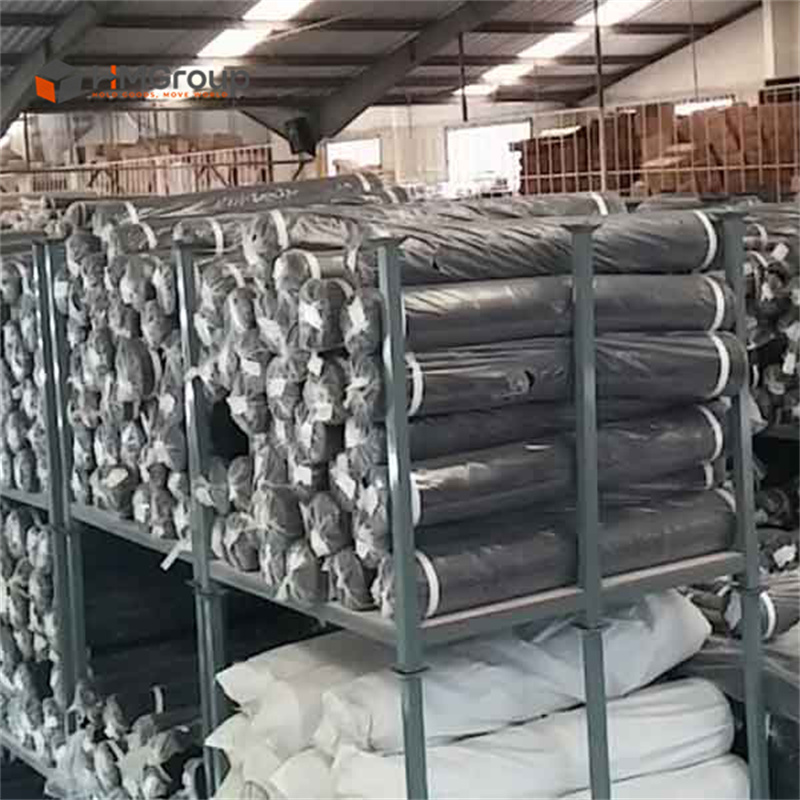
The core constraint is geometric rather than financial. Textile and fabric roll storage deals with a load that is bulky, heavy and sometimes delicate at the same time, and that is prone to creasing and surface damage when it is stacked without structural support.
- Rolls deform. A fabric roll resting on a flat surface contacts along a single line. Under its own weight that contact area flattens, and the flattened section is often unusable.
- Rolls move. Cylindrical loads roll. Floor-stacked rolls create trip hazards and accidental roll drops when a worker pulls one roll out of a pile.
- Retrieval is blocked. In an unstructured pile, reaching one specific roll means moving the rolls around it — slow, and a common source of damage.
- Floor space disappears. Flat storage converts valuable vertical clearance into empty air and pushes production pressure into the aisles.
- Pads compress and shift. Carpet pads and underlay bundles are lighter per unit but wide and awkward, and they compress or slide when stacked loose on the floor.
The application requirement that follows is consistent across textile, logistics and furniture operations: structured placement that prevents rolls from flattening, slipping or being damaged; accessibility that lets workers identify and retrieve a specific roll without moving surrounding inventory; and safety and logistics performance that removes tripping hazards and accidental drops while keeping material flow from storage to cutting smooth.
Industry Background: Where Roll Storage Demand Is Growing
Storage racking is a mature but still expanding equipment category, and the growth is concentrated in exactly the sectors that handle rolls and pads.
- The global warehouse racking market was valued at approximately USD 9.71 billion in 2024 and is projected to reach USD 12.41 billion by 2030 (Grand View Research).
- A broader definition of the storage rack market, including wider material handling contexts, was estimated at USD 22.4 billion in 2024 with a 4.9% CAGR forecast through 2034 (Global Market Insights). The two figures differ mainly because of scope, not because one is inaccurate.
- North America held the largest regional share of the warehouse racking market in 2024, at 27.8% of global revenue (Grand View Research).
- Selective pallet racking remained the dominant product segment in 2024 at approximately 45.0% of market share (Grand View Research) — a reminder that most storage is still organised around fixed pallet positions, while roll-specific racks serve the loads that fixed racking handles poorly.
Two structural standards are commonly referenced when textile and furniture buyers specify static steel storage systems. In the United States, industrial steel storage racks must comply with ANSI MH16.1-2023, which specifies minimum requirements for structural design, testing and utilisation (Rack Manufacturers Institute). In Europe, EN 15512:2020, updated in 2022, governs the structural design principles for steel static storage systems and adjustable pallet racking (European Committee for Standardization). These are design references rather than product certificates, so the practical question for a buyer is narrower: which inspection or survey report can a supplier show for the exact model being quoted, and which markets does that report cover?
Fabric roll rack applications of this type are established in the United Arab Emirates, Argentina, Australia, Canada, Germany, France, the United Kingdom, Italy, Mexico, Malaysia, Poland, Portugal and the United States — a spread that reflects where textile production, fabric distribution and flooring retail are concentrated rather than any single market.
Materials and Finishes That Matter for Textile Storage Racks
HM Group (Dalian HuaMao Logistics Equipment Group Co., Ltd.) is a manufacturer of material handling and logistics equipment founded in 2003, operating a 62,000 m² factory footprint with production bases in Xiamen, Nanjing and Qingdao. Its range covers wire mesh containers, cage pallets, nestainer racks, tyre racks, fabric roll racks, barrel racks, post pallet racks, wire mesh roll containers, wire mesh decking, Danish trolleys and steel pallets. The company runs a 10-person R&D team and a trading department of 50 employees, exports 100% of production, and serves the EU, North America, Asia and Middle East markets.
Every rack in the fabric and carpet roll range is built from mild steel Q235. That choice is deliberate. Q235 is a general structural carbon steel that welds predictably, holds a stable section under repeated forklift impact, and can be formed into the reinforced frames and smooth edges that delicate fabric requires. Frame stiffness — not cosmetic thickness — is what keeps a roll supported along its full length after years of loading and unloading.
Finish options: zinc, hot-dip galvanised or powder coating
Three surface treatments are available across HM-FR005, HM-FR007 and HM-FR002, and the differences matter in a textile environment:
- Zinc finish — a uniform, thin, bright coating suited to dry indoor warehouses and cutting rooms where clean handling and appearance matter.
- Hot-dip galvanised finish — a thicker, sacrificial zinc coating that tolerates humidity, condensation and wash-down areas. This is normally the recommendation where fabric is stored in humid climates or in zones adjacent to cold storage.
- Powder coating — a durable coloured finish that also allows colour coding, a practical inventory tool in multi-line textile warehouses where racks can be assigned to a fabric family, a customer order or a production line.
Whichever finish is specified, the functional requirements for fabric handling stay the same: anti-rust coatings, reinforced frames, and smooth edges that prevent snagging delicate fabrics.
Customisation available on textile storage racks
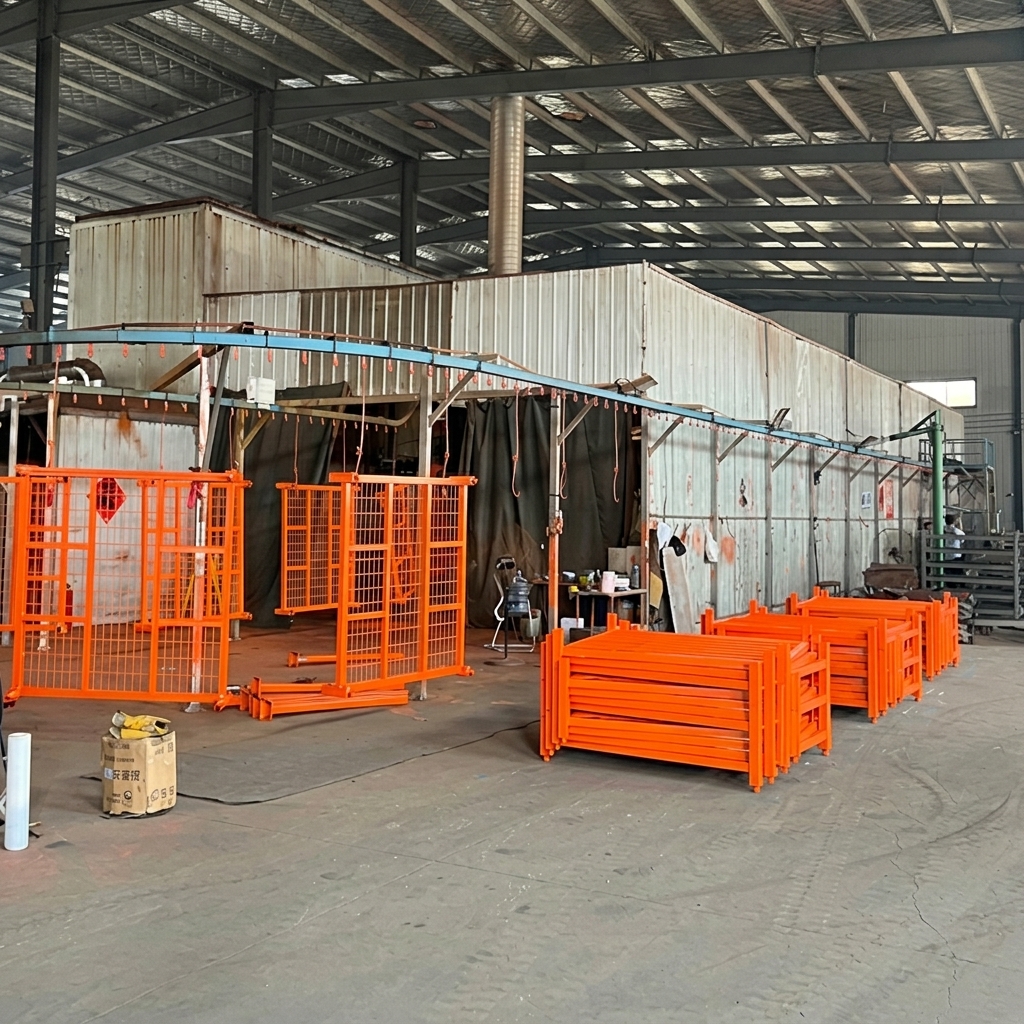
Production runs in OEM, ODM or fully customised mode. The customisable variables are surface treatment (zinc, hot-dip galvanised or powder coating), size, loading capacity, powder coating colour, logo printing, and design features including wire mesh guard, bottom wire mesh decking, forklift guide, bottom steel plate and wheels. That list matters for roll storage because non-standard roll widths and weights are the norm in textile production rather than the exception: load-bearing capacities and dimensions can be matched to actual roll widths or weights instead of forcing inventory to fit a catalogue size.
Quality control runs through six inspection phases: pre-production sample inspection, raw material inspection, component inspection, semi-finished product inspection, finished product inspection and packaging inspection. A process report is provided throughout the order, online video audits are supported, and the product is designed for a durable service life of 3 to 5 years under proper operational use, backed by a 3 to 5 year warranty under proper use.
The Three Rack Models for Roll, Pad and Carpet Storage
HM Group's fabric and carpet range covers three distinct load profiles: soft rolls stored horizontally, denser rolls and general stackable goods, and wide carpet pad bundles. Choosing between them is a matter of matching the load envelope and the weight per position — not of picking the largest unit available.
HM-FR005 — Fabric Roll Storage Rack
HM-FR005 is the dedicated horizontal fabric roll rack. Its exterior dimension is 1500 L × 1100 W × 900 H mm, with a loading capacity of 1000 kg. It stacks up to 4 sets in the open (loaded) configuration and up to 20 sets closed (empty), and 160 sets load into one 1 × 40′ HQ container. Material is mild steel Q235 with a zinc, hot-dip galvanised or powder coating finish, and the applicable industries are textile and fabric roll handling and logistics and warehousing.
The low 900 mm height and the long 1500 mm base make this a horizontal roll platform: the roll rests along the length of the rack rather than being balanced across a narrow frame, which is what prevents the single-line flattening that damages upholstery and apparel fabric. With 160 sets per 40′ HQ container, it is also a container-efficient choice for importers buying in volume.
HM-FR007 — Stackable Steel Storage Racks
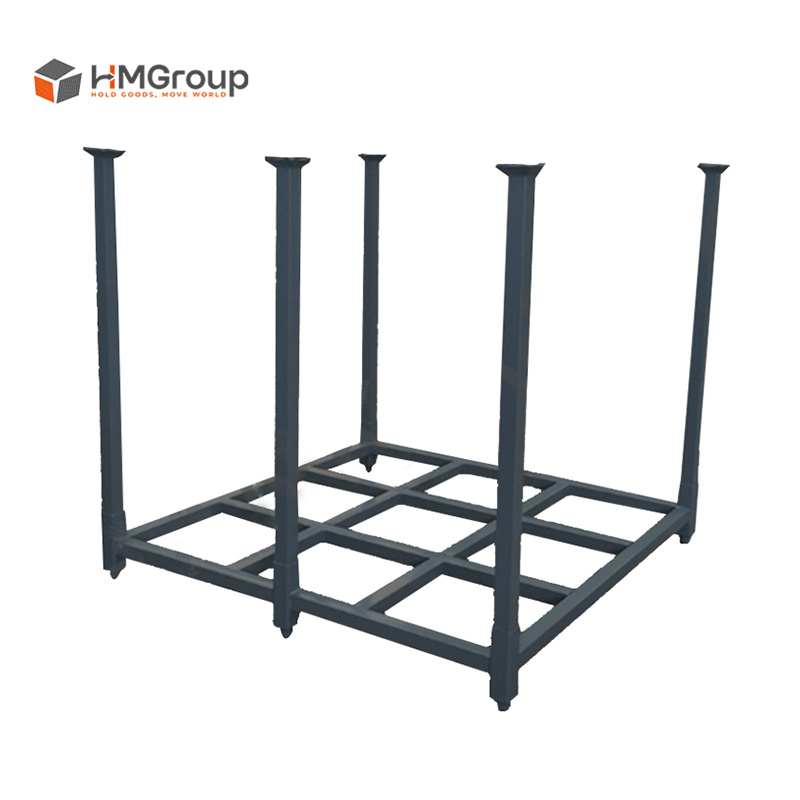
HM-FR007 is the higher-stacking, higher-container-density option. Its exterior dimension is 48 × 48 × 36 inches, loading capacity 1100 kg, and one 1 × 40′ HQ container carries 380 sets. Stacking is 6 sets open and 20 sets closed. It is also built from mild steel Q235 with zinc, hot-dip galvanised or powder coating finishes.
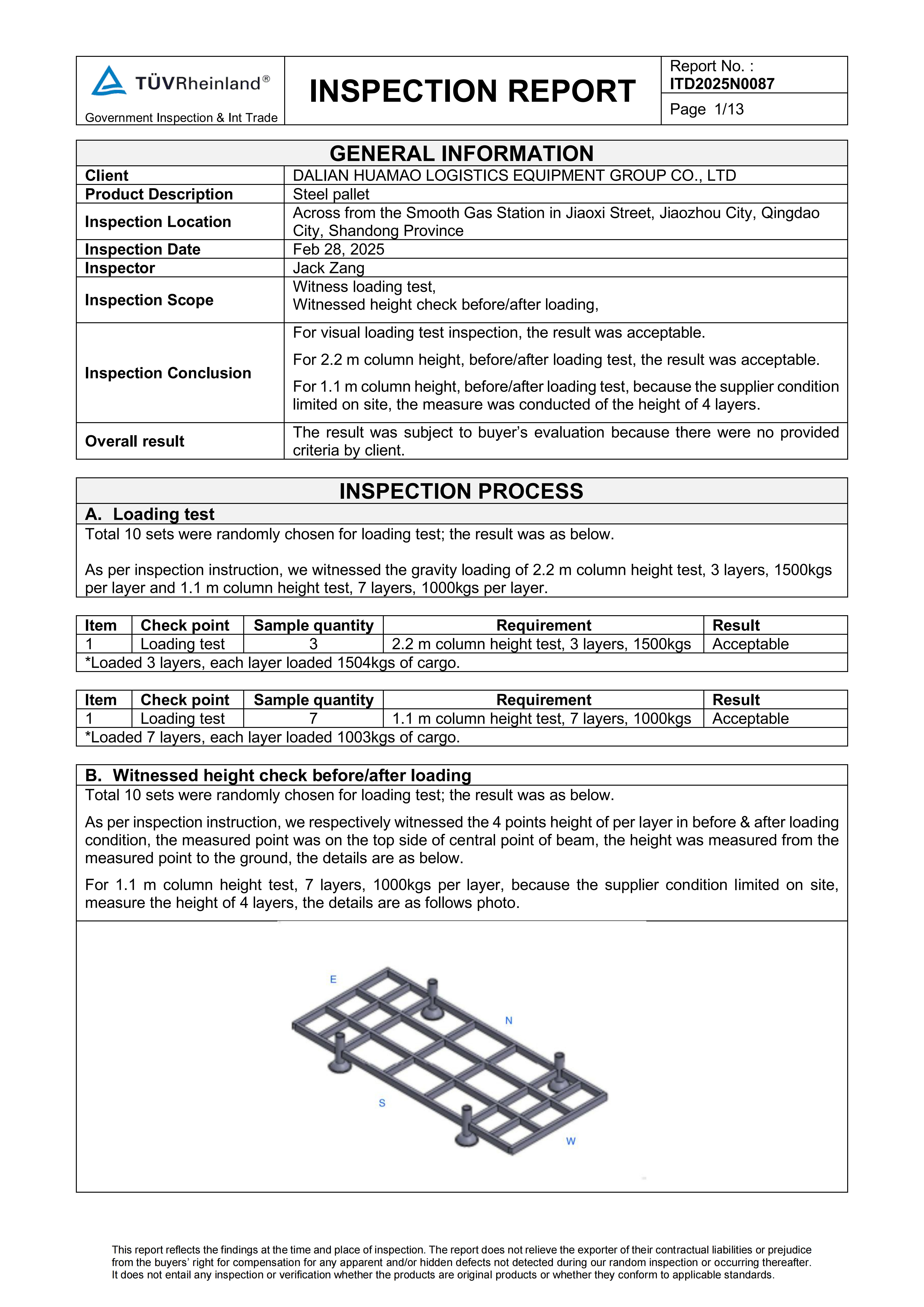
Its applicable industries are broader: textile and fabric roll, logistics and warehousing, food and grocery, agricultural, and the furniture industry. For textile and furniture buyers that flexibility matters, because the same rack type can serve roll storage, upholstery components and general stackable goods within one facility. Two documented facts support its use in regulated supply chains: it is covered by a TUV inspection report, number ITD2025N0087, issued on 2025-02-28 and valid for the EU, North America, Asia and Middle East markets; and it is among the products associated with HM Group's ISO 9001:2015 certificate, number CN24/00004786, issued by SGS.
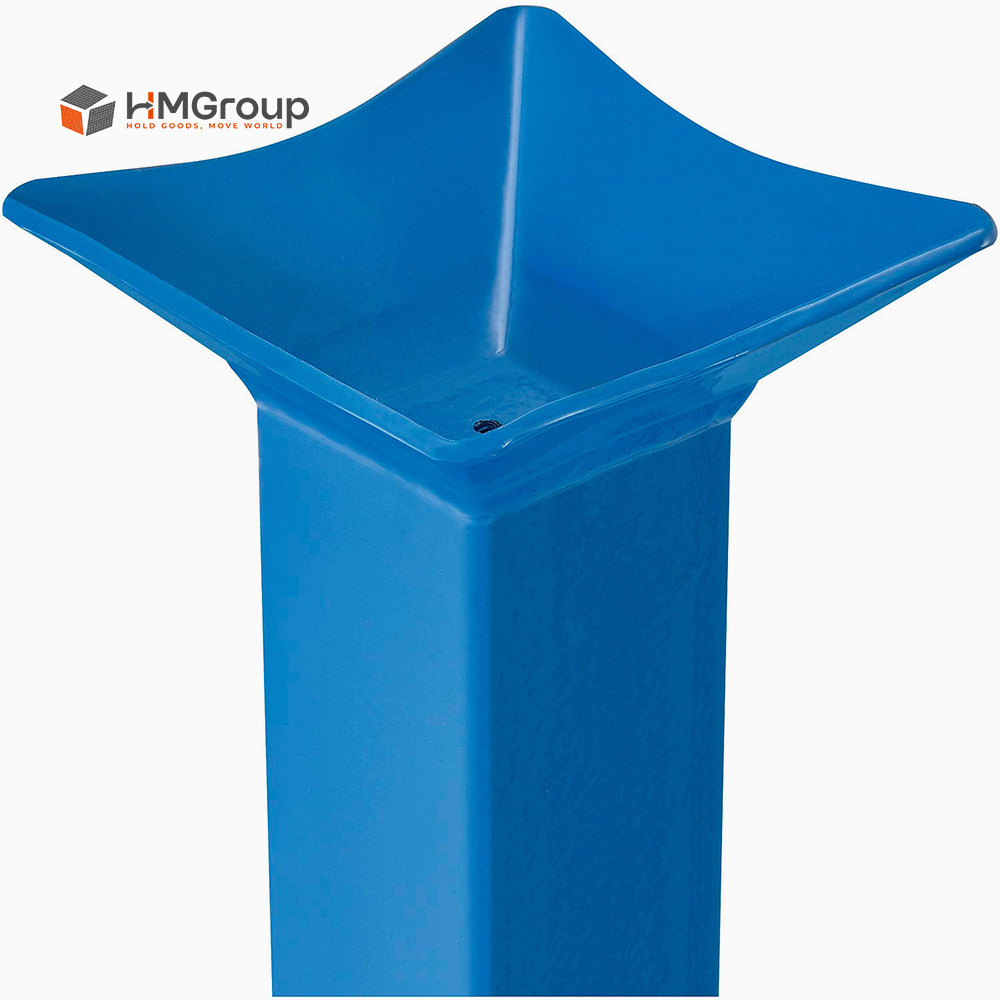
HM-FR002 — Carpet Pad Storage Racks
HM-FR002 is sized for carpet pads and similar wide, flat bundles rather than rolls. Its exterior dimension is 1521 × 1000 × 1360 mm, loading capacity 500 kg, and stackability is 4 to 5 high. One 1 × 40′ HQ container holds 126 sets. It is built from mild steel Q235, is available in zinc, hot-dip galvanised or powder coating finishes, and is applicable to textile and fabric roll handling and to logistics and warehousing.
The taller 1360 mm frame and the 500 kg rating reflect a lighter but bulkier load: carpet underlay and pad bundles occupy volume rather than concentrated weight, so the rack geometry prioritises a stable, tall, open footprint over maximum load per position. Stacking 4 to 5 high converts a low, wide pad pile into a vertical block that a forklift can address from a single aisle.
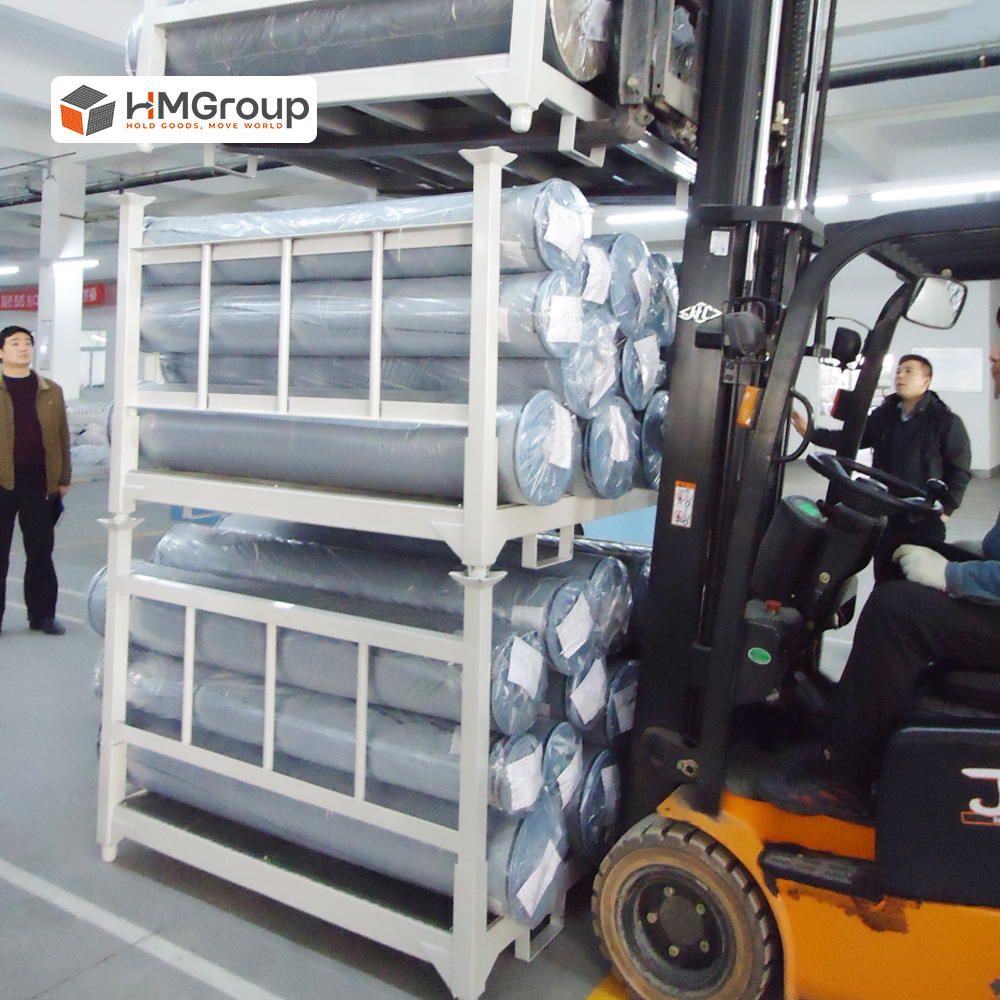
Step-by-Step: Matching a Storage Rack to a Roll or Pad Load
Working through these seven steps in order prevents the most common specification error in textile warehousing, which is buying a rack for the roll diameter while ignoring the stacked weight.
- Measure the load envelope. Record the largest roll diameter and width, or the footprint and thickness of pad bundles. The longest and widest items set the minimum base dimensions — 1500 × 1100 mm for HM-FR005, 1521 × 1000 mm for HM-FR002.
- Weigh the loaded position, then multiply. Take the weight of one fully loaded rack position and multiply by the intended stack height. A 1000 kg rated rack stacked four high handles up to 4000 kg at floor level, so ground bearing and load spread matter as much as the rack rating.
- Choose roll orientation. Horizontal orientation suits long, soft rolls and prevents creasing; vertical orientation suits shorter, denser rolls and frees aisle width. The range supports flexible layouts for either vertical or horizontal orientation.
- Match the model to base size and rating. HM-FR005 for fabric rolls up to 1000 kg; HM-FR007 where higher stacking (6 open) and maximum container density (380 sets per 40′ HQ) are the priority; HM-FR002 for wide carpet pad bundles at 500 kg with 4 to 5 high stackability.
- Select the finish for the environment. Dry, clean cutting rooms suit zinc or powder coating; humid, condensation-prone or wash-down areas point to hot-dip galvanising.
- Confirm documentation for the exact model. Request the inspection or survey report that names the model being quoted, and check which markets it covers.
- Plan handling equipment and layout. Roll storage relies on forklifts, reach trucks and hand pallet jacks to load multi-tier systems, alongside production tools such as industrial fabric cutting machines, winding equipment and measuring tables, and management tools including inventory labels, barcode scanners and ERP systems for stock tracking.
Use Cases Across the Textile, Carpet and Furniture Supply Chain
Roll and pad storage racks serve a wider set of operations than the name suggests. The primary sectors are textile and apparel manufacturing, fashion production and large-scale fabric distribution. Secondary sectors include furniture and upholstery manufacturing, industrial printing, automotive interior supply, and carpet and flooring retail.
- Textile mills and cutting rooms. High-traffic production floors where rapid material changeover is required. Racks keep rolls identifiable and retrievable without disturbing surrounding stock.
- Fabric distribution centres. Warehouses managing bulky, heavy or delicate rolls prone to creasing and damage, where vertical expansion replaces floor expansion.
- Carpet and flooring retail. HM-FR002 turns low, wide pad piles into 4 to 5 high vertical blocks, suited to back-of-house and distribution stockrooms.
- Furniture and upholstery manufacturing. HM-FR007's 1100 kg rating and 6-high open stacking suit upholstery rolls, foam components and general stackable goods in one facility.
- Industrial printing and automotive interior supply. Roll stock that must stay clean and uncreased before cutting, in organised production areas where dust reduction and clear floor space are priorities.
The typical warehouse optimisation projects behind these purchases are vertical space expansion, clearing floor area, setting up structured workflows for new textile processing units or tailoring workshops, and inventory management initiatives aimed at improving stock visibility and reducing fabric waste.
Comparison Table: HM-FR005 vs HM-FR007 vs HM-FR002
| Specification | HM-FR005 Fabric Roll Storage Rack | HM-FR007 Stackable Steel Storage Racks | HM-FR002 Carpet Pad Storage Racks |
|---|---|---|---|
| Exterior dimension | 1500 L × 1100 W × 900 H mm | 48 × 48 × 36 inch | 1521 × 1000 × 1360 mm |
| Loading capacity | 1000 kg | 1100 kg | 500 kg |
| Max stacked (open / loaded) | 4 sets | 6 sets | 4 to 5 high |
| Max stacked (closed / empty) | 20 sets | 20 sets | Not specified in product data |
| Loaded in 1 × 40′ HQ | 160 sets | 380 sets | 126 sets |
| Material | Mild steel Q235 | Mild steel Q235 | Mild steel Q235 |
| Finish options | Zinc / hot-dip galvanised / powder coating | Zinc / hot-dip galvanised / powder coating | Zinc / hot-dip galvanised / powder coating |
| Applicable industry | Textile & fabric roll; logistics & warehousing | Textile & fabric roll; logistics & warehousing; food & grocery; agricultural; furniture industry | Textile & fabric roll; logistics & warehousing |
| Model-specific inspection document | Covered at company level by ISO 9001:2015 certificate CN24/00004786 (SGS) | TUV inspection report ITD2025N0087, issued 2025-02-28 | Covered at company level by ISO 9001:2015 certificate CN24/00004786 (SGS) |
| Best matched load | Long, soft fabric rolls stored horizontally | Denser rolls plus general stackable goods; highest container density | Wide, light carpet pad and underlay bundles |
Note on documentation scope: the TUV inspection report ITD2025N0087 applies to the stackable steel storage rack and is valid for the EU, North America, Asia and Middle East markets. Separately, SGS Survey Report CANWT00478167 covers the Stacking Shelves (Style No. M2) and applies to the global market.
Compliance and Inspection Documentation
For buyers working through a procurement checklist, the documentation set associated with these racks and with HM Group as a supplier is as follows.
- TUV inspection report — ITD2025N0087. Issued 2025-02-28, covering the stackable steel storage rack (HM-FR007). Valid for the EU, North America, Asia and Middle East markets.
- ISO 9001:2015 — CN24/00004786. Issued by SGS, valid from 2024-07-30 to 2027-07-29, with the scope of sales of material handling equipment for logistics turnover. HM-FR007, HM-FR005's sister stacking products and the wider rack range appear in the associated product list.
- Alibaba.com verified Pro Supplier — 486803081_T. Issued by SGS, valid to 2027-03-06, covering all logistics equipment products. This is a platform-level supplier verification rather than a product certification.
- SGS Survey Report — CANWT00478167. Issued 2026-01-23, covering the Stacking Shelves (Style No. M2) and applicable to the global market.
- Made-in-China BV Audit Report — MIC-ASI2491658. Issued by BV, with a scope covering post pallets, tyre racks, roll containers, wire mesh containers, wire decking, cage pallets, stacking racks, PET preform containers, IBC containers and Danish trolleys.
Buyers who specify against ANSI MH16.1-2023 or EN 15512:2020 should treat those documents as design and utilisation frameworks, then request the model-specific inspection or survey report that demonstrates the supplier has actually tested the unit being purchased. That is the practical boundary between a design standard and a supplier claim.
Frequently Asked Questions
Which inspection and certification documents apply to HM fabric and carpet roll storage racks?
The stackable steel storage rack, HM-FR007, is covered by a TUV inspection report, number ITD2025N0087, issued on 2025-02-28 and valid for the EU, North America, Asia and Middle East markets. At company level, HM Group holds ISO 9001:2015 certificate number CN24/00004786 issued by SGS, valid from 2024-07-30 to 2027-07-29, with a scope of sales of material handling equipment for logistics turnover, and Alibaba.com verified Pro Supplier number 486803081_T, issued by SGS and valid to 2027-03-06. A separate SGS Survey Report, number CANWT00478167, covers the Stacking Shelves (Style No. M2) and applies to the global market. Buyers using ANSI MH16.1-2023 or EN 15512:2020 as design references should ask for the report that names the model being quoted.
Can HM-FR005, HM-FR007 and HM-FR002 be customised for non-standard roll sizes or weights?
Yes. Production runs in OEM, ODM or fully customised mode. The customisable variables are surface treatment (zinc, hot-dip galvanised or powder coating), size, loading capacity, powder coating colour, logo printing, and design features including wire mesh guard, bottom wire mesh decking, forklift guide, bottom steel plate and wheels. This matters for textile warehousing because roll widths and weights vary between mills, printing lines and upholstery operations; dimensions and load ratings can be matched to the actual roll or pad profile. Monthly production capacity is 80,000 sets, and quality control runs through six inspection phases from pre-production sample inspection to packaging inspection.
What is the minimum order quantity, and what drives the cost of a roll storage rack order?
The minimum order quantity is one 1 × 20GP container. Because pricing depends on the configured model, finish class and customisation, the more useful cost lever for budgeting is container density: one 1 × 40′ HQ container carries 380 sets of HM-FR007, 160 sets of HM-FR005, or 126 sets of HM-FR002. A model that fills a container more densely reduces the freight and handling cost carried by each rack, which is often a larger variable than the unit price difference between two similar models. Freight economics should therefore be calculated on a per-set landed basis rather than per container.
Can a sample or loading validation be arranged before a full production order?
Phase I of HM Group's quality control process is pre-production sample inspection, so a sample stage exists within the standard production workflow. Buyers can also request the process report that is provided throughout the order, and online video audits are supported for remote verification. For buyers who need third-party evidence rather than a first-party sample report, the TUV inspection report ITD2025N0087 for the stackable steel storage rack is issued for the EU, North America, Asia and Middle East markets.
What is the typical lead time and warranty for textile storage rack orders?
Typical production lead time is 30 to 45 days, with a minimum order quantity of one 1 × 20GP container. The product is designed for a durable service life of 3 to 5 years under proper operational use, and is covered by a 3 to 5 year warranty under proper use. For a project schedule, the lead time should be planned from order confirmation rather than from enquiry, and container planning should account for the set count per 1 × 40′ HQ — 380 sets for HM-FR007, 160 for HM-FR005 and 126 for HM-FR002. You can request a current quotation and the full product catalogue from the HM Group sales team to confirm model, finish and delivery terms against your own roll dimensions.
Conclusion
Textile and fabric roll warehousing rewards a specific approach rather than a generic one: support the roll along its full length, keep every unit retrievable without moving surrounding stock, and convert floor area into vertical capacity. HM-FR005 handles long fabric rolls horizontally at 1000 kg with 1500 × 1100 × 900 mm dimensions; HM-FR007 covers denser rolls and general stackable goods at 1100 kg with 6-high open stacking and the highest container density of the three at 380 sets per 40′ HQ; HM-FR002 addresses wide carpet pad bundles at 500 kg with 4 to 5 high stackability. All three use mild steel Q235 and are available in zinc, hot-dip galvanised or powder coating finishes, with OEM, ODM and fully customised dimensions and load ratings available to match real roll profiles.
The selection sequence is straightforward once the numbers are on the table: measure the load envelope, multiply the loaded position weight by the stack height, choose horizontal or vertical orientation, match the model, select the finish for the humidity level, confirm the model-specific inspection document, and plan the handling equipment. Get those seven steps right and the rack stops being a storage purchase and starts being a space and damage-reduction decision.
Next Step: Confirm the Right Rack for Your Rolls
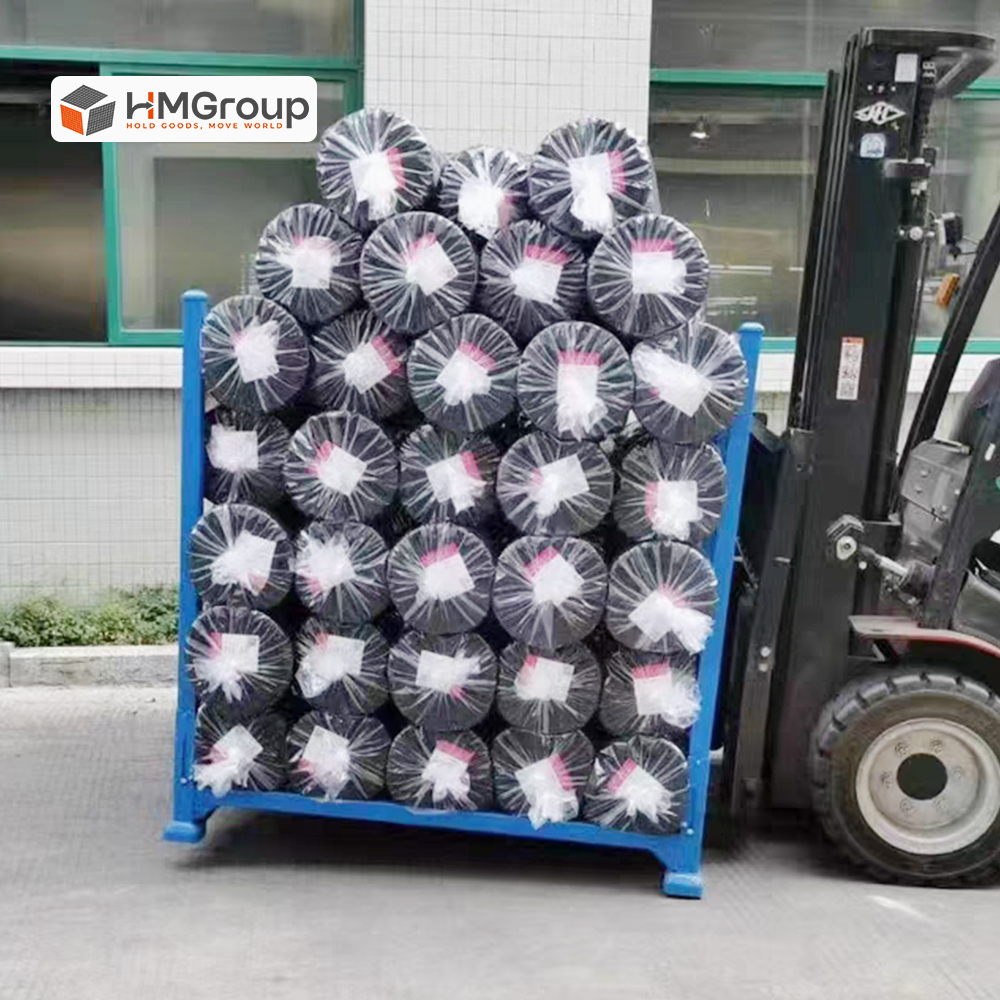
Send HM Group your roll diameters, roll widths, bundle sizes and target stack height, and the team can confirm whether HM-FR005, HM-FR007 or HM-FR002 is the closest match — or specify a customised size and load rating under OEM/ODM production.
Download the full product catalogue: HM Group storage rack and logistics equipment catalogue (PDF)
Website: www.hmlwires.com
Contact: MARY KONG — mary@net-railing.com
Tel / WhatsApp: +86 150 4058 7228
Office: +86 411-3981 3061
Address: 3306 Times Square (Times 1), 50 Renmin Road, Zhongshan Dist, Dalian, Liaoning, China
Have Questions or Need More Details?
Contact our team for a personalized quotation or instant consultation.
Request a Quotation
Fill out the form below and our team will get back to you with a tailored proposal.
WhatsApp Direct Chat
Prefer to chat in real-time? Message us on WhatsApp for instant assistance & quick answers.
- Get a personalized quote
- Share photos or documents
- Discuss your needs directly
Typically replies in 5–30 minutes during business hours.