Wire Container Compliance FAQs: Navigating Q235 Steel, Load Ratings, and Regional Standards
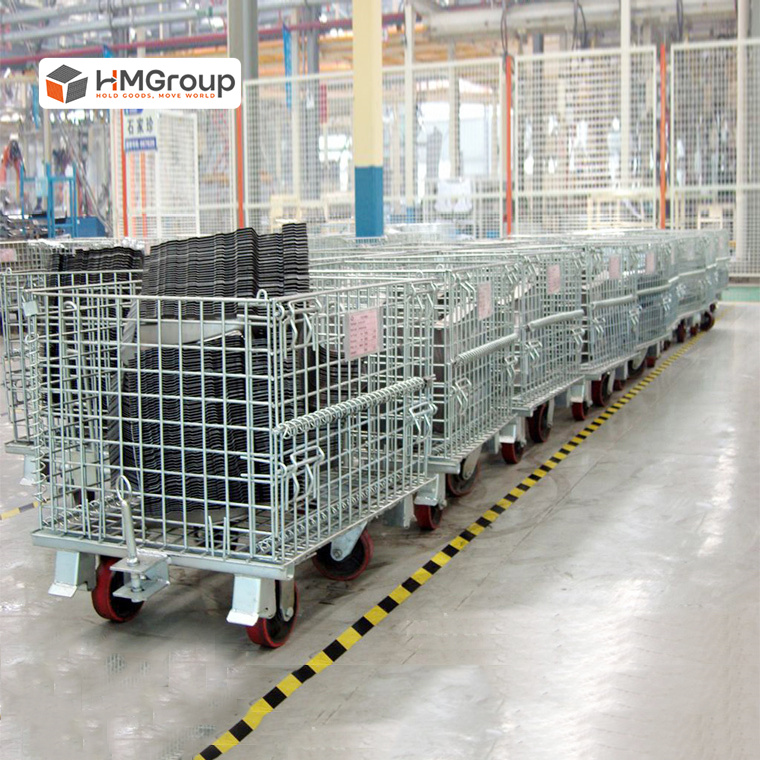
Wire container compliance is not one document. It is a chain of verifiable claims — steel grade, wire gauge, grid size, load rating, stacking limit, surface finish, certification scope and destination-market requirements — that must line up with the unit that actually arrives at your loading dock. When any link in that chain is unverified, buyers either over-specify and pay for capacity they never use, or under-specify and inherit a stacking risk in a live warehouse. This FAQ answers the constraint questions industrial buyers raise most often between research and evaluation, using published specifications for HM Group models including HM-HD001, HM-CP001 and HM-PPC22.
HM Group — Dalian HuaMao Logistics Equipment Group Co., Ltd. — is a Chinese manufacturer of wire mesh containers, PET preform containers, cage pallets, stillages, wire mesh decking and related material handling equipment. Founded in 2003, the company runs manufacturing bases in Xiamen, Nanjing and Qingdao and exports 100% of its output to markets including the EU, North America, Asia and the Middle East.
Problem Definition: Why Wire Container Compliance Questions Stall Sourcing
Most wire container compliance problems are documentation problems before they become physical problems. Three patterns repeat in nearly every RFQ round.
First, load ratings are published without a test basis. A datasheet may state 800 kg for one model and 1300 kg for another, but published capacities are not directly comparable between suppliers unless the test conditions, the static or dynamic basis, and the safety factor are disclosed. Two containers with the same nominal rating can behave differently under the same forklift cycle.
Second, certificates are read as product approvals. An ISO 9001 certificate confirms that a quality management system has been audited. It does not certify that a specific container will hold a specific load in a specific stacking configuration. The two are related but not interchangeable, and buyers who treat them as the same thing usually discover the gap during a factory audit or a safety review.
Third, regional requirements are assumed to travel with the product. A container shipped into the EU, North America, Asia or the Middle East may face different expectations around documentation, coating performance, contamination control and packaging. Those expectations are set by the destination, not by the supplier's home market, and unless the requirement is written into the purchase order it is not part of the contract.
Industry Background: A Defined Market With Uneven Documentation
Wire containers are a well-defined industrial product category with meaningful commercial weight. Published commercial market research places global wire mesh container sales at approximately USD 2.34 billion in 2025. The broader wire mesh market, which also includes fencing and filtration products, was estimated at USD 8.18 billion in 2024 by Market Research Future, with a projected value of USD 12.13 billion by 2035.
Within the container segment, stackable wire mesh containers held the largest product segment share at 32.5% of total revenue in 2025. That figure matters for compliance planning. If roughly one third of the category's value sits in units that get stacked on top of each other, then stacking documentation — not just nominal capacity — is the single most important technical claim a buyer has to verify.
Trade data reinforces the point. The United States accounted for approximately 16.7% of import market share for articles of iron or steel wire under HS Code 732620 in 2024, which means a large share of the world's wire containers cross at least one border before use. Every border crossing adds a documentation checkpoint: how the product is classified, what the certificate actually covers, and whether the supplier can produce evidence on request.
The remaining gap is not a shortage of products. It is a shortage of comparable, attributable specification data at model level — which is what the rest of this article works through.
Detailed Solution: Reading Q235, Gauge, Grid and Capacity Correctly
What Q235 mild steel means in practice
Q235 is the mild steel grade used across HM Group's wire container range, including HM-HD001, HM-CP001, HM-PPC22, HM-HD005 and HM-HD010. Practically, Q235 tells a buyer three things: the containers are built from low-carbon steel rather than stainless steel or aluminium, they rely on structural geometry and weld quality rather than alloy content for strength, and their corrosion protection comes from surface treatment rather than from the base metal itself.
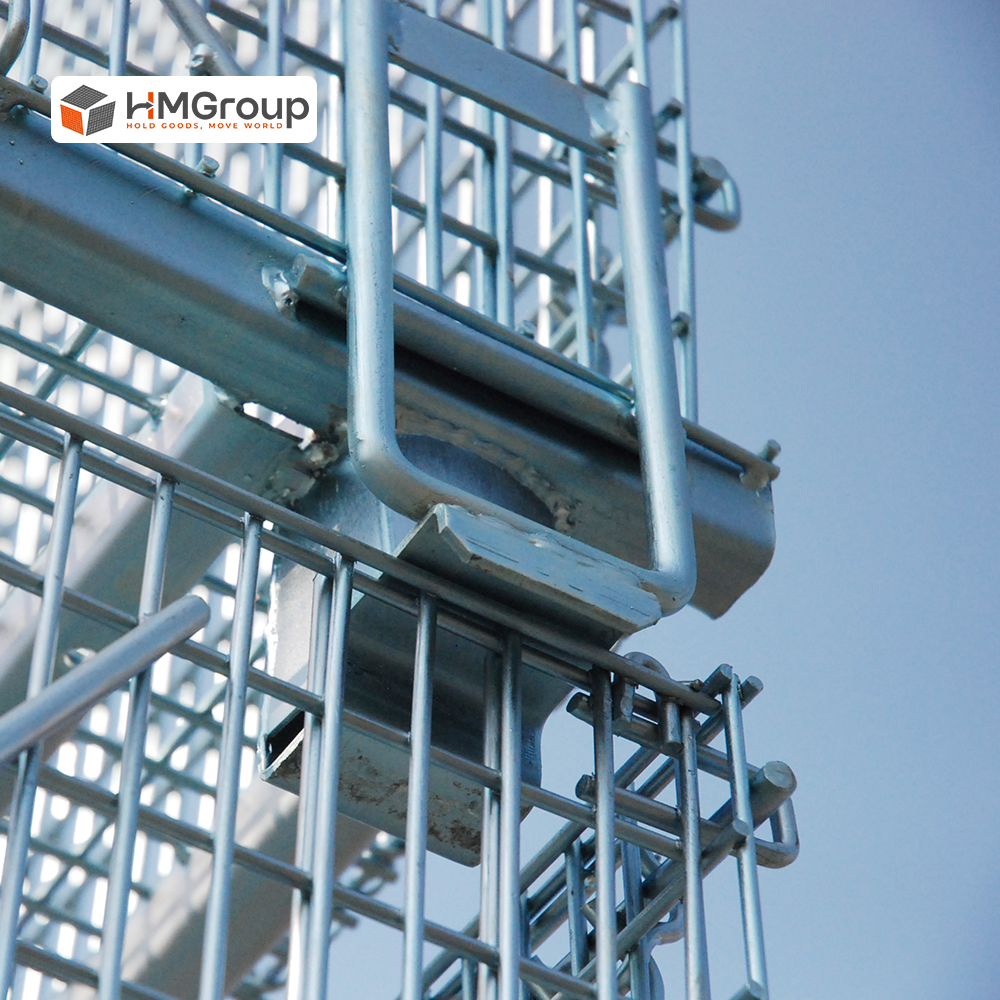
HM Group describes its wire containers as mainly composed of low-carbon wire rod and plate material, with wire parts joined by resistance welding. For a buyer, that translates into a concrete verification request: ask for the material grade, the wire diameter range and the welding method in writing, then confirm them against the packing list and inspection report when the order ships.
Wire gauge and grid size: the two numbers that decide fit
Across the HM Group range, wire gauge runs from 4 mm on bulk and industrial models such as HM-ST007 and HM-ST-AU001 up to 12 mm on wine and PET preform models. Grid size is the second variable, and it is the one that determines whether a container suits a specific load rather than just a specific weight: open 50 × 50 mm grids suit rigid automotive and agricultural components, while tighter, product-specific grids — 25 × 50 mm on HM-HD010 or 62 × 125 mm on HM-PPC22 — are designed around what is being contained.
This is why heavy duty wire containers and fine mesh containers are not interchangeable, even when their load ratings look similar. A 1300 kg rating on a 50 × 50 mm grid does not make the same unit suitable for small, loose components that would fall through.
Load ratings from 500 kg to 1300 kg
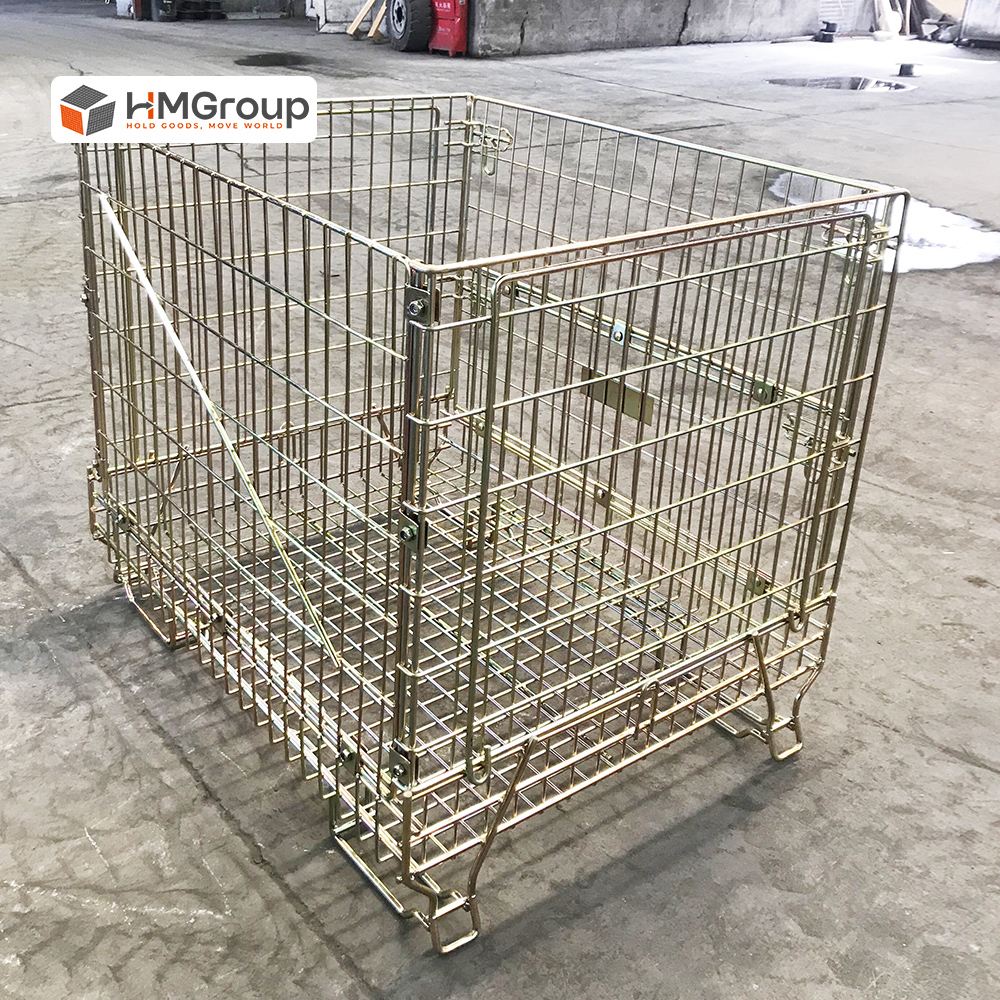
Load capacity across the verified HM Group model range spans 500 kg to 1300 kg. The 1300 kg rating belongs to HM-HD001, a 1030 × 840 × 850 mm unit with a 6 mm wire gauge and a 50 × 50 mm grid, stackable 4 high, loading 500 sets into a 1 × 40'HQ container. At the lower end, HM-ST-AU001 and HM-HD028 are listed at 500 kg.
The practical question is not which number is higher but which number applies to your configuration. A load rating is only meaningful together with the stacking height it was established for, the base support available, and whether the load is evenly distributed. Buyers should request the load basis in writing as part of the RFQ rather than inferring it from a catalogue figure.
Stackability: 4-high, 4+1 and 5+1 explained
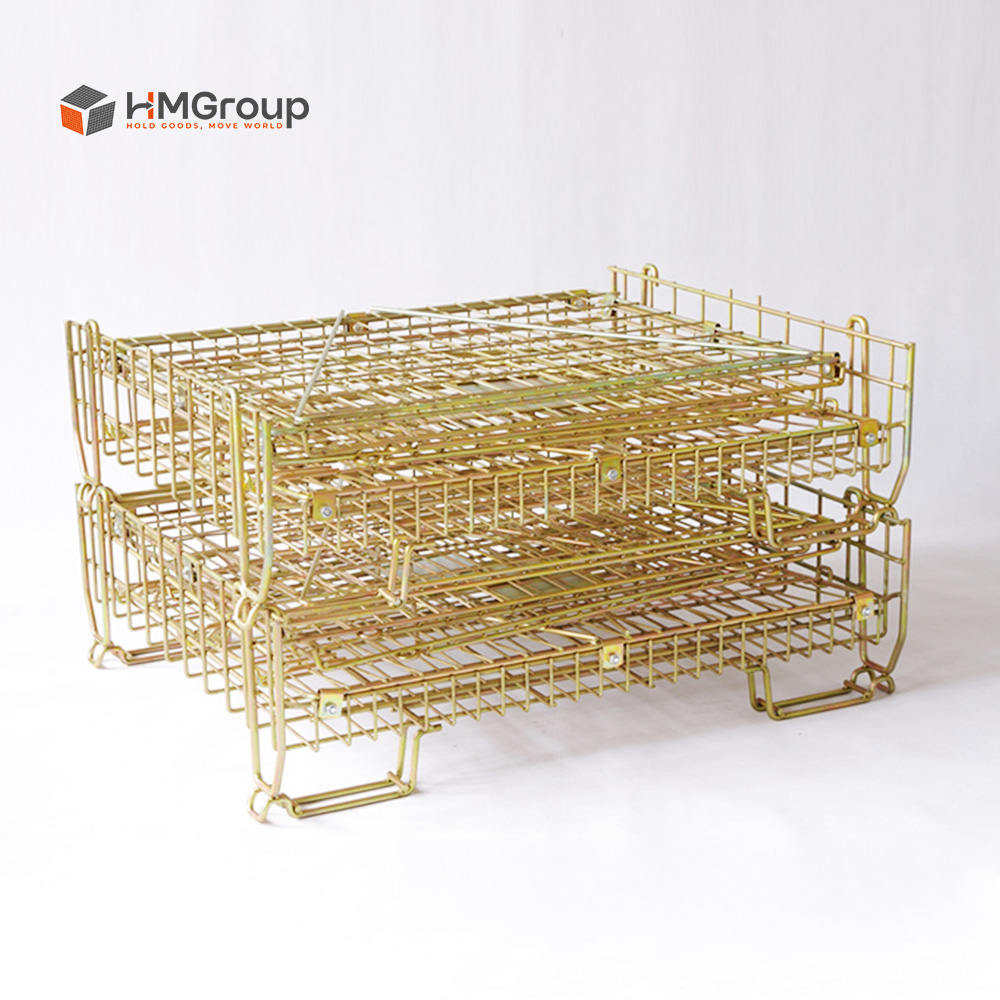
HM Group specifications use two notation styles. Most industrial models — HM-HD001, HM-CP001, HM-ST007, HM-ST-AU001, HM-HD005, HM-HD010, HM-HD028 and HM-PPC14 — are listed as stackable 4 high. Several wine and PET preform models use a plus-one notation: HM-WEU001, HM-WEU005 and HM-WEU010 are listed at 4+1, and HM-PPC22 at 5+1.
The plus-one indicates an additional unit above the rated stack rather than a free increase in capacity. Buyers working with racking, a mezzanine or a height-limited trailer should confirm the intended stacking configuration in writing before deployment.
Certifications and regional standards: what to verify, what not to assume
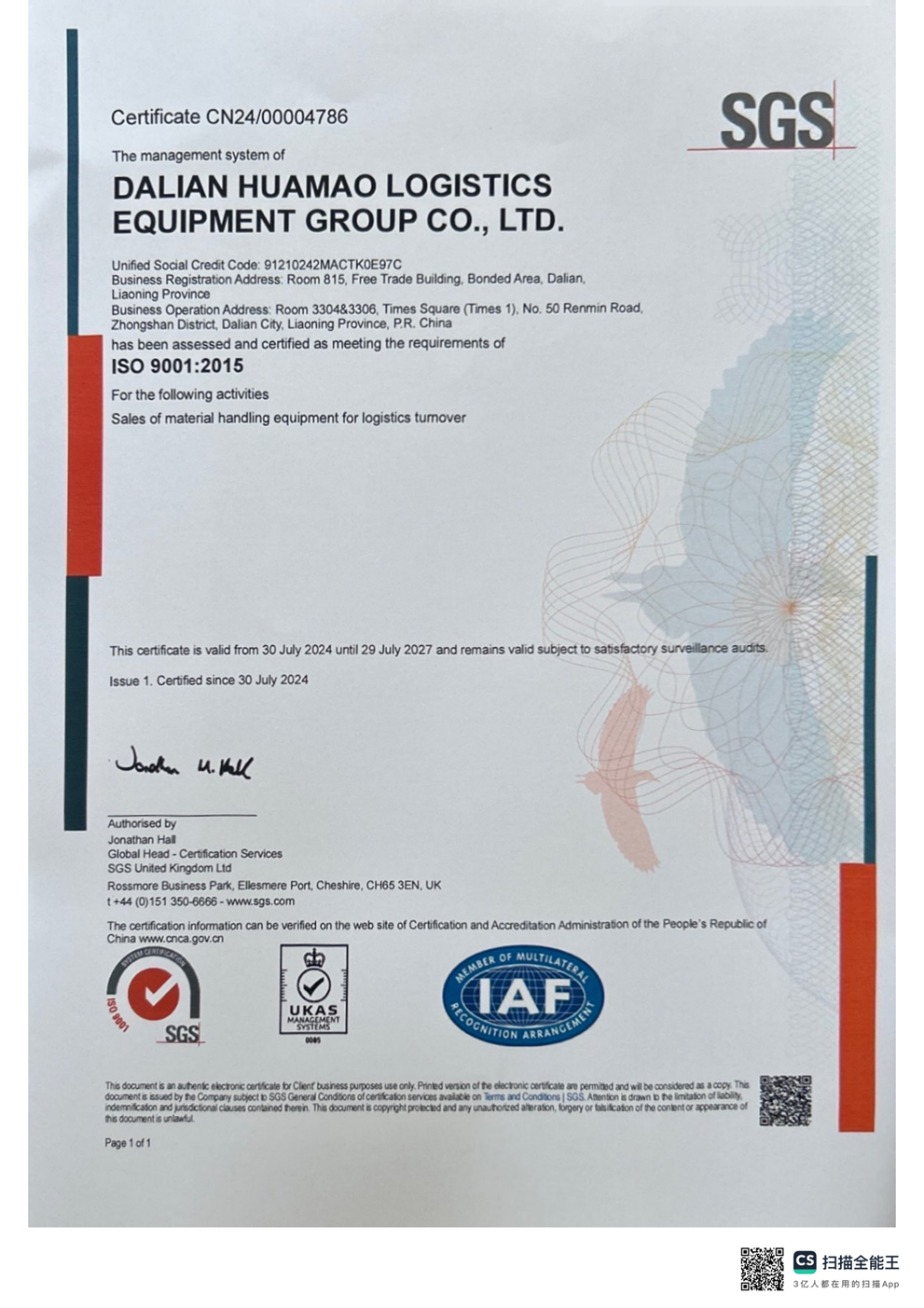
HM Group holds three auditable credentials relevant to a wire container purchase, summarised in the table below. Two verification habits follow from them.
| Credential | Number | Issuer | Validity | Stated scope |
|---|---|---|---|---|
| ISO 9001:2015 | CN24/00004786 | SGS | 2024-07-30 to 2027-07-29 | Sales of material handling equipment for logistics turnover |
| Made-in-China BV Audit Report | MIC-ASI2491658 | BV | Valid until 2026-10-28 | Post pallet, tire rack, roll container, wire mesh container, wire decking, cage pallet, stacking rack, PET preform container, IBC container, Danish trolley |
| Alibaba.com verified Pro Supplier | 486803081_T | SGS | 2026-03-06 to 2027-03-06 | All logistics equipment products |
First, check the scope. A report that lists wire mesh containers within its scope is more useful to a container buyer than one that does not. Second, check the validity date against your order date, because audit reports run on fixed renewal cycles — the BV report above, for example, expires on 2026-10-28.
On regional standards, the honest position is that wire containers are not covered by a single global product standard. ISO 668:2020 defines classification, dimensions and ratings for Series 1 freight containers, which is a different product category from industrial wire mesh containers. Where an internal specification, a customer requirement or a destination-market rule references a container standard, the applicable document should be confirmed in writing with the supplier rather than assumed from a sales page.
Classification matters too. Articles of iron or steel wire sit under HS Code 732620, and the classification a broker applies determines what documentation is requested at import. Buyers should confirm the classification and destination requirements with their own customs broker before the first shipment, not after it.
Comparison Table: Verified Wire Container Specifications
The table below compares published specifications across the HM Group wire container range. Every model listed uses mild steel Q235, and every value is a manufacturer-reported model specification that should be confirmed against the final order specification.
| Model | Type | Exterior dim. L×W×H | Wire gauge | Grid size | Load capacity | Stackability | Sets per 40'HQ |
|---|---|---|---|---|---|---|---|
| HM-HD001 | Heavy duty wire container | 1030 × 840 × 850 mm | 6 mm | 50 × 50 mm | 1300 kg | 4 high | 500 |
| HM-ST007 | Wire bulk container | 1230 × 835 × 970 mm | 4 mm | 50 × 50 mm | 1000 kg | 4 high | 160 |
| HM-ST-AU001 | Industrial wire container | 1125 × 1125 × 1000/800 mm | 4 mm | 50 × 50 mm | 500 kg | 4 high | 160 |
| HM-HD005 | Collapsible wire container | 1230 × 1040 × 900 mm | 6.2 mm | 50 × 100 mm | 1000 kg | 4 high | 350 |
| HM-HD010 | Wire mesh storage container | 1200 × 1000 × 1250 mm | 6 mm | 25 × 50 mm | 800 kg | 4 high | 216 |
| HM-HD028 | Wire container with PP sheet | 1200 × 1000 × 1140 mm | 5 mm | 50 × 100 mm | 500 kg | 4 high | 330 |
| HM-CP001 | Wire mesh pallet container | 1200 × 800 × 1000 mm | 5–10 mm | 60 × 103 mm | 800 kg | 4 high | 550 |
| HM-PPC22 | PET preform wire container | 1196 × 1008 × 1174 mm | 4.8–12 mm | 62 × 125 mm | 600 kg | 5+1 | 170 |
| HM-PPC14 | Foldable wire container | 1120 × 971 × 1050 mm | 6–12 mm | 54 × 160 mm | 800 kg | 4 high | 240 |
| HM-WEU001 | Metal wire container for wine bottles | 1140 × 830 × 980 mm | 5–12 mm | 55 × 113 mm | 800 kg | 4+1 | 332 |
| HM-WEU005 | Wine storage wire container | 1200 × 920 × 1018 mm | 5–12 mm | 51 × 118 mm | 800 kg | 4+1 | 228 |
| HM-WEU010 | Wire mesh container | 1183 × 948 × 991 mm | 5–12 mm | 60 × 120 mm | 800 kg | 4+1 | 235 |
Loading density is the column buyers most often overlook: the same nominal container can occupy 160 to 550 sets inside a single 40-foot high-cube container, which changes landed cost per unit substantially.
Step-by-Step: A Six-Stage Compliance Verification Workflow
Step 1 — Define the load envelope before the model. Record the actual load weight, the load type (rigid, loose, fragile or palletised), the stacking height available in your facility, the forklift or reach-truck access pattern, and the handling method. This determines whether you need a 500 kg class or a 1300 kg class unit, and whether grid size is a constraint rather than a preference.
Step 2 — Shortlist by specification, not by category name. Match exterior dimensions, wire gauge, grid size and stackability against the shortlist. A typical comparison in this range is HM-CP001 at 1200 × 800 × 1000 mm with a 5–10 mm gauge and 800 kg capacity, versus HM-HD001 at 1030 × 840 × 850 mm with a 6 mm gauge and 1300 kg capacity.
Step 3 — Request certificate scope and validity in writing. Ask for the certificate number, the issuing body, the scope statement and the validity period, and confirm that the product family you are buying falls inside that scope.
Step 4 — Confirm material and finish against the destination environment. HM Group offers zinc, hot-dip galvanized or powder coating finishes, with the powder coating colour selected by the buyer. Product documentation describes zinc plating or hot-dip galvanization as providing 3 to 5 years of rust resistance in industrial environments. Humid cellars, coastal sites and wash-down areas need this decision made explicitly at specification stage.
Step 5 — Validate a sample before mass production. HM Group runs a six-phase quality control process: pre-production sample inspection, raw material inspection, component inspection, semi-finished product inspection, finished product inspection and packaging inspection. Process reporting runs throughout the order, and online video audit is supported for buyers who cannot travel.
Step 6 — Lock lead time and shipping quantity against your schedule. Standard lead time is 30–45 days with a minimum order quantity of 1 × 20GP. Because container loading varies widely by model — from 160 sets per 40'HQ for HM-ST007 and HM-ST-AU001 up to 550 sets for HM-CP001 — freight planning belongs in the specification decision rather than in a later calculation.

Use Cases: Where the Compliance Requirements Change
PET preform handling
PET preform containers pair a moderate load rating with tight surface-finish control. HM-PPC22 is listed at 1196 × 1008 × 1174 mm, 4.8–12 mm wire gauge, 62 × 125 mm grid, 600 kg capacity and 5+1 stacking, with 170 sets per 40'HQ. HM-PPC14 is a foldable variant at 1120 × 971 × 1050 mm with an 800 kg capacity, and HM-HD028 adds a PP sheet option for dust and scratch protection at 500 kg. In these applications the compliance conversation centres on contamination control and preform surface integrity rather than maximum tonnage. HM Group has supplied 15,000 PET preform containers for Coca-Cola Germany and completed a 10,000-unit PET preform container deployment for a global food and beverage manufacturer.
Wine and beverage storage
Wine storage containers are configured around bottle counts as much as weight. HM-WEU001 stores 500 Bourgogne bottles at an 800 kg rating, and HM-WEU005 stores 400 Bordeaux bottles at the same rating. Both are listed at 4+1 stackability, which suits temperature-controlled cellars where vertical space is expensive and humidity is high. This configuration is common in Australia, Spain, Italy, Portugal, France, Chile, Argentina and Malaysia. For wine buyers, the coating decision usually carries more commercial weight than the load rating.
Automotive, agricultural and heavy industrial storage
High-tonnage handling favours lower container heights and rigid grids. HM-HD001 at 1300 kg, HM-ST007 at 1000 kg and HM-ST-AU001 at 500 kg are all built on 50 × 50 mm grids, which suits automotive components, agricultural produce and metal hardware where the load is irregular but the unit must survive repeated forklift cycles. The core application sectors recorded for this configuration are automotive components, manufacturing and retail distribution, with agriculture, e-commerce logistics and metal hardware storage as related sectors.
Warehouse, e-commerce and fulfilment
Where freight efficiency dominates, HM-CP001 is the highest-density option in the range at 550 sets per 40'HQ, with a 1200 × 800 × 1000 mm footprint that matches standard pallet handling and 4-high stacking. These units are typically specified for visible-inventory storage, lean transformation projects and reverse logistics, where the open mesh design supports fast visual stock checks without opening a container.
Wire Container Compliance FAQs
Which certifications should a wire container buyer verify before ordering?
Verify three things: the certificate number, the scope, and the validity period. HM Group holds ISO 9001:2015 certificate No. CN24/00004786 issued by SGS, valid to 2027-07-29, with a scope covering the sales of material handling equipment for logistics turnover; a Made-in-China BV Audit Report No. MIC-ASI2491658 issued by BV, valid until 2026-10-28, covering post pallet, tire rack, roll container, wire mesh container, wire decking, cage pallet, stacking rack, PET preform container, IBC container and Danish trolley; and Alibaba.com verified Pro Supplier certificate No. 486803081_T issued by SGS, valid to 2027-03-06. These credentials verify a quality system and a supplier audit. They do not by themselves certify a load rating for a specific unit, so the load basis should be confirmed separately in the RFQ.
How do I verify a stated load rating such as 1300 kg on HM-HD001?
Treat the rating as a claim that needs three supporting details: the test basis (static or dynamic), the stacking configuration it was established for, and the exact model configuration being ordered. HM-HD001 is listed at 1030 × 840 × 850 mm, 6 mm wire gauge, 50 × 50 mm grid, 1300 kg capacity and 4-high stackability. Because published capacities are not directly comparable across suppliers without test conditions and safety factors, the rating plus the intended configuration should be confirmed in writing before the purchase order is issued, then re-checked against the finished product inspection report.
Can wire containers be customized to match our specification?
HM Group operates on OEM, ODM and fully customized production, supported by three manufacturing bases in Xiamen, Nanjing and Qingdao with a reported 62,000 m² factory area and annual output of 2,000,000 units. Customizable elements include surface treatment (zinc, hot-dip galvanized or powder coating), exterior size, loading capacity, powder coating colour, logo printing, and design features such as forklift guides, wire dividers, runner bars, name plates and wheels. Monthly capacity is 40,000 sets, which supports both repeat replenishment programmes and first-time custom runs. Buyers with a destination-market requirement should raise it at specification stage so it is built into the drawing rather than retrofitted after production.
What drives the cost of a wire container order?
Cost in this category is driven by specification rather than by a single list price: wire gauge, grid density, load-rating class, surface treatment (zinc, hot-dip galvanized or powder coating), PP sheet liners, wheels or casters, and custom features such as dividers, name plates and logo printing. Freight volume is a major variable, because loading density ranges from 160 sets per 40'HQ for bulk models such as HM-ST007 to 550 sets for HM-CP001, so the same container footprint can carry very different landed costs. Minimum order quantity is 1 × 20GP and standard lead time is 30–45 days. Budgeting against a model-level quotation for your final specification is the reliable approach, and a quotation can be prepared against a defined requirement rather than a category name.
How do we validate a sample, and what lead time should we plan for?
Validation follows the same six-phase quality control sequence used on every order: pre-production sample inspection, raw material inspection, component inspection, semi-finished product inspection, finished product inspection and packaging inspection. Process reporting continues throughout production, and online video audit is available for buyers who want factory verification without travelling. Plan for a 30–45 day lead time from confirmed specification, with a 1 × 20GP minimum order quantity and a 3 to 5 year warranty under proper use. For a first project, start with sample validation of the exact model and finish combination, then convert to the production order once the inspection report matches the agreed specification.
Conclusion: Turning Compliance Questions Into a Signed-Off Specification
Wire container compliance is a documentation exercise with physical consequences. The buyers who avoid surprises are the ones who define the load envelope first, shortlist by gauge, grid and capacity rather than by product name, verify certificate scope and validity at the moment of order, and confirm the load basis and stacking configuration in writing.
The verified data behind that workflow is straightforward: Q235 mild steel across the range, wire gauges from 4 mm to 12 mm, grid sizes from 25 × 50 mm to 54 × 160 mm, load ratings from 500 kg to 1300 kg, stackability typically 4 high with 4+1 and 5+1 configurations for wine and PET preform models, and three auditable credentials — ISO 9001:2015 (CN24/00004786, SGS), a Made-in-China BV Audit Report (MIC-ASI2491658) and Alibaba.com verified Pro Supplier status (486803081_T, SGS).
For buyers moving from research into evaluation, the next step is a specification-level conversation rather than a catalogue request. Share the load, the grid requirement, the destination market and the stacking height, and ask for the corresponding model, the certificate scope and the container loading quantity in a single response.
Next step
Send your load, dimensions and destination market to HM Group and request a model-level quotation, the applicable certificate scope, and a sample validation plan.
Email: mary@net-railing.com | Tel / WhatsApp: +86 150 4058 7228 | Phone: +86 411-3981 3061
Website: https://www.hmlwires.com/ | Brochure: https://cdn.socialarks.com/sbsp/24780/common/2026/0512/6a02c6bba978c.pdf
Address: 3306 Times Square (Times 1), 50 Renmin Road, Zhongshan Dist, Dalian, Liaoning, China
Product specifications, certification numbers and validity dates in this article are manufacturer-reported facts and should be re-confirmed at the time of order, since audit reports and certificates follow fixed renewal cycles.
Have Questions or Need More Details?
Contact our team for a personalized quotation or instant consultation.
Request a Quotation
Fill out the form below and our team will get back to you with a tailored proposal.
WhatsApp Direct Chat
Prefer to chat in real-time? Message us on WhatsApp for instant assistance & quick answers.
- Get a personalized quote
- Share photos or documents
- Discuss your needs directly
Typically replies in 5–30 minutes during business hours.