Wire Container Mobility: A Buyer’s Guide to Casters, Wheels, and Mobile Mesh Storage
Wire containers with casters (also written as wire containers with wheels, mobile wire mesh containers, or roll cages) are steel wire mesh storage units fitted with caster wheels so they can be moved by hand or by small handling equipment. They are used in warehouses, manufacturing plants, and distribution centers where goods need to be transported short distances, picked, or repositioned without using a forklift for every move. This guide explains what mobile wire containers are, how they compare to standard non-mobile models, how HM Group approaches caster and wheel options, and what buyers should check before ordering.
Wire containers are already one of the most widely used industrial storage formats because they combine visibility, strength, stacking ability, and collapsibility. According to third-party market data, the global wire mesh containers sales market is valued at approximately USD 2.34 billion in 2025 and is projected to reach USD 3.72 billion by 2034. The same source indicates that Asia Pacific holds a 38.2% revenue share as of 2025. When mobility is required, adding casters or wheels changes the unit from a static storage asset into a handling tool. That change affects design, load rating, stacking behavior, and purchasing criteria.
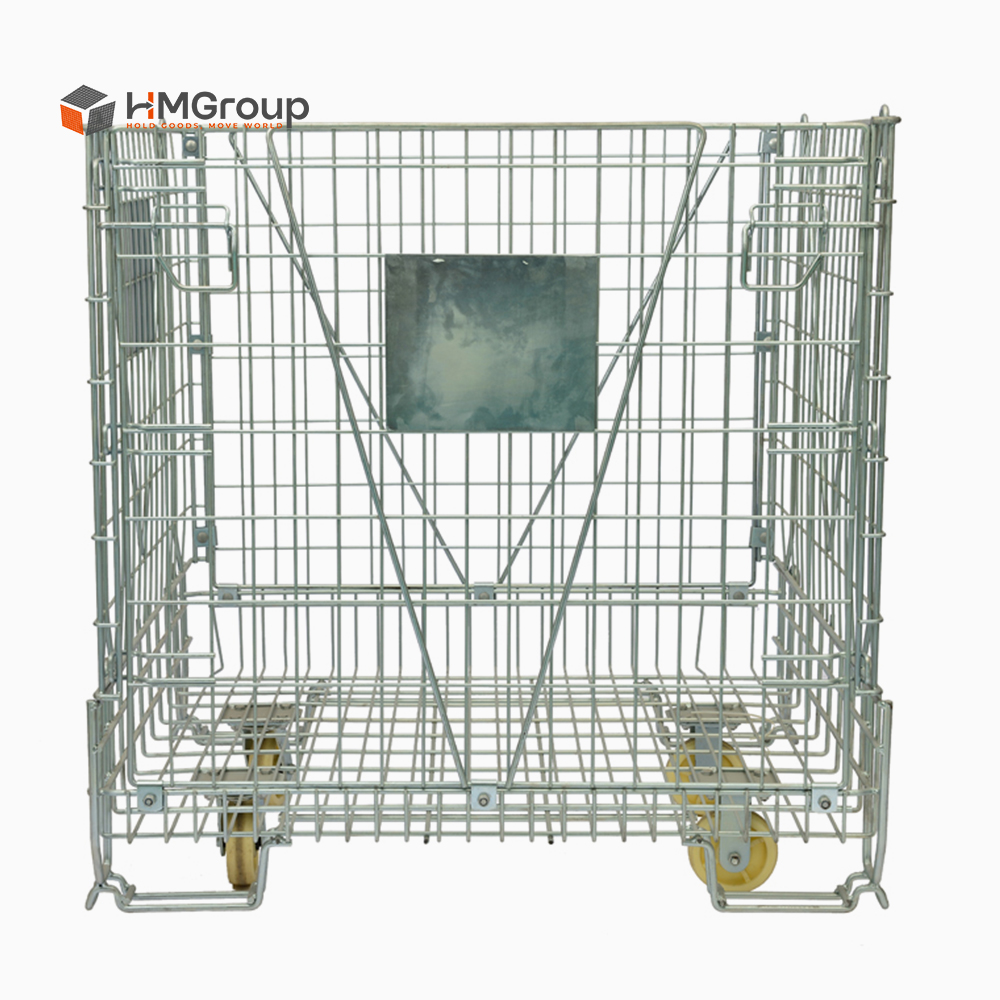
Wire bin on wheels — mobile wire mesh container with caster configuration
The Problem: Fixed Storage Does Not Always Match Fast-Moving Operations
Standard wire containers are designed for vertical stacking and forklift-based movement. They are effective when materials stay in one zone and are moved by mechanical handling equipment. However, many facilities have operations where a static unit creates friction.
Common constraints include:
- Frequent short-distance moves. Picking, assembly feeding, or line-side replenishment may require moving a container a few meters or between aisles many times per shift.
- Limited forklift availability. Not every location or shift has a forklift ready to relocate a single container.
- Manual handling needs. Technicians or pickers may need to position a unit close to a workbench or shelf without calling for mechanical equipment.
- Return logistics. Empty containers may need to be moved back to a storage area quickly.
- Space constraints. Narrow aisles or congested lines may not allow forklift turning.
Wire containers with casters and wire containers with wheels answer these constraints by allowing the container to be moved manually or with small tugs. However, the addition of wheels introduces engineering trade-offs. The same unit can no longer be treated as a purely static pallet-based container; the caster system, frame base, and load distribution must be designed together.
Industry Background: What Buyers Mean by Mobile Wire Containers
The terms in this category are not perfectly standardized. Buyers may search for “wire container with casters,” “wire container with wheels,” “steel wire container on castors,” or “mobile wire mesh container.” In many European and Asian markets, the same product family is also called a roll container or roll cage, especially when it is designed primarily for manual movement and retail or warehouse picking.
From a design standpoint, mobile wire containers generally fall into two groups:
- Manual mobility configurations: Caster wheels are fitted to a standard or reinforced wire container base so the unit can be pushed, pulled, or towed. Load capacity may be adjusted depending on the caster type and floor conditions.
- Hybrid configurations: The unit retains 4-way forklift entry and stacking capability, while casters are added for positioning in specific areas. In these cases, the buyer must clarify whether stacking is still allowed with casters attached, with casters removed, or only when the unit is converted back to a static base.
In fast-moving environments, the open-mesh design remains important. Operators can identify SKUs, colors, and quantities without opening a lid or removing wrapping. That visibility is one reason wire mesh containers are preferred over solid bins in picking and line-side applications. Mobility adds a second layer of value: the visible inventory can also be moved to where it is needed.
Detailed Solution: How HM Group Handles Caster and Wheel Options
HM Group (Dalian HuaMao Logistics Equipment Group Co., Ltd.) is a China-based manufacturer of wire mesh containers and other logistics equipment. The company operates three manufacturing bases in Xiamen, Nanjing, and Qingdao, and exports 100% of its output to markets including the EU, North America, Asia, and the Middle East. Its annual production capacity is 2,000,000 units, with a 62,000 m² factory footprint and a foreign-trade department of 50 employees. For mobility-related designs, HM Group treats casters and wheels as part of its OEM/ODM customization scope rather than as a single fixed product option.
The company’s customization range includes: surface treatment (zinc, hot-dip galvanized, or powder coating), size, loading capacity, powder coating color, logo printing, and designs such as forklift guide, wire divider, runner bar, name plate, and wheels. In this product structure, “wheels” is an explicit design option. That means a buyer can start from a standard model and request a caster configuration to suit the application, rather than being limited to one mobile-only SKU.
For applications that require both mobility and high load capacity, HM Group can work from heavy-duty or collapsible wire container platforms. It can also produce wire containers with PP sheets for applications where small or delicate items, such as PET preforms, need protection from dust and scratching. The caster option can be combined with wire mesh containers, wire bulk containers, industrial wire containers, and other models, depending on the project specification.
HM Group’s quality control system follows six phases: pre-production sample inspection, raw material inspection, component inspection, semi-finished product inspection, finished product inspection, and packaging inspection. The company holds ISO 9001:2015 certification (certificate number CN24/00004786, issued by SGS), a Made-in-China BV Audit Report (certificate number MIC-ASI2491658, valid until 2026-10-28), and Alibaba.com verified Pro Supplier certification (certificate number 486803081_T, issued by SGS). Monthly production capacity is 40,000 sets, lead time is 30–45 days, and MOQ is 1x20GP.
Step-by-Step Breakdown: What to Specify When Buying Wire Containers with Casters
Buyers should not treat “with wheels” as a single checkbox. A caster-equipped wire container is the result of several specifications that must match the application. The following steps summarize what should be clarified before ordering.
Step 1: Define the Movement Task
Determine how the container will be moved. Will it be pushed by hand, towed by a tugger, or moved only for positioning? Different movement tasks require different caster sizes, wheel materials, and swivel configurations.
Step 2: Define Load and Floor Conditions
The loading capacity of the container must be compatible with the caster rating. Floor surface, thresholds, elevators, and outdoor or indoor use all affect wheel type. For example, hard tread wheels may work on smooth concrete, while softer tread wheels may be better for protecting floor surfaces.
Step 3: Decide Stacking Requirements
Ask whether the mobile unit must be stackable. Many wire containers are engineered for 4-high stacking. With casters attached, stacking can become unstable or exceed the caster’s rated capacity. Buyers should specify whether casters must be removable, retractable, or replaced by a static base for stacking.
Step 4: Choose the Base and Entry Design
If the container will still be moved by forklift for part of its life, it should retain forklift entry. HM Group designs can include a forklift guide, and standard wire containers typically feature 4-way forklift-friendly bases. Combining forklift entry with casters requires a clear layout so the casters do not block fork pockets.
Step 5: Select Additional Features
Depending on the goods, the container may need a half-drop gate, wire divider, runner bar, top lid, name plate, PP sheet lining, or other features. Each addition affects weight, cost, and handling.
Step 6: Verify Compliance and Inspection
Confirm that the manufacturer has documented quality control and, where relevant, certifications. HM Group’s production process covers inspection phases from raw material to packaging. Buyers can also request process reports and online video audits during production.
Use Cases: Where Mobile Wire Mesh Storage Adds the Most Value
Line-Side Feeding in Automotive and Manufacturing
In automotive components, manufacturing, and retail distribution, materials shift constantly and require rapid identification. Mobile wire containers allow operators to place components close to the production line and move them out quickly when full. The open mesh supports visual stock checks, and the caster base reduces the need for forklift trips on short internal routes.
Warehouse Picking and Fulfillment
Wire mesh containers are used in fulfillment, warehouse, hypermarket, and e-commerce logistics. When picking routes change during a shift, a caster-equipped unit can follow the operator. The half-drop gate feature, which HM Group offers in several models, provides ergonomic access even when units are stacked.
Wine Bottle Storage and Movement
Specialized wire containers for wine bottles protect labels and glass while allowing ventilation. In a cellar or distribution center, a caster version can simplify movement between aging zones, packing areas, and loading bays. HM Group’s wine-industry models include containers designed to store 400 Bordeaux bottles and 500 Bourgogne bottles, with stackability of 4+1 high in static configuration.
PET Preform Handling
PET preform containers are used in high-volume beverage production. HM Group has supplied PET preform containers to international beverage companies and produces models such as the HM-PPC22 and the foldable HM-PPC14. For preform operations, a mobile configuration is useful for repositioning containers between injection molding and blow-molding lines, while PP sheet liners protect preforms from contamination and scuffing.
Distribution and Return Logistics
Collapsible wire containers already provide a 4:1 return ratio when empty, reducing return freight costs. Adding casters can make empty units easier to marshal and stage in a yard or dock area. Buyers should confirm whether the caster design remains safe when the collapsed units are moved or stacked.
Comparison: Key Considerations for Standard vs. Mobile Wire Containers
| Comparison Dimension | Standard Wire Container | Wire Container with Casters / Wheels |
|---|---|---|
| Primary movement method | Forklift, reach truck, pallet jack | Manual push/pull, tugger, or small handling equipment |
| Forklift entry | Usually 4-way entry base | Must be confirmed; caster base may affect fork pocket design |
| Stacking | Engineered for high stacking, e.g., 4-high or 5+1-high depending on model | Requires confirmation; casters may reduce or block stacking unless removable |
| Load capacity | Up to 1,000 kg or more depending on model | Depends on caster rating and frame base; confirm combined rating |
| Best for | High-density vertical storage, stable zones | Short-distance movement, line-side feeding, picking |
| Standard designs in HM Group range | Heavy duty HM-HD001, collapsible HM-HD005, wire mesh HM-HD010, wire bulk HM-ST007, PET preform HM-PPC22, etc. | Wheels/casters as a design customization option across multiple models |
The table above is a decision aid, not a ranking. Some facilities will benefit from a mixed fleet: standard stackable containers for storage, and a smaller number of caster-equipped units for movement and picking. This combination avoids the cost and handling penalties of putting wheels on every container.
Limitations and Trade-offs to Discuss with the Supplier
Mobile wire containers are not a universal upgrade. Buyers should weigh the following trade-offs:
- Stacking stability. A container on casters may not be safe to stack as high as a static container. If vertical storage is the main goal, keep the unit on a static base.
- Load rating. The container’s frame may be rated for 1,000 kg, but the casters may carry only a fraction of that. The effective working load is limited by the weakest component.
- Floor wear. Caster wheels can mark or damage floors if the wrong tread is selected.
- Maintenance. Casters, swivel locks, and brakes are moving parts that require inspection and occasional replacement.
- Cost. Adding casters increases material and labor cost and may reduce the number of units that fit in a shipping container.
Buyers should request drawings, load test evidence, and caster specifications before ordering. HM Group’s six-phase quality control system includes pre-production sample inspection and component inspection, which gives buyers a structured point to review caster quality before mass production.
How to Request a Caster or Wheel Configuration from HM Group
Because wheels are a customization option rather than one standard product, the clearest way to request a mobile configuration is to provide the following information:
- Base model or preferred exterior dimensions (e.g., 1200×1000×1140 mm).
- Required loading capacity in kg, and whether the load is static, dynamic, or both.
- Number of casters, swivel vs. fixed, and wheel diameter if known.
- Whether the container must remain forklift-accessible with casters fitted.
- Whether stacking must still be possible, and if casters should be removable for stacking.
- Surface treatment preference: zinc, hot-dip galvanized, or powder coating.
- Any additional requirements such as PP sheet lining, dividers, half-drop gates, or name plates.
HM Group can provide a process report throughout production and supports online video audits. For buyers in the United States, Canada, Mexico, Argentina, Brazil, South Africa, Saudi Arabia, and other key regions, the company has local sales, technical, and service teams that can support project-specific requirements.
Frequently Asked Questions
What certifications apply to foldable wire containers from HM Group?
The Foldable Wire Container from HM Group is certified to ISO 9001:2015 (certificate number CN24/00004786, issued by SGS), covered by a Made-in-China BV Audit Report (certificate number MIC-ASI2491658, valid until 2026-10-28), and verified as an Alibaba.com Pro Supplier (certificate number 486803081_T, issued by SGS). These certifications apply to the global market.
Can a wire container with casters still be stacked?
This must be confirmed with the manufacturer for each design. Standard static wire containers are engineered for stacking, with examples including 4-high and 5+1-high configurations. When casters or wheels are added, stacking stability and total load capacity depend on the caster rating, frame base, and whether the casters are removable. Buyers should state their stacking requirement before ordering so the base and caster system can be engineered accordingly.
Does HM Group offer mobile wire containers for industries such as wine or PET preforms?
HM Group offers wheels as a design option within its OEM/ODM customization scope. The company’s product range includes wire mesh containers, PET preform wire containers (e.g., HM-PPC22 and HM-PPC14), wine storage wire containers (e.g., HM-WEU001 and HM-WEU005), wire bulk containers, and heavy-duty models. Casters or wheels can be requested on a project-specific basis, along with options such as zinc, hot-dip galvanized, or powder coating surface treatment.
What is the typical lead time and MOQ for a customized mobile wire container?
HM Group’s standard production lead time is 30–45 days, monthly capacity is 40,000 sets, and MOQ is 1x20GP. Customized caster configurations follow the same production window, but buyers should confirm lead time with the sales team because specific components such as caster type and wheel material may affect procurement time.
How does HM Group control quality for customized containers with casters?
Quality control is performed in six phases: pre-production sample inspection, raw material inspection, component inspection, semi-finished product inspection, finished product inspection, and packaging inspection. Customers can also receive process reports throughout production and request online video audits.
Need a wire container specification that fits your warehouse and budget?
HM Group can provide a sample, a quote, or a technical inquiry for caster-equipped wire containers and other customized mesh storage solutions.
Email: mary@net-railing.com
Tel/WhatsApp: +86 150 4058 7228
Third-party market data cited in this article comes from publicly available industry reports and is provided for context only. Product specifications and company facts reflect HM Group’s published information at the time of writing.
Have Questions or Need More Details?
Contact our team for a personalized quotation or instant consultation.
Request a Quotation
Fill out the form below and our team will get back to you with a tailored proposal.
WhatsApp Direct Chat
Prefer to chat in real-time? Message us on WhatsApp for instant assistance & quick answers.
- Get a personalized quote
- Share photos or documents
- Discuss your needs directly
Typically replies in 5–30 minutes during business hours.