Wire Container Partnership FAQ: Long-Term Supply & Support
Wire Container Partnership FAQ: Long-Term Supply & Support

A long-term wire container partnership is not a single purchase repeated on a schedule. It is a frozen specification, a documented acceptance routine, and a service commitment that has to survive dozens of production cycles. The questions below are the ones buyers ask after their first delivery, when the decision shifts from which container to buy to which supplier, which terms, and what happens in year three.
HM Group — Dalian HuaMao Logistics Equipment Group Co., Ltd. — is a logistics equipment manufacturer established in 2003. It operates three manufacturing bases in Xiamen, Nanjing and Qingdao covering 62,000 m², with an annual production capacity of 2,000,000 units, a 10-engineer R&D team and a trading department of approximately 50 staff. Export business accounts for 100% of total sales, with major markets in the EU, North America, Asia and the Middle East. The catalogue includes wire mesh containers, PET preform containers, cage pallets, stillages, tire racks, nestainer racks, fabric roll racks, wine barrel racks, post pallet racks, wire mesh roll containers, wire mesh decking, Danish trolleys and steel pallets.
Why long-term wire container supply fails after the first order
The first shipment of a wire container order is usually inspected closely. The tenth is not. Risk accumulates in that gap, and it rarely shows up as an obvious structural failure. It shows up as a purchase order that no longer matches the approved drawing, an acceptance argument nobody wrote down, or a service request with no named owner.
Four failure modes account for most of the friction in repeat supply:
- Specification drift. Grid size, wire gauge or surface finish shifts between batches, and the change is visible only to the person who compares two shipments side by side.
- Undefined acceptance. The buyer checks external dimensions, the supplier checks function, and no document establishes which check is binding when the two disagree.
- Untracked change. A material or coating substitution is made to protect a delivery date and communicated verbally, then forgotten by both sides until an end user raises it.
- Unclear after-sales ownership. Caster problems, coating damage or stacking questions reach a sales contact who has no defined route to a technical answer.
None of these is a product defect in the narrow sense. They are contract defects that later present themselves as product complaints, which is why the useful work in a long-term partnership happens before the second order rather than after the fifth.
Industry background: repeat demand, not one-off demand
Published market research places the global wire mesh market at USD 8.18 billion in 2024, projected to reach USD 12.13 billion by 2035 (Market Research Future). The narrower wire mesh container segment was reported at approximately USD 2.34 billion in 2025, and stackable wire mesh containers held the largest product segment share at 32.5% of total revenue in that year.
Two conclusions follow for a buyer negotiating a framework agreement. First, stacking is the dominant design intent rather than a secondary feature, which is why stackability ratings such as 4 high, 4+1 and 5+1 belong in the specification and not only in the brochure. Second, a segment of this size is sustained by replenishment and replacement, not solely by first-time capital projects. Buyers who treat wire containers as project purchases rather than reusable assets tend to renegotiate the same points every year.
Trade data adds a sourcing dimension. The United States accounted for approximately 16.7% of imports under HS 732620 — articles of iron or steel wire — in 2024, the category that most often carries wire containers and comparable steel mesh handling equipment. Import-heavy demand means most buyers compare suppliers across borders, which raises the value of documentation relative to proximity.
A caution on market numbers: published figures group wire mesh broadly, covering fencing, filtration and containers together, and they do not include unit prices, minimum order quantities or lead times for wire containers. They support a demand argument. They cannot substitute for a quotation built on a defined specification.
How HM Group supports a long-term wire container program
Manufacturing footprint and capacity
Three production bases in Xiamen, Nanjing and Qingdao give the group a combined facility area of 62,000 m² and annual capacity of 2,000,000 units. For a buyer, the relevant point is continuity: multi-base manufacturing matters when a single site is fully committed, and it matters more when a specification change requires tooling work alongside ongoing production. The 10-engineer R&D team is the function that absorbs those changes, and the roughly 50-person trading department is the commercial interface that keeps quotation, documentation and shipment scheduling in one conversation.
Quality system and documentation
HM Group holds an ISO 9001:2015 certificate, number CN24/00004786, issued by SGS and valid through July 2027. ISO 9001:2015 is a quality management system standard and should not be read as a product-specific load certification. A buyer who needs load evidence should request test documentation tied to the model rather than accept a management-system certificate in its place.
On construction, HM Group describes its wire containers as made mainly from low-carbon wire rod and plate material, with wire parts joined by resistance welding. Across the listed models discussed here, wire gauges range from 4.8 mm to 12 mm, and finishes are available in zinc, hot-dip galvanized or powder coating. Those three finish routes behave differently in humid or outdoor environments, so the finish should be fixed in writing rather than left to a supplier default.
Three models that anchor repeat orders
Repeat programs usually standardise on one or two models rather than on an entire catalogue. The three below cover dense industrial loads, pallet-footprint distribution and PET preform handling respectively.
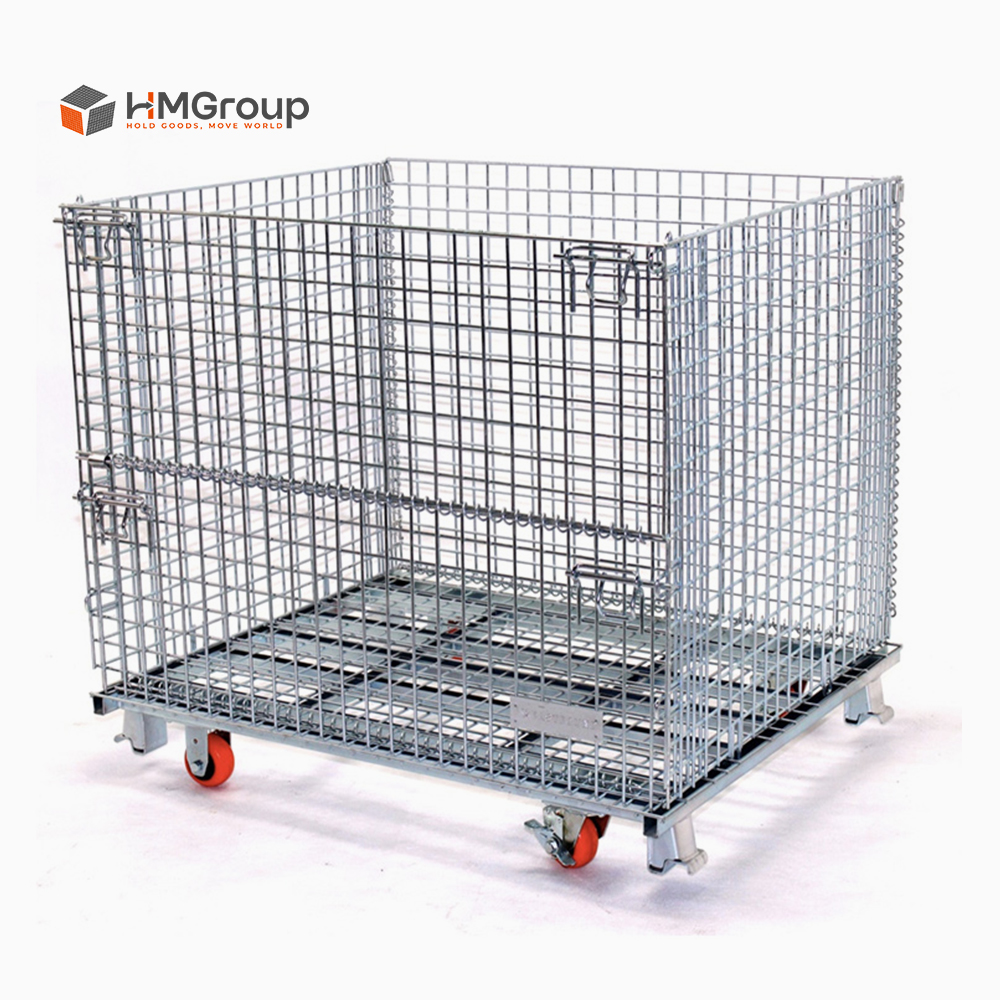
The HM-HD001 heavy duty wire container measures 1030 × 840 × 850 mm and uses a 6 mm wire gauge with a 50 × 50 mm grid. Its stated loading capacity is 1300 kg, it stacks 4 high, and 500 sets load into a 1 × 40' HQ container. It is built from mild steel Q235 and is applied in auto parts, agricultural, fulfillment and warehouse, and food and beverage operations. In a long-term program, the 50 × 50 mm grid and the 1300 kg rating are the two numbers that must not drift, because both are tied to what the container carries and how it is handled.
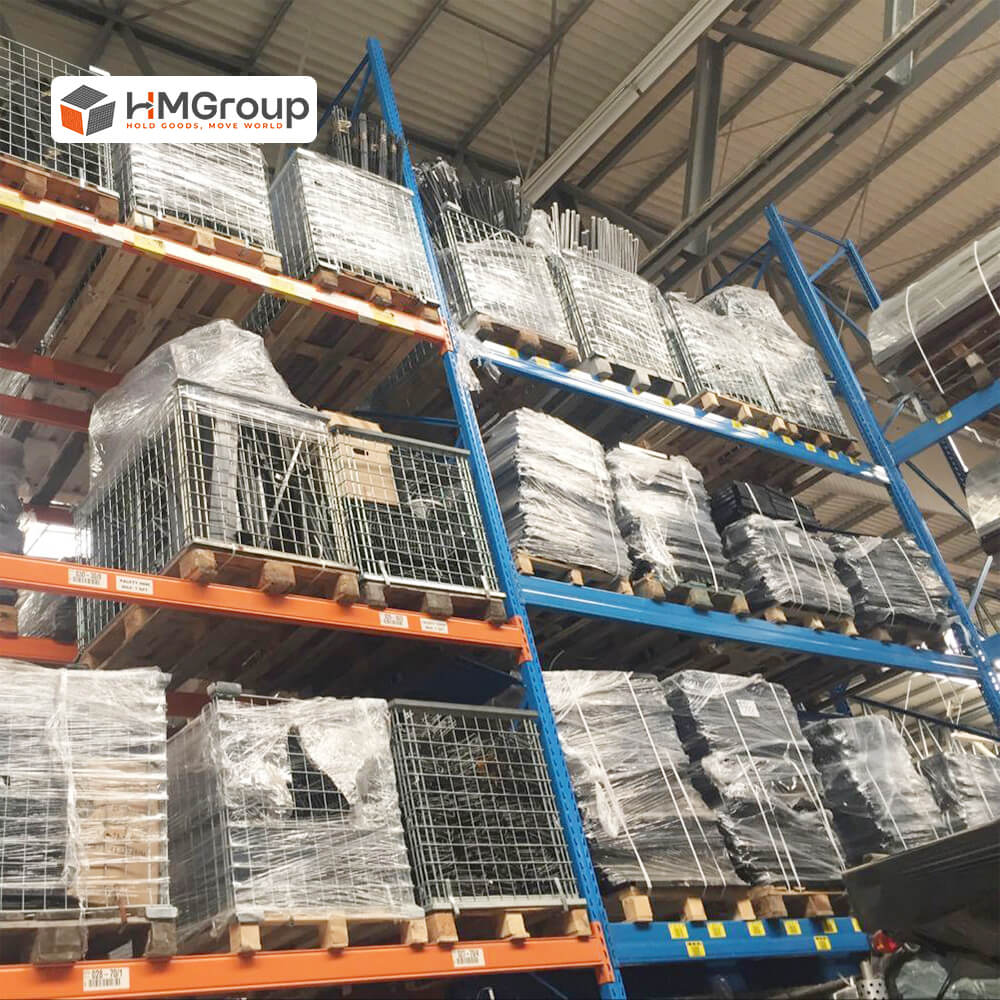
The HM-CP001 wire mesh pallet container measures 1200 × 800 × 1000 mm with a 5–10 mm wire gauge and a 60 × 103 mm grid. It stacks 4 high and loads 550 sets per 1 × 40' HQ container, which makes it the most freight-efficient of the three on a unit basis. It is used in agricultural, fulfillment and warehouse, e-commerce, hypermarket, and food and beverage operations — environments where the container footprint has to align with existing pallet and racking standards rather than with a bespoke dimension.
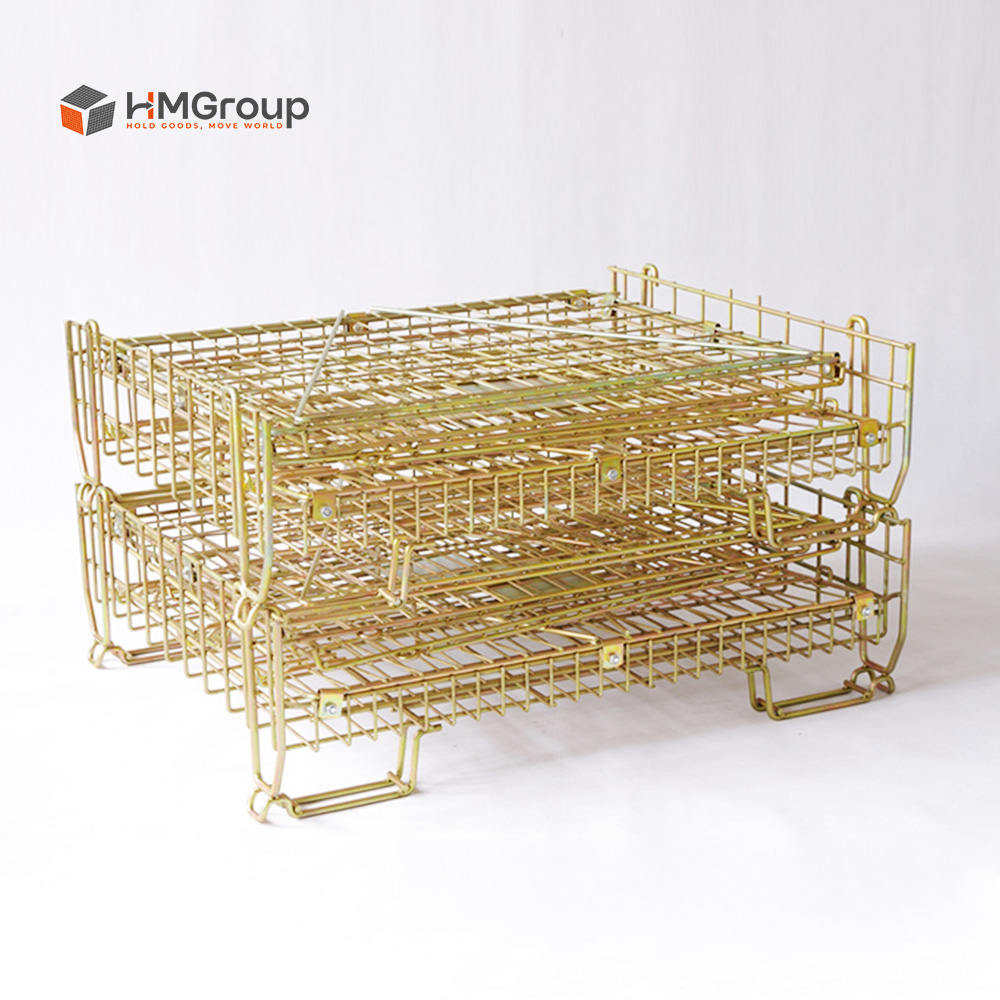
The HM-PPC22 PET preform wire container measures 1196 × 1008 × 1174 mm with a 4.8–12 mm wire gauge and a 62 × 125 mm grid. It is designed for the PET preform industry and warehouse storage, and stacks 5+1 high — the tallest stacking configuration of the three models. Because preforms are light but bulky and easily marked, the mesh opening and the surface condition of the wire matter more than raw load capacity, and both should be re-confirmed whenever the preform format changes.
Where dust or scratch protection is a requirement, the range also includes the HM-HD028 wire container with PP sheet: 1200 × 1000 × 1140 mm, 5 mm wire, 50 × 100 mm grid, 500 kg stated capacity, stackable 4 high, 330 sets per 1 × 40' HQ container, intended for PET preform and fulfillment and warehouse use. The PP lining changes the cleaning and inspection routine, which is exactly the kind of detail a long-term agreement should capture once rather than rediscover at every audit.
Service footprint after delivery
In 2024 HM Group established sales, technical and service teams across the United States, Canada, Mexico, Argentina, Brazil, South Africa, Saudi Arabia and other key regions. For a buyer running a multi-year program, a regional team shortens the path between a problem report and a technical answer, particularly when the question concerns stacking practice or handling rather than a replacement part. Direct contact runs through mary@net-railing.com and +86 150 4058 7228.
Step-by-step: building a repeatable wire container supply agreement
Step 1 — Freeze the specification baseline
Write down the model code, exterior dimensions, wire gauge, grid size, stackability, material grade and finish. For HM-HD001 that means 1030 × 840 × 850 mm, 6 mm wire, 50 × 50 mm grid, 4 high, Q235 and one named finish. For HM-PPC22 it means 1196 × 1008 × 1174 mm, 4.8–12 mm, 62 × 125 mm and 5+1. The published values form the baseline; the agreement still has to add tolerances, because a nominal dimension without a tolerance is an argument waiting to happen.
Step 2 — Validate with a sample or first article
Test one unit or a small pilot lot with the real load, the real forklift and the real stack height. Record the result — measurements, photographs, the load used, the number of handling cycles — and retain that record as the reference for the framework. A pilot that is measured becomes a specification. A pilot that is only observed becomes an anecdote.
Step 3 — Write acceptance criteria
The agreement should state, at minimum: dimensional check against the approved drawing; wire gauge and grid size verification; weld integrity inspection method; finish type and inspection method; a stack trial at the contracted height; marking and identification; packing method; and the inspection record that travels with each batch. HM-HD001 at 1300 kg and HM-PPC22 at 5+1 stacking are only meaningful as acceptance points if the test condition is written down beside them.
Step 4 — Control change between batches
Any change to wire gauge, grid, material, finish or base configuration should require written notice and written approval before production, with the affected batch identified. Define in advance which changes trigger re-validation and which do not. This single clause prevents most of the disputes that otherwise surface two years into a program.
Step 5 — Plan loading and delivery against real quantities
Container loading quantities — 500 sets for HM-HD001, 550 for HM-CP001, 170 for HM-PPC22 and 330 for HM-HD028 — are a planning input, not a guarantee. They depend on packing configuration, and a change in packing can move the number. Use them to size order quantities and freight, then confirm the figure order by order.
Step 6 — Schedule an after-sales review
Set a named contact, an issue log and an annual review covering specification fit, failure patterns and any change in handling equipment. A review that happens once a year catches drift while it is still cheap to correct. A review triggered by a complaint catches it after the cost has already been paid.
Use cases: what each long-term program has to lock
Automotive and agricultural parts — HM-HD001
Dense metal components and harvested goods share a requirement: the container must survive repeated forklift handling without the base or the mesh deforming. In this setting the 50 × 50 mm grid, the 6 mm wire and the 1300 kg rating are the load-bearing facts of the contract, and the annual review should focus on base condition and weld integrity rather than on appearance.
Retail, e-commerce and food distribution — HM-CP001
Here the constraint is usually dimensional compatibility with existing pallet, racking and vehicle standards rather than maximum load. The 1200 × 800 × 1000 mm footprint and the 4-high stack are the anchors, and the 550-set loading quantity makes freight planning predictable. Programs in this segment often expand by adding units rather than by changing models, which makes repeat-order consistency the dominant risk.
PET preform supply — HM-PPC22
Preform handling punishes small specification changes. The 62 × 125 mm grid and the surface condition of the wire determine whether preforms fall through, snag or mark, and the 5+1 stacking configuration determines how much warehouse height is usable. Because preform formats change more often than container formats, this is the program most likely to need a controlled revision — and the one where an untracked change becomes visible to the end customer.
Specification comparison of three repeat-order models
| Specification | HM-HD001 | HM-CP001 | HM-PPC22 |
|---|---|---|---|
| Model type | Heavy duty wire container | Wire mesh pallet container | PET preform wire container |
| Exterior dimensions | 1030 × 840 × 850 mm | 1200 × 800 × 1000 mm | 1196 × 1008 × 1174 mm |
| Wire gauge | 6 mm | 5–10 mm | 4.8–12 mm |
| Grid size | 50 × 50 mm | 60 × 103 mm | 62 × 125 mm |
| Stackability | 4 high | 4 high | 5+1 high |
| Material | Mild steel Q235 | Mild steel Q235 | Mild steel Q235 |
| Finish options | Zinc / hot-dip galvanized / powder coating | Zinc / hot-dip galvanized / powder coating | Zinc / hot-dip galvanized / powder coating |
| Primary applications | Auto parts, agricultural, fulfillment and warehouse, food and beverage | Agricultural, fulfillment and warehouse, e-commerce, hypermarket, food and beverage | PET preform industry, warehouse storage |
| Loaded in 1 × 40' HQ | 500 sets | 550 sets | 170 sets |
Stated load capacity is published per model; HM-HD001 is stated at 1300 kg. For the other models in this table, confirm the current stated capacity and the basis on which it is measured in the quotation before writing a number into a long-term agreement.
What a repeat-order document set should contain
| Document | What it should fix | Why it matters |
|---|---|---|
| Approved drawing | Dimensions with tolerances, grid size, wire gauge, base configuration | Defines the reference that every batch is measured against |
| Reference sample or first-article record | The physical and recorded standard, including test load and stack height | Settles disputes without renegotiating the specification |
| Inspection plan | Who checks what, at which stage, using which method, and what is recorded | Turns acceptance into a procedure rather than an opinion |
| Change-control clause | Notice period, approval route, batch identification, re-validation triggers | Prevents silent substitution of wire, material or finish |
| Packing and loading specification | Packing method and confirmed quantity per 1 × 40' HQ | Keeps freight and order sizing predictable |
| After-sales contact sheet | Named contact, escalation route, annual review date | Gives service ownership instead of a generic inbox |
Frequently asked questions
What acceptance criteria should a long-term wire container agreement define?
At minimum: dimensions against an approved drawing with tolerances, wire gauge and grid size (6 mm and 50 × 50 mm for HM-HD001; 62 × 125 mm for HM-PPC22), finish type, weld inspection method, a stack trial at the contracted height, marking, packing and the inspection record shipped with each batch. Published model data states capacity, gauge and grid but does not define tolerances or a test method. Those two items have to be added by the agreement, otherwise acceptance depends on who happens to be inspecting.
Can HM Group hold the same specification across repeat orders?
The repeatable element is the frozen model specification: HM-HD001 at 1030 × 840 × 850 mm, 6 mm wire, 50 × 50 mm grid, 1300 kg, 4 high; HM-CP001 at 1200 × 800 × 1000 mm, 5–10 mm wire, 60 × 103 mm grid, 4 high; HM-PPC22 at 1196 × 1008 × 1174 mm, 4.8–12 mm wire, 62 × 125 mm grid, 5+1 high. Consistency is maintained by referencing the same specification record on every purchase order and by routing any change through written approval. If production location matters to your audit program, name the base — Xiamen, Nanjing or Qingdao — in the agreement.
Which purchasing terms matter most in a multi-year wire container agreement?
Price is only one term. Those that generate disputes are specification revision rights, quantity tolerance, packing and loading basis, pre-shipment inspection rights, replacement-part terms and the point at which risk transfers. Public sources do not publish unit prices, minimum order quantities or Incoterms for wire containers, so those come from a quotation against a defined specification. HM Group sells 100% for export across the EU, North America, Asia and the Middle East, so export documentation is a routine part of the commercial conversation rather than a special request.
Can we validate a sample or pilot batch before committing to a framework order?
A pilot order of the exact model is the most direct route. Test it with your real load, your forklift and your stack height; measure and photograph the result; keep the record as the reference sample for the framework. Where stacking is critical, test the actual stack configuration, because 4 high and 5+1 are published as model attributes and behave differently under real floor conditions. A pilot of HM-CP001 at 1200 × 800 × 1000 mm, for example, will tell you more about racking compatibility than any drawing.
What after-sales support and delivery planning should buyers expect?
HM Group established sales, technical and service teams in the United States, Canada, Mexico, Argentina, Brazil, South Africa, Saudi Arabia and other key regions in 2024, which gives a program a regional technical contact rather than only a sales channel. Standard lead times are not published for these models, so delivery has to be confirmed order by order and planned against loading quantities — 500 sets for HM-HD001, 550 for HM-CP001, 170 for HM-PPC22. In a written program, name the contact, the escalation route and the review date. To start that conversation, send your specification to mary@net-railing.com.
What a workable partnership looks like in practice
A long-term wire container partnership holds together when three things are documented and one habit is maintained. The three are a frozen specification with tolerances, an acceptance routine that a third party could apply without asking questions, and a named after-sales owner with a review date. The habit is refusing verbal changes — to wire gauge, grid, finish or packing — no matter how small they look on the production floor.
HM Group brings the manufacturing side of that equation: three bases across 62,000 m², annual capacity of 2,000,000 units, an ISO 9001:2015 certificate numbered CN24/00004786 issued by SGS and valid through July 2027, a product range that runs from the 1300 kg HM-HD001 to the 5+1 stacking HM-PPC22, and service teams established across North America, South America, Africa and the Middle East since 2024. The buyer brings the specification discipline. Neither half works alone.
Next step
If you are moving from a first order to a framework agreement, start with the specification rather than the price. Review the full wire container range, confirm the model that matches your load and stacking requirement, and request a quotation against your written specification.
Download the HM Group product catalogue: HM Group Catalogue (PDF). For sample requests, repeat-order terms or a specification review, contact mary@net-railing.com or +86 150 4058 7228, or visit hmlwires.com.
Have Questions or Need More Details?
Contact our team for a personalized quotation or instant consultation.
Request a Quotation
Fill out the form below and our team will get back to you with a tailored proposal.
WhatsApp Direct Chat
Prefer to chat in real-time? Message us on WhatsApp for instant assistance & quick answers.
- Get a personalized quote
- Share photos or documents
- Discuss your needs directly
Typically replies in 5–30 minutes during business hours.