Wire Container Technical Guide: How to Match Wire Gauge, Grid Size, and Load Capacity
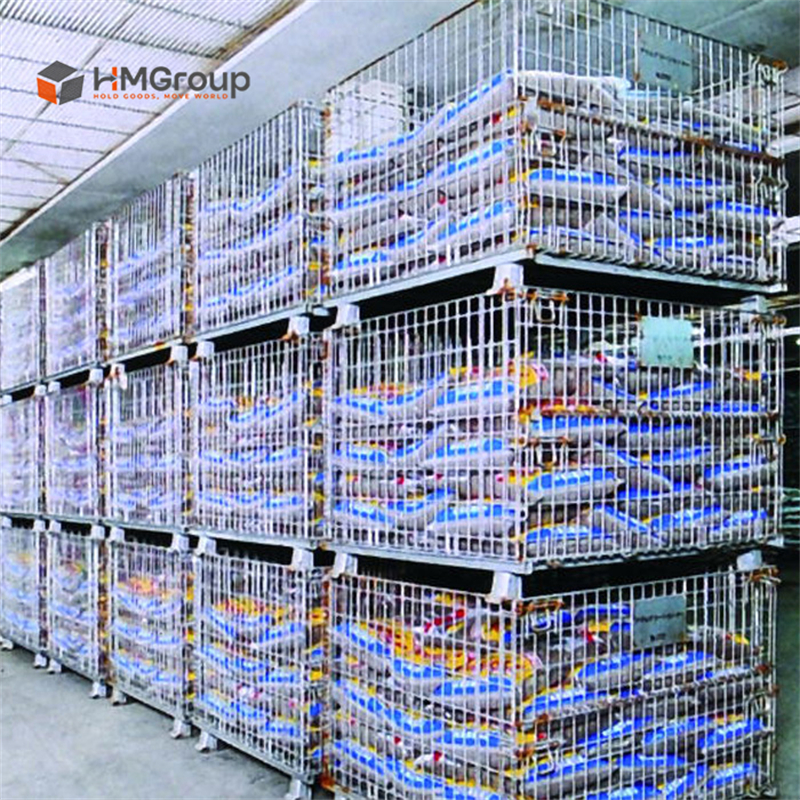
Wire gauge, grid size, and load capacity are one engineering decision, not three separate line items on a quotation. The gauge sets how much load a single wire and the welded mesh panel can carry. The grid aperture decides whether the load stays inside the container and how much air circulates around it. The load rating, in turn, is only valid for a specific combination of gauge, aperture, external dimensions, and stacking height. HM Group builds containers on the same base material — mild steel Q235 — yet the verified models in this guide range from 500 kg to 1300 kg, because those three parameters are matched differently for each application.
Why Parameter Mismatches Fail in Real Projects
Most wire container problems in warehouses and production lines trace back to one of three mismatches, and none of them is visible on an invoice.
Undersized wire for the stated load. A container rated at 1300 kg in the heavy duty HM-HD001 configuration uses 6 mm wire in a 50×50 mm grid. The same 6 mm gauge appears in the HM-HD010 fine-mesh container, which is rated at 800 kg in a 25×50 mm grid. A buyer who selects on gauge alone, without reading the grid and the rating together, can end up specifying a panel that was never engineered for the load on the drawing board.
Aperture that does not match the part. An aperture that is too large lets small components fall through or shift into a jammed pattern during transport. An aperture that is too fine adds steel, weight, and cost without improving containment. This is why the wine-industry models use 51×118 mm and 55×113 mm apertures while a PET preform container uses a 62×125 mm aperture and a fine-mesh storage container uses 25×50 mm.
Footprint and stacking assumptions that never reach the floor. A container can be perfectly rated and still fail a project if four-high stacking is planned in a building with insufficient clear height, or if the footprint does not match the pallet, rack, or truck configuration. Parameter matching has to happen at the project level, not the product level.
Practical rule: never compare two wire containers on gauge alone. Compare gauge + grid size + external dimensions + load capacity + stacking rating as one bundle, and confirm the rating for the exact configuration you intend to buy.
Industry Background: Why Parameter Discipline Matters Now
The global wire mesh containers sales market was valued at approximately USD 2.34 billion in 2025 and is projected to reach USD 3.72 billion by 2034, expanding at a CAGR of 5.2% over the forecast period from 2026 to 2034, according to Dataintelo. Within that market, stackable wire mesh containers held the largest product-segment share in 2025 at 32.5% of total revenue, and Asia Pacific accounted for a 38.2% revenue share — a reflection of both manufacturing concentration and export volume. The United States alone represented roughly 16.7% of imports under HS Code 732620 (articles of iron or steel wire) in 2024.
The practical consequence for buyers is straightforward. Stackable designs dominate because vertical density is where the savings are, and vertical density is exactly where parameter matching is least forgiving. Two containers that look similar on a specification sheet can behave very differently at the fourth stacking tier, because stacking performance depends on the interaction of wire gauge, frame construction, base design, and the load rating the manufacturer is willing to publish for that specific geometry.
Material is the other constant. HM Group manufactures its wire containers from mild steel Q235, with surface treatment options of zinc plating, hot-dip galvanizing, or powder coating. The same base material supports a 500 kg container and a 1300 kg container; the difference is the engineered combination of gauge, aperture, frame, and dimensions.
The Three Parameters and What Each One Controls
1. Wire gauge: the load path
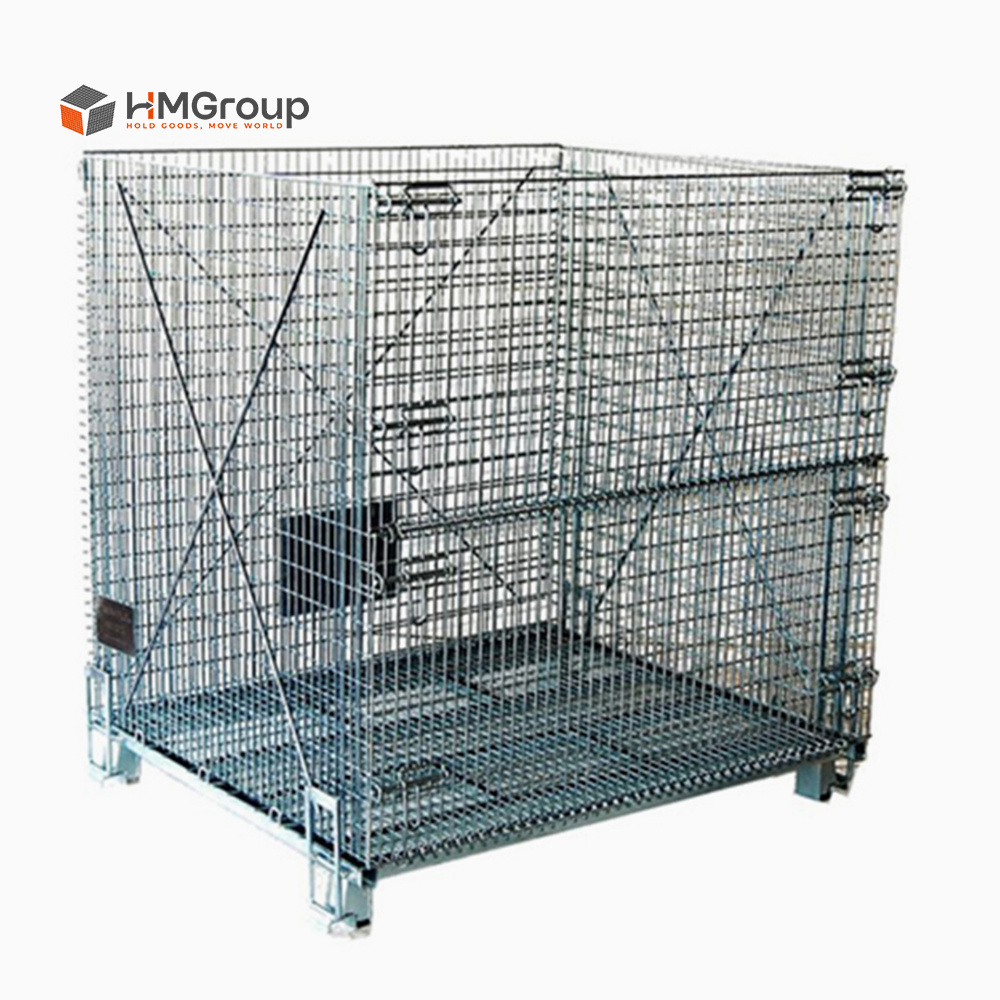
Wire gauge is the diameter of the steel wire used in the mesh panels and, in most designs, in the structural frame. It is the primary determinant of how a container converts a distributed load into a stable structure. Heavier gauges resist bending and fatigue under repeated forklift handling and stacked compression; lighter gauges reduce container weight, which matters for return freight and manual handling.
HM Group's verified range shows how widely this parameter moves within one product family. The HM-WEU005 wine storage container and the HM-CP001 pallet container are both specified from 5 mm to 12 mm wire depending on the panel. The HM-HD001 heavy duty container is specified at 6 mm. The HM-HD010 fine-mesh container is also 6 mm, but paired with a much tighter 25×50 mm grid — a combination that produces a denser, heavier panel and a published rating of 800 kg rather than 1300 kg.
2. Grid size: containment, ventilation, and weight
Grid size, or mesh aperture, is the open distance between adjacent wires. It determines three things at once: whether the smallest item in the load can escape or wedge, how much air moves through the load, and how much steel the panel contains. Finer mesh means more wires per square meter, more welding, and more weight — which is why aperture selection and gauge selection cannot be separated.
| Grid aperture (verified models) | Containment behaviour | Typical fit |
|---|---|---|
| 25×50 mm — HM-HD010 | Fine mesh, small items cannot pass through | Small components, PET preforms, agriculture, warehouse storage |
| 50×50 mm — HM-HD001, HM-ST007, HM-ST-AU001 | Balanced aperture for structural loads | Auto parts, agriculture, food & beverage, mining |
| 51×118 mm — HM-WEU005 | Bottle-body containment with airflow | Wine industry, 400 Bordeaux bottles per unit |
| 55×113 mm — HM-WEU001 | Bottle-body containment with airflow | Wine industry, 500 Bourgogne bottles per unit |
| 60×103 mm — HM-CP001 | General-purpose containment, high container fill | Agriculture, e-commerce, hypermarket, food & beverage |
3. Load capacity and stacking height
Load capacity is a published rating for a defined configuration, and stacking height is part of that definition. HM Group's verified models are rated at 4 high, with the HM-WEU005 wine container and HM-WEU001 specified at 4+1 high and the HM-PPC22 PET preform container at 5+1 high. Those figures describe safe vertical arrangement for the matching model — they are not interchangeable between models, and they should not be extended by adding tiers to a container specified for fewer.
Stacking also interacts with handling. A container that is stacked four high must still be pickable, which is why half-drop gate access appears across the range: it allows ergonomic access to the load when units are stacked, rather than requiring the top tier to be removed first.
4. Footprint, freight fill, and finish
Two containers with the same load rating can differ substantially in total project cost because of how many units fit in a container. In a 1×40'HQ, HM-HD001 loads 500 sets, HM-CP001 loads 550 sets, HM-HD010 loads 216 sets, and HM-WEU005 loads 228 sets. Finer mesh and larger external dimensions reduce freight density. Finish selection follows the operating environment: zinc plating, hot-dip galvanizing, and powder coating are all offered, with corrosion resistance being the deciding factor in humid cellars, unheated warehouses, and outdoor staging.
Step-by-Step Breakdown: How to Match the Three Parameters
The following sequence is the order that keeps a wire container specification internally consistent. It works for a single unit or a multi-site rollout.
- Define the load first, in kilograms and in shape. Record the unit weight, the number of units per container, and the total load. Then record the smallest dimension of the smallest item, because that dimension, not the total weight, drives the grid aperture.
- Set the aperture against the smallest part, not the heaviest part. If the smallest part can pass through the aperture, the load will shift and the picking accuracy advantage of an open-mesh container is lost. Fine parts push the specification toward 25×50 mm; bottle-shaped loads sit comfortably around 51×118 mm to 60×103 mm.
- Select the wire gauge for the load and the handling intensity. Heavy, frequently forklifted loads justify a heavier gauge and a structural frame. Where the container is used mainly for internal storage and infrequent movement, a lighter gauge reduces unit weight and freight cost.
- Confirm the external footprint against your real infrastructure. Check the container dimensions against rack beams, pallet footprints, aisle width, truck internal width, and building clear height at the planned stacking tier. A 1300 kg container that does not fit the aisle is a project delay, not a capacity gain.
- Select the finish for the actual environment. Zinc plating, hot-dip galvanizing, and powder coating are all available; the choice should follow humidity, wash-down, and outdoor exposure rather than habit.
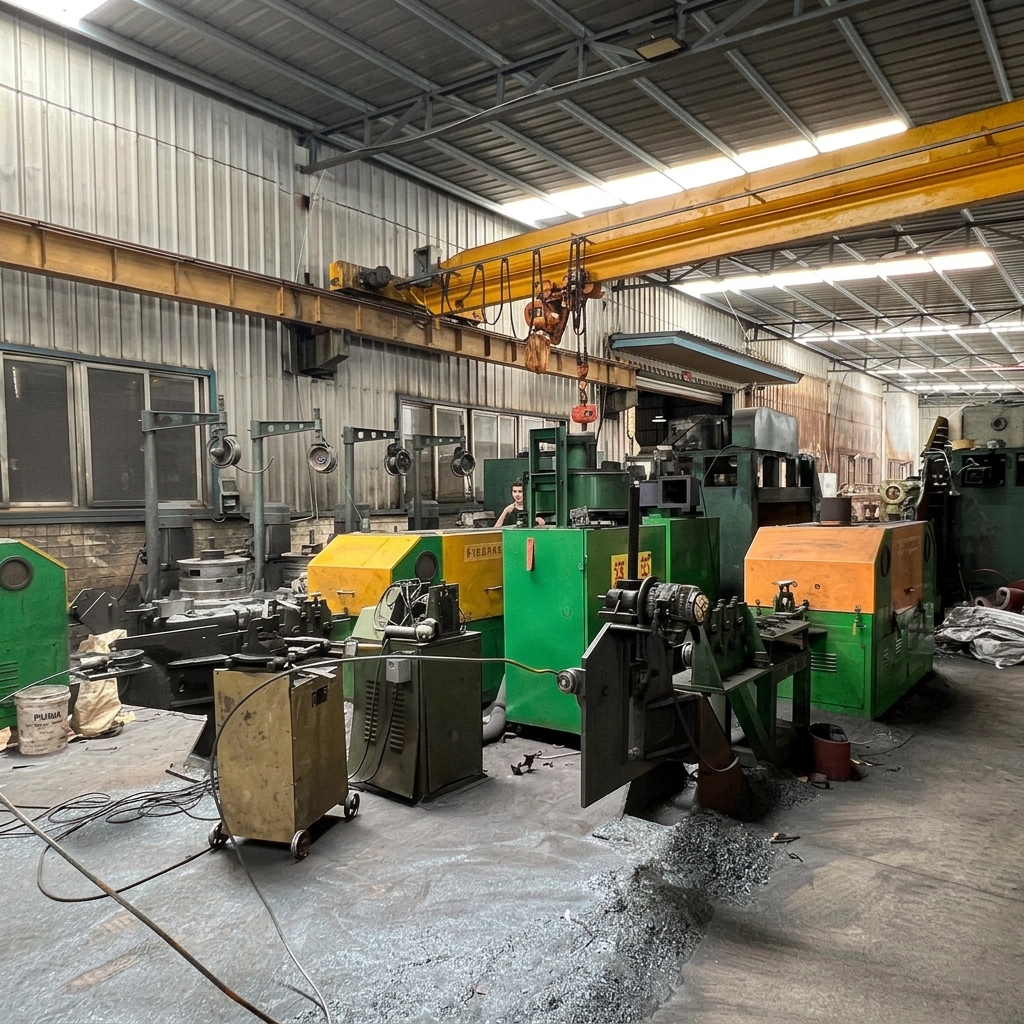
- Validate before scaling. HM Group's quality control runs in six phases: pre-production sample inspection, raw material inspection, component inspection, semi-finished product inspection, finished product inspection, and packaging inspection. Sample validation at phase one is where a parameter mismatch is cheapest to correct.
Use Cases: Which Parameter Combination Fits Which Project
Heavy-duty components and industrial floors
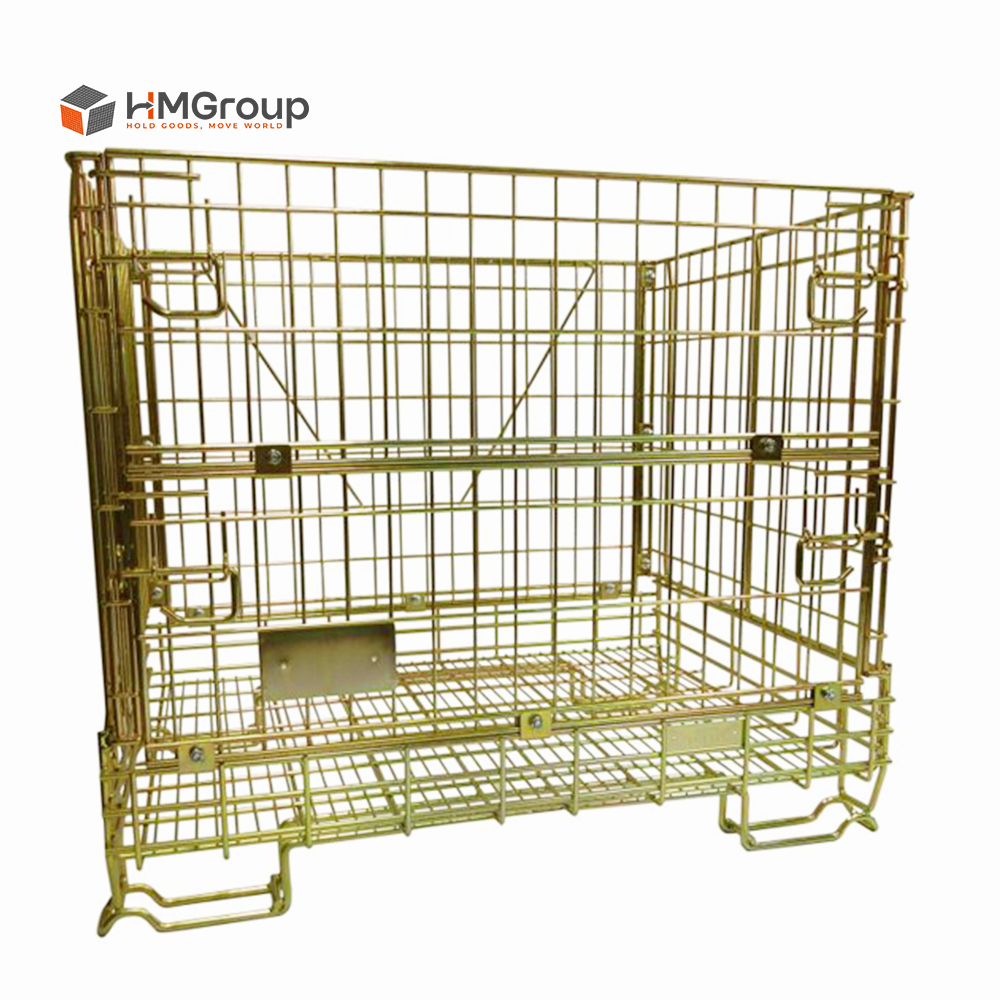
HM-HD001 is the reference point for the heaviest requirement in the verified range: 1030×840×850 mm, 6 mm wire, 50×50 mm grid, and a 1300 kg loading capacity, stackable 4 high. It suits auto parts, agriculture, fulfillment and warehouse use, and food and beverage handling — environments where loads are dense, forklift movements are frequent, and a 50×50 mm aperture still contains the parts. Industry references for automotive container specifications also cite standards such as GM 5131 and Ford-compatible designs for integration into production logistics, which is the type of requirement heavy-duty containers are usually specified against.
Wine cellars and cross-border wine logistics
HM-WEU005 is built specifically around bottle geometry: a 51×118 mm grid, 5–12 mm wire, 1200×920×1018 mm, 800 kg capacity, stackability of 4+1 high, and storage for 400 Bordeaux bottles per unit. The aperture holds bottle bodies while keeping airflow moving, which matters in high-humidity cellars, and the half-drop gate allows bottle access when units are stacked. The 800 kg rating and the bottle count are both configuration-specific facts, not general claims about wine containers.
PET preforms and small molded parts
Preforms are light, high-count, and sensitive to surface scuffing, which pushes the specification toward finer apertures and denser stacking. HM-HD010 uses a 25×50 mm grid at 800 kg and 4-high stacking, while HM-PPC22 uses a 62×125 mm grid at 600 kg with 5+1 high stacking and a 170-set container fill. Where dust control and surface protection are required, HM-HD028 pairs a 50×100 mm grid with a PP sheet liner at 500 kg. In projects HM Group has delivered, this class of container has been deployed at scale: 10,000 units for a global food and beverage leader's preform logistics, and 5,000 units for a beverage producer in South Africa, both designed around 4-high to 6-tier vertical stacking with PP sheet inner lining.
High-turnover warehousing and retail distribution
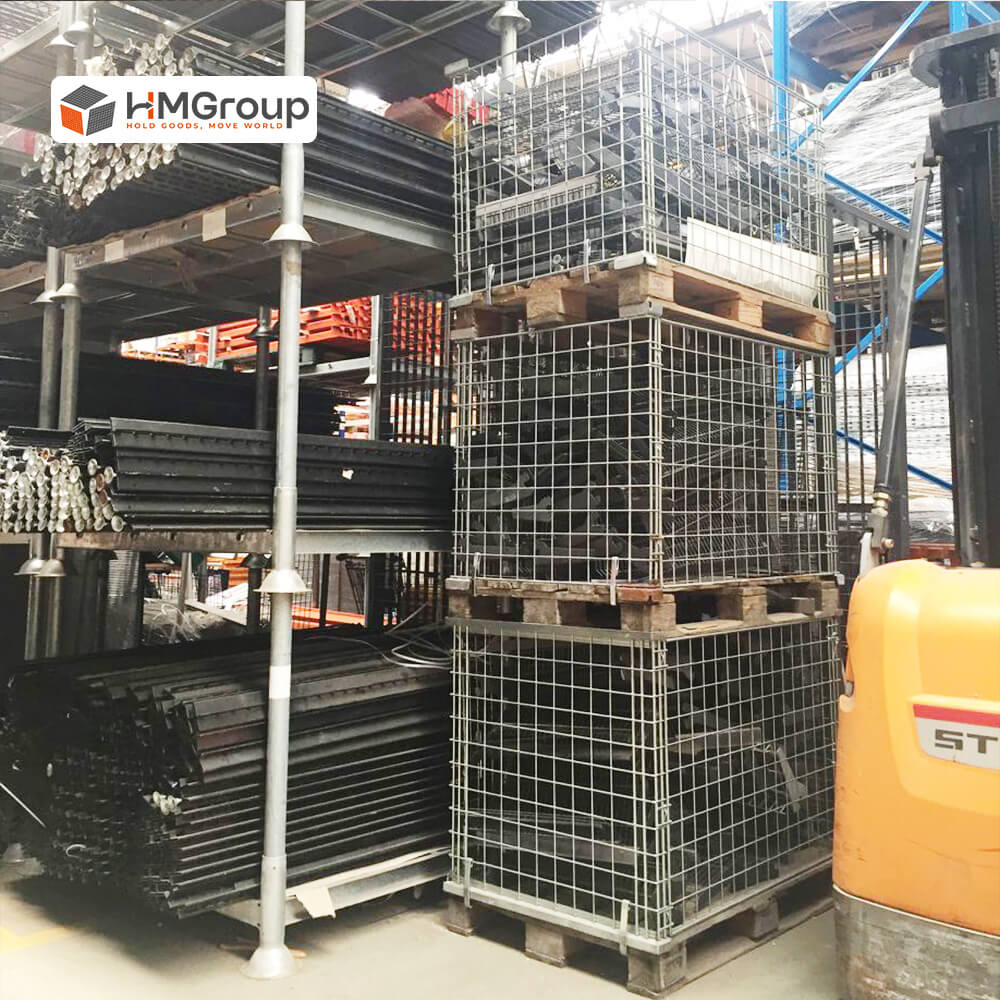
HM-CP001 covers the general-purpose middle of the range: 1200×800×1000 mm, 5–10 mm wire, 60×103 mm grid, 800 kg, 4-high stacking, and the highest container fill in this comparison at 550 sets per 1×40'HQ. It is specified for agriculture, fulfillment and warehouse, e-commerce, hypermarket, and food and beverage applications — projects driven by visible inventory management, lean transformation from floor storage to vertical stacking zones, and reverse logistics where the collapsible frame provides a 4:1 return ratio.
Comparison Table: Verified HM Group Models by Parameter
| Model | Wire gauge | Grid size | External dimensions (L×W×H) | Load capacity | Stacking | 1×40'HQ fill | Best-fit application |
|---|---|---|---|---|---|---|---|
| HM-HD001 (heavy duty wire containers) | 6 mm | 50×50 mm | 1030×840×850 mm | 1300 kg | 4 high | 500 sets | Auto parts, agriculture, food & beverage, warehouse |
| HM-HD010 (Wire Mesh Storage Containers) | 6 mm | 25×50 mm | 1200×1000×1250 mm | 800 kg | 4 high | 216 sets | Fine components, PET preforms, agriculture |
| HM-CP001 (Wire Mesh Pallet Containers) | 5–10 mm | 60×103 mm | 1200×800×1000 mm | 800 kg | 4 high | 550 sets | E-commerce, hypermarket, food & beverage, agriculture |
| HM-WEU005 (Wine Storage Wire Container) | 5–12 mm | 51×118 mm | 1200×920×1018 mm | 800 kg | 4+1 high | 228 sets | Wine industry — 400 Bordeaux bottles per unit |
| HM-HD028 (Wire Container With PP Sheet) | 5 mm | 50×100 mm | 1200×1000×1140 mm | 500 kg | 4 high | 330 sets | PET preforms and dust-sensitive storage with liner |
All models are manufactured from mild steel Q235 with zinc plating, hot-dip galvanizing, or powder coating. Ratings and stacking figures apply to the listed configuration; confirm before ordering for any modified geometry.
Selection Checklist Before You Confirm a Wire Container Order
- Total load per container stated in kilograms, with a margin for dynamic forklift handling.
- Smallest item dimension recorded and compared against the grid aperture, not assumed.
- Wire gauge matched to both the load and the handling frequency, not copied from a previous order.
- External dimensions checked against rack, pallet, aisle, truck, and stacking clear height.
- Stacking tier confirmed against the manufacturer's published rating for that exact model.
- Surface finish selected against real humidity, wash-down, and outdoor exposure.
- Container fill per 1×40'HQ reviewed, because freight economics often decide between two technically suitable models.
- Accessory requirements confirmed: forklift guide, wire divider, runner bar, name plate, casters, top lid, or PP sheet liner.
- Sample produced and inspected before volume production.
HM Group offers OEM/ODM and fully customized production across these parameters, including surface treatment (zinc, hot-dip galvanized, or powder coating), size, loading capacity, powder coating color, logo printing, and design features such as forklift guides, wire dividers, runner bars, name plates, and wheels. Monthly capacity is 40,000 sets.
FAQ: Parameter Matching Questions Buyers Ask Most
What documentation and compliance points should be verified when ordering wire containers?
Buyers should treat this as a specification-verification task rather than a certificate-collection task. The published third-party standard most frequently referenced in shipping-container discussions is ASTM D6573/D6573M, the standard specification for general-purpose wirebound shipping boxes and containers used for domestic and overseas shipment; it is not a wire mesh cage standard, and it should not be presented as one. What can be verified directly on HM Group documentation is the material (mild steel Q235), the specified wire gauge, grid aperture, external dimensions, load capacity, stacking rating, and surface finish (zinc plating, hot-dip galvanizing, or powder coating), together with the inspection record. For automotive applications, industry references point to container specifications such as GM 5131 and Ford-compatible designs, which are usually supplied as project requirements by the buyer rather than assumed by the manufacturer.
Can wire gauge, grid size, and dimensions be customized for a specific project?
Yes. HM Group operates in OEM/ODM and fully customized mode, and the customization scope explicitly includes size, loading capacity, surface treatment, powder coating color, logo printing, and design features such as forklift guides, wire dividers, runner bars, name plates, and wheels. The constraint is engineering rather than capability: gauge, aperture, dimensions, and load rating must remain internally consistent, so a customization request normally starts by fixing the load and the smallest part dimension, then deriving the other parameters. Monthly production capacity is 40,000 sets, and quality control runs through six phases from pre-production sample inspection to packaging inspection.
How does wire gauge and mesh density affect the cost of a wire container?
The dominant cost driver in this class of product is the amount of steel in the panel and frame. Moving from a 25×50 mm aperture to a 50×50 mm aperture at a comparable wire gauge reduces the number of wires, welds, and kilograms per panel; increasing the wire gauge adds material along every wire. Finer mesh and heavier gauges are therefore justified only where the load, the part size, or the handling intensity requires them. Freight is the second driver: the same 1×40'HQ holds 550 sets of HM-CP001 but 216 sets of HM-HD010, so container fill changes landed cost per unit independently of the unit price. Because HM Group does not publish list prices for configured projects, quoting is based on the confirmed specification.
Can I validate a sample before committing to a volume order?
Yes, and the process starts there. The first of HM Group's six quality-control phases is pre-production sample inspection, followed by raw material inspection, component inspection, semi-finished product inspection, finished product inspection, and packaging inspection. In practice this means the gauge, aperture, dimensions, and finish are confirmed on a physical unit before the production run begins. Buyers evaluating a new load type, a new bottle format, or a new stacking tier should use this stage to test-fit the actual product rather than a specification drawing. Online video audit support is available for remote verification.
What are the minimum order quantity and lead time, and how long does the product last?
The minimum order quantity is 1×20GP, and standard lead time is 30–45 days, with monthly capacity of 40,000 sets supporting larger rollouts. Under proper use, HM Group containers carry a 3 to 5 year warranty, with process reports provided throughout the order. Lead time is measured from a confirmed specification, which is why resolving gauge, aperture, and stacking decisions before the order is placed is the single most effective way to protect a project schedule.
Conclusion
Matching wire gauge, grid size, and load capacity is a sequence, not a comparison. Fix the load and the smallest part dimension first; derive the aperture; select the gauge for the loads and handling the container will actually see; confirm the footprint against real infrastructure; choose the finish for the real environment; then validate a sample before scaling. Applied in that order, the parameters reinforce each other, and a project moves from a specification sheet to a working storage system without surprises at the fourth stacking tier.
The verified HM Group range covers that sequence from 500 kg to 1300 kg — heavy-duty 50×50 mm mesh for dense industrial loads, 25×50 mm fine mesh for small components, 51×118 mm bottle-oriented apertures for wine, and 60×103 mm general-purpose mesh with the highest container fill in the range. Everything is built on mild steel Q235 with a choice of zinc, hot-dip galvanized, or powder coated finish.
For buyers who want to test a configuration against their own load, HM Group provides sample validation, project-specific quoting, and online video audits. Start with your load data and the smallest part dimension, and the specification will follow.
Next Step: Match a Container to Your Load
Send your load weight, part dimensions, stacking plan, and target market. HM Group will confirm a matching wire gauge, grid size, and load capacity configuration — and arrange a sample for validation.
Download the full product catalogue: HM Group Wire Container Catalogue (PDF)
Email: mary@net-railing.com · WhatsApp: +86 150 4058 7228 · Tel: +86 411-3981 3061 · Website: www.hmlwires.com
Have Questions or Need More Details?
Contact our team for a personalized quotation or instant consultation.
Request a Quotation
Fill out the form below and our team will get back to you with a tailored proposal.
WhatsApp Direct Chat
Prefer to chat in real-time? Message us on WhatsApp for instant assistance & quick answers.
- Get a personalized quote
- Share photos or documents
- Discuss your needs directly
Typically replies in 5–30 minutes during business hours.