Wire Container With Casters vs Fixed-Base Units: A Project Fit Guide for Mobile and Static Storage
Wire Container With Casters vs Fixed-Base Units: A Project Fit Guide
Question: How do you decide between a wire container with casters and a fixed-base wire container for your specific project?
Short answer: The choice depends on how often the container must move. If materials need to be picked, staged, or loaded manually across short distances, a wire container with casters is the appropriate configuration. If the container will spend most of its life stacked in a warehouse or on a truck, a fixed-base wire container with fork pockets is usually the safer and more cost-effective choice.
This project-fit guide explains the functional differences, operating conditions, customization options, and selection criteria for both configurations. It uses the product range and engineering experience of HM Group (Dalian HuaMao Logistics Equipment Group Co., Ltd.) as the reference point for procurement teams, plant engineers, and logistics managers moving from research to evaluation.
What Is the Difference Between a Wire Container With Casters and a Fixed-Base Wire Container?
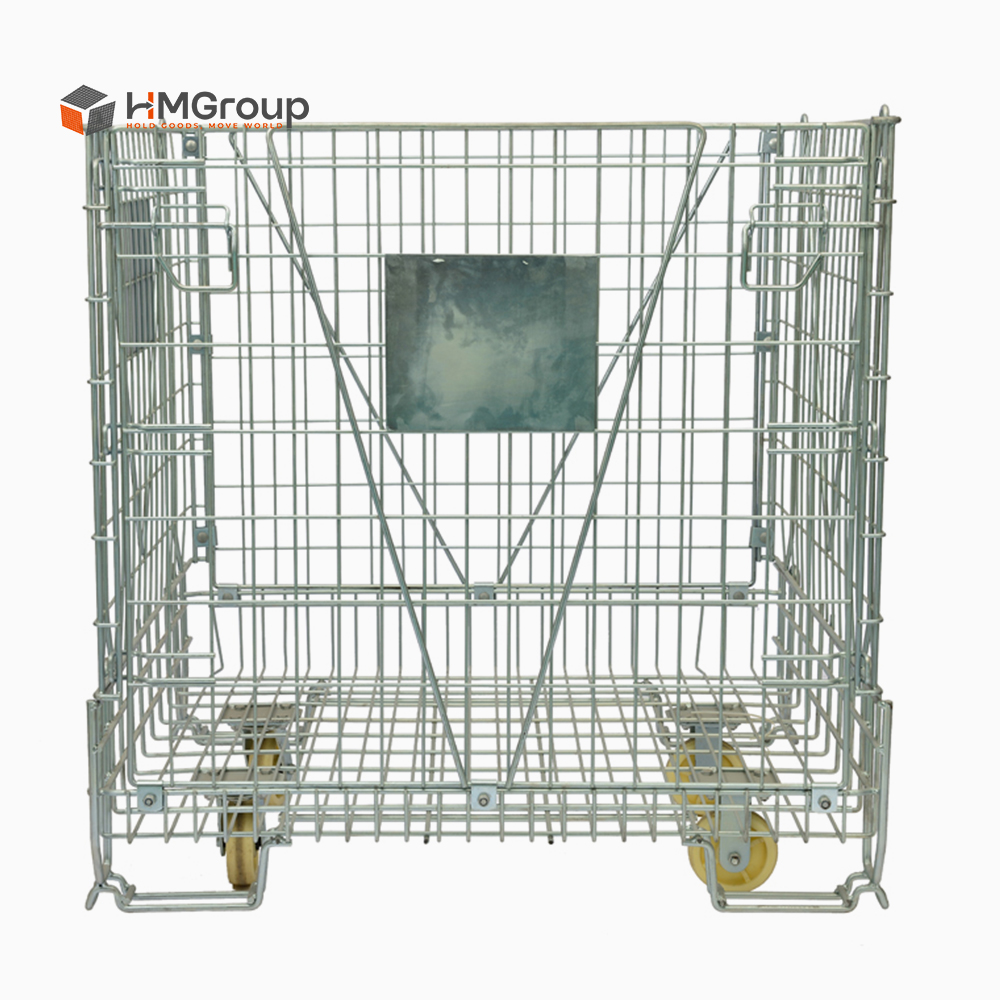
A wire container with casters, also called a wire container with wheels, is a wire mesh storage unit fitted with swivel or fixed caster wheels so it can be moved by hand or by a small tow unit over relatively short distances. A fixed-base wire container uses a flat steel base with forklift channels and is designed to be lifted, stacked, and transported by forklift, reach truck, or pallet jack.
HM Group offers both configurations across its wire container range. For example, the PET Preform Wire Container HM-PPC22 is available with castors for mobile handling, while models such as the Collapsible Wire Container HM-HD005, heavy duty wire containers HM-HD001, and Wire Mesh Storage Containers HM-HD010 use fixed bases engineered for 4-high stacking and forklift-oriented handling.
The distinction matters because casters change the stacking behavior, load path, and total cost of the unit. A wheeled container cannot be stacked as safely as a fixed-base container in most designs, because the weight of the upper unit presses onto the caster housings instead of a continuous steel frame. For this reason, most caster-equipped wire containers are specified as non-stackable, one-level mobile units, or stackable only with a dedicated locating frame.
Project Scenarios That Favor a Wire Container With Casters
Use a steel wire container with wheels when your operation requires frequent movement of goods at ground level, especially in picking, packing, assembly supply, or cross-dock environments. The application unit for visible inventory management describes it well: this product supports projects focused on reducing sorting errors through 100% visibility storage, warehouse lean transformation, and reverse logistics optimization.
Common characteristics of caster-ready projects include:
- High-frequency handling of small or medium loads by operators rather than forklifts.
- Short travel distances, typically within a single workshop or between adjacent picking zones.
- Frequent repositioning of containers during order picking or kanban replenishment.
- Low stacking requirements, often single-level storage at the point of use.
- Manual ergonomics programs aimed at reducing forklift traffic in pedestrian areas.
How Casters Are Applied Without Sacrificing Product Protection
Even when mobility is required, the container must continue to protect the product. In wine logistics, for example, caster versions are not the primary specification because bottle protection and stacking density matter more than manual movement. The dedicated wine container models HM-WEU001 and HM-WEU005 are designed to store 500 Bourgogne bottles and 400 Bordeaux bottles respectively, using fixed bases for 4+1-high stacking and stable forklift handling.
For PET preforms, HM Group supplies the Wire Container With PP Sheet HM-HD028 with a 500 kg loading capacity, 4-high stackability, and a 5 mm wire gauge. A PP liner can be added inside the mesh to protect preforms from scratches and dust. This configuration protects the product while preserving full forklift compatibility.
When a Fixed-Base Wire Container Is the Right Choice
Choose a fixed-base wire container when your main requirement is vertical storage density, forklift-based movement, or long-distance transport. The application unit for mining, heavy manufacturing, and automotive describes the working condition as demanding environments with heavy workloads, frequent material movement, and long-term exposure requiring corrosion-resistant performance.
Fixed-base models are the better fit when you need:
- High stacking density: Models like HM-HD001, HM-HD010, HM-HD005, and HM-CP001 are designed for 4-high stacking.
- High loading capacity: For example, HM-HD001 carries 1,300 kg; HM-HD005 carries 1,000 kg; HM-ST007 carries 1,000 kg.
- Forklift-based flow: Four-way forklift entry and stable lifting without the risk of caster swivel during movement.
- Return logistics efficiency: Collapsible models fold flat, providing a 4:1 return ratio in EU logistics and reducing empty volume by up to 75% in some configurations.
- Long service life: Zinc plating, hot-dip galvanizing, or powder coating protects against corrosion in demanding industrial environments.
Wire Container With Casters vs Fixed-Base: Comparison Table
| Parameter | Wire Container With Casters | Fixed-Base Wire Container |
|---|---|---|
| Primary movement method | Manual pushing or low-speed towing on casters | Forklift, reach truck, or pallet jack via fork pockets |
| Typical travel distance | Short distances within a facility | Short to long distances; forklift-dependent |
| Stacking behavior | Usually limited; caster housings reduce stacking stability | Designed for 4-high or higher stacking in HM Group standard models |
| Loading capacity range | Dependent on caster rating; typically 500–1,000 kg | Up to 1,000–1,300 kg in models such as HM-HD005 and HM-HD001 |
| Operator ergonomics | High; suitable for picking and manual replenishment | Medium; requires material handling equipment |
| Forklift compatibility | Possible but less common; design must be verified | Standard 4-way entry on most HM Group models |
| Return logistics | Folding options can reduce volume; casters add tare weight | Collapsible designs achieve 4:1 return ratio; larger volume reduction up to 75% |
| Surface treatment options | Zinc, hot-dip galvanized, powder coating | Zinc, hot-dip galvanized, powder coating |
| Typical applications | Picking, assembly line supply, cross-dock, small-part staging | Bulk storage, vertical warehousing, tire racks, PET preforms, wine bottles |
Note: Caster capacity and stackability must be confirmed for each specific model and configuration. The base product specifications in this article use HM Group standard models; custom combinations can be engineered when project quantities justify it.
Step-by-Step: How to Match Wire Container Mobility to Your Project
Step 1: Define the movement pattern
Map your material flow: where is the unit loaded, where is it stored, and where is it emptied? A wheeled design adds value only when operators move the unit manually at least a few times per day. In processes where a forklift is already present, caster wheels often add cost and reduce stackability without adding benefit.
Step 2: Determine stacking requirements
If the container must be stacked in storage, select a fixed-base model with a rated stackability of 4-high or higher. HM Group fixed-base models such as HM-HD001, HM-HD010, HM-HD005, and HM-PPC14 provide stackability up to 4 high; the PET Preform Wire Container HM-PPC22 supports 5+1 high. For a caster model, confirm whether the caster assembly has a dedicated locking and stacking frame.
Step 3: Calculate load weight and caster rating
If casters are required, the total loaded weight must be within the load rating of the wheel and its mounting bracket. Structural requirements include reinforced steel frames and high-tensile wire mesh to sustain dynamic loads. A wire container with casters rated for 500 kg may handle a 600 kg PET preform load if the caster is upgraded, but only an engineered review can confirm the safe working load.
Step 4: Check facility floor and environmental conditions
Casters perform best on smooth, level, dry floors. For facilities with high humidity, wash-down requirements, or outdoor exposure, specify the surface protection accordingly. The application guidance for demanding industrial environments recommends hot-dip galvanized finishes for long-term, corrosion-resistant performance.
Step 5: Define return logistics and empty storage
If containers must travel empty between sites, choose a collapsible or foldable version. The Collapsible Wire Container HM-HD005 and the Foldable Wire Container HM-PPC14 are examples of space-saving designs. For wine logistics, collapsible design mode provides a 4:1 return ratio, making return freight significantly cheaper.
Step 6: Plan for accessories and custom designs
HM Group supports OEM/ODM and fully customized production with optional designs such as forklift guide, wire divider, runner bar, name plate, and wheels. For containers with casters, the wheel configuration can be customized, but it must be integrated with the base design and stacking frame. For PET preform applications, add an internal PP sheet liner to protect sensitive preform surfaces from scratches and dust.
Use Cases: From Theory to Project Application
Use case 1: Mobile assembly line supply in an automotive components plant
An automotive components manufacturer needs small parts moved from a central kitting area to multiple assembly stations. Operators are already on foot; forklifts are not available in every aisle. A steel wire container with casters is the relevant solution, using 100% visibility storage to reduce sorting errors and support a lean, structured floor layout. The open-mesh design gives operators instant visual confirmation of part numbers and quantities.
Use case 2: High-density PET preform storage in a beverage bottling hub
A beverage plant receives preforms and stores them before blow-molding. The priority is density, hygiene, and easy inventory counting. Fixed-base containers such as the Wire Mesh Storage Containers HM-HD010 or the Wire Container With PP Sheet HM-HD028 offer 4-high stacking and a tight mesh option (25x50 mm on HM-HD010) to keep preforms clean. The open-mesh design enables instant stock visibility. For returnable logistics, a foldable version such as the Foldable Wire Container HM-PPC14 lowers empty return volume.
Use case 3: Wine bottle storage and export logistics
In the wine industry, the core requirement is bottle protection and space utilization. The Metal Wire Container For Wine Bottles HM-WEU001 stores 500 Bourgogne bottles; the Wine Storage Wire Container HM-WEU005 stores 400 Bordeaux bottles. Both are fixed-base models with 4+1-high stackability. The half-drop gate provides ergonomic access to bottles even when units are stacked. High-micron zinc plating or hot-dip galvanizing resists high-humidity cellar conditions.
Use case 4: Reverse logistics and collapsible return flow
Distribution networks that ship goods in wire containers and then return empty units benefit from collapsible configurations. When empty, the units fold flat, reducing return volume by up to 75% in PET preform applications and offering a 4:1 return ratio in wine logistics. This lowers freight cost per trip and improves warehouse space utilization.
Customization and Engineering Considerations
HM Group produces wire mesh containers, PET preform containers, cage pallets, stillages, tire racks, nestainer racks, fabric roll racks, wine barrel racks, post pallet racks, wire mesh roll containers, wire mesh decking, danish trolleys, and steel pallets. The company operates three manufacturing bases in Xiamen, Nanjing, and Qingdao, with an annual output of 2,000,000 units.
Available customizations include:
- Surface treatment: zinc plating, hot-dip galvanizing, or powder coating with selectable colors.
- Size and loading capacity changes.
- Designs: forklift guide, wire divider, runner bar, name plate, wheels, top lid, security top lid, half-drop door, and PP sheet liners.
- Logo printing for brand or content identification.
Monthly capacity is 40,000 sets, with a standard lead time of 30 to 45 days and a minimum order quantity of 1x20GP for standard production. Quality control runs through six phases: pre-production sample inspection, raw material inspection, component inspection, semi-finished product inspection, finished product inspection, and packaging inspection.
Procurement Checklist for Wire Container Projects
- Confirm whether the project requires manual movement or forklift movement.
- Define stacking height, floor space, and clear height in the warehouse.
- Calculate total unit load, including dynamic handling factors.
- If casters are required, verify caster wheel diameter, swivel versus fixed, lock type, and load rating.
- Check whether the goods need fine mesh, PP liners, lids, dividers, or a half-drop gate.
- Specify the surface finish according to humidity, wash-down, and corrosion requirements.
- Plan empty-unit return logistics; prefer collapsible designs when return volume matters.
- Audit the supplier’s manufacturing capacity, quality control phases, and lead time.
- Request samples or process reports before mass production.
Frequently Asked Questions
Are caster-equipped wire containers safe to stack?
Fixed-base wire containers are the safer stacking configuration. Most standard wire containers from HM Group, including the heavy duty HM-HD001, Collapsible Wire Container HM-HD005, and Wire Mesh Storage Containers HM-HD010, are engineered for 4-high stacking. A wire container with casters should only be stacked if the manufacturer confirms the caster design includes a dedicated stacking interface. In most projects, caster units are used at single level while fixed-base units carry the vertical stacking density.
What is the maximum load capacity of HM Group wire containers?
Capacity depends on the model. The heavy duty wire containers HM-HD001 carry 1,300 kg, the Collapsible Wire Container HM-HD005 carries 1,000 kg, and the Wire Bulk Containers HM-ST007 carry 1,000 kg. Many mid-size models such as HM-HD010, HM-PPC14, and the wine container HM-WEU001 carry 800 kg. The PET Preform Wire Container HM-PPC22 carries 600 kg. Custom designs can be engineered for specific load requirements and casters, but the safe working load must be confirmed through technical review rather than assumed.
Can wire containers be customized with casters, dividers, forks, and surface finishes?
Yes. HM Group supports OEM/ODM and fully customized production. Custom options include caster sets, forklift guides, wire dividers, runner bars, name plates, logo printing, powder coating colors, and surface treatments such as zinc plating, hot-dip galvanizing, or powder coating. For PET preforms, a PP sheet liner can be added for scratch and dust protection. Customization should be agreed during the engineering phase so that the caster configuration, stacking frame, and load capacity remain consistent.
What is the typical lead time and MOQ for custom wire containers?
HM Group states a monthly capacity of 40,000 sets, a standard lead time of 30 to 45 days, and a minimum order quantity of 1x20GP. The production process includes sample inspection, raw material inspection, component inspection, semi-finished inspection, finished product inspection, and packaging inspection. This makes the lead time estimate relevant for both standard and customized wire container projects, including caster versions and collapsible models.
Can I request a product sample before placing a bulk order?
HM Group’s quality control includes pre-production sample inspection, and its after-sales service includes process reports throughout production and online video audit support. Buyers evaluating a custom design, especially a wire container with casters or a PP-sheet-lined container, should request a sample or a detailed process report to verify the material, welding quality, caster movement, and surface finish. The company also provides a brochure for a comprehensive product overview—see the link at the end of this article.
Conclusion: Match the Mobility to the Material Flow
A wire container with casters is a specialized tool for floor-level mobility; a fixed-base wire container is the backbone of high-density vertical warehousing. Project fit depends on the movement pattern, stacking requirement, facility floor conditions, load weight, and return logistics plan.
The engineering team at HM Group can help buyers translate these requirements into a technical specification. With three manufacturing bases in Xiamen, Nanjing, and Qingdao and a monthly capacity of 40,000 sets, the company supports both standard configurations and OEM/ODM custom designs. For procurement teams moving from evaluation to request phase, the next step is to submit a product requirement with your target size, load, finish, and mobility needs.
Need a caster configuration or a fixed-base stacking solution?
Send your project parameters to mary@net-railing.com or contact Mary Kong on WhatsApp at +86 150 4058 7228.
Download the HM Group Product Brochure
HM Group — Dalian HuaMao Logistics Equipment Group Co., Ltd. | HOLD GOODS, MOVE WORLD