Wire Container vs Traditional Storage: Cost, Efficiency & ROI Guide
Wire Container vs. Plastic Bins & Cardboard Boxes: A Data-Driven ROI Guide for Industrial Buyers
Introduction
Industrial buyers face a critical decision when selecting storage and transport solutions for high-volume operations. The choice between wire containers, solid plastic bins, and corrugated cardboard boxes directly impacts warehouse efficiency, total cost of ownership (TCO), and operational safety. This guide provides a data-driven comparison of wire mesh storage containers versus traditional alternatives, drawing on verified performance metrics from global deployments and manufacturer specifications.
Problem Definition
Many logistics managers and procurement professionals struggle to quantify the long-term value of reusable industrial packaging. Common pain points include:
- Hidden costs of single-use corrugated boxes (recurring purchase, disposal fees)
- Low space utilization with solid plastic bins (limited stacking stability)
- Inventory management errors due to opaque containers
- High return logistics costs for empty containers
The core question: How do wire containers compare economically and operationally against plastic bins and cardboard boxes?
Industry Background
In industries such as automotive parts distribution, e-commerce fulfillment, PET preform storage, and beverage supply chains, material handling equipment must balance durability, visibility, and space efficiency. Wire containers—also known as wire mesh storage containers, collapsible wire containers, or heavy duty wire containers—have emerged as a preferred solution for lean warehousing and returnable packaging systems.
Leading manufacturers like HM Group (Dalian HuaMao Logistics Equipment Group Co., Ltd.), with three manufacturing bases in Xiamen, Nanjing, and Qingdao, produce over 2,000,000 units annually, serving global clients including Nestlé and Coca-Cola. Their track record demonstrates the scalability and reliability of wire container systems.
Detailed Solution: Comparative Analysis
1. Cost Analysis (Total Cost of Ownership)
| Factor | Wire Container | Solid Plastic Bin | Corrugated Cardboard Box |
|---|---|---|---|
| Initial Purchase Cost | Higher (approx. 30% more vs. disposable) | Moderate | Low (one-time) |
| Reuse Cycles | 100+ cycles (3–5 years lifetime) | 50–80 cycles | 1–2 cycles (typically single-use) |
| Cost per Cycle (estimated) | Negligible after breakeven | Moderate | High (recurring purchase + disposal) |
| Return Logistics Cost (empty) | 75% volume reduction when folded (4:1 ratio) | Moderate (nestable but less efficient) | High (requires bundling or crushing) |
Key insight: According to independent analysis, a wire container costs 30% more upfront but achieves cost neutrality through over 100 reuse cycles. The per-use cost drops dramatically after the first year, making it the most economical choice for high-frequency applications.
2. Operational Efficiency
- Picking Accuracy: The self-cleaning open-mesh design reduces picking errors by 30% through instant SKU identification without opening lids. This eliminates the need to open plastic bins or cut cardboard boxes for visual checks.
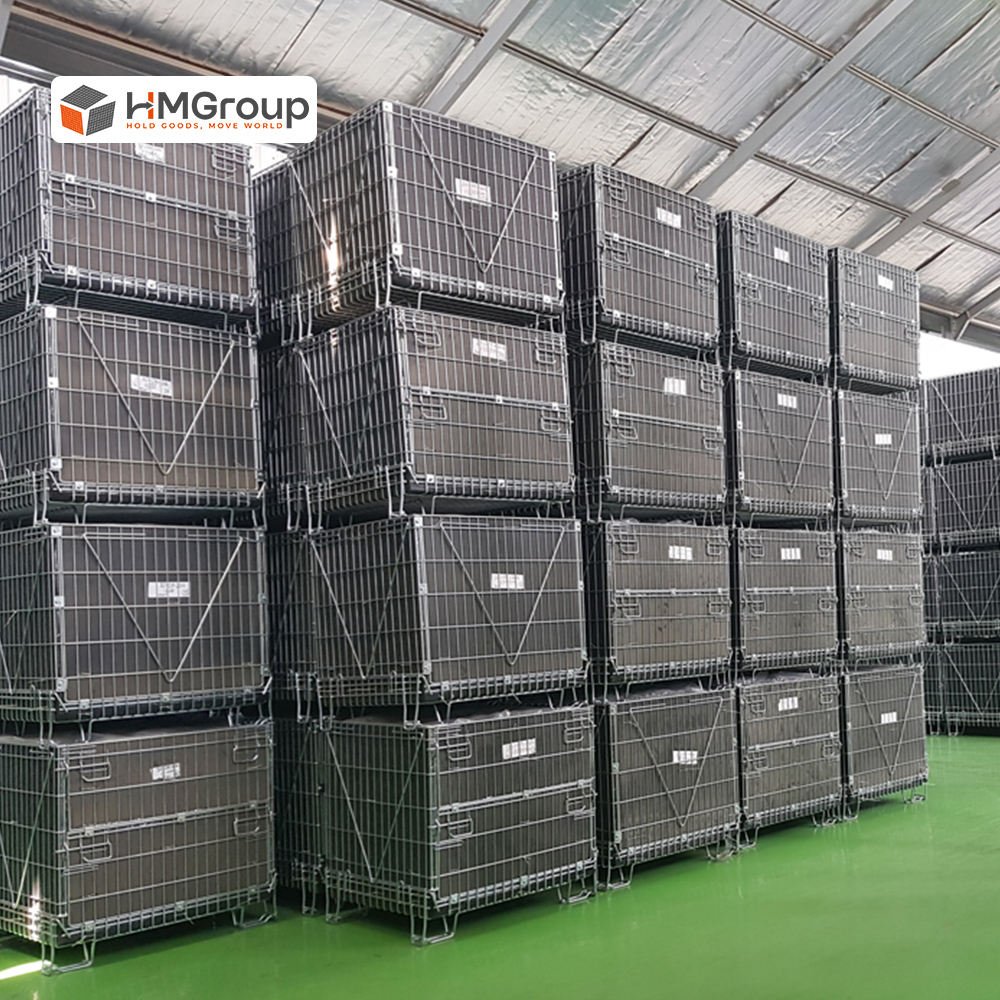
- Space Utilization: Wire containers can be stacked up to 4–6 units high under full load, reclaiming up to 70% of floor space compared to floor-level storage of bulk bags or pallets.
- Maintenance: Open-mesh design prevents dust accumulation and reduces cleaning costs. Solid plastic bins require periodic washing, and cardboard boxes generate waste that must be managed.
- Return Ratio: When empty, wire containers fold flat to a 4:1 return ratio (75% volume reduction), drastically reducing reverse logistics space and costs.
3. Product Protection & Durability
Wire containers made from mild steel Q235 with zinc, hot-dip galvanized, or powder coating finishes offer corrosion resistance for 3–5 years in industrial environments. Optional PP sheet liners provide 100% protection for delicate items like PET preforms. In contrast, solid plastic bins may crack under heavy loads, and cardboard boxes lose strength when wet or repeatedly handled.
Technical Specification Example: HM Group Foldable Wire Container (Model HM-PPC14)
- Exterior Dim.: 1120L x 971W x 1050H mm
- Wire Gauge: 6–12 mm
- Grid Size: 54 x 160 mm
- Loading Capacity: 800 kg
- Stackability: 4 high
- Surface Treatment: Zinc / hot-dip galvanized / powder coating
Step-by-Step Selection Framework
- Assess Your Use Case: Identify whether your operation requires frequent visual inventory checks (wire container wins) or if items are clean and non-fragile (plastic bins may suffice).
- Calculate Throughput: If you handle more than 50 cycles per container per year, wire containers become cost-negative within the first 12 months.
- Evaluate Space Constraints: For high-density warehouses, the ability to stack 4+ high with wire containers is a decisive advantage.
- Check Return Logistics: For inter-site or intercontinental return trips, the 4:1 fold ratio generates significant savings.
- Verify Certifications: Look for ISO 9001:2015 certification (e.g., HM Group holds SGS-issued certificate CN24/00004786) and third-party audits (BV, SGS) to ensure quality and safety.
Use Cases
Case 1: PET Preform Storage for Coca-Cola South Africa
HM Group supplied 5,000 PET Preform Wire Containers (Model HM-PPC22) to Coca-Cola South Africa. The open-mesh design with PP sheet inner lining enabled 5+1 high stacking, increasing warehouse density by 400%. Inventory counting time was reduced by 50% thanks to instant visual identification. The foldable feature allowed a 75% volume reduction during empty return logistics.
Case 2: Global Beverage Leader (Nestlé) – 10,000 Units
A massive deployment of Wire Containers with PP Sheet (Model HM-HD028) for Nestlé’s PET preform storage. Key results: 300% expansion of warehouse capacity through 4-high stacking, 40% faster stock counting, and 25% reduction in logistics downtime. The containers met strict food-grade hygiene standards.
Case 3: Wine Industry (Australia, Europe)
For wine storage and export, HM Group’s Metal Wire Container for Wine Bottles (Model HM-WEU001) stores 500 Bourgogne bottles per unit, stackable 4+1 high. The open design allows 100% visual vintage management and prevents label damage. Hot-dip galvanized finish withstands high-humidity cellar conditions.
Frequently Asked Questions
What is a wire container and how does it work?
A wire container is a reusable steel mesh storage unit designed for transporting and storing bulk materials. It typically features a collapsible frame, forklift pockets, and half-drop gates for easy access. It works by providing a rigid, ventilated enclosure that can be stacked vertically when loaded and folded flat when empty.
Why is a wire container better than a cardboard box?
Cardboard boxes are single-use and require constant repurchasing. Wire containers offer a 100+ cycle lifespan, a 75% return volume reduction, and eliminate waste disposal costs. The open-mesh design reduces picking errors by 30% and provides 100% inventory visibility.
Who uses wire containers?
They are widely used in automotive, e-commerce fulfillment, PET preform manufacturing, wine storage, agriculture, and food & beverage industries. Global brands like Nestlé and Coca-Cola rely on wire container systems for their supply chains.
How do I choose the right wire container supplier?
Look for suppliers with ISO 9001 certification, experience with large-scale deployments (like HM Group’s 10,000-unit project for Nestlé), in-house automation (welding robots, auto welding machines), and transparent quality control processes including pre-shipment inspection and third-party audits.
What are common buyer concerns?
Buyers often worry about initial cost, stack stability, and surface rust. HM Group addresses these with mild steel Q235, zinc/hot-dip galvanized coatings, reinforced welds, and a 3–5 year warranty under proper use.
Conclusion
When evaluating wire containers vs. solid plastic bins vs. corrugated cardboard boxes, the data clearly favors wire containers for any operation with moderate to high throughput. The 30% higher upfront investment is recouped through 100+ reuse cycles, a 4:1 return ratio, and a 30% reduction in picking errors. For industrial buyers seeking a sustainable, cost-effective, and space-optimized solution, wire mesh storage containers from a proven manufacturer like HM Group offer the best long-term value.
Download the HM Group corporate brochure for detailed product specifications and case studies:
📄 Download HM Group Brochure (PDF)For inquiries, contact Mary Kong:
Email: mary@net-railing.com
Tel/WhatsApp: +86 150 4058 7228
Address: 3306 Times Square, 50 Renmin Road, Zhongshan Dist, Dalian, Liaoning, China
Website: www.hmlwires.com