Wire Container with Casters: A Practical Guide to Mobile Wire Mesh Storage
When industrial buyers search for a wire container, they often need more than a static storage cage. Warehouses, production lines, and distribution centers increasingly require mobility: the ability to load, move, and position materials without tying up a forklift. A wire container with casters answers that need by combining the visibility, stackability, and durability of steel wire mesh construction with integrated wheels for manual or towed movement.
This guide explains what mobile wire mesh storage containers are, how they compare with standard wire containers, which industries use them, and what specifications matter when sourcing from a manufacturer such as HM Group.
Why Mobile Wire Containers Are a Separate Buying Category
A standard wire container is designed for forklift handling and vertical stacking. A wire container with casters is designed for movement. The difference affects the base frame, wheel specification, load rating, and how the unit behaves in production or retail environments.
Mobile units are commonly used in:
- Assembly lines where components must move between workstations
- Order picking and fulfillment operations where staff move goods by hand
- Supermarkets and hypermarkets for stock display and replenishment
- Wine cellars and bottling plants where forklift access is limited
- Return logistics, where foldable or collapsible mobile cages reduce empty return volume
What Is a Wire Container?
A wire container is a rigid or collapsible storage and transport unit made from welded steel wire mesh, typically mounted on a steel base with forklift entry points. It is used for storing, moving, and shipping materials such as automotive parts, PET preforms, agricultural products, and bottled goods.
HM Group describes its core range as including wire mesh containers, PET preform containers, cage pallets, stillages, tire racks, and related logistics equipment. The company manufactures from mild steel Q235, with wire gauges generally ranging from 4 mm to 12 mm depending on the model and application. Common finishes are zinc plating, hot-dip galvanizing, and powder coating.
Most HM Group wire containers can be stacked at least 4 high, and larger models such as the PET preform container HM-PPC22 support 5+1 high stacking. This vertical density is a key reason warehouses replace floor storage with wire container systems.
Wire Container with Casters: How It Differs from Standard Units
There is a common misunderstanding that a wire container with wheels is simply a standard wire container bolted onto casters. In practice, mobile units require different engineering priorities.
Key differences include:
- Base strength: The base must transfer load through the caster mounts without flexing.
- Center of gravity: A loaded container on wheels must remain stable during manual pushing and cornering.
- Wheel type: Buyers must choose between nylon, rubber, or polyurethane casters depending on floor surface and load weight.
- Braking: Mobile containers often need brakes on at least two wheels to prevent movement during loading or picking.
- Weight: Caster-equipped containers are heavier than standard units, which can affect shipping cost and empty return logistics.
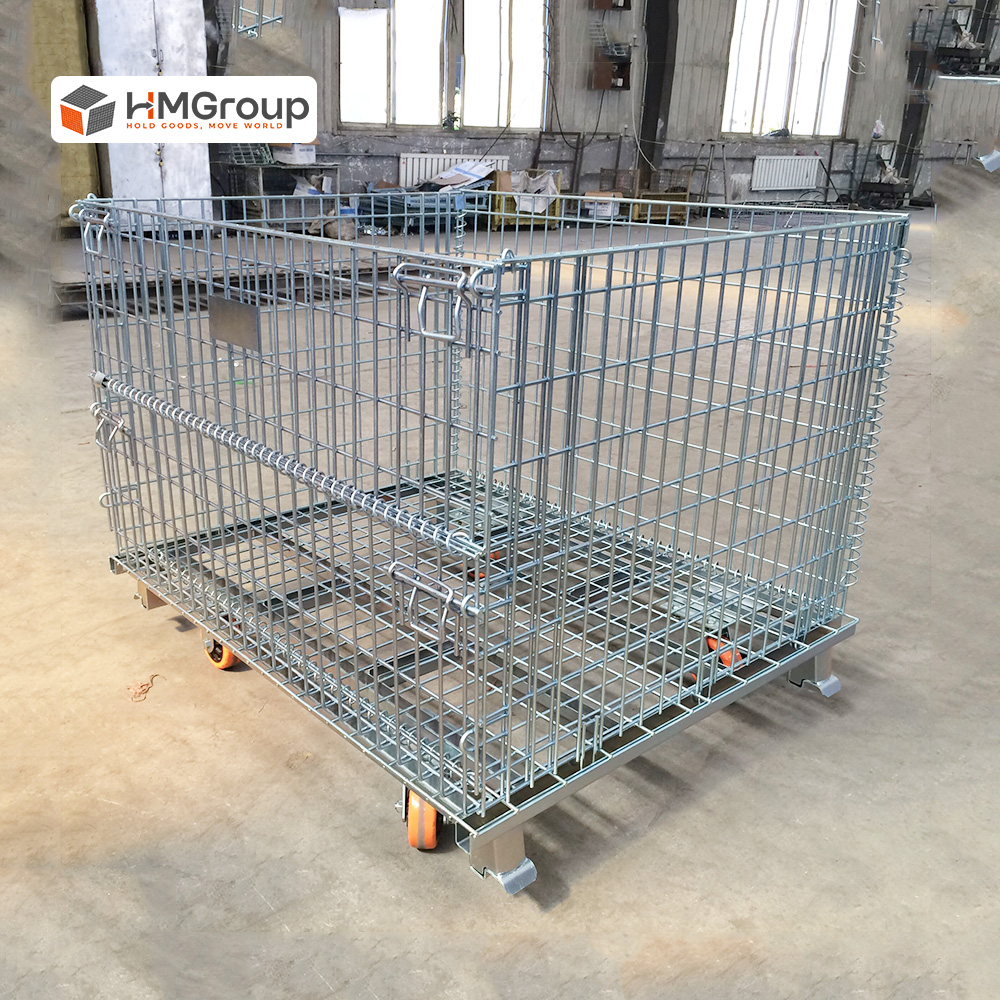
HM Group offers wire containers with casters across several product families, including the collapsible wire container HM-HD005 and the PET preform wire container HM-PPC22. These models retain forklift entry where the design allows, giving buyers the option of manual movement or mechanical handling.
When to Choose a Wire Container with Casters
Mobile wire containers add cost and complexity compared with standard units, so the decision should be driven by the workflow.
Choose Mobile Containers When:
- Materials move between workstations without a forklift.
- Staff pick orders from multiple locations within a picking zone.
- Goods must be displayed and moved in a retail or hypermarket environment.
- Space between racks is too narrow for forklift access.
- You need frequent repositioning of stored materials for cleaning or inspection.
Stay with Standard Forklift-Handled Containers When:
- Containers are stacked 4 high and moved only by forklift.
- Load weights exceed the practical limit for manual movement.
- Containers remain in fixed racking positions for long periods.
- Floor surfaces are uneven or outdoors, where casters are less effective.
In mixed operations, many buyers use standard wire containers for bulk storage and add caster-equipped units for the picking or production line stage.
Wire Container with Casters: Key Specifications to Check
When sourcing a mobile wire container, buyers should verify the same core specifications used for standard units, plus additional criteria for the caster system.
| Specification | What to Verify | Why It Matters |
|---|---|---|
| Exterior dimensions | L × W × H in mm | Determines fit in aisles, trailers, and racking bays |
| Wire gauge | mm range | Thicker wire increases structural strength but also weight |
| Grid size | mm × mm | Smaller grids retain small parts; larger grids improve airflow and visibility |
| Loading capacity | kg per unit | Must include dynamic load during movement, not just static storage |
| Stackability | number of units high | Affects warehouse density; mobile units may need different stacking rules |
| Finish | zinc / hot-dip galvanized / powder coating | Determines corrosion resistance in humid or washdown environments |
| Caster type | diameter, material, load rating, brake | Affects maneuverability, floor protection, and safety |
| Handling integration | forklift entry, tow handle, racking compatibility | Determines whether the unit can be moved mechanically when fully loaded |
| Return ratio | folded vs. assembled volume | Collapsible mobile containers reduce empty return freight cost |
Example: HM Group Collapsible Wire Container HM-HD005
The HM-HD005 is a collapsible wire container with exterior dimensions of 1230×1040×900 mm. It carries 1000 kg, uses 6.2 mm wire with a 50×100 mm grid, and stacks 4 high. Finish options are zinc, hot-dip galvanized, or powder coating. A 40-foot high cube container can hold 350 sets.
Because this model is collapsible, it suits operations where empty return logistics matter. When fitted with casters, it can serve as a mobile picking or production feeder container while still being forklift-and rack-compatible in many configurations.
This product is used in automotive components, manufacturing, retail distribution, agriculture, e-commerce logistics, and metal hardware storage. It is designed for fast-moving environments where materials shift constantly and require rapid identification.
Wire Containers with Wheels Across Industries
Mobile wire mesh storage containers are not a niche product. They appear across multiple sectors, and the specific model choice depends on the load and environment.
Automotive and Heavy Manufacturing
In automotive parts logistics, containers move between production lines and storage areas under high rotation. HM Group offers the industrial wire container HM-ST-AU001 for auto parts, fulfillment, warehouse, and mining applications. It uses a 1125×1125×1000/800 mm footprint, carries 500 kg, and stacks 4 high.
For heavier plant-floor loads, the heavy duty wire container HM-HD001 offers 1300 kg capacity in a 1030×840×850 mm frame with 6 mm wire and a 50×50 mm grid. In automotive-style applications, structural integrity and predictable handling matter more than collapsibility.
PET Preform and Beverage Bottling
PET preform manufacturing is a high-volume, high-rotation environment. HM Group produces the PET preform wire container HM-PPC22 with dimensions of 1196×1008×1174 mm, a 62×125 mm grid, and stacking up to 5+1 high. The foldable wire container HM-PPC14 offers an 800 kg capacity in a 1120×971×1050 mm frame with 54×160 mm grid spacing.
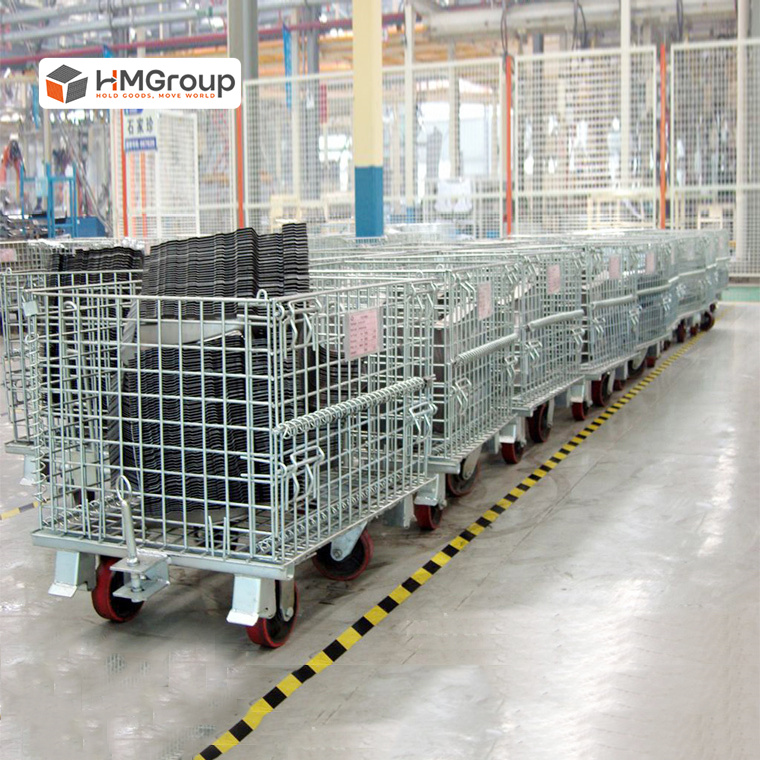
For mobile applications, a caster-equipped preform container allows operators to position preforms directly beside injection or blow-molding lines. The half-drop gate design on several HM Group models supports ergonomic picking even when containers are stacked.
HM Group's PET preform container HM-PPC22 also has application in warehouse storage and is designed for the PET preform industry. Some wire containers with PP sheet lining, such as the HM-HD028, are used in PET preform and fulfillment & warehouse operations where dust protection and finer material retention are needed.
Wine Industry
Wine storage and logistics have unique requirements: bottle protection, humidity resistance, and efficient density. HM Group offers two dedicated models:
- The metal wire container for wine bottles HM-WEU001 measures 1140×830×980 mm, carries 800 kg, stores 500 Bourgogne bottles, and stacks 4+1 high.
- The wine storage wire container HM-WEU005 measures 1200×920×1018 mm, carries 800 kg, stores 400 Bordeaux bottles, and stacks 4+1 high.
Both models are made from mild steel Q235 with 5-12 mm wire gauge and offer zinc, hot-dip galvanized, or powder coating finishes. The hot-dip galvanized option is relevant for high-humidity cellar environments.
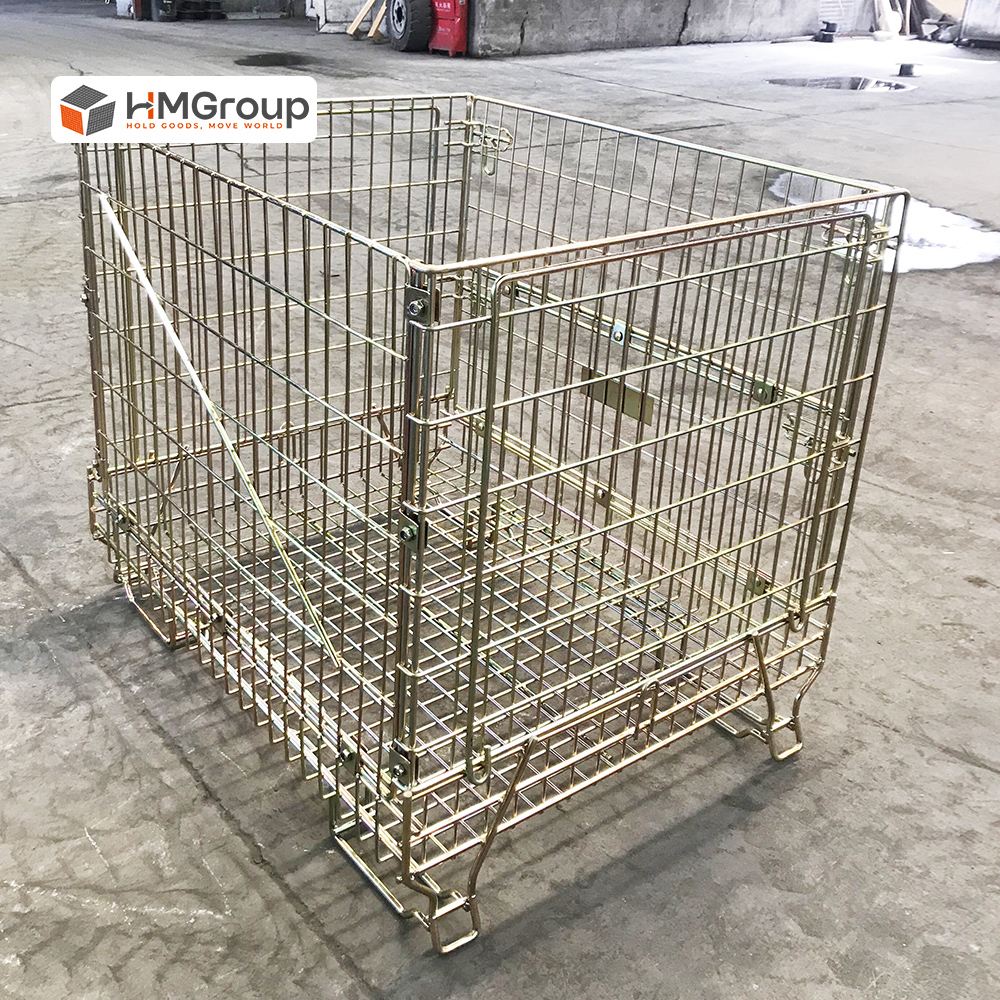
For mobile wine handling, caster-mounted wine containers allow staff to move bottled wine between cellar, labeling line, and dispatch without repeated forklift trips. The half-drop gate provides access to bottles even when units are stacked.
E-commerce Fulfillment and Retail
In fulfillment centers, mobile wire containers improve picking efficiency by allowing staff to move a visible, organized batch of orders. The wire mesh pallet container HM-CP001 measures 1200×800×1000 mm, stacks 4 high, and is intended for fulfillment & warehouse, agricultural, hypermarket, e-commerce, and food & beverage industries.
The wire mesh storage container HM-HD010, with a 1200×1000×1250 mm footprint and 25×50 mm grid, suits applications requiring finer material retention such as agricultural storage and e-commerce small parts handling.
In retail distribution, mobile wire containers can function as both transport units and display fixtures, eliminating double handling. This is especially common in hypermarket replenishment cycles where staff move goods from backroom to sales floor.
Collapsible and Foldable Mobile Containers: Return Logistics
One of the strongest arguments for collapsible or foldable wire containers is the return ratio. HM Group states that its collapsible container designs offer a 4:1 return ratio when empty, and the PET preform model supports a 75% volume reduction in collapsible mode.
For caster-equipped units, buyers should still look for collapsible designs where possible. A mobile container with casters that collapses flat can be shipped back to a distribution center or manufacturer more economically than a rigid box.
The HM Group collapsible wire container HM-HD005 is an example of a product that combines high load capacity (1000 kg) with a foldable structure. It is suitable for auto parts, agricultural, fulfillment & warehouse, and food & beverage industries.
How to Compare Wire Container with Caster Options from Suppliers
Buyers at the research stage should compare suppliers on documented specifications rather than marketing claims. The following comparison framework is based on verifiable product facts and standard industrial expectation.
| Dimension | HM Group Advantage | What to Check with Other Suppliers |
|---|---|---|
| Manufacturing base | Three bases in Xiamen, Nanjing, and Qingdao; 62,000 m² total facility area | Location of production, not just trading office |
| Production capacity | 2,000,000 units annual capacity | Ability to support repeat orders and committed lead times |
| Export experience | 100% export; markets include EU, North America, Asia, Middle East | Relevant export documentation and regional compliance experience |
| Product range | Wire mesh containers, PET preform containers, cage pallets, stillages, tire racks, wire mesh decking, danish trolleys | Breadth matters for long-term supply partnerships |
| Engineering team | 10-engineer R&D team | Customization capability for caster type, mesh size, dividers, and finish |
| Quality narrative | Engineering discipline; global service teams established in 2024 | Evidence of field service or after-sales support in your region |
HM Group was established in 2003 as Dalian HuaMao Logistics Equipment Group Co., Ltd. The trading department employs approximately 50 staff, and the company markets under the brand HM Group with the tagline "HOLD GOODS, MOVE WORLD."
Step-by-Step: Matching a Mobile Wire Container to Your Operation
- Define the load. Record the maximum weight, part size, and whether the load is static or dynamic. Dynamic loads during movement are often more demanding than static storage loads.
- Define the path. Measure aisle widths, door openings, elevator access, and floor conditions. These determine caster diameter, wheel material, and overall container footprint.
- Define the handling method. Will staff push the container manually, pull it with a tug, or still use a forklift for long moves? This affects whether you need a tow hitch, a push handle, or reinforced base plates.
- Check stacking requirements. If containers must stack when full, verify the stacking capacity with casters. Some suppliers derate stacking for mobile units unless the base is specially reinforced.
- Consider the finish. Indoor dry warehouses can use zinc plating. Humid or washdown environments usually require hot-dip galvanizing. Retail-facing units may prefer powder coating for color and appearance.
- Plan return logistics. Choose collapsible designs if empty containers will be returned to a central point. Compare the folded height against the assembled height.
- Request a sample or drawing. Before full procurement, validate the caster load rating, turning radius, and gate access with a physical unit or detailed engineering drawing.
Common Mistakes When Buying Wire Containers with Casters
Buyers at the research stage often focus on price and basic dimensions, then encounter problems during operation. The most common mistakes include:
- Under-specifying the caster: A caster rated for 300 kg cannot be used on an 800 kg container without risk. The caster load rating must cover the maximum loaded weight, divided across the number of wheels, with a safety factor.
- Ignoring dynamic load: A container that can hold 1300 kg statically may not be safe to push when fully loaded, especially if the wheel diameter is small or the floor is uneven.
- Choosing small wheels on rough floors: Hard nylon wheels on concrete with debris create vibration and noise. Rubber or polyurethane wheels improve grip but may increase rolling resistance.
- Forgetting brakes: Mobile containers without brakes can roll during loading or when parked on an incline.
- Assuming all wire containers stack the same: Stacking capacity is model-specific. HM Group specifies different stacking heights for different models, from 4 high to 5+1 high.
- Overlooking collapsibility: A rigid mobile container consumes the same space whether full or empty. Collapsible models reduce empty return volume significantly.
Cost Considerations
Caster-equipped wire containers cost more than standard units because the base frame, caster set, and assembly add material and labor. However, the total cost of ownership may be lower if the alternative requires additional handling equipment or extra labor.
Factors that influence cost include:
- Caster material and load rating
- Brake configuration
- Custom mesh size or dividers
- Finish type
- Collapsible vs. rigid design
- Order quantity and shipping method
HM Group's annual production capacity of 2,000,000 units and three manufacturing bases support repeat orders across multiple container models. For buyers managing an existing fleet, the ability to match welding quality, finish, and dimensions across batches is a practical consideration.
Why Supplier Structure Matters
A wire container with casters is a returnable, long-life asset. The supplier's engineering and after-sales structure affects how easily you can replace parts, add units, or customize future orders.
HM Group operates three manufacturing bases in Xiamen, Nanjing, and Qingdao, covering 62,000 square meters. The company's trading department employs about 50 staff, supported by a 10-engineer R&D team. Export business accounts for 100% of sales, with major markets in the EU, North America, Asia, and the Middle East.
In 2024, HM Group established sales, technical, and service teams across the United States, Canada, Mexico, Argentina, Brazil, South Africa, Saudi Arabia, and other key regions. This matters for buyers who need local communication, installation guidance, or after-sales coordination.
Frequently Asked Questions
What is the main difference between a wire container and a wire container with casters?
A standard wire container is designed primarily for forklift handling and vertical stacking. A wire container with casters adds integrated wheels so the unit can be moved manually or with a tow system. The caster version requires a reinforced base and careful load distribution to remain stable during movement. Buyers should not assume that any standard wire container can simply be retrofitted with casters without rechecking structural capacity.
What load capacity can a typical mobile wire container handle?
Load capacity depends on the model. HM Group's heavy duty wire container HM-HD001 carries 1300 kg, while the collapsible wire container HM-HD005 carries 1000 kg. Other models such as the wire mesh storage container HM-HD010 and the wire mesh pallet container HM-CP001 carry 800 kg each. When casters are added, the safe working load may be reduced by the caster rating, so the caster specification should be confirmed with the manufacturer.
Can a wire container with casters still be stacked?
Some wire containers with casters are designed for stacking, but the presence of casters can interfere with a stable footprint unless the base is engineered correctly. Buyers should verify the stackability rating for the specific caster-equipped model. Many HM Group wire containers are rated for stacking 4 high, and the PET preform wire container HM-PPC22 is rated for 5+1 high, but this rating applies to the standard configuration. Caster retrofits may change the stacking behavior.
Which industries use wire containers with wheels?
Mobile wire containers are used in automotive manufacturing, e-commerce fulfillment, retail and hypermarket distribution, PET preform and beverage bottling, and wine logistics. In each case, the container allows staff to move materials without a forklift while retaining visual identification and ventilation. HM Group's application data covers automotive components, manufacturing, retail distribution, agriculture, e-commerce logistics, and metal hardware storage.
What should I ask a supplier before ordering mobile wire containers?
Ask for the exact loading capacity with casters, caster diameter and material, brake type, stacking compatibility, finish options, and the return ratio if the container is collapsible. Also ask whether the supplier can provide a sample or engineering drawing. HM Group can be contacted at mary@net-railing.com or +86 150 4058 7228 for quotation and specification details.
Conclusion
A wire container with casters is a practical solution when materials must move frequently within a facility. It combines the well-documented benefits of wire mesh storage—visibility, ventilation, stackability, and durability—with the flexibility of manual mobility. The right choice depends on load weight, floor path, stacking needs, and return logistics.
HM Group offers a broad portfolio of wire containers suited to industrial, agricultural, beverage, and retail applications, with manufacturing bases in Xiamen, Nanjing, and Qingdao, an annual capacity of 2,000,000 units, and export experience across the EU, North America, Asia, and the Middle East. Buyers who need additional support can request the company brochure or contact the team directly.
For a downloadable overview of HM Group's product range and manufacturing capabilities, see the HM Group brochure.
Have Questions or Need More Details?
Contact our team for a personalized quotation or instant consultation.
Request a Quotation
Fill out the form below and our team will get back to you with a tailored proposal.
WhatsApp Direct Chat
Prefer to chat in real-time? Message us on WhatsApp for instant assistance & quick answers.
- Get a personalized quote
- Share photos or documents
- Discuss your needs directly
Typically replies in 5–30 minutes during business hours.