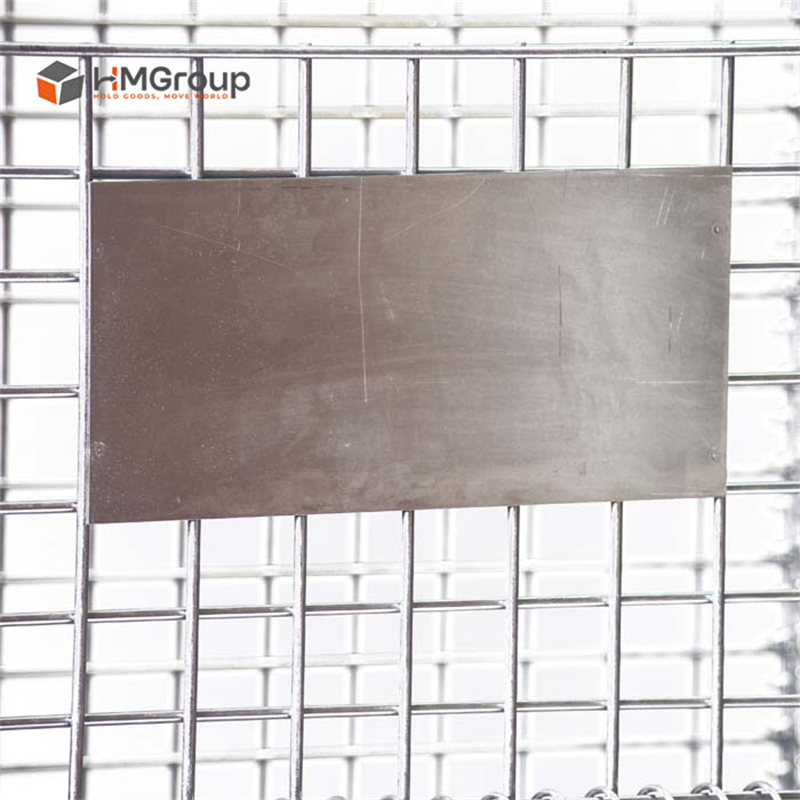
Wire Gauge and Grid Size Decoded: How to Select Wire Containers for 1000 kg Loads
Wire Gauge and Grid Size Decoded: How to Select Wire Containers for 1000 kg Loads
Two wire containers can both be rated for 1,000 kg and still be built from completely different wire. The HM-HD005 Collapsible Wire Container reaches 1,000 kg with 6.2 mm wire on a 50×100 mm grid. The HM-ST007 Wire Bulk Container reaches the same 1,000 kg rating with 4 mm wire on a 50×50 mm grid. Wire gauge tells you how thick each individual wire is. Grid size tells you how far apart those wires sit. Neither figure on its own explains the load rating — and reading either one in isolation is the most common way a heavy-duty wire container is mis-specified.
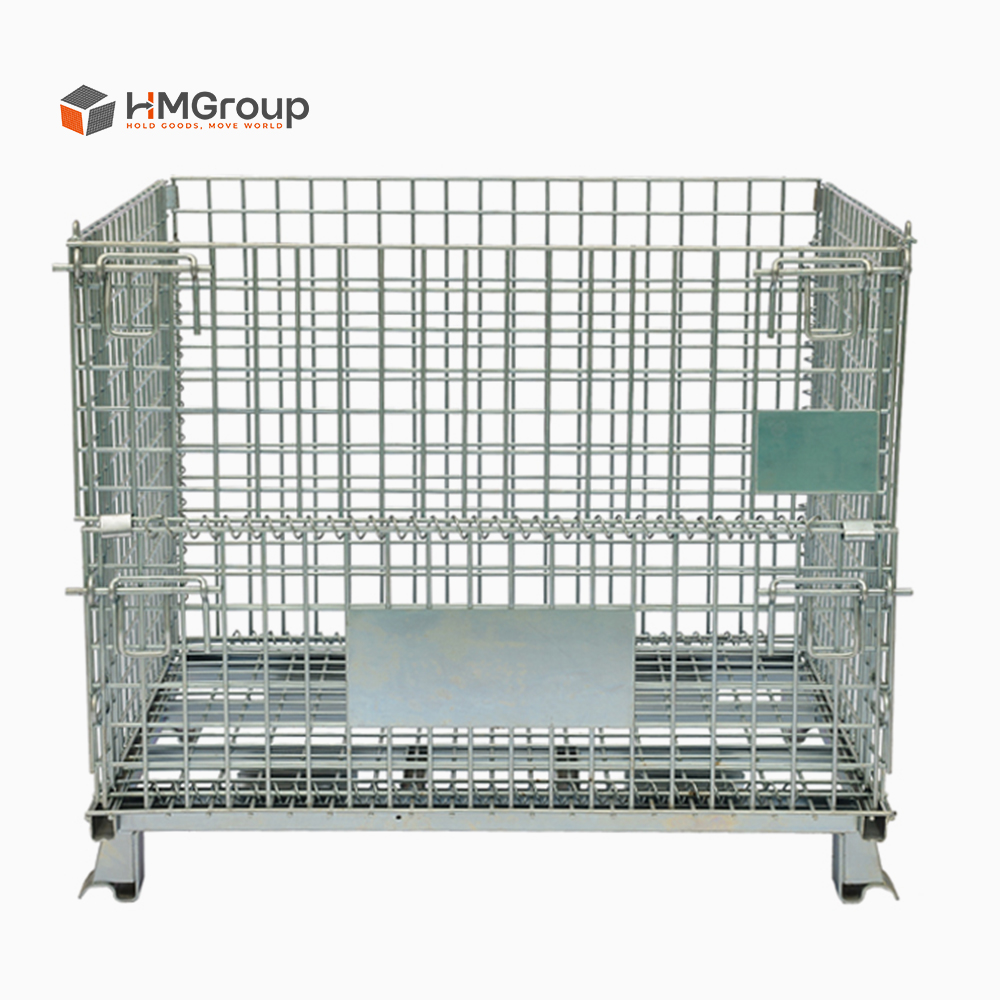
This guide separates the three variables that normally arrive bundled into a single datasheet line — wire gauge, grid size, and rated loading capacity — and then works through a selection sequence for containers used in the 1,000 kg class. The reference configurations are three heavy-duty models: HM-HD001, HM-HD005 and HM-ST007.
Problem Definition: Why 1,000 kg Ratings Get Misread
A wire container rated 1,000 kg is not the product of a gauge multiplied by a grid. It is the outcome of an assembly: mesh panels, corner posts, a base frame, hinges or latches, and the welds that hold them together. Four misreadings account for most specification errors in this load class.
1. Treating wire gauge as a capacity number. A buyer who assumes thicker wire always means a higher rating will get the wrong answer immediately. HM-HD001 uses 6 mm wire on a 50×50 mm grid and is rated 1,300 kg. HM-HD005 uses 6.2 mm wire on a 50×100 mm grid and is rated 1,000 kg. The container with the thicker wire carries the lower rating. Gauge is a local property of a single wire; capacity is a global property of the whole structure.
2. Reading grid size only as containment. Grid size is usually discussed in terms of whether small parts fall through. That is only one of its jobs. Aperture also determines how many wire intersections sit under a given contact area, how load spreads from the part into the mesh panel, how much the mesh deflects at mid-span, and how much wire is available at each weld. A tighter grid raises the number of load paths; a wider grid reduces mesh weight and improves visibility and airflow, but concentrates load on fewer wires.
3. Ignoring the base frame and the stack. A rated capacity describes one unit standing under load. A four-high stack is a structure. The bottom unit does not carry only its own payload; it also carries what the units above it transmit down through the posts and the stacking interface. Buyers should always ask how the published rating is defined for the stacking height they intend to use.
4. Waiting for visible failure instead of watching deformation. Wire containers rarely collapse without warning. They deflect first. Elastic deflection recovers when the load is removed; permanent set does not. The difference between the two is the practical line between a container that is in specification and one that is on its way out of it.
Industry Background: Why the 1,000 kg Class Matters Now
The wire mesh container market is valued at approximately USD 2.34 billion in 2025 and is projected to reach USD 3.72 billion by 2034, expanding at a CAGR of 5.2% during the 2026–2034 forecast period (Dataintelo, wire mesh containers sales market). Stackable wire mesh containers held the largest share of the product segment in 2025 at 32.5% of total revenue, which is consistent with what buyers actually purchase: units designed to go up, not sideways. Asia Pacific is the dominant producing and consuming region, holding a 38.2% revenue share as of 2025.
On the demand side, the United States remains a major importer of articles of iron or steel wire under HS Code 732620, with an import market share of approximately 16.7% in 2024 (UN Comtrade data as compiled by Abrams Wiki). Heavy-duty mesh containers are a recurring part of that flow because they replace single-use packaging in exactly the loops where return freight matters most.
Two regulatory and specification threads sit behind the 1,000 kg class. For automotive applications, container specifications such as GM 5131 and Chrysler- and Ford-compatible designs are commonly referenced so that containers integrate into existing production logistics without adaptation. Separately, ASTM D6573/D6573M covers the standard specification for general-purpose wirebound shipping boxes and containers used for domestic and overseas shipment — a useful adjacent reference point for buyers who are used to standardised shipping containers rather than industrial stillage units.
HM Group — Dalian HuaMao Logistics Equipment Group Co., Ltd. — is a wire mesh container manufacturer founded in 2003, operating a 62,000 m² manufacturing footprint with an annual output of 2,000,000 units and a 100% export ratio across the EU, North America, Asia and the Middle East. The company operates manufacturing bases in Xiamen, Nanjing and Qingdao, and has supplied 15,000 PET preform containers for Coca-Cola Germany and produced wire mesh decking for the Dexion Group.
Detailed Solution: Decoding Gauge, Grid and Load Rating
Wire gauge — the diameter of the individual steel wire used in the mesh panel, expressed in millimetres in HM Group specifications: for example 4 mm (HM-ST007), 6 mm (HM-HD001), or 6.2 mm (HM-HD005).
Grid size — the spacing between adjacent wires in the mesh, for example 50×50 mm or 50×100 mm. In the HM Group range this runs from a fine 25×50 mm (HM-HD010) to a wide 54×160 mm (HM-PPC14).
Load capacity — the rated load for the complete container, not for the mesh panel alone. It depends on wire gauge, grid size, base frame, posts, welds, and stacking geometry together.
What wire gauge actually controls
Gauge governs three things, and only the first is obvious.
- Bending stiffness of each wire. Resistance to bending rises steeply with diameter, so a small increase in gauge produces a disproportionately stiffer wire. This is why 6 mm and 6.2 mm wire behave quite differently from 4 mm wire in service, even though the numbers look close.
- Weld cross-section at every intersection. A thicker wire offers more material for the weld to bite into at each mesh node. On a tight grid there are many nodes, and each one is a transfer point between perpendicular wires.
- Resistance to local dents. Point loads from sharp-edged or irregular parts — a machined casting, a steel bracket, a forklift tine brushing a panel — deform thin wire locally long before the panel as a whole is overloaded.
A thicker gauge is not automatically better. It adds weight, reduces the payback from return logistics on collapsible units, and can make a container harder to handle manually. The right question is not “what is the thickest wire available” but “what is the thinnest wire that holds this rated load in this frame, over this service life.”
What grid size actually controls
Grid size does four jobs simultaneously.
- Contact and load spread. A tighter grid places more wire crossings under the same footprint, so load enters the panel through more paths. A wider grid concentrates the same load on fewer wires, which raises local stress even when the gauge is unchanged.
- Part retention. Fine grids hold small components and prevent them from protruding through the panel during transport. A 25×50 mm grid behaves very differently from a 50×100 mm grid when the load includes small parts.
- Ventilation and visibility. Open mesh allows airflow and lets operators read stock without opening the unit — relevant wherever goods need inspection or air circulation.
- Overall mesh weight. For a given panel size, a tighter grid means more wire and more welds, which changes the tare weight and therefore the shipping economics.
Verify before you approve: confirm whether the published grid size is a clear opening or a centre-to-centre pitch. Both conventions appear in the market, and the two measurements are not the same number.
Why the 1,000 kg class has more than one valid configuration
Three verified configurations reach or exceed the 1,000 kg class by different routes.
- HM-HD001 — 6 mm wire on a 50×50 mm grid, 1,300 kg rated load, 1030×840×850 mm. Thick wire and a tight grid, in the most compact frame of the three.
- HM-HD005 — 6.2 mm wire on a 50×100 mm grid, 1,000 kg rated load, 1230×1040×900 mm. Thicker wire, wider aperture, larger footprint.
- HM-ST007 — 4 mm wire on a 50×50 mm grid, 1,000 kg rated load, 1230×835×970 mm. Thinner wire, tight grid.
Read together, the three produce the rule that matters: gauge and grid are inputs, and the rating is an output of the complete frame. HM-ST007 shows that a 4 mm mesh can sit in the 1,000 kg class. HM-HD010 shows the counter-intuitive case: a 6 mm mesh on a finer 25×50 mm grid is rated 800 kg, and it stands 1,250 mm tall against HM-HD001’s 850 mm. HM-ST-AU001 makes the point from the other direction — 4 mm wire on a 50×50 mm grid, the same mesh family as HM-ST007, rated 500 kg in a 1,125×1,125 mm frame with a 1,000/800 mm height.
Taller panels increase the unsupported span between the base and the top rail. A larger footprint changes how load reaches the base frame and the fork entry. A collapsible frame introduces hinges and latches that behave differently from a fixed welded body. All of these move the rating at least as much as the gauge does.
Deformation risk: where it starts and what it signals
A load rating describes a limit. Deformation describes the behaviour on the way to it, and it is the part buyers most often overlook. Three patterns are worth monitoring.
- Base frame sag. The base carries the entire payload and transmits it to the forklift. A base that visibly flexes under a 1,000 kg load will eventually transfer that movement into the posts.
- Post-to-base weld cracking or paint chipping at the joint. Coatings crack where the substrate moves. Check the same joint at the same point on every unit in a batch, not just one.
- Mesh panel bulge at mid-span, and latch or hinge wear on collapsible units. On folding frames, the hinge and drop-gate latch are wear points; looseness there allows panel movement that a fixed frame would resist.
Deformation matters commercially, not only structurally. A container that sags out of square jams in racking, misaligns on forklift entry, and allows load to shift. In a four-high stack, all of that compounds upward. HM Group addresses this class of risk with reinforced steel frames and high-tensile wire mesh intended to sustain dynamic loads, zinc plating or hot-dip galvanization for surface protection, and configurable mesh sizes and internal dividers where small or delicate components need separation.
Before signing off a specification, ask the supplier to state how the rating is defined: static evenly distributed load on level ground, dynamic load during forklift transport, or load carried by a bottom unit in a stack. A rating without that definition is not comparable to another supplier’s rating.
Step-by-Step Breakdown: Selecting a 1,000 kg Wire Container
- Define the real load, not the nominal one. Start with the weight of the goods, add the container’s own tare weight, then account for how the unit will actually be handled. If the container will be the bottom of a stack, the load it must resist is the stack above it, not just its own contents.
- Fix grid size from the part, not from the load. Decide the maximum aperture that safely retains the smallest item being handled, and the maximum aperture that prevents parts from protruding through the panel. Grid size is a containment decision first.
- Shortlist by wire gauge within the structural class. Once the grid is fixed, gauge becomes the variable that balances stiffness against weight. A tight grid with a lighter gauge and a wide grid with a heavier gauge can both land in the same load class, which is exactly the pattern seen across HM-ST007 and HM-HD005.
- Inspect the base frame and stacking interface. Confirm that the base is designed for four-way forklift entry and that the stacking feet or posts locate positively on the unit below rather than relying on the mesh panels to align.
- Confirm stack height under full load. All three reference models — HM-HD001, HM-HD005 and HM-ST007 — are rated for 4-high stacking. Confirm the rating applies at full load at that height, not only at partial load, and confirm the floor or racking beneath the stack can take it.
- Match surface treatment to the environment. Zinc plating, hot-dip galvanizing and powder coating are all available across the HM Group range. Wash-down areas, humid cellars and coastal sites place different demands on the finish than a dry, controlled warehouse.
- Validate with a sample and with documentation. A sample confirms gauge, grid pitch and weld quality in the hand. Documentation confirms the manufacturer behind it. Only after both should the order be released.
Use Cases: Where the 1,000 kg Class Earns Its Cost
Automotive components. Stamped parts, castings and sub-assemblies are dense, irregular and often sharp-edged, which is exactly the profile that punishes thin wire locally. Buyers in this sector frequently reference container specifications such as GM 5131 and Chrysler- and Ford-compatible designs so containers move through existing production logistics without modification. HM-ST007 — 4 mm wire on a 50×50 mm grid at 1,000 kg, and HM-ST-AU001, an Industrial Wire Container rated 500 kg in the same mesh family — both list the auto parts industry among their applicable sectors.
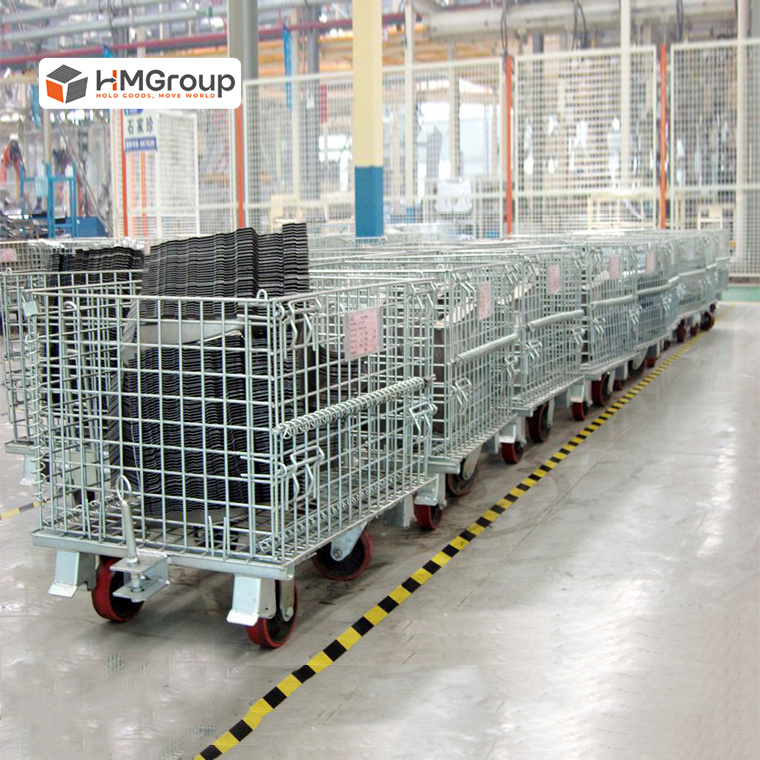
Agricultural and food & beverage handling. Produce, packaged goods and bulk ingredients need airflow and quick visual stock checks. All three reference models list Agricultural and Food & Beverage among their applicable industries, and open mesh delivers the ventilation that solid containers cannot.
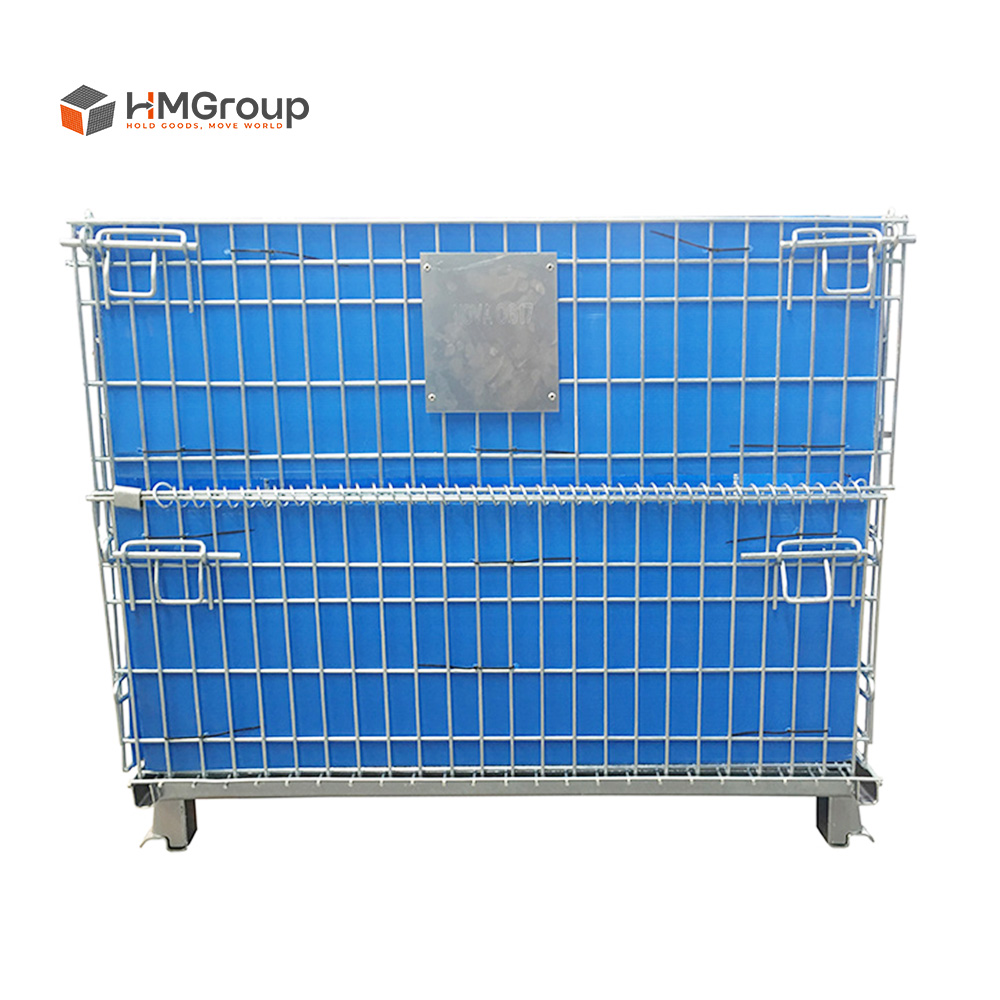
Beverage and PET preform logistics. Preforms are light per unit but stacked in very high counts, so the container itself does most of the load-bearing work. HM Group supplied 15,000 PET preform containers for Coca-Cola Germany, and the wider PET preform range includes configurations rated 600 kg (HM-PPC22) and 800 kg (HM-PPC14) with PP sheet liners where surface protection is required. The gauge-and-grid logic from this guide applies directly: for preforms, the protective liner and a smooth mesh finish matter as much as raw load capacity.
Warehouse and fulfilment operations. Where floor space is the constraint, the container’s ability to stack safely at full load is worth more than its maximum rating on paper. A 1,000 kg unit that stacks four high with confidence releases vertical space that a higher-rated unit with a weaker stacking interface does not.
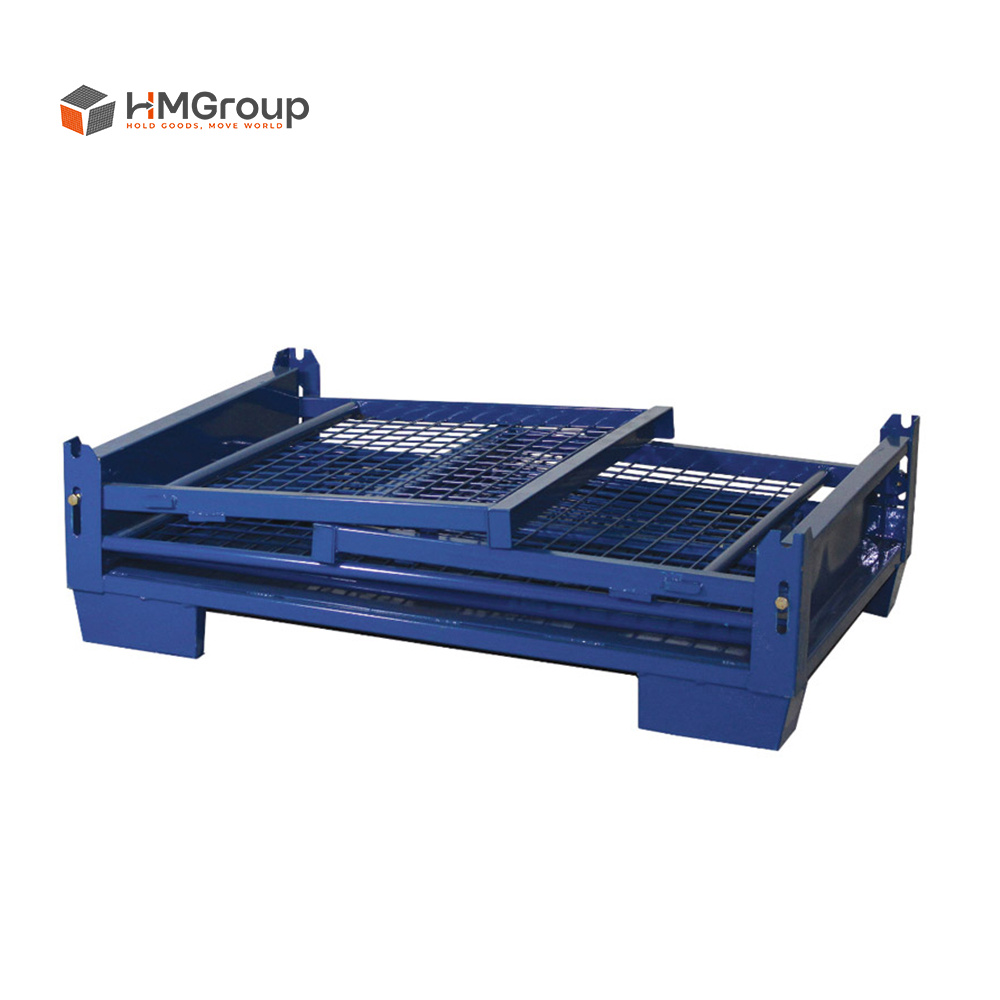
Comparison Table: Verified Configurations at and Near 1,000 kg
The first table sets out the three reference configurations named at the start of this guide. All figures are manufacturer specifications.
| Model | Product name | Wire gauge | Grid size | Rated load | Exterior dims (L×W×H) | Per 1×40'HQ | Stackability |
|---|---|---|---|---|---|---|---|
| HM-HD001 | heavy duty wire containers | 6 mm | 50×50 mm | 1,300 kg | 1030×840×850 mm | 500 sets | 4 high |
| HM-HD005 | Collapsible Wire Container | 6.2 mm | 50×100 mm | 1,000 kg | 1230×1040×900 mm | 350 sets | 4 high |
| HM-ST007 | Wire Bulk Containers | 4 mm | 50×50 mm | 1,000 kg | 1230×835×970 mm | 160 sets | 4 high |
Two additional configurations illustrate how much the frame changes the outcome. They are included as reference points, not as recommendations for a 1,000 kg duty.
| Model | Product name | Wire gauge | Grid size | Rated load | Exterior dims (L×W×H) | Per 1×40'HQ | Stackability |
|---|---|---|---|---|---|---|---|
| HM-HD010 | Wire Mesh Storage Containers | 6 mm | 25×50 mm | 800 kg | 1200×1000×1250 mm | 216 sets | 4 high |
| HM-ST-AU001 | Industrial Wire Containers | 4 mm | 50×50 mm | 500 kg | 1125×1125×1000/800 mm | 160 sets | 4 high |
All five models above share the same base material — mild steel Q235 — and the same finish options: zinc, hot-dip galvanized, or powder coating. What separates them is the combination of wire gauge, grid size, panel height and frame footprint. HM-HD010 carries a heavier 6 mm wire than HM-ST007 and still rates lower, because it is 1,250 mm tall and uses a finer grid. HM-ST-AU001 uses the same 4 mm / 50×50 mm mesh as HM-ST007 but rates 500 kg in a wider, taller frame.
Shipping density is a real cost variable inside the same load class. HM-HD001 loads 500 sets per 1×40'HQ; HM-ST007 loads 160 sets. At the same target payload per container, that difference changes freight cost per tonne of goods moved, which is often more decisive than the unit price.
Frequently Asked Questions
What certifications should I verify on a heavy-duty wire container before ordering?
Three certification documents apply to the Foldable Wire Container range and to the global market. First, ISO 9001:2015, certificate number CN24/00004786, issued by SGS. Second, a Made-in-China BV Audit Report, certificate number MIC-ASI2491658, issued by BV and valid until 2026-10-28. Third, an Alibaba.com verified Pro Supplier certification, certificate number 486803081_T, issued by SGS. Buyers in automotive supply chains should also confirm that the container design is compatible with the container specifications used in their own production logistics, such as GM 5131 and Chrysler- and Ford-compatible designs, which is a design requirement rather than a certification.
Can wire gauge, grid size and load capacity be customized instead of chosen from a catalogue?
Yes. Customization covers surface treatment (zinc, hot-dip galvanized or powder coating), size, loading capacity, powder coating color, and logo printing, together with design options such as forklift guide, wire divider, runner bar, name plate and wheels. The manufacturing basis behind that is a monthly capacity of 40,000 sets, an R&D team of 10, and a 62,000 m² footprint operating across three manufacturing bases in Xiamen, Nanjing and Qingdao, with annual output of 2,000,000 units. For buyers who need a specific grid pitch to retain a particular part, this is the lever that matters most.
What drives the cost of a 1,000 kg wire container?
Cost in this class is driven by the wire gauge, the density of the grid, the base frame and post construction, the surface treatment selected, and the optional features added. Two further factors sit outside the unit price but affect total cost: shipping density, measured in sets per 1×40'HQ, and the container’s return behavior when empty. Minimum order quantity is 1×20GP, and lead time is 30–45 days, so specification changes made late in a project carry schedule consequences as well as cost ones. Buyers comparing quotations in this load class should compare the gauge, grid, finish and shipping density line by line rather than comparing a single price figure.
Can I validate a 1,000 kg container before committing to full production?
Yes, and the inspection process is documented in six phases: pre-production sample inspection, raw material inspection, component inspection, semi-finished product inspection, finished product inspection, and packaging inspection. Buyers can also request an online video audit to observe production and inspection remotely, and a process report is provided throughout the order. After delivery, containers carry a 3 to 5 year warranty under proper use. For a 1,000 kg duty, the sample stage is where gauge, grid pitch and weld quality should be confirmed in the hand before the specification is frozen.
What is the lead time for a 1,000 kg wire container order, and how do I start?
Lead time is 30–45 days with a minimum order quantity of 1×20GP, supported by a monthly production capacity of 40,000 sets. To start, send the required wire gauge, grid size, exterior dimensions, target load, stacking height, surface treatment and any add-on features such as casters, wire dividers or PP sheet liners. HM Group is Dalian HuaMao Logistics Equipment Group Co., Ltd., founded in 2003, exporting 100% of its output to the EU, North America, Asia and the Middle East. You can reach the export team at mary@net-railing.com or +86 150 4058 7228, or download the full product catalogue at HM Group catalogue (PDF).
Conclusion
Wire gauge and grid size describe two different properties of the same mesh, and neither one is a load rating. The verified configurations in this guide make that concrete: HM-ST007 reaches 1,000 kg on 4 mm wire, HM-HD005 reaches 1,000 kg on 6.2 mm wire with a wider grid, and HM-HD001 reaches 1,300 kg on 6 mm wire in the most compact frame of the three. HM-HD010 and HM-ST-AU001 show what happens when height and footprint change while gauge stays the same or increases.
For buyers working in the 1,000 kg class, the sequence is straightforward. Set the grid by the part being handled. Shortlist the gauge by the stiffness the duty cycle needs. Then verify the base frame, the stacking interface, the declared definition of the rating, and the surface treatment for the environment. Confirm the certifications: ISO 9001:2015 (CN24/00004786, issued by SGS), the Made-in-China BV Audit Report (MIC-ASI2491658, issued by BV, valid until 2026-10-28), and the Alibaba.com verified Pro Supplier certification (486803081_T, issued by SGS). Finally, validate on a sample before the specification is frozen — because deformation in service is always cheaper to catch before production than after delivery.
Next Step: Check a Sample Against Your Specification
If you are specifying a 1,000 kg duty container, HM Group can supply a sample so that wire gauge, grid pitch and weld quality can be verified before an order is placed. Share your part dimensions, target payload, stacking height and operating environment, and the export team will match the specification to a configuration or quote a customized one.
Email: mary@net-railing.com | Tel / WhatsApp: +86 150 4058 7228 | Phone: +86 411-3981 3061
Request the sample and full technical catalogue: Download the HM Group wire container catalogue (PDF) | www.hmlwires.com
HM Group — HOLD GOODS, MOVE WORLD.