
Wire Mesh Pallet Containers: A Plain-Language Explainer
A wire mesh pallet container is a welded steel wire box built onto a pallet-style base. The base carries the load, the mesh walls contain it, and the open structure lets you see, count and ventilate the contents without opening anything. It moves like a pallet rather than like a box: handling equipment lifts the base, not the sides.
The fastest way to learn the category is to read one model closely. HM Group’s HM-CP001 is a wire mesh pallet container with a 1,200 × 800 × 1,000 mm exterior, 5–10 mm wire, a 60 × 103 mm grid, an 800 kg stated loading capacity and a stated stackability of four high. This explainer uses that model as the worked example, then sets it beside a purpose-built wine-bottle container from the same range, HM-WEU005. Comparing the two shows which specification lines actually change a buying decision and which are just numbers on a page.
No prior container vocabulary is assumed. If you are researching the product, building a shortlist or preparing a first quotation request, the sections below follow that order.

HM-CP001 wire mesh pallet container — 1,200 × 800 × 1,000 mm, 5–10 mm wire, 60 × 103 mm grid.
What a Wire Mesh Pallet Container Actually Is
Three parts define the product. The base is a steel frame with a pallet-style profile, and it is the part that transfers load into the stack or the floor. The body is welded wire mesh, normally with heavier frame wire at the corners and along the top rail. The stacking interface is whatever lets one unit locate safely on the next — usually feet or a base profile that sits into the unit below.
Material and construction matter because they explain the finish options later on. HM Group describes its wire containers as being made mainly from low-carbon wire rod and plate material, with the wire parts joined by resistance welding, and lists mild steel Q235 as the material for HM-CP001. Published finish options for the model are zinc plating, hot-dip galvanizing or powder coating.
One clarification saves confusion during research. A wire mesh pallet container is not a freight container. ISO 668:2020, the standard most buyers find first when they search for container specifications, covers Series 1 freight containers — the ocean shipping containers — and does not define welded wire storage containers. The two categories are handled differently, rated differently and purchased differently.
Why the Category Is Hard to Buy the First Time
Three problems usually arrive before any technical question does.
- The names overlap. “Wire container”, “wire mesh container”, “pallet container”, “bulk container”, “stillage” and “cage pallet” are used loosely, sometimes for the same object and sometimes for different ones. HM Group’s own range carries several of these as separate type names with separate specifications — HM-CP001 as a wire mesh pallet container, HM-ST007 as a wire bulk container, HM-HD005 as a collapsible wire container — so a product name narrows the search but does not define the product.
- The specification lines look comparable when they are not. HM-ST007 is listed with 4 mm wire and a 1,000 kg capacity; HM-CP001 is listed with 5–10 mm wire and 800 kg. Read side by side, those two lines make the point: wire diameter and load rating are separate statements, and a catalogue capacity figure rarely says whether it is a static or dynamic rating, what safety factor applies, or how the load was distributed during the test.
- There is no single obvious standard to check against. No product-specific safety standard for industrial wire containers appeared in the evidence reviewed for this article. That does not mean the products are unregulated; it means the load rating usually rests on the supplier’s own design and test practice. That is exactly why the verification questions further down carry more weight here than in categories with an obvious certificate to request.
Industry Background: A Large Market, Loosely Defined
Published market figures for this category need handling. A commercial research summary put the global wire mesh market at USD 8.18 billion in 2024, projected to reach USD 12.13 billion by 2035 — but that total covers wire mesh products broadly, including fencing and filtration, not industrial containers. A separate manufacturer-published selection guide cites approximately USD 2.34 billion for wire mesh container sales in 2025 and puts stackable containers at 32.5% of revenue. These are not competing estimates of the same thing: the definitions and scopes differ, and neither is a container-level demand forecast to plan capacity against.
The second figure does support one practical reading. If stackable units make up the largest product segment, stackability is a mainstream expectation rather than a premium feature — and precisely because it is standard, it is worth confirming rather than assuming. Neither figure says anything about what a specific container will carry.
What is missing from the public picture matters just as much to a first purchase. No independently verified load, fatigue, corrosion or caster test data for the category appeared in the evidence reviewed, and no comparable price, minimum order or lead-time data either. Those inputs have to come from the supplier, not from published research, which is why the evaluation sequence later in this article focuses on documents rather than on market statistics.
HM-CP001, Specification Line by Line
Answer first: HM-CP001 is a general-purpose wire mesh pallet container on a 1,200 × 800 mm footprint, built from Q235 mild steel, rated by the manufacturer at 800 kg and four-high stacking, and listed at 550 sets per 40-foot high-cube container. Each of those statements does a different job in a purchase decision, and reading them in the wrong order is what makes the category feel complicated.

HM-CP001: welded mesh body on a pallet-style steel base.
Footprint and height: 1,200 × 800 × 1,000 mm
The 1,200 × 800 mm footprint decides whether the container fits the system you already run. If your pallet positions, rack beams, truck decks and lift equipment are set up around 1,200 × 800 mm loads, this model is dimensioned to slot in. If they are not, the footprint is the first thing to check — before gauge, before capacity, before finish.
The 1,000 mm height sets how many layers clear a rack beam and how much of the load a person can reach over the side. Note that these are published exterior dimensions, so internal volume is smaller. Ask for a drawing if internal dimensions matter for your load.
Wire gauge and grid: 5–10 mm wire, 60 × 103 mm aperture
These are two different controls and they are often read as one. Wire gauge is the diameter of the wire itself and drives stiffness, impact resistance and unit weight. Grid size is the gap between wires and drives what stays in, what falls through and how much you can see.
The 5–10 mm band is model-specific. HM Group’s published range across its wire containers is 4.8–12 mm, so a range rather than a single number normally means different wire diameters are used in different parts of the structure — heavier wire in base and frame, lighter wire in the mesh panels. Which wire is used where is a drawing question, not a catalogue question.
The 60 × 103 mm aperture is rectangular, wider in one direction than the other. It holds cartons, bagged goods, produce, components in trays and most packaged food and beverage items. It does not retain small loose parts, fixings or narrow bottles that can pass through a 60 mm gap. For those loads, a finer grid or a lined container is the right conversation, not a heavier version of the same grid.
Capacity and stack height: 800 kg, four high
800 kg is the manufacturer’s stated loading capacity and four high is the stated stackability. What the published specification does not state is the basis behind either figure: whether 800 kg is a static or a dynamic rating, whether four-high refers to loaded units on the floor, loaded units in racking, or empty units in storage, and what load each level carries in a four-high stack.
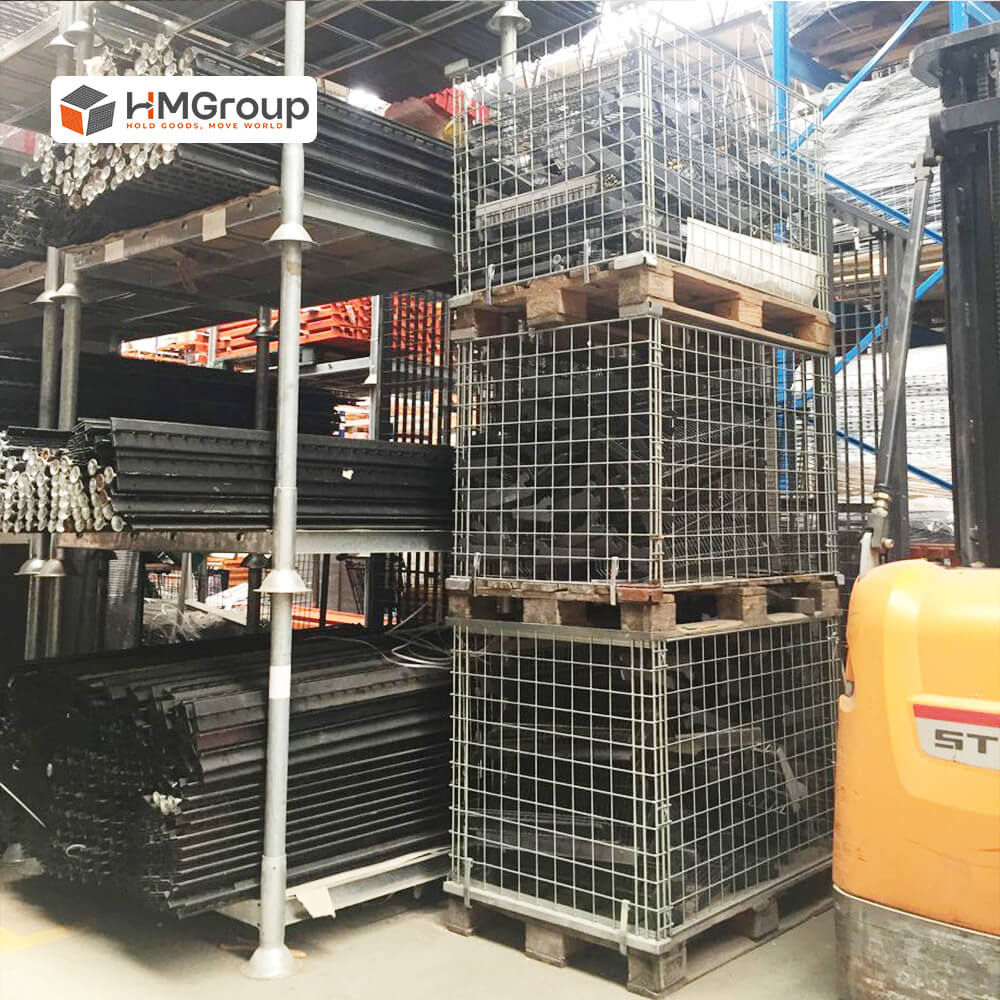
Stackability is a stated specification — ask which load case it describes.
Container loading quantity: 550 sets per 40-foot high-cube
This is a freight-planning number, not a price. It tells you how efficiently the model packs relative to alternatives: HM-CP001 at 550 sets, HM-HD005 at 350 sets, HM-WEU005 at 228 sets and HM-ST007 at 160 sets per 40-foot high-cube container, as published by the manufacturer. The packing configuration behind each figure is not disclosed, so nested or knock-down packing, palletisation and mixed loads can all change the real quantity. Use the number to compare models on shipping efficiency, then confirm it at quotation stage.
Material and finish: Q235 steel with three finish routes
Mild steel Q235 with zinc plating, hot-dip galvanizing or powder coating is a common commercial combination, and the three finishes are not interchangeable. Zinc plating and hot-dip galvanizing are sacrificial metal coatings; powder coating is a barrier film. No coating thickness, salt-spray result or corrosion-life data was published for this model in the material reviewed, so the finish decision should rest on the specification the supplier can commit to in writing, matched to your environment. Indoor dry storage, humid or washdown areas, and outdoor yard storage are three different requirements, and only one finish conversation will fit all three.
How It Differs from Other Wire Containers
The clearest way to see what a pallet container is, is to put it next to a container built for one specific load. HM-WEU005 is a wine storage wire container from the same manufacturer: the same 800 kg stated capacity, the same three finish options, the same mild steel Q235, but a different shape, a different aperture and a different purpose. It is listed as holding 400 Bordeaux bottles, with a 1,200 × 920 × 1,018 mm exterior, 5–12 mm wire, a 51 × 118 mm grid and 4+1 stacking.
Taken together, the two models show where design effort actually sits in this category. The wine container’s value is internal geometry matched to bottle handling. The pallet container’s value is a footprint and stacking behaviour that fit general warehouse and transport systems. Choosing between them is not a question of which is stronger — it is a question of whether your load has a shape that needs dedicated geometry.
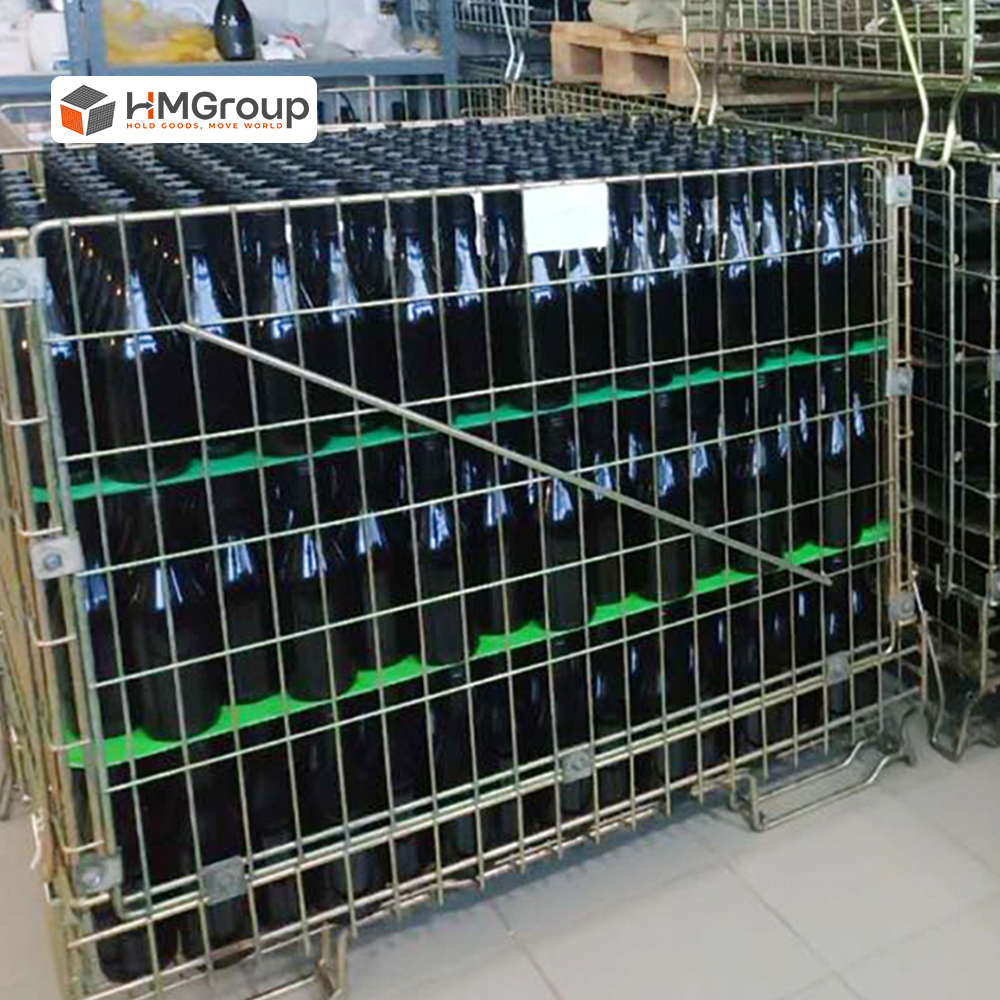
HM-WEU005: a purpose-built wine container, not a general-purpose pallet container.
| Model | Type as listed | Exterior dims (mm) | Wire gauge | Grid (mm) | Stated capacity | Stackability | Sets per 40′HQ |
|---|---|---|---|---|---|---|---|
| HM-CP001 | Wire mesh pallet container | 1,200 × 800 × 1,000 | 5–10 mm | 60 × 103 | 800 kg | 4 high | 550 |
| HM-WEU005 | Wine storage wire container | 1,200 × 920 × 1,018 | 5–12 mm | 51 × 118 | 800 kg (400 Bordeaux bottles) | 4+1 high | 228 |
| HM-HD005 | Collapsible wire container | 1,230 × 1,040 × 900 | 6.2 mm | 50 × 100 | 1,000 kg | 4 high | 350 |
| HM-ST007 | Wire bulk container | 1,230 × 835 × 970 | 4 mm | 50 × 50 | 1,000 kg | 4 high | 160 |
All figures are manufacturer-published model specifications. Load-rating test conditions are not published, so the capacity column is a stated figure rather than a comparable test result. The four rows are different product types, not four versions of one product; all four list mild steel Q235 and zinc, hot-dip galvanized or powder-coated finishes.
Step by Step: How to Evaluate a Pallet Container Before You Quote
The sequence below turns the specification lines into a decision path. It works for HM-CP001 and for any comparable model from another supplier.
- Write down the load, not the product. Unit weight, how the goods are packed, and whether the load is uniform or point-loaded. An 800 kg rating covers very different realities depending on how that weight sits on the base.
- Ask for the rating basis. Static or dynamic, safety factor, load case, and whether the figure applies to a single unit or to a four-high stack.
- Check the footprint against your system. A 1,200 × 800 mm load against your pallet positions, rack beams, aisle widths and truck decks. Mismatches here are expensive later.
- Match the aperture to the smallest item. A 60 × 103 mm grid suits cartons and larger goods; small components need a finer grid or an internal liner.
- Match the finish to the environment and get it in writing. Finish type, coating thickness if specified, and any test data the supplier can share. Published data for this model does not include coating performance.
- Confirm the handling interface. Whether the base is forklift-only or also accessible to a pallet truck, and whether a wheeled configuration is available if the container will move inside the building rather than between buildings.
- Check the shipping figure and the packing method behind it. Sets per 40-foot high-cube container is a planning input; ask how the units are packed to reach it.
- Verify the quality system, then sample. HM Group holds ISO 9001:2015 certificate No. CN24/00004786 issued by SGS, valid through July 2027. That certificate covers the quality management system rather than an individual product rating, so pair it with a drawing and, for a first order, a physical sample showing the mesh, welding and finish.
Typical Applications — and Where Open Mesh Works Against You
HM Group lists HM-CP001 for agriculture, fulfillment and warehouse, e-commerce, hypermarket, and food and beverage use. That list is a fair map of where the format earns its place: goods that arrive in cartons, bags, trays or crates; sites that need to see stock without opening it; and operations that move the same container between storage, picking and dispatch.
- Warehouse and fulfillment. Vertical storage with visible contents, so stock can be counted from the aisle and picked without unloading a whole unit.
- Agriculture. Open mesh allows air movement around produce, which closed bins restrict.
- Hypermarket and food and beverage. Fast identification and shelf replenishment, where the container itself often becomes the display or the transfer unit.
- E-commerce and general manufacturing. Mixed, fast-moving stock where handling speed matters more than protection from dust.
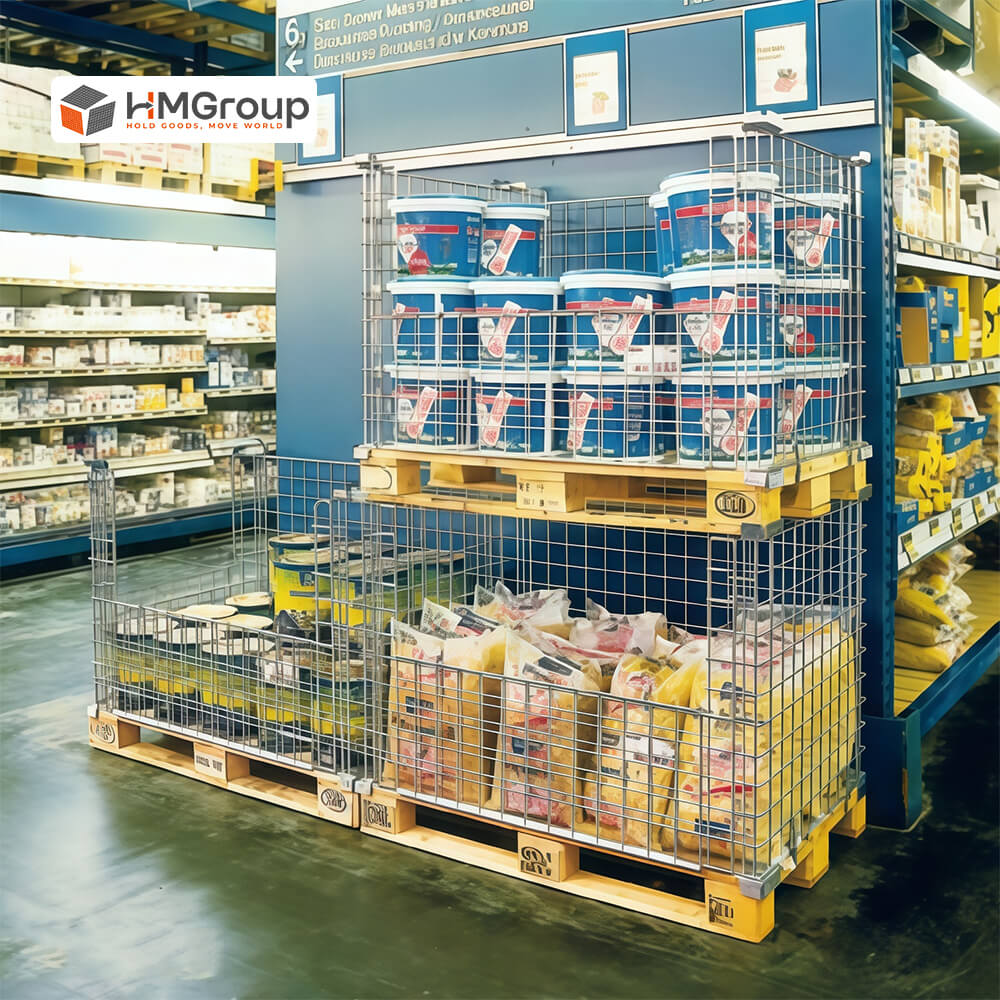
Retail and hypermarket use: the container doubles as a visible transfer unit.
Open mesh also has limits that are worth naming before you buy:
- Small loose items fall through a 60 × 103 mm aperture.
- Dust, rain and humidity reach the load directly; open mesh delivers ventilation, not protection.
- Point loads and sharp edges concentrate force on individual wires instead of spreading it across a panel.
- Where solid walls or a clean liner are required, a different model is the honest answer. HM Group’s HM-HD028 is listed as a wire container with PP sheet: 1,200 × 1,000 × 1,140 mm exterior, 5 mm wire, 50 × 100 mm grid and a 500 kg stated capacity.
Mobility deserves the same care. Wheeled wire containers exist as a category, and other manufacturers’ published product pages list wheels, dividers and handles as options, but casters are not part of HM-CP001’s published specification. If the container will be moved by hand rather than by forklift, ask about a wheeled configuration instead of assuming one is included.
Frequently Asked Questions
What documentation should I ask for to verify a wire mesh pallet container’s load rating?
Ask for the rating in writing together with its basis: whether the figure is static or dynamic, the safety factor, and the load case — uniform load, stacked, or in racking. HM Group’s published data for HM-CP001 states an 800 kg loading capacity without publishing the test method, and the third-party evidence reviewed for the category did not include independent load, fatigue or stacking test data. Treat the number as a company-reported specification until a drawing, test report or agreed acceptance test confirms it. HM Group’s ISO 9001:2015 certificate No. CN24/00004786, issued by SGS and valid through July 2027, covers the quality management system rather than the capacity of an individual container.
What do the 5–10 mm wire gauge and the 60 × 103 mm grid actually control?
Wire gauge is the diameter of the wire and grid size is the aperture between wires — two separate specification lines. On HM-CP001 the stated range is 5–10 mm wire with a 60 × 103 mm grid. Gauge affects stiffness and how much the mesh deflects under impact; the grid sets what can fall through and how much of the load you can see. A 60 × 103 mm aperture is wide enough that small components, loose fixings and narrow bottles can pass through, so it suits cartons, bagged goods, produce and larger parts rather than small loose items. Neither number on its own tells you the load capacity, which is a separately stated rating.
Can HM-CP001 be stacked four high when it is loaded?
The manufacturer lists a stackability of four high for HM-CP001 alongside an 800 kg loading capacity. The specification does not state whether four high applies to loaded units stacked on the floor, loaded units in racking, or empty units in storage, and it does not state the load carried at each level. Before planning a four-high layout, confirm with the supplier the load in the bottom unit, whether a pallet or rack beam supports each level, and whether the stack is a long-term storage arrangement or a short transport configuration.
How does HM-CP001 differ from the wine-bottle container HM-WEU005?
Both are welded wire containers with an 800 kg stated capacity, but they are built for different loads. HM-CP001 is the general-purpose pallet container: 1,200 × 800 × 1,000 mm, 5–10 mm wire, 60 × 103 mm grid, four-high stacking and 550 sets per 40-foot high-cube container. HM-WEU005 is a wine-industry container: 1,200 × 920 × 1,018 mm, 5–12 mm wire, a 51 × 118 mm grid, a listed capacity of 400 Bordeaux bottles, 4+1 stacking and 228 sets per 40-foot high-cube container. The wine model’s dimensions and aperture are matched to bottle handling, so its internal geometry — not its load rating — is the reason to select it.
What does 550 sets per 40-foot high-cube container actually tell me?
It is a manufacturer-reported loading quantity for HM-CP001, useful for freight planning and for comparing models on shipping efficiency: HM-WEU005 is listed at 228 sets, HM-HD005 at 350 sets and HM-ST007 at 160 sets per 40-foot high-cube container. It is not a general freight benchmark. The packing configuration behind each figure is not published, so nested or knock-down packing, palletisation and mixed loads can all change the real quantity. Use it as a planning input to confirm at quotation, never as a landed cost per unit.
How do I request a sample or a quotation for a wire mesh pallet container?
Start with the load case rather than the model code: what will go into the container, the weight per unit, the stack height you need and the handling equipment on site. With those four inputs a supplier can confirm whether a standard model fits or whether grid, dimensions or finish need to change. HM Group publishes its wire container range at hmlwires.com and offers a downloadable catalogue; a sample request, drawing request or quotation enquiry can be sent to MARY KONG at mary@net-railing.com or +86 150 4058 7228.
The Short Version for a First Purchase
A wire mesh pallet container is a simple product that is easy to over-complicate at the specification stage. Read the lines in order — footprint, gauge and aperture, capacity basis, stacking case, finish — and the category stops being confusing. HM-CP001 works well as a reference point because it states all five: a 1,200 × 800 × 1,000 mm exterior, 5–10 mm wire, a 60 × 103 mm grid, an 800 kg capacity with four-high stacking, and three finish options on Q235 mild steel.
The open questions are the ones to take to a supplier: whether the capacity is static or dynamic, what four-high means for a loaded stack, how the finish will perform in your environment, and whether the aperture suits your smallest item. Those answers, not the model name, decide whether the container fits your operation.
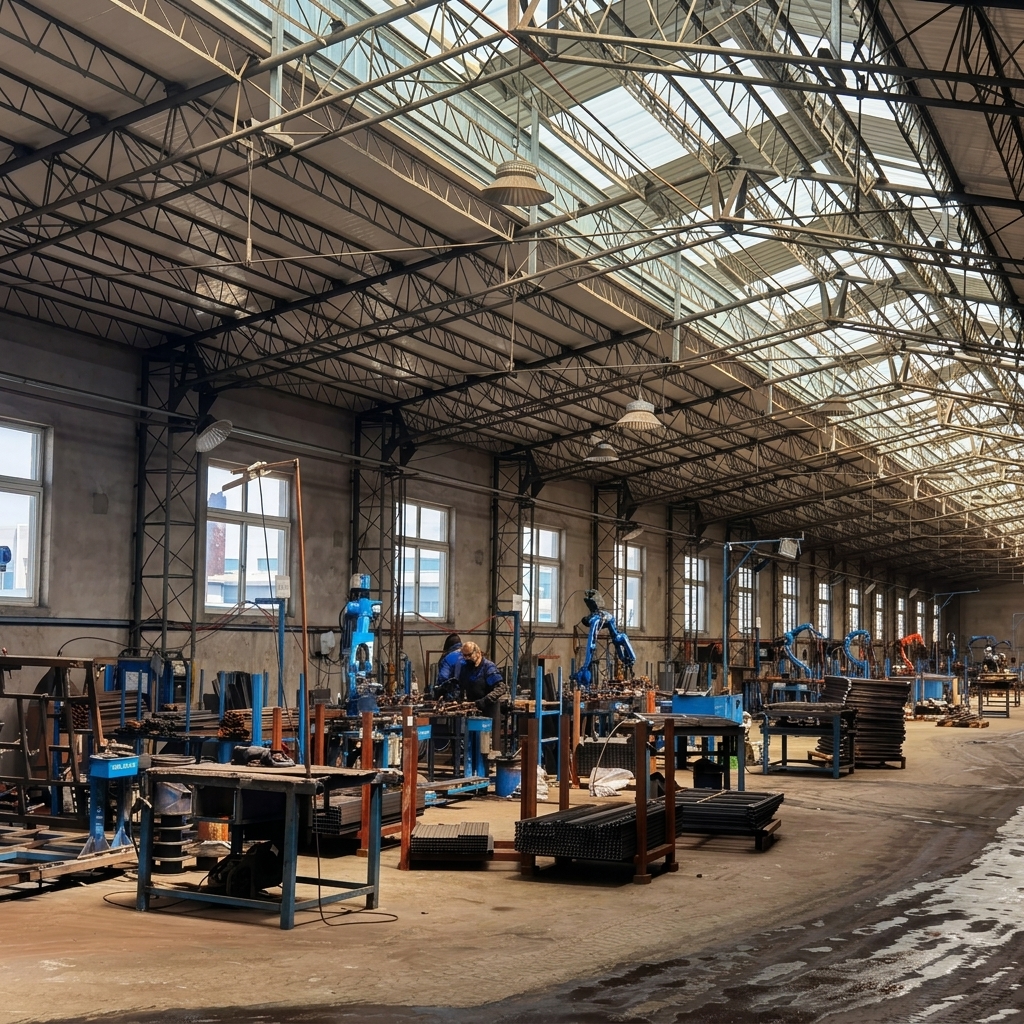
Wire mesh production at an HM Group manufacturing base.
HM Group supplies wire mesh pallet containers, PET preform containers, wine-bottle wire containers and related material handling equipment, with manufacturing bases in Xiamen, Nanjing and Qingdao. Product range and specifications are published at HM Group.
The current catalogue is available for download: HM Group product brochure (PDF).
For HM-CP001 drawings, finish options, samples or a quotation, contact MARY KONG — mary@net-railing.com, +86 150 4058 7228.
Have Questions or Need More Details?
Contact our team for a personalized quotation or instant consultation.
Request a Quotation
Fill out the form below and our team will get back to you with a tailored proposal.
WhatsApp Direct Chat
Prefer to chat in real-time? Message us on WhatsApp for instant assistance & quick answers.
- Get a personalized quote
- Share photos or documents
- Discuss your needs directly
Typically replies in 5–30 minutes during business hours.