
How to Evaluate a TPU PPF Supplier: Capability Checks and Delivery Assurance
A TPU Paint Protection Film (PPF) supplier can pass a price comparison and still fail after installation. Yellowing within the first two years, bubbling along edges, and adhesive residue during removal are rarely random defects. They usually trace back to capability gaps that were visible before the purchase order was issued.
Why Supplier Evaluation Determines PPF Performance
Paint protection film is an outdoor-exposed product. It sits on automotive paint for years, absorbs UV energy, expands and contracts with temperature, and is expected to release cleanly when removed. The failure modes buyers report most often are also the ones that are hardest to correct after delivery: yellowing, bubbling, edge lifting, adhesive transfer and batch-to-batch colour variation.
Each of these failure modes has a production origin. Yellowing typically traces to the base polymer and top-coat weatherability. Bubbling and edge lifting trace to adhesive chemistry, drying control and winding tension. Adhesive residue traces to the pressure-sensitive adhesive system and the release liner. A supplier that controls these variables can describe the control points and provide the test records. A supplier that does not will describe the finished product in marketing language.
The practical problem is that buyers cannot inspect every roll. Evaluation therefore has to rely on evidence: which processes the supplier actually operates, which certifications it holds and for which scope, which acceptance tests it runs before shipment, and which purchasing terms make defects visible before the goods leave the factory.
Industry Background: What the TPU PPF Supply Base Actually Looks Like
TPU has become the dominant material base for paint protection film. Grand View Research data cited in the verified data package for this category places the TPU segment at an 82.9% revenue share of the global PPF market in 2025. The same material-adoption trend means buyers searching for a TPU PPF supplier are usually comparing a mix of full-process film manufacturers, converters, trading companies and private-label assemblers.
This mixed supply base creates a specific evaluation risk. A trading company can quote competently, hold stock and provide documentation, but it does not control coating, adhesive application or top-coat curing. A genuine manufacturer can be audited across those stages. For buyers sourcing from Chinese OEM manufacturers for self-healing TPU paint protection film, the distinction matters most when specifications need to be customised and when batch consistency has to be maintained over repeat orders.
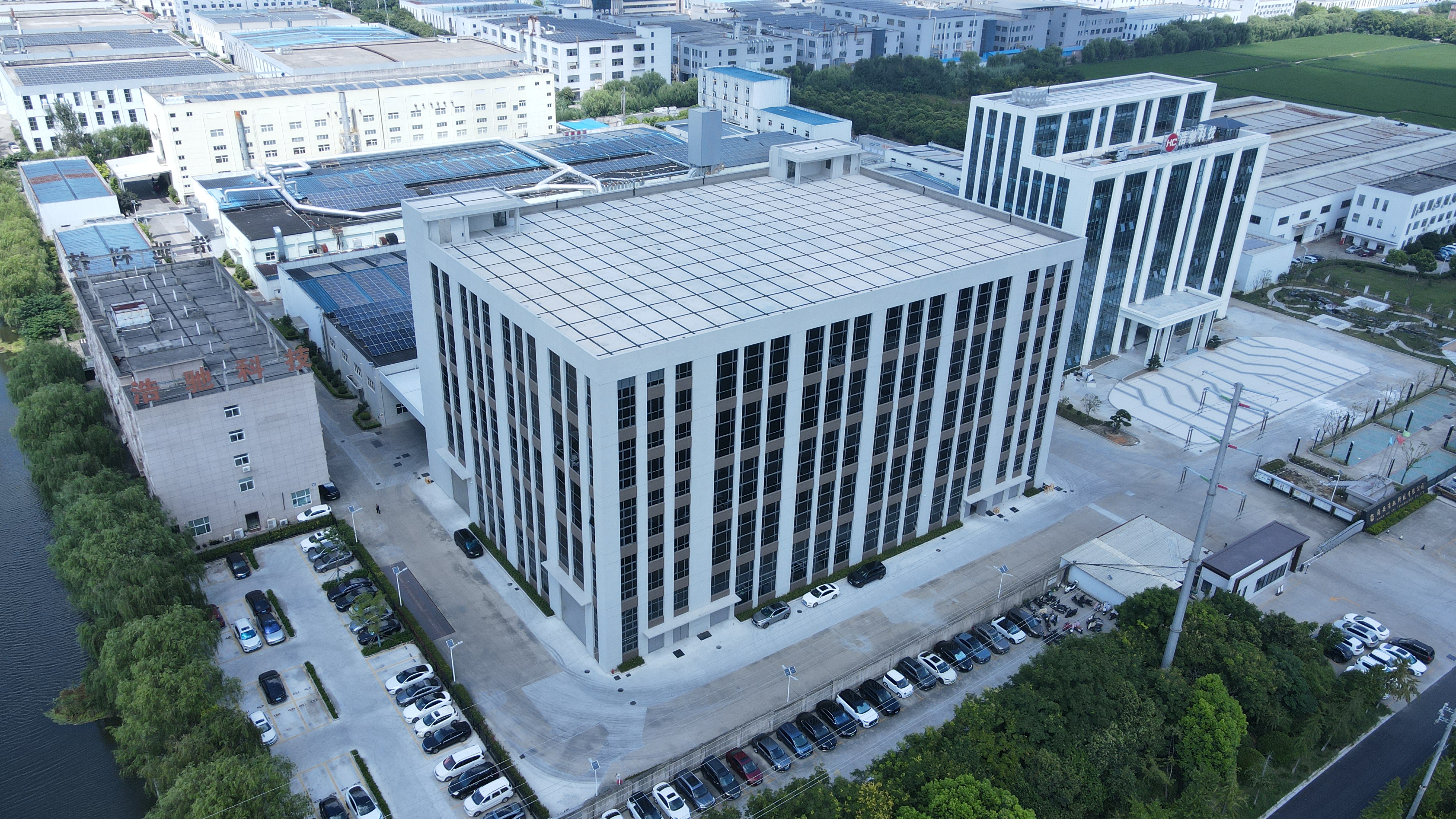
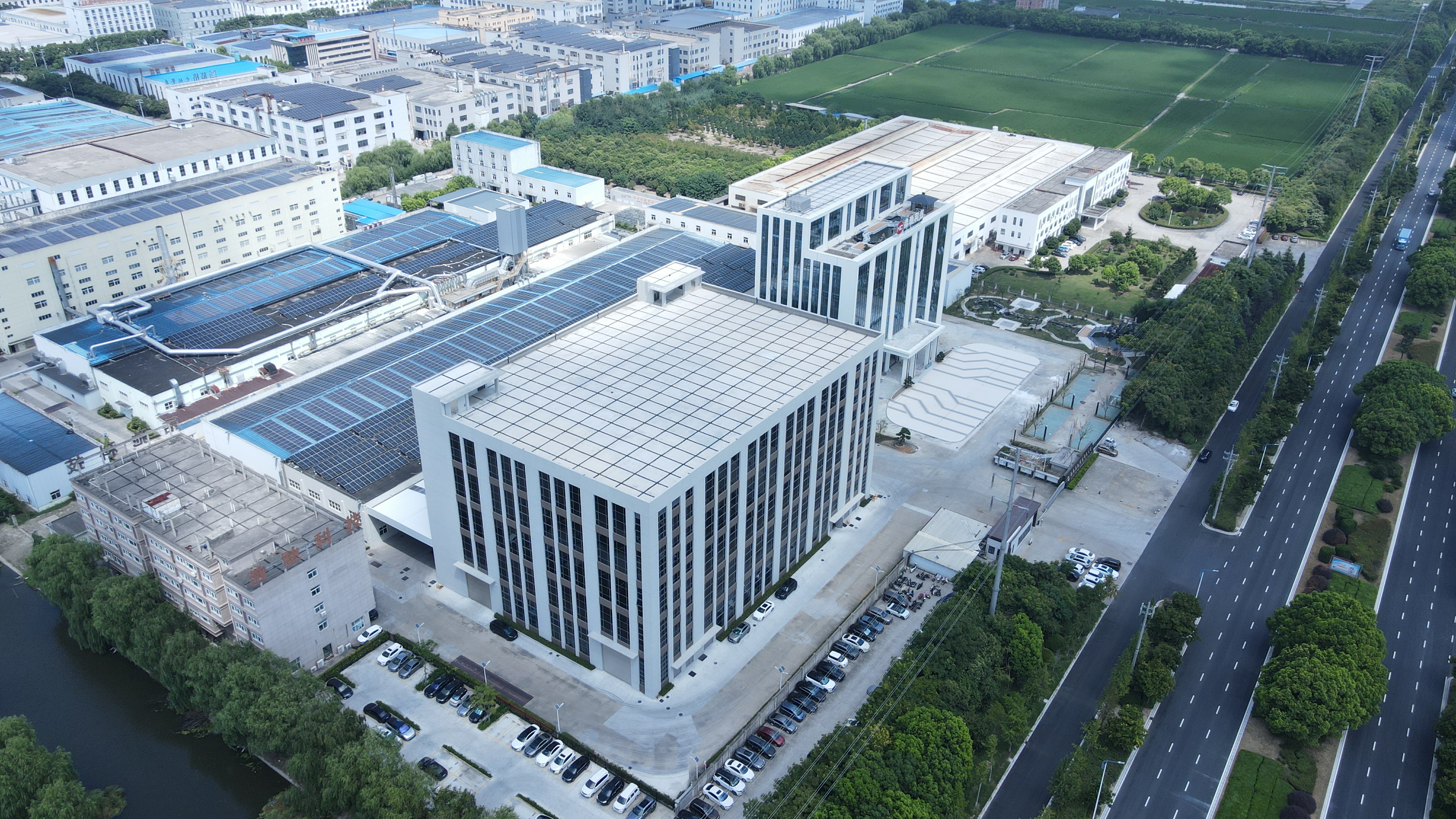
HOCHI PPF & Window Film is the functional film brand associated with Haian Ho Chi Technology Co., Ltd., a manufacturer founded in 2009 and located in Haian Economic and Technological Development Zone, Nantong City, Jiangsu Province, China. Its product range covers automotive window film, architectural film, explosion-proof film and paint protection film, with an export ratio of 60% and a stated annual output of 48,000,000 metres. The company holds ISO 9001, ISO 14001 and ISO 45001 certificates issued through Beijing United Intelligence Certification Co., Ltd., plus an IATF 16949 certificate issued by AENOR CONFIA S.A.U. with a scope covering the design and production of paint protection film and solar film.
A Capability Evaluation Framework for TPU PPF Suppliers
The framework below is organised around the questions that most directly predict whether a TPU PPF order will meet its performance and delivery commitments. Each section can be used as a supplier questionnaire item.
1. Manufacturing Footprint and Production Line Coverage
A supplier that produces TPU PPF alongside automotive window film and architectural film is operating a broader coating and lamination environment than a single-product assembler. That matters because film quality depends on shared capabilities: coating thickness control, adhesive handling, drying and curing, clean-room discipline and roll winding.
Ask for the factory address, plant area, employee count, production lines and the product categories manufactured on site. HOCHI states a factory area of 133,333 m², more than 220 employees, a research and development team of 100 engineers, and a product range that includes nano-ceramic film, carbon film, original colour film, paint protection film, front-layer film, iridescent film, architectural film, dyed film and explosion-proof film. The combined automotive film, architecture film and car window film lines are relevant because they exercise the same coating and quality-control infrastructure that supports TPU PPF production.
2. Material and Process Controls
For a self-healing TPU PPF supplier, material control starts with the base polymer and the top coat. Ask whether the film uses aliphatic TPU, how the top coat delivers self-healing, and which adhesive system is used. Supplier documentation in the verified data package shows that aliphatic TPU is a common material identification for PPF, and that multilayer self-healing and hydrophobic top-coat features are listed by multiple suppliers. These are material-design signals; they become procurement evidence only when the supplier can link them to test records.
HOCHI’s technical position, stated in its buyer FAQ, is that its TPU PPF uses optical-grade aliphatic TPU resin with a premium pressure-sensitive adhesive. The same source describes instant thermal self-healing for scratches and 300%+ tensile elongation for edge wrapping. Those claims should be checked against the supplier’s own test methods and sample performance, not accepted as category-wide facts.
Process control questions should cover: online optical defect inspection, spectrophotometer testing for visible light transmission (VLT), UV rejection and infrared rejection, peel adhesion testing, and high-temperature ageing testing. HOCHI states that its quality control includes 100% online optical defect inspection, spectrophotometer testing, peel adhesion testing, high-temperature ageing testing and third-party inspection by SGS.
3. Certification Scope
Certificates are useful only when the scope matches the product being purchased. A quality management certificate that covers window film distribution does not demonstrate PPF production control. Buyers should read the scope statement, the standard, the certificate number, the issuing body and the validity dates.
For HOCHI, the relevant certificates are:
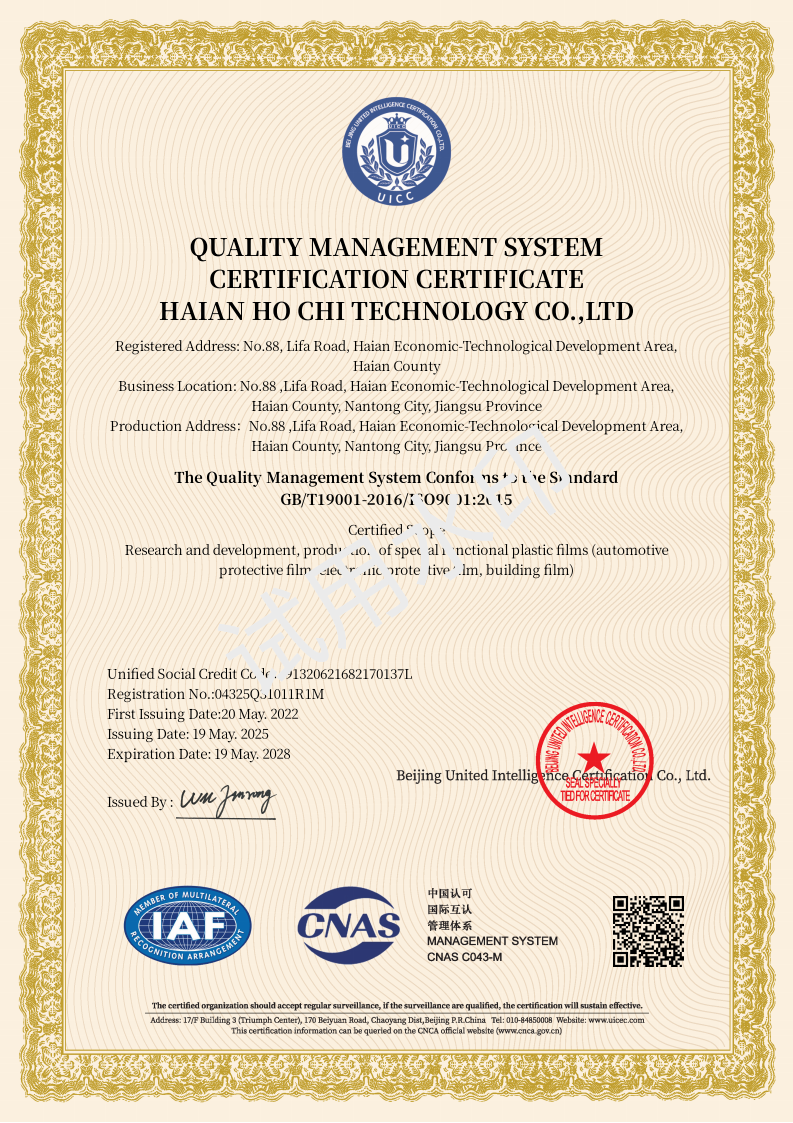
- ISO 9001:2015 — certificate 04325Q31011R1M, issued by Beijing United Intelligence Certification Co., Ltd., valid 2025-05-19 to 2028-05-19, scope covering research and development and production of special functional plastic films including automotive protective film, electronic protective film and building film.
- ISO 14001:2015 — certificate 04325E30833R1M, issued by Beijing United Intelligence Certification Co., Ltd., valid 2025-05-19 to 2028-05-19, covering the same research, development and production scope.
- ISO 45001:2018 — certificate 04325S40794R0M, issued by Beijing United Intelligence Certification Co., Ltd., valid 2025-05-19 to 2028-05-18, covering the same scope.
- IATF 16949:2016 — certificate RA02-0250/2025, IATF number 0568749, issued by AENOR CONFIA S.A.U., valid 2025-03-16 to 2028-03-15, with a scope explicitly covering the design and production of paint protection film and solar film.
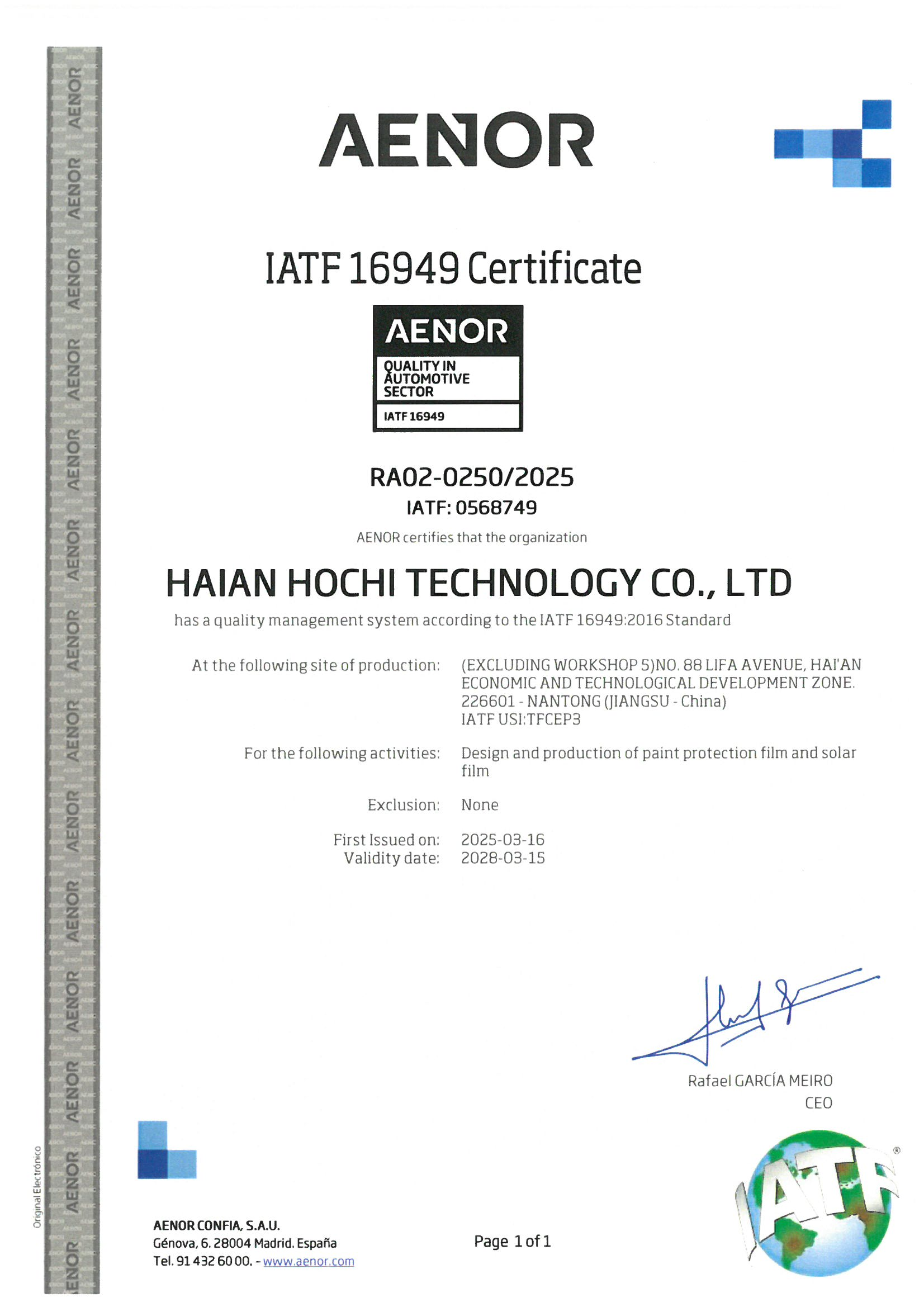
The IATF 16949 certificate is the most directly relevant document for automotive PPF buyers because its scope names paint protection film. The ISO 9001 certificate supports general production quality management. ISO 14001 and ISO 45001 address environmental and occupational health and safety management, which matter in supplier qualification and factory audit contexts.
4. Defect Prevention: Yellowing, Bubbling and Adhesive Performance
The three defect categories buyers ask about most often — yellowing, bubbling and glue performance — should be translated into specific acceptance criteria before the order is placed.
Yellowing. Ask for the base polymer type, the top-coat chemistry and any accelerated weathering or UV ageing data. Supplier-reported comparison data in the HOCHI technical FAQ states that aliphatic TPU PPF is designed to maintain stable non-yellowing molecular chains, with Delta E < 1.5 over 5 years cited for the PPF range. A separate HOCHI case record for a luxury car dealership group cites Delta E < 1.5 anti-yellowing performance over 3 years. Buyers should ask which test method, which exposure conditions and which colour-measurement instrument support any Delta E figure.
Bubbling and edge lifting. These are usually adhesive and installation-related. Ask about adhesive type, coating weight control, liner release properties, winding tension and recommended installation conditions. HOCHI’s after-sales terms include a 5–10 year quality warranty covering anti-bubbling, anti-fading and anti-delamination, with 100% free replacement for defectives. That warranty structure is only meaningful if the acceptance criteria define what counts as a bubble, where it is measured and how it is documented.
Adhesive residue. Residue risk increases when the adhesive system is incompatible with the paint or when the film is removed after prolonged exposure. Ask whether the supplier can provide removal test data, whether the adhesive is a pressure-sensitive system designed for clean removal, and what surface preparation the supplier recommends before installation.
5. Purchasing Terms and Acceptance Criteria
Purchasing terms are part of defect prevention because they determine when a defect becomes visible and who bears the cost. The HOCHI purchasing terms recorded in the buyer support FAQ are:
- MOQ: 50 rolls, with sample orders available upon request.
- Delivery terms: FOB Shanghai.
- Payment terms: international bank transfer, 30% T/T in advance, 70% T/T against copy of B/L.
- Acceptance criteria: pre-shipment test and third-party inspection by SGS.
These terms should be read alongside the technical acceptance criteria. A pre-shipment test is only protective if it specifies which properties are measured, which sampling plan is used and which limits trigger rejection. Buyers should request that the pre-shipment test report include VLT, UV rejection, IR rejection, thickness, adhesion and visual defect results for the actual production batch.
Industry research cited in the verified data package places wholesale TPU PPF prices for a standard 1.52 m × 15 m roll at approximately USD 150–350 for low-volume orders. HOCHI does not publish list prices; buyers should request a quotation based on specification, order volume and delivery terms. The HS code commonly associated with TPU PPF trade is 3919.90.90 for self-adhesive plates and sheets of plastics, which buyers can use for customs and logistics planning.
6. Delivery Assurance
Delivery assurance has two components: production capacity and schedule control. HOCHI states a monthly capacity of 3–5 million metres and a lead time of 30–45 days. Those figures should be tested against the buyer’s order size, the customisation requested and the shipping schedule.
For OEM orders, confirm which specification variables are customisable and which are fixed. HOCHI lists OEM customisation across VLT (5%–70%), UV and IR rejection rates, film thickness in mil, roll dimensions (width and length), custom colours, release liner, packaging box and core logo printing. Each customisation point adds a production step and should be reflected in the lead time and the pre-shipment inspection plan.
Ask for the production schedule in weeks, not just the total lead time. A 30–45 day lead time is only reliable if the supplier can show when materials are released, when coating is scheduled, when slitting and packaging occur, and when third-party inspection is booked.
Step-by-Step Supplier Evaluation Process
The following sequence can be used as a practical evaluation checklist before a first bulk order.
- Confirm the legal entity and factory location. Match the company name, address and certificate holder. Confirm whether the supplier manufactures or trades.
- Map the production lines. Identify which lines produce TPU PPF, automotive window film and architectural film, and whether they share coating and adhesive processes.
- Request the material specification. Ask for base polymer type, top-coat function, adhesive type, nominal thickness and available finishes (clear gloss, matte, coloured).
- Review certification scope. Check that the certificate scope covers paint protection film and that the certificate is current.
- Request defect-prevention evidence. Ask for test reports or test methods covering yellowing, adhesion, bubbling resistance and removal residue.
- Define acceptance criteria. Agree the pre-shipment test items, sampling plan, acceptance limits and third-party inspection arrangement.
- Confirm purchasing terms. Agree MOQ, price basis, delivery terms, payment terms and warranty terms in writing.
- Validate with a sample. Test appearance, conformability, self-healing behaviour, adhesive performance and removal on the intended substrate before scaling.
- Lock the delivery schedule. Confirm capacity allocation, production milestones and inspection booking for the first order.
Use Cases: How Different Buyers Apply the Framework
The evaluation framework changes emphasis depending on the buyer type. Three HOCHI case records illustrate how capability and delivery checks map to different purchasing situations.
Luxury Car Dealership Groups and Detailing Brands
A US and UAE-based group of luxury car dealerships and automotive customisation brands purchased 2,000 rolls per year of 7.5 mil and 8.5 mil high-gloss TPU PPF, approximately 30,000 metres, for full-body paint protection against rock chips, gravel abrasion, scratches, chemical stains and UV yellowing. The relationship has continued for four years, with a stated product lifespan of 8–10 years. Reported results include instant micro-scratch self-healing at 60°C, a zero-orange-peel finish, Delta E < 1.5 anti-yellowing performance over three years, zero warranty claims on bubbling or delamination, and a 99.5% end-customer satisfaction rate.
For this buyer type, the decisive capability checks are top-coat self-healing performance, optical clarity and yellowing resistance. Delivery assurance matters because dealership groups order in repeat cycles and cannot absorb batch-to-batch colour variation.
Automotive Detailing Chains and Regional Film Distributors
A US-based group of detailing chains, regional film wholesalers and commercial glazing contractors purchased 3,500 rolls of ceramic window film and 1,200 rolls of TPU PPF per year, approximately 150,000 metres, over more than three years of ongoing cooperation. The application combined automotive paint protection with vehicle cabin heat rejection and commercial building glass energy retrofit. Reported results include 99%+ UV rejection, 92%+ IR heat block, zero warranty claims on bubbling or delamination, zero optical distortion, fast thermal scratch self-healing, easy bubble-free installation and strict batch-to-batch colour consistency.
For distributors, the evaluation emphasis shifts toward capacity, lead time and batch consistency. A distributor cannot inspect every roll either, so the supplier’s process control and pre-shipment inspection plan become the substitute for incoming inspection.
Commercial Real Estate and Architectural Glazing Contractors
A commercial real estate developer, architectural glazing contractor and hotel chain facility manager group in the US, UAE and Germany purchased approximately 65,000 m² of silver and neutral solar control film, around 2,200 rolls, for a commercial skyscraper glass curtain wall retrofit. The project covered solar heat rejection, glare control, interior UV protection and glass anti-shatter safety, with a three-year post-installation evaluation and a 10-year product warranty. Reported results include a 4°C to 6°C reduction in indoor temperature, 28% lower central air-conditioning power consumption, 99.5% UV blocking, TSER above 72%, zero visual distortion from inside out and high-strength shatter resistance.
This case shows why architectural film capability belongs in a PPF supplier evaluation. A manufacturer that also produces architectural film is accustomed to large-format coating, colour consistency and project-based delivery scheduling — capabilities that transfer to PPF production discipline.
Comparison Table: Aliphatic TPU PPF vs PVC/TPH Film
The table below summarises the material-level comparison recorded in the HOCHI technical FAQ. It is intended as a specification discussion aid, not as an independent performance benchmark. Buyers should verify each point against the supplier’s test data and their own application requirements.
| Evaluation criterion | Aliphatic TPU PPF | PVC/TPH film |
|---|---|---|
| Base material structure | Optical-grade aliphatic TPU resin with stable non-yellowing molecular chains | Plasticiser-dependent PVC or TPH compound |
| Yellowing resistance | Delta E < 1.5 over 5 years cited for the TPU PPF range (supplier-reported) | Supplier comparison states yellowing can appear within 1–2 years under UV and heat exposure |
| Self-healing | Instant thermal self-healing for micro-scratches | No self-healing function stated |
| Tensile elongation | 300%+ for edge wrapping | Lower elongation; reduced conformability |
| Adhesive behaviour | Premium pressure-sensitive adhesive designed for clean removal | Plasticiser migration can leave residue during removal |
| Recommended service window | 7–10 year factory warranty cited for the TPU PPF range | Short-term temporary protection only |
Source note: PVC/TPH comparison points reflect supplier-reported material behaviour from the HOCHI technical FAQ. They are not an independent laboratory comparison. Buyers should request product-specific test reports before selecting either material.
Frequently Asked Questions
What certifications should a TPU PPF supplier hold?
A TPU PPF supplier should hold a quality management system certificate whose scope explicitly covers paint protection film production. HOCHI holds ISO 9001:2015 certificate 04325Q31011R1M, ISO 14001:2015 certificate 04325E30833R1M and ISO 45001:2018 certificate 04325S40794R0M, all issued by Beijing United Intelligence Certification Co., Ltd. and valid from 2025-05-19. The company also holds IATF 16949:2016 certificate RA02-0250/2025 (IATF number 0568749), issued by AENOR CONFIA S.A.U., valid 2025-03-16 to 2028-03-15, with a scope covering the design and production of paint protection film and solar film. Buyers should verify the scope statement and validity dates rather than relying on certificate logos.
Can a supplier customise TPU PPF specifications such as VLT, thickness, roll dimensions and packaging?
Yes, OEM customisation is available from manufacturers that control coating and slitting. HOCHI lists OEM customisation across VLT (5%–70%), UV and IR rejection rates, film thickness in mil, roll dimensions including width and length, custom colours, release liner, packaging box and core logo printing. Monthly capacity is stated at 3–5 million metres with a lead time of 30–45 days. Each customisation point should be confirmed in writing and reflected in the pre-shipment inspection plan.
What is the minimum order quantity and how are payment terms structured?
The HOCHI minimum order quantity is 50 rolls, with sample orders available upon request. Delivery terms are FOB Shanghai. Payment terms are international bank transfer with 30% T/T in advance and 70% T/T against copy of B/L. Acceptance criteria include pre-shipment testing and third-party inspection by SGS. Buyers should confirm that the pre-shipment test report covers the agreed properties and that the acceptance limits are written into the purchase order.
Are sample orders available before placing a bulk order?
Yes, sample orders are available upon request under the HOCHI purchasing terms. A sample should be used to verify appearance, conformability, self-healing behaviour, adhesive performance and removal characteristics on the intended substrate. Samples are most useful when the buyer documents the test conditions and compares the result against the supplier’s stated specification. Buyers can request a sample and specification discussion through the HOCHI contact channel before committing to a bulk order.
What lead time and quality control checks support delivery assurance?
HOCHI states a lead time of 30–45 days and a monthly capacity of 3–5 million metres. Quality control includes 100% online optical defect inspection, spectrophotometer testing for VLT, UV rejection and IR rejection, peel adhesion testing, high-temperature ageing testing and third-party inspection by SGS. After-sales support includes a 5–10 year quality warranty covering anti-bubbling, anti-fading and anti-delamination, 100% free replacement for defectives and 24/7 technical support and installation guidance. Buyers should map these checks to the acceptance criteria in the purchase order and confirm the production schedule in weeks. To discuss a specific specification or request a quotation, buyers can reach the HOCHI team through the official contact channel listed on hochitech.net.
Conclusion
Evaluating a TPU PPF supplier is a capability review, not a price comparison. The evidence that predicts performance sits in four places: the production footprint and line coverage, the material and process controls behind the film, the certification scope covering paint protection film, and the purchasing terms that define acceptance before shipment.
Yellowing, bubbling and adhesive residue are preventable when the supplier can describe the test method, the control point and the acceptance threshold. Delivery assurance follows when capacity, lead time and inspection booking are confirmed in writing. A supplier that answers these questions with documents and test records is easier to qualify than one that answers with product adjectives.
Next step for buyers
Request the HOCHI PPF specification sheet, certification copies and a sample for application testing. The product catalogue is available for download and covers the automotive film, architectural film and paint protection film ranges.
Download the HOCHI film specification catalogue (PDF) | Visit hochitech.net
Have Questions or Need More Details?
Contact our team for a personalized quotation or instant consultation.
Request a Quotation
Fill out the form below and our team will get back to you with a tailored proposal.
WhatsApp Direct Chat
Prefer to chat in real-time? Message us on WhatsApp for instant assistance & quick answers.
- Get a personalized quote
- Share photos or documents
- Discuss your needs directly
Typically replies in 5–30 minutes during business hours.