
SILVER/GREEN 10 vs SILVER/GREY 05: Which Film Fits Your Glass?
Two silver-tone architectural films from the same HOCHI PPF & Window Film range — SILVER/GREEN 10 and SILVER/GREY 05 — share a 2PLY 1.5 mil optical grade PET construction, 99% UV rejection and a 4-year quality warranty. They differ in two numbers that decide how a glazed facade actually behaves: visible light transmission (8% versus 10%) and infrared cut (90% versus 75%).
This comparison reads both models specification by specification, then converts those figures into practical selection rules for building orientation, glare tolerance and daytime privacy, so a project team can choose between them with evidence rather than with a colour sample.
Why Two Silver-Tone Films Behave Differently in the Same Building
Architectural film selection is an energy-management decision, not a colour decision. Two films can look almost identical on a sample card and still change a room's temperature, brightness and privacy in different ways once they are applied to real glass.
Four metrics drive that difference:
- Visible light transmission (VLT) — the share of visible daylight that passes through the glass and film into the interior.
- Infrared (IR) cut — how much of the infrared band of solar energy the film rejects. Infrared energy is a major contributor to solar heat gain inside a building.
- UV rejection — how much ultraviolet radiation is blocked, which protects interior finishes, furnishings and occupants.
- Total solar energy rejection (TSER) — a combined figure across the whole solar spectrum, used when a project needs one thermal number instead of several.
SILVER/GREEN 10 and SILVER/GREY 05 are identical on UV rejection: both block 99%. The decision therefore narrows to VLT and IR cut, plus the privacy behaviour that follows from them.
The practical failure mode is choosing on VLT alone. A specification that asks only for "a dark silver film" can end up on a west-facing curtain wall where the real problem was heat load, or on a ground-floor retail unit where the real problem was daytime visibility from the street.
How Architectural Solar Control Film Is Specified and Checked
Solar control films manage ultraviolet, visible light and infrared energy by absorbing or reflecting selected wavelengths of solar radiation. Because colour alone tells a buyer very little, film performance should be evaluated using verified VLT, UV rejection, IR rejection and TSER test data rather than by looking at the film on a roll or judging it by its tone.
Two published references are commonly used when a project needs an objective check:
- The IWFA Visual Quality Standard requires window film to be inspected from 6 feet (approximately 2 metres) under natural daylight.
- ASTM D882 is the testing method specified for measuring tensile strength, break strength and elongation of safety films under IWFA policies.
The manufacturing environment matters as much as the datasheet. Haian Haochi Technology Co., Ltd., the manufacturer behind HOCHI PPF & Window Film, operates a Class 1000 dust-free coating workshop covering 3,000 square metres. That class of controlled environment is what keeps optical defects out of a 2PLY 1.5 mil architectural film before it reaches a glazing contractor.
Detailed Comparison: SILVER/GREEN 10 Against SILVER/GREY 05
Visible light transmission: 8% versus 10%
SILVER/GREEN 10 has a visible light transmission of 8%. SILVER/GREY 05 has a visible light transmission of 10%. The two-point gap is small, but it points in a consistent direction: the lower-VLT film darkens the interior more and strengthens daytime privacy, while the higher-VLT film keeps slightly more natural daylight in the room.
On a fully glazed office floor, that difference is usually perceptible in the morning and evening when daylight levels are low, and barely perceptible at midday when exterior illuminance is high.
Infrared cut: 90% versus 75% — the largest single difference
SILVER/GREEN 10 rejects 90% of infrared energy. SILVER/GREY 05 rejects 75%. This is the widest performance gap between the two models, and on a heavily sun-loaded facade it normally outranks the VLT difference in importance.
For a project team, the decision rule is straightforward: where the glazing faces a strong, sustained solar load, the 90% IR cut model removes more of the heat that would otherwise be handled by the cooling system. Where the glazing is shaded, north-facing or already protected by exterior shading, the 75% IR cut model remains a workable specification.
UV rejection: 99% on both models
Both films reject 99% of ultraviolet radiation. For projects whose primary concern is fading of interior finishes, artwork, flooring or upholstery, or UV exposure for occupants seated close to glazing, either model satisfies the requirement equally. UV performance is not a differentiator here.
Construction and thickness: 2PLY 1.5 mil on both models
Both films are built on optical grade PET film with a 2PLY structure at 1.5 mil. Because the thickness and ply structure are the same, installation handling, cutting behaviour and shrinkage characteristics are closely comparable between the two. An installer who is competent with one is competent with the other.
Adhesive and colour tone
SILVER/GREEN 10 is specified with a strong adhesive for secure application. Colour tone separates the two visually: a silver/green tone for SILVER/GREEN 10 and a silver/grey tone for SILVER/GREY 05. On a multi-storey facade, tone consistency across elevations affects how uniform the glass reads from street level, which is why tone should be approved on the actual glass build-up rather than on a paper sample.
Privacy behaviour
SILVER/GREY 05 is designed for daytime one-way privacy: during daylight hours the outdoor side reads as reflective while the interior retains outward visibility. This makes it a practical option for street-level retail, ground-floor offices and residential glazing that faces public space. Because the effect depends on the light differential between inside and outside, it is a daytime behaviour, and interior lighting levels after dark will change how the glass reads from outside.
Warranty
Both models carry a 4-year quality warranty.
Side-by-Side Specification Table
| Specification | SILVER/GREEN 10 | SILVER/GREY 05 |
|---|---|---|
| Product category | Architectural film, silver coloured | Architectural film, silver coloured |
| Base material | Optical grade PET film | Optical grade PET film |
| Thickness | 2PLY 1.5 mil | 2PLY 1.5 mil |
| Visible light transmission (VLT) | 8% | 10% |
| Infrared cut | 90% | 75% |
| UV rejection | 99% | 99% |
| Colour tone | Silver / green | Silver / grey |
| Adhesive | Strong adhesive | Standard adhesive system |
| Privacy characteristic | High shading, low daylight intake | Daytime one-way privacy |
| Quality warranty | 4 years | 4 years |
| Typical application | High solar-load elevations, glare-critical interiors | Shaded elevations, street-level and privacy-driven glazing |
Step-by-Step: Matching VLT and IR Cut to Your Building
Choosing between the two models is a sequence, not a single judgement call. Working through the following steps in order prevents the most common specification error, which is fixing the film tone before the heat load and privacy brief have been defined.
- Survey the glazing. Record the glass type, glass build-up and the area of each elevation. Glass condition should also be inspected for cracks, damage or coating, because film compatibility depends on the existing glass structure.
- Rank the orientation. Identify which elevations carry the strongest and longest solar exposure. These elevations set the thermal requirement for the project and should drive the IR cut decision.
- Set a VLT target. Decide how much daylight the interior needs. Spaces that rely on daylight for illumination tolerate less darkening than spaces that are artificially lit through the working day.
- Match IR cut to the heat load. For elevations with sustained direct solar gain, the 90% IR cut model removes more infrared energy. For shaded, north-facing or externally shaded glass, the 75% IR cut model is generally sufficient.
- Define the privacy requirement. If the brief calls for daytime one-way privacy at street level or on lower floors, the 10% VLT model addresses it directly without relying on interior blinds.
- Confirm glass compatibility. A glass compatibility or thermal stress assessment is recommended before installing solar control film on certain laminated, insulated or treated glass, since film can change the thermal behaviour of the glazing assembly.
- Validate with a sample. Apply a sample on the actual glass build-up and inspect under real daylight before committing to the full order.
- Plan installation and curing. Allow sufficient curing time before final evaluation, cleaning or heavy use of the glazing.
Installation quality affects measured performance. Architectural film installation includes glass compatibility verification, surface cleaning, accurate cutting, wet application, professional squeegee work and edge inspection. A film that is correctly specified but contaminated, poorly squeegeed or trimmed short will underperform its datasheet regardless of which model was chosen.
Use Cases: Which Film Suits Which Space
The two models map onto recognisably different project situations.
- West-facing office curtain wall. Peak afternoon solar load with a long exposure window. The 90% infrared cut of SILVER/GREEN 10 addresses the dominant load, and the 8% VLT reduces glare on screens.
- East-facing glazing. Morning solar load is real but shorter. Either model can work; where the brief prioritises daylight, the 10% VLT model retains more usable morning light.
- North-facing and shaded elevations. Thermal load is limited, so the 75% IR cut specification is reasonable and the 10% VLT keeps the interior brighter.
- Street-level retail and showrooms. Daytime one-way privacy on a fully glazed frontage points to SILVER/GREY 05, which keeps the display visible from inside while limiting inward visibility from the pavement during daylight hours.
- Residential living rooms facing public space. The same privacy requirement applies, and the higher VLT keeps the room from feeling closed in.
- Hotel and hospitality glazing. Guest-room comfort depends on both heat and glare. High-load elevations favour the 90% IR cut model; low-rise or shaded wings can be specified with the 75% IR cut model to keep interiors lighter.
- Existing low-E, laminated or insulated glass units. Here the priority shifts to compatibility assessment first, then model selection, because the glazing assembly constrains what the film can safely do.
Decision Table by Project Type
| Project situation | Primary requirement | Recommended model |
|---|---|---|
| Sustained direct solar load, glare-critical interior | Maximum infrared heat rejection | SILVER/GREEN 10 |
| Shaded or north-facing elevation, daylight preferred | Lower thermal load with more visible light | SILVER/GREY 05 |
| Street-level glazing facing a public pavement | Daytime one-way privacy | SILVER/GREY 05 |
| Interior fading and UV exposure concerns | UV protection | Either model (both 99% UV rejection) |
| Multi-storey facade requiring uniform external tone | Tone consistency across elevations | Sample on actual glass, then standardise one model per elevation |
| Laminated, insulated or treated glass | Glass-film compatibility | Compatibility assessment first, then model selection |
Field Performance: Silver-Tone Solar Control Film on a Real Facade
Specification data becomes easier to trust when there is installation history behind it. In a commercial glazing retrofit delivered for commercial real estate developers, architectural glazing contractors and hotel chain facility managers across the US, UAE and Germany, approximately 65,000 square metres of silver and neutral solar control film (around 2,200 rolls) were applied to a commercial skyscraper glass curtain wall.
The scope covered solar heat rejection, glare control, interior UV protection and glass anti-shatter safety. Over a three-year post-installation evaluation, the project recorded an indoor temperature reduction of 4°C to 6°C, a 28% reduction in central air-conditioning power consumption, and 99.5% of harmful UV rays blocked, alongside a reported improvement in tenant comfort. The installation used magnetron sputtering metal technology with total solar energy rejection above 72% and no visual distortion from inside out.
Note on scope: the field figures above come from a silver and neutral solar control film project as a whole. Warranty terms for a specific model are set by that model's own specification, and both SILVER/GREEN 10 and SILVER/GREY 05 carry a 4-year quality warranty.
Manufacturing, Compliance and OEM Capability Behind Both Models
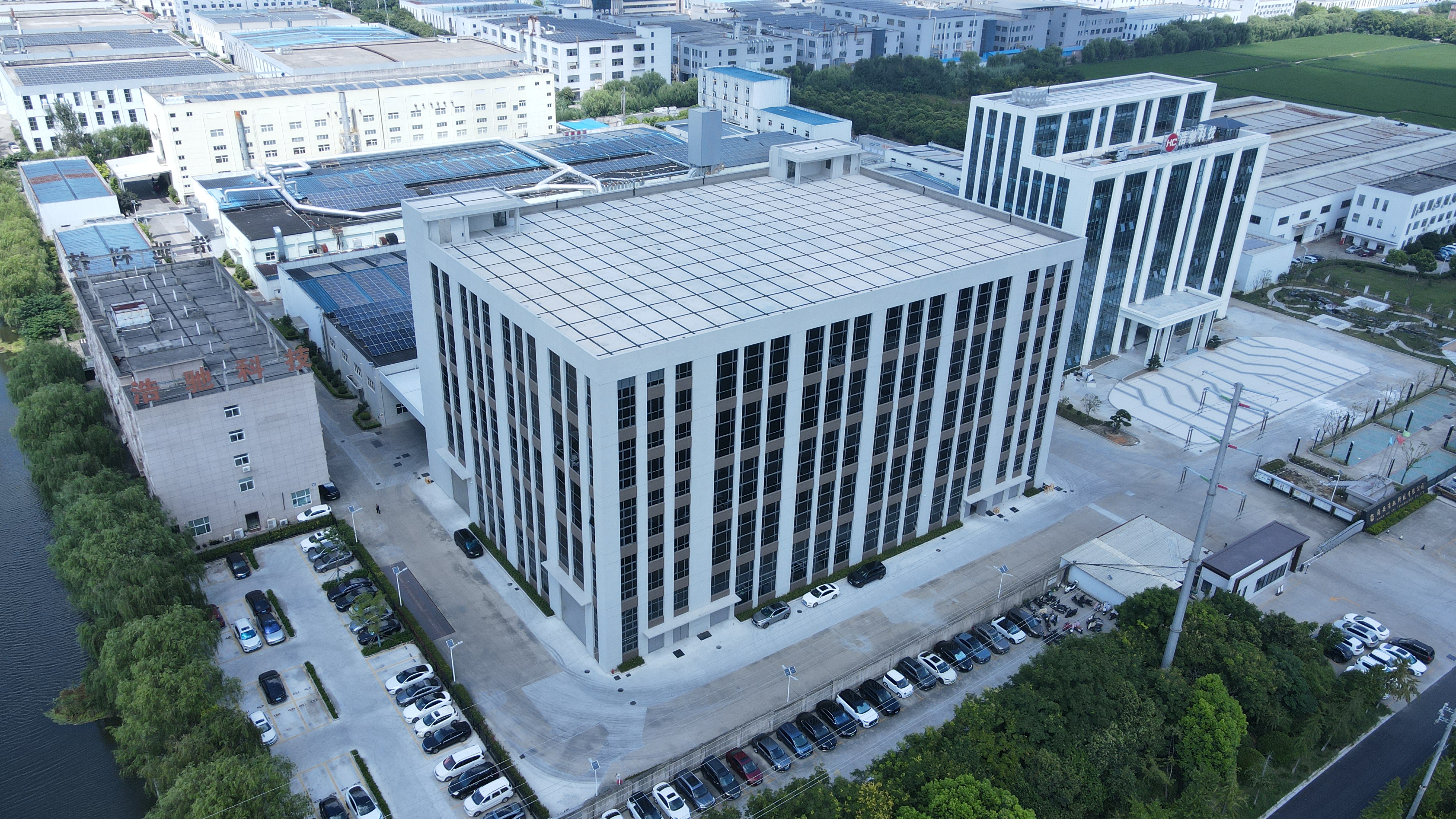
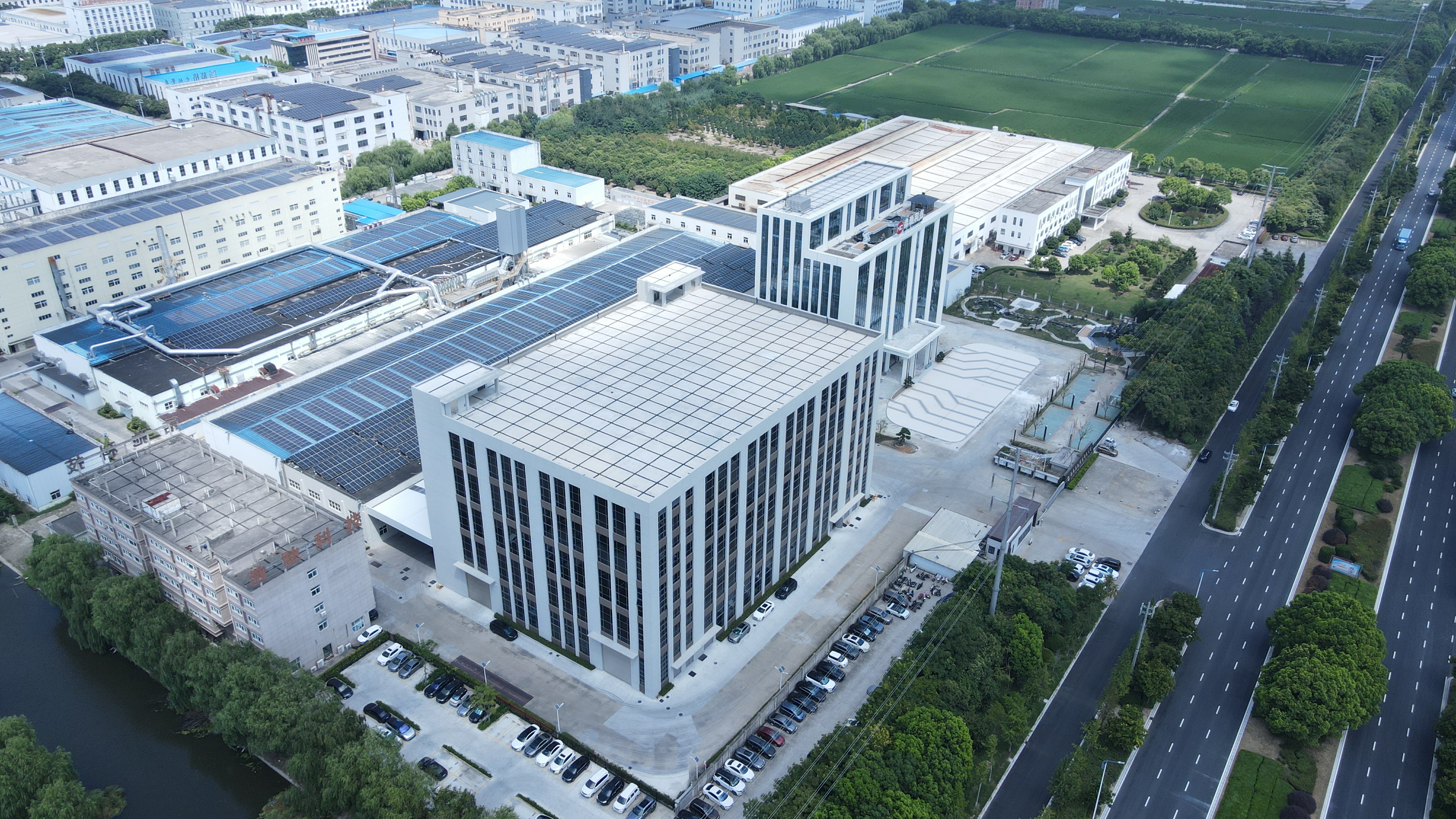
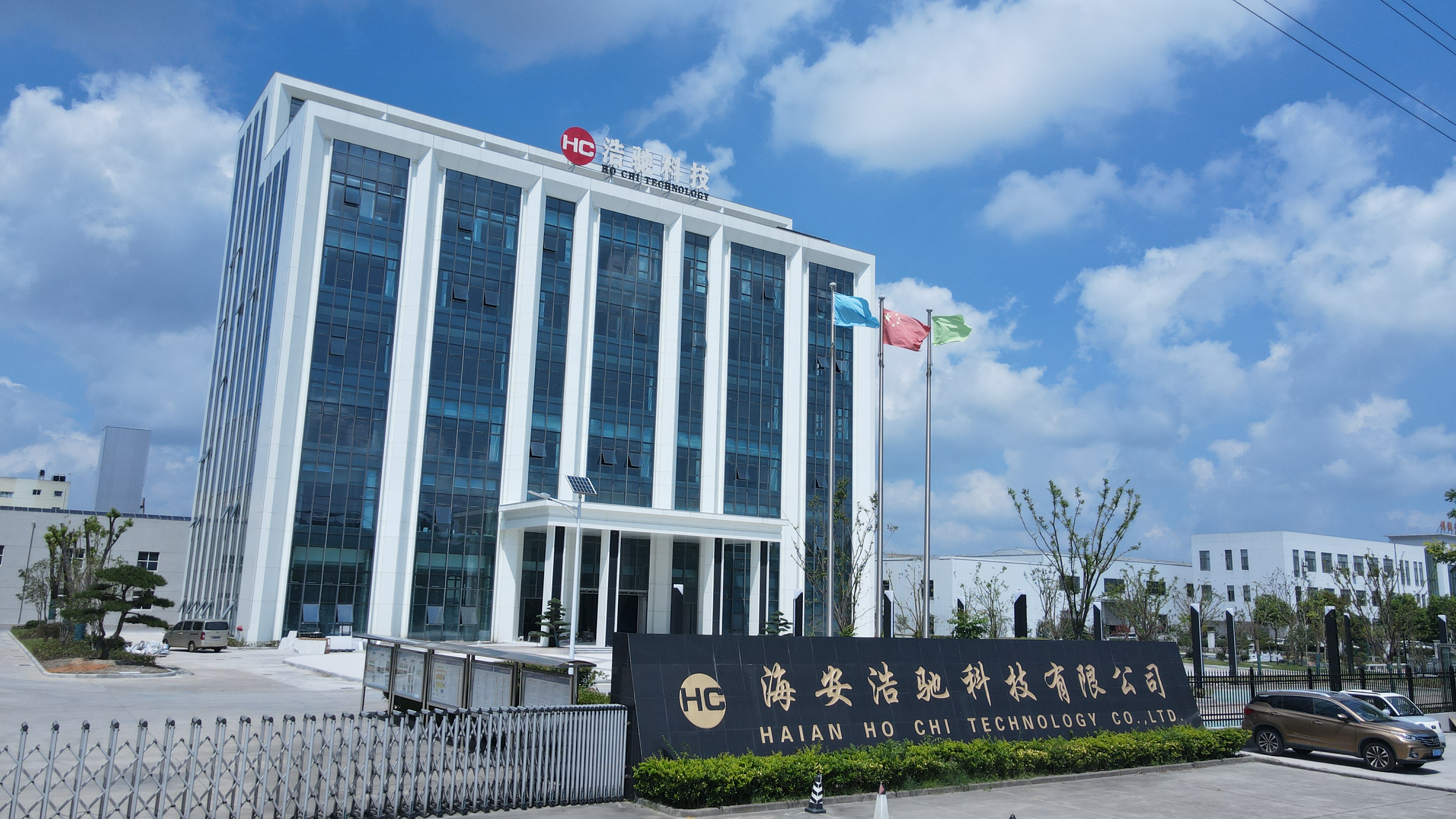
Both films are produced by Haian Haochi Technology Co., Ltd., a wholly owned subsidiary of Shanghai Haochi Technology Co., Ltd. and a national-level specialised and innovative high-tech enterprise focused on the research, development, production and sale of functional films. The company was founded in 2009 and operates a 133,333 square metre factory with more than 220 employees, an annual output of 48,000,000 metres and an R&D team of 100 engineers. Export accounts for 60% of its business.
For a project buyer, the relevant compliance position is the following:
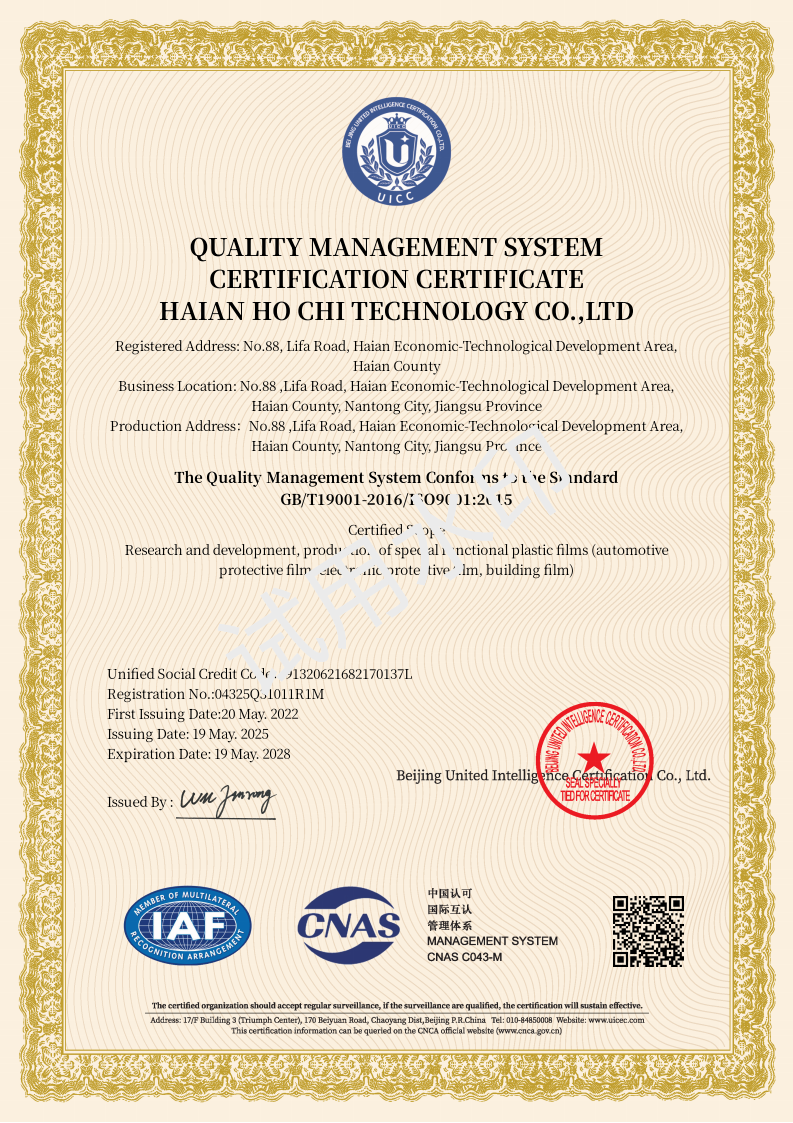
- ISO 9001 quality management system certification (certificate 04325Q31011R1M, issued by Beijing United Intelligence Certification Co., Ltd., valid to 2028-05-19), covering research and development and production of special functional plastic films including automotive protective film, electronic protective film and building film.
- ISO 14001 environmental management system certification (certificate 04325E30833R1M, valid to 2028-05-19), with the same functional film scope.
- ISO 45001 occupational health and safety management system certification (certificate 04325S40794R0M, valid to 2028-05-18).
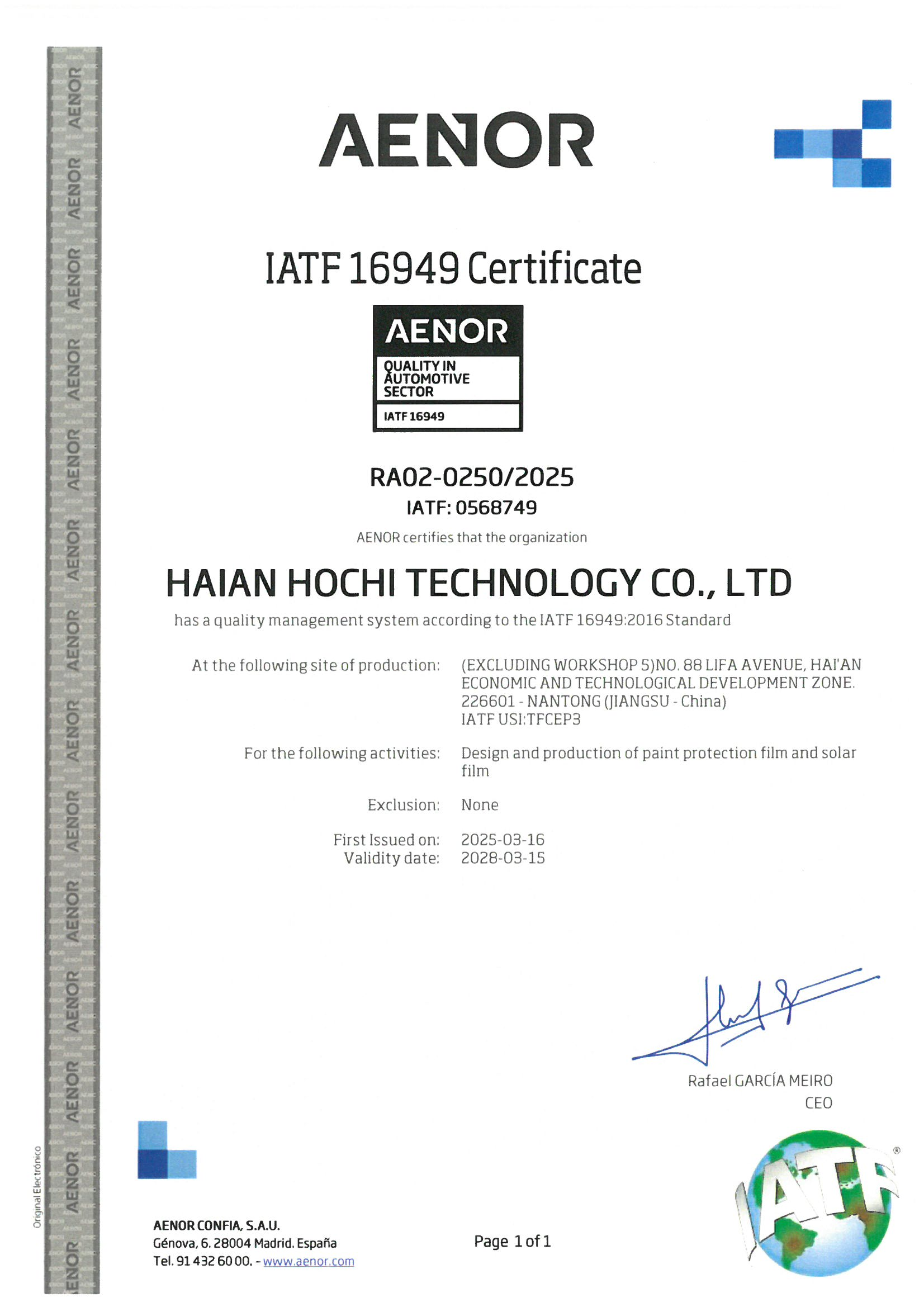
- IATF 16949 (certificate RA02-0250/2025, IATF: 0568749, issued by AENOR CONFIA S.A.U., valid to 2028-03-15) for the design and production of paint protection film and solar film; the certification applies to the architecture film product SILVER 10%.
Quality control on architectural and functional film production includes 100% online optical defect inspection, spectrophotometer testing of VLT, UV rejection and IR rejection, peel adhesion testing and high-temperature aging testing, with third-party inspection available through SGS. Monthly production capacity runs at 3 to 5 million metres.
For distributors, brand owners and glazing contractors who need a private-label specification, OEM production services are available. The customisation scope covers VLT from 5% to 70%, UV and IR rejection rates, film thickness in mil, roll dimensions in width and length, custom colours, release liner, and packaging box and core logo printing.
Frequently Asked Questions
What is the main performance difference between SILVER/GREEN 10 and SILVER/GREY 05?
Both are 2PLY 1.5 mil architectural films made from optical grade PET, both reject 99% of UV radiation, and both carry a 4-year quality warranty. The difference is in two figures: SILVER/GREEN 10 has a visible light transmission of 8% and an infrared cut of 90%, while SILVER/GREY 05 has a visible light transmission of 10% and an infrared cut of 75%. The infrared cut gap of 15 percentage points is the most significant performance difference between the two models.
Does a lower VLT always mean better heat rejection?
No. VLT describes only visible light, while heat rejection is governed by infrared and total solar energy performance. The two metrics move independently. In this pair, SILVER/GREEN 10 happens to have both the lower VLT (8%) and the higher infrared cut (90%), but VLT cannot be used as a substitute measure for thermal performance when comparing films in general. Selection should be based on verified VLT, UV rejection, IR rejection and TSER data rather than on tone or darkness alone.
Can these architectural films be customised for OEM projects?
Yes. The manufacturer provides OEM production services for private-label requirements. Customisation covers VLT in the range of 5% to 70%, UV and IR rejection rates, film thickness in mil, roll dimensions in width and length, custom colours, release liner, and packaging box and core logo printing. Monthly production capacity is 3 to 5 million metres, so both standard and custom specifications run on the same lines.
What is the minimum order quantity, sample policy and lead time?
For OEM orders the minimum order quantity is 50 rolls, and sample orders are available upon request, which allows a project team to validate appearance and performance on the actual glass build-up before committing to a full order. Lead time is 30 to 45 days. Pre-shipment testing and third-party inspection such as SGS are available for acceptance, delivery terms are FOB Shanghai, and standard payment terms are 30% T/T in advance with 70% T/T against a copy of the bill of lading.
What warranty and after-sales support applies to these films?
SILVER/GREEN 10 and SILVER/GREY 05 each carry a 4-year quality warranty. Across the wider functional film range, quality warranties run from 5 to 10 years covering anti-bubbling, anti-fading and anti-delamination, with 100% free replacement for defectives and 24/7 technical support and installation guidance. To move a project forward, you can request architectural film samples or a specification sheet for the glass elevations in your building by contacting the HOCHI PPF & Window Film team at WhatsApp +86 180 3645 9980 or hochitech@sina.com.
Bring the Specification to Your Facade
Tell us the orientation, glass type and privacy requirement of your project, and we will confirm whether SILVER/GREEN 10, SILVER/GREY 05, or a custom OEM specification is the better match. Sample orders and full specification data are available on request.
Website: hochitech.net | Email: hochitech@sina.com | Tel / WhatsApp: +86 180 3645 9980
Product specification download: Window Film HC Specifications (PDF)
Conclusion
SILVER/GREEN 10 and SILVER/GREY 05 are close relatives, not opposites. They share the same 2PLY 1.5 mil optical grade PET construction, the same 99% UV rejection and the same 4-year quality warranty. The choice between them comes down to two decisions a project team has to make anyway: how much daylight the interior needs, and how much infrared heat the facade has to shed.
Where solar load is sustained and glare is a working condition, the 90% infrared cut and 8% VLT of SILVER/GREEN 10 address the dominant problem directly. Where glazing is shaded, north-facing or primarily needs daytime one-way privacy, the 75% infrared cut and 10% VLT of SILVER/GREY 05 keep the interior brighter while still delivering full UV protection. Both should be confirmed on the actual glass build-up, and on glass types that carry thermal stress risk, a compatibility assessment should precede the order.
Have Questions or Need More Details?
Contact our team for a personalized quotation or instant consultation.
Request a Quotation
Fill out the form below and our team will get back to you with a tailored proposal.
WhatsApp Direct Chat
Prefer to chat in real-time? Message us on WhatsApp for instant assistance & quick answers.
- Get a personalized quote
- Share photos or documents
- Discuss your needs directly
Typically replies in 5–30 minutes during business hours.