Safety Clear Window Film Application Guide for Auto Service Bays: SF12 and SF02
Short answer: when an auto service bay or parts counter has to keep its existing glass transparent but needs shatter retention and UV reduction, two safety clear models cover most specifications. SF12 is a 1-ply, 12.0 mil optical-grade PET safety clear film with 90% VLT, 88% UV rejection, 10% IR cut, a strong adhesive and a 6-year quality warranty. SF02 is a 1-ply, 2.0 mil safety clear film in the same clear, optical-grade PET family, documented at the same 90% VLT, 88% UV rejection, 10% IR cut and strong adhesive. Both are listed as security protection films. Neither is a heat-rejection or privacy product.
This guide is written for the people who actually scope and sign off a bay retrofit: facility and branch managers, glazing contractors, film installers, and dealership or workshop groups. It covers four working stages - project scoping, glass-by-glass film selection, installation over existing windows, and acceptance checks for VLT, UV rejection and adhesive/security performance.
Decision rule: customer-facing bay glass and large fixed architectural panes that must stay clear - SF12. Vehicle glass and thinner glazing handled inside the bay - SF02. Where reduced VLT is acceptable and UV control matters more than daylight - NEX4MIL05 or NEX8MIL05 dark security film at 5% VLT and 99% UV rejection.
What Problem Does Clear Safety Film Solve in an Auto Service Bay?
Three problems drive almost every clear-film retrofit in a workshop environment, and each one points to a different part of the film specification.
- Glass breaking into occupied space. Bay glazing sits next to tool carts, tyre handling, lift traffic and customer walkways. A safety clear film bonds to the glass surface so the pane is held together rather than released. The product data for SF12 and SF02 lists two defining attributes for this function: security protect and strong adhesive.
- UV exposure on the things behind the glass. Both SF12 and SF02 reject 88% of UV. That figure matters for rubber seals and weatherstrip, plastic trim, printed parts labels, packaged stock stored against the counter glass, and the interiors of vehicles parked close to a bay window.
- Managing light without darkening the workplace. At 90% VLT, both films keep a bay bright enough for technicians to work and for customers to see in. This is the main reason a clear film is chosen over a dark automotive tint for architectural bay glazing.
A fourth consideration is practical rather than technical: retrofit instead of replacement. Film is applied to glass that already exists, so a workshop avoids the cost and disruption of removing and re-installing glazing. Glass compatibility still has to be confirmed before installation.
Limits worth stating up front. Safety clear film is not a substitute for replacing cracked, damaged or non-compliant glass. With a 10% IR cut, SF12 and SF02 are not heat-rejection films - if heat load is the real problem, an architectural solar control film is the correct product family. And unless a verified impact or blast rating is supplied for the specific project, film thickness alone should not be read as a certified blast-mitigation rating.
Industry Background: Why Bay Glazing Retrofits Keep Growing
Retrofit demand sits inside a large film market. The global automotive tinting film market is projected to reach USD 14.7 billion by 2033, according to the 2026-2033 market report published by Grand View Research. Growth of that kind keeps specification work - not just retail tinting - at the centre of the category, because commercial and workshop glazing has to be documented, installed and inspected rather than simply applied.
Two reference points frame how a retrofit is judged after installation. The International Window Film Association's Visual Quality Standards require window film inspection at 6 feet (approximately 2 metres) under natural daylight. ASTM D882 is the testing method for tensile strength, break strength and elongation of safety films under IWFA policies. Both are useful when a facility manager or contractor has to write an acceptance clause into a purchase order, and both are used later in this guide.
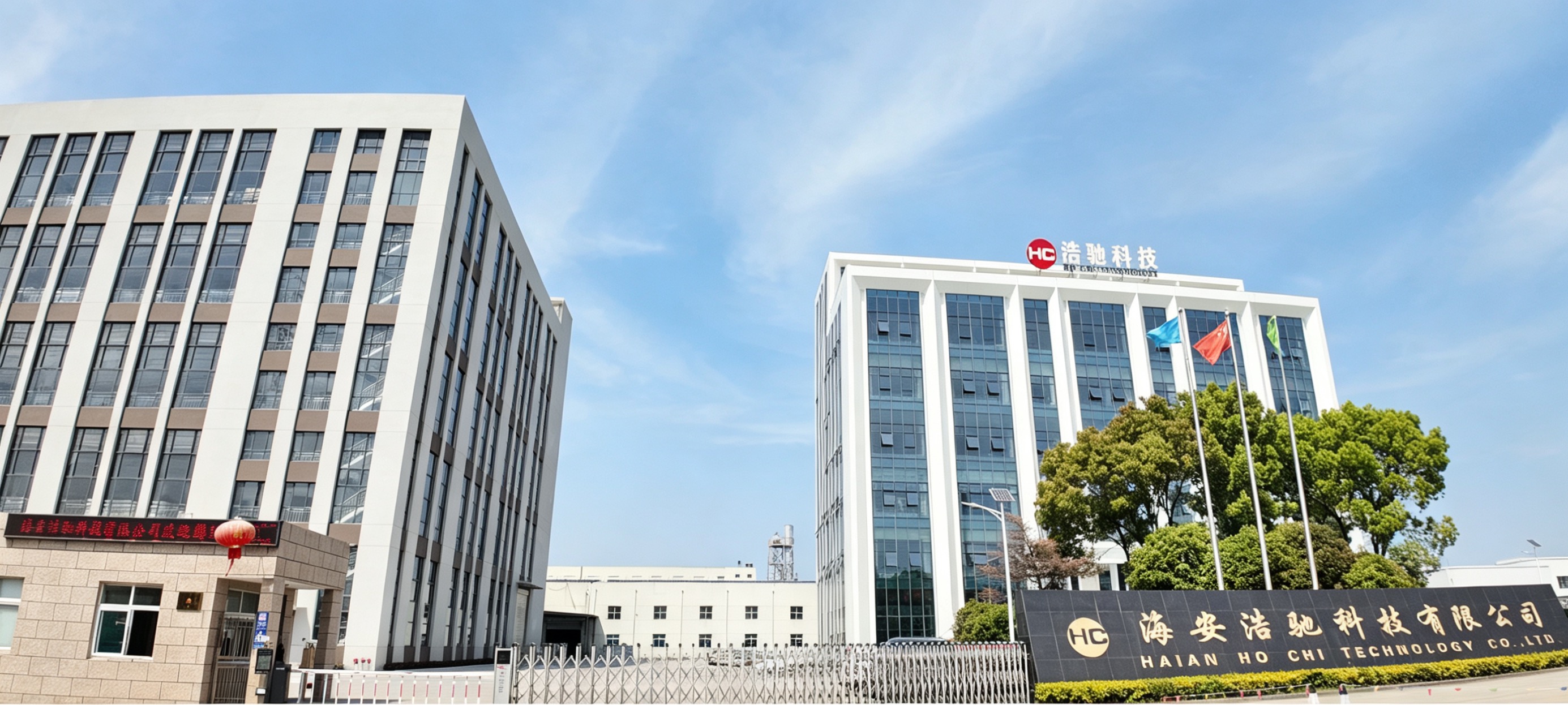
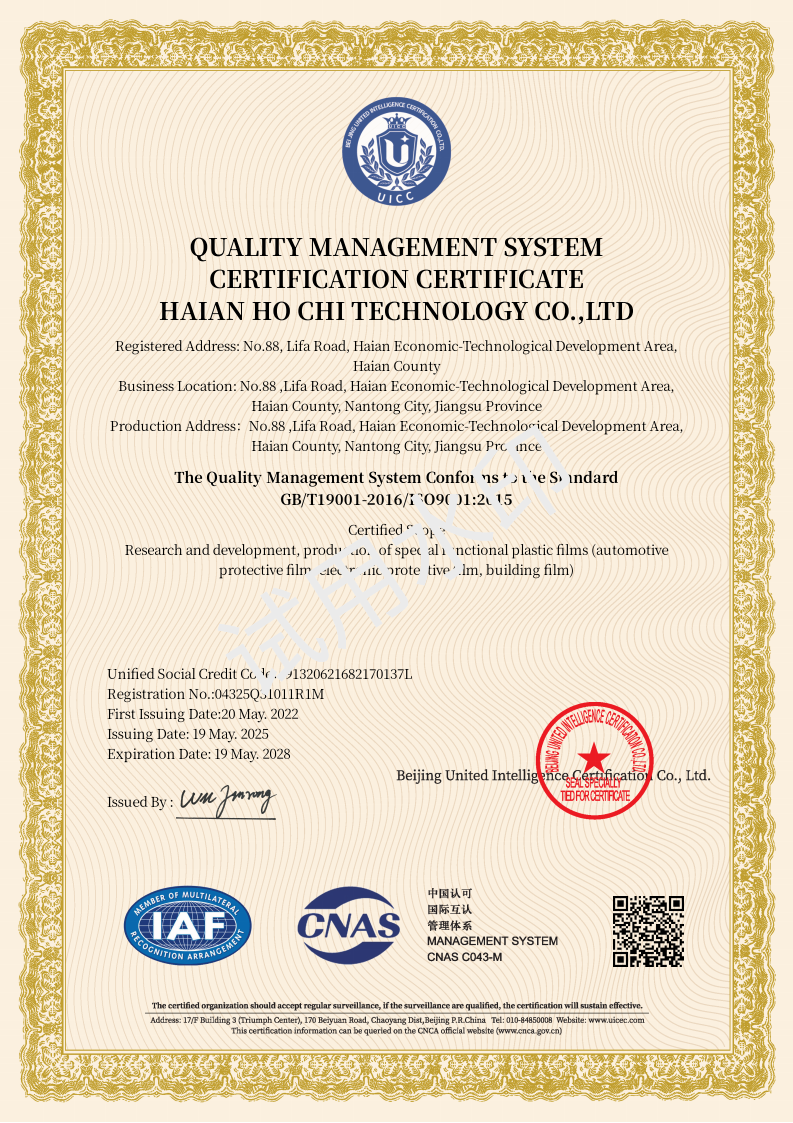
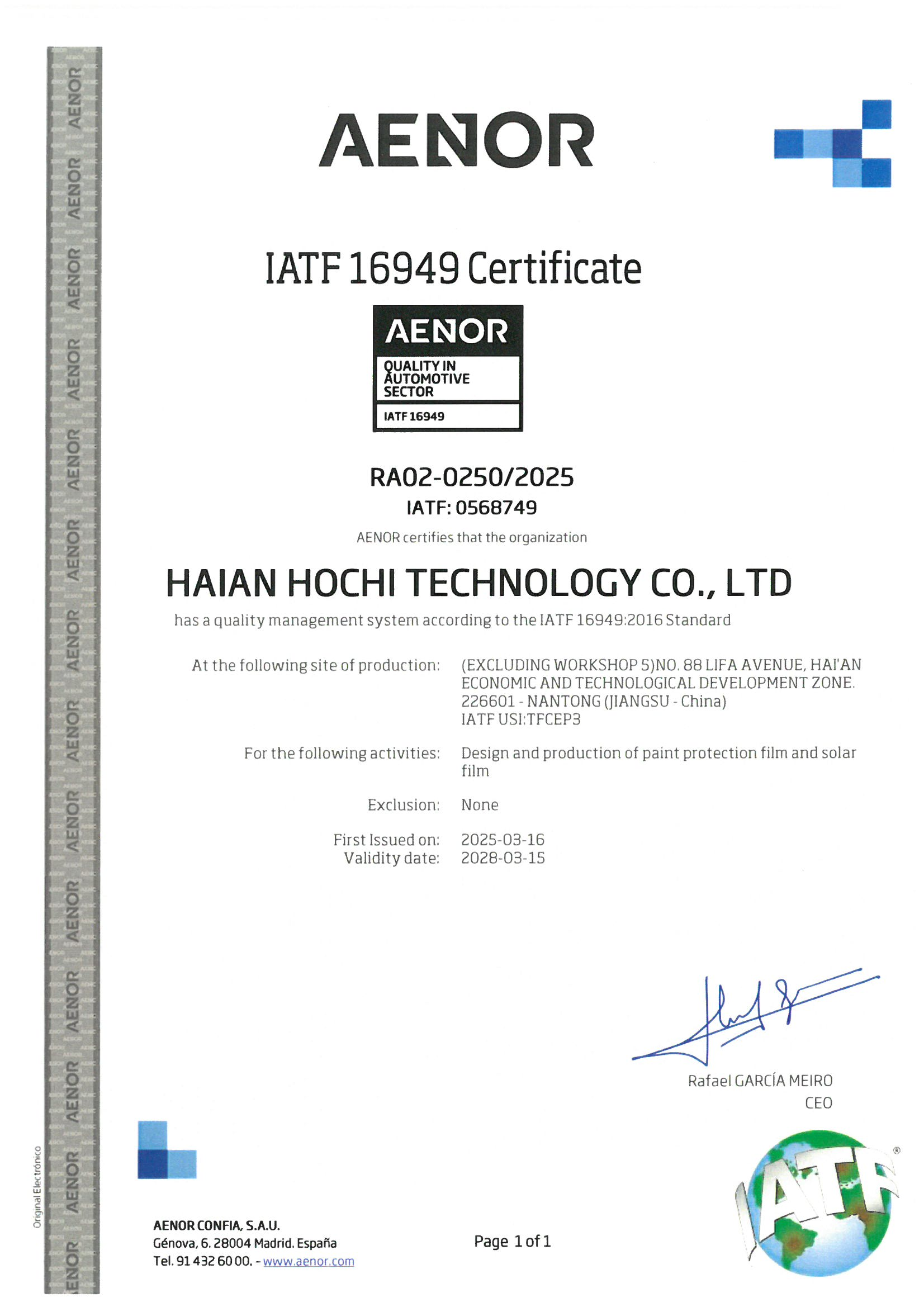
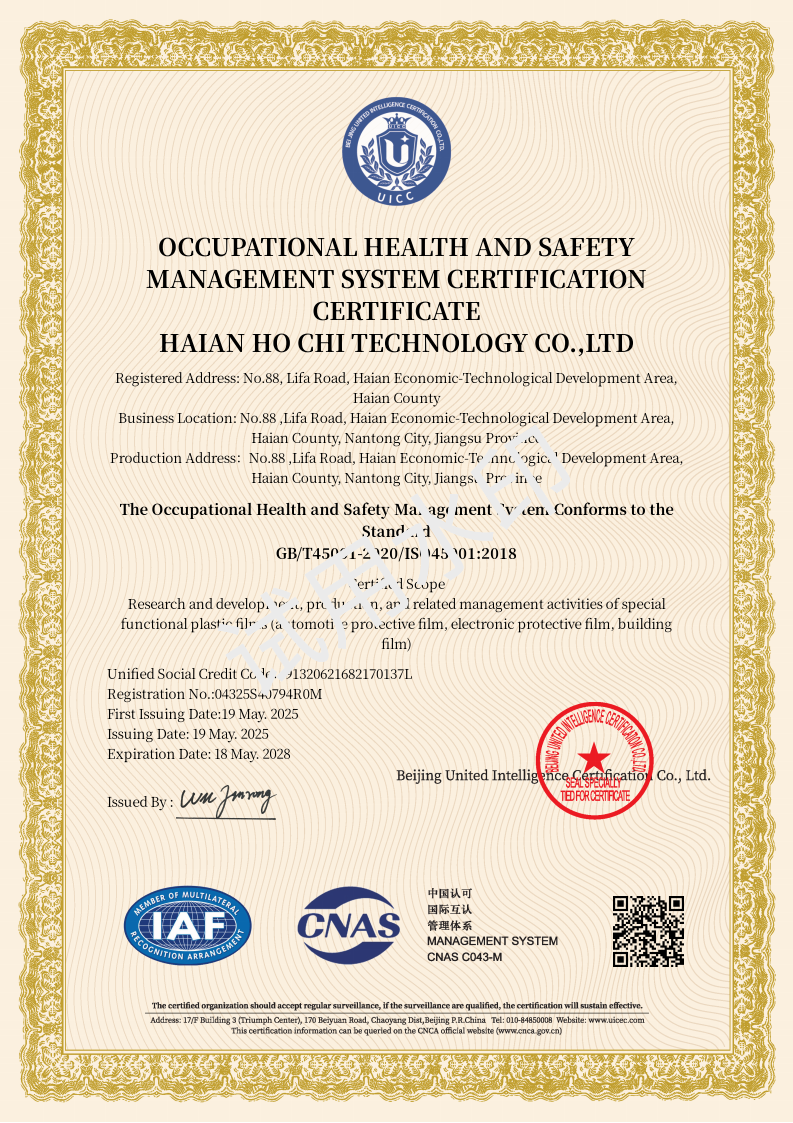
Who supplies these films. Haian Haochi Technology Co., Ltd. (HOCHI, hochitech.net) is a functional film manufacturer founded in 2009 and based in the Haian Economic and Technological Development Zone, Nantong City, Jiangsu Province, China. The company operates a 133,333 sqm facility with 220+ employees, a 100-engineer R&D team, and an annual output of 48,000,000 metres, with about 60% of production exported. Its range covers automotive window film, architectural film, explosion-proof safety film, paint protection film and related functional films, and it also runs a 3,000 sqm Class 1000 dust-free coating workshop. Quality documentation includes ISO 9001, ISO 14001 and ISO 45001 certificates issued by Beijing United Intelligence Certification Co., Ltd., and an IATF 16949 certificate issued by AENOR CONFIA S.A.U.
The Two Films: SF12 and SF02 Safety Clear Film
SF12 - 12.0 mil safety clear film for fixed architectural glazing
SF12 is the heavier gauge option in the safety clear range and is listed under HOCHI's architectural film range with the product type SAFETY CLEAR. It is built on optical grade PET film in a 1-ply, 12.0 mil construction with a clear colour. Its documented performance values are 90% visible light transmission, 88% UV rejection and 10% infrared cut, and it is specified with a strong adhesive for security protection. The product carries a 6-year quality warranty.
In a service bay, that combination points to large, fixed, customer-facing panes: showroom-style bay windows, roller-door glazing, and interior partitions where a trolley or door can strike the glass and where the space behind the glass must stay visible and evenly lit.
SF02 - 2.0 mil safety clear film for vehicle glass
SF02 is the thinner safety clear model, documented as a 1-ply, 2.0 mil film made of optical grade PET, in clear colour, with the same 90% VLT, 88% UV rejection and 10% IR cut, a strong adhesive for security protection, and a 6-year quality warranty. It belongs to the same SAFETY CLEAR family as SF12; the difference a specifier works with is thickness - 2.0 mil against 12.0 mil.
That makes SF02 the practical choice for vehicle glass handled inside the bay and for glazing where the extra thickness of SF12 would complicate edge work, frame clearance or panel curvature. Where vehicle windows are re-glazed or protected in a tint and PPF bay, SF02 keeps the glass clear at 90% VLT while adding the same 88% UV rejection as the architectural model.
What safety clear film does not do
- It does not darken the glass. At 90% VLT, SF12 and SF02 provide no privacy and no meaningful glare cut. If a bay needs reduced light or privacy, that is a different specification.
- It is not a heat-rejection film. Both models are documented at 10% IR cut. HOCHI's heat-oriented architectural films sit in a different family - for example, SILVER 5% is a 2-ply, 1.5 mil silver reflective architectural film documented at 5% VLT, 95% IR cut, 99% UV rejection and a 6-year quality warranty.
- The documented data set has boundaries. The catalog values for SF12 and SF02 cover construction, thickness, VLT, UV rejection, IR cut, adhesive and warranty. A project that requires a certified blast or impact classification should request the corresponding test documentation rather than infer a rating from film thickness.
Glass-by-Glass Selection: Which Film on Which Pane?
Assign film pane by pane, using exposure, pane size and who stands on each side of the glass. The table below is the working rule for a typical bay layout.
| Glass zone in the bay | Film | Verified specification basis | Why it fits |
|---|---|---|---|
| Customer-facing bay storefront and roller-door glazing | SF12 | 1 ply, 12.0 mil, clear, 90% VLT, 88% UV rejection, 10% IR cut, strong adhesive, 6-year quality warranty | Heavier gauge on large fixed panes; 90% VLT keeps the bay usable; 88% UV rejection protects displays, trim and interiors behind the glass |
| Parts counter partition, shop office and internal glazing | SF12 or SF02 | 12.0 mil or 2.0 mil, both 90% VLT and 88% UV rejection | Use SF12 where trolleys and foot traffic can strike the pane; use SF02 where frame capacity, panel size or edge detailing favours a thinner film |
| Vehicle windows handled inside the bay | SF02 | 1 ply, 2.0 mil, clear, optical grade PET, 90% VLT, 88% UV rejection, strong adhesive, 6-year quality warranty | Thinner film suits vehicle glazing and smaller panes; check local automotive window tint and VLT rules before installation |
| Bay glazing where dark glass is acceptable | NEX4MIL05 or NEX8MIL05 | 2 ply, 4.0 mil or 8.0 mil, super black, 5% VLT, 11% IR cut, 99% UV rejection, strong adhesive, 5-year quality warranty | Dark security films for sites that permit reduced VLT and want maximum UV rejection; they remove daylight entirely |
| Glazing where the main problem is heat, not breakage | SILVER 5% (solar control family) | 2 ply, 1.5 mil, silver, 5% VLT, 95% IR cut, 99% UV rejection, 6-year quality warranty | Heat rejection is a separate specification; do not expect it from a 10% IR cut clear safety film |
Step-by-Step: Specifying and Installing Safety Clear Film on Existing Windows
Step 1 - Scope the project glass by glass
Build a pane schedule before talking about film models. For each pane record dimensions, glass type (single, laminated, insulated or coated), orientation and sun exposure, whether film is already installed, visible cracks or edge damage, the traffic or impact exposure on each face, and the working height needed to reach the glass. Film selection and acceptance values are then set per pane rather than per building.
Step 2 - Fix the acceptance values before ordering
Write the pass/fail values into the purchase order so the installer and the facility manager measure against the same numbers:
- Target VLT: 90% for SF12 and SF02.
- Minimum UV rejection: 88% for SF12 and SF02.
- IR cut: 10% for SF12 and SF02 - recorded so that no one later treats the film as a heat-rejection product.
- Visual quality: inspection at 6 feet (approximately 2 metres) under natural daylight, following the IWFA Visual Quality Standard.
- Verification: pre-shipment test and third-party inspection (SGS).
Step 3 - Confirm glass compatibility
Before any film is cut, identify the glass type and inspect it for cracks, damage or coating, then confirm that the selected film is compatible with the glass structure. A glass compatibility or thermal stress assessment is recommended before installing film on certain laminated, insulated or treated glass. At the same time, protect surrounding walls, floors, frames and electrical equipment so the retrofit does not create a second problem.
Step 4 - Install on the existing architectural glass (SF12 and SF02 on fixed panes)
- Identify the glass type and inspect it for cracks, damage or coating.
- Confirm the selected film is compatible with the glass structure.
- Protect surrounding walls, floors, frames and electrical equipment.
- Clean the glass thoroughly and remove dust, grease and residue.
- Measure and cut the film with an appropriate trimming allowance.
- Spray the approved installation solution on the glass and the adhesive surface.
- Position the film and remove water and air with a professional squeegee.
- Trim the edges and inspect the installation for contamination, bubbles and lifting.
- Allow sufficient curing time before cleaning the glass or evaluating the final appearance.
Confirm glass-film compatibility before installation, because an incompatible film may increase thermal stress and the risk of glass breakage. Installers should follow local building safety requirements and use appropriate protective equipment when working at height.
Step 5 - Install on vehicle glass in the bay (SF02)
- Inspect the vehicle glass and confirm the required VLT, film model and installation position.
- Work in a clean, dust-free environment and protect the vehicle interior.
- Thoroughly clean the inside and outside surfaces and remove oil, dust and adhesive residue.
- Measure and cut the film, leaving a margin for trimming.
- Heat-shrink and shape the film on curved automotive glass when necessary.
- Spray the approved installation solution on the adhesive side and the glass surface.
- Position the film and use a professional squeegee to remove water and air from the centre toward the edges.
- Trim the edges and inspect for bubbles, dust, creases and edge lifting.
- Allow the film to cure before lowering the windows or cleaning the glass.
Use professional cutting tools, heat guns and installation solution, and protect glass, rubber seals, electronic components and the vehicle interior during the work. Do not apply excessive heat to laminated glass, and check local automotive window tint and VLT regulations before installation.
Step 6 - Cure, then hand over
Allow sufficient curing time before cleaning the glass or judging the final appearance. Actual curing time depends on film type, temperature and humidity, so the hand-over date should be agreed with the installer rather than assumed.
Acceptance Checks: VLT, UV Rejection and Adhesive / Security Performance
Acceptance testing is where a service bay retrofit either closes cleanly or generates a warranty argument six months later. Measure against the documented values, and measure the finished pane, not only the roll sample.
| Check | Method | What to look for |
|---|---|---|
| Visible light transmission | Spectrophotometer test (VLT / UVR / IRR) | SF12 and SF02 are documented at 90% VLT; the installed pane should be measured and recorded against that value |
| UV rejection | Spectrophotometer test (VLT / UVR / IRR) | Documented at 88% UV rejection for both models |
| Infrared cut | Spectrophotometer test (VLT / UVR / IRR) | Documented at 10% IR cut for both models - record it so the film is not mistaken for a heat-rejection product |
| Adhesive and security performance | Peel adhesion test; high-temperature aging test | Both models are listed with a strong adhesive and security protection; the 6-year quality warranty supports the specification |
| Mechanical properties of the safety film | ASTM D882 (tensile strength, break strength, elongation) per IWFA policies | Request the test report for the delivered batch |
| Visual quality | IWFA Visual Quality Standard, inspection at 6 feet (approximately 2 metres) under natural daylight | Check for contamination, bubbles, creases and edge lifting |
| Pre-shipment and third-party verification | Pre-shipment test; third-party inspection (SGS) | Confirm before the rolls leave the factory; production also runs 100% online optical defect inspection |
| Documentation | ISO 9001 (04325Q31011R1M), ISO 14001 (04325E30833R1M), ISO 45001 (04325S40794R0M), IATF 16949 (RA02-0250/2025, IATF: 0568749) | Confirm the certificate scope covers building film and automotive film, and that the validity dates are current |
Use Cases
Independent workshop with a street-facing bay window
A single large storefront pane facing a road takes the highest impact and UV exposure in the building. SF12 at 12.0 mil with a strong adhesive gives the pane a bonded surface while the 90% VLT keeps the bay visibly open to passing customers. The 88% UV rejection protects the trim and packaging behind the glass.
Dealership parts counter and customer lounge glazing
Interior partitions between a parts counter and a customer area are struck by trolleys and hand carts rather than weather. SF12 or SF02 both work here; the deciding factor is usually pane size and frame clearance, since both films share the same 90% VLT and 88% UV rejection values.
Tint and PPF bay handling vehicle glass
Where a workshop also processes vehicle glazing, SF02 at 2.0 mil handles the vehicle windows while SF12 handles the building glass - one purchase order, one acceptance standard, two thicknesses matched to two different surfaces.
Multi-site retrofit programmes
Larger programmes are usually run as a documented retrofit cycle rather than a one-off installation. A reference project supplied to commercial real estate developers, architectural glazing contractors and hotel chain facility managers in the US, AE and DE covered 65,000 square metres - approximately 2,200 rolls of silver and neutral solar control film - with a 3-year post-installation evaluation and a 10-year product warranty. Reported results included a 4 to 6 degree Celsius reduction in indoor temperature, a 28% reduction in central air-conditioning power consumption, 99.5% of harmful UV blocked, and a total solar energy rejection above 72%, using magnetron sputtering metal technology. That project used solar control film, not safety clear film, but the workflow transfers directly to bay glazing: glass survey, per-pane film assignment, pre-shipment test, third-party inspection, and a measured acceptance check at hand-over.
SF12 vs SF02: Comparison Table
This table compares the two safety clear models against a dark security alternative. Every value below is taken from HOCHI product data; nothing is estimated.
| Attribute | SF12 | SF02 | NEX4MIL05 / NEX8MIL05 (reference) |
|---|---|---|---|
| Product type | SAFETY CLEAR | SAFETY CLEAR | GLUE TINT SECURITY FILM |
| Material | Optical grade PET film | Optical grade PET | High-purity optical-grade thickened PET |
| Structure and thickness | 1 ply, 12.0 mil | 1 ply, 2.0 mil | 2 ply, 4.0 mil / 8.0 mil |
| Colour | Clear | Clear | Super black |
| VLT | 90% | 90% | 5% |
| IR cut | 10% | 10% | 11% |
| UV rejection | 88% | 88% | 99% |
| Adhesive / security attributes | Strong adhesive, security protect | Strong adhesive, security protect | Strong adhesive, colour stable, good clarity |
| Quality warranty | 6 years | 6 years | 5 years |
| Best fit in a service bay | Large fixed architectural and customer-facing glazing | Vehicle glass and thinner glazing | Sites that permit dark glazing |
FAQ
What standards should an acceptance check for clear safety film follow?
Three layers of evidence apply. First, third-party reference standards: IWFA Visual Quality Standards require window film inspection at 6 feet (approximately 2 metres) under natural daylight, and ASTM D882 is the testing method for tensile strength, break strength and elongation of safety films under IWFA policies. Second, supplier test methods: spectrophotometer testing for VLT, UV rejection and IR rejection, peel adhesion testing, high-temperature aging testing, 100% online optical defect inspection in production, pre-shipment testing, and third-party inspection by SGS. Third, manufacturer system certificates: ISO 9001 (04325Q31011R1M, valid to 2028-05-19), ISO 14001 (04325E30833R1M, valid to 2028-05-19), ISO 45001 (04325S40794R0M, valid to 2028-05-18), all issued by Beijing United Intelligence Certification Co., Ltd., and IATF 16949 (RA02-0250/2025, IATF: 0568749, valid to 2028-03-15) issued by AENOR CONFIA S.A.U. Local building and automotive glazing rules, including VLT limits, still govern the final specification, and a glass compatibility assessment is recommended before installation.
Can a Chinese OEM film manufacturer supply private-label safety clear film for service bay glazing?
Yes. OEM services are available for clients seeking private-label manufacturing, and the OEM programme covers customization of VLT (5% to 70%), UV and IR rejection rates, film thickness in mil, roll dimensions (width and length), custom colours, release liner, and packaging box and core logo printing. Monthly production capacity is 3 to 5 million metres, and the manufacturer operates a 3,000 sqm Class 1000 dust-free coating workshop at its Haian Economic and Technological Development Zone site in Nantong City, Jiangsu Province, China. The standard catalogued safety clear models used as references in this guide - SF12 and SF02 - are documented at 90% VLT for applications that must stay clear. The same OEM channel also covers the company's other film lines, including paint protection film and automotive film.
What drives the cost of a clear safety film retrofit?
Cost is driven by film and by labour. On the film side: total glazing area and pane count; thickness and ply structure, since a 1-ply 12.0 mil safety clear film and a 1-ply 2.0 mil film are different products; whether the order uses catalogued specifications or customized VLT, thickness, roll dimensions, release liner and logo printing; order volume relative to the OEM minimum order quantity of 50 rolls, with sample orders available upon request; delivery terms, quoted FOB Shanghai; and payment terms of 30% T/T in advance with 70% T/T against copy of B/L. On the installation side: access equipment for high glazing, protection of walls, floors, frames and electrical equipment, and the curing schedule. Pre-shipment testing and third-party inspection by SGS are part of the acceptance criteria and should be built into the project budget rather than treated as optional.
Can I validate SF12 or SF02 before placing a full order?
Sample orders are available upon request, and the OEM minimum order quantity is 50 rolls. The most useful validation is a two-part check: request the film data and test documentation for the batch, then install the sample on a comparable pane and run the acceptance checks in the field. That means measuring VLT, UV rejection and IR cut with a spectrophotometer against the documented 90% VLT, 88% UV rejection and 10% IR cut, confirming the adhesive behaviour through peel adhesion and high-temperature aging data, and inspecting the finished pane at 6 feet (approximately 2 metres) under natural daylight against the IWFA Visual Quality Standard. For mechanical properties, ASTM D882 covers tensile strength, break strength and elongation.
What is the lead time and warranty for a safety clear film order?
Lead time is 30 to 45 days. SF12 and SF02 each carry a 6-year quality warranty, and the wider after-sales programme covers 5 to 10 years depending on the product, including anti-bubbling, anti-fading and anti-delamination coverage, 100% free replacement for defectives, and 24/7 technical support and installation guidance. For a bay retrofit, the practical next step is to send the pane schedule and the required acceptance values so the film, roll dimensions and packaging can be confirmed in writing - you can request a sample or a quotation for SF12 and SF02, or download the HOCHI window film specification brochure for the full specification set.
Conclusion: Specify Once, Measure at Hand-Over
Clear safety film on an auto service bay is a specification decision, not a tinting decision. SF12 and SF02 are both SAFETY CLEAR films built on optical grade PET with 90% VLT, 88% UV rejection, 10% IR cut, a strong adhesive and a 6-year quality warranty; the choice between them is thickness and surface - 12.0 mil for large fixed architectural glazing, 2.0 mil for vehicle glass and thinner panes. Fix the acceptance values before ordering, confirm glass compatibility before cutting, and measure VLT, UV rejection and adhesive performance after curing. Where heat rather than breakage is the real problem, specify a solar control film instead, and where dark glass is acceptable, the NEX4MIL05 and NEX8MIL05 security films provide 99% UV rejection at 5% VLT.
Request a sample or a quotation
Send your pane schedule and required acceptance values to HOCHI and we will confirm the film model, roll dimensions and packaging in writing.
Email: hochitech@sina.com | Tel / WhatsApp: +86 180 3645 9980 | Website: hochitech.net

Have Questions or Need More Details?
Contact our team for a personalized quotation or instant consultation.
Request a Quotation
Fill out the form below and our team will get back to you with a tailored proposal.
WhatsApp Direct Chat
Prefer to chat in real-time? Message us on WhatsApp for instant assistance & quick answers.
- Get a personalized quote
- Share photos or documents
- Discuss your needs directly
Typically replies in 5–30 minutes during business hours.