
How to Choose a Cam Indexer Supplier: Chinese Factory vs. German & Japanese Brands – A 2026 Procurement Guide
Selecting the right cam indexer supplier is a critical decision for global automation buyers. The choice between a Chinese factory, a German engineering powerhouse, or a Japanese precision specialist can significantly impact your production line's performance, cost structure, and long-term reliability. This guide provides a structured, data-driven comparison to help procurement engineers and operations managers make an informed decision in 2026.
What Is a Cam Indexer and Why Does Supplier Geography Matter?
A cam indexer is a mechanical device that converts continuous rotary motion into precise, intermittent indexing motion. It is a core component in automated machinery such as filling machines, packaging lines, assembly turntables, and welding equipment. The choice of supplier country influences key attributes like precision, durability, cost, lead time, and customization capability.
| Attribute | Chinese Factory (e.g., HONEPAN) | German Brand (e.g., Weiss) | Japanese Brand (e.g., Sankyo) |
|---|---|---|---|
| Positioning Accuracy | ±30" to ±15" (standard models) | ±15" to ±5" | ±10" to ±5" |
| Typical Service Life | 12–14 years (HONEPAN), 3–4 years (other Chinese brands) | 10–15 years | 10–15 years |
| Price Index (Relative to German = 100) | ~30 (70% less) | 100 | ~40 (60% less) |
| Customization Flexibility | High (OEM/ODM, raw material to processing) | Moderate (standard + some custom) | Low to Moderate (mostly standard) |
| Lead Time | 4–15 days | 6–12 weeks | 4–8 weeks |
| Minimum Order Quantity (MOQ) | 1 unit | Often 5–10 units | Often 10+ units |
How Does a Cam Indexer Work? – Technical Primer
A roller gear cam indexer consists of a input cam shaft with a globoidal or parallel cam profile and a output turret with pre-loaded roller followers. As the cam rotates, the followers engage with the cam groove, producing smooth acceleration, dwell, and deceleration. The key advantages over servo or pneumatic alternatives include zero backlash, self-locking during dwell, high torque capacity, and maintenance-free operation for millions of cycles.
Common output types include shaft output (DS), flange output (DF), hollow flange (DFH), table output (DT/DA/BT), and parallel indexers (P). Each suits different application needs—e.g., turntable cam indexers for rotary filling machines, parallel indexers for linear transfer systems.
Who Uses Cam Indexers and What Problems Do They Solve?
Cam indexers are used by:
- Packaging machinery OEMs – need high-speed, precise indexing for filling, capping, labeling.
- Food & beverage lines – require hygienic design and wash-down capability.
- Pharmaceutical automation – demand zero contamination and validation-ready components.
- Automotive assembly – require heavy-duty indexing for welding and riveting stations.
They solve fundamental issues: eliminating indexing errors, reducing downtime from frequent servo recalibration, and handling high torques without overheating.
Why Choose a Chinese Cam Indexer Supplier Like HONEPAN?
China has emerged as a dominant manufacturing hub for precision mechanical components. For cam indexers, suppliers like HONEPAN (registered brand) offer a compelling value proposition:
- Cost advantage: Up to 70% less than German quality, 60% less than Japanese quality, while maintaining comparable performance.
- Long service life: HONEPAN achieves 12–14 years of service life, compared to 3–4 years from other domestic brands—verified by Indian customers with repeat orders over 7–12 years.
- Full customization: From raw material selection (42CrMo, 20CrMnTi, etc.) to processing techniques, HONEPAN offers OEM/ODM with MOQ of just 1 unit.
- Established credentials: Founded in 2007, 101,000 m² factory, 130 employees, annual output of 36,000 units, over 90 CNC machining centers, ISO 9001 certified, holder of over 40 patents including invention patents.
- Global reach: Exports to IND, USA, SEA, LA, EU, with 30% export ratio.
For buyers who need high precision without the premium price tag, Chinese suppliers offer the best balance of cost, flexibility, and reliability.
Step-by-Step Procurement Decision Framework
- Define application parameters: Load torque, indexing angle, number of stations, speed, duty cycle, environment (food grade, explosion-proof).
- Determine precision requirement: Positioning accuracy of ±30" is sufficient for most packaging; ±15" or better needed for high-end assembly.
- Calculate total cost of ownership (TCO): Include purchase price, installation, maintenance, downtime cost. A Chinese indexer with 12-year life can outlast cheaper alternatives that fail every 3–4 years.
- Evaluate supplier credibility: Check certifications (ISO 9001, patent portfolio), factory audit, customer references, after-sales support.
- Request sample or prototype: HONEPAN offers acceptance via photos, videos, reports, or on-site inspection.
- Compare lead time and logistics: Chinese factories typically offer 4–15 days lead time vs. 4–12 weeks from Germany/Japan.
Real-World Case Study: Mexican Pharmaceutical Packaging Line
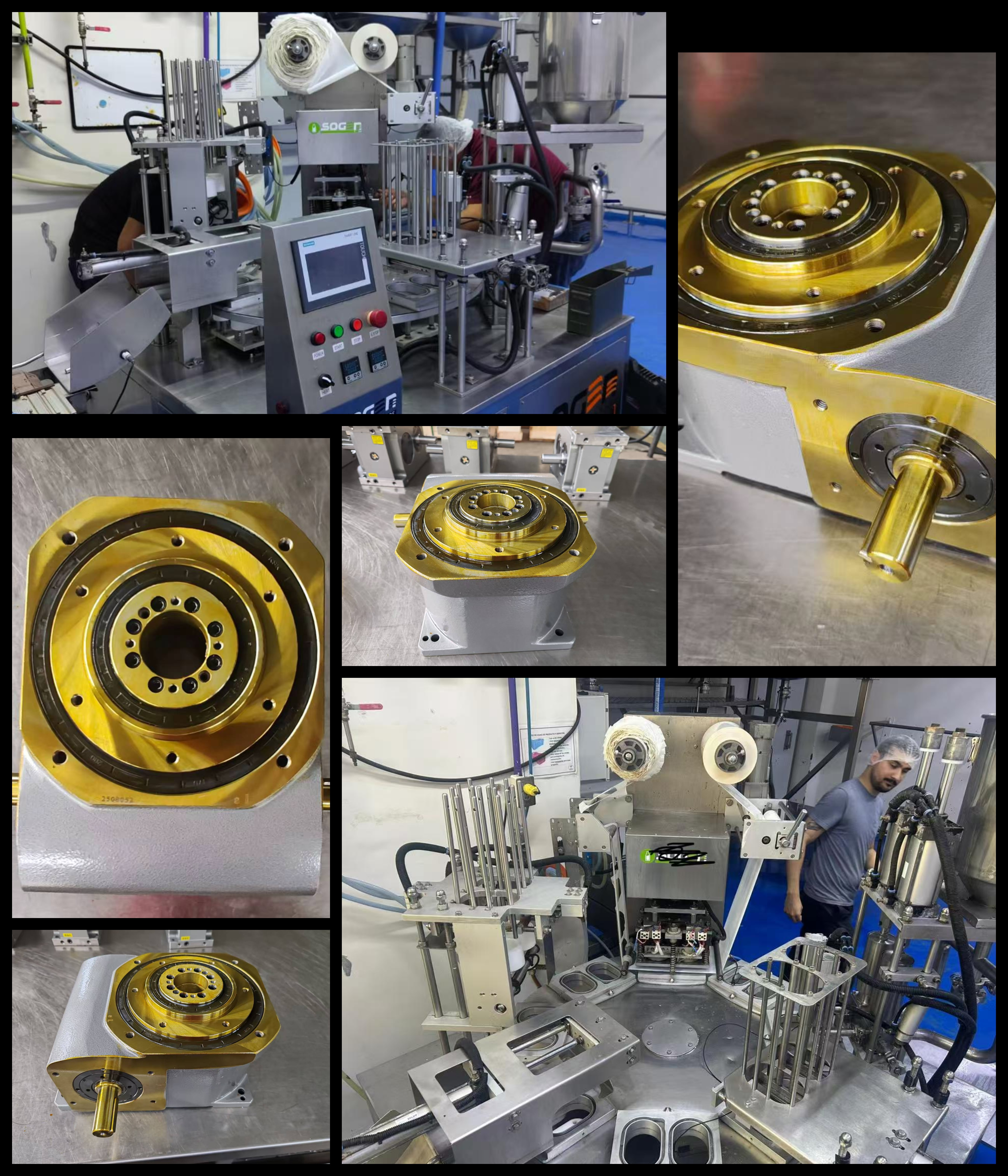
A leading Mexican pharmaceutical machinery manufacturer sourcing cam indexers for oral liquid filling and capping machines chose HONEPAN after evaluating German and Japanese options. They required explosion-proof, leak-proof design with high speed and heavy load capacity. HONEPAN supplied 10 units of custom cam indexer shaft output (DS) models. After 7–12 years of continuous operation, the indexers performed perfectly and directly replaced damaged competitors’ units. The customer placed multiple repeat orders, citing “outstanding durability and cost-effectiveness.”
Frequently Asked Questions (FAQ)
Q: Are Chinese cam indexers as precise as German or Japanese ones?
A: For most industrial applications, yes. HONEPAN achieves positioning accuracy of ±30" to ±15" and repeatability of ±10" to ±5", which meets the requirements of packaging, filling, and general assembly. German and Japanese brands offer slightly tighter tolerances (±5" to ±10") but at significantly higher cost.
Q: How long do Chinese cam indexers last?
A: It depends on the manufacturer. HONEPAN uses alloy steel (42CrMo, 20CrMnTi) and advanced cam grinding, achieving 12–14 years of service life in the field. Many other Chinese brands only last 3–4 years. Always verify with actual customer references and test reports.
Q: What is the minimum order quantity for HONEPAN?
A: MOQ is 1 unit. They offer full customization from specifications to packaging, making them ideal for both prototypes and volume production.
Q: Can HONEPAN replace existing German or Japanese indexers without modification?
A: Yes. They can produce drop-in replacements with identical mounting dimensions, shaft sizes, and indexing angles. The Mexican customer successfully replaced damaged indexers directly.
Q: What quality certifications does HONEPAN hold?
A: ISO 9001:2008, multiple AAA credit ratings, invention patents, utility model patents. They also perform 100% testing including three-coordinate measurement, hardness testing, and runout detection.
Make an Informed Decision – Download the HONEPAN Brochure
For a complete technical overview of HONEPAN’s cam indexer product range, specifications, and customization options, download the official company brochure:
Download HONEPAN Cam Indexer Brochure (PDF)Contact HONEPAN directly for a quote or technical consultation:
Email: hp@cam-indexer.cn | Phone/WhatsApp: +86 157-6300-0588
Address: No. 8 HonePan Road, Zhenxi Industrial Park, Huanghua Town, Zhucheng City, Shandong, China