
Application Guide: Choosing the Right High-Speed Bunching/Stranding Machine for Robotics, Automotive, and Energy Cables
Choosing a high-speed bunching or stranding machine for robotics, automotive, or energy cables begins with the conductor, not the machine. Each of these three cable families imposes a different dominant requirement on the stranded conductor — flex life, crimp repeatability, or current-carrying mechanical integrity — and that requirement decides the twist method, the pitch control, the pay-off arrangement, and the take-up configuration you should specify.
Bunching and stranding are both twist operations, but they do not produce the same conductor. Bunching combines a defined number of wires in a single group twist, which gives a flexible, round conductor at high output. Stranding lays wires in concentric layers around a centre, which gives a larger, dimensionally stable conductor with controlled layer geometry. The two are frequently treated as interchangeable in early procurement discussions, and that assumption is one of the most common reasons a machine ends up mismatched to the cable it was bought for.
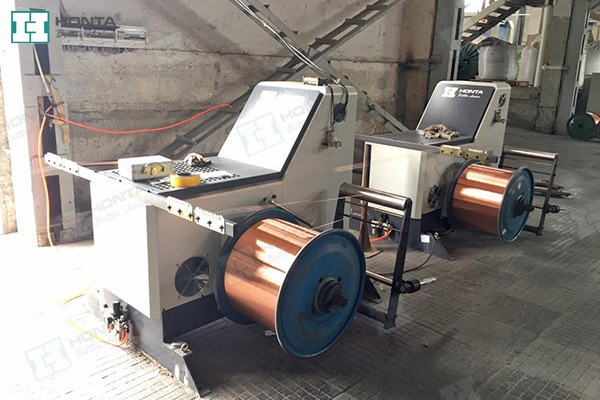
The Problem: One Machine Category, Three Different Conductor Targets
The procurement difficulty is rarely a shortage of machine options. It is that a specification written for one cable family gets quietly reused for another, because the machines look similar from the outside and all of them are described as high speed.
A robotics cable lives on repeated bending and torsional movement. Its conductor is built from many fine wires, bunched rather than concentrically stranded, with a short lay length and controlled back-twist so that individual wires share the bending load instead of one outer wire absorbing it. If the conductor is too stiff or carries residual twist, the failure appears later as conductor fatigue or as jacket damage near the bend zone.
An automotive cable is produced in volume, then cut, crimped, and assembled into a harness. Its conductor has to be geometrically repeatable: the same lay length, the same finished diameter, and the same surface condition from spool to spool. Variation here does not show up as an electrical fault; it shows up as crimp rejects, length tolerance problems, and line stoppages at the harness builder.
An energy cable carries current at larger cross-sections and then passes through insulation, screening, and armouring. Its conductor has to hold shape, resist distortion during those downstream operations, and meet a defined resistance value. Flexibility is secondary; geometric stability and layer control are not.
Three cable families, three different acceptance criteria. When a single machine configuration is stretched across all three, the compromise usually appears first in the lowest-volume, highest-specification product — typically the robotics conductor — while the volume product absorbs the cost in rework.
Industry Background: Why Conductor Specification Now Drives Machine Choice
Two shifts in cable design have pushed conductor decisions earlier in the project timeline, and both change what a buyer should ask a machine supplier.
The first is the move toward finer wires and higher strand counts in flexible and specialty cables. As individual wire diameters fall, the wire behaves less like a rod and more like a filament: it is more sensitive to pay-off tension, more sensitive to guide and die contact, and more likely to cross over during take-up. Machine attributes that were secondary a decade ago — motorised pay-off with fine tension resolution, stable pitch control at low tension, traverse accuracy on the take-up — now determine whether the conductor is saleable at all.
The second is surface engineering. Nickel, silver, and tin plated conductors are specified where temperature resistance, corrosion resistance, or solderability matter, and the plating step happens on the wire before it reaches the strander. Because plated wire has a different friction and contact behaviour than bare copper, the plating line and the bunching or stranding line should be specified as one conductor system rather than as two unrelated purchases.
Alongside these, line integration has changed the economics. Multi-wire drawing lines, rod breakdown lines, wire electrolytic plating lines, and high-speed stranding equipment can now run as a connected sequence, which reduces handling damage and work-in-progress but couples capacity: a bottleneck at the strander no longer has a buffer in front of it. Automation and humanized operation — recipe recall, closed-loop tension, assisted spool handling — have become part of the specification because they determine how much of the machine's rated output survives a shift change.
The Solution: Mapping Machine Capability to Cable Function
HONTA is a cable equipment manufacturer established in September 2006 in Kunshan, Jiangsu, China, supplying copper and aluminium RBD lines, electrolytic plating lines, multi-wire drawing lines, and high-speed stranding equipment. The company established a second production base, HONTA INC., in the United States in 2017, and operates as a cable equipment system service provider, with equipment designed around speed, efficiency, automation, and humanized operation.
That product scope matters for this decision because the four capabilities below do not sit inside one machine. They sit across the conductor line, and they have to be matched together.
1. Flexibility: bundle geometry, not wire count alone
Conductor flexibility is set by wire diameter, strand count, lay length, and back-twist — not by machine speed. A bunching configuration for a robotics conductor prioritises a short lay length with low residual twist, so the finished cable does not try to untwist during jacketing and does not stiffen in the bend zone.
The machine attribute that decides this is pitch stability at the wire count you actually intend to run, combined with tension control light enough not to neck fine wire at the bow or the die. A machine rated for a high wire count at high speed but without fine tension resolution will produce an acceptable conductor on the first spool and a drifting one by the twentieth.
2. Compactness: what energy cable conductors demand
Energy cable conductors are normally concentric, and often compacted or shaped. Concentric stranding means each layer is laid at its own pitch and direction around the centre, and those layer parameters have to be set deliberately rather than inherited from a single group twist.
For large cross-sections, a rigid frame stranding machine is the usual configuration: the conductor is built layer by layer, with take-up tension and layer pitch controlled so the finished conductor stays round and does not distort when it is subsequently insulated or armoured. Where a smaller diameter for the same cross-section is required, compaction is applied during stranding, which raises the demand on die condition and on tension consistency rather than on spindle speed.
3. Mechanical strength: the drawing and plating side of the equation
Strand tensile strength and elongation are inherited from the wire; the strander does not create them. A conductor that fails an elongation check after stranding has usually lost that property in drawing, in plating, or in an over-tensioned pay-off — and the fault is then incorrectly attributed to the twisting machine.
This is where an integrated equipment scope is useful. HONTA's product range covers the wire side — copper and aluminium RBD lines and multi-wire drawing lines — and the surface side, through electrolytic plating lines for nickel, silver, and tin plated conductors. Specifying drawing, plating, and twisting together keeps wire surface quality and twist parameters consistent, instead of leaving the strander to compensate for upstream variation it cannot control.
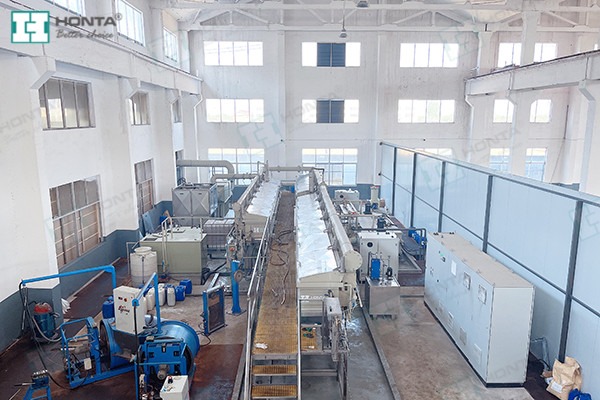
4. Throughput: speed is a system property
Rated line speed is a system output, not a machine specification in isolation. Pay-off stability, twist unit design, and take-up all cap the achievable rate, and the weakest of the three sets the real production figure.
Double-twist configurations raise output per spindle revolution, and single-twist configurations are easier to control on difficult conductors; this trade-off has been covered in detail elsewhere and does not need repeating here. What matters for application matching is that automation — automatic spool change, closed-loop tension, stored recipes — decides how much of the theoretical speed is actually recovered across a full shift, which is the figure a production planner should be given.
Step-by-Step: From Cable Specification to a Machine Configuration
- Write the conductor construction first. Record wire diameter, wire count, bunched or concentric, lay length range, twist direction, and any plating. This document, not the machine brochure, is what the supplier should quote against.
- Convert the construction into machine parameters. Wire diameter range, number of wires per bundle, lay length range, back-twist requirement, and tension window. Any parameter the supplier cannot restate back to you accurately is a parameter that will be resolved by trial and error later.
- Choose the twist method deliberately. Bunching for flexible, high-count conductors; concentric stranding for larger, dimensionally stable conductors; rigid frame stranding where layer-by-layer control is required. Mixing these up is the single most expensive selection error in this category.
- Match the pay-off to the wire supply. Fine plated wire needs a motorised pay-off with fine tension resolution and stable braking; heavier bare copper tolerates a simpler arrangement. Pay-off quality shows up in the finished conductor as diameter variation and surface marks.
- Match the take-up to the downstream process. Spool size, traverse, and winding tension must suit what happens next — extrusion, cutting and crimping, or armouring. Semi-automatic double spoolers and single spoolers are used where changeover time and spool handling dominate the shift; the take-up decision is a handling decision as much as a winding one.
- Fix acceptance criteria before the trial. Define measurable checks: finished conductor diameter, lay length, elongation, surface condition, joint-free length per spool, and spool-to-spool consistency. Criteria agreed after the trial tend to reflect what the machine did rather than what the cable needs.
- Confirm documentation, certification, and service support. Ask for the inspection and test documentation that will ship with the machine, the certificate scope behind the supplier's quality and environmental management systems, and the spare-parts and commissioning plan.
Use Cases: Three Application Profiles
Robotics and continuous-flex cables
Here the conductor is a flex element. Selection should prioritise bunching with short lay length, predictable back-twist, and low-tension wire handling at high strand counts. Pay-off quality and take-up winding without cross-overs matter more than rated speed, because a cross-over in the spool becomes a stiffness point in the finished cable and a fatigue initiation site in service. Buyers should also confirm that the machine can hold its pitch at the lowest wire diameter in the range, not only at the nominal mid-range.
Automotive and harness cables
Here the conductor is a repeatability element. Selection should prioritise lay-length consistency, diameter tolerance, and spool-to-spool uniformity, because downstream cutting and crimping amplifies any variation. High output matters, but only after repeatability is proven: a machine that runs faster with wider scatter moves the cost from the stranding line to the crimping line. Surface condition also belongs on the acceptance list, since plated or tinned conductors affect crimp quality directly.
Energy and power cables
Here the conductor is a structural and electrical element. Selection should prioritise concentric layer control, compaction capability where a reduced diameter is specified, and take-up tension that keeps the conductor round through insulation and armouring. Rigid frame stranding configurations are the normal answer at larger cross-sections, and the specification conversation should include how layer pitch and direction are set and verified, not only the maximum conductor size the machine accepts.
Application Comparison: Requirement Priorities by Cable Type
| Decision point | Robotics cable | Automotive cable | Energy cable |
|---|---|---|---|
| Dominant conductor requirement | Flex and torsion life | Crimp consistency and dimensional repeatability | Current capacity with mechanical integrity |
| Construction direction | Many fine wires, bunched, short lay length | Fine to medium wires, bunched or concentric depending on harness specification | Concentric layers, compacted or shaped where required |
| Machine attribute to prioritise | Pitch stability and low-tension handling at high strand counts | Lay-length repeatability and spool-to-spool uniformity | Layer-by-layer pitch control and tension on large cross-sections |
| Typical twist configuration | Bunching with back-twist control | Bunching or stranding, single or double twist by output target | Rigid frame stranding at larger sizes |
| Pay-off requirement | Motorised pay-off for fine-wire tension control | Motorised pay-off for uniform wire feed | Pay-off matched to wire diameter and spool weight |
| Downstream process | Jacketing, braiding, coil winding | Cutting, crimping, harness assembly | Insulation, screening, armouring, jacketing |
| Most common failure if mismatched | Conductor fatigue and jacket damage in the bend zone | Crimp rejects and length variation | Conductor distortion and insulation voids |
Supplier-Side Verification Before You Sign
Machine capability is only half of the purchasing decision. The other half is whether the supplier can document and support what was sold.
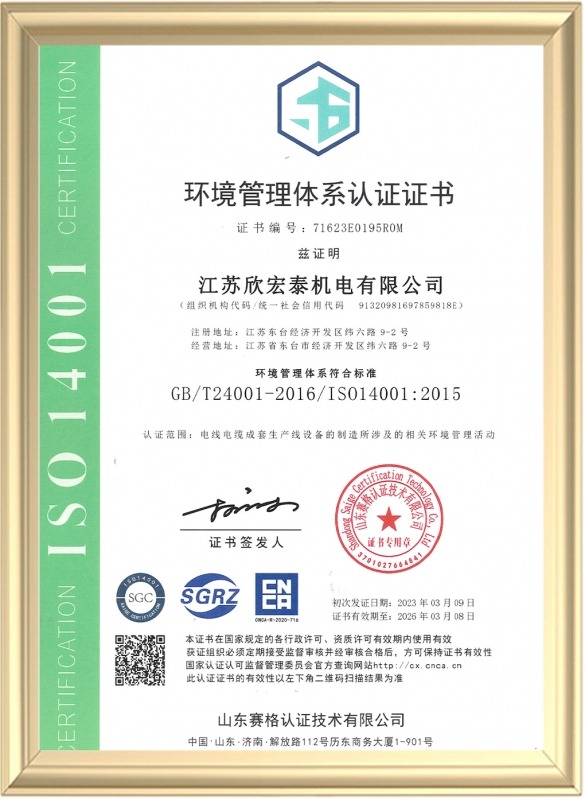
Start with management-system certification. HONTA holds ISO 9001 certification for quality management, ISO 14001 certification for environmental management, and UDEM International Certification. Buyers should ask for the scope and validity dates behind those certificates, and confirm which inspection and test records will be delivered with the machine — conductor dimensional checks, run-in records, and electrical verification, as applicable to the order.
Then test the technical conversation. A supplier who builds both bunching and stranding equipment, and who also supplies drawing and plating lines, can tell you where a conductor problem originates instead of attributing everything to the strander. That is the practical value of an integrated equipment scope: fewer boundary disputes between upstream and downstream equipment when a conductor does not meet specification.
Finally, verify the support structure against your maintenance reality: commissioning plan, operator training, spare-parts availability, and response route. The equipment scope here spans drawing, plating, and stranding, which means the same supplier relationship covers most of the conductor line and one escalation path applies.
Frequently Asked Questions
Which certifications should a high-speed bunching/stranding machine supplier hold?
HONTA holds ISO 9001 certification for quality management, ISO 14001 certification for environmental management, and UDEM International Certification. Buyers should confirm the scope and validity dates of each certificate and agree in advance which inspection and test documents will be supplied with the machine, since certification demonstrates a management system rather than the performance of a specific unit.
Can one bunching/stranding machine cover robotics, automotive, and energy cable conductors?
Rarely well. A bunching configuration optimised for fine, high-count robotics conductors differs from the concentric, layer-controlled stranding used for energy cable conductors, and automotive conductors sit between the two with repeatability as the dominant requirement. A supplier that builds both bunching and stranding equipment allows each line to be specified against its own conductor instead of forcing one compromise configuration across three product families.
What drives the cost of a high-speed bunching/stranding machine?
Cost is configuration-driven rather than model-driven. The main variables are wire diameter range, number of wires or spindles, lay length and back-twist control, automation level, pay-off and take-up type, spool size, and the documentation and acceptance-testing scope. Buyers should request an itemised quotation against a written conductor specification and compare configurations on that basis, rather than comparing headline prices for machines that are not equivalent.
Can we validate the machine on our own wire before committing to an order?
Trial running on buyer-supplied conductor is the normal way to confirm pitch control, surface quality, and spooling behaviour before an order is placed. The trial should be judged against acceptance criteria agreed in advance — finished diameter, lay length, elongation, surface condition, and spool-to-spool consistency — so that the result is a decision rather than an impression.
What affects delivery lead time, and how should it be contracted?
Lead time depends on configuration complexity, quantity, the documentation and acceptance-testing scope, and the shipping route; higher automation levels and special take-up arrangements add engineering time before production begins. The schedule should be written into the contract with milestones covering design confirmation, factory acceptance, shipment, and commissioning. To discuss a specific conductor application, trial arrangements, or a configuration-specific quotation, HONTA can be reached at tammy@jshonta.com or on +86 182 6287 9467.
Conclusion
The right high-speed bunching or stranding machine is the one whose configuration matches the conductor the cable has to deliver. For robotics cables that means bundle geometry and low-tension handling; for automotive cables it means repeatability at volume; for energy cables it means concentric layer control and shape retention through downstream processes. Speed is the outcome of getting these right, not the criterion for choosing between them.
Practically, the sequence is stable: write the conductor construction, convert it into machine parameters, choose the twist method deliberately, match pay-off and take-up to the wire supply and the downstream process, and fix acceptance criteria before any trial run. Buyers who follow that order tend to discover mismatches on paper rather than on the production floor.
Next Step: Test the Configuration Against Your Conductor
HONTA supplies copper and aluminium RBD lines, electrolytic plating lines, multi-wire drawing lines, and high-speed stranding equipment from Kunshan, Jiangsu, China, with a second production base, HONTA INC., in the United States.
Email: tammy@jshonta.com
Phone: 0086 182 6287 9467 | WhatsApp: 0086 187 5292 2675 | WeChat: wtammy0631
Website: www.kshonta.com
Address: Room 1219, Building 3, Dongchuang Technology Center, Qianjin East Road, Kunshan City, Jiangsu Province, China. Zip: 215300
Send your conductor specification — wire diameter, wire count, construction, lay length, and downstream process — and request a configuration-matched proposal or a trial discussion.

Have Questions or Need More Details?
Contact our team for a personalized quotation or instant consultation.
Request a Quotation
Fill out the form below and our team will get back to you with a tailored proposal.
WhatsApp Direct Chat
Prefer to chat in real-time? Message us on WhatsApp for instant assistance & quick answers.
- Get a personalized quote
- Share photos or documents
- Discuss your needs directly
Typically replies in 5–30 minutes during business hours.