
Compliance for US Buyers: What a Multiwire Drawing Machine Must Ship With
A multiwire drawing machine shipped to a US plant should arrive with four document families, not a single certificate: a conformity file that states exactly what was assessed and against which standards; a nameplate and electrical data record that agrees with the machine, the manual and the shipping papers; verification records that show what was checked on that specific unit before dispatch; and a traceability and support file that still functions when the plant needs a duplicate document or a spare part five years later.

The certificate a US buyer usually receives first is an EU one, and it is the document most often misread. Acceptance at a US site is assembled from several separate reviews — the buyer's engineering and EHS team, the electrical contractor and site inspector, the insurer, and whoever evaluates the control panel — and none of those reviewers treats an EU mark as the answer to a US question.
This guide is written for the buyer's compliance, engineering and procurement team. It sets out what each document family has to contain, how to test whether a supplier can produce and re-issue it, and what HONTA's current file covers — including the point at which that file stops. It ends with a documentation checklist that can be attached directly to the purchase order.
Why US Acceptance Is a Documentation Problem, Not a Logo Problem
In the EU route, a machine carries a mark because a conformity assessment was completed against a directive and the standards harmonised to it. The US does not work through a single authority for a machine installed in a plant. Acceptance is assembled locally, from separate reviews, and each reviewer reads a different piece of paper.
- Plant engineering and EHS read the technical file and the electrical data, and decide whether the line can be run and maintained safely by the people who will actually operate it.
- The electrical contractor and the site inspector read the nameplate, the control-panel documentation and the installation instructions, and decide how the equipment may be connected and energised.
- The insurer or corporate risk group reads whatever the plant presents as evidence that this is a documented, known asset rather than an undocumented import.
- Procurement and legal read the certificate scope, the issuing body, the standard list and the validity dates, and check that all four match what was ordered.
A supplier's EU certificate is useful in all four reviews and sufficient in none of them. It is evidence that a conformity assessment was carried out for the EU market under the standards it names. It says nothing by itself about how a specific control panel will be evaluated at a US site, whether the local inspector will require third-party evaluation of that panel before energisation, or whether the plant's insurer will ask for something the certificate does not contain.
What HONTA's File Already Covers — and Where It Stops
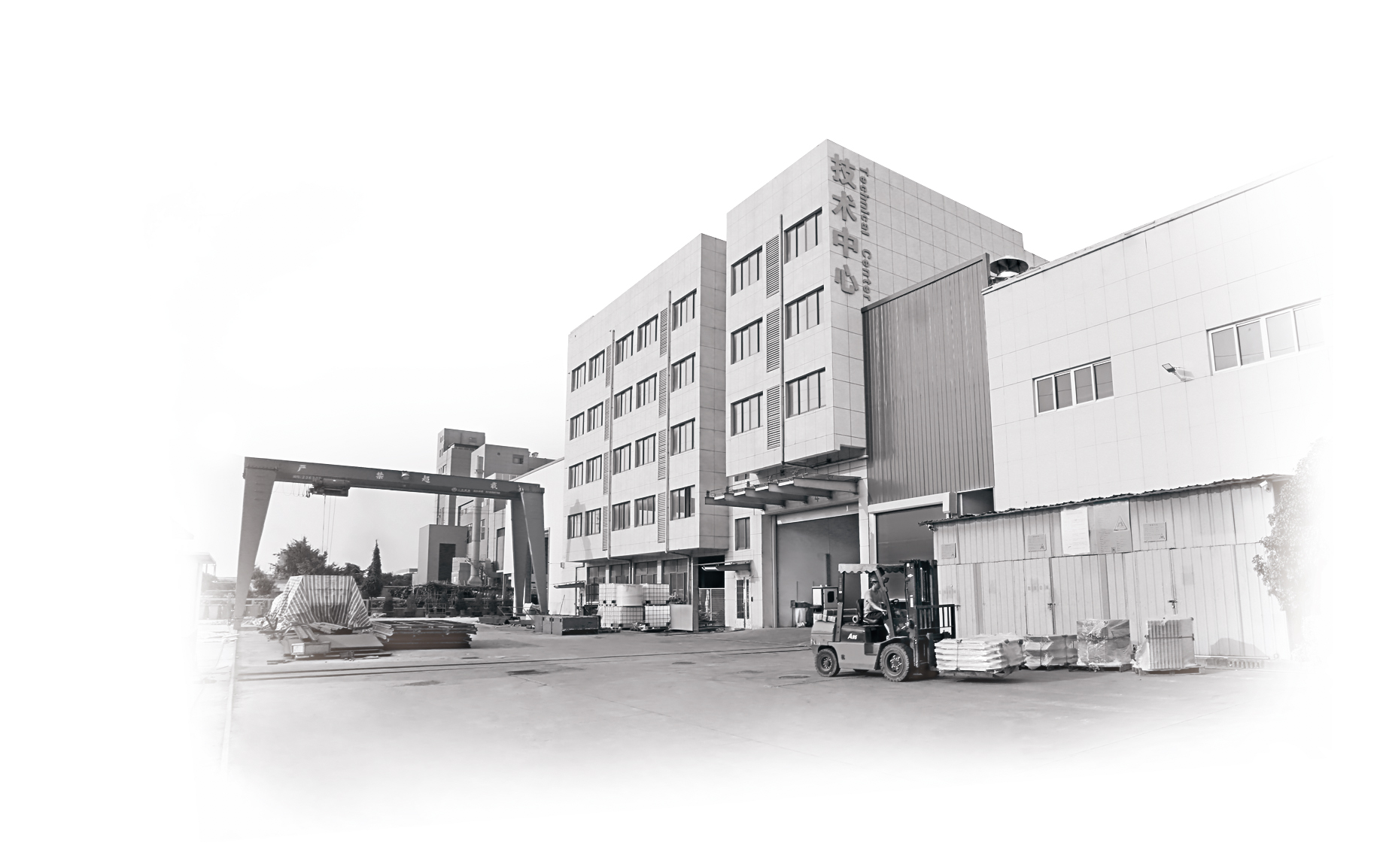
Jiangsu HONTA Machinery was founded in September 2006 and builds conductor drawing and stranding equipment on a 30,000 m² site with 157 employees, 30 engineers and an annual output of about 200 sets. Its product range covers copper and aluminium rod breakdown lines, multiwire drawing lines, high-speed bunching and stranding lines, and wire electrolytic plating lines. Export accounts for 45% of output, and the United States is listed among the company's main markets alongside the Middle East, Africa and Asia.
HONTA also established HONTA INC in the United States in 2017 as a second production base. For a compliance discussion, the value of that fact is operational rather than promotional: a document request raised after commissioning — a duplicate certificate copy, a revised nameplate drawing, a component change note — is attached to a supply relationship that already has a US-side address.
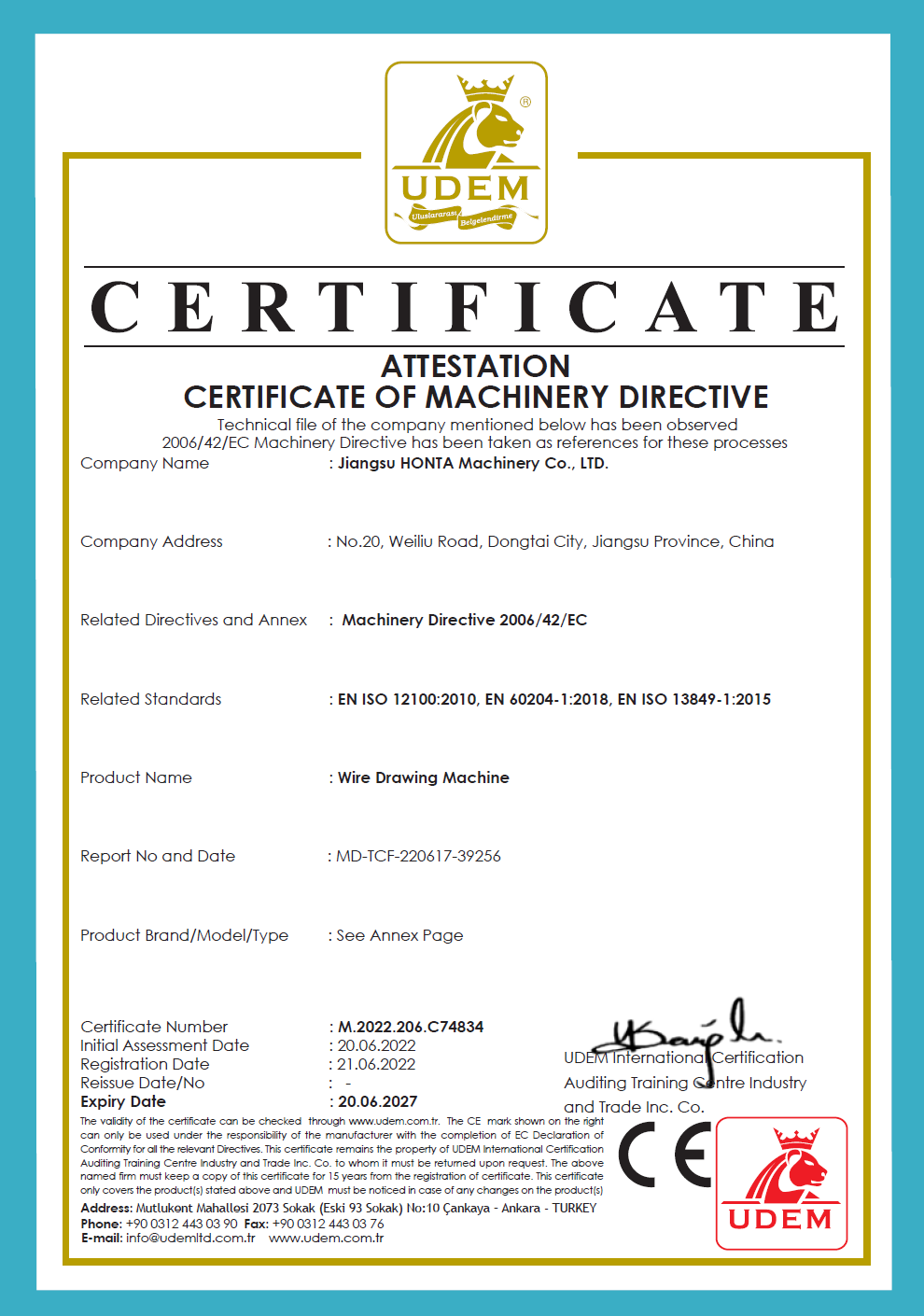
The certification record supplied with HONTA's wire drawing machine material is specific enough to be checked line by line:
- Certificate type: CE-MD, certificate number M.2022.206.C74834.
- Issuing body: Udem International Certification Auditing Trading Centre Industry and Trade Inc. Co.
- Market and scope: EU market; scope stated as wire drawing machine.
- Standards named: Machinery Directive 2006/42/EC; EN ISO 12100:2010; EN 60204-1:2018; EN ISO 13849-1:2015.
- Validity: issued 20 June 2020, expiring 20 June 2027.
Separately, reporting published in October 2026 by The National Law Review lists HONTA as holding ISO 9001 and ISO 14001 certification and as complying with IEC 60204-1 safety standards. Those records should be read carefully rather than counted. ISO 9001 and ISO 14001 are management-system certificates, and their worth to a buyer depends entirely on the certified scope and the site the certificate covers — a question worth asking in writing rather than assuming.
Where the file stops matters just as much. The CE certificate is an EU conformity document; it does not address US evaluation of a control panel. Its stated scope is "wire drawing machine", so the buyer still has to confirm that the exact model on the order sits inside that scope. And it expires on 20 June 2027, which means a machine delivered in 2027 or later should ship either with a current copy or with a written renewal plan.
The Four Document Families a US-Bound Machine Must Ship With
1. The conformity and certification file
This file answers one question: what was assessed, by whom, against what, and does the answer cover the machine in the crate? A complete file contains the certificate itself with its number and issuing body, the list of standards cited, the scope statement, the issue and expiry dates, and a statement — on letterhead, referencing the sales order — that the ordered model is within that scope.
Ask who holds the underlying technical file and whether a copy or an index can be released under confidentiality. Ask what happens at renewal: if the certificate lapses while the machine is in service, the plant's file becomes a historical document, and some insurers and internal audit teams treat that as a finding.
2. The nameplate and electrical data record
The nameplate is the only document that stays on the machine for its whole life, so it should be approved before the build, not discovered at commissioning. The deliverable is a nameplate drawing signed off by the buyer, the same data repeated in the operation manual, and the same data again on the shipping and customs paperwork.
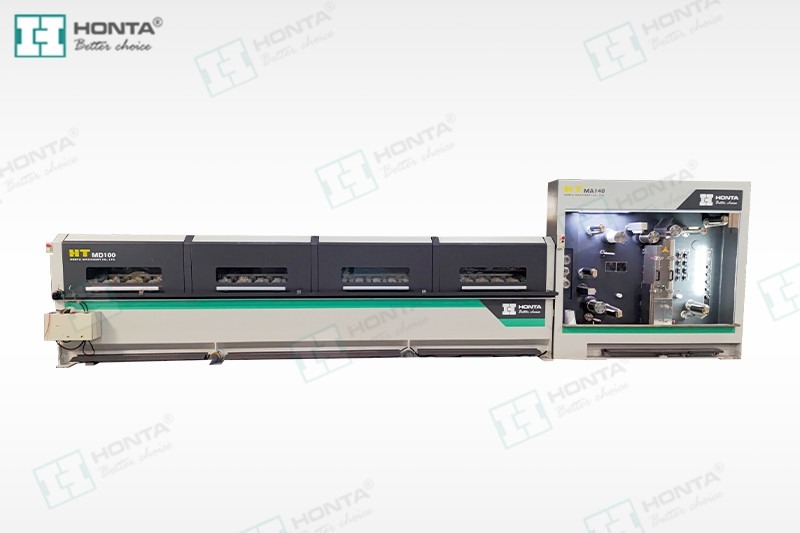
For the HT.MD100B.16.22D.01 16-wire multiwire drawing machine, the process data that has to appear consistently is an inlet wire diameter of 1.8–2.0 mm and an outlet wire diameter of 0.18–0.5 mm, with 16 wires running in parallel. The drive and control identity is a Siemens motor and a Siemens PLC, which is also what a maintenance team needs listed when it opens a spares request two years later.
3. The verification and test record
HONTA states 100% test as its quality-control regime. The question a US buyer should ask is not whether testing happens but what the record of it contains. Which checks are performed on every unit, at what speed and for how long, which instrument readings are captured, who signs the record, and does a copy travel in the document folder with the machine's serial number on it?
Because these machines are specified for continuous production with stable tension control and accurate wire alignment, the records that carry the most weight for a US plant are the ones tied to those conditions: tension-control settings as commissioned, alignment verification, and the run-in at operating speed. Witnessed testing, where the buyer's engineer attends the final run, converts several of these questions into a single answered document.
4. The traceability and support file
This is the file that decides how expensive the machine becomes in year four. It should list the as-built components by make and model, record any customization applied under HONTA's ODM arrangement — customization covers colour and the model type of components and parts — and state how a replacement nameplate or a duplicate certificate is issued.
Support arrangements belong here too. HONTA provides after-sales support by remote and on-site routes, and its export markets are stated as the EU, the Middle East and Africa, with the United States listed among main markets and served through HONTA INC. A buyer should confirm in writing which of those channels handles a documentation request, as distinct from a service call.
Nameplate and Electrical Data: The Fields a US Reviewer Actually Reads
Most commissioning friction over imported machinery comes down to data that was never written down, or was written down three different ways. The nameplate should be built from four blocks, and each block should be checked against the manual and the shipping documents before the crate is closed.
- Identity block: legal manufacturer name, model designation, serial number, year of manufacture. The model designation must be the full ordered designation, not a family name — HT.MD100B.16.22D.01, not "multiwire line".
- Electrical block: supply voltage, number of phases, frequency, full-load current, control-circuit voltage, and the motor rating. Where the control panel is documented separately, the panel's short-circuit current rating is the figure your inspector will look for; if the supplier's documents do not state it, that is a question to raise, not a gap to fill in yourself.
- Process rating block: number of wires, inlet and outlet diameter range, and rated speed. Speed figures do not transfer between models — HONTA's published data for the 24-wire HT.MD100.03.27.24 states a maximum mechanical speed of 1,800 m/min, and that number belongs to that model. The rated speed for a 16-wire machine is a different figure and must be stated for the model on the order.
- Warning and language block: safety warnings, direction of rotation, earthing point, and the language of the plate and manual. A US maintenance team needs English documentation, and the plate itself should be readable without a translation sheet.
Motor architecture changes what belongs in the electrical block. A machine built with individual motors rather than a common shaft presents per-motor data, which is more entries on the sheet but also more precise maintenance information. Industry analysis published by HTNXT in June 2026 estimates that individual-motor multiwire machines can reduce energy consumption by up to 25% compared with common-shaft systems; that is an estimate rather than a measured guarantee, and it is the kind of figure a buyer should ask to see substantiated for the specific configuration being quoted.
Questions to Put to the Supplier, in the Order They Matter
Documentation requests fail when they arrive as one long list at the end of a project. Sequenced against the commercial milestones, each group is short enough to be answered in writing.
- Before the RFQ: Which certificate applies to the model we are considering, what is its number and scope, and when does it expire? Who issued it? Which standards are cited? Is a copy available now, before pricing?
- At purchase order: Will the PO list the document set as a line item, with content, language and delivery point? Will a nameplate drawing be issued for approval before the build starts? Will the conformity statement name our exact configuration rather than the product family?
- Before shipment: What does the test record contain, and can we see a sample for a comparable unit? Will the record for our serial number be included in the folder? If we send an engineer, which tests can be witnessed?
- At arrival: Do the nameplate, manual, packing list and commercial invoice agree on model, serial number and electrical data? Is there a single contact for a documentation discrepancy, and what is the response route?
- At commissioning: Which documents transfer to the plant's maintenance system, and which stay with the installer? Who signs off the as-commissioned settings?
- Year two and beyond: How is a replacement nameplate issued? How is a duplicate certificate obtained if the original is lost? If the certificate is renewed, is the renewed copy sent to existing machine owners?
How Three US Buyer Types Use the Same Packet
A US cable plant adding a 16-wire line. The immediate internal customers are the electrical contractor and the plant's insurer. That buyer needs the nameplate drawing and the electrical data before the contractor prices the connection, and needs the test record before the line is energised. The conformity file goes into the engineering archive and is referenced, not read, unless an audit asks for it.
A US distributor or integrator reselling into a plant. This buyer needs every document to be transferable, because the end user will ask the distributor for it. A certificate naming only the manufacturer, with no route to a model-specific statement, becomes the distributor's problem. Ask at quotation stage whether a model-specific conformity statement can be issued to a named end user.
A plant extending an existing conductor line. Here the documentation question is continuity: does the new machine's data match the drawings, spares list and maintenance records of the equipment already running? HONTA's case record lists two machines supplied for wire drawing to a wire and cable factory recorded under the country codes US, UM, PL, PT, ES and TR; after three years of operation the machines are reported to produce steadily to the customer's requirements, with fast speed and high efficiency noted as the highlights. For an expanding plant, the useful question is what documentation was reissued during those three years, and how quickly.
The Document Set at a Glance
The table below maps each document to what it actually establishes, who reads it in the US, and the one question that closes the remaining gap. None of the rows is satisfied by a logo on the machine.
| Document element | What it establishes | Who reads it in the US | Question that closes the gap |
|---|---|---|---|
| CE-MD certificate M.2022.206.C74834 (valid to 20 June 2027) | That a conformity assessment was completed for the EU route under Machinery Directive 2006/42/EC, EN ISO 12100:2010, EN 60204-1:2018 and EN ISO 13849-1:2015 | Buyer's engineering file; corporate compliance | Is our ordered model inside the stated scope, and who holds the technical file? |
| Nameplate and electrical data sheet | The machine's electrical identity: voltage, phases, frequency, full-load current, control voltage, ratings | Electrical contractor; site inspector | Will this panel be accepted as shipped, or will our inspector require third-party evaluation before energisation? |
| Test and verification record | What was checked on this serial number before dispatch | Buyer's QA; insurer | Which checks does the 100% test regime cover, and does the signed record ship with the machine? |
| As-built component list | The make and model of the motor, PLC and key components actually installed (Siemens motor and Siemens PLC on HT.MD100B.16.22D.01) | Maintenance; spares purchasing | Will the list be reissued if a component changes during build? |
| ISO 9001 and ISO 14001 certification, as reported by The National Law Review in October 2026 | Process discipline at the certified site — not product safety | Procurement; supplier audit | What is the certified scope, and which site does it cover? |
| Support and spares file | The after-sales route (remote and on-site), the US-side entity, and how documents are reissued | Operations; service planning | Who issues a replacement nameplate or a duplicate certificate in year five? |
What a Document Packet Cannot Do
A complete folder does not make a machine conform, and no supplier should imply otherwise. Four limits are worth stating plainly before a purchase order is drafted.
- It does not replace the installation review. The decision on how the equipment may be connected and energised belongs to the authority inspecting the site, and that decision can add requirements the supplier never sees.
- Certificate scope is narrower than product range. A scope line reading "wire drawing machine" still has to be matched against the model, the options and the customization applied.
- Expiry is a live risk. A certificate expiring on 20 June 2027 is valid today and a maintenance item tomorrow; buyers taking delivery late in the validity window should ask for the renewal position in writing.
- Management-system certificates are not product approvals. ISO 9001 and ISO 14001 describe how a site is run. They support confidence in document control; they do not certify a machine's safety.
FAQ: US Compliance Questions for Multiwire Drawing Machine Buyers
Does a CE certificate make a multiwire drawing machine acceptable in the US?
No. A CE certificate records that a conformity assessment was completed for the EU market against the standards it names — on HONTA's file, Machinery Directive 2006/42/EC with EN ISO 12100:2010, EN 60204-1:2018 and EN ISO 13849-1:2015, under certificate M.2022.206.C74834 valid to 20 June 2027. It is strong supporting evidence for a US technical file, but US acceptance is decided by separate reviewers at the plant: engineering and EHS, the electrical inspector, the insurer, and whoever evaluates the control panel. The buyer's task is to ask each of them what they need, then request those items from the supplier in writing.
How can a US buyer confirm that a supplier can actually produce and reissue the document packet?
Test the document system, not the sales claim. Ask for the certificate copy before pricing, check that the model on your order sits inside the stated scope, request a sample test record for a comparable unit, and ask in writing who issues a replacement nameplate or duplicate certificate after delivery. Evidence of a functioning system includes HONTA's stated 100% test regime, its ISO 9001 and ISO 14001 certification as reported by The National Law Review in October 2026, the defined validity period of its CE-MD certificate, its ODM customization process covering colour and the model type of components and parts, and the presence of HONTA INC in the United States since 2017 as a second production base.
Which documentation items change the budget or the schedule?
Anything that takes the machine out of standard configuration. HONTA's stated lead time is 90 days, monthly capacity is 15 sets and the minimum order is 1 set, so the schedule is set by the build slot rather than by paperwork — but special requirements move the machine out of a catalogue build. Specific wire diameters or coating thickness, laser alignment, high-speed twisting specifications and carbon-fibre dynamic balance structures all have to be engineered, tested and documented, so they should be confirmed before the price is fixed rather than after the purchase order. Customization of colour and of component model types has the same effect on the document set: the nameplate drawing and as-built list change with it.
What can a buyer examine before the machine ships?
Four things, all of which can be requested at quotation stage: the certificate copy with its scope and expiry, a sample test record from a comparable unit, the proposed nameplate drawing for approval, and the as-built component list for the configuration quoted. Where physical verification matters more than paper, the practical options are witnessed final testing at the works and a review of the reference record — HONTA's case record lists two machines supplied for wire drawing to a wire and cable factory recorded under the country codes US, UM, PL, PT, ES and TR, reported to produce steadily to the customer's requirements after three years of operation. A witnessed test converts several documentation questions into one signed document.
How does the 90-day lead time interact with the documentation work?
Documentation has to run in parallel with the build, not after it. With a 90-day lead time, the nameplate drawing should be approved in the first weeks, the conformity statement should be issued against the final configuration before packing, and the test record should be signed at final inspection — not reconstructed afterwards. The most reliable way to hold that sequence is to place the document set in the purchase order as a deliverable with a named recipient, and to confirm at order acknowledgement which contact owns each item. Buyers who want to review the equipment scope before that conversation can start with the Catalogue of drawing machines (PDF) and then request the documentation pack for the specific model.
Documentation Checklist to Attach to the Purchase Order
The checklist below is written to be copied into a purchase order or an annex. Each line is a deliverable with an owner, not a topic for discussion.
- Certificate copy with number, issuing body, standard list, scope statement, issue date and expiry date.
- Written confirmation that the ordered model and configuration fall within the certificate's stated scope.
- Nameplate drawing issued for buyer approval before the build begins.
- Electrical data sheet: voltage, phases, frequency, full-load current, control-circuit voltage, motor rating, and the panel's short-circuit current rating where the panel is documented separately.
- Process rating sheet: number of wires, inlet and outlet diameter range, rated speed for the exact model ordered.
- Test and verification record for the machine's serial number, signed, with the checks it covers listed on its face.
- As-built component list naming the installed motor and PLC and other key components by make and model.
- Customization record covering any colour or component model-type changes applied under the ODM arrangement.
- Operation and maintenance manual in English, matching the nameplate data exactly.
- Spares list and the named contact for spare-part and document-reissue requests.
- After-sales route confirmed in writing, separating remote support from on-site support and naming the US-side contact.
- Renewal undertaking for the certificate expiring on 20 June 2027, for machines delivered inside or after that window.
What This Means Before You Sign
The compliance question for a US-bound multiwire drawing machine is not answered by a mark on the frame. It is answered by a folder that a plant engineer, an electrical inspector, an insurer and a procurement reviewer can each read for their own purpose — and by a supplier who can reissue any page of that folder after the warranty conversation has ended. HONTA's position in that conversation rests on documents a buyer can inspect today: CE-MD certificate M.2022.206.C74834 with its named standards and 2027 expiry, ISO 9001 and ISO 14001 certification reported by a third party, a 100% test regime, a stated 90-day lead time, and a US production base established in 2017.
What no supplier can do on the buyer's behalf is decide what a particular US site will require. That decision sits with the plant's own reviewers. The workable sequence is to ask them first, convert their answers into a document list, and place that list in the purchase order while the machine is still a build slot rather than a crate on the dock.
Building the document list for a US installation?
Start with the machine scope in the Catalogue of drawing machines, then request the certificate copy, nameplate drawing and test-record sample for the exact model under consideration.
Company reference: Jiangsu HONTA Machinery — international trade contact Tammy, tammy@jshonta.com, tel +86 182 6287 9467.

Have Questions or Need More Details?
Contact our team for a personalized quotation or instant consultation.
Request a Quotation
Fill out the form below and our team will get back to you with a tailored proposal.
WhatsApp Direct Chat
Prefer to chat in real-time? Message us on WhatsApp for instant assistance & quick answers.
- Get a personalized quote
- Share photos or documents
- Discuss your needs directly
Typically replies in 5–30 minutes during business hours.