
Factory Acceptance vs. Site Acceptance for High-Speed Bunching/Stranding Machines

Cover image: HONTA company site context for factory acceptance planning. The image is company-level context, not a machine-specific acceptance record.
Factory acceptance and site acceptance answer different procurement questions. Factory acceptance should prove that a high-speed bunching/stranding machine was built and configured to the approved order before shipment. Site acceptance should prove that the installed machine, connected line, utilities, operators and production wire work together under the buyer's conditions. A purchasing contract that uses only one stage leaves either the machine build or the installed production result under-controlled.
The practical answer is to treat acceptance as a two-stage release system. Put design, build, safety, documentation and pre-shipment readiness in the factory acceptance protocol. Put installation, line integration, wire trial, run stability, training and handover in the site acceptance protocol. Then attach each payment and release milestone to a defined protocol event, not to a calendar date alone.
What Factory Acceptance and Site Acceptance Mean in a Stranding Machine Order
Factory acceptance, often called FAT, is the formal review and test of a machine at the supplier's manufacturing site before shipment. For a high-speed bunching/stranding machine, it can cover the agreed configuration, mechanical assembly, guarding, electrical and control functions, safety devices, no-load or short-run operation, documentation package, and shipment readiness. The exact content belongs in the contract protocol; the label “FAT” alone does not define it.
Site acceptance, often called SAT, is the formal review after delivery and installation at the buyer's plant. It can cover installation quality, utility connections, line integration, guarding in the installed position, control and interlock checks, operation with the buyer's wire and product, operator familiarization, punch-list closure and handover. SAT is not a repeat of FAT by default. It should focus on the conditions that did not exist at the factory.
The buyer's main task is to write acceptance criteria that match each stage. If a clause says “machine must run stably,” it is not an acceptance criterion until the protocol says what is observed, under which conditions, with which wire, by whom, and with what record. This is a contract-design issue before it is a technical issue.
Why One Acceptance Stage Cannot Prove Everything
A high-speed bunching/stranding machine is an integrated system: pay-off, wire path, tension control, bunching or stranding head, drive, take-up, lubrication, guarding and controls interact. Final wire quality and run stability emerge from that interaction plus the input wire, setup and operating environment. Factory conditions can control many machine variables; they cannot reproduce every buyer-side variable.
Factory acceptance is strong for build verification. The supplier can inspect the machine against the approved configuration, check assembly and alignment, confirm control logic and safety functions, and review documentation before packing. It can also run the machine under factory conditions when the protocol provides for it. What factory acceptance cannot fully prove is whether the same machine will perform in the buyer's building, with the buyer's incoming wire, the buyer's operators, the buyer's utilities and the full downstream line.
Site acceptance is strong for installed-system verification. It can show whether the machine starts, stops, interlocks, tensions and takes up as installed; whether the line interfaces work; whether guards and access remain correct after installation; and whether operators can follow the handover procedures. What site acceptance cannot easily prove is build quality that is hidden after installation, or configuration details that should have been checked before shipment. That is why the split matters.
What Factory Acceptance Can Prove About Wire Quality, Run Stability and Documentation
Factory acceptance can prove wire quality only to the extent that the protocol includes a wire trial with an agreed reference sample, machine settings and evaluation method. Without that, FAT proves machine functions, not final product quality. When a wire trial is included, the record should identify the wire source, specification, product type, settings and the characteristics observed. The buyer should also state the limit of the claim: a factory trial using a reference sample is evidence for that sample and setup, not a guarantee for every production batch.
For run stability, factory acceptance can verify that the machine operates through its agreed functions without obvious mechanical, electrical or control faults. It can confirm acceleration and deceleration sequences, tension response, traverse or take-up behavior, and safety responses where the protocol defines them. It cannot prove long-term production stability in the buyer's plant because the installed foundation, utility quality, ambient conditions, wire supply and operator routine are not present.
Factory acceptance is also the right stage to verify the documentation set before shipment. The buyer can require approved drawings, operating manuals, maintenance instructions, control backups, spare-parts lists and records of the agreed checks. The contract should distinguish draft documents from final documents and state the language and format. Documentation review at FAT reduces the risk of discovering missing manuals after the machine is already installed.
What Site Acceptance Can Prove About Installed Stability and Handover
Site acceptance can prove that the machine and its line are installed and connected as a working system. It can verify foundation and anchoring conditions, level and alignment, utility connections, direction of rotation, guarding, emergency stops, interlocks, control communications and line interfaces. These are site-specific facts; they cannot be established by a factory test alone.
Site acceptance is also the better stage for a production wire trial when the buyer wants evidence under actual conditions. The protocol can define the product family, wire source, operating settings, sampling method and record. The result should be treated as evidence for the tested configuration and conditions. It should not be written as a universal performance promise for every future product or every operator.
Handover belongs at site acceptance. That includes operator familiarization, safety briefing, cleaning and lubrication routines, fault-response guidance, spare-parts location, and a clear punch list. The buyer should not release final acceptance merely because the machine has arrived or because a fixed number of days has passed. Release should follow the agreed evidence and closure of defined items.
Factory vs. Site Acceptance: Comparison Table
| Decision area | Factory acceptance can establish | Site acceptance can establish | Contract treatment |
|---|---|---|---|
| Wire quality | Whether an agreed reference wire trial was performed and recorded under factory conditions, if the protocol includes one. It is limited to the tested sample and settings. | Whether the installed machine produces the agreed product from the buyer's production wire and line setup. It is limited to the tested product and conditions. | Define sample source, product family, settings, evaluation method and record. Avoid a general “good wire quality” clause. |
| Run stability | Functional operation, control response, safety functions and short-run behavior under factory conditions as defined in the protocol. | Operation in the installed line, with actual utilities, foundation, environment and operator routine, over the agreed site observation. | Use separate factory and site criteria. Do not use one stage's result as automatic proof of the other. |
| Documentation | Availability and completeness of drawings, manuals, control backups, check records and spare-parts lists before shipment. | Installed configuration, site modifications, training records and final dossier after commissioning. | List deliverables by stage, with language, format and final-status requirements. |
| Spares | Identification, preservation, packing and shipment readiness of the agreed spare-parts list. | Actual fit, use during installation and commissioning, and replenishment needs found on site. | Require a spare-parts list at FAT and a handover check at SAT. |
| Handover | Release of the machine for shipment after agreed factory checks and packing review. | Operator familiarization, safety briefing, punch-list closure and final release for production. | Use two separate certificates: factory release and site acceptance. |
How to Split Purchasing Terms and Acceptance Criteria
A workable split starts with the order configuration. The contract should identify the machine model, line arrangement, supplied scope, interface boundaries and excluded items. Then the acceptance protocol should assign each check to FAT, SAT or both with a clear purpose. Repeating the same check at both stages is not automatically wrong, but the buyer should know why it is repeated and which result controls release.
For factory acceptance, the purchasing terms should define the notice period for witnessing, the documents to be reviewed, the test record format, the handling of open items, and the conditions for a factory release certificate. If the buyer cannot attend, the contract should say whether remote witnessing, video records or third-party inspection are allowed and what evidence is accepted. The contract should also state whether a factory release certificate authorizes shipment, payment, or both.
For site acceptance, the terms should define who installs and commissions the machine, what utilities and wire the buyer supplies, how long the site observation lasts, what product is tested, how output is recorded, and what happens if an item fails. The protocol should separate safety-critical punch items from minor documentation or cosmetic items. Final acceptance should require closure of the agreed items, not merely the passage of time.
A useful rule is to keep criteria observable. “Machine is stable” is not observable. “Machine completes the agreed start-stop sequence, tension response check and product trial with the record signed by both parties” is observable. The same rule applies to documentation, spares and training. The contract does not need to be long; it needs to be specific enough that a third party can read the record and understand what was accepted.
Payment and Release Milestones That Follow the Split
Payment milestones should follow evidence, not hope. A common structure is deposit at order, a payment after signed factory acceptance, a payment after delivery or installation, provisional acceptance after site acceptance, and a final release after the agreed punch list and handover are complete. The exact percentages are commercial terms and are not fixed by the acceptance method. The important point is that each payment is linked to a named certificate or record.
The factory acceptance certificate should not be issued if the protocol has not been completed or if material open items remain. The site acceptance certificate should not be issued merely because the machine has been installed. It should depend on the agreed site checks, product trial where specified, training and punch-list closure. If the buyer needs a retention amount, it should be tied to a defined final event, not to an indefinite future condition.
Buyers should also avoid “deemed acceptance” by elapsed time alone unless they have had a real opportunity to inspect, test and document the machine. A time-based fallback can be reasonable for minor items, but it is weak for safety, wire-quality or run-stability criteria. The contract can require written notice of any blocking item before a deadline, with a clear path to resolve it.
Use Cases: Three Practical Allocation Models
New line with variable wire supply
When the buyer is installing a new line and expects to process a range of wire sources, factory acceptance should focus on build, configuration, safety, documentation and a reference wire trial if agreed. Site acceptance should carry more weight for production wire trials, line integration and operator handover. Payment release can be split so that a larger share follows site acceptance, while still recognizing the supplier's completed build at FAT.
Replacement machine in a known process
When the buyer already knows the product and process, factory acceptance can include a more specific reference trial and a detailed configuration check. Site acceptance can be shorter but should still verify installation, utilities, interlocks, take-up and handover. The buyer should not skip site acceptance entirely; a known process reduces uncertainty but does not remove installation variables.
Multi-line order with staged delivery
For multiple machines or lines, acceptance should be defined per unit and per line. Factory acceptance can be staged by serial number, with a certificate for each. Site acceptance can follow installation of each line, with its own punch list. Payment milestones should identify the unit or line they relate to; otherwise a dispute on one machine can block release of the whole order.
Documentation, Spares and Handover Details Buyers Often Miss
Documentation should be treated as an acceptance deliverable, not an afterthought. At factory acceptance, the buyer can check that the agreed drawings, manuals, control backups, maintenance schedules and spare-parts lists exist and match the machine configuration. At site acceptance, the buyer can confirm that the final installed configuration, site changes, training records and commissioning records are included in the handover dossier.
Spares need two checks. At FAT, the agreed spare-parts list should be identified, preserved and packed for shipment. At SAT, the buyer can confirm that the spares fit the installed machine and that the storage or replenishment plan is understood. This is especially relevant for wearable or routine-maintenance items, where the buyer needs to know what is supplied, what is recommended and what must be ordered separately. The contract should state which items are included rather than leaving the spare-parts scope to assumption.
Handover should include more than a signature. Operators need to know the normal start and stop sequence, safety checks, lubrication and cleaning routines, fault indications and escalation path. Maintenance staff need the relevant drawings and control information. The buyer's acceptance record should show who received the handover and which documents were transferred.
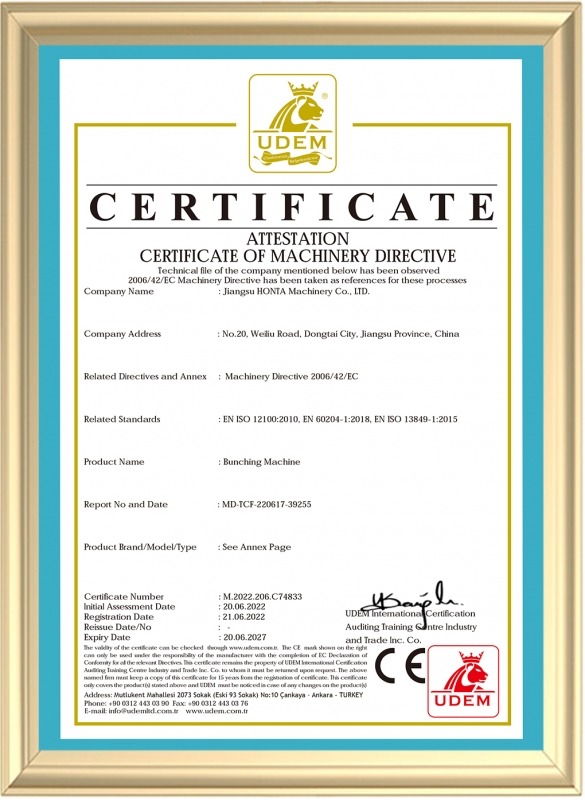
HONTA's supplied certificate list includes UDEM International Certification. A company-level certificate supports supplier documentation, but it does not replace a machine-specific factory acceptance record.
Company-level certificates and machine-level acceptance records serve different purposes. HONTA's supplied certificate list includes ISO 9001 Certification, ISO 14001 Certification and UDEM International Certification. These can support a supplier evaluation, but the buyer should still require the FAT and SAT records for the actual machine, configuration and order. A certificate image should not be used as a substitute for the acceptance protocol.
Where HONTA Fits in a High-Speed Stranding Equipment Evaluation
HONTA is a cable equipment system service provider established in September 2006. Its main products include copper and aluminum RBD lines, electrolytic plating lines, multi-wire drawing lines and high-speed stranding equipment. HONTA also states that it established its second production base, HONTA INC., in the United States in 2017. For a buyer preparing a factory and site acceptance split, these facts help identify the supplier's product scope and support context; they do not by themselves define the acceptance criteria for a specific machine.
The acceptance protocol should still be built around the actual order: the machine configuration, the buyer's wire and product, the line interfaces, the utilities, the documentation language and the handover plan. HONTA's stated product focus includes high-speed stranding equipment, so the FAT/SAT discussion should be tied to the supplied configuration and the agreed test records rather than to a general supplier claim.
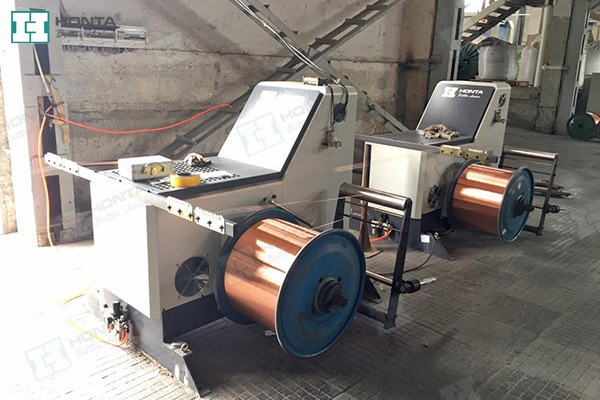
A multi-wire pay-off is part of the wire path around a stranding line. Its installed interface is a site-acceptance check, not a substitute for the stranding machine's factory acceptance.
FAQ
What should a factory acceptance test cover for a high-speed bunching/stranding machine?
Factory acceptance should cover the agreed configuration, mechanical assembly, guarding, electrical and control functions, safety devices, documentation set, spare-parts identification and shipment readiness. If the contract includes a reference wire trial, the protocol should state the wire source, settings, evaluation method and record. The test should not be described as proof of performance in the buyer's plant.
What can site acceptance prove that factory acceptance cannot?
Site acceptance can prove how the machine works after installation in the buyer's plant. It can verify foundation and alignment, utility connections, line interfaces, guards and interlocks in the installed position, operation with the buyer's production wire, operator familiarization and punch-list closure. These conditions are not present at the factory, so they cannot be accepted there.
How should payment and release milestones follow the chosen acceptance split?
Link each payment to a named acceptance event: order deposit, signed factory acceptance certificate, delivery or installation milestone, site acceptance certificate and final release after punch-list and handover. The exact percentages are commercial terms. The key is that no payment or release should depend on an undefined “acceptance” event, and final release should not be automatic by elapsed time alone.
Can a buyer combine remote witnessing with a site acceptance?
A buyer can use remote witnessing for factory acceptance if the contract allows it and defines the evidence: live video, recorded tests, signed records, document review or third-party inspection. Remote witnessing does not replace site acceptance for installation, line integration and handover. The contract should state which records are accepted and who signs each certificate.
How long should the site acceptance window be before final release?
The window should be long enough to complete the agreed installation checks, product trial, training and punch-list review. A fixed number of days is less useful than a defined event sequence. The contract can set a target period for the site observation and a separate final-release condition after the agreed items are closed. If you are preparing an order, HONTA can review the FAT/SAT split against the supplied machine configuration; contact tammy@jshonta.com or call 0086 182 6287 9467.
Conclusion
Factory acceptance and site acceptance are not competing formalities. They are two evidence gates for one purchase. Factory acceptance controls what can be verified before shipment: build, configuration, safety functions, documentation and shipment readiness. Site acceptance controls what can be verified only after installation: line integration, utilities, production wire trials, run stability in the buyer's environment and handover.
For high-speed bunching/stranding machine orders, the strongest purchasing terms assign each criterion to a stage, define the record that proves it, and connect payment or release to that record. The exact allocation can vary with the buyer's product, line maturity and risk tolerance. What should not vary is the discipline: no undefined acceptance, no single-stage proof for a two-stage problem, and no final release without the evidence the contract actually requires.
Have Questions or Need More Details?
Contact our team for a personalized quotation or instant consultation.
Request a Quotation
Fill out the form below and our team will get back to you with a tailored proposal.
WhatsApp Direct Chat
Prefer to chat in real-time? Message us on WhatsApp for instant assistance & quick answers.
- Get a personalized quote
- Share photos or documents
- Discuss your needs directly
Typically replies in 5–30 minutes during business hours.