
High-Speed Bunching/Stranding Machine Comparison: Single Twist vs. Double Twist Configurations
Bunching and stranding machines are among the core equipment decisions in cable conductor production. When selecting a high-speed bunching/stranding machine, production planners and procurement teams often need to evaluate two broadly used configurations: single twist and double twist. The choice affects usable output, maintenance workload, floor-space requirements, product-changeover flexibility, and the way a supplier can support capacity and delivery targets.
The purpose of this guide is practical. It compares single twist and double twist configurations without inventing specifications. It also links the comparison to the procurement question that is most difficult to answer before signing a contract: how do you judge whether the proposed machine design, and the supplier behind it, can match your production demand and delivery schedule?
HONTA is a cable equipment manufacturer established in September 2006, headquartered in Kunshan, Jiangsu Province, China. The company has long-term cooperation with cable producers internationally and established its second production base, HONTA INC., in the United States in 2017. Its product scope covers copper and aluminum RBD lines, electrolytic plating lines, multi-wire drawing lines, and high-speed stranding equipment. The company supplies this comparison in the context of complete cable conductor manufacturing lines rather than isolated machinery.
The Procurement Problem: Matching Machine Configuration to Real Output
A common procurement risk is basing capacity planning on a machine type rather than on the total production process. Single twist and double twist machines can be built with similar maximum mechanical ratings, but their true throughput differs because each configuration applies twists differently. If the proposed configuration is not aligned with the conductor design, the line may produce far less usable output than expected, or it may require excessive downtime and rework.
Another risk is delivery-time uncertainty. A supplier may quote a standard machine delivery period, but if the configuration requires special tension control, custom take-up equipment, or additional integration with drawing and pay-off lines, the lead time can change significantly. Understanding the difference between single twist and double twist configurations is therefore not only an engineering exercise. It is a capacity-planning and supply-chain risk control task.
Industry Background: Bunching/Stranding Machines Inside a Complete Conductor Line
Modern cable manufacturing is increasingly evaluated as a continuous value stream. Raw rod enters a rod breakdown machine, then passes through multi-wire drawing, optional electrolytic plating, and finally bunching or stranding to create a flexible conductor. For this reason, a high-speed bunching/stranding machine is rarely an independent island on the factory floor; it must be coordinated with pay-off equipment, tension control, spoolers, and downstream processes.
HONTA's product portfolio reflects this system-level view. The company supplies copper and aluminum rod breakdown lines, electrolytic plating lines, multi-wire drawing lines, and high-speed stranding equipment. That breadth is relevant to the configuration comparison because a single-twist or double-twist decision cannot be isolated from the upstream conductor condition and the downstream take-up system.
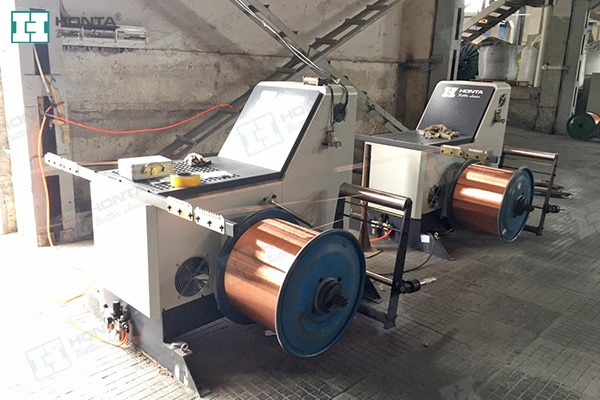
When buyers evaluate machine comparisons, they should look for evidence that the supplier understands the surrounding line. A supplier with experience in pay-off, drawing, plating, and spooling can give more reliable answers about how a single twist or double twist machine will behave when it is connected to a particular production line.
What Is a Single Twist Bunching/Stranding Machine?
In a single twist bunching or stranding configuration, one complete twist is formed for each revolution of the rotating part. This means the amount of twisted product length is directly related to the number of rotations that the machine makes. Single twist machines have traditionally been valued for their relatively direct wire path and simpler operating principle.
From a buyer perspective, the strongest argument for a single twist configuration is usually predictability. Because the twisting principle is straightforward, it can be easier to explain, easier to set up, and easier for maintenance staff to understand. Single twist configurations may be preferred when the production program includes frequent product changes or when the plant wants to keep machine complexity low.
At the same time, for a given rotational speed, a single twist machine generally produces less finished length than a double twist machine because it delivers fewer twists per revolution. This is a fundamental difference in operating principle, not a statement about any particular brand or model.
What Is a Double Twist Bunching/Stranding Machine?
A double twist bunching/stranding machine uses a wire path that generates two twists per revolution of the rotating rotor. The double twist principle is one of the main reasons why high-speed bunching/stranding machines are able to deliver more output from a single machine position than single twist designs under comparable rotational conditions.
The practical benefit is higher production potential per unit of floor space. This becomes important when a manufacturer has dedicated, uninterrupted production programs and wants to maximize output from a limited plant area. Double twist configurations are often associated with fine and medium conductor stranding in volume cable production.
The trade-off is greater complexity. The wire path requires careful tension management, and there are more rotating and guiding elements involved in the machine construction. Buyers should not assume that double twist is automatically the best choice. Its commercial advantage is meaningful only when the product mix and plant resources allow the machine to run with good utilization and stable maintenance.
Detailed Solution: Comparing the Two Configurations for Realistic Decision-Making
To translate the two machine types into a procurement decision, compare them on evidence-based operating characteristics rather than on a single speed claim. The most useful comparison is built around output, complexity, maintenance, product fit, and integration effort.
Operational speed and output
Double twist machines have an inherent structural speed advantage because two twists are formed per revolution. At the same rotor speed, the double twist principle can complete more twists in a given time than a single twist principle. However, maximum mechanical speed is not the same as usable production speed. The actual achievable speed depends on the wire diameter, tensile strength, conductor class, spool size, tension control, and downstream take-up stability.
Single twist machines can be built as high-speed machines as well, but their productivity per rotation is lower. For a buyer comparing throughput, the correct question is not simply whether the machine is single twist or double twist. The correct question is: what usable output does the complete configuration deliver for a defined conductor specification?
Machine complexity and maintenance
Single twist designs usually offer a simpler wire path. This can simplify training, setup, and routine maintenance. With fewer moving elements in the twisting zone, the maintenance team has fewer variables to inspect. This is a meaningful benefit for plants with limited specialized maintenance resources.
Double twist configurations can achieve higher output per position, but the wire path and rotating mechanism are more complex. Regular inspection of the tension path, rotating elements, and communication between pay-off and take-up is essential. Buyers should include projected maintenance cost and downtime in the comparison instead of comparing only the purchase price.
Floor-space and capacity planning
For high-volume requirements, double twist machines can reduce the number of machine positions needed to reach the same output target. That can lower floor-space consumption per unit of production and reduce material handling between stages. For lower production volumes or very changeable product mixes, a smaller number of single twist machines may provide sufficient output while keeping the production area more flexible.
Product suitability
There is no universal rule that divides all products cleanly between single twist and double twist machines. Conductor construction, lay length, wire diameter range, strand count, and downstream processing requirements matter as much as the twisting mechanism. The correct approach is to identify the product family that must run on the machine, then see whether the proposed configuration can meet quality and throughput requirements for that family without excessive changeover time.
Step-by-Step Breakdown: How to Match Single or Double Twist Machines to Your Demand and Delivery Plan
The following workflow helps a procurement team move from machine theory to a capacity and delivery decision.
Step 1: Define the conductor specification clearly
Document the number of wires, wire diameter range, final conductor construction, lay length, required tensile/elongation performance, and any customer-specific electrical requirements. This specification becomes the common reference for comparing single twist and double twist offers. Without a clear specification, every speed comparison is guesswork.
Step 2: Calculate the required usable output, not just mechanical speed
Convert annual production targets into weekly or daily output requirements. Include planned changeovers, potential rework, maintenance time, and operator availability. Ask each supplier to state how the proposed machine configuration reaches the required usable output. If a supplier only quotes maximum machine speed, request a production calculation based on your conductor specification.
Step 3: Evaluate setup flexibility and maintenance capability
Compare how long it takes to change from one wire construction to another on each configuration. Consider the availability of local maintenance skills. A double twist configuration may offer higher throughput, but if the plant cannot efficiently maintain it, the gain may disappear through downtime. A single twist configuration may be easier for a small technical team to keep stable.
Step 4: Audit supplier capacity and delivery control
Delivery risk is not caused only by the machine type; it is also caused by supplier load, component sourcing, and production planning. Ask whether the supplier has enough engineering and manufacturing capacity to build the machine in the requested time window. Check whether they have documented quality management systems. HONTA's manufacturing and quality processes, for example, are supported by ISO 9001 and ISO 14001 certifications. Buyers can use such certifications as evidence that the supplier follows structured procedures for production and environmental management.
Step 5: Plan line integration and commissioning
Clarify what is included in the delivery scope. A high-speed bunching/stranding machine needs upstream pay-off control and downstream take-up spoolers. If the same supplier can provide line integration, commissioning risk may be reduced because interface responsibilities sit in one place. HONTA's product range includes not only high-speed stranding equipment but also multi-wire pay-off machines, spoolers, and other line components, making integrated line proposals possible.
Use Cases for Each Configuration
Buyers should treat the following use cases as decision patterns, not absolute guarantees.
When a single twist configuration may be more practical
A single twist configuration can be practical when the factory produces a broad mix of conductor sizes and the same line must be changed over often. Simplicity helps the team respond quickly to changing orders. It can also be preferred in plants where the available maintenance skill is not yet ready for a more complex high-output double twist mechanism.
When a double twist configuration may be more economical
Double twist configurations are often considered when a cable maker has a stable, high-volume product family and wants maximum output per machine position. The higher production potential can justify the greater complexity if the line runs long enough. It is especially relevant when floor space is expensive or when expansion plans require adding capacity inside an existing building.
When the production demand is still unclear
If demand forecasts are uncertain, avoid buying only on peak output. The safer approach is to choose a configuration whose payback is acceptable at a lower utilization rate. In such cases, a simpler machine with lower maintenance exposure may be a better financial decision than a high-output configuration that needs full utilization to deliver its payback.
Single Twist vs Double Twist Comparison Table
| Decision Factor | Single Twist Configuration | Double Twist Configuration |
|---|---|---|
| Twist mechanism | One twist is formed per revolution of the rotating part | Two twists are formed per revolution |
| Relative output per revolution | Lower with the same rotor speed | Higher with the same rotor speed |
| Machine complexity | Usually simpler wire path and fewer rotating elements | More complex wire path and more components to manage |
| Maintenance consideration | Often easier for routine maintenance and operator training | Usually requires more detailed inspection and condition monitoring |
| Floor-space productivity | May require more machine positions for high-volume output | Can produce high output from one machine position |
| Product mix flexibility | Can be easier to adapt when product changes are frequent | Often suited to stable high-volume product families |
| Integration effort | Needs matching pay-off and take-up, but control complexity may be lower | Needs precise tension control and coordinated line components |
This table describes general tendencies. Actual behavior depends on the machine builder's engineering, the conductor specification, and the production line design. Buyers should verify every tendency with a documented proposal and sample validation.
Frequently Asked Questions
Before accepting a configuration recommendation, verify that it is based on your conductor specification, required lay length, daily output target, and available support capability. Ask for a written production calculation, not only an equipment description. A supplier with documented quality systems such as ISO 9001 or ISO 14001, or with an international certification such as UDEM International Certification, can provide stronger evidence that its engineering and production processes are controlled.
Not necessarily. The double twist principle creates two twists per revolution, so at the same rotor speed it can produce more twisted length than a single twist design under otherwise equal conditions. However, true usable speed depends on the wire specification, spool size, tension control, and downstream take-up. A double twist machine may not deliver its theoretical advantage if the product causes unstable tension or frequent stops.
In general, single twist configurations have a simpler twisting path and fewer moving elements, which can reduce maintenance workload. Double twist machines may require more attention to rotating guides, tension control, and component wear. The comparison should be based on projected maintenance cost per output tonne or per kilometer of conductor, not only on the initial machine price.
Request a capacity calculation based on your own conductor parameters, ask for reference machines in similar applications, and schedule a sample validation on the proposed configuration. For lead-time control, confirm the supplier's current manufacturing load, main component sourcing plan, and commissioning schedule. A supplier that builds the machine as part of an integrated line scope, including pay-off and take-up equipment, can reduce interface risk and make delivery timing easier to manage.
Conclusion
Single twist and double twist bunching/stranding machines are not competing definitions of quality. They are different engineering responses to different production conditions. The final choice should be based on usable output for your conductor range, maintenance capability, floor-space limits, product-changeover frequency, and the supplier's ability to deliver and integrate the machine on schedule.
For high-volume, stable production, double twist configurations offer a strong productivity argument. For flexible production with frequent changes or limited maintenance resources, a single twist configuration can be a more predictable solution. In every case, the buyer needs evidence: a production calculation, line-integration scope, certified quality processes, and a realistic delivery plan.
HONTA can help buyers compare these configurations for their specific conductor lines. HONTA's headquarters are located at Room 1219, Building 3, Dongchuang Technology Center, Qianjin East Road, Kunshan City, Jiangsu Province, China 215300. For more information, contact the company by phone at +86 182 6287 9467, by WhatsApp at +86 187 5292 2675, by WeChat at wtammy0631, or by email at tammy@jshonta.com. The official website is www.jshonta.com.