
High-Speed Bunching/Stranding Machine Selection for Robotics, Automotive and Energy Cables
A high-speed bunching or stranding machine should be chosen against the cable it will produce, not against a headline speed figure. Robotics, automotive and energy cables each require a different balance of strand flexibility, conductor compactness, lay length consistency and surface quality — and that balance determines pay-off type, twisting method, tension control and take-up configuration.
This application guide is written for cable manufacturers, process engineers and procurement teams specifying a bunching or stranding line for three demanding end markets. It explains how to translate a cable's performance requirements into machine selection criteria, and where the real decision points sit.
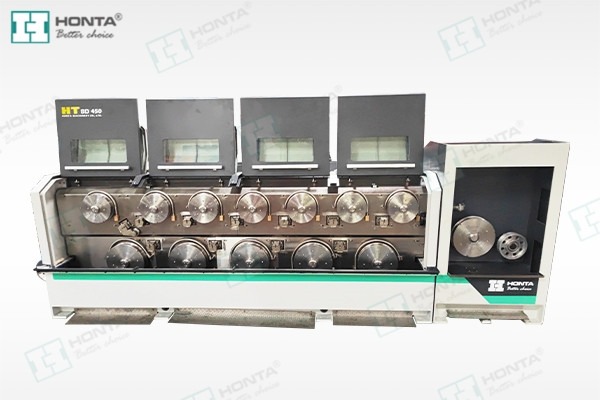
HONTA compact series rod breakdown machine — conductor preparation upstream of high-speed bunching and stranding.
Problem Definition: Why "High Speed" Is Not a Selection Criterion
Speed is an output of a machine, not a requirement of the cable. Two lines can quote similar throughput and still produce very different conductors, because the properties that decide cable performance are settled elsewhere in the machine: strand integrity, lay length repeatability, tension uniformity, wire surface condition and spooling quality.
A common specification error is to compare bunching machines on throughput alone and to treat conductor construction as a secondary detail. When a machine is matched to a generic specification rather than to a defined cable, the cost usually surfaces downstream — in loose or crossed strands, uneven conductor elongation, inconsistent outer diameter, jacket defects, or failures in flex, crimp or electrical testing.
The practical rule is that four inputs must be fixed before machine configuration is discussed:
- Conductor material — copper or aluminium, and whether the wire is bare or plated.
- Conductor construction — wire diameter range, number of wires, bunched versus stranded, lay direction.
- Product mix — a single cable family, or several families produced on the same line.
- Downstream process — insulation, jacketing, harness assembly, or forming and installation.
Once these four are defined, the machine discussion becomes specific: which pay-off, which twisting method, which tension control, which take-up.
Industry Background: Requirements Across the Three Segments Are Diverging
Three market developments are pushing conductor requirements in different directions at the same time.
Automation and robotics continue to expand into handling, welding, assembly and mobile platforms. Cables in these applications are commonly exposed to continuous flexing, small bend radii and, in some designs, torsional movement. The conductor therefore has to remain flexible across a long service life, which places the emphasis on fine wire, high strand count, uniform tension during bunching and a wire path that does not damage the strand surface.
Automotive electrification and harness miniaturisation move in a different direction. Harness designers are looking for compact conductors that save space and weight while remaining mechanically robust under vibration and temperature cycling. Here the emphasis shifts towards conductor compactness, diameter consistency and repeatable stranding, because an inconsistent conductor complicates crimping, terminal geometry and automated harness assembly.
Energy cables — transmission and distribution, renewable generation, industrial power and charging infrastructure — typically operate at larger conductor sections and longer production runs. In this segment, lay stability, section consistency and take-up quality matter as much as twisting speed, because a conductor that varies along its length creates problems in insulation, sheathing and installation.
A fourth, cross-cutting factor is surface condition. Nickel, silver and tin coatings are widely used where corrosion resistance, elevated temperature performance or contact reliability matters, and plated wire behaves differently in drawing, bunching and stranding. Cable equipment suppliers are therefore increasingly evaluated on whether they can support the whole conductor route — drawing, plating, stranding and spooling — rather than a single machine.
Detailed Solution: Matching Machine Capability to Application
HONTA is a cable equipment system service provider based in Kunshan, Jiangsu Province, China, established in September 2006 and focused on cable conductor drawing and stranding technology. The company set up a second production base, HONTA INC., in the United States in 2017, and works with cable manufacturers in China and overseas.
HONTA's product range covers four equipment families that sit on the same conductor route:
- Copper and aluminium RBD lines
- Multi-wire drawing lines
- High-speed stranding equipment
- Electrolytic plating lines, including Ni, Ag and Sn single-wire plating lines and high-speed wire electrolytic plating lines
That range matters for application matching because strand quality is rarely decided by the stranding machine alone. Incoming wire diameter consistency and surface condition are established in drawing and plating; they are then either preserved or degraded in bunching and stranding; and they are finally protected or damaged in take-up and spooling. A supplier that builds all four stages can align them to one conductor specification, instead of asking the buyer to reconcile separate machine specifications from separate vendors.

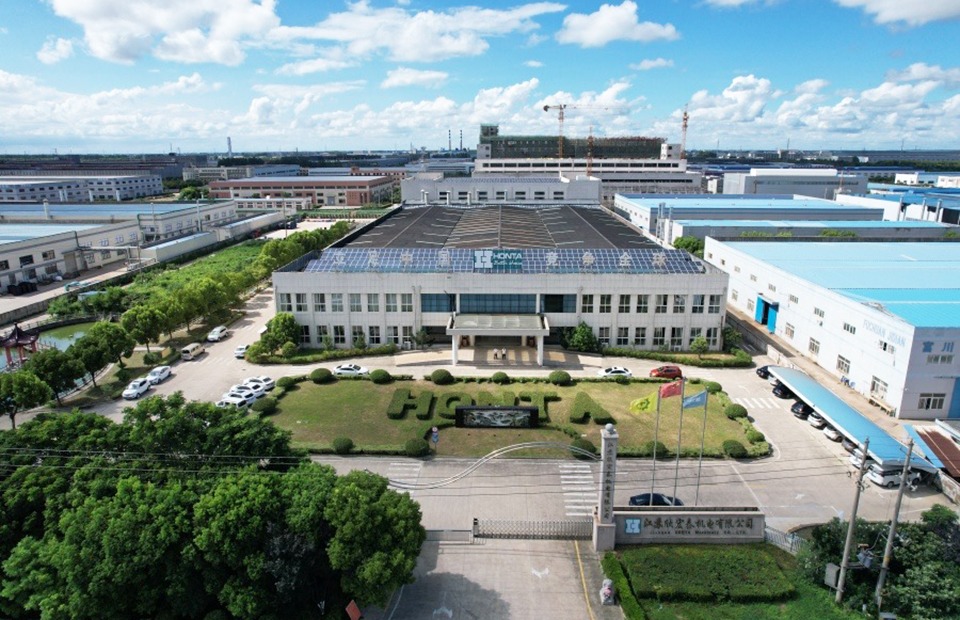
HONTA manufacturing facility, Kunshan, Jiangsu Province, China.
HONTA holds ISO 9001 and ISO 14001 certification and UDEM International Certification. For buyers, certification is a starting point rather than a conclusion: the scope of a certificate, its validity and the processes it actually covers should be checked against the equipment being purchased.
Step-by-Step: Choosing the Right Configuration
Use Cases: Three Application Profiles
Robotics and continuous-flex cables
For robotics cables, the conductor behaves as a fatigue component. Fine wire and high strand count are only useful if every strand carries load evenly, so tension uniformity during bunching and a gentle wire path matter more than maximum throughput. Buyers should validate with a flex or torsion test on the finished cable, and should treat strand surface damage as a reject criterion rather than a cosmetic issue.
Automotive and harness cables
Automotive conductors are usually judged on consistency. Compactness, diameter tolerance and repeatable lay length determine how the conductor behaves in crimping and automated harness assembly. In this segment, a machine's ability to hold the same result across a long run is more valuable than a higher peak speed, and integration with drawing becomes attractive because incoming wire consistency directly affects stranding consistency.
Energy and power cables
Energy cables combine larger conductor sections with long production runs. The priorities are lay stability, section consistency across the full spool and take-up quality, because these determine how predictable the conductor is in insulation and sheathing. Where plated conductors are specified for corrosion or temperature resistance, the plating line becomes part of the conductor specification and should be selected together with the stranding equipment rather than afterwards.
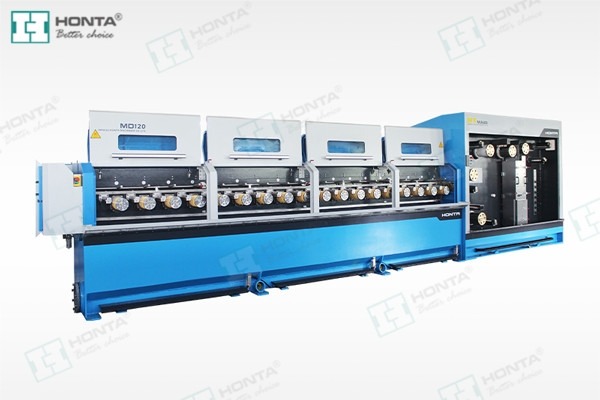
Incoming wire condition from drawing and plating sets the starting point for every bunching and stranding decision.
Comparison: Application Priorities at a Glance
The first table summarises general application considerations. It describes typical priorities in each segment and is not a specification of any individual machine.
| Selection factor | Robotics cables | Automotive cables | Energy cables |
|---|---|---|---|
| Dominant conductor property | Flexibility and fatigue resistance | Compactness and mechanical robustness | Lay stability and section consistency |
| Strand profile focus | Fine wire, high strand count, undamaged surface | Uniform diameter, repeatable compactness | Larger sections, stable lay along the length |
| Machine-side focus | Tension uniformity, gentle wire path, lay length repeatability | Run-to-run consistency, speed stability, diameter control | Long-run stability, take-up quality, spool consistency |
| Downstream sensitivity | Flex and torsion performance of the finished cable | Crimping and automated harness assembly | Insulation, sheathing and installation |
| Where integration helps | Drawing to stranding, to protect wire surface | Drawing to stranding, for diameter consistency | Plating to stranding, for plated conductors |
The second table maps HONTA's equipment families to the conductor route, using only the product categories the company manufactures.
| HONTA equipment family | Role in the conductor route | When it enters the selection discussion |
|---|---|---|
| Copper and aluminium RBD lines | Rod breakdown to intermediate wire | When incoming wire quality and surface condition must be controlled at source |
| Multi-wire drawing lines | Drawing multiple wires to final diameter | When output volume and wire count must be matched to the stranding line |
| High-speed stranding equipment | Bunching and stranding of the conductor | The core decision in this guide, driven by conductor construction and end application |
| Electrolytic plating lines (Ni, Ag, Sn) | Single-wire and high-speed electrolytic coating | When plated conductors are specified for corrosion, temperature or contact performance |
Frequently Asked Questions
Which certifications should a buyer verify before ordering a high-speed bunching/stranding machine?
HONTA holds ISO 9001, ISO 14001 and UDEM International Certification, and certificate copies are available on request. Verification should go beyond the logo: confirm that the certificate scope covers the equipment being purchased, check validity dates and the issuing body, and ask how incoming inspection, assembly checks and final testing are recorded. Certification supports a supplier evaluation; it does not replace a sample trial or a factory visit.
Can one machine configuration serve robotics, automotive and energy cable production?
Usually not without compromise. The three segments differ in conductor construction, wire diameter, lay length requirements and tension range, and a line optimised for fine, highly flexible bunched conductors is not the same line that produces compact or large-section stranded conductors consistently. Where a plant runs a mixed portfolio, the practical answer is either a configuration built around the dominant product family with defined changeover capability, or separate lines for the two extremes. HONTA supplies multi-wire drawing lines, RBD lines, high-speed stranding equipment and electrolytic plating lines, so the configuration can be discussed as one conductor route rather than as isolated machines.
What drives the cost of a high-speed bunching/stranding line?
Cost follows scope rather than headline speed. The main drivers are the number of wires and the pay-off arrangement, including motorised pay-off; the twisting method and lay length control; the tension control concept; the degree of automation; and the take-up or spooling configuration, such as single spoolers or semi-automatic double spoolers. Whether drawing or electrolytic plating is integrated into the same route also changes the investment and the footprint. Comparing quotations on price alone usually means comparing different scopes.
How should a buyer validate a machine before purchase?
Ask for a trial on representative conductor rather than on the most convenient sample. Evaluate strand integrity, lay length consistency, conductor diameter, surface condition and spool winding quality, and test the finished cable the way the end customer will test it — flex, torsion, crimping or electrical performance as applicable. Agree acceptance criteria in writing before the trial so that the result is a decision, not an opinion. HONTA can run sample evaluations with buyers and discuss the conductor construction to be trialled; contact tammy@jshonta.com to arrange one.
What determines lead time, and how can it be shortened?
Lead time depends on the configuration, the level of integration with drawing or plating, the spooling arrangement and the documentation package. The most reliable way to shorten it is to freeze the conductor specification and the acceptance criteria early, and to request a written production schedule with milestones covering design confirmation, build, factory testing, shipment and commissioning. Changes made after the specification is frozen are the most common reason a schedule slips.
Conclusion
Choosing a high-speed bunching/stranding machine for robotics, automotive and energy cables is an exercise in matching, not in comparing headline numbers. Define the cable first — its flex duty, its compactness requirement, its section and its downstream process — and let that definition drive the pay-off, the twisting method, the tension control and the take-up. Then validate the result on representative conductor with written acceptance criteria.
HONTA builds the conductor route around that logic: RBD lines, multi-wire drawing lines, high-speed stranding equipment and electrolytic plating lines, supported by ISO 9001, ISO 14001 and UDEM International Certification. Buyers who want to discuss a specific conductor construction can reach the team directly.
HONTA supports buyers from conductor specification through commissioning and after-sales service.
Next step
Send your conductor construction — material, wire diameter range, number of wires and end application — and HONTA will discuss the matching bunching or stranding configuration and the sample validation plan.
Email: tammy@jshonta.com · Phone: 0086 182 6287 9467 · WhatsApp: 0086 187 5292 2675 · WeChat: wtammy0631 · www.jshonta.com
Have Questions or Need More Details?
Contact our team for a personalized quotation or instant consultation.
Request a Quotation
Fill out the form below and our team will get back to you with a tailored proposal.
WhatsApp Direct Chat
Prefer to chat in real-time? Message us on WhatsApp for instant assistance & quick answers.
- Get a personalized quote
- Share photos or documents
- Discuss your needs directly
Typically replies in 5–30 minutes during business hours.