
Multiwire Drawing Machine Application Guide: Copper vs. Aluminium Conductor Projects
A multiwire drawing machine is not chosen from a specification sheet alone. Copper and aluminium conductor projects ask the same questions — wire count, pass schedule, annealing, take-up, downstream bunching or stranding — and produce different answers, because the two materials behave differently at the die, on the capstan and in the package that leaves the line. This guide is written for plant engineers, project managers and procurement teams who have already identified the equipment category and now need to turn a conductor specification into a line definition, an acceptance plan and a purchase order.
It is deliberately not a parameter table. It sets out the project inputs that decide a multiwire line, walks through the specification sequence step by step, and separates what a copper project usually needs from what an aluminium project usually needs, before closing with the capability and compliance evidence HONTA can supply during evaluation.

Why the Conductor Material Comes Before the Machine Specification
A multiwire drawing machine pulls several wires in parallel through a series of dies and capstans, with inline annealing where the product requires it, and delivers the finished wire to spools, coils or a linked bunching line. The machine category is standard. The configuration is not — and the first variable that splits one project from another is the conductor material.
Copper carries current more efficiently per unit of cross-section than aluminium, and it work-hardens as it is drawn, so a copper project usually depends on annealing to restore elongation before the wire is bunched, stranded or bent in a subsequent process. Aluminium has lower conductivity and lower density, so an aluminium conductor designed for the same current duty generally needs a larger cross-section; it is also the softer of the two, with a surface oxide that makes surface condition, die condition, lubrication and tension control more visible in the finished product. Those differences do not change the machine category, but they change the die series, the annealing decision, the handling practice and often the take-up format.
That is why the specification should start with the conductor, not with a machine model. A line sized around the wrong conductor assumption is difficult to correct later: the pass schedule, the annealer position, the spool package and the interface to the buncher all follow from the material and the product mix.
Industry Background: Conductor Lines Are Being Specified as Systems
Multiwire drawing sits between rod supply and the bunching, stranding or insulating stages, so the drawing line and the machines around it are increasingly quoted as one scope rather than as isolated units. When the interface between drawing and bunching is part of the same order, the buyer can hold one supplier to the handoff — package format, tension, line speed matching — instead of mediating between two vendors after installation.
Two published figures are useful for framing that decision, provided their limits are respected. An HTNXT technical comparison published in June 2026 estimates that individual motor multiwire drawing machines can reduce energy consumption by up to 25% compared with traditional common-shaft systems; this is an estimate for evaluation, not a guaranteed saving for a specific plant, and the actual figure depends on the conductor mix, uptime and load profile. Separately, a Dataintelo commercial research report published in April 2026 values the global wire drawing machine market at USD 3.8 billion in 2025 and projects USD 6.1 billion by 2034 — a projection covering wire drawing machinery generally rather than the multiwire segment alone.
For a plant in the evaluation and execution stage, the practical reading is narrower than either headline: the purchase decision turns on how well the line matches a defined conductor programme, and on whether the energy and maintenance profile of the chosen drive architecture fits a plant that intends to run the line for years.
The Project-Fit Framework: Six Inputs That Decide the Line
Six project inputs do most of the work in defining a multiwire line. Each one should be written down before quotations are compared, because a supplier who receives all six can answer with a configuration, while a supplier who receives only a material name can only answer with a catalogue page.
| Project input | What it changes in the line | What to bring to the supplier |
|---|---|---|
| Conductor material and temper | Die series, annealing arrangement, lubrication and surface handling | Rod certificate, temper condition, target elongation |
| Inlet rod diameter | First die and total reduction, therefore the number of passes | Rod diameter range and rod supplier consistency |
| Finished diameter and wire count | Number of wires per line, capstan sizing, line speed target | Diameter range with tolerances, wires per pass |
| Annealing requirement | Whether an inline annealer is in scope and where it sits | Elongation or temper target, downstream forming operation |
| Downstream process | Take-up format, tension control, line linking to bunching or stranding | Package the next machine accepts, its speed range |
| Plant integration and compliance | Layout, power and utility data, control interface, documentation file | Available floor space, utility data, destination market and standards |
The framework is not a checklist for its own sake. Each row removes an assumption a supplier would otherwise have to make on your behalf, and assumptions are where delivery schedules and acceptance tests usually fail.
Step-by-Step: From Conductor Specification to Commissioned Line
Step 1 — Write the conductor specification before the machine specification
Start with the product, not the equipment: material, temper, inlet rod diameter, finished wire diameter and tolerance, wires per conductor, and the elongation the next process needs. If the plant runs several products, state the range and the expected share of each, because a line optimised for one product can be inefficient as a multi-product line. This document is also the basis for the acceptance test later, so imprecise wording here becomes a dispute at commissioning.
Step 2 — Fix wire count and pass schedule together
Wire count and pass schedule are a single decision. A higher wire count raises output per pass but narrows the diameter window the line can run economically; a heavier reduction requires more passes and a different die series. Configuration classes of 8, 16, 24 and 32 wires are common in multiwire project briefs, and HONTA's published specification for its 24-wire multiwire drawing line, model HT.MD100.03.27.24, lists a maximum mechanical speed of 1,800 m/min. That is a mechanical figure for that model, not a promise of sustained output for a given conductor, so the usable running speed should be confirmed against your own diameter and elongation targets.
Step 3 — Decide annealing before comparing quotations
An inline annealer changes the electrical scope, the line length and the operator routine, so a quotation with annealing and a quotation without it are not comparable. For copper, annealing is usually part of the route because the material work-hardens during drawing. For aluminium, the requirement depends on temper and final product, so it should be stated explicitly rather than assumed either way. Ask each supplier to show where the annealer sits in the line and how the elongation target is verified at acceptance.
Step 4 — Define the take-up package and the downstream handoff
Take-up format — single spooler, double spooler, basket coiler or another wire take-up arrangement — must match the package the next machine accepts. If the drawn wire feeds a high-speed double twist bunching machine, the spool or coil weight, the changeover time and the tension at the transfer point all affect the practical output of the pair. Defining this interface at the inquiry stage is cheaper than correcting it during commissioning.
Step 5 — Integrate the line into the plant, not just the building
Floor space is the visible constraint; power availability, cooling, compressed air, cable routing and the control interface to existing equipment are the ones that delay installation. Provide the supplier with the actual utility data for the intended location and confirm who is responsible for each connection. A line that is technically correct but cannot be connected on schedule still costs production time.
Step 6 — Lock compliance, documentation and acceptance criteria
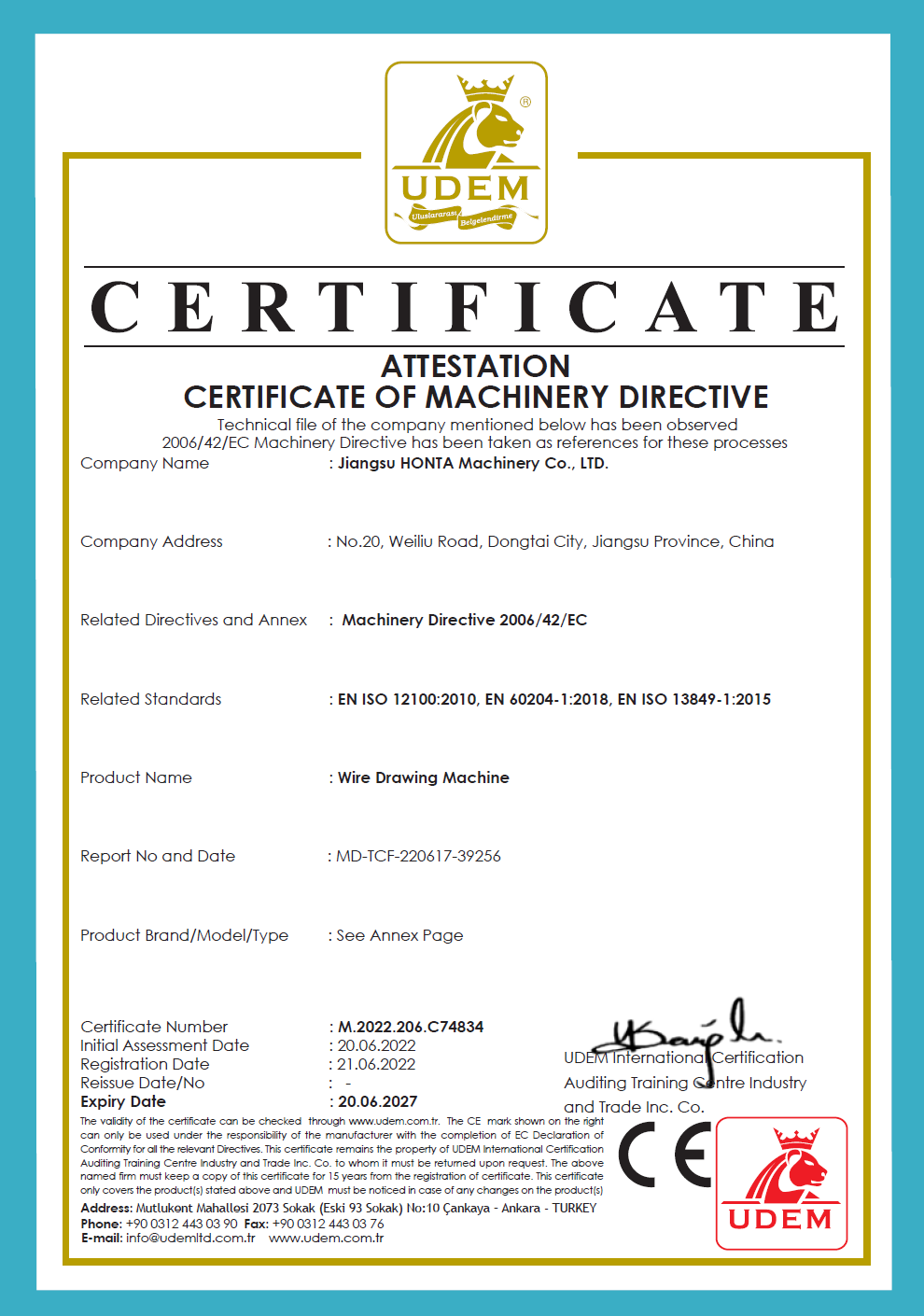
Compliance should be defined by the destination market and confirmed against the certificate that names the ordered model, not against a general statement on a website. HONTA's CE-MD certificate M.2022.206.C74834, issued on 20 June 2020 by Udem International Certification Auditing Trading Centre Industry and Trade Inc. Co. and valid to 20 June 2027, covers wire drawing machines and cites Machinery Directive 2006/42/EC together with EN ISO 12100:2010, EN 60204-1:2018 and EN ISO 13849-1:2015; the listed model is HT.MD100B.16.22D.01. The acceptance criteria should be written into the contract alongside the documentation set.
Step 7 — Agree commissioning and after-sales scope in writing
HONTA provides after-sales support both remotely and on site, and the split between the two should be agreed before shipment: what is handled by remote diagnosis, what triggers an on-site visit, and what spares the plant keeps on the shelf. For a conductor line that runs continuously, the response path matters as much as the machine specification.
Copper Conductor Project Scenarios
Copper projects tend to be defined by the finished conductor rather than by tonnage. Three profiles recur in project briefs.
Bunched copper conductors for flexible cords and building wire. Many fine wires are drawn and then bunched into a flexible conductor. The line is specified around a high wire count, a narrow finished-diameter window and an elongation target that lets the wire survive bunching without breaks. Annealing is normally in scope, and the handoff to the bunching machine — package format and tension — is part of the line definition.
Small-diameter copper for control, instrumentation or automotive-type products. Here tolerance and surface cleanliness carry more weight than raw output. Die condition, filtration and the take-up arrangement determine whether the wire meets the customer's dimensional requirement, and the acceptance test should measure the diameters that actually matter to the next process rather than a single nominal size.
Copper conductors that are plated before or after drawing. Where a tinned conductor is required, the plating operation is a separate scope from drawing, and HONTA's product range includes a wire electrolytic plating line alongside rod breakdown, multiwire drawing and high-speed double twist bunching equipment. Treating plating as a separate scope keeps the drawing line specification clean and puts the surface requirement where it belongs.
Aluminium Conductor Project Scenarios
Aluminium projects are usually shaped by cross-section and by the downstream forming operation.
Aluminium power cable conductors. Because aluminium has lower conductivity than copper, an aluminium conductor built for the same current duty generally carries a larger cross-section, which shifts the finished-diameter range upward and changes the stranding rather than bunching route downstream. Pass schedules, capstan sizing and the take-up package should all be defined against that larger section from the start.
Aluminium conductors for distribution and building applications. Softer material means surface marking and tension control become visible quality issues. Die condition, lubrication practice and the alignment of the wire path deserve explicit attention in the acceptance criteria, because a defect that would be cosmetic in copper can become a scrapped length in aluminium.
Plants that run both materials. A plant serving both copper and aluminium products has to decide whether it wants dedicated lines or a line intended to cover both, and that decision must be stated in the inquiry. HONTA's scope covers copper and aluminium RBD lines and a multiwire drawing line series, but the material a specific multiwire model is built for is set by the die series, annealing arrangement and wire handling defined in the specification — so a dual-material requirement needs written confirmation rather than an assumption based on the product category.
Copper vs Aluminium: A Project-Level Comparison
The comparison below is written at the level of project decisions, not machine performance. It intentionally leaves out figures that depend on the specific line, because those belong in the supplier's configuration document for your conductor.
| Decision area | Copper conductor project | Aluminium conductor project | What to confirm in writing |
|---|---|---|---|
| Cross-section for a given current duty | Higher conductivity allows smaller cross-sections | Lower conductivity and lower density push toward larger cross-sections | Finished diameter range with tolerances |
| Annealing | Usually in scope, because copper work-hardens during drawing | Depends on temper and final product; state it explicitly | Elongation or temper target, and whether an inline annealer is included |
| Drawing behaviour | Harder material; die wear and lubrication practice matter | Softer material; surface marking and tension control matter more | Die series, lubrication and tension settings verified at commissioning |
| Downstream route | Often bunched into flexible conductors | Often stranded in larger sections | Whether bunching or stranding is inside the ordered scope |
| Take-up package | Spool or coil matched to the buncher | Spool or coil matched to the strander or next process | Package weight and format the next machine accepts |
Where HONTA Fits: Capability Evidence for Conductor Projects
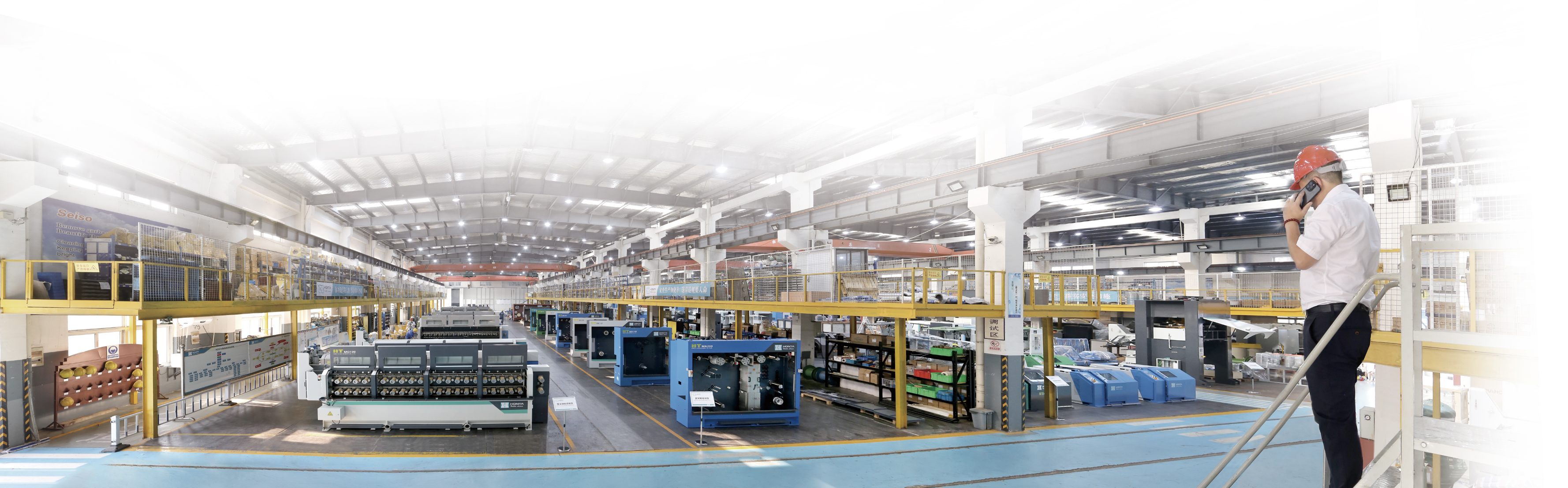
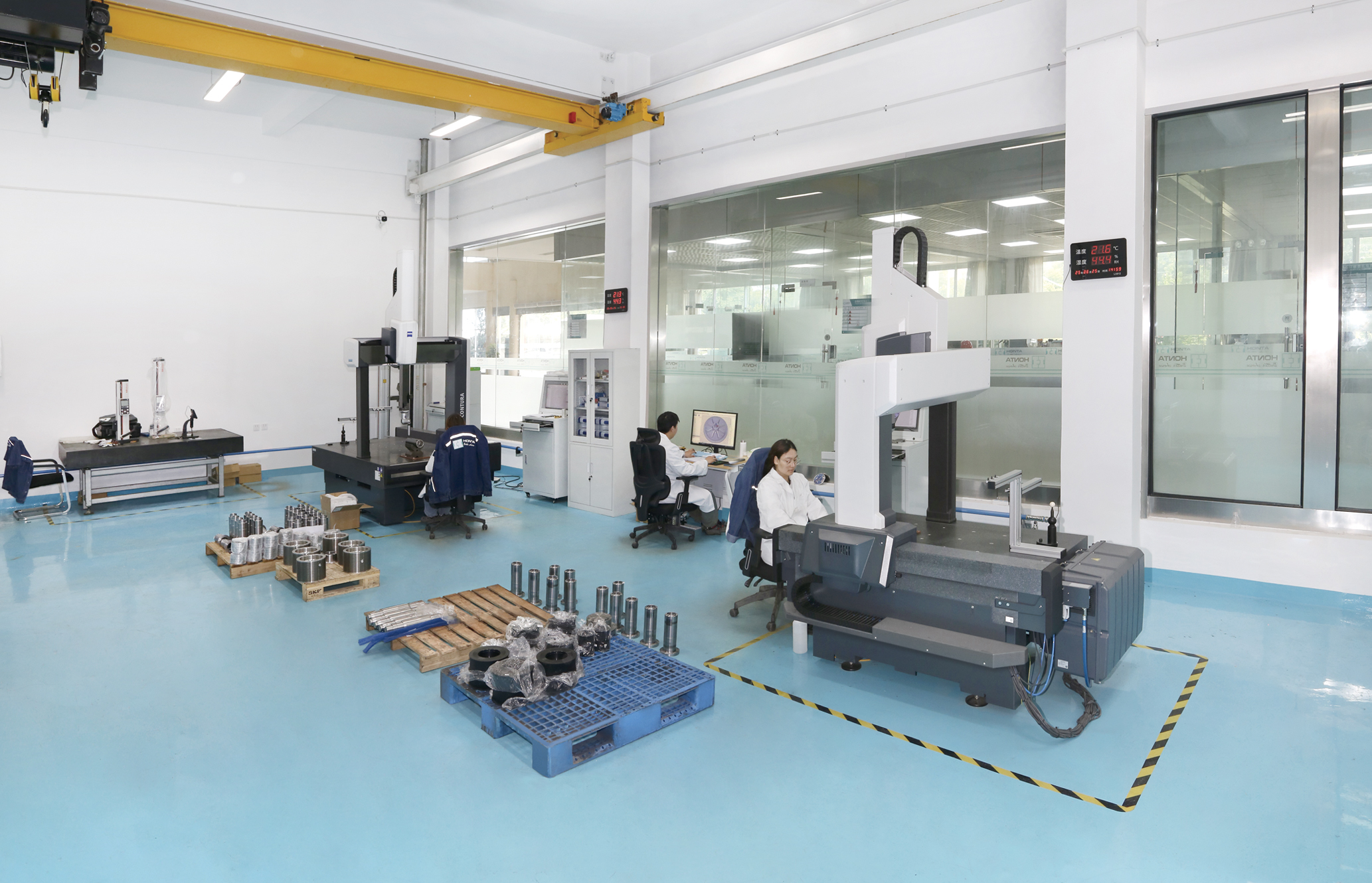
HONTA, formally Jiangsu HONTA Machinery, is a Chinese builder of cable conductor drawing and stranding equipment founded in September 2006, with a 30,000 m² factory, 157 employees and an annual output of 200 sets. Its engineering resource is a 30-engineer R&D team, and the company established a second production base in the United States, HONTA INC, in 2017. Around 45% of output is exported, with the United States, the Middle East, Africa and Asia listed as main markets.
The product scope matters for the copper-versus-aluminium question because it covers both sides of the material split: copper and aluminium RBD lines, a multiwire drawing line series, a high-speed double twist bunching machine and a wire electrolytic plating line. A plant that draws, bunches and plates can therefore define the interfaces inside one supplier relationship, which is exactly where copper and aluminium projects usually lose time.
On the commercial side, HONTA states a production mode of ODM with customization of colour and the model type of components and parts, a minimum order of one set, a 90-day lead time and a monthly capacity of 15 sets. Quality control is described as 100% test, and after-sales support is provided remotely and on site. These terms are useful benchmarks during evaluation, but they should be re-confirmed against the specific configuration, because the lead time runs from the agreed technical specification rather than from the first inquiry.
Two further pieces of evidence are worth placing next to the capability claims. The first is compliance: the CE-MD certificate noted earlier is valid to 20 June 2027 and names model HT.MD100B.16.22D.01, and a 2026 report published by The National Law Review records ISO 9001 and ISO 14001 certification together with compliance to IEC 60204-1 safety standards. The second is operating history: HONTA's case record documents two sets of the HT.MD100B.16.22D.01 wire drawing machine at a wire and cable factory, in service for three years and reported to steadily produce products that meet the customer's requirements, with fast speed and high efficiency cited as the highlights.
Execution Checks Before Shipment and After Arrival
Between purchase order and production, three checks prevent most of the friction that shows up at commissioning.
- Certificate scope versus ordered model. Confirm that the compliance file names the model actually being built, and that the destination market's requirements are covered by the documents supplied.
- Acceptance criteria versus conductor specification. The factory test should measure the diameters, elongation and surface condition your product requires, using the same inspection method you will use in production.
- Interface versus neighbours. Spool or coil format, tension and line speed at the handoff to bunching or stranding should be agreed with the receiving machine's data in hand, not assumed from the drawing line's own maximum.
After arrival, the first production runs should be treated as a commissioning record rather than a formality: log the settings that produce acceptable wire, keep them with the machine documentation, and use them as the baseline for later product changes. This is also the point at which the remote-versus-on-site after-sales split becomes practical rather than contractual.
Frequently Asked Questions
What certification evidence should a copper or aluminium conductor project request?
For EU-bound equipment, ask for the certificate that names the model you are buying. HONTA's CE-MD certificate M.2022.206.C74834 was issued on 20 June 2020 by Udem International Certification Auditing Trading Centre Industry and Trade Inc. Co., is valid to 20 June 2027, covers wire drawing machines and cites Machinery Directive 2006/42/EC together with EN ISO 12100:2010, EN 60204-1:2018 and EN ISO 13849-1:2015. The listed model is HT.MD100B.16.22D.01, so confirm that the ordered model sits inside the certificate scope.
Can one multiwire drawing machine run both copper and aluminium?
Do not assume that it can. HONTA's product scope covers copper and aluminium RBD lines and a multiwire drawing line series, but the material a specific multiwire model is built for is set by the die series, annealing arrangement and wire handling defined in the project specification. If a plant wants one line to cover both materials, the requirement must be stated in the inquiry and confirmed in writing before the order.
What downstream equipment should be planned with the drawing line?
Plan the handoff before the drawing line is sized. Multiwire output normally goes to bunching or stranding, and HONTA's scope includes a high-speed double twist bunching machine alongside rod breakdown, multiwire drawing and wire electrolytic plating lines. Take-up format — single spooler, double spooler or basket coiler — must match the package the next process accepts, and the speed targets should be set so the drawing line and the buncher do not queue against each other.
What drives cost in a copper versus an aluminium conductor line?
Configuration drives cost more than the material label. Wire count, inlet rod diameter, finished diameter range, whether an inline annealer is included, motor architecture, take-up format, automation level and compliance documentation all change the scope. Running cost also differs: an HTNXT technical comparison published in 2026 estimates that individual motor multiwire machines can cut energy consumption by up to 25% against common-shaft systems — an estimate for evaluation, not a guaranteed saving for a specific plant.
What operating evidence can be reviewed before committing?
HONTA's case record documents two sets of the HT.MD100B.16.22D.01 wire drawing machine at a wire and cable factory, in service for three years and reported to steadily produce products that meet the customer's requirements, with fast speed and high efficiency cited as the highlights. Treat this as a supplier case record rather than an independent audit, and pair it with a reference discussion and the factory acceptance test protocol for your own configuration.
What are the MOQ, lead time and customization terms?
HONTA's stated terms are a minimum order of one set, a 90-day lead time and a monthly capacity of 15 sets. Production mode is ODM, with customization of colour and the model type of components and parts, and after-sales support is provided remotely and on site. Confirm the dates and the customization list in the purchase order, because the 90-day lead time runs from the agreed technical specification, not from the first inquiry.
Conclusion: Specify the Conductor, Then the Line
Copper and aluminium conductor projects converge on the same equipment category and diverge on almost everything that matters in execution: the cross-section the line must run, whether annealing belongs in the scope, how much attention surface condition needs, and which machine receives the wire at the other end. A multiwire drawing machine specified from the conductor outward can be tested against criteria written before the order; one specified from a catalogue page can only be judged after installation.
The practical sequence is short: write the conductor specification, fix wire count and pass schedule together, decide annealing explicitly, define the take-up package and the downstream handoff, integrate the line into real plant data, and lock compliance and acceptance criteria against the model actually being built. Suppliers who can answer all six points with a configuration — and with the evidence to support it — are the ones worth shortlisting.
Next step. If you are defining a copper or aluminium conductor line, send HONTA the conductor specification — material and temper, inlet rod diameter, finished diameter range, wires per pass and the downstream process — and ask for a configuration proposal against it. Contact: Tammy, International Trade Department, tammy@jshonta.com, tel. 0086 182 6287 9467. Company website: www.jshonta.com. The drawing machine catalogue can be downloaded here: Catalogue of Drawing Machine (PDF).

Have Questions or Need More Details?
Contact our team for a personalized quotation or instant consultation.
Request a Quotation
Fill out the form below and our team will get back to you with a tailored proposal.
WhatsApp Direct Chat
Prefer to chat in real-time? Message us on WhatsApp for instant assistance & quick answers.
- Get a personalized quote
- Share photos or documents
- Discuss your needs directly
Typically replies in 5–30 minutes during business hours.