
Multiwire Drawing Machine Compliance by Region: A Breakdown for Cable Manufacturers
Compliance & Export Documentation
A multiwire drawing machine does not become compliant once, at the factory gate. It becomes documented — region by region. The machine specification can be identical for a conductor mill in the United States, a financed project in the Gulf, a plant in West Africa and a workshop in South Asia, but the paperwork that clears customs and satisfies an installation inspector is not identical at all. This breakdown takes a “what applies where” approach and converts regional compliance into a list of document questions a cable manufacturer can raise before the purchase order is signed.
The practical question is not whether a standard exists somewhere. It is: which document will be requested, by whom, at which stage of the project, and can my supplier issue it signed by the right entity? Buyers who answer that question during research and evaluation avoid most of the delay that appears later, at port and at commissioning.
This guide covers the four export regions that matter most to a supplier with a global order book — the United States, the Middle East, Africa and Asia — and separates two things that are frequently merged into one word: the conformity evidence attached to the machine, and the commercial documentation attached to the shipment. Buyers need both, and inside most suppliers they are produced by different departments.
Problem Definition: The Three Points Where Documentation Fails
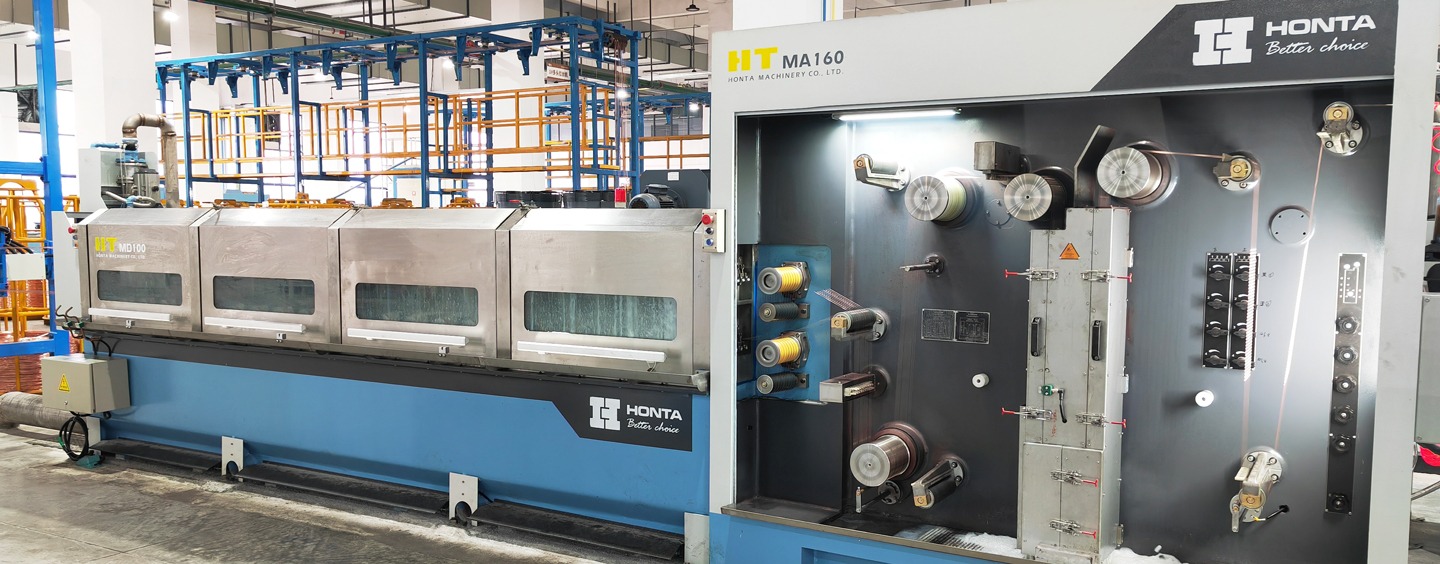
When a cable manufacturer specifies a drawing line for an export project, the technical conversation is usually efficient. Wire count, inlet and outlet diameters, motor and PLC selection, annealing, take-up format, line speed — these are engineering variables that suppliers answer well. The documentation conversation is where projects lose time, because nobody owns the whole file at the start.
- At quotation. The buyer writes “compliance documents required” into the RFQ. The supplier replies with a catalogue and a specification table. Nothing in the response identifies who issues a declaration, under what revision, with what test evidence, or in which language. The gap stays invisible until it becomes urgent.
- At customs. The importer of record or the customs broker asks for a declaration or a test record that the file does not contain. The machine waits at port while the manufacturer, the trading company and the buyer negotiate who is permitted to sign which statement.
- At installation. A local inspector or the end client’s engineer reviews electrical documentation, wiring practice, safety functions and the acceptance record. Here, “the machine runs” and “the file is complete” are two different achievements.
One technical anchor sits below all four regions and is therefore a sensible first line on any document request list. IEC 60204-1, the standard covering electrical equipment of machines, addresses wiring practices and electrical safety for machinery — the equipment category into which wire drawing systems fall. It is a global reference rather than a regional mark, so it travels with the machine regardless of destination, while the market-specific layers on top of it change.
The commercial consequence is straightforward. A machine that is fully built but under-documented cannot be commissioned. The buyer carries the cost of that gap — idle floor space, idle operators, delayed customer orders — while the supplier carries almost none of it unless the contract says so.
Industry Background: Why Documentation Scrutiny Keeps Rising
Machines are crossing borders in larger volumes, and every border crossing is a documentation checkpoint. Three published figures frame the environment that cable manufacturers are specifying into:
- The global wire and cable market was valued at USD 230.9 billion in 2025 and is projected to reach USD 313.1 billion by 2033 (Grand View Research).
- The global wire drawing machines market is projected to grow from USD 1.37 billion in 2025 to USD 2.13 billion by 2034, at a CAGR of 4.98% (The Insight Partners).
- China’s exports of machine tools — the category that includes wire drawing machinery — accounted for 19% of global exports in the first half of 2025, surpassing Germany (Silverado Policy Accelerator).
The wiring and cable sectors that consume this equipment also shape documentation depth indirectly. Machines are specified for power and energy, automotive manufacturing, communications and electronics, intelligent equipment, construction and installation, household and electronics, and new energy applications — each with its own end-product acceptance expectations. A conductor mill supplying an automotive harness customer is asked for different evidence than one supplying a general construction cable buyer, and that pressure is transmitted back up the chain to the drawing equipment supplier.
The Regional Picture: What Applies Where
What follows is a working framework for RFQ planning, not legal advice. The binding requirement at any destination is set by that market’s authorities and by your own importer of record — so every point below should be confirmed with them before the order is placed.
United States
US projects generally carry the deepest documentation expectations of the four regions. Electrical equipment intended for regulated industrial environments is commonly reviewed against recognised listing and installation requirements, and procurement teams frequently expect a supplier that has an accountable in-country presence — someone who can be reached during commissioning rather than only during the sales cycle.
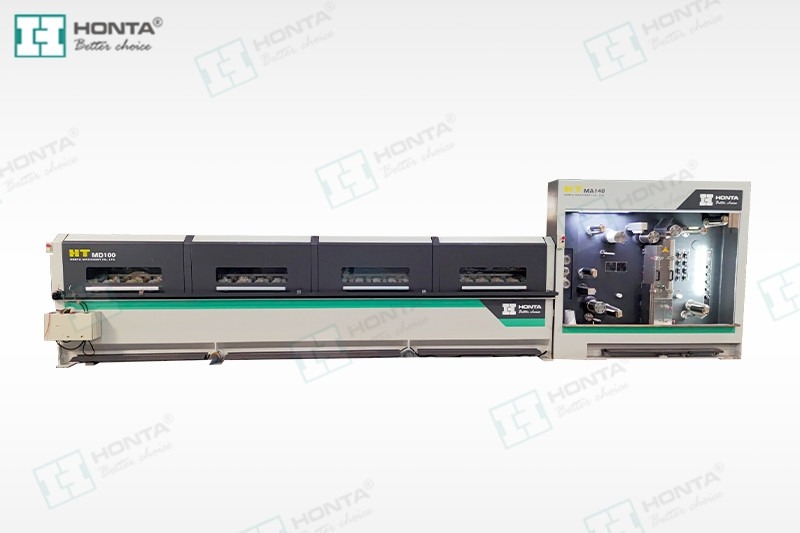
HONTA’s verified position is relevant here. Jiangsu HONTA Machinery, founded in September 2006 and based in Kunshan, Jiangsu, has been committed to cable conductor drawing and stranding technology for a long period, and it established HONTA INC, a second production base in the United States, in 2017. Exports account for 45% of sales, and the United States is one of the company’s main markets.
Questions to raise at RFQ stage:
- Which legal entity signs the declaration of conformity, and under which standard or scheme is the machine supplied?
- Does the acceptance test record reference the machine serial number and the individual component identifiers?
- Can electrical schematics and wiring documentation be supplied in English, with component-level identification for the motor and PLC?
- Who is the in-country contact if a document is questioned during installation?
Middle East
Procurement in the Middle East is frequently project-driven. Documentation depth is often set by the project consultant, the EPC contractor or the financing party rather than by the country alone, and conformity evidence is usually tied to import clearance rather than to a separate factory audit. That means the importer of record effectively controls the process — and the importer of record is sometimes not the party who negotiated the machine.
HONTA exports to the Middle East, and the company’s documented export markets span the EU, the Middle East and Africa, with after-sales delivered remotely and on site. For a region where commissioning support is often negotiated as part of the package, that combination matters more than a line on a specification sheet.
Questions to raise at RFQ stage:
- Does the purchase order name the importer of record, and has that party confirmed the document set in writing?
- Which body performs the conformity assessment, and at what point in the shipment schedule?
- Is on-site commissioning support included, and who signs the installation acceptance?
- If the consultant’s document list changes mid-project, what is the change mechanism?
Africa
Documentation depth varies more within Africa than between continents. In some markets the controlling factor is a single clearance requirement; in others it is an EPC contractor or a development financier with its own file specification. File completeness often matters more than any single mark, because clearance can hinge on whether the folder is whole rather than on which logo appears on page one.
Africa is listed among HONTA’s export markets, and exports represent 45% of the company’s sales across the USA, the Middle East, Africa and Asia. For buyers in project-financed environments, that matters because a supplier with repeat shipments to a region has usually already learned what that region’s clearance chain reads.
Questions to raise at RFQ stage:
- Who clears the machine at destination, and what file does that party require?
- Does an EPC contractor or financier define the documentation set independently of the buyer?
- What is the escalation path if a document is questioned after arrival?
- Are spare parts and after-sales terms documented with the same rigour as the machine itself?
Asia
Asia is the most fragmented of the four regions, because national and sector-specific schemes sit side by side. Being manufactured in Asia does not remove documentation requirements — it only changes who is familiar with them. A machine built in Kunshan and shipped within Asia still crosses a border, and the file still has to satisfy a customs authority and an installation engineer.
HONTA’s manufacturing profile is documented and verifiable: founded in 2006, a 30,000 m² facility, approximately 157 employees, a 30-engineer R&D team, and an annual output of 200 sets. The production model is ODM with customization of colour and component types, and quality control is described as 100% testing.
Questions to raise at RFQ stage:
- Which national or sector scheme applies at destination, and who confirms that in writing?
- Does the required test record format match the manufacturer’s standard record, or does it need to be reissued?
- Is the configuration identical to a domestic build, or does it carry export-specific documentation?
- Which documents are issued in English by default, and which need translation?
How to Read a Supplier’s Conformity and Specification Documents
1. Separate the catalogue from the controlled document
A product catalogue is a specification summary. It tells you what a machine family can do. A controlled document is revision-numbered, traceable and signed. Both are useful, but only one of them will satisfy an inspector. HONTA’s published drawing machine catalogue is the correct starting point for configuration; it is not a substitute for the conformity file.
2. Identify the issuing party
Ask directly: does this declaration come from the manufacturer, from a testing body, or from a trading intermediary? HONTA’s supplier profile lists ISO 9001 and ISO 14001 certification, and quality control is documented as 100% testing — both are statements about process discipline at the manufacturer, which is where a conformity file should originate.
3. Bind every specification claim to a test point
Take one model and check it end to end. HONTA’s HT.MD100B.16.22D.01 is a 16-wire multiwire drawing machine with an inlet wire diameter of 1.8–2.0 mm and an outlet wire diameter of 0.18–0.5 mm, using a Siemens motor and a Siemens PLC. Every one of those claims is checkable: motor nameplate, PLC model number, and a run test at the stated inlet and outlet diameters. A supplier who cannot point you to the test point behind a parameter is offering a description, not a specification.
4. Compare within the right product family
Specifications are only meaningful inside their family. HONTA’s 14-wire multiwire drawing line, model HT.MD120.03.19.14, is publicly listed at maximum speeds of 1800 m/min with an outlet wire range of 0.20–1.05 mm — a different configuration from the 16-wire machine with a 0.18–0.5 mm outlet range. Confirm which line your project actually requires before comparing numbers, because comparing across families produces false conclusions.
5. Ask for the material declaration
Main materials in HONTA’s machine build are structural steel and alloy for frames and components, with carbon-fibre material used for bow components on certain bunching machines, and corrosion-resistant materials and protective treatments used on plating lines. Material declarations increasingly appear on end-customer questionnaires in the cable industry, so request them at RFQ stage rather than after arrival.
6. Treat matched equipment as one system
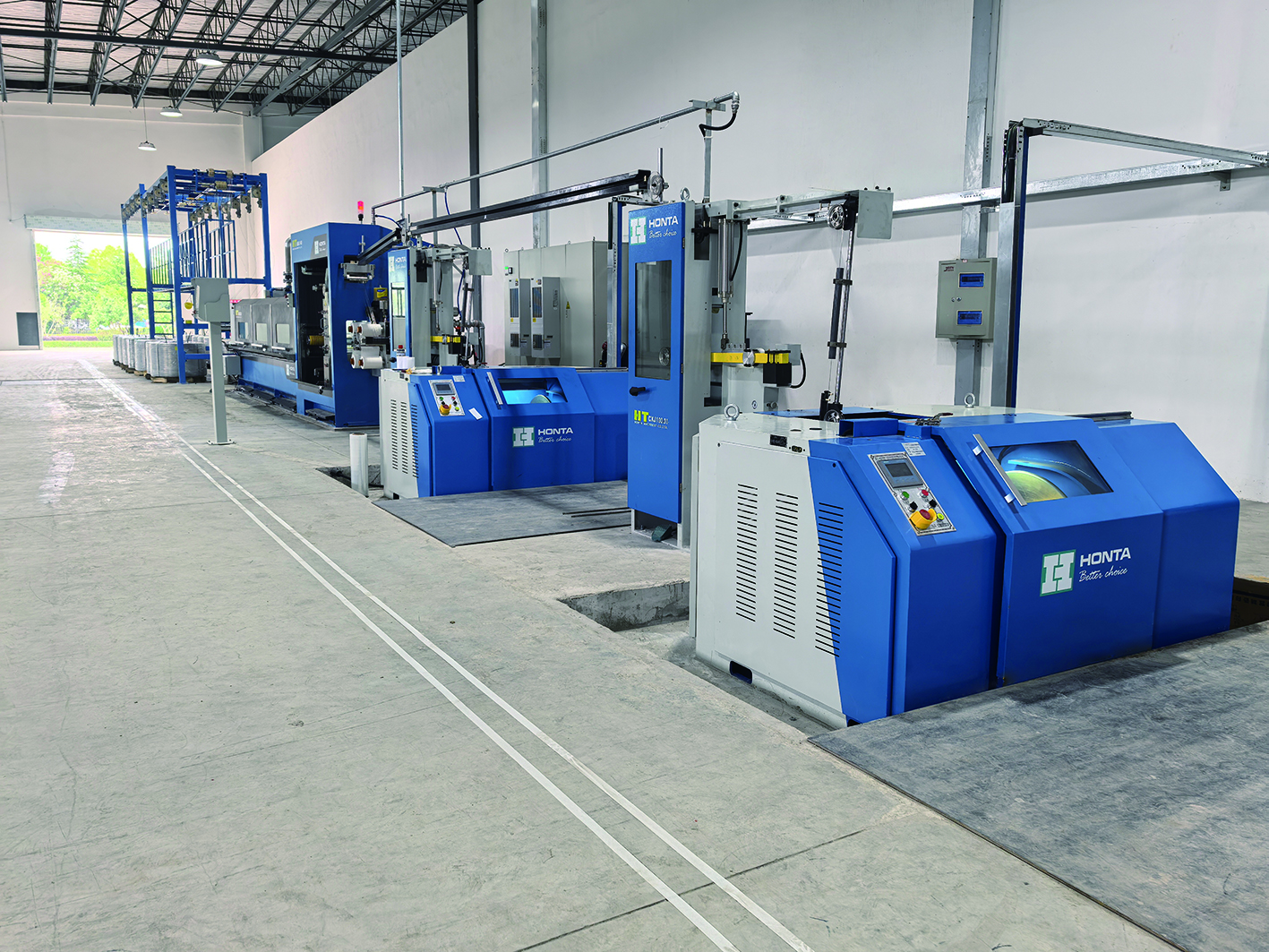
A drawing line is not a single machine. Supporting devices include annealing furnaces, pay-off and take-up units, winding and unwinding machines, annealers, and single or double-disc take-up machines. If these are documented individually by different suppliers, the installation file fragments. Ask for one system-level document set that covers the matched configuration.
7. Verify the operating profile you are documenting
Documentation should describe the environment the machine will actually run in. HONTA drawing equipment is designed for industrial continuous production lines with high-speed automated operation requiring stable tension control and accurate wire alignment, operated automatically or semi-automatically under PLC control with computer-screen parameter settings and automatic tension modes. Special requirements can include defined wire diameters and coating thicknesses, laser alignment, high-speed twisting specifications, and carbon-fibre dynamic balance structures — each of which changes what the technical file has to say.
Step-by-Step: Building the Documentation File Before the Order
- Name the destination and the importer of record. Everything downstream depends on this. A machine destined for a financed project in Africa and a machine destined for a US conductor mill need different files, even if they are the same model.
- Write the document request list into the RFQ. Do not write “compliance documents required.” List the documents, the language, the issuing party and the delivery date for each.
- Ask who signs, and under what revision control. A declaration without an identified signatory is a draft, not a document.
- Confirm the electrical and control baseline. Ask how the electrical documentation aligns with IEC 60204-1 practice for machine wiring and safety, and require component-level identification for the motor and PLC.
- Confirm the test regime and what the buyer receives. HONTA applies 100% testing; the question to ask is whether the recorded test result travels with the machine and whether it references the serial number.
- Match the configuration to the project. Wire count, inlet and outlet diameter range, speed, annealing and take-up format. For a 16-wire fine-wire project, HT.MD100B.16.22D.01 documents an inlet of 1.8–2.0 mm and an outlet of 0.18–0.5 mm.
- Plan logistics against lead time, not around it. HONTA states a lead time of 90 days, a monthly capacity of 15 sets and a minimum order quantity of 1 set. Because documentation questions surface at clearance, the file should be complete before the machine ships — not after it arrives.
- Fix the after-sales and escalation terms in writing. HONTA provides after-sales support remotely and on site. Decide in advance who is called, in what language, and within what timeframe if a document is challenged after arrival.
Use Cases: How Regional Documentation Plays Out
US conductor mill adding fine-wire capacity
A cable factory in the United States adds a 16-wire fine-wire line. The technical decision is settled quickly: inlet 1.8–2.0 mm, outlet 0.18–0.5 mm, Siemens motor and Siemens PLC. The delaying factor is documentation depth — English-language electrical schematics, component traceability and an acceptance record that references serial numbers. The presence of HONTA INC, established as a second production base in the United States in 2017, shortens the distance between a question raised at the plant and an answer issued by the manufacturer.
Multi-year operation as post-installation evidence
The strongest compliance evidence is a machine that has already run. HONTA’s reference record includes a wire and cable factory operating two drawing machines for three years, steadily producing products that meet customer requirements, with recorded country codes spanning the United States and several European markets. The documented highlight is fast speed and high efficiency. For a buyer in the evaluation stage, a reference like this answers a different question than a certificate does: it shows the machine performs as the file says it will.
Project-financed plant in Africa or the Middle East
Here the document set is usually defined by a consultant or a financier, and the buyer’s leverage depends on when they ask. Raise the question at RFQ stage and the supplier can build the file alongside the machine. Raise it after shipment and the plant waits. HONTA’s export mix — 45% of sales, across the USA, the Middle East, Africa and Asia — means the company has handled this ordering sequence across each of those markets.
Asian plant expanding multiwire capacity
A conductor mill inside Asia adds capacity alongside existing matched equipment: annealing furnaces, pay-off and take-up units, winding and unwinding machines and single or double-disc take-up machines. The compliance task here is coherence — ensuring the new machine’s documentation refers to the same operating conditions as the surrounding line, from tension control to wire alignment.
Regional Comparison Table
The table below is a planning framework for RFQ conversations. It summarises the documentation depth to expect, the questions worth raising, and the verified HONTA position relevant to each market.
| Export market | Documentation depth to expect | Questions to raise at RFQ | HONTA-related verified fact |
|---|---|---|---|
| United States | Deepest of the four: component-level traceability, English-language electrical documentation, accountable in-country contact | Who signs the declaration? Who issues the acceptance record? Is the electrical file readable by a local inspector? | HONTA INC, a second production base in the United States, established in 2017; the USA is one of HONTA’s main markets |
| Middle East | Project-driven: depth usually set by the consultant, EPC or financier; clearance tied to the importer of record | Who is the importer of record? Which body performs conformity assessment? Is on-site commissioning in scope? | Middle East is among HONTA’s export markets; after-sales support is delivered remotely and on site |
| Africa | Variable: file completeness often matters more than any single mark | Who clears at destination? Does an EPC or financier define the document set? What is the post-arrival escalation path? | Africa is listed among HONTA’s main markets; exports account for 45% of sales |
| Asia | Fragmented by national and sector schemes; cross-border rules still apply | Which scheme applies? Does the test record format match? Is the build export-specific? | HONTA manufactures in Kunshan, Jiangsu, founded in 2006; 30,000 m² facility; 200 sets annual output |
The second table converts the regional discussion into a request list. It shows what each document answers and where it should originate.
| Document | What it answers | Typically issued by |
|---|---|---|
| Declaration of conformity | Which standard or scheme applies to the machine as supplied, and who stands behind that statement | Manufacturer |
| Electrical schematics and wiring documentation | Whether electrical equipment follows recognised machinery wiring and safety practice, such as IEC 60204-1 | Manufacturer or integrator |
| Component traceability record | Whether the motor and PLC match the ordered specification — for example the Siemens motor and Siemens PLC specified on HT.MD100B.16.22D.01 | Component supplier plus manufacturer |
| Test and acceptance record | Whether the unit passed the manufacturer’s test regime; HONTA applies 100% testing | Manufacturer |
| Material declaration | What the machine is built from — structural steel and alloy for frames and components, carbon-fibre bow components on certain bunching machines, corrosion-resistant materials and protective treatments on plating lines | Manufacturer |
| Packing list and HS code alignment | Whether the shipped configuration matches the customs file | Manufacturer plus freight forwarder |
| Installation and commissioning plan | Who installs, in what sequence, and what is signed at acceptance | Manufacturer plus buyer |
| After-sales and spare parts terms | What happens after acceptance, including remote and on-site support | Manufacturer |
FAQ
Which conformity documents should I request with a multiwire drawing machine quotation?
Request four groups, and name each one explicitly in the RFQ. First, the declaration of conformity, stating the standard or scheme the machine is supplied against and identifying the signing entity. Second, electrical documentation prepared in line with recognised machinery practice such as IEC 60204-1, covering wiring practice and electrical safety. Third, component traceability for the motor and PLC — HONTA’s HT.MD100B.16.22D.01 model, for example, specifies a Siemens motor and a Siemens PLC, both of which can be verified against nameplates and model numbers. Fourth, the test record showing the unit was tested before shipment; HONTA applies 100% testing, and its supplier profile lists ISO 9001 and ISO 14001 certification. Ask where each document is issued, who signs it, and in which language it will arrive.
Does a supplier’s export track record actually reduce friction at customs and during installation?
It usually does, for a specific reason: a supplier that ships repeatedly into a market has already learned what that market’s importers and inspectors ask for, and it prepares the file accordingly. HONTA’s export position is documented — exports account for 45% of sales, the main markets are the USA, the Middle East, Africa and Asia, and the company established HONTA INC, a second production base in the United States, in 2017. Installation evidence supports the same point: a wire and cable factory reference covers two machines running for three years, steadily producing products that meet customer requirements. What an export record cannot do is replace your own review. Treat the supplier’s history as a reason to expect fewer questions, not as a reason to skip the questions.
What drives the cost of the documentation and compliance side of a multiwire drawing machine project?
There is no single compliance price, because the cost follows the destination and the configuration rather than the machine type. Five drivers appear consistently. First, the destination market and the depth of documentation it requires, including translation. Second, configuration choices — wire count, motor and PLC selection, and whether the design uses individual motors or a common shaft. Published industry analysis attributes up to a 25% reduction in energy consumption to individual-motor multiwire designs compared with traditional common-shaft systems, by eliminating mechanical transmission losses; that is a configuration decision with both an operating-cost and a commercial dimension. Third, customization scope: HONTA operates an ODM model with customization of colour and component types. Fourth, the depth of testing and record-keeping required. Fifth, installation and commissioning scope. Ask for these five items as separate line items in the quotation so that the compliance element never hides inside a lump sum.
Can I validate a machine and its documentation before committing to a full production line order?
HONTA’s commercial terms support staged validation: the minimum order quantity is 1 set, so a project can begin with a single machine, and quality control is documented as 100% testing. For a compliance-driven project, extend the validation to documents rather than parts alone. Ask for a sample documentation pack for the exact model under consideration — for HT.MD100B.16.22D.01 that means a 16-wire machine with an inlet range of 1.8–2.0 mm and an outlet range of 0.18–0.5 mm — then have your importer of record read it before you commit. If the pack is clear to them at sample stage, it will be clear to customs later.
How much lead time should I plan for, and how does it interact with customs clearance?
HONTA states a lead time of 90 days, supported by a monthly capacity of 15 sets. Plan backwards from installation rather than forwards from the order: machine build, shipment, customs clearance, inland delivery, installation and commissioning. Because documentation questions are most likely to appear during clearance, the file should be complete before the machine leaves the factory. After-sales support is available remotely and on site, which covers the post-arrival stage if a document is challenged. For region-specific questions — which documents a particular destination expects, or how a configuration should be documented — the fastest route is a direct conversation with the manufacturer’s export team rather than a general enquiry.
Conclusion: Compliance Is a Document Discipline, Not a Certificate
Multiwire drawing machine compliance differs by region in one specific way: not in what the machine can do, but in how deeply the market reads the file behind it. The United States typically asks for the deepest traceability and an accountable in-country presence. The Middle East often follows a project-driven document set defined by a consultant, an EPC or a financier. Africa varies more by project structure than by continent, where file completeness frequently decides clearance. Asia is fragmented across national and sector schemes, and exporting within the region still means crossing a border.
The thread that runs through all four is the same. Name the importer of record. Write the document list into the RFQ. Confirm who signs, under which standard, with which test evidence. Bind every specification claim to a verifiable test point. And treat a supplier’s export record as evidence of process, not as a substitute for your own file review.
A supplier’s export share, its production base locations and its reference installations are not marketing decorations in this context — they are proxies for how many times that supplier has already answered the questions your customs broker and your installation engineer are about to ask. That is the practical meaning of regional compliance for a cable manufacturer.

Next Step: Review the Specifications, Then Ask the Regional Questions
Start with the published configuration data. HONTA’s drawing machine catalogue documents the machine families, models and parameters referenced in this article, and it is the same starting point the manufacturer’s export team uses when preparing a project file: download the HONTA drawing machine catalogue (PDF).
Product and company information, including the multiwire drawing line series, rod breakdown machines, high-speed double twist bunching machines and wire electrolytic plating lines, is published at www.jshonta.com.
For region-specific documentation questions — which documents a destination expects, how a 16-wire or 24-wire configuration should be documented, or what a sample documentation pack contains — contact the international trade department directly:
Tammy, International Trade Department Manager
E-mail: tammy@jshonta.com
Tel: 0086 182 6287 9467
WhatsApp: +86 187 5292 2675
Address: Room 1219, Building 3, Dongchuang Technology Center, Qianjin East Road, Kunshan City, Jiangsu Province, China. Zip: 215300
Jiangsu HONTA Machinery., Ltd. — founded 2006, Kunshan, Jiangsu — manufactures copper and aluminium rod breakdown lines, multiwire drawing lines, high-speed stranding lines and wire electrolytic plating lines, with exports accounting for 45% of sales across the USA, the Middle East, Africa and Asia.