
Multiwire Drawing Machine: Copper vs. Aluminium Head-to-Head for Cable Manufacturers
On a multiwire drawing machine, copper and aluminium are not two settings of the same recipe. They are two different line specifications. Copper rewards fine-diameter capability, tight tolerance control and annealing matched to a work-hardening metal. Aluminium rewards larger finished cross-sections, gentler reduction sequencing and strict surface and oxide control. Both can be drawn on the same machine architecture, but the pass schedule, die set, annealing profile, spooling and outlet diameter band must be engineered for the metal that will fill most of the order book.
Problem Definition: Why the Metal Decision Comes Before the Machine Decision
Most multiwire drawing machine evaluations start with wire count and headline speed. Both matter, and both are secondary. The metal decides the outlet diameter band, the reduction sequence, the annealing scope and the take-up format — and those four items decide whether the line earns its capital back on the product mix you actually sell.
Three specification failures recur in cable plant projects:
- Buying on wire count alone. A 32-wire line and a 16-wire line are not interchangeable production assets. High wire counts suit long runs of a narrow diameter band; lower counts give more flexibility when the outlet range is wide. Choosing the count before choosing the metal usually produces a line that is efficient on one product family and marginal on the rest.
- Treating the annealer as an optional add-on. Copper work-hardens as it is drawn and needs annealing to restore elongation before stranding or insulation. Aluminium also requires annealing, but the thermal profile differs because the metal's behaviour under heat and its surface condition are different. A rod breakdown with annealer machine for copper and aluminium is a scope decision, not a checkbox.
- Assuming the take-up is interchangeable. Single spooler, double spooler and basket coiler formats change changeover time, package weight and downstream handling. Aluminium's lower density changes the package economics even when the spool is identical.
The practical rule: fix the metal mix and the finished conductor range first, then specify wire count, motor architecture, annealing and spooling. Reversing that order is the most common reason a new line underperforms its datasheet.
Industry Background: Capacity Growth, Not Material Substitution
Conductor demand is expanding on both sides of the copper–aluminium question. The global wire drawing machines market was projected at USD 1.37 billion in 2025, rising to USD 2.13 billion by 2034 at a CAGR of 4.98%, according to The Insight Partners. The wider wire and cable market was valued at USD 230.9 billion in 2025 and projected to reach USD 313.1 billion by 2033, according to Grand View Research.
Supply is shifting as well. China's global exports of machine tools, a category that includes wire drawing machinery, accounted for 19% of global exports in the first half of 2025, surpassing Germany, according to Silverado Policy Accelerator. For a procurement team, that means more credible equipment sources and a wider spread of configuration quality — which makes specification discipline more valuable, not less.
What this growth does not show is a wholesale move from copper to aluminium. Both conductors keep expanding because they serve different jobs. Aluminium's advantage appears where weight and conductor cost dominate and where a larger cross-section is acceptable. Copper keeps its position where conductivity per unit area, termination practice and long-established product standards dominate. Most cable plants therefore run a mixed portfolio, and the machine decision is really a question of which metal gets the optimised line and which metal gets the flexible one.
Electrical safety requirements apply to either choice. Electrical equipment for machinery, including wire drawing systems, must comply with IEC 60204-1 regarding wiring practices and safety — a point that belongs in the technical annex whether the line draws copper or aluminium.
Copper vs. Aluminium: The Head-to-Head on a Multiwire Drawing Machine
1. Conductivity and the finished cross-section
Copper has higher electrical conductivity than aluminium. For the same current-carrying requirement, an aluminium conductor must generally be sized to a larger cross-section. That single physical difference propagates through the whole machine specification: an aluminium-focused line typically works at larger finished diameters, which shifts the outlet diameter band, the capstan series and the drafting between passes. A copper-focused line works toward finer diameters, where tolerance control and die quality dominate the outcome.
2. Cost per kilogram versus cost per metre
Aluminium is generally lower cost per unit weight, but the purchase comparison that matters is cost per metre of finished conductor at the required ampacity — and that is where the larger cross-section partly offsets the cheaper metal. For the machine buyer, the practical consequence is different: aluminium generates more scrap sensitivity at start-up and stop, more surface risk in handling, and different package economics because the metal is lighter per unit volume. A line optimised for copper will produce aluminium, but the cost model that justified the copper line does not transfer automatically.
3. Drawing behaviour, dies and lubrication
Aluminium is softer than copper and behaves differently in the die. Reduction sequencing, die geometry, capstan speed ratios and lubricant selection must be set for the metal rather than carried over. Aluminium oxide forms quickly on the surface and is abrasive, so surface preparation and filtration discipline matter more than on a copper line. Copper, being the harder metal, loads the tooling differently and is less forgiving of tolerance drift at fine diameters.
4. Annealing: the inline annealer decision
Both metals need annealing to deliver the elongation downstream processes require, but the thermal profile is not the same. On copper, annealing is a routine part of the line's job. On aluminium, temperature control and surface condition interact more sensitively. This is the point where buyers most often under-specify: an inline annealer machine adds capital cost, and skipping it caps the product range the line can sell into. A rod breakdown with annealer machine for copper and aluminium should be scoped against the final product list, not against the rod feedstock alone.
5. Take-up and spooling format
The wire take up machine choice — single spooler, double spooler or basket coiler — changes changeover time and downstream handling more than it changes drawing performance. Because aluminium is lighter per unit volume, package weight and spool utilisation behave differently at the same spool size. Plants running both metals usually need to decide whether the take-up is optimised for one metal and tolerated for the other, or specified for a compromise package.
6. End-use application
Application, not preference, settles most of the argument. Aluminium is the natural choice where weight reduction and conductor cost dominate and where a larger cross-section is acceptable. Copper remains the default where conductivity per unit area, established termination and connection practice, and long-qualified product standards drive the design. A plant's order book therefore determines which metal the optimised line should serve.
Detailed Solution: How the Line Is Configured Around the Metal
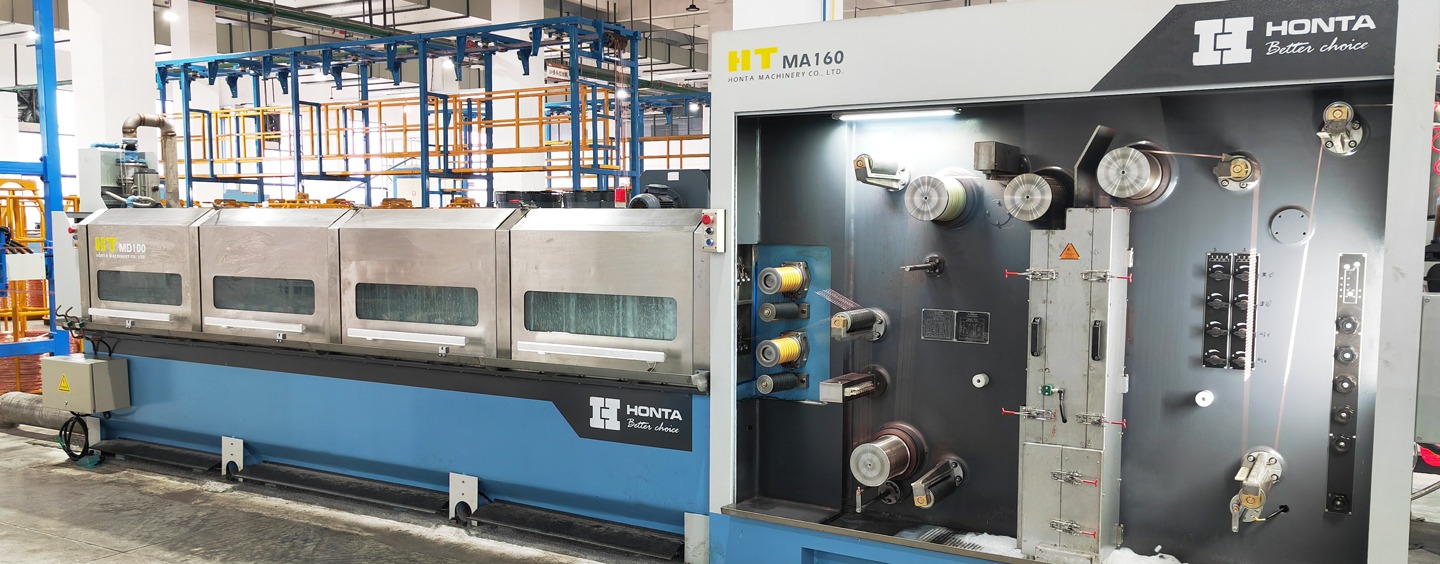
Jiangsu HONTA Machinery., Ltd. — trading as HONTA — is a Chinese cable-conductor equipment builder founded in September 2006 and based in Kunshan, Jiangsu Province, China. HONTA designs and manufactures rod breakdown machines, multiwire drawing machines, high-speed double twist bunching machines and wire electrolytic plating lines, and it builds both copper and aluminium RBD lines. That dual-material product scope is the relevant qualification for this decision, because the copper-versus-aluminium question is answered at configuration level, not at brand level.

Engineering capability behind the configuration
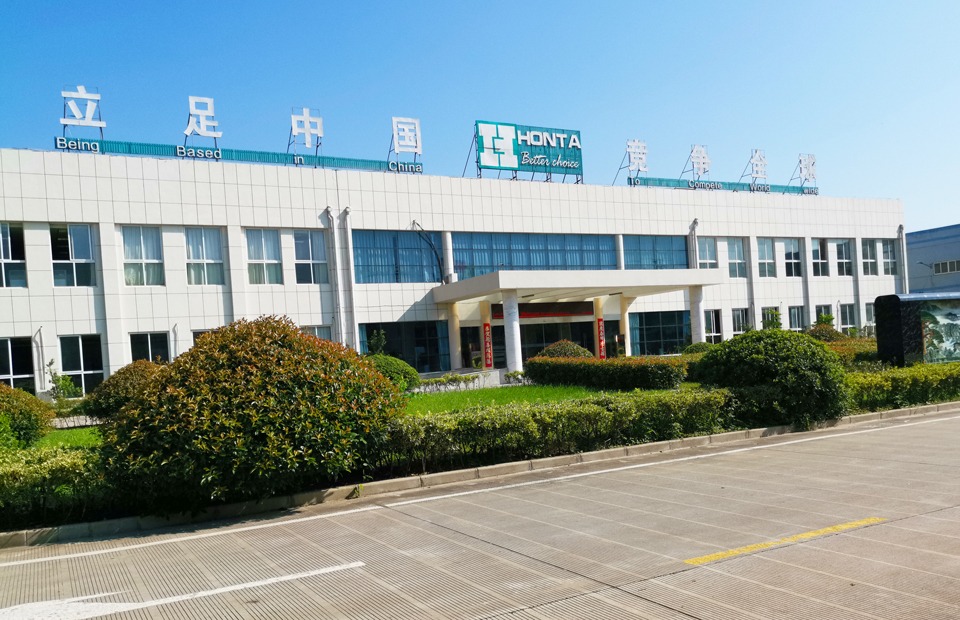
HONTA's R&D team numbers 30 engineers. The company operates a 30,000 m² factory with 157 employees and an annual output of 200 sets, and its production mode includes ODM with customization covering colour and the model type of components and parts. In practice, that means the material decision is translated into an engineering package — pass schedule, die set, annealing scope, spooling format — rather than into a standard model number.
Documented configurations show the range. The 16-wire HT.MD100B.16.22D.01 multiwire drawing machine is specified with an inlet wire diameter of 1.8–2.0 mm, an outlet wire diameter of 0.18–0.5 mm, Siemens motors and Siemens PLC. The 14-wire HT.MD120.03.19.14 line is listed at a maximum speed of 1,800 m/min with an outlet wire range of 0.20–1.05 mm. Those two data points illustrate the trade-off buyers face: a wider outlet band versus a tighter one, at different wire counts. Larger counts such as 24 and 32 wires, and lower counts such as 8 wires, shift the same trade-off further in each direction and should be selected against the product mix, not against the maximum number on a brochure.
| Configuration lever | What changes | Why it matters for copper vs. aluminium |
|---|---|---|
| Wire count (8 / 16 / 24 / 32 wires) | Number of wires drawn in parallel and the outlet diameter band per wire | High counts suit long runs in a narrow band; lower counts give flexibility when the plant runs a mixed copper and aluminium product list |
| Motor architecture | Individual motors per capstan versus a common shaft drive | Individual motors decouple capstan speeds, which supports a metal-specific pass schedule; a third-party industry analysis published on HTNXT's industrial blog estimates up to 25% lower energy consumption by eliminating mechanical transmission losses |
| Annealing scope | Inline annealer machine included or omitted; rod breakdown with annealer machine configuration | Annealing profiles differ between copper and aluminium; omitting the annealer caps the sellable product range |
| Take-up format | Single spooler, double spooler or basket coiler | Package weight and changeover economics shift with aluminium's lower density |
| Customization | Colour and model type of components and parts under ODM production | Allows the line to be matched to plant layout and existing downstream equipment |
Global footprint and compliance evidence
HONTA exports approximately 45% of its output, with main markets in the USA, the Middle East, Africa and Asia, and it established HONTA INC, a second production base in the United States, in 2017. Regional presence matters in this decision because aluminium-heavy product mixes are common in exactly those markets, and support response time affects how quickly a material change can be validated on site. After-sales support is delivered by remote and on-site service.
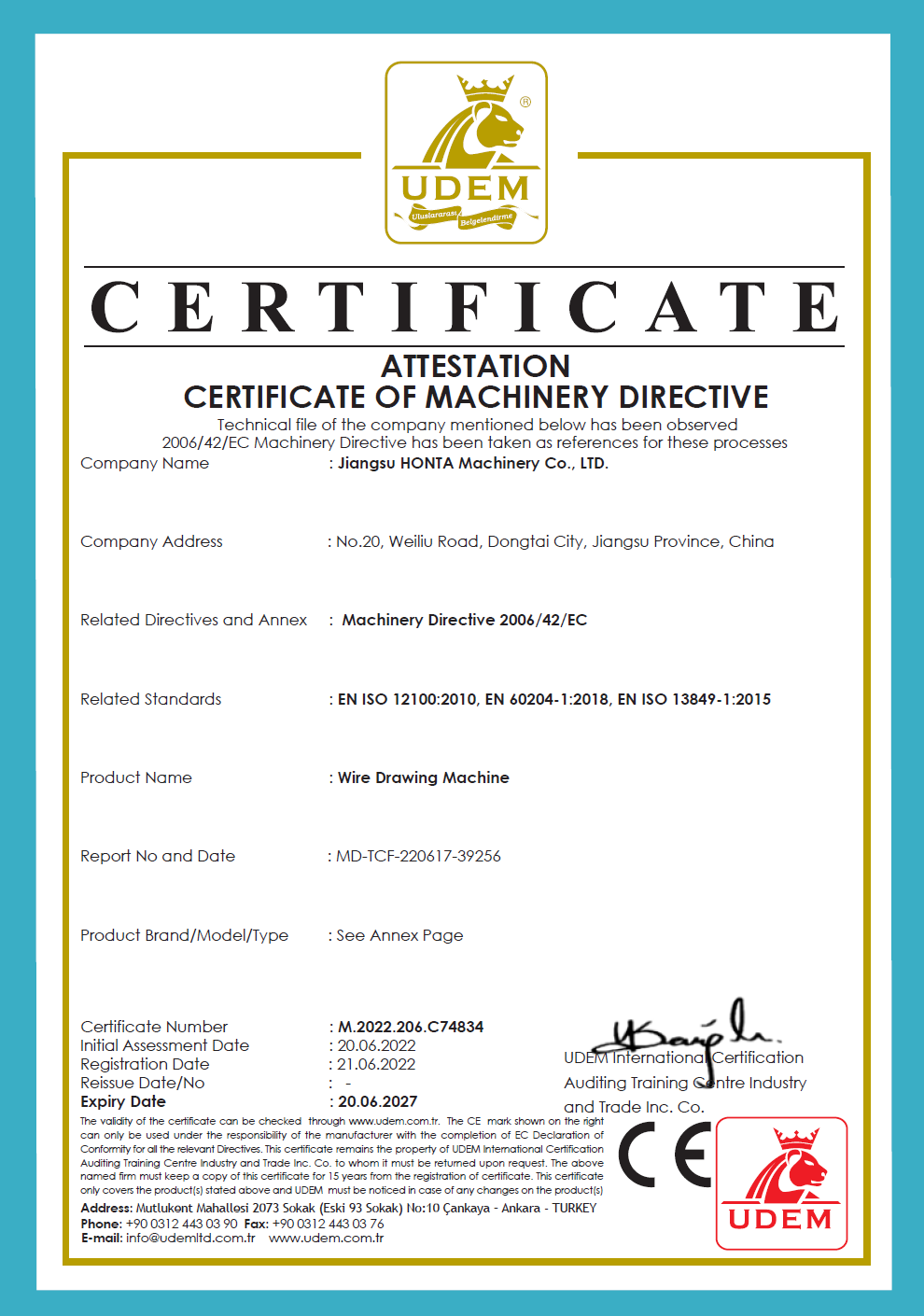
On compliance, HONTA holds CE-MD certification M.2022.206.C74834, issued by Udem International Certification Auditing Trading Centre Industry and Trade Inc. Co. on 20 June 2020 and valid until 20 June 2027 for the EU market. The scope is wire drawing machine, assessed against Machinery Directive 2006/42/EC together with EN ISO 12100:2010, EN 60204-1:2018 and EN ISO 13849-1:2015. The listed applicable product is the 16-wire HT.MD100B.16.22D.01.
Step-by-Step Breakdown: From Metal Decision to Purchase Order
- Fix the metal mix. Quantify the share of copper and aluminium in the next three years of output and the finished conductor range for each. This is the input that drives everything else.
- Convert application requirements into an outlet diameter band. For aluminium, the larger cross-section required for a given current rating must be reflected in the outlet range the line has to hold.
- Define the pass schedule and die set per metal. Reduction sequencing and die geometry are metal-specific. On a dual-metal project, ask for both schedules in writing.
- Scope the annealer against the product list. Decide whether an inline annealer machine is required, and confirm whether the line is configured as a rod breakdown with annealer machine for copper and aluminium or as a drawing-only line feeding a separate process.
- Select the motor architecture. Individual motors multiwire drawing machine designs allow each capstan to be set independently, which is what a metal-specific pass schedule needs. Compare the energy argument for individual motors against a common-shaft arrangement on your own production pattern.
- Select wire count and take-up together. Choose between 8, 16, 24 or 32 wires against run length and diameter band, then match the wire take up machine format — single spooler, double spooler or basket coiler — to downstream handling.
- Confirm compliance and documentation. Verify the certificate scope, the standards applied and the product model listed. For EU supply, the CE-MD certificate and the referenced standards belong in the technical file; IEC 60204-1 compliance applies to the electrical equipment regardless of market.
- Lock commercial terms. HONTA's stated terms are a minimum order quantity of one set, a lead time of 90 days, 100% testing before shipment, and after-sales support by remote and on site.
Use Cases
Case 1: A plant adding aluminium capacity alongside an existing copper line
A cable manufacturer already running copper needs to add aluminium LV power conductor without abandoning copper output. The efficient answer is usually not a dual-purpose compromise line but a second line configured for aluminium's larger cross-section and different annealing profile, with the existing copper line left optimised as it is. The decision hinges on the outlet diameter band and the take-up format, not on the drawing speed.
Case 2: A fine-wire producer staying on copper
A producer serving electronics, data and fine building wire stays on copper and needs a tight outlet band. The documented 16-wire HT.MD100B.16.22D.01 configuration — inlet 1.8–2.0 mm, outlet 0.18–0.5 mm, Siemens motor and Siemens PLC — is representative of the specification logic: narrow band, high wire count, tolerance control first. Aluminium is not a substitute in this product family, so the metal question resolves quickly and the engineering effort goes into pass schedule stability.
Case 3: An export-focused plant needing one qualified platform
HONTA has supplied multiwire drawing machines to wire and cable factories in the United States, Poland, Portugal, Spain, Turkey and the Middle East — two sets per project in the referenced installations, which have run for three years and steadily produced material meeting the customers' requirements, with fast speed and high efficiency cited as the operating highlights. For export-focused plants, the value of that record is not the destination list itself but the combination of a qualified machine, a defined compliance file and a support route that works across time zones.
Comparison Table: Copper vs. Aluminium Line Specification
| Decision factor | Copper-optimised line | Aluminium-optimised line | What to lock in the purchase order |
|---|---|---|---|
| Finished cross-section | Finer diameters; tolerance control dominates | Larger diameters required for equivalent current rating | Outlet diameter band, stated per metal |
| Pass schedule and dies | Set for a harder metal; drift at fine diameters is the main risk | Set for a softer metal; oxide and surface condition are the main risks | Written pass schedule and die set for each metal |
| Annealing | Routine part of the line's job | Required, with a different thermal profile and higher surface sensitivity | Inline annealer scope confirmed against the product list |
| Take-up and spooling | Package economics set by copper density | Lower density changes package weight and spool utilisation | Single spooler, double spooler or basket coiler, named explicitly |
| Typical end use | Where conductivity per unit area and qualified connection practice drive design | Where weight reduction and conductor cost dominate and a larger cross-section is acceptable | Product list with target volumes per metal |
| Compliance | CE-MD M.2022.206.C74834 scope covers wire drawing machine (EU); IEC 60204-1 applies to electrical equipment | Same certification framework; configuration changes require review against the same standards | Certificate scope and applicable product model in the technical file |
| Supplier engineering load | Concentrated on tolerance and annealing stability | Concentrated on reduction sequencing and surface control | Named engineering contact and review milestones before shipment |
FAQ
Which certification covers a HONTA multiwire drawing machine, and does it settle the copper-versus-aluminium question?
HONTA holds CE-MD certification M.2022.206.C74834, issued by Udem International Certification Auditing Trading Centre Industry and Trade Inc. Co. on 20 June 2020 and valid until 20 June 2027 for the EU market. The scope is wire drawing machine, assessed against Machinery Directive 2006/42/EC with EN ISO 12100:2010, EN 60204-1:2018 and EN ISO 13849-1:2015, and the listed applicable product is the 16-wire HT.MD100B.16.22D.01. The certificate defines the machine scope, not the metal being drawn, so a configuration change affecting driven components or the electrical equipment should be reviewed against the same standards before shipment. IEC 60204-1 compliance for electrical equipment applies independently of the market being supplied.
Can HONTA engineer a line that is genuinely set up for both copper and aluminium?
HONTA builds both copper and aluminium RBD lines alongside its multiwire drawing line series, and its R&D team numbers 30 engineers. Because pass schedules, die sets, annealing profiles and spooling differ between the two metals, dual-material operation is treated as a per-project engineering decision rather than a standard catalogue option. Production runs in ODM mode, with customization covering colour and the model type of components and parts, so machine details can be aligned with an existing plant layout and downstream equipment. The honest limit is this: a line configured for one metal will run the other, but the second metal usually operates outside the band the line was optimised for.
What drives the price difference between a copper-oriented and an aluminium-oriented line?
Published prices are not comparable across configurations, so the useful approach is to compare cost drivers. The main levers are wire count, whether an inline annealer machine is included, the motor architecture (individual motors multiwire drawing machine design versus a common-shaft arrangement), the take-up format (single spooler, double spooler or basket coiler) and the degree of customization. The energy argument belongs in the same calculation: a third-party industry analysis published on HTNXT's industrial blog estimates that individual motor multiwire drawing machines can reduce energy consumption by up to 25% compared with traditional common-shaft systems by eliminating mechanical transmission losses. Request a configuration-level quotation with each lever listed separately rather than a single lump figure.
How can a buyer validate the configuration before committing to a full line?
Validation rests on three documented items rather than on a demonstration alone. First, the reference record: HONTA machines supplied to wire and cable factories in the United States, Poland, Portugal, Spain, Turkey and the Middle East — two sets per project in those installations — have run for three years and steadily produced material meeting customer requirements, with fast speed and high efficiency cited as the operating highlights. Second, the test regime: 100% testing is stated as the quality-control standard. Third, the specification package: the outlet diameter band, pass schedule and annealing scope confirmed in writing. The minimum order quantity is one set, so a single-line validation project is commercially possible.
What lead time should be planned, and how is support handled after installation?
HONTA's stated lead time is 90 days, with a monthly capacity of 15 sets and an annual output of 200 sets across a 30,000 m² factory employing 157 people. After-sales support is delivered by remote and on site, which is the relevant detail for plants in the USA, the Middle East, Africa and Asia where the aluminium product mix is often the growth area. For a project that switches or adds a metal, plan the compliance review and the pass-schedule sign-off inside that 90-day window rather than after delivery.
Conclusion: Decide the Metal, Then Specify the Machine
Copper and aluminium do not compete for the same slot in a cable plant's product list. They compete for the same capital budget, and that is a configuration question. Copper asks for fine-diameter capability, tolerance discipline and annealing stability. Aluminium asks for larger cross-sections, metal-specific reduction sequencing, surface and oxide control, and a take-up format that reflects lower density. A buyer who settles the metal mix first — and then specifies wire count, motor architecture, annealing scope and spooling against it — gets a line that performs to its datasheet on the products it was bought for.
The supplier side of that decision is about engineering depth and evidence, not slogans. A builder that manufactures both copper and aluminium RBD lines, maintains a 30-engineer R&D team, works in ODM mode with documented customization, and holds a certificate whose scope, standards and applicable model can be checked line by line is a builder that can answer the material question with a specification rather than an opinion.
Next Step: Match the Line to Your Metal Mix
Send your finished conductor range, target volumes per metal and take-up preference, and HONTA's engineering team will respond with a configuration-level proposal covering pass schedule, annealing scope, wire count and spooling format. The full machine range, specifications and configuration options are documented in the downloadable catalogue.
Download the HONTA drawing machine catalogue (PDF)
Jiangsu HONTA Machinery., Ltd. · Website: www.jshonta.com · Email: tammy@jshonta.com · Tel: 0086 182 6287 9467 · WhatsApp: +8618752922675
Address: Room 1219, Building 3, Dongchuang Technology Center, Qianjin East Road, Kunshan City, Jiangsu Province, China. Zip: 215300
Have Questions or Need More Details?
Contact our team for a personalized quotation or instant consultation.
Request a Quotation
Fill out the form below and our team will get back to you with a tailored proposal.
WhatsApp Direct Chat
Prefer to chat in real-time? Message us on WhatsApp for instant assistance & quick answers.
- Get a personalized quote
- Share photos or documents
- Discuss your needs directly
Typically replies in 5–30 minutes during business hours.