
Multiwire Drawing Machine Explained: Key Terms and Where It Fits in a Conductor Line
A multiwire drawing machine is the stage in a cable conductor line where several wires are drawn in parallel from rod-derived input down to finished conductor gauge, with annealing, spooling and downstream bunching handled as connected but separately specified steps. This explainer decodes the vocabulary that appears on a datasheet and shows exactly where the machine sits between rod breakdown and bunching.

Close view of the drawing section on a multiwire drawing machine, the stage between rod breakdown and bunching in a cable conductor line.
The first pass through a multiwire drawing machine specification produces a specific kind of confusion. Terms from three different process stages appear in the same columns: wire count from the machine architecture, drawing and annealing from the metallurgical side, and spooling or bunching from the material-handling side. Buyers in the evaluation stage are usually fluent in one of these three vocabularies and not the other two.
Jiangsu HONTA Machinery., Ltd. (HONTA) has worked on cable conductor drawing and stranding equipment since September 2006, which means the company spends a large part of its technical conversations translating exactly this vocabulary for buyers who are comparing configurations for the first time. HONTA manufactures Rod Breakdown Machines, Multiwire Drawing Machines, High Speed Double Twist Bunching Machines and Wire Electrolytic Plating Lines, so the entire sequence discussed in this article is available from a single source — which also makes the boundaries between the stages easier to define clearly.
Why terminology is the first real obstacle in evaluating a multiwire line
The obstacle is not that the terms are technical. It is that the same word can mean different things depending on which stage it belongs to. Wire count describes how many parallel drawing paths exist. Annealing describes a thermal stage that may or may not be inside the scope of the offer. Spooling describes the form in which the wire leaves the machine. Bunching describes the next machine entirely.
A buyer who treats these as a single feature list ends up comparing offers that are not equivalent. One quotation includes an inline annealer, another assumes the wire is annealed downstream. One includes a double spooler, another assumes a basket coiler. The price gap that follows is usually a scope gap, not a supplier gap.
The practical fix is to separate the machine from the line. The multiwire drawing machine is one station. The conductor line is the sequence of stations. Evaluation only becomes comparable once each offer is mapped onto the same sequence.
Industry background: the anatomy of a cable conductor line
A conductor line in the wire and cable industry turns rod into finished conductor through a chain of specialised machines. Each machine changes one property of the metal: diameter, temper, surface condition, or package form. Multiwire drawing is one link in that chain, not the whole chain.
The general sequence runs from rod handling, through rod breakdown, into multiwire drawing with annealing, out through spooling or coiling, and onward to bunching or stranding before the conductor reaches the insulation line. Copper and aluminium both follow this architecture, which is why equipment catalogs from wire and cable machine manufacturers list rod breakdown machines, drawing machines, bunching machines and plating lines as one family rather than as unrelated products.
Demand for this equipment tracks the cable industry itself. Commercial research cited in industry analysis estimates the global wire drawing machine market at USD 3.8 billion in 2025, with a projected figure of USD 6.1 billion by 2034. Those numbers describe the wider wire drawing category rather than multiwire machines specifically, and they are third-party estimates rather than statistical agency data — but they explain why buyers are being offered an increasing number of configurations to compare.
Key terms decoded
Each term below belongs to one stage of the line. Read together, they form the working vocabulary needed to read a multiwire drawing machine datasheet without guessing.
Wire count
Wire count is the number of wires the machine draws simultaneously. It is the single most defining choice in a configuration and the term most buyers encounter first. The configurations most frequently discussed in the market are 8-wire, 16-wire, 24-wire and 32-wire multiwire drawing machines. Wire count drives the number of drawing paths, the number of take-up positions and the physical footprint of the machine, and it therefore has to be settled before anything else in the specification is discussed.
Rod breakdown
Rod breakdown is the upstream stage that reduces a large-diameter rod to an intermediate diameter suitable for the drawing machine downstream. A copper rod breakdown machine and an aluminium rod breakdown machine do the same job on different metals, and both can be supplied with annealing. Rod breakdown with an annealer and rod breakdown with individual motors are two ways that stage is configured. In a multiwire context, rod breakdown supplies the input; it is not part of the multiwire machine itself.
Drawing stage and dies
The drawing stage is where the wire is pulled through a sequence of dies, each smaller than the last, reducing diameter step by step. On a multiwire machine, several wire paths run through the drawing section in parallel, each path following the same die sequence. The number of dies, the diameter at entry and the diameter at exit are the parameters that define this stage on a datasheet.
Annealing and the inline annealer
Drawing hardens the metal. Annealing restores the ductility needed for the conductor to be stranded, bunched or otherwise processed without cracking. When the annealer is integrated into the drawing machine, it is described as an inline annealer machine, and the annealing stage is treated as part of the drawing scope rather than as separate equipment. Whether annealing is in scope is one of the first questions that separates two otherwise similar quotations.
Spooling, take-up and basket coiling
Spooling is how the finished wire is collected. A single spooler collects onto one spool per wire path. A double spooler collects onto two, and a basket coiler collects the wire into a coiler basket instead of onto a spool. A wire take up machine is the general term for the collection end of the line, and the choice between spool, double spool and basket affects how the wire is moved to the next process, how it is stored, and what handling equipment the plant needs.
Downstream bunching and stranding
Bunching combines multiple fine wires into a single conductor. A high speed double twist bunching machine performs this immediately after drawing in many conductor lines, which is why the two machines are often evaluated together. The interface that matters is the package: the spool or coil leaving the drawing machine has to be the package the bunching machine can accept.
Drive architecture
Multiwire machines are described by how the drawing capstans are driven. An individual motors multiwire drawing machine gives each capstan its own motor; a common-shaft arrangement drives multiple capstans from a shared shaft. In terminology terms, this is an architecture label rather than a performance statement, and it is one of the items that should be confirmed explicitly when reading a specification.
Electrolytic plating line
A wire electrolytic plating line deposits a metallic coating onto wire through an electrolytic process. It sits alongside drawing and bunching in the conductor equipment family rather than inside the drawing machine, and it is relevant here only because it completes the equipment vocabulary that buyers encounter when they scope a full conductor workshop.
Where the multiwire drawing machine sits in a complete line
The machine occupies the middle of the conductor chain. Rod breakdown produces intermediate wire; multiwire drawing produces finished conductor gauge in multiple parallel streams; spooling converts those streams into packages; bunching turns packages of fine wire into a stranded conductor.
Because HONTA builds every station in that sequence, the handover points are defined inside one product family rather than negotiated between unrelated vendors. That matters most at the two interfaces: the input diameter coming from the rod breakdown machine, and the output package going to the bunching machine.
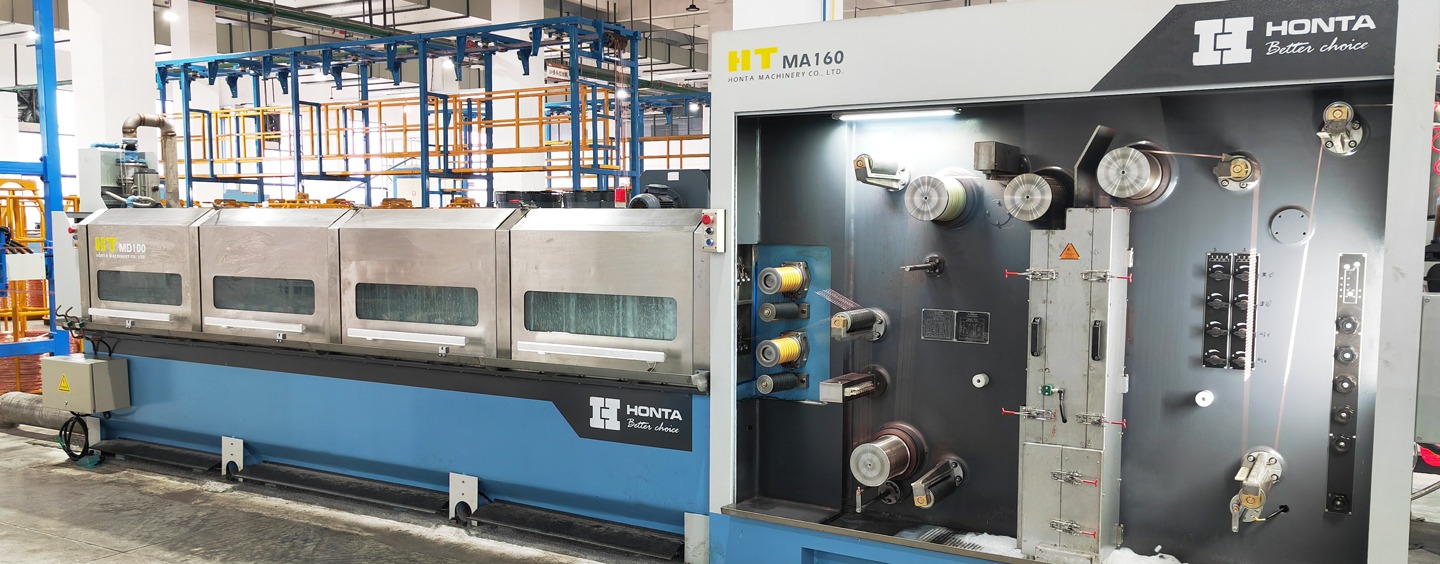
Drawing tank detail: the drawing stage sets the die sequence and the entry and exit diameter that define the rest of the line.
Multiwire drawing versus single-wire rod breakdown, in plain language
This section compares the two concepts structurally. It deliberately makes no performance or cost claims about either approach, because those depend on the specific plant, material and contract.
A single-wire rod breakdown machine takes one rod and reduces it along one drawing path. The output is one wire on one spool. The machine is organised around a single line of capstans and dies, and the operator handles one wire path at a time.
A multiwire drawing machine takes multiple wires and reduces them along several parallel drawing paths inside the same machine frame. The output is multiple wires, each collected on its own spool or position. The machine is organised around repetition: the same die sequence is replicated across every path.
The difference is therefore one of parallelism and package output, not of metallurgy. Both stages draw wire through dies, both can include annealing, and both can feed downstream stranding or bunching. In a conductor line they are usually sequential rather than alternatives: rod breakdown prepares the wire, multiwire drawing finishes it in volume. A buyer choosing between them is really choosing where in the chain the capacity is added.
Reading a multiwire specification in six steps
The sequence below turns the vocabulary into a workable evaluation order. Each step closes one variable before the next is opened, which prevents two offers from being compared at different scopes.
- Fix the input. Confirm the material — copper or aluminium — and the diameter entering the machine. This links the drawing machine to the rod breakdown machine upstream.
- Fix the output and wire count. Confirm the finished diameter and the number of wire paths, choosing between 8-wire, 16-wire, 24-wire or 32-wire configurations.
- Decide whether annealing is in scope. If the conductor must be soft for downstream bunching, the inline annealer belongs in the specification, not in a later add-on.
- Decide the take-up form. Single spooler, double spooler or basket coiler — matched to how the plant moves wire to the next process.
- Confirm the downstream interface. Check that the output package is accepted by the high speed double twist bunching machine or stranding equipment in the same plant.
- Confirm documentation and commercial terms. Certification, test regime, minimum order quantity and lead time — covered in the FAQ below.
Where these configurations are used
Multiwire drawing lines are specified by wire and cable factories, conductor mills and plants that supply bunched or stranded conductor to downstream insulation lines. The configuration choice follows the plant, not the machine: a plant feeding several bunching machines tends to define its requirement by wire count and package form, while a plant adding conductor capacity for the first time tends to define it by input diameter and finished gauge.
HONTA equipment is in service with wire and cable factories in the United States, Poland, Portugal, Spain and Turkey, where two sets supplied for wire drawing have been running for three years and have steadily produced output that meets the customers' requirements. The characteristics those customers cite are fast speed and high efficiency at the line level — a point of reference for evaluation, not a substitute for a specification matched to a specific plant.
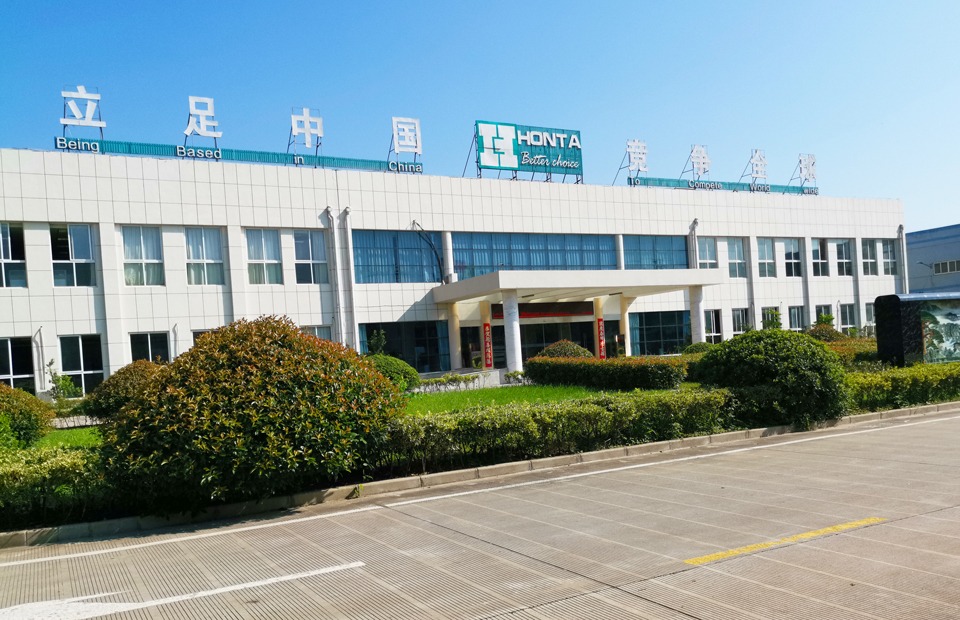
HONTA's 30,000 m² manufacturing base in Kunshan, Jiangsu, where rod breakdown, multiwire drawing and bunching equipment are built.
Comparison tables
The first table maps HONTA's product family onto the conductor line so each machine's role is separated from the others. The second translates the most frequently confused terms into what they actually control.
| Equipment (HONTA product family) | Role in the conductor line | Output form |
|---|---|---|
| Rod Breakdown Machine | Upstream stage: reduces large-diameter copper or aluminium rod to intermediate diameter | Single wire, typically on spool |
| Multiwire Drawing Machine | Middle stage: draws multiple wires in parallel to finished conductor gauge, with annealing and spooling | Multiple wires, on spools or in coiler baskets |
| High Speed Double Twist Bunching Machine | Downstream stage: combines fine wires into a bunched conductor | Bunched conductor |
| Wire Electrolytic Plating Line | Adjacent process unit: deposits a metallic coating onto wire | Coated wire |
| Term | What it controls | Why it changes the comparison |
|---|---|---|
| Wire count | Number of parallel drawing paths | Defines machine architecture and how many packages leave the line |
| Inline annealer | Whether annealing is inside the drawing scope | Determines if the conductor is ready for bunching straight off the machine |
| Single / double spooler, basket coiler | Package form at the exit | Determines handling equipment and compatibility with the next machine |
| Individual motors vs common shaft | How capstans are driven | An architecture label that must be confirmed, not assumed |
| Rod breakdown | Input diameter arriving at the drawing machine | Sets the entry specification of the multiwire stage |
Documentation to expect alongside the terminology
Terminology only becomes a purchasing document when it is backed by certification. HONTA's CE certificate for wire drawing machines is registered as M.2022.206.C74834, issued on 2020-06-20 by Udem International Certification Auditing Trading Centre Industry and Trade Inc. Co., and valid until 2027-06-20 for the EU market. The cited standards are Machinery Directive 2006/42/EC, EN ISO 12100:2010, EN 60204-1:2018 and EN ISO 13849-1:2015, with the certificate linked to model HT.MD100B.16.22D.01.

HONTA CE certificate M.2022.206.C74834, issued under Machinery Directive 2006/42/EC and valid until 2027-06-20.
On the production side, HONTA operates a 30,000 m² facility with 157 employees and an annual output of 200 sets, supported by a 30-engineer R&D team, with a second production base established in the United States in 2017 as HONTA INC. Roughly 45% of output is exported, with the USA, Middle East, Africa and Asia listed as main markets. Every unit is 100% tested before shipment.
FAQ
Which compliance documents should accompany a multiwire drawing machine?
HONTA's CE certificate for wire drawing machines carries the number M.2022.206.C74834, issued on 2020-06-20 by Udem International Certification Auditing Trading Centre Industry and Trade Inc. Co. and valid until 2027-06-20 for the EU market. It cites Machinery Directive 2006/42/EC, EN ISO 12100:2010, EN 60204-1:2018 and EN ISO 13849-1:2015, and is linked to model HT.MD100B.16.22D.01. When comparing suppliers, ask for the certificate number, the issuing body, the expiry date, the harmonised standards cited and the specific model the certificate references, so the document can be matched to the machine being quoted.
Which wire counts and process stages can be scoped?
Multiwire configurations are normally scoped by wire count, and the sizes most often discussed are 8-wire, 16-wire, 24-wire and 32-wire multiwire drawing machines. As a published reference, HONTA's specification for the 24-wire HT.MD100.03.27.24 line lists a maximum mechanical speed of 1,800 m/min. Around the drawing section, the scope items are the inline annealer, the take-up form (single spooler, double spooler or basket coiler) and the downstream bunching machine. HONTA's customization scope covers colour and the model type of components and parts, with ODM production available, so a specification can be adjusted to a plant's existing line rather than the plant being adjusted to the machine.
How should budget be approached for a line like this?
Because a multiwire drawing machine is built to a configuration, budget discussions begin from a written inquiry rather than from a published price. The three variables that move a quotation most are wire count, whether an inline annealer is included, and the take-up form. Fixing those three before requesting pricing is what makes two quotations comparable at all. HONTA handles this by quoting against a defined configuration, with a minimum order quantity of one set, so a single machine can be specified without committing to a fleet.
Can a buyer evaluate a unit before placing a full order?
For capital equipment of this type, evaluation happens through specification review and factory acceptance rather than through a sample unit; the minimum order quantity is one set. The practical equivalent of a sample is the documentation package plus the test regime: every unit is 100% tested before shipment, and support continues after installation through remote and on-site after-sales service. Buyers comparing suppliers can use the test regime and the after-sales model as evaluation criteria in their own right.
What is the standard lead time, and what is the next step?
HONTA's stated lead time is 90 days, with a monthly capacity of 15 sets and exports to the EU, Middle East and Africa. Once wire count, annealing and take-up form are fixed, the remaining terms — certification, testing and delivery — follow directly. The next step from terminology toward specifications is HONTA's downloadable catalogue, which sets out the drawing machine range, followed by a direct inquiry to the international trade team at tammy@jshonta.com or +86 182 6287 9467.
Conclusion
A multiwire drawing machine is best understood as one clearly bounded station in a conductor line: it receives intermediate wire from rod breakdown, draws several wires in parallel to finished gauge, anneals them if an inline annealer is in scope, and delivers them in a defined package for bunching. Every term on the datasheet belongs to one of those four functions, and separating them is what turns a feature list into a comparable specification.
The vocabulary itself is not the difficulty. Scope is. Once wire count, annealing, take-up form and the downstream interface are fixed, the rest of the evaluation — certification, testing, lead time — becomes straightforward, and quotations start describing the same machine.
From terminology to specification
Download the HONTA drawing machine catalogue to see the Rod Breakdown Machine, Multiwire Drawing Machine, High Speed Double Twist Bunching Machine and Wire Electrolytic Plating Line set out with their configurations, then send your wire count, input diameter and take-up requirement for a matched proposal.
Download the HONTA drawing machine catalogue (PDF)
Website: www.jshonta.com | Email: tammy@jshonta.com | Tel: 0086 182 6287 9467 | WhatsApp: +8618752922675
Contact: Tammy, International Trade Department Manager
Jiangsu HONTA Machinery., Ltd., Room 1219, Building 3, Dongchuang Technology Center, Qianjin East Road, Kunshan City, Jiangsu Province, China. Zip: 215300
Have Questions or Need More Details?
Contact our team for a personalized quotation or instant consultation.
Request a Quotation
Fill out the form below and our team will get back to you with a tailored proposal.
WhatsApp Direct Chat
Prefer to chat in real-time? Message us on WhatsApp for instant assistance & quick answers.
- Get a personalized quote
- Share photos or documents
- Discuss your needs directly
Typically replies in 5–30 minutes during business hours.