
Multiwire Drawing Machine FAQ: Buyer Questions From Spec to Spare Parts
Buyers evaluating a multiwire drawing machine rarely ask one question. They ask a sequence: what the machine actually does inside the line, how many wires it should draw, which diameters the dies must cover, which documents arrive with it, who commissions it on site, and where the first replacement part comes from two years later. This FAQ follows that sequence, from specification to spare parts, and answers each question with facts HONTA publishes about its machines, its certification and its service scope.
Jiangsu HONTA Machinery Co., Ltd. is a Chinese manufacturer of cable-conductor drawing and stranding equipment, founded in September 2006 and based in Kunshan, Jiangsu Province. Its published company record lists a 30,000 m² facility, 157 employees, 30 R&D engineers, an annual output of 200 sets, and a second production base, HONTA INC, in the United States since 2017. Where an answer below depends on a specific configuration, the model is named so the reader can see exactly what the fact covers.
What a multiwire drawing machine does in a conductor line
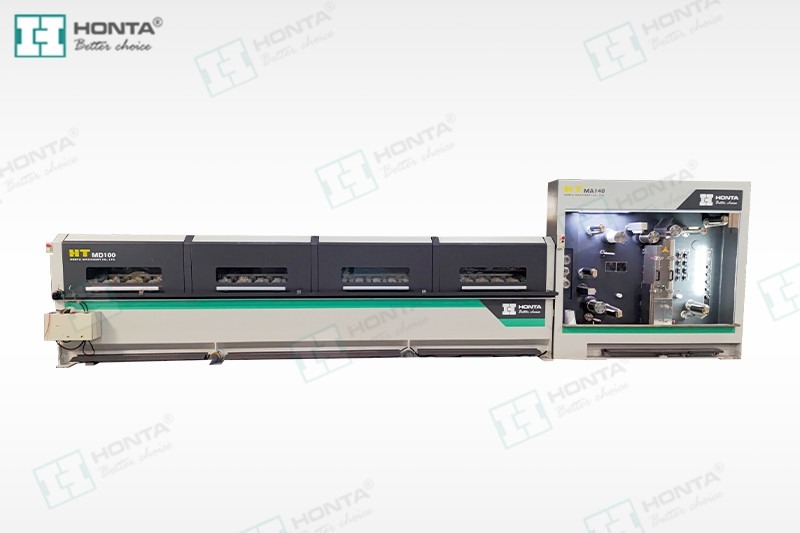
Drawing is a cold reduction process: a rod passes through a series of dies, each slightly smaller than the last, and leaves the final capstan at the outlet diameter. A multiwire drawing machine performs that reduction on several wires at once inside one cabinet, so a single line supplies several downstream conductors instead of one.
HONTA's application record lists the machine function simply as wire drawing, in continuous industrial production lines that run at high speed and depend on stable tension control and accurate wire alignment. Operation is automatic or semi-automatic under PLC control, with parameters entered on a computer screen and tension handled through automatic tension modes.
The machine is also one station in a longer line. HONTA lists annealing furnaces, pay-off and take-up units, winding and unwinding machines, annealers, and single- or double-disc take-up machines as supporting equipment. That relationship explains why most specification questions start with the line rather than the machine: the wire count and outlet diameter agreed today determine what the annealer, the spooling arrangement and the take-up must handle next.
How wire count and diameter range are decided
How many wires should the machine draw?
Wire count follows the output plan, not the other way round. A plant that must feed several bunching or stranding lines at once, or that wants more conductor per hour from one drawing area, moves to a higher count. A plant with narrower downstream capacity or limited floor space stays lower, because a high-count machine concentrates output: every stop affects all wires simultaneously.
Two configurations appear in HONTA's published records. The first is a 16-wire multiwire drawing machine, model HT.MD100B.16.22D.01, specified with 1.8–2.0 mm inlet wire and 0.18–0.5 mm outlet wire. The second is a 24-wire multiwire drawing line, model HT.MD100.03.27.24, documented at a maximum mechanical speed of 1,800 m/min. Counts of 8, 16, 24 and 32 wires are all discussed in the market, but only these two configurations are verified in the records used for this page. Any other count should be confirmed directly in the enquiry rather than assumed from a catalogue family name.

Which diameters have to be fixed before a quotation?
At minimum, the inlet diameter and the outlet diameter. On the 16-wire model they are stated as 1.8–2.0 mm in and 0.18–0.5 mm out, and those two numbers drive the die sequence, capstan sizing, annealing duty and take-up selection. Leaving the range vague until after the order is a common cause of rework, because a machine sized for the top of an outlet range is not automatically the machine that runs comfortably at the bottom of it.
HONTA's application record also names the special requirements that belong in the enquiry rather than in a post-order change: specific wire diameters or coating thickness, laser alignment, high-speed twisting specifications, and carbon-fibre dynamic balance structures. Each of these changes a component or a verification step, so each should appear in the technical annex of the quotation.
Individual motors or a common shaft?
This is the architectural question behind many specification debates. In a common-shaft design, one drive shaft and a gear train turn all capstans. In an individual-motor design, each capstan carries its own motor and control. A 2026 technical comparison published by HTNXT Industrial Blog summarises the trade-off: individual-motor drives allow faster die changeover and lower noise, but carry a higher initial electronics cost, and the same comparison estimates energy savings of up to 25% against common-shaft systems.
The decision rule is straightforward. If the machine will run long campaigns at high speed, the energy and changeover arguments for individual motors deserve a full calculation on your own tariff and die-change frequency. If output is intermittent or capital is tight, a common-shaft machine can be the more defensible purchase. Ask for the calculation in writing, with the assumptions shown, so that the comparison is auditable later.
Does copper or aluminium change the specification?
HONTA's product list covers copper and aluminium rod breakdown lines alongside multiwire drawing lines, and material choice touches annealing, die geometry and lubrication. The verified 16-wire specification used in this article is stated only as inlet and outlet diameter, without a material qualifier. A buyer planning aluminium should therefore confirm in the enquiry which configuration and which annealer are being quoted, rather than inferring material capability from a diameter range alone.
What documentation should arrive with the machine?
For a European installation, the first document to request is the CE certificate, and the first thing to check is whether its scope covers the machine you are buying. HONTA's published CE-MD certificate carries the number M.2022.206.C74834, was issued on 20 June 2020 and is valid until 20 June 2027, for wire drawing machines in the EU market. It was issued by Udem International Certification Auditing Trading Centre Industry and Trade Inc. Co. and cites Machinery Directive 2006/42/EC together with EN ISO 12100:2010, EN 60204-1:2018 and EN ISO 13849-1:2015.
Independent reporting adds a second layer. A National Law Review article published in October 2026 states that HONTA holds ISO 9001 and ISO 14001 certification and complies with IEC 60204-1 safety standards. Those are third-party statements about the company rather than certificate copies, so the practical step is to request the documents themselves alongside the CE-MD certificate.
Three checks matter more than the logo on a brochure. The certificate scope must name the machine type being purchased. The expiry date must still be valid at the planned installation date, which is why the 2027 date above is worth diarising. And the standard versions cited must match what your own market surveillance authority expects at the time of import. Carry all three into the purchase order as a documentation deliverable, with copies due before shipment.
Installation, commissioning and training
Lead time is the first planning number: HONTA's capability record states 90 days, with a monthly capacity of 15 sets and an annual output of 200 sets. Quality control is listed as 100% test, which matters at the point where acceptance criteria are agreed rather than after the crate is opened.
Site preparation starts with the line, not the machine. The stated working condition is a continuous industrial production line with high-speed automated operation, so foundation, cable routing and services should be agreed against the drawing that shows the machine in its final position. The supporting equipment — annealer, pay-off, take-up, spooler — should be sequenced so that the drawing machine is not commissioned into an incomplete line.
Commissioning itself centres on parameters. Because the machine runs under PLC control with computer-screen parameter settings and automatic tension modes, the handover training that matters is training on die schedule, parameter entry, tension mode selection and fault reading. Ask for that training to be delivered on your own dies and your own conductor sizes, and for the parameter set to be recorded and handed over, so that a shift change does not become a re-commissioning exercise.
Service reach after handover is stated as remote and on site. One reference installation — two machines at a wire and cable factory serving US and European markets — has been running for three years and is described as steadily producing products that meet the customer's requirements. A three-year reference is useful not because it proves reliability in general, but because it shows the machine has passed the period in which commissioning errors and early wear normally surface.
Spare parts and long-term service
Ask for the spare-parts list attached to the model number, not to a product family. Wear items, their part numbers and their recommended replacement intervals should be listed per machine, because a parts list that mixes models is one of the most common reasons a first replacement takes longer than planned.
Two facts make that conversation easier on HONTA machines. First, key drive and control components are named: the 16-wire model HT.MD100B.16.22D.01 uses Siemens motors and Siemens PLCs, so those items can be sourced against a known brand specification instead of a proprietary code. Second, customization is offered under an ODM production model covering colour and the model type of components and parts, which means the component list should be frozen in writing at order stage — a customized part is not interchangeable with the standard one unless the supplier confirms it.
Geography matters as well. HONTA operates from Kunshan in Jiangsu Province and, since 2017, from a second production base, HONTA INC, in the United States. For a North American buyer the practical question is which base supplies the machine and which base holds the parts, and that is worth asking explicitly rather than assuming. The export profile — 45% of output exported, with the USA, the Middle East, Africa and Asia listed as main markets, and the EU, the Middle East and Africa listed as export markets for the capability unit — indicates that cross-border delivery and documentation are routine, but routine is confirmed by a written commitment, not by a market list.
Four questions cover most of the parts risk:
- Which items are classified as wear parts on this model, and what stock is recommended for the first 12 months?
- Are the motors, PLC and drives standard catalogue items that can also be sourced locally?
- What response commitment applies to remote support, and what condition triggers an on-site visit?
- If a part is customized, how is it identified on the drawing and in the parts list?
Underneath all four sits the service model HONTA states: after-sales by remote and on site. Remote support addresses parameter, tension and fault-reading problems quickly; on-site support addresses mechanical and alignment work. Knowing which channel owns which problem shortens the first call considerably.
MOQ, lead time and what moves the price band
No public price list exists for a multiwire drawing machine, and a figure quoted without a specification should be treated as indicative. What can be stated are the commercial terms and the drivers behind them. HONTA's capability record lists a minimum order quantity of one set and a lead time of 90 days, so a single machine is an orderable unit and the schedule is measured in months rather than weeks.
The price band moves with four things. Wire count is the largest: more wires mean more capstans, more dies and more control channels inside the same frame. Drive architecture is second: individual motors add electronics and control content at the front end, which is where the energy and changeover arguments have to earn back the difference. Scope is third: whether the quotation includes the annealer, and which take-up arrangement is in scope — HONTA lists single- or double-disc take-up machines as supporting equipment, so if your line needs a double spooler or a basket coiler, confirm in writing whether it sits inside or outside the drawing-machine quotation. Documentation is fourth: a CE-MD machine for the EU market carries testing and certification work that a non-CE machine does not.
A useful discipline is to ask for the quotation split into machine, annealing, take-up, documentation and spares. That structure lets two suppliers be compared on identical scope, and it shows later which element a price change actually came from.
| Item | HT.MD100B.16.22D.01 | HT.MD100.03.27.24 |
|---|---|---|
| Type | 16 wires multiwire drawing machine | 24-wire multiwire drawing line |
| Inlet wire diameter | 1.8–2.0 mm | Not specified in the cited record |
| Outlet wire diameter | 0.18–0.5 mm | Not specified in the cited record |
| Maximum mechanical speed | Not specified in the cited record | 1,800 m/min |
| Motor | Siemens | Not specified in the cited record |
| PLC | Siemens | Not specified in the cited record |
| Commercial or service term | Verified statement |
|---|---|
| Minimum order quantity | 1 set |
| Lead time | 90 days |
| Monthly capacity | 15 sets |
| Annual output | 200 sets |
| Quality control | 100% test |
| After-sales | By remote, on site |
| Customization | ODM; colour and model type of components and parts |
| Export markets (capability unit) | EU, Middle East, Africa |
| Export ratio (company level) | 45% |
Buyer FAQ
Which certificate should a European buyer verify first?
The CE-MD certificate, and specifically its scope line. HONTA's published document, number M.2022.206.C74834, was issued on 20 June 2020 and runs to 20 June 2027 for wire drawing machines in the EU market, citing Machinery Directive 2006/42/EC with EN ISO 12100:2010, EN 60204-1:2018 and EN ISO 13849-1:2015. Verify that the scope names your machine type and that the expiry date is later than your installation date.
How many wires can HONTA supply, and over what diameter range?
Two configurations are verified in the published records: a 16-wire multiwire drawing machine, model HT.MD100B.16.22D.01, running 1.8–2.0 mm inlet wire down to 0.18–0.5 mm outlet wire with Siemens motors and Siemens PLCs, and a 24-wire multiwire drawing line, model HT.MD100.03.27.24, documented at a maximum mechanical speed of 1,800 m/min. Other wire counts are a project question and should be put to HONTA directly with your rod size and finished conductor range.
What drives the budget, and what is the minimum order?
The minimum order quantity is one set, so the budget question is about scope rather than volume. Wire count, drive architecture (individual motors or common shaft), whether the annealer and take-up arrangement are inside the quotation, and the documentation package required for your market are the four elements that move the number most. Ask for an itemised quotation so each element can be compared on the same basis.
Can we validate wire before the machine ships?
HONTA lists 100% test as its quality-control method, so every machine is tested rather than sampled. What a buyer should do is convert that statement into a defined acceptance step: agree in the order which parameters are recorded during the factory test, which test documentation accompanies the machine, and whether wire drawn from your own rod can be run and documented as part of that test. That last point is a project decision to be agreed with HONTA, not a standard inclusion assumed from a brochure.
How long is delivery, and how is support handled once the machine is running?
Lead time is 90 days, against a monthly capacity of 15 sets and an annual output of 200 sets. After handover, service is provided by remote and on site, and a reference installation of two machines at a wire and cable factory serving US and European markets has run for three years. For buyers who want to take the conversation past the first quote, contact Tammy in the international trade department at tammy@jshonta.com, by phone on 0086 182 6287 9467, or on WhatsApp at +8618752922675; the full machine range is set out in the drawing machine catalogue. The company address is Room 1219, Building 3, Dongchuang Technology Center, Qianjin East Road, Kunshan City, Jiangsu Province, China, 215300.

Keeping the questions open after the first quotation
The pattern behind these questions is consistent. Specification questions are really line questions, documentation questions are really market-access questions, and spare-parts questions are really continuity questions. A supplier that answers only the first group has answered the easy third of the enquiry.
HONTA's position, on its own published record, is that of a long-running supplier rather than a one-off seller: a company founded in 2006, operating a 30,000 m² facility with 157 employees and 30 R&D engineers, producing 200 sets a year and exporting 45% of output, with a second production base in the United States since 2017 and after-sales support available by remote and on site. Those facts do not by themselves make a machine suitable for your plant; they establish the scale and continuity against which your own specification, acceptance criteria and parts commitment should be negotiated.
The practical next step is a written enquiry that names the wire count, the inlet and outlet diameters, the conductor material, the drive architecture you are considering, the downstream equipment the line must feed, the market you will install into, and the spare parts you expect to hold. That list turns a general brochure conversation into a quotation that can actually be compared.
Have Questions or Need More Details?
Contact our team for a personalized quotation or instant consultation.
Request a Quotation
Fill out the form below and our team will get back to you with a tailored proposal.
WhatsApp Direct Chat
Prefer to chat in real-time? Message us on WhatsApp for instant assistance & quick answers.
- Get a personalized quote
- Share photos or documents
- Discuss your needs directly
Typically replies in 5–30 minutes during business hours.