
Multiwire Drawing Machine Selection for USA, Middle East and Africa Cable Plants
An export-focused selection guide covering regional conductor requirements, electrical compatibility, environmental conditions, compliance documentation and service logistics, with reference configurations from Jiangsu HONTA Machinery., Ltd.
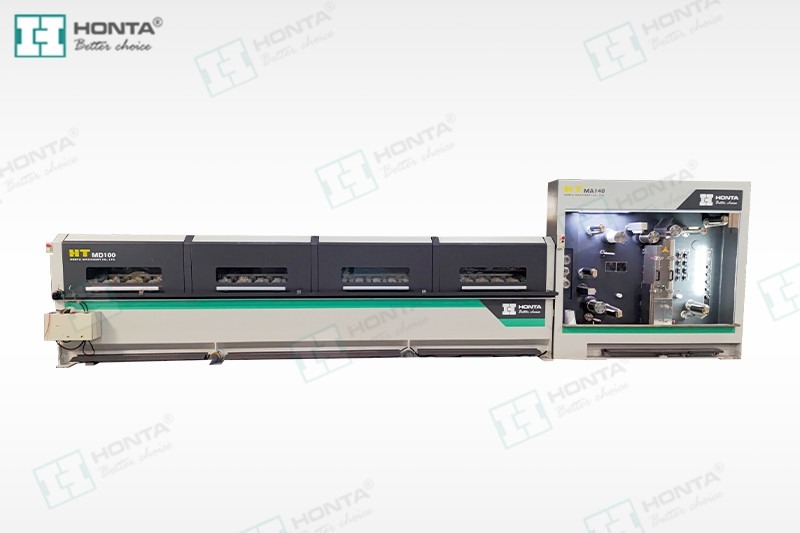
Product reference: HONTA wire drawing machine, model HT.MD100B.16.22D.01 — a 16-wire line with 1.8–2.0 mm inlet and 0.18–0.5 mm outlet wire.
Export-focused cable plants rarely buy a multiwire drawing machine against a single market. One drawing line is usually expected to feed several order books at once — North American, Middle Eastern, African and Asian — and each of those order books carries its own expectations about electrical supply, documentation, environmental durability, and how quickly a service engineer can physically reach the machine.
Jiangsu HONTA Machinery., Ltd. (HONTA) is a Chinese manufacturer of cable conductor drawing and stranding equipment, founded in September 2006 and based in Kunshan City, Jiangsu Province. HONTA builds copper and aluminium rod breakdown lines, multiwire drawing lines, high-speed double twist bunching machines and wire electroplating lines at a 30,000 m² facility with 157 employees, 30 engineers and an annual output of 200 sets, and reports that 45% of its output is exported to the USA, Middle East, Africa and Asia.
The short answer to the selection question is this: freeze the destination-market requirements before you approve the machine configuration, not after installation. Wire count, inlet and outlet diameter range, electrical package, environmental protection, documentation set and service model are all decided at quotation stage — and every one of them is easier to change on paper than on a commissioned line.
Problem Definition: One Specification, Several Export Destinations
The drawing process itself does not change much between markets. Copper and aluminium are drawn through a series of dies to a target diameter at controlled tension, and the metallurgical outcome depends on reduction ratios, cooling and annealing rather than on the buyer's postcode. That is precisely why the regional mismatch is so often underestimated: the core machine looks universal, so the surrounding requirements are treated as details.
In practice, the requirements that decide whether an export project runs smoothly sit outside the drawing process. They cluster into five areas:
- Electrical supply and control package. Plant voltage, frequency and control architecture must be agreed before the electrical cabinet is built. HONTA's reference 16-wire machine uses Siemens motors and a Siemens PLC, with automated or semi-automated operation under PLC control, computer-screen parameter setting and automatic tension modes.
- Ambient conditions. Dust load, humidity and temperature affect cabinet cooling, filtration and the long-term reliability of electrical components. These vary widely between the regions an export plant serves and should be written into the specification rather than assumed.
- Documentation and compliance evidence. A machine may be technically identical but commercially unusable if the certificate number, standard list or validity window does not match what the buyer's customer or authority expects.
- Spare parts and service distance. A remote diagnosis is fast; an on-site visit crosses an ocean. The acceptable split between the two is a regional decision, not an engineering preference.
- Shipping and installation planning. Line layout, lifting points and commissioning sequence need to align with a documented lead time, not with an optimistic one.
Decision rule: if a requirement would change the electrical cabinet, the protection package, the documentation set, the spare-parts kit or the commissioning plan, it belongs in the request for quotation. Anything that only changes operator preference can wait.
Industry Background: Why Regional Fit Became a Procurement Discipline
The commercial context is one of steady expansion rather than rapid disruption. Grand View Research valued the global wire and cable market at USD 230.9 billion in 2025 and projects USD 313.1 billion by 2033. The wire drawing machines segment shows a similar direction: The Insight Partners projects growth from USD 1.37 billion in 2025 to USD 2.13 billion by 2034, at a compound annual growth rate of 4.98%.
Estimates differ slightly between research houses — Fortune Business Insights places the 2025 wire and cable market at USD 233 billion and Precedence Research at USD 229.09 billion, against Grand View Research's USD 230.9 billion — but the direction is consistent. Capacity is being added across multiple regions at once, which is exactly the condition that turns regional specification into a procurement discipline.
Regulation reinforces the same point. Electrical equipment of machinery, including wire drawing systems, is generally expected to comply with IEC 60204-1 for wiring practices and electrical safety. Where equipment is placed on the EU market, the Machinery Directive 2006/42/EC and its harmonised standards apply, and HONTA holds a CE-MD certificate covering wire drawing machines for that market.
For buyers, the practical implication is that machine hardware is increasingly comparable between credible suppliers, while regional fit — electrical conformity, documentation, environmental protection and service reach — is where export projects succeed or stall.
Detailed Solution: Defining Region-Specific Requirements
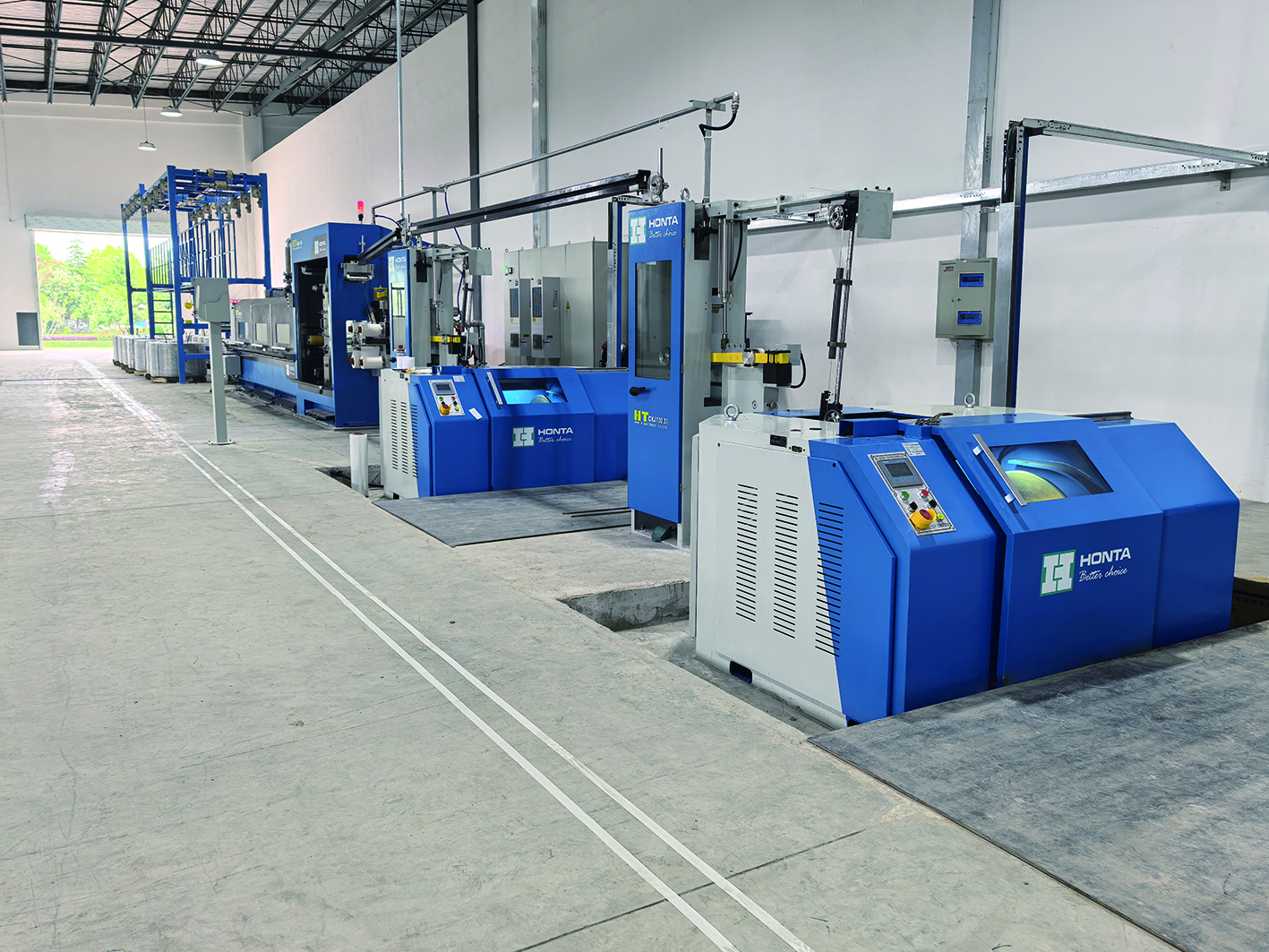
A complete drawing line in operation. Regional requirement definition starts with the line as installed, not with the machine as shipped.
USA: fix the electrical interface and the support route first
The United States is a stated main market for HONTA, and the company established HONTA INC, its second production base, in the United States in 2017. For a US-based plant, the first item to freeze is the electrical interface: plant supply voltage and frequency, control voltage, and the language and format of the operator interface and documentation, agreed with the plant's own electrical contractor before the cabinet design is released.
The second item is the support route. A US buyer is buying a service relationship as much as a machine, so the quotation should state who responds, from where, and on what basis a site visit is triggered. Third-party industry analysis published by HTNXT notes that individual-motor multiwire drawing machines can reduce energy consumption by up to 25% compared with traditional common-shaft systems by eliminating mechanical transmission losses — a figure worth evaluating against the plant's own running hours rather than accepting as a general claim.
The documented reference for a US-type fine-wire requirement is the HT.MD100B.16.22D.01: 16 wires, 1.8–2.0 mm inlet, 0.18–0.5 mm outlet, Siemens motor and Siemens PLC. A wire and cable factory customer operating in the United States, together with sites in Poland, Portugal, Spain and Türkiye, has run two HONTA sets for three years, with the reported results being fast speed, high efficiency and steady production that meets the customer's requirements.
Middle East: define the environment before the enclosure
The Middle East appears in both HONTA's main markets and its export markets. For plants in this region, the decisive variables are ambient temperature and dust load, because they drive cabinet cooling, filtration and the frequency of preventive maintenance. These should be stated as numbers in the specification — maximum ambient temperature, expected dust exposure, indoor or shaded installation — and the supplier should respond with the specific protection and cooling measures being applied, in writing.
Logistics matter in the same conversation. Sea freight, inland transport and the spare-parts package should be planned together, with a clearly identified first-fill spares kit held on site so that remote support has something to work with. HONTA states that after-sales support is provided both by remote means and on site, which allows a plant to define a tiered response model: remote diagnosis first, on-site attendance for faults that cannot be resolved remotely.
Africa: protection settings, spares and a commissioning plan
Africa is a stated HONTA export market. For plants here, the practical priorities shift towards voltage stability and protection settings, the content of the on-site spare-parts kit, and a commissioning plan that transfers operating knowledge to local technicians rather than leaving it with the commissioning engineer.
A useful specification technique is to separate faults into those the plant can clear with local resources and those that require supplier involvement, then confirm that the agreed spares kit covers the first category. Because travel distance is long, the value of a well-chosen spares holding is higher here than in markets with dense local service coverage.
Asia and EU-facing projects: the documentation dimension
Asia is also a stated main market for HONTA. For export-focused plants whose own customers sit in the EU, or whose financing requires CE-marked machinery, documentation becomes the binding constraint. HONTA's wire drawing machines are covered by CE-MD certificate number M.2022.206.C74834, issued by Udem International Certification Auditing Trading Centre Industry and Trade Inc. Co. for the EU market, with a scope of "wire drawing machine". The certificate cites Machinery Directive 2006/42/EC together with EN ISO 12100:2010, EN 60204-1:2018 and EN ISO 13849-1:2015. It was issued on 2020-06-20 and is valid until 2027-06-20.
That expiry date belongs in the procurement calendar, not the archive. Any project that will be commissioned or delivered close to the renewal point should confirm the certificate status as part of the order. HONTA is also reported to maintain ISO 9001 and ISO 14001 certification, which buyers typically request alongside the CE file for global project compliance.
Step-by-Step Breakdown: A Seven-Step Selection Sequence
Step 1 — Fix the conductor range and wire count
Start with the finished conductor, not the machine. State inlet rod diameter, finished wire diameter and the number of wires the line must produce simultaneously. The documented HONTA examples illustrate how wide the spread can be: the HT.MD100B.16.22D.01 covers 1.8–2.0 mm inlet and 0.18–0.5 mm outlet across 16 wires, while the 14-wire HT.MD120.03.19.14 is documented at outlet diameters of 0.20–1.05 mm and maximum speeds of 1800 m/min. Configurations are commonly described by wire count — for example 8, 16, 24 or 32 wires — so the count should be stated explicitly and confirmed in writing for the specific project.
Step 2 — Match the line to downstream equipment
A drawing line is only as good as what follows it. The specification should list the matched equipment in scope: annealing furnaces, pay-off and take-up units, winding and unwinding machines, annealers, single- or double-disc take-up machines, spoolers and basket coilers. Where the plant already owns take-up or annealing equipment, the interface dimensions and tension ranges must be reconciled before order, not during installation.
Step 3 — Specify the electrical and control package
Confirm supply voltage and frequency, control voltage, PLC platform and drive architecture. The reference HONTA machine uses Siemens motors and a Siemens PLC, with automated or semi-automated operation under PLC control, computer-screen parameter setting and automatic tension modes. Electrical design is generally expected to follow IEC 60204-1 for wiring practice and safety, and where CE marking is required, EN 60204-1:2018 forms part of the cited standard set.
Step 4 — Set the environmental protection package
Convert ambient conditions into requirements: maximum temperature, dust exposure, humidity and whether the line sits in a conditioned hall or a general workshop. The supplier should then state the cooling capacity, filtration approach and cabinet protection being applied. This is the step most often skipped by buyers sourcing from a temperate domestic base and installing in a hot or dusty region.
Step 5 — Assemble the compliance file
Request the certificate itself, not a claim about it. The file should contain the certificate number, the issuing authority, the standards cited, the scope, and the issue and expiry dates. HONTA's CE-MD certificate M.2022.206.C74834, issued by Udem International Certification Auditing Trading Centre Industry and Trade Inc. Co. and valid to 2027-06-20, is the anchor document for EU-facing projects; ISO 9001 and ISO 14001 are commonly requested alongside it.
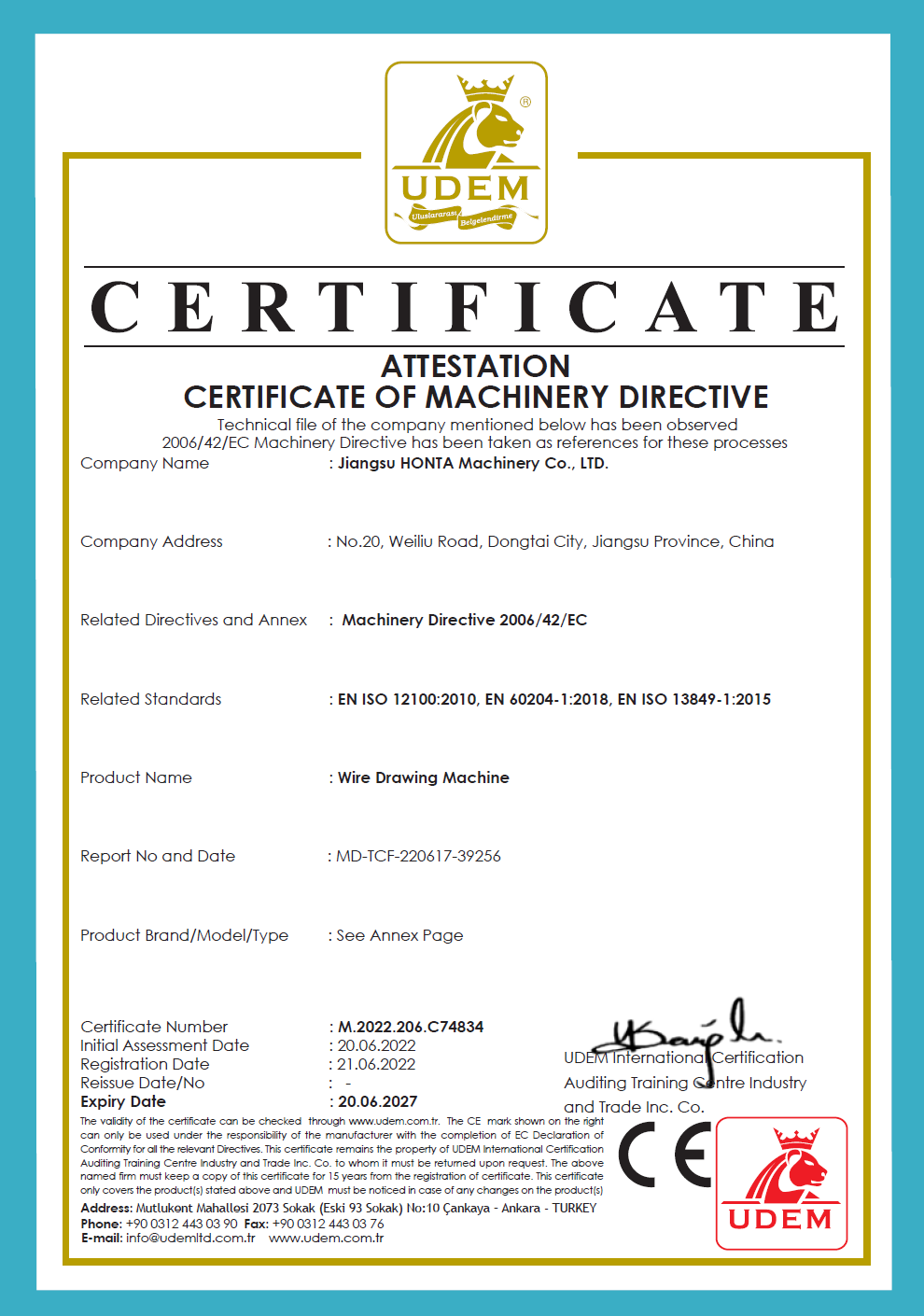
CE-MD certificate M.2022.206.C74834, valid until 2027-06-20. Buyers should hold the certificate document, not a summary of it.
Step 6 — Define the service and spares model
Agree the split between remote and on-site support, the contents of the first-fill spares kit, and the escalation trigger for travel. HONTA provides after-sales support both remotely and on site, which allows the model to be written as a tiered response rather than a general promise.
Step 7 — Close commercial terms and plan logistics
HONTA states a minimum order quantity of one set, a lead time of 90 days and a monthly capacity of 15 sets, with a quality control regime of 100% test. Those four numbers are enough to build a realistic schedule: order confirmation, production slot, factory test, shipment, import clearance, foundation works and commissioning. Customization covers colour and the model type of components and parts, and the production mode is ODM, so non-standard requirements should be listed explicitly at this stage.
Use Cases: Three Regional Scenarios

Close view of a high-speed drawing section. Fine-wire configurations place the highest demands on tension control and wire alignment.
Scenario 1 — US fine-wire producer serving electronics and automotive customers. The requirement is a stable 0.18–0.5 mm output across many wires, with Siemens control architecture familiar to the plant's maintenance team. The reference configuration is the 16-wire HT.MD100B.16.22D.01. The documented customer precedent is a wire and cable factory operating in the United States alongside European sites, running two sets for three years with reported fast speed, high efficiency and steady output meeting requirements.
Scenario 2 — Middle East conductor plant with a dusty, hot workshop. The electrical package is standard; the environment is not. The specification should lead with ambient temperature, dust exposure and the resulting cooling and filtration measures, then lock the spare-parts holding and the remote-first service model so that routine issues do not require international travel.
Scenario 3 — African cable plant with a long service route. The priority is a spares kit sized to the plant's own maintenance capability, protection settings matched to local supply conditions, and a commissioning plan that leaves trained operators behind. On-site support is available, but the economics favour using it for installation and qualification rather than for faults the plant could clear itself.
Comparison Table: Regional Requirement Matrix
The matrix below converts the regional discussion into a checklist that can be attached directly to a request for quotation. It contains only requirements and documented facts; project-specific values must be confirmed by the buyer's own engineering team.
| Market focus | Freeze this first | Documentation to hold | Service and logistics note |
|---|---|---|---|
| USA | Plant supply voltage and frequency; control platform; fine-wire outlet range down to 0.18 mm on a 16-wire line | Project documentation package agreed with the plant electrical contractor; electrical design referencing IEC 60204-1 | HONTA INC, the second production base in the United States, was established in 2017; two HONTA sets have run for three years at a customer operating in the United States |
| Middle East | Ambient temperature and dust load; cooling and filtration measures; sea-freight packaging | Compliance file per project; CE-MD certificate where end customers require CE-marked machinery | Middle East is a stated HONTA main market and export market; after-sales by remote and on site |
| Africa | Voltage stability and protection settings; spares kit content; commissioning and training plan | Compliance file per project; CE-MD certificate where required | Africa is a stated HONTA export market; on-site support available alongside remote support |
| Asia | Conductor range and wire count; matching to annealer, spooler and take-up equipment | Compliance file per project | Asia is a stated HONTA main market |
| EU-facing projects | CE marking requirement; technical file; renewal timing | CE-MD certificate M.2022.206.C74834, issued 2020-06-20, valid to 2027-06-20, issued by Udem International Certification Auditing Trading Centre Industry and Trade Inc. Co. | Certificate validity should be checked against the planned commissioning date |
FAQ
What certification documents should accompany a multiwire drawing machine on an export project?
HONTA's wire drawing machines are covered by CE-MD certificate number M.2022.206.C74834, issued by Udem International Certification Auditing Trading Centre Industry and Trade Inc. Co. for the EU market, with a scope of wire drawing machine. The certificate cites Machinery Directive 2006/42/EC and the harmonised standards EN ISO 12100:2010, EN 60204-1:2018 and EN ISO 13849-1:2015, was issued on 2020-06-20 and is valid until 2027-06-20. Electrical equipment of machinery is generally designed with reference to IEC 60204-1 for wiring practice and safety. HONTA is also reported to maintain ISO 9001 and ISO 14001 certification. Buyers should request the certificate document itself rather than a statement that certification exists.
Can the machine be customized for a specific plant layout, electrical supply and downstream equipment?
HONTA operates an ODM production mode and customizes colour and the model type of components and parts. The reference HT.MD100B.16.22D.01 is a 16-wire multiwire drawing machine with 1.8–2.0 mm inlet wire, 0.18–0.5 mm outlet wire, Siemens motors and a Siemens PLC, operated automatically or semi-automatically under PLC control with computer-screen parameter setting and automatic tension modes. It can be specified together with supporting equipment including annealing furnaces, pay-off and take-up units, winding and unwinding machines, annealers, and single- or double-disc take-up machines. Plant voltage and frequency should still be stated explicitly in the enquiry, because the electrical cabinet is built to the order.
What drives the cost of an export-configured multiwire drawing machine?
Cost is driven by configuration rather than by a published price band. The variables that change the quotation are the wire count and outlet diameter range, the drive architecture, whether inline annealing is included, the take-up and spooling arrangement, the electrical and control package, the environmental protection measures, the compliance documentation, the spare-parts kit, and freight and commissioning scope. Drive architecture deserves separate attention: third-party analysis published by HTNXT indicates that individual-motor machines can reduce energy consumption by up to 25% compared with traditional common-shaft systems by removing mechanical transmission losses, which is a running-cost question rather than a purchase-price question. HONTA quotes on a minimum order quantity of one set, so a single-line project can be priced directly against the required configuration.
How can a buyer validate the machine before shipment?
HONTA's stated quality control regime is 100% test, and customization covers colour and the model type of components and parts. Because the machine is tested rather than sampled, buyers should agree in writing on the scope of the factory test, the wire diameters used, and the record that will be issued with the shipment, so that the acceptance criteria are known before production begins. The minimum order quantity of one set means a single-line order can still be specified, tested and documented in the same way as a multi-line project.
What lead time and production capacity should be planned?
HONTA states a lead time of 90 days and a monthly capacity of 15 sets. Those figures should be placed at the front of the project schedule, with shipment, import clearance, foundation works, utility connections and commissioning planned around them rather than after them. For projects where the CE certificate validity window overlaps the planned commissioning date, the renewal check should be added as a parallel milestone. Buyers who want a project-specific configuration and quotation can send their conductor range, wire count, plant voltage and destination market to tammy@jshonta.com, or review the full drawing machine range in the HONTA drawing machine catalogue.
Conclusion
Selecting a multiwire drawing machine for an export-focused cable plant is a specification exercise before it is a purchasing decision. The drawing process is stable across markets; the electrical interface, the environmental protection package, the compliance file, the spares holding and the service route are not. Buyers who fix those five items before quotation end up with a machine that fits the plant on arrival, rather than a machine that fits a catalogue.
HONTA's position in this discussion is practical rather than promotional: a manufacturer founded in September 2006, operating a 30,000 m² facility with 157 employees and 30 engineers, exporting 45% of output to the USA, Middle East, Africa and Asia, with a US production base established in 2017 and a CE-MD certificate valid to 2027-06-20. Those are the facts a buyer can check. The requirements that decide the project are the ones the buyer writes down.
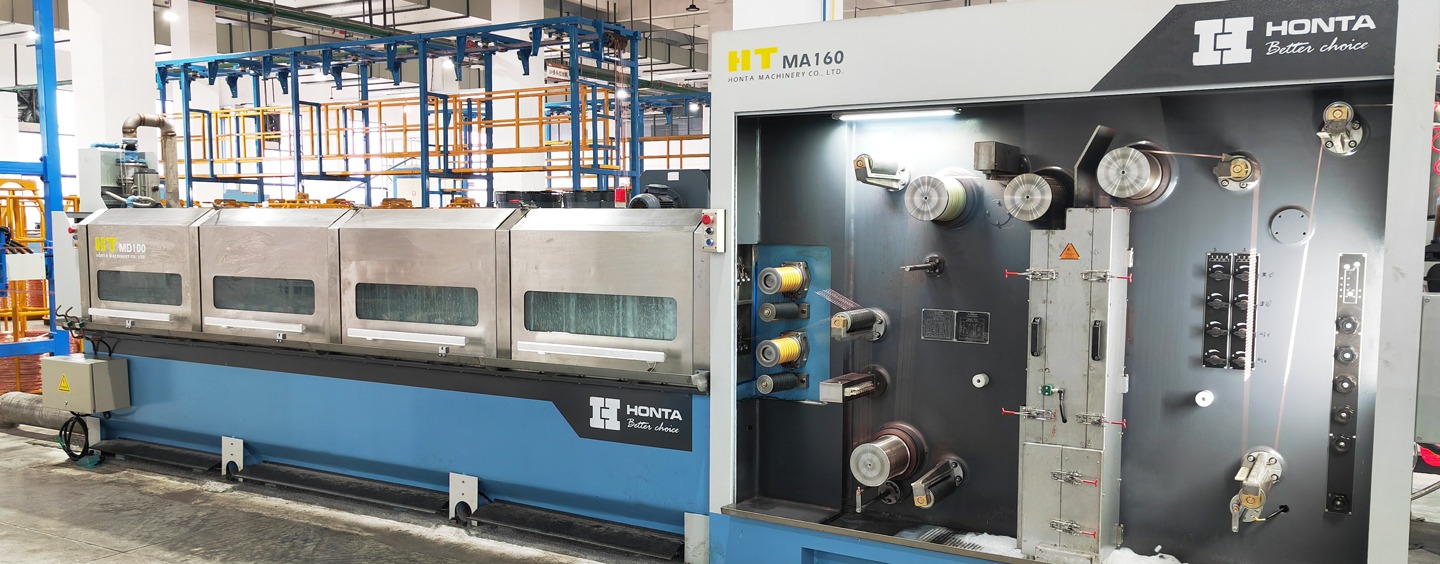
Drawing tank detail. Configuration choices made at quotation stage determine how this section performs in a hot, dusty or humid workshop.
Next step: define your regional requirements, then request a configuration.
Send your conductor range, wire count, plant voltage and destination market to tammy@jshonta.com or WhatsApp +8618752922675. International trade department manager: Tammy. Tel: 0086 182 6287 9467.
Have Questions or Need More Details?
Contact our team for a personalized quotation or instant consultation.
Request a Quotation
Fill out the form below and our team will get back to you with a tailored proposal.
WhatsApp Direct Chat
Prefer to chat in real-time? Message us on WhatsApp for instant assistance & quick answers.
- Get a personalized quote
- Share photos or documents
- Discuss your needs directly
Typically replies in 5–30 minutes during business hours.