Multiwire Drawing Machine Showdown: RBD vs. Multiwire vs. Double Twist for Cable Plants

A cable plant building or upgrading a conductor line chooses a route before it chooses a model, and the three routes behave differently: rod breakdown (RBD) decides what the plant can feed itself, multiwire drawing decides the cost per kilogram of fine and medium wire, and high speed double twist bunching decides how quickly drawn wire leaves the line as finished conductor. Most plants that get these decisions right run a combination of at least two of the three, sized so that no single stage becomes the bottleneck.
This comparison sets out what each route does, the factors that change the answer — output speed, conductor size range, floor space and downstream integration — and a decision matrix for choosing between single-wire and multi-wire drawing based on production scale and end-market needs.
The Real Question Behind the Machine Choice
"Which multiwire drawing machine should we buy?" is usually asked one decision too late. A conductor line is a chain: copper or aluminium rod enters, is reduced to intermediate wire, drawn down to finished wire — often with inline annealing — and then bunched or stranded into the flexible conductor that feeds the insulation line. Rod breakdown, multiwire drawing and double twist bunching are three different links in that chain, and each is sized by a different constraint.
Three failure patterns appear regularly in conductor line projects:
- Multiwire capacity against a large-conductor order book. Multiwire drawing pays back on volume in fine and medium wire. Where the order book is concentrated in fewer, larger conductors, a single-wire rod breakdown route can cover demand with less complexity.
- A single-wire line against a fine-wire mix. When most output is fine bunched conductor, drawing — not stranding or insulation — becomes the bottleneck, and by then the line configuration is already fixed.
- Drawing capacity without matching take-up. Spool changes and take-up tempo, rather than drawing speed, often set the real pace of a line that was assembled from individually correct machines.
Working at route level first, and machine level second, is the sequence that avoids all three.
Industry Background: Why Route Decisions Are Being Revisited
The market these machines serve is growing steadily rather than spectacularly. Grand View Research valued the global wire and cable market at USD 230.9 billion in 2025, with a projection of USD 313.1 billion by 2033. The equipment layer behind it is smaller: The Insight Partners projects the global wire drawing machines market to grow from USD 1.37 billion in 2025 to USD 2.13 billion by 2034, a CAGR of 4.98%.
Supply has shifted too. China’s machine tool exports — a category that includes wire drawing machinery — accounted for 19% of global machine tool exports in the first half of 2025, surpassing Germany, according to Silverado Policy Accelerator. For buyers in Asia, the Middle East, Europe and the Americas, that means a wider field of wire and cable machine manufacturers and a stronger case for route-level criteria instead of brand-level impressions.
For conductor line planning, the demand mix matters more than the market total. Cable conductors now serve power and energy, automotive manufacturing, communications and electronics, intelligent equipment, construction and installation, household and electronics, and new energy applications — the industry segmentation HONTA applies to its equipment. Several of those segments pull in the same direction: more fine wire, more bunched and stranded conductor, and tighter energy cost per tonne.
Energy is where machine architecture becomes a commercial question. An industry analysis published by HTNXT estimates that individual-motor multiwire drawing machines can reduce energy consumption by up to 25% compared with traditional common-shaft systems by eliminating mechanical transmission losses. That figure is worth validating against your own load profile, but it points to the same conclusion as the market data: the drawing stage is now judged on cost per tonne of finished conductor, not on nameplate speed alone.
The Three Routes, Defined on One Conductor Line
Route selection starts with position in the process. RBD sits at the entry, multiwire drawing in the middle, and double twist bunching at the exit toward the insulation line.
Rod Breakdown (RBD): Owning the First Reduction
A rod breakdown machine reduces incoming copper or aluminium rod to intermediate wire on a single-wire path. It determines whether a plant converts its own rod or buys drawn wire from outside, which makes it a raw-material strategy decision as much as an equipment decision. HONTA builds copper and aluminium RBD lines, including rod breakdown machines with individual motors and rod breakdown with annealer configurations for copper and aluminium where inline annealing is required before the wire moves to the next stage.
RBD is the route to choose when conversion control is the binding requirement rather than throughput per square metre. It is also the route most often mis-sized: a plant that installs a very large breakdown line behind a small drawing line simply relocates its bottleneck.
Multiwire Drawing: Buying Throughput per Square Meter
A multiwire drawing machine draws several wires simultaneously, so the route is normally compared on wire count. HONTA’s multiwire range covers 8 wires, 16 wires, 24 wires and 32 wires configurations in individual-motor and common-shaft architectures, with inline annealer options and take-up equipment such as single spooler, double spooler and basket coiler.
Published specifications for two HONTA multiwire lines describe the size bands involved. The HT.MD100B.16.22D.01 is a 16-wire machine with an inlet wire diameter of 1.8–2.0 mm, an outlet wire range of 0.18–0.5 mm, and Siemens motor and PLC. The HT.MD120.03.19.14 is a 14-wire line specified at maximum speeds of 1,800 m/min with an outlet wire range of 0.20–1.05 mm. Together they show the core trade-off: narrower outlet ranges buy throughput in fine wire, while wider outlet ranges preserve product flexibility.
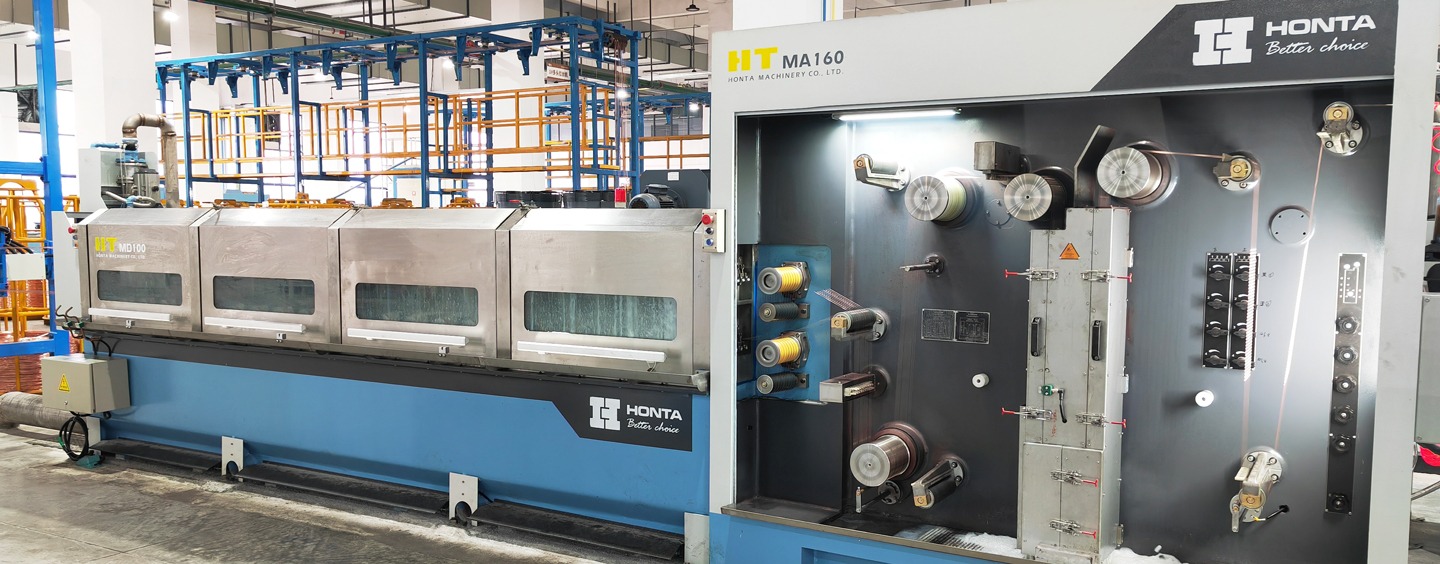
Multiwire drawing earns its place when drawing is the bottleneck and the order book concentrates in fine and medium wire. It also changes labour and floor-space economics, because several wires per pass mean one machine, one operator and one drive set doing the work of multiple single-wire lines.
High Speed Double Twist Bunching: Converting Wire Into Conductor
Double twist bunching takes drawn wires and combines them into a bunched or stranded conductor with the twist geometry the finished cable requires. HONTA builds high speed double twist bunching machines as part of its core range and uses carbon-fibre material for bow components on certain bunching machines, reducing the weight of rotating parts at higher bunching speeds.
This route is usually the last capacity decision a plant makes and the first one to be under-planned. A plant can hold adequate drawing capacity and still miss delivery dates because bunching and take-up cannot absorb what the drawing line produces.
Where HONTA Fits in This Route Map
Jiangsu HONTA Machinery., Ltd. is a wire and cable machinery manufacturer based in Kunshan, Jiangsu Province, China, founded in September 2006 and focused on cable conductor drawing and stranding technology. Its main products are rod breakdown machines, multiwire drawing machines, high speed double twist bunching machines and wire electrolytic plating lines, which means the three routes compared here are delivered from one product portfolio rather than assembled from three separate suppliers.
Operational facts that matter to a route decision: a 30,000 m² facility, 157 employees, a 30-engineer R&D team, annual output of 200 sets and monthly capacity of 15 sets. Production runs in ODM mode with customization of colour and component model types, quality control is 100% test, minimum order quantity is one set, standard lead time is 90 days, and after-sales support is delivered both remotely and on site. Exports account for about 45% of output, with main markets in the USA, the Middle East, Africa and Asia, and the company established a second production base in the United States, HONTA INC, in 2017.

Decision Factors That Change the Answer
Output Speed Versus Throughput
Maximum speed is the most quoted and least useful number on its own. A 14-wire line at 1,800 m/min and a 16-wire line running more slowly can produce comparable tonnage in different size bands. The route-level metric is throughput per hour at the conductor sizes you actually sell, weighted by each size’s share of the order book.
Conductor Size Range and Annealing
Size range decides whether one route can cover the whole order book. A narrow outlet band — such as the 0.18–0.5 mm range of the 16-wire HT.MD100B.16.22D.01 — is efficient but specialised. Where a plant’s mix spans coarse and fine conductor, either two drawing configurations or a wider-range line is required, and inline annealing becomes a process decision rather than an accessory. Conductor that must be soft and fully annealed before bunching changes the machine sequence, not just the machine model.
Floor Space per Tonne
Multiwire drawing exists as a category largely because of floor space, labour and energy per tonne. Several wires per pass mean one machine, one operator and one drive set producing what would otherwise need multiple single-wire lines. In expensive industrial locations that arithmetic often decides the route before any technical comparison begins.
Downstream Integration and Take-Up
The output side of the drawing line must be configured to the input side of the next stage. Take-up and spooling — single spooler, double spooler, basket coiler, and wire take-up machines generally — determine how drawing output is presented to the bunching or stranding machine. A plant that ships bunched conductor on basket coilers and buys a drawing line configured only for spool take-up has created a handling problem it did not need.
Comparison Table: RBD vs. Multiwire vs. Double Twist
| Decision dimension | Rod Breakdown (RBD) | Multiwire Drawing Machine | High Speed Double Twist Bunching Machine |
|---|---|---|---|
| Position in the conductor line | Entry stage — converts incoming copper or aluminium rod into intermediate wire | Main drawing stage — produces finished wire from larger input wire | Finishing stage — combines drawn wires into bunched or stranded conductor |
| Wire path logic | Single wire per pass | Multiple wires drawn in parallel; HONTA configurations cover 8, 16, 24 and 32 wires | Multiple wires combined into one conductor |
| HONTA range coverage | Copper and aluminium RBD lines, including rod breakdown machines with individual motors and rod breakdown with annealer configurations | Multiwire drawing line series in individual-motor and common-shaft architectures, with inline annealer and take-up options | High speed double twist bunching machines; carbon-fibre bow components on certain bunching machines |
| Published specification anchors | Model-level speed and wire-range data to be confirmed per configuration | HT.MD100B.16.22D.01: 16 wires, inlet 1.8–2.0 mm, outlet 0.18–0.5 mm, Siemens motor and PLC. HT.MD120.03.19.14: up to 1,800 m/min, outlet 0.20–1.05 mm | Model-level speed and bunching data to be confirmed per configuration |
| Annealing | Inline annealing available in copper and aluminium RBD configurations | Inline annealer configurations available within the drawing line | Not a drawing stage; conductor properties are set upstream |
| Take-up and spooling | Configured to the intermediate wire and the next process stage | Single spooler, double spooler and basket coiler options; take-up selected to match the bunching input | Take-up matched to bunched conductor output |
| Floor-space logic | Footprint grows with each single-wire stage required | Highest output per square metre of the three routes for fine and medium wire | Compact relative to stranding output |
| Best-fit production profile | Plants that must control their own rod-to-wire conversion or run larger conductor sizes | Plants whose order book concentrates in fine and medium wire and where drawing is the bottleneck | Plants that already buy drawn wire and need downstream conductor capacity |
| Compliance check | Confirm certificate scope against the specific machine | CE certificate M.2022.206.C74834 covers wire drawing machines under Machinery Directive 2006/42/EC; valid until 20 June 2027 | Confirm machinery-directive scope per machine; electrical design practice per IEC 60204-1 |
How to read this table: entries reflect HONTA’s published product range and the verified specification data available for this comparison. Model-level speed, wire-range and bunching data for RBD and bunching configurations should be confirmed in writing for your specific conductor mix.
Step-by-Step: Configuring the Route in Eight Steps
- Define the conductor you must ship. List the constructions — solid, stranded, bunched — and the size bands in the order book. Route selection follows conductor data, not equipment catalogues.
- Map the process route end to end. Write out rod, breakdown, drawing, annealing, bunching and take-up, and mark which stages you own today and which you intend to own after the investment.
- Size for throughput per shift, not peak speed. Convert each machine’s speed into hourly output at your conductor sizes, then weight it by the share of each size in the order book.
- Choose single-wire, multiwire, or both. This is the central decision: multiwire drawing suits volume in fine and medium wire, while single-wire RBD suits conversion control and larger conductors.
- Decide the annealing configuration. Inline annealing determines whether the wire reaches bunching in the metallurgical condition the finished cable requires.
- Specify take-up and spooling. Single spooler, double spooler and basket coiler each imply a different downstream handling routine; match the choice to how the bunching machine is fed.
- Fix the compliance baseline. Confirm CE scope and harmonised standards per machine, and check electrical design practice against IEC 60204-1.
- Validate, then commit. Run a sample of your own conductor sizes, confirm lead time and capacity in writing, and only then release the purchase order.
Compliance Baseline Before You Sign
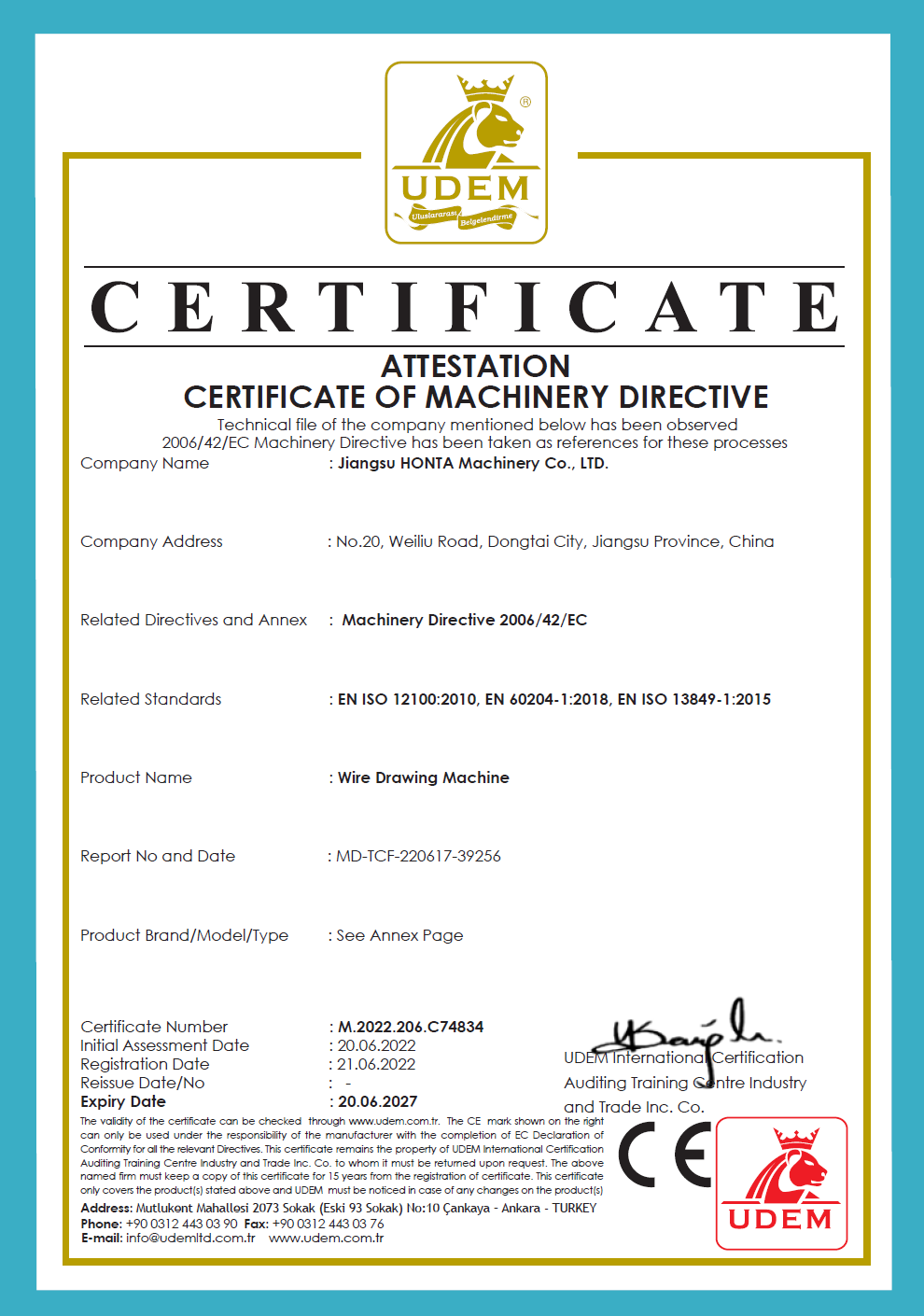
CE documentation is a gate item for EU-bound equipment and is increasingly requested elsewhere. HONTA holds CE certification for wire drawing machines under the Machinery Directive 2006/42/EC — certificate M.2022.206.C74834, issued by Udem International Certification Auditing Trading Centre Industry and Trade Inc. Co., with the harmonised standards EN ISO 12100:2010, EN 60204-1:2018 and EN ISO 13849-1:2015 listed. The certificate was issued on 20 June 2020 and is valid until 20 June 2027, and it relates to the HT.MD100B.16.22D.01 16-wire multiwire drawing machine, so the certificate scope should be checked against every machine in a quotation.
On the electrical side, IEC 60204-1 is the reference standard for wiring practices and safety on electrical equipment of machines, complementing the EN 60204-1:2018 harmonised standard listed on the certificate. Third-party industry coverage also lists ISO 9001 and ISO 14001 among the quality and environmental certifications HONTA maintains for global project compliance; certification documents should be requested with their expiry dates at quotation stage.
Use Cases: Three Plant Profiles, Three Route Answers
Profile 1 — Fine-wire and bunched-conductor producer. The order book is dominated by electronic, communications and household cable conductors in fine sizes. The route answer is multiwire drawing with inline annealing into double twist bunching, with take-up matched to how the bunching machine is loaded. A 16-wire configuration such as the HT.MD100B.16.22D.01 (inlet 1.8–2.0 mm, outlet 0.18–0.5 mm) fits a plant that wants high output inside a narrow, well-defined size band.
Profile 2 — Mixed-size plant with its own rod supply. The plant buys copper or aluminium rod and wants to convert it internally across a wider size mix. The route answer starts with a copper or aluminium RBD line, then adds multiwire drawing where volume justifies it. This is the profile where route sequencing matters most, because RBD output and multiwire input must be matched rather than maximised independently.
Profile 3 — Downstream conductor capacity. The plant already buys drawn wire and needs more finished conductor. The route answer is double twist bunching only, with drawing capacity left with the wire supplier. Investing in drawing here would duplicate a capability the plant has already outsourced.
A reference point from HONTA’s installation record: a wire and cable factory operating across the United States, Europe and Turkey took delivery of 2 sets for wire drawing; after 3 years the equipment steadily produces product meeting that customer’s requirements, with fast speed and high efficiency recorded as the highlights of the installation.
FAQ
What certification should be in place before a wire drawing machine ships to an EU plant?
CE certification under the Machinery Directive 2006/42/EC is the baseline. HONTA’s CE certificate M.2022.206.C74834 was issued by Udem International Certification Auditing Trading Centre Industry and Trade Inc. Co. for wire drawing machines, listing EN ISO 12100:2010, EN 60204-1:2018 and EN ISO 13849-1:2015 as harmonised standards, and it remains valid until 20 June 2027. The certificate relates to the HT.MD100B.16.22D.01 16-wire multiwire drawing machine, so buyers should confirm that the certificate scope covers each machine in the quotation.
Can one supplier deliver RBD, multiwire drawing and double twist bunching for the same line?
For suppliers with a route-level portfolio, yes. HONTA’s main products are rod breakdown machines, multiwire drawing machines, high speed double twist bunching machines and wire electrolytic plating lines, and it builds copper and aluminium RBD lines as well as multiwire drawing lines in 8-, 16-, 24- and 32-wire configurations. Production runs in ODM mode with customization of colour and component model types, quality control is 100% test, and a 30-engineer R&D team handles engineering. Sourcing the whole route from one supplier removes interface risk between drawing, annealing and take-up stages.
How should a buyer compare cost between single-wire and multiwire drawing?
Compare cost per tonne of finished conductor rather than machine price. The dominant drivers are energy, labour per tonne and floor space per tonne of output. An industry analysis published by HTNXT estimates that individual-motor multiwire drawing machines can reduce energy consumption by up to 25% compared with traditional common-shaft systems by eliminating mechanical transmission losses — a figure worth validating against your own load profile. Multiwire configurations also produce several wires per pass, lowering labour per tonne, while single-wire RBD stays the simpler route when the order book is dominated by larger conductors.
Can a machine be validated before committing to a full line?
Staged validation is supported by HONTA’s commercial terms: minimum order quantity is one set, quality control is 100% test, and after-sales support is provided remotely and on site. A wire and cable factory customer that took 2 sets for wire drawing has run the equipment for 3 years, steadily producing to its requirements with fast speed and high efficiency recorded. Validation should use your own conductor sizes and end-market constructions — for fine wire, the 16-wire HT.MD100B.16.22D.01 with its 1.8–2.0 mm inlet and 0.18–0.5 mm outlet range is the relevant configuration to test.
What lead time and production capacity should a buyer plan for?
HONTA works to a 90-day standard lead time, with monthly capacity of 15 sets and annual output of 200 sets, produced in a 30,000 m² facility staffed by 157 employees. About 45% of output is exported, to markets including the USA, the Middle East, Africa and Asia, and the company has operated a second production base in the United States, HONTA INC, since 2017. To plan against these numbers, download the drawing machine catalogue and send your conductor size mix, target output per shift and end-market construction to the HONTA international trade team at tammy@jshonta.com so lead time, spooling and take-up can be confirmed in writing.
Conclusion: Decide the Route, Then the Machine
RBD, multiwire drawing and double twist bunching are not competing machines — they are three links in one conductor line, and the real question is which links a plant should own. Rod breakdown buys conversion control at the entry stage; multiwire drawing buys throughput per square metre in the fine and medium wire bands where the 8-wire, 16-wire, 24-wire and 32-wire configurations operate; double twist bunching buys the conductor output that reaches the insulation line. Wiring the route together from one supplier, against a matched capacity calculation, is what keeps the bottleneck from moving to whichever stage was configured last.
Next step: route review with HONTA
Send your conductor size mix, target output per shift and end-market constructions, and the HONTA team will map them onto the RBD, multiwire drawing and double twist bunching options in the drawing machine catalogue.
Download the HONTA drawing machine catalogue (PDF)
Tammy — International Trade Department Manager
E-mail: tammy@jshonta.com · Tel: 0086 182 6287 9467 · WhatsApp: +8618752922675
Jiangsu HONTA Machinery., Ltd. · www.jshonta.com