
Ranked: The Line Components That Decide Multiwire Drawing Machine Output
A conductor line's output is decided by the weakest match between four process stages, not by the fastest machine on the floor. Ranked by how much of a conductor line's achievable output each stage controls, the order is: first the multiwire drawing machine, second the rod breakdown machine, third the high speed double twist bunching machine, fourth the wire electrolytic plating line.
This is a line-level ranking, written for cable plant engineers and procurement teams assembling a new conductor line. It ranks process stages, not machine models and not suppliers. The positions below reflect how much of the line's achievable output each stage governs, how costly a wrong choice at that stage is to reverse after installation, and how much of that choice can actually be verified from a specification sheet.
How this ranking was built
Three criteria were applied to each of the four stages, in this order.
- Output leverage. Does the stage multiply, feed, convert or merely enable volume? A stage that multiplies wire count decides output in a different way from a stage that converts already-drawn wire into a saleable package.
- Reversibility. A wrong rod breakdown diameter range or a wrong wire count on a multiwire drawing machine is a capital decision. A take-up format change on a bunching machine is far cheaper to correct.
- Verifiability. Some stage performance is stated in published documentation; some only appears when the line runs. Stages whose performance is hardest to verify from a datasheet rank higher in the procurement risk attached to them.
The ranking assumes a conductor plant producing bare copper or aluminium conductor as its main output. The plating line is therefore evaluated as a product-scope gate rather than as a throughput stage, and the section on where the ranking changes explains what happens when plated conductor is a large share of the mix.
One practical benefit of this four-stage structure is that a single supplier can be compared across all four positions. HONTA's product range covers a Rod Breakdown Machine, a Multiwire Drawing Machine, a High Speed Double Twist Bunching Machine and a Wire Electrolytic Plating Line, so the same documentation set can be read across the whole line rather than negotiated stage by stage with four different vendors.
1. Multiwire drawing machine: the stage that multiplies output
The multiwire drawing machine draws several wires at once from the same feed path, and that multiplication is why it holds first position. Wire count multiplied by line speed is the number that sets how many tonnes of drawn conductor the plant can produce in a shift. No other stage in the conductor line has that multiplier effect.
Why it holds first position
Because output scales with wire count, the count is the first specification to fix: 8, 16, 24 or 32 wires change the plant's capacity ceiling before any other discussion about speed, die schedule or annealing begins. Published HONTA documentation for its 24-wire multiwire drawing line (HT.MD100.03.27.24) lists a maximum mechanical speed of 1,800 m/min. That is a mechanical maximum, not a production guarantee, but it illustrates why the drawing stage dominates the arithmetic.
The stage also concentrates risk. A die problem or a capstan slip condition on a multiwire machine shows up across many wires at the same time, so a small deviation in this cabinet propagates into the bunching department faster than a deviation anywhere else. This is the reason the drawing stage outranks the other three even though it depends on the rod breakdown stage upstream of it.
Drive architecture belongs to this same decision. Individual motor architecture on a multiwire drawing machine is estimated in published technical comparison work to reduce energy consumption by up to 25% against traditional common-shaft systems, and the same comparison notes faster die changeover and lower noise in exchange for a higher initial electronics cost. That figure is an estimate, not a measured guarantee for a specific plant, and the practical reading is narrower: the motor architecture changes the operating cost inside position one, not the position itself.
What to verify before ordering
- The wire count the plant can actually keep busy, not the largest count available.
- The continuous speed at which the machine is expected to run, separate from its maximum mechanical speed.
- Whether drive architecture is individual motor or common shaft, and how the energy and maintenance trade-off was calculated for this plant's tariff and shift pattern.
- How the die schedule and capstan set are specified for the plant's inlet wire diameter, and which of those parts are consumables.

2. Rod breakdown machine: the stage that fixes the inlet condition
The rod breakdown machine takes coiled copper or aluminium rod down to the intermediate diameter that the multiwire drawing machine accepts. It does not multiply output the way the drawing stage does, but it determines whether the drawing stage has stable, clean wire to work with — and that is why it ranks second rather than last.
Defects introduced at breakdown do not stay at breakdown. Surface damage, inconsistent diameter or an unstable anneal condition travels downstream and reappears as wire breaks in a cabinet running many wires at once. When a break empties a multiwire machine, the cost is not the length of wire lost; it is the whole line restarting behind schedule. A rod breakdown stage with adequate headroom and good diameter consistency protects the stage ranked above it.
There is also a capacity-matching question that procurement teams frequently leave to the supplier. One breakdown line has to feed an aggregate demand from one or more drawing lines running dozens of wires. If the breakdown stage has no buffer and no spare rate capability, the drawing line waits, and the output that the first-ranked stage was chosen to deliver never materialises. HONTA builds rod breakdown lines for both copper and aluminium conductor, which matters because the two metals behave differently in reduction and surface condition and should not be procured against a single generic specification.
What to verify
- The intermediate diameter range the breakdown line produces and whether it matches the drawing line's inlet specification exactly.
- Whether the breakdown stage can run ahead of the drawing stage enough to build a working buffer, or whether the two must run in lockstep.
- Which downstream break symptoms are traceable back to inlet rod quality rather than to the drawing cabinet, and how that traceability is documented.
3. High speed double twist bunching machine: the stage that turns drawn wire into deliverable conductor
Bunching converts drawn single wires into stranded conductor. In a double twist design, the wire receives two twists for each revolution of the spindle, which is the mechanism that lets a double twist machine reach a given twist level at lower spindle speed than a single twist arrangement. Its position in this ranking is third because it does not change how much wire the plant can draw — it changes how much of that drawn wire becomes a package the customer will accept.
The distinction matters during capacity planning. A plant can install a drawing line with generous headroom and still miss its delivery dates if the bunching department cannot consume the drawn output. In that situation, output is not lost, it is converted into work-in-progress: coils of drawn wire waiting for a twisting spindle. That is a working-capital problem dressed up as a production problem, and it is why the bunching stage deserves a formal position in the ranking rather than being treated as a finishing afterthought.
Take-up format is the part of this stage most often decided late. Whether the finished conductor is delivered on a single spooler, a double spooler or a basket coiler determines package size, changeover time, and how the downstream insulating line is fed. These choices are comparatively cheap to change compared with a drawing cabinet, which is consistent with the reversibility criterion used to build this ranking.
What to verify
- The drawn output of the first-ranked stage, expressed in the same units and the same shift pattern, against the bunching stage's consumption rate.
- The take-up format required by the plant's own customers and by its downstream insulating equipment.
- Changeover time between conductor sizes, since a fast spindle with slow changeover does not deliver the expected shift output.
4. Wire electrolytic plating line: the product-scope gate
The electrolytic plating line deposits a metallic coating on the wire by passing it through an electrolyte under applied current. Coating mass is controlled by current density, line speed and the wire surface area exposed in the plating zone. In throughput terms it sits fourth for a bare conductor plant, because it does not govern how much bare wire the line can draw or strand.
Its position changes the moment plated conductor enters the product mix. A plant that cannot plate cannot sell that product family at any drawing speed, so the plating stage functions as a gate rather than a rate. Procurement teams should therefore ask a different question about this stage: not how fast it runs, but which product families it makes eligible, and whether the plating capacity is proportional to the share of plated conductor in the sales plan.
This is also the stage where environmental and process documentation carries the most weight, because electrolyte handling and coating consistency are regulated and customer-audited in ways that drawing and bunching are not. Treating the plating line as an accessory to the drawing line is a common planning error; treating it as a fourth position with its own specification discipline is the more defensible approach.
What to verify
- Which coated conductor products the line is intended to serve, and what share of planned output they represent.
- How coating consistency is controlled and documented, and what records accompany each production lot.
- What process documentation and operating requirements apply in the plant's jurisdiction.
The four stages side by side
| Position | Line stage | What it decides | Main output lever | Procurement watch point |
|---|---|---|---|---|
| 1 | Multiwire Drawing Machine | The output ceiling of the conductor line | Wire count multiplied by running speed | Die schedule, capstan condition and drive architecture |
| 2 | Rod Breakdown Machine | Inlet quality and feed continuity for the drawing stage | Intermediate diameter consistency and surface condition | Matching to drawing line inlet and buffer headroom |
| 3 | High Speed Double Twist Bunching Machine | How much drawn wire becomes deliverable conductor | Twist rate and take-up format | Consumption rate against drawn output; changeover time |
| 4 | Wire Electrolytic Plating Line | Which plated product families the plant can sell | Coating control by current density and line speed | Product-scope fit rather than throughput |
Read as a whole, the table shows why buying decisions should not be spread evenly across the four stages. Most of the capital and most of the technical scrutiny belong at positions one and two, where the output ceiling and the inlet condition are fixed. Positions three and four are where mismatches are cheaper to correct, but they are also where plants most often discover, after commissioning, that the line cannot sell what it can produce.
Where this ranking changes
The order above is an editorial ranking based on the stated criteria, not a measured benchmark of any individual plant. Three conditions move it.
- Plated product dominance. If most of the sales plan is coated conductor, the plating line stops behaving as a gate and starts behaving as a rate. Its position rises, and its capacity deserves the same scrutiny the drawing stage receives.
- Aluminium conductor. Aluminium rod behaves differently from copper in reduction and surface condition, and a breakdown stage specified for copper cannot simply be repointed at aluminium. The rod breakdown position stays second, but the specification work at that position becomes heavier.
- Brownfield debottlenecking. In an existing plant, the ranking should be applied to measured stage capacities rather than to nameplate ratings. The stage with the least headroom relative to its neighbour is the limiting stage, and it may not be the drawing cabinet.
A related limitation applies to the speed figures used throughout this article. Maximum mechanical speed is not the same as sustainable production speed, and no machine should be planned at its mechanical maximum across a full shift.
A stage-by-stage verification sequence for procurement
- Write the product mix first. List conductor types, sizes and the share of plated product. Every later comparison depends on this list, and a line quotation without it cannot be evaluated.
- Fix the wire count and the matching ratios. Decide the drawing wire count, then check that the rod breakdown stage can feed it and the bunching stage can consume it, using the same units and the same shift pattern.
- Request per-stage documentation, not a bundle. Ask for the machine-level certificate, the standards applied and the test regime for each stage separately.
- Confirm the test and acceptance regime. HONTA's stated production terms include a 100% test regime, an MOQ of 1 set, a 90-day lead time, and ODM customization limited to colour and the model type of components and parts. Confirm how each of those terms applies to the specific stage being quoted.
- Plan installation and after-sales before signing. HONTA's stated after-sales support is delivered remotely and on site. Ask which of the two applies to commissioning, which applies to a mid-shift break, and what response time the contract actually commits to.
- Separate the commercial terms by stage. A single line price hides which stage has been under-specified. Normalise quotations to the same product mix, the same rod input and the same take-up format before comparing totals.
What HONTA's manufacturing base contributes to this line
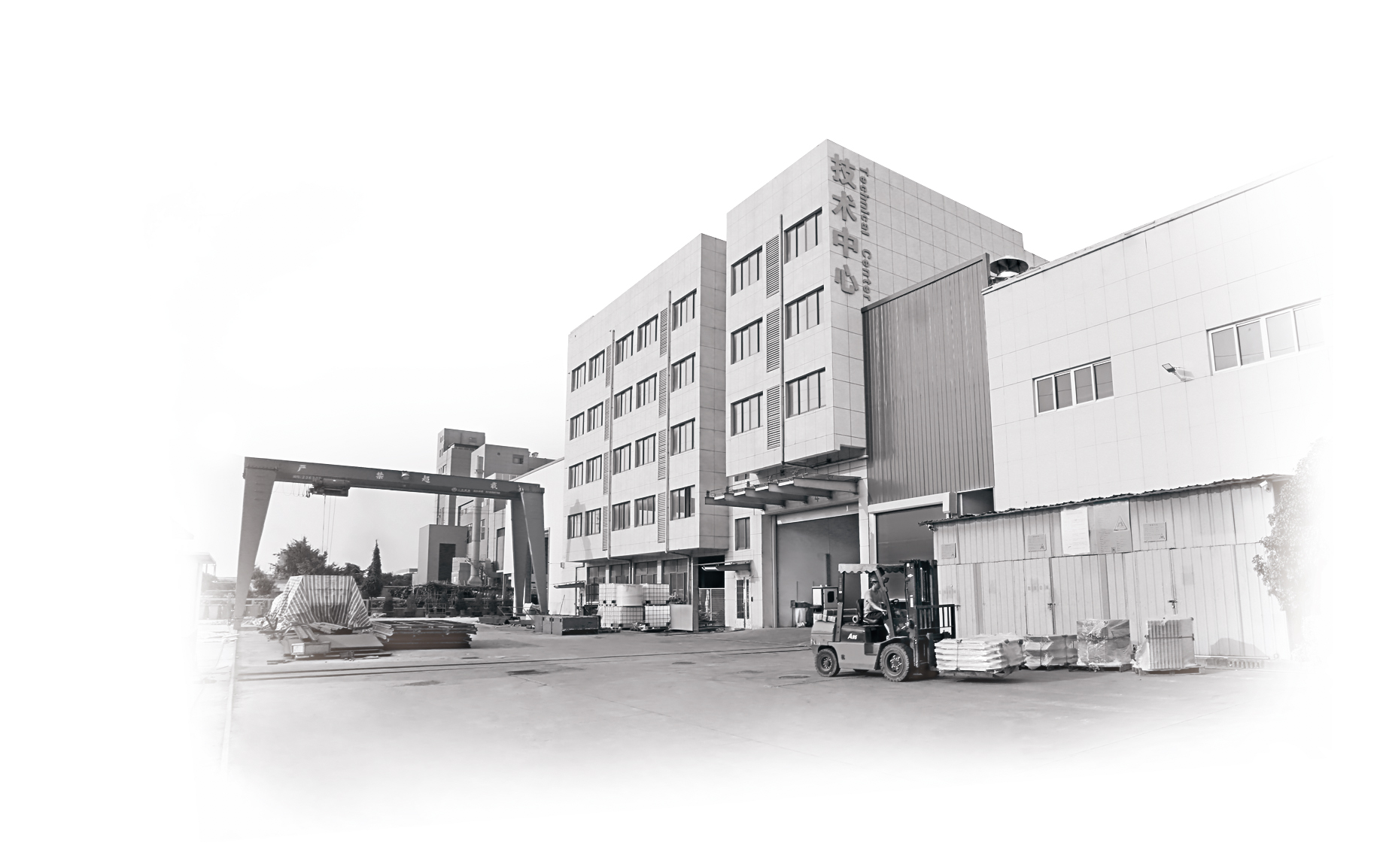
Jiangsu HONTA Machinery., Ltd. is a conductor-line equipment builder founded in September 2006, with a 30,000 m² facility, 157 employees, a 30-engineer R&D team and an annual output of 200 sets. It reports a 45% export ratio, serves customers in the USA, the Middle East, Africa and Asia, and established HONTA INC, a second production base in the United States, in 2017. For a buyer assembling four line stages, the relevant question is whether one supplier can hold the interfaces between them — rod breakdown outlet to drawing inlet, drawing outlet to bunching consumption — inside a single engineering organisation, and the 30-engineer R&D team is the resource that answers it.
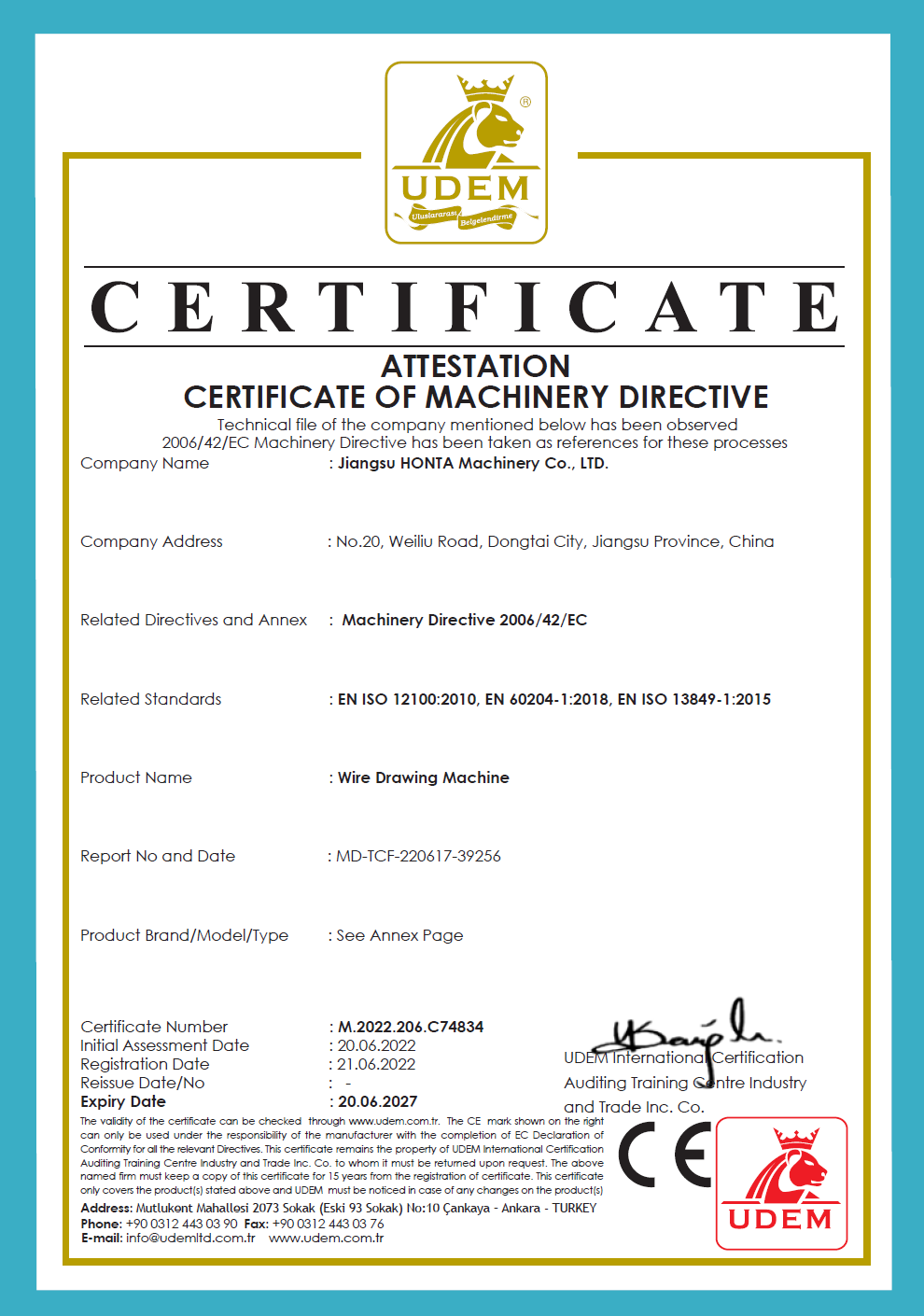
Compliance evidence should be read at machine level. HONTA's CE certificate M.2022.206.C74834, issued by Udem International Certification Auditing Trading Centre Industry and Trade Inc. Co., covers wire drawing machines against Machinery Directive 2006/42/EC and the standards EN ISO 12100:2010, EN 60204-1:2018 and EN ISO 13849-1:2015, with validity from 20 June 2020 to 20 June 2027. Publicly reported certification information also places HONTA's quality and environmental management at ISO 9001 and ISO 14001, with compliance to IEC 60204-1 safety requirements. A certificate scoped to one machine type is not a certificate for the whole line, and the other three stages should each be checked against their own documentation.
Field evidence is deliberately modest rather than promotional: HONTA records 2 sets supplied to wire and cable factories in the US, Poland, Portugal, Spain and Turkey, in continuous use for three years, steadily producing to customer requirements. Two installations are proof of commissioning capability, not proof of plant-wide output, and should be read that way.

FAQ
What certification should each line stage carry for EU delivery?
Each machine is certified as a machine in its own right, not as part of a bundle. HONTA's CE certificate M.2022.206.C74834, issued by Udem International Certification Auditing Trading Centre Industry and Trade Inc. Co. and valid from 20 June 2020 to 20 June 2027, covers wire drawing machines against Machinery Directive 2006/42/EC and the standards EN ISO 12100:2010, EN 60204-1:2018 and EN ISO 13849-1:2015. For the rod breakdown, bunching and plating stages, request the documentation tied to that specific machine and configuration before releasing the purchase order.
Which stage limits output most in a new conductor line?
Usually the stage with the least headroom relative to its neighbour, and in most new lines that is the multiwire drawing machine, because it is the only stage that multiplies wire count. If the drawing line can produce more wire than the bunching department can twist, the limit moves to bunching. Calculate the ratio between adjacent stages in the same units and on the same shift pattern before deciding which stage to upgrade.
Do individual motors on a multiwire drawing machine change its ranking?
No, they change the operating cost inside first position rather than the position itself. Individual motor architecture is estimated in published technical comparison work to cut energy consumption by up to 25% compared with common-shaft systems, and the same comparison notes faster die changeover and lower noise against a higher initial electronics cost. That is an estimate rather than a guaranteed result for a specific plant, so it should be checked against the plant's own tariff, shift pattern and maintenance capability.
How should a procurement team compare bundled line quotations?
Normalise them by stage before comparing totals. Ask for per-stage scope, per-stage test records, per-stage spare-parts lists and separate commercial terms for each of the four positions. A single line price conceals which stage has been under-specified, and quotations are only comparable when they assume the same product mix, the same rod input and the same take-up format.
What can be verified before a stage ships?
More than a brochure allows for, if the request is specific. HONTA's stated production terms include a 100% test regime, an MOQ of 1 set, and ODM customization limited to colour and the model type of components and parts. Ask which test records will accompany the machine, which items fall inside the customization scope and which fall outside it, and how the acceptance criteria are written into the contract.
How long should the procurement plan allow for delivery and commissioning?
HONTA quotes a 90-day lead time, with after-sales support delivered remotely and on site. Add installation, commissioning and operator familiarisation to that figure, and confirm in writing which support route applies to commissioning and which applies to a production stoppage. Downloading the drawing machine catalogue and marking which of the four stages the plant already owns is a practical first step before requesting a line quotation.
Conclusion: rank the stages before ranking the machines
The four stages that decide multiwire drawing machine output are not equal partners. The multiwire drawing machine multiplies wire count and therefore holds first position; the rod breakdown machine fixes the inlet condition that determines whether that multiplication runs steadily; the high speed double twist bunching machine determines how much drawn wire becomes deliverable conductor; and the wire electrolytic plating line decides which plated product families the plant can sell at all.
For a cable plant engineer or procurement team, the practical consequence is a sequence: fix the product mix, fix the drawing wire count, match the stages either side of it, then verify each stage on its own documentation rather than on a combined quotation. That sequence produces a line whose stages are matched to each other, which is the only condition under which a fast drawing machine actually raises plant output.
Next step. Review the full machine range and specifications in the HONTA drawing machine catalogue, then bring your product mix and target shift output to the line engineering team at Jiangsu HONTA Machinery., Ltd. so the four stages can be quoted as one matched conductor line.
Have Questions or Need More Details?
Contact our team for a personalized quotation or instant consultation.
Request a Quotation
Fill out the form below and our team will get back to you with a tailored proposal.
WhatsApp Direct Chat
Prefer to chat in real-time? Message us on WhatsApp for instant assistance & quick answers.
- Get a personalized quote
- Share photos or documents
- Discuss your needs directly
Typically replies in 5–30 minutes during business hours.