
Selecting a Multiwire Drawing Machine for Export-Focused Cable Plants: A Guide for USA, Middle East, and African Markets
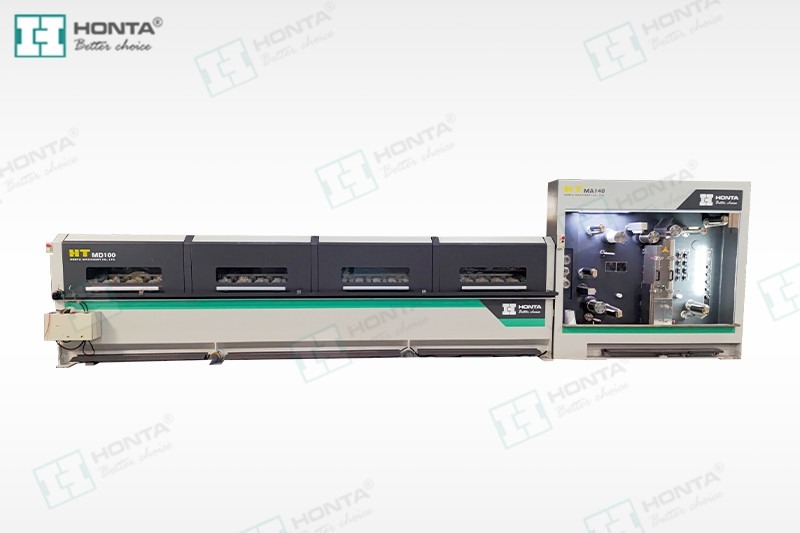
A cable plant that ships conductor to more than one region is not purchasing a standalone machine. It is purchasing a configuration that must pass a local electrical inspection, tolerate a different climate, and remain serviceable long after the commissioning engineer has left the site. The drawing parameters that dominate most multiwire drawing machine discussions are only one layer of that decision.
Problem Definition: Why a Good Machine Data Sheet Does Not Answer the Export Question
Most multiwire drawing machine specifications are written in a domestic frame of reference. Wire count, inlet diameter, outlet diameter, maximum speed, motor type and annealing arrangement are compared side by side, and the selection is closed on those numbers. For a plant selling into its home market, this is usually sufficient, because the electrical supply, the product standard and the service network are already known quantities.
The export case breaks that assumption in five places.
First, the conductor schedule follows the destination market. A plant producing AWG-based building wire for the USA, a plant producing metric conductors for a Gulf infrastructure project, and a plant supplying African utilities under European-referenced specifications can all use a multiwire drawing machine of similar layout — but not with an identical die schedule, identical elongation targets, or identical spooling arrangement.
Second, the electrical package must match the site, not the catalogue. Motor voltage, control voltage, frequency, PLC input/output isolation and control-transformer tapping are all defined by the plant's actual supply and by the destination authority's requirements. These are order-release decisions, not afterthoughts.
Third, climate affects mechanical reliability. High ambient temperature, dust, salt-laden coastal air and wide humidity swings change how a drawing line behaves over a multi-year operating horizon — particularly in control cabinets, lubrication circuits and tension control loops.
Fourth, logistics and installation set a real cost and risk floor. Segmented shipment, container planning, on-site lifting capacity, available power at the installation bay and the number of available technicians all shape what should be ordered.
Fifth, service response is a specification item, not a promise. A buyer in the Middle East or West Africa should know in advance what the supplier's remote and on-site support model looks like, and what the realistic spare-parts path is.
Industry Background: Where Multiwire Drawing Capacity Is Being Added
The pressure to configure regionally is a direct consequence of where conductor capacity is growing. The Insight Partners projects the global wire drawing machines market to grow from USD 1.37 billion in 2025 to USD 2.13 billion by 2034, a CAGR of 4.98%. Behind that equipment figure sits the consuming industry: Grand View Research values the global wire and cable market at USD 230.9 billion in 2025, with a projected reach of USD 313.1 billion by 2033.
Supply-side geography has shifted as well. Silverado Policy Accelerator reports that China's global exports of machine tools, a category that includes wire drawing machinery, accounted for 19% of global exports in the first half of 2025, surpassing Germany. In practical terms, a larger share of new drawing equipment is now sourced from Asian manufacturers and shipped into projects in the USA, the Middle East, Africa and Asia — which is exactly the pattern that makes regional configuration a procurement issue rather than an engineering footnote.
Publicly reported specifications illustrate the range now available in the multiwire segment. A HONTA 14-wire multiwire drawing line (HT.MD120.03.19.14) is listed at maximum speeds of 1800 m/min with an outlet wire range of 0.20–1.05 mm. A 2026 HTNXT comparison reports that individual motor multiwire drawing machines can reduce energy consumption by up to 25% compared with traditional common-shaft systems by eliminating mechanical transmission losses. Both points matter to export buyers, because energy cost and outlet range are evaluated differently in different power markets.
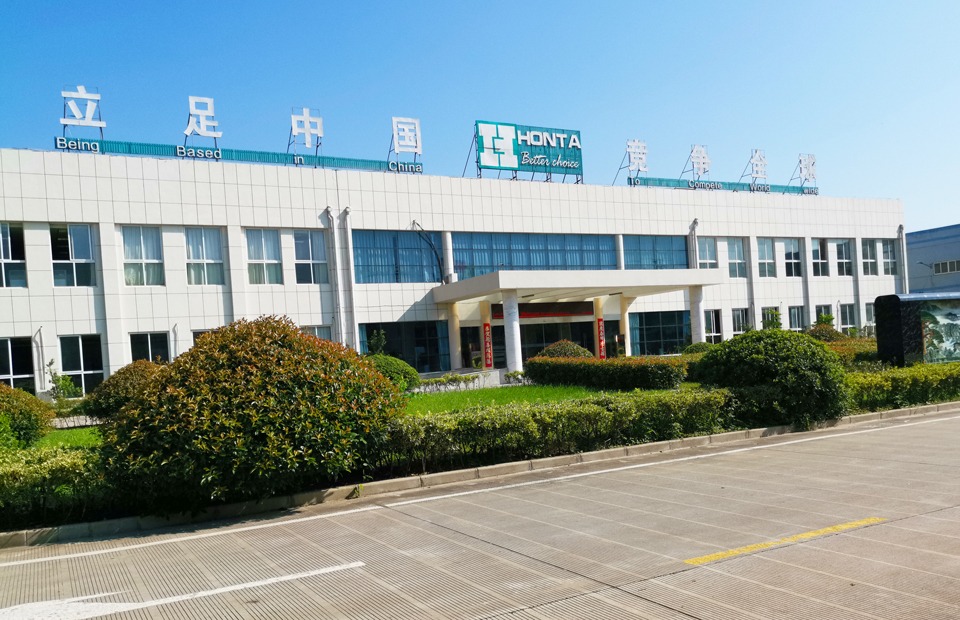
Jiangsu HONTA Machinery., Ltd. is a Chinese manufacturer of cable conductor drawing and stranding equipment, founded in September 2006 and based in Kunshan, Jiangsu Province. Its product range covers rod breakdown machines, multiwire drawing machines, high-speed double twist bunching machines and wire electrolytic plating lines, and it reports a 45% export ratio with main markets in the USA, the Middle East, Africa and Asia.
Detailed Solution: The Five Regional Constraints That Drive Configuration
Regional selection is not a matter of choosing a different machine for each continent. It is a matter of fixing five variables in the following order, because each one constrains the ones after it.
1. Conductor schedule and outlet range
The outlet diameter range is the first hard constraint. A machine sized for fine conductor cannot economically serve a plant whose product mix is dominated by medium conductor, and the reverse is equally true. HONTA's 16-wire model HT.MD100B.16.22D.01 covers an inlet of 1.8–2.0 mm and an outlet of 0.18–0.5 mm, which places it in the fine and extra-fine conductor band. The publicly listed 14-wire HT.MD120.03.19.14, with an outlet range of 0.20–1.05 mm and a maximum speed of 1800 m/min, reaches further into the medium conductor band.
For an export-focused plant, the practical rule is to build the die schedule from the destination market's wire table rather than from the machine's nominal range. A plant supplying AWG-based conductor schedules and a plant supplying metric schedules may both fall inside the same outlet window, but the intermediate die sequence, the annealing set-points and the take-up tension profile will differ. That difference should be resolved on paper before the order, not on the shop floor after arrival.
2. Voltage, frequency and the electrical compliance package
Electrical mismatch is the single most common source of delay in export installations. Plant supply voltage and frequency vary between regions and sometimes between sites inside the same country, so the machine's motors, drives, PLC and control transformers must be quoted against the actual measured site supply. A default domestic build is not a safe assumption.
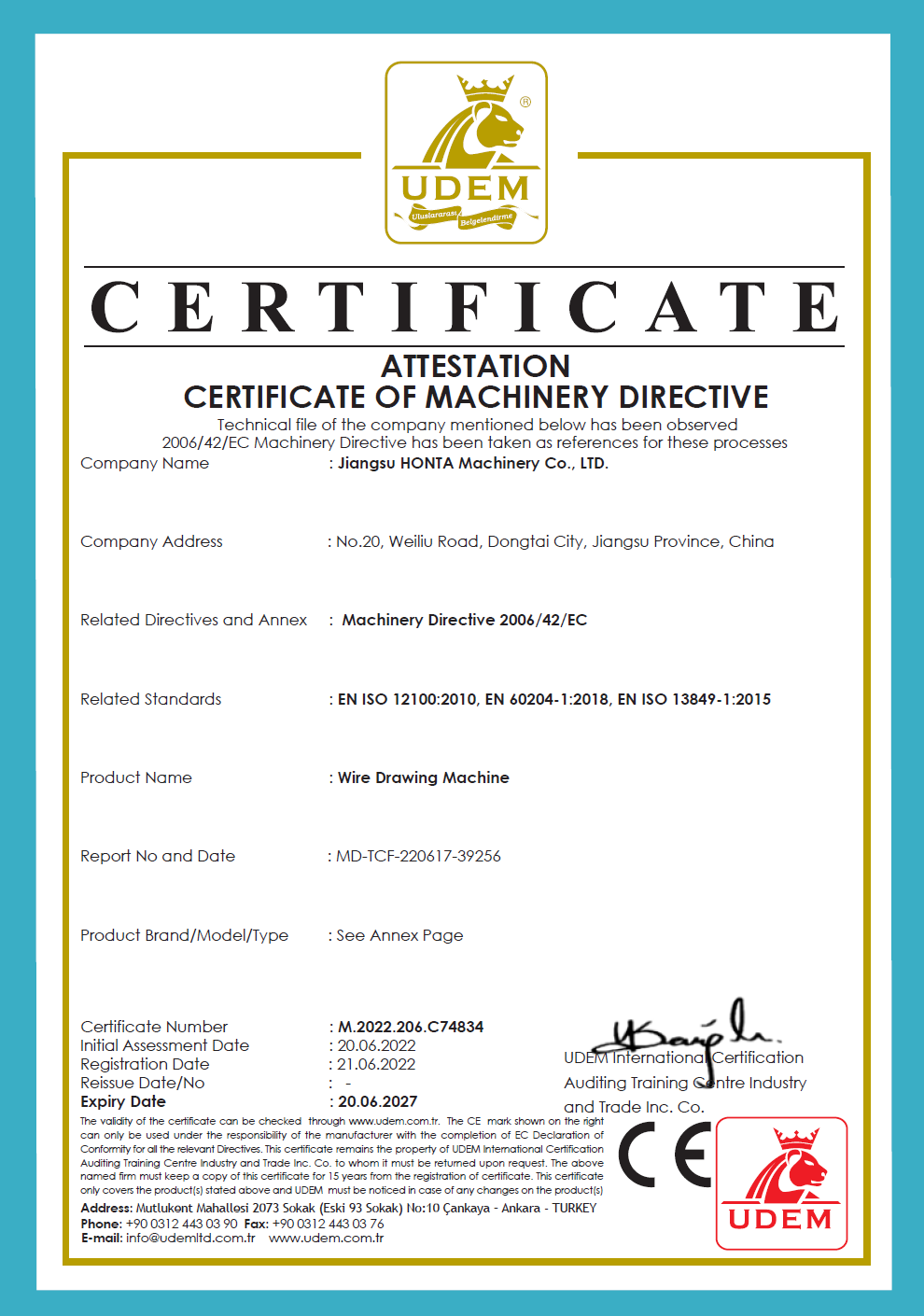
Compliance is a separate question from electrical matching, and it is destination-specific. Electrical equipment for machinery, including wire drawing systems, is expected to follow IEC 60204-1 for wiring practices and safety. For the European market, HONTA holds CE-MD certification M.2022.206.C74834, issued on 20 June 2020 and valid to 20 June 2027 by Udem International Certification Auditing Trading Centre Industry and Trade Inc. Co., covering wire drawing machines against Machinery Directive 2006/42/EC, EN ISO 12100:2010, EN 60204-1:2018 and EN ISO 13849-1:2015. The CE certificate is also documented for the HT.MD100B.16.22D.01 model.
That certificate addresses the EU market. It does not automatically satisfy requirements set for the USA, the Middle East or individual African markets, which are defined by the destination authority and, frequently, by the end customer's own technical specification. The correct procedure is to list every applicable requirement in the purchase specification, name the authority that will inspect the installation, and obtain written confirmation of scope before order release.
3. Environmental protection package
Climate is specified in writing or it is absorbed as downtime. Middle East installations typically combine high ambient temperature with airborne dust and, on coastal sites, salt-laden air. African installations frequently combine high temperature with unstable supply and long spare-parts lead times. Humid Asian sites put continuous emphasis on cabinet conditioning and corrosion protection.
Four elements should be defined explicitly in the specification: control cabinet cooling and filtration, the sealing class of the drawing emulsion and lubrication circuits, surface treatment and corrosion protection for frames and guards, and the tension-control strategy that keeps elongation stable when ambient temperature moves through the day. HONTA's stated materials approach uses structural steel and alloy for frames and components, carbon-fibre material for bow components on certain bunching machines, and corrosion-resistant materials with protective treatments on plating lines — a materials logic that should be matched to the destination climate at the quotation stage.
4. Shipping, installation and site logistics
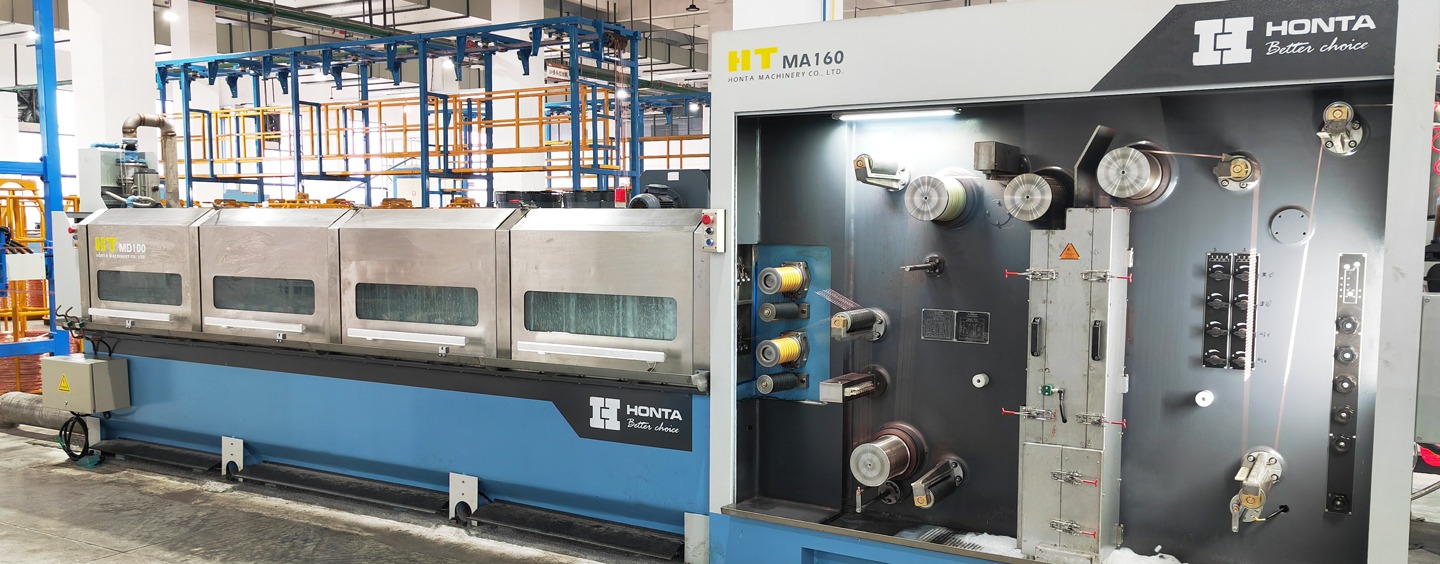
Export configuration starts at the packing list. Whether the line ships as a single assembled frame or in modules depends on container dimensions, the lifting capacity available at the destination port and factory, and the width of the installation bay. Buyers should confirm these physical facts before the shipping plan is frozen, because re-rigging a drawing line on site is expensive and slow.
The second logistics question is installation labour. Commissioning a multiwire drawing line requires electrical, mechanical and process competence at the same time. If the destination plant does not have that combination available, the supplier's remote and on-site support model becomes part of the commercial evaluation rather than a post-sale detail.
5. Service response and spare-parts path
HONTA's stated after-sales model combines remote support with on-site service. For an export buyer, that statement should be converted into concrete terms: which time zone the remote support operates in, what the escalation path is, which wear parts should be held on the buyer's shelf from day one, and how long a critical spare takes to reach the site.
Physical proximity helps here. HONTA was founded in September 2006 and established HONTA INC, its second production base, in the United States in 2017. For North American buyers, a US-based production presence changes the practical response distance for service coordination and parts movement compared with a supplier operating from a single Asian site. For Middle East and African buyers, the relevant comparison is the remote diagnostic capability plus the freight route to the nearest port.
Where HONTA's Export Support Structure Fits
The supplier-side facts that matter to this guide are operational rather than promotional. Jiangsu HONTA Machinery., Ltd. operates a 30,000 m² facility with 157 employees, an annual output of 200 sets and a 30-engineer R&D team. Capacity is quoted at 15 sets per month with a 90-day lead time and a minimum order quantity of one set. Production follows an ODM model with customization available on colour and on component and part model types. Quality control is stated as 100% testing. Export markets are listed as the EU, the Middle East and Africa, consistent with the 45% export ratio and the main-market list of USA, Middle East, Africa and Asia.
Quality and environmental management are separately documented: HONTA maintains ISO 9001 and ISO 14001 certification, which support global project compliance at the management-system level. These are management-system certifications, not product certifications, and they should not be presented to a destination authority as a substitute for a product-level approval.
Existing installations give a reference point for durability expectations. One HONTA customer, a wire and cable factory operating machines in the United States and in European markets including Poland, Portugal, Spain and Türkiye, has run two sets for three years in wire drawing application, with the reported result of steadily producing products that meet the customer's requirements, and the reported highlights of fast speed and high efficiency.
Step-by-Step Breakdown: Specifying a Region-Targeted Machine
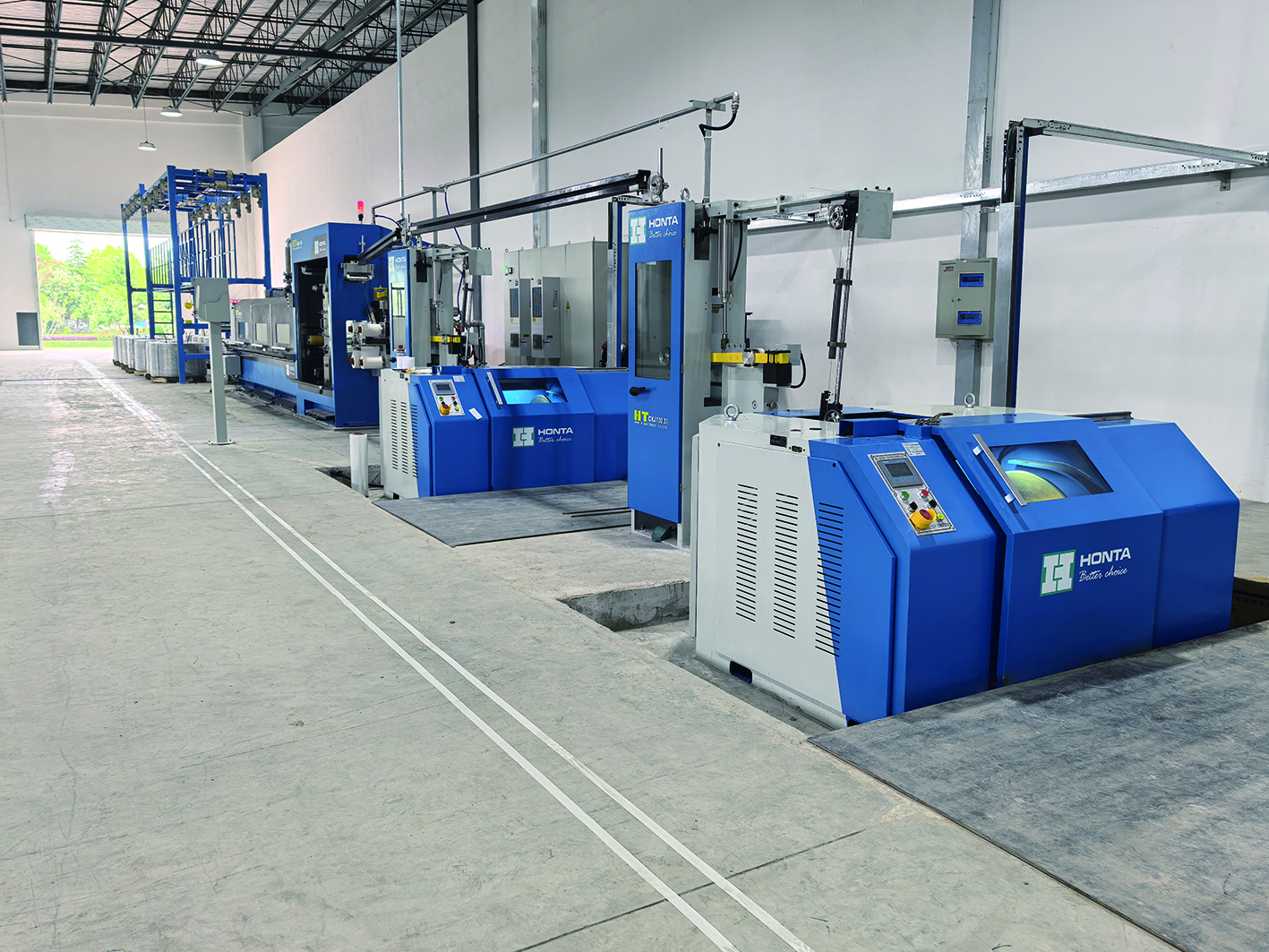
The workflow below is ordered so that each step constrains the next. Running the steps out of sequence is what produces a machine that meets its data sheet but not its destination.
Step 1 — Map the conductor schedule by destination
List every conductor size the plant will produce in the first three years, grouped by destination market. Include the governing standard for each group and the elongation and surface requirements the end customer applies. This list, not the machine catalogue, determines the die schedule.
Step 2 — Fix wire count and outlet range
Select the wire count against required throughput and available floor space, then confirm that the outlet range covers the full schedule from Step 1. A 16-wire configuration such as HT.MD100B.16.22D.01, with a 0.18–0.5 mm outlet, suits fine-conductor production; a 14-wire line reaching 1.05 mm outlet covers a broader medium-conductor band. If the schedule spans both, the honest answer may be two configurations rather than one compromise.
Step 3 — Lock the electrical and compliance package
Record the measured site voltage and frequency, the control voltage, and the name of the authority that will inspect the installation. Attach the destination requirements to the purchase order as an annex. Confirm what the CE-MD scope covers and what it does not, and confirm which additional approvals, if any, the destination requires.
Step 4 — Define the environment package
State ambient temperature range, dust exposure, humidity range, coastal exposure and any corrosive atmosphere on site. Convert each into a specific requirement: cabinet cooling method, filtration grade, enclosure protection, surface treatment, and emulsion-circuit materials.
Step 5 — Plan logistics and installation
Confirm shipping modules, container count, lifting capacity at port and factory, installation bay dimensions and the number of qualified technicians available on site. Decide in advance whether commissioning is supplier-led, buyer-led with remote support, or joint.
Step 6 — Set the service and spare-parts model
Agree the remote support channel and response expectations, the on-site escalation conditions, and a first-order critical spares list sized to the plant's maintenance capability and to the freight time from the supplier to the site.
Step 7 — Approve through testing and acceptance
Define acceptance before shipment. Factory testing against the agreed conductor schedule, with recorded speed, elongation and surface results, gives the buyer a documented baseline. The 100% test policy stated for HONTA production should be treated as the starting point for that acceptance protocol, not as its replacement.

Use Cases: How the Same Machine Family Adapts to Different Regions
North American conductor plant
A plant producing AWG-based building and industrial conductor for the US market is primarily concerned with outlet-range coverage across its wire table, with electrical documentation that satisfies the local inspection authority, and with response distance for service. The US production base established by HONTA in 2017 is directly relevant to the third point. The reference installation described above — two sets running for three years in a US and European customer base — illustrates the durability expectation for this pattern.
Middle East infrastructure supplier
A Gulf-region plant supplying project cable faces high ambient temperature, dust and, on coastal sites, salt exposure. The configuration decision concentrates on cabinet cooling and filtration, corrosion protection for frames and guards, and stable tension control across a wide daily temperature swing. Electrical documentation is checked against the project specification and the inspecting authority rather than assumed from a CE file.
African multi-product manufacturer
A plant serving several national markets typically runs a wider product mix on fewer lines, which pushes the outlet range toward the medium band. The dominant risks are supply stability and spare-parts latency, so the specification should weight the electrical package for voltage tolerance and the spares list for coverage of wear parts that cannot be sourced locally.
Asian export-processing plant
A plant producing for export from a high-humidity location prioritizes cabinet conditioning, corrosion protection and emulsion-circuit maintenance intervals. Because the same plant often serves several export destinations at once, the die schedule is usually managed as changeable tooling rather than as a fixed machine attribute — which makes documentation of the changeover procedure part of the specification.
Comparison: Regional Confirmation Matrix and Verified Reference Data
The first table converts each regional constraint into a confirmation item that should appear in the purchase specification. It is a planning checklist, not a statement of regulatory equivalence between markets.
| Confirmation item | USA | Middle East | Africa | Asia |
|---|---|---|---|---|
| Conductor schedule basis | AWG-based wire table, confirmed by end customer | Metric schedule, often project-specified | Metric schedule, varies by national market | Metric schedule, often multi-destination |
| Electrical documentation | Authority inspection requirements listed in the order annex | Project specification plus inspecting authority | National requirements per destination | Destination-specific, changeable per order |
| CE-MD relevance | Not the governing approval | Not the governing approval | Not the governing approval | Applies where EU-referenced specifications are used |
| Climate focus | Site-specific, generally moderate | High temperature, dust, coastal salt | High temperature, supply stability | High humidity, corrosion |
| Service model priority | Response distance, US-based support | Remote diagnostics plus site visit planning | Spare-parts latency and wear-part stocking | Remote support and changeover documentation |
The second table lists only verifiable reference data used in this guide.
| Reference | Verified value | Source |
|---|---|---|
| HONTA 16-wire model HT.MD100B.16.22D.01 | Inlet 1.8–2.0 mm; outlet 0.18–0.5 mm; Siemens motor and PLC | HONTA product specification |
| HONTA 14-wire line HT.MD120.03.19.14 | Max speed 1800 m/min; outlet 0.20–1.05 mm | Honta India product listing |
| CE-MD certification | M.2022.206.C74834, issued 20 June 2020, valid to 20 June 2027 | Udem International Certification Auditing Trading Centre Industry and Trade Inc. Co. |
| Global wire drawing machines market | USD 1.37 billion (2025) to USD 2.13 billion (2034), CAGR 4.98% | The Insight Partners |
| Global wire and cable market | USD 230.9 billion (2025) to USD 313.1 billion (2033) | Grand View Research |
| China machine tool export share | 19% of global exports, first half of 2025 | Silverado Policy Accelerator |
Frequently Asked Questions
What certifications should an export-focused cable plant verify before ordering a multiwire drawing machine?
Verification should cover two separate layers. The first is product-level approval for the destination market. HONTA holds CE-MD certification M.2022.206.C74834, issued 20 June 2020 and valid to 20 June 2027 by Udem International Certification Auditing Trading Centre Industry and Trade Inc. Co., covering wire drawing machines against Machinery Directive 2006/42/EC and the harmonised standards EN ISO 12100:2010, EN 60204-1:2018 and EN ISO 13849-1:2015 — this addresses the EU market specifically. The second layer is management-system certification; HONTA maintains ISO 9001 and ISO 14001, which support project compliance but do not replace a product approval. Electrical equipment for machinery is also expected to follow IEC 60204-1 for wiring practices and safety. For the USA, the Middle East and individual African markets, the applicable requirements are set by the destination authority and by the end customer's specification, so they must be listed in the purchase specification and confirmed in writing before order release.
Can one multiwire drawing machine configuration cover both fine and medium conductor production?
Coverage depends on the outlet range, not on the wire count alone. The HONTA 16-wire HT.MD100B.16.22D.01 covers an inlet of 1.8–2.0 mm and an outlet of 0.18–0.5 mm, which is a fine-conductor band. The publicly listed 14-wire HT.MD120.03.19.14 reaches an outlet of 0.20–1.05 mm at a maximum speed of 1800 m/min, which extends into the medium-conductor band. Where a plant's schedule spans both bands, the practical choice is usually two dedicated configurations rather than one machine pushed to the edge of its range. Energy configuration also matters: a 2026 HTNXT comparison reports that individual motor multiwire drawing machines can reduce energy consumption by up to 25% compared with traditional common-shaft systems by eliminating mechanical transmission losses, which changes the operating-cost calculation for plants running multiple lines.
What drives the price of a multiwire drawing machine for an export project?
Price is built from configuration rather than from a single headline figure. The main drivers are wire count and outlet range, motor and drive arrangement including individual-motor versus common-shaft design, annealing and take-up selection, the destination electrical and compliance package, the environmental protection package, and the shipping and commissioning scope. HONTA quotes a minimum order quantity of one set, which allows a single-line plant to order without a volume commitment, and customization is available on colour and on component and part model types under an ODM production model. Buyers comparing quotations should normalize every offer to the same scope list before comparing totals, because a lower headline figure often reflects a narrower compliance or service scope.
How can a buyer validate a multiwire drawing machine before it ships?
Validation should be documented against the buyer's own conductor schedule rather than against a generic test report. HONTA's stated quality control is 100% testing, which provides the baseline; the buyer's acceptance protocol should add recorded speed, elongation and surface results for each conductor size in the agreed schedule, plus a visual and dimensional check of the die sequence. Factory acceptance before shipment is the most cost-effective point to catch a mismatch, because correcting a die schedule or a control parameter at the buyer's site carries freight, labour and schedule consequences. The existing installation reference — two sets running for three years at a wire and cable factory serving the United States and European markets including Poland, Portugal, Spain and Türkiye — illustrates the operating outcome that a well-matched configuration is expected to deliver: steady production meeting the customer's requirements, with fast speed and high efficiency.
What lead time applies, and how does regional support affect delivery risk?
HONTA quotes a lead time of 90 days with a monthly capacity of 15 sets, an annual output of 200 sets and a 30-engineer R&D team supporting a 30,000 m² facility with 157 employees. Those figures define the production side of the schedule; the delivery risk sits mostly on the destination side — approval timing, shipping route, port handling and site readiness. Regional support reduces that risk. HONTA was founded in September 2006 and established HONTA INC, its second production base, in the United States in 2017, which shortens the practical response distance for North American buyers, while remote and on-site after-sales support covers the Middle East, Africa and Asia under a 45% export ratio and a main-market list of USA, Middle East, Africa and Asia. Buyers who want to review the full machine range before finalizing a configuration can download the catalogue at Catalogue of drawing machine (PDF), or send the conductor schedule directly to the export team for a configuration review.
Conclusion: Fix the Region Before You Fix the Machine
Regional selection is a sequencing discipline. The conductor schedule comes first, then wire count and outlet range, then the electrical and compliance package, then environmental protection, then logistics, and finally the service and spares model. A buyer who follows that order ends up with a specification that can be quoted, inspected and accepted without renegotiation. A buyer who starts from a data sheet usually discovers the regional gaps during commissioning, when correcting them is most expensive.
The market context supports the discipline. A wire drawing machines market moving from USD 1.37 billion in 2025 toward USD 2.13 billion by 2034, and a wire and cable market moving from USD 230.9 billion in 2025 toward USD 313.1 billion by 2033, both describe capacity being added across multiple regions rather than concentrated in one. Equipment that is configured for a named destination market — with documented certification scope, a defined environmental package and a realistic service path — is the version that stays productive after the warranty period.
Jiangsu HONTA Machinery., Ltd. supports that process with a documented certification file, a stated capacity and lead-time position, a US production base established in 2017, and after-sales coverage by remote and on-site means across a 45% export business serving the USA, the Middle East, Africa and Asia.
Next Step: Match the Configuration to Your Destination Market
Send your conductor schedule, destination market, site voltage and frequency, and ambient conditions. The export team will return a configuration proposal covering wire count, outlet range, electrical and compliance scope, environmental protection and spares.
Contact: Tammy, International Trade Department Manager
E-mail: tammy@jshonta.com | Tel: 0086 182 6287 9467 | WhatsApp: +8618752922675
Address: Room 1219, Building 3, Dongchuang Technology Center, Qianjin East Road, Kunshan City, Jiangsu Province, China. Zip: 215300
Website: www.jshonta.com
Have Questions or Need More Details?
Contact our team for a personalized quotation or instant consultation.
Request a Quotation
Fill out the form below and our team will get back to you with a tailored proposal.
WhatsApp Direct Chat
Prefer to chat in real-time? Message us on WhatsApp for instant assistance & quick answers.
- Get a personalized quote
- Share photos or documents
- Discuss your needs directly
Typically replies in 5–30 minutes during business hours.