
Vetting a High-Speed Bunching/Stranding Supplier: Checklist

Evaluating a supplier for a high-speed bunching or stranding machine is a purchasing task, not a popularity contest. The machine must match the wire, the process and the acceptance method, and the supplier must be able to document what it will deliver. A beginner can reduce risk by moving from broad supplier names to a written checklist built around purchasing terms and acceptance criteria.
Why a criteria-based checklist is safer than a generic ranking
A ranking can be a starting point for discovery. It is not a substitute for a supplier evaluation. If a ranking does not show its method, the buyer cannot tell whether the listed suppliers were assessed on the buyer's wire range, machine configuration, commercial terms, acceptance tests, documentation, spare parts or after-sales support. Those are the areas where a purchase is won or lost.
A criteria-based checklist works differently. It forces the buyer to write down the requirement before speaking to suppliers, then compare answers on the same basis. The result is not a claim that one supplier is universally better. It is a record of which supplier has supplied evidence for the actual project.
| Approach | What it gives the buyer | Main limitation | Safer use |
|---|---|---|---|
| Generic ranking | Names for further research | May not show method or project fit | Use only for discovery |
| Criteria-based checklist | Comparison against written requirements | Requires buyer preparation and supplier evidence | Use for shortlist and decision |
| Price-only comparison | A starting commercial signal | Can hide scope, testing and support gaps | Compare after scope is equal |
What the supplier is really being evaluated for
A high-speed bunching/stranding machine supplier is being evaluated on four connected abilities: understanding the wire and production task; defining a machine configuration that matches the inquiry; committing to measurable acceptance conditions; and supporting the equipment after handover. A supplier that can speak only in general terms about quality is not yet a qualified supplier for a specific order. The buyer needs names, documents, drawings, terms and acceptance steps that can be reviewed.
The beginner's supplier evaluation checklist
Use the following ten items as a first-pass filter. A supplier does not need to answer every point at the first contact, but it should be able to state where the evidence will come from.
- Product scope: Ask which machine type, model family and configuration the supplier proposes for the wire and output requirement. Confirm what is standard and what is optional.
- Wire and process fit: Ask the supplier to repeat the wire range, material, package type and process assumptions used in its proposal. Any mismatch should be corrected before price comparison.
- Machine configuration: Request a configuration list covering the main machine, pay-off, take-up, controls and agreed options. This becomes the basis for the purchasing terms.
- Purchasing terms: Clarify scope, price basis, payment schedule, delivery terms, warranty, spare parts, documentation and change control in writing.
- Acceptance criteria: Agree what will be checked, how it will be checked, who will witness it and what record will be signed before shipment or handover.
- Documentation: Request drawings, manuals, electrical diagrams, spare-parts lists and inspection records that match the proposed configuration.
- Quality and compliance evidence: Ask for certificates and inspection documents that identify the holder, site, scope and validity. Keep copies in the purchasing file.
- Spare parts and service: Ask how spare parts are identified, how support requests are handled and what information the buyer must keep for future service.
- Delivery and logistics: Require a written schedule with milestones, shipping terms and responsibilities for packing, transport and installation where applicable.
- Change control: Agree how a later change to wire, speed, package or option will be quoted, approved and recorded so that price and acceptance do not drift.
Purchasing terms to clarify before technical detail becomes a contract
Purchasing terms turn the commercial promise into obligations. At beginner level, the goal is not to draft a legal masterpiece, but to make sure no important term is left to memory.
- Scope of supply: List the machine, controls, auxiliaries, options, documents and services included in the offer.
- Price basis: State what the price covers and what is excluded, such as freight, installation, training, taxes or optional tooling.
- Payment: Record the schedule and the event linked to each payment, such as order, pre-shipment inspection or handover.
- Delivery: Use a dated schedule and named delivery terms rather than a single verbal lead time.
- Warranty: Define the warranty period, what is covered, what is excluded and how claims are handled.
- Spare parts: Agree the initial spare list and how future parts will be identified and supplied.
- Documentation: Name the documents to be delivered and the language required.
- Changes: Require written approval for any change that affects price, schedule or acceptance.
Acceptance criteria: turn promises into testable conditions
Acceptance criteria turn technical promises into a pass-or-fail discussion. They should be agreed before the order is placed and linked to the purchasing terms. A useful acceptance plan states the item to be checked, the method, the record, the responsible person and what happens if the result is not accepted.
For a high-speed bunching/stranding machine, acceptance may cover the agreed machine configuration, guards and controls, operating sequence, documentation, and any project-specific test that the buyer and supplier have written into the order. Where a test is specified, state the method and record it. Where a sample is used, define the sample size, material, evaluation method and retention. Where factory acceptance or site acceptance is used, separate the checks at each stage so that unresolved items are not hidden by the shipment schedule.
The key beginner rule is simple: if a claim cannot be checked at acceptance, it should not be treated as a contract commitment. It can be discussed, but the purchasing file should distinguish between a stated capability and an agreed acceptance item.
What to verify in supplier conversations
A supplier conversation is useful only when it produces verifiable answers. Ask the same questions of every candidate and record the evidence. The table below is a practical conversation guide.
| Question to ask | Evidence to request | Follow-up if the answer is vague |
|---|---|---|
| Which configuration are you quoting? | Configuration list and outline drawing | Ask for standard-versus-optional marking |
| Which wire and package assumptions apply? | Written process assumptions | Ask the supplier to confirm them in the offer |
| What will be inspected before shipment? | Draft acceptance plan and record form | Ask who witnesses and signs |
| Which documents come with the machine? | Document list with language | Ask for a sample manual or drawing set |
| Which certificates apply? | Certificate copy with holder and scope | Ask how the certificate relates to the proposed equipment |
| What support follows handover? | Warranty and service process description | Ask for the spare-parts identification method |
Using HONTA as an example of evidence to request
HONTA is a cable equipment system service provider established in September 2006, with a second production base, HONTA INC., in the United States since 2017. Its supplied product range includes copper and aluminum RBD line, electrolytic plating line, multi-wire drawing line and high-speed stranding equipment. For a buyer evaluating a high-speed stranding supplier, that range is a reason to ask more precise questions, not a reason to skip them.
The company also supplies certification records including ISO 9001, ISO 14001 and UDEM International Certification. The practical check is to confirm the certificate holder, site and scope that apply to the proposed equipment, and to keep the certificate with the commercial file. The certification images below are evidence to discuss, not a replacement for project-specific acceptance.
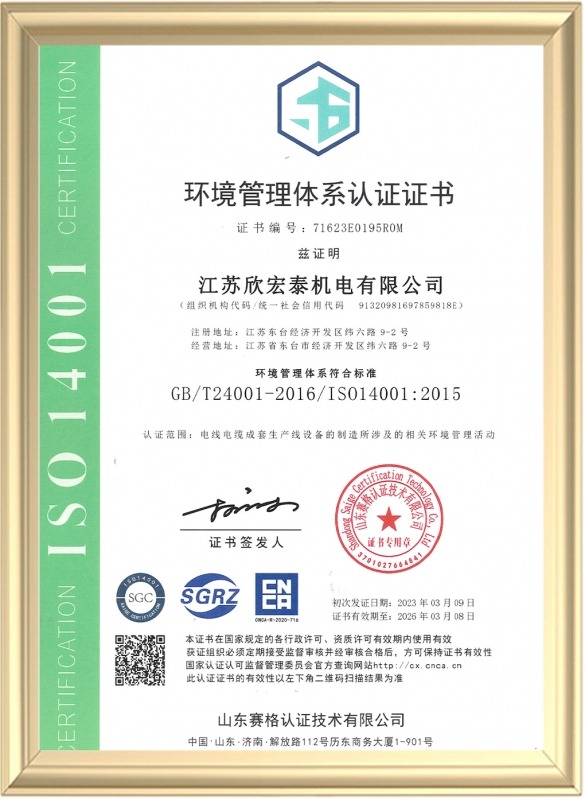
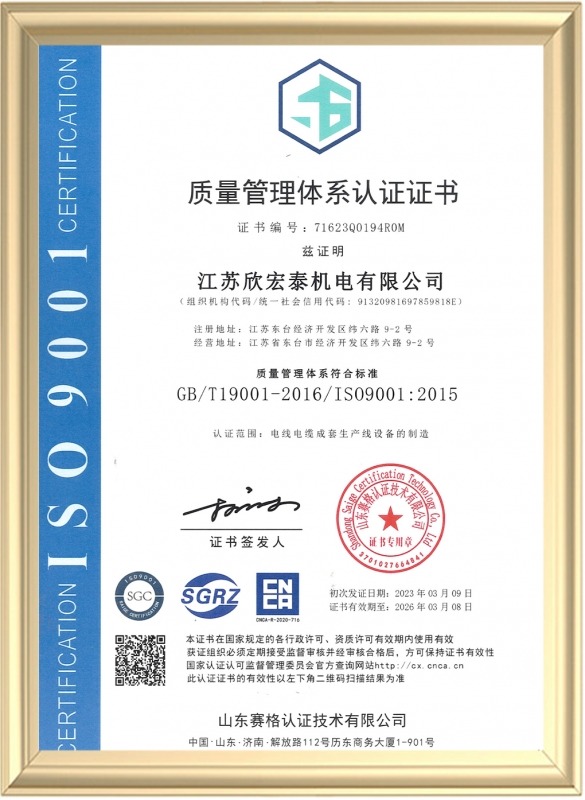
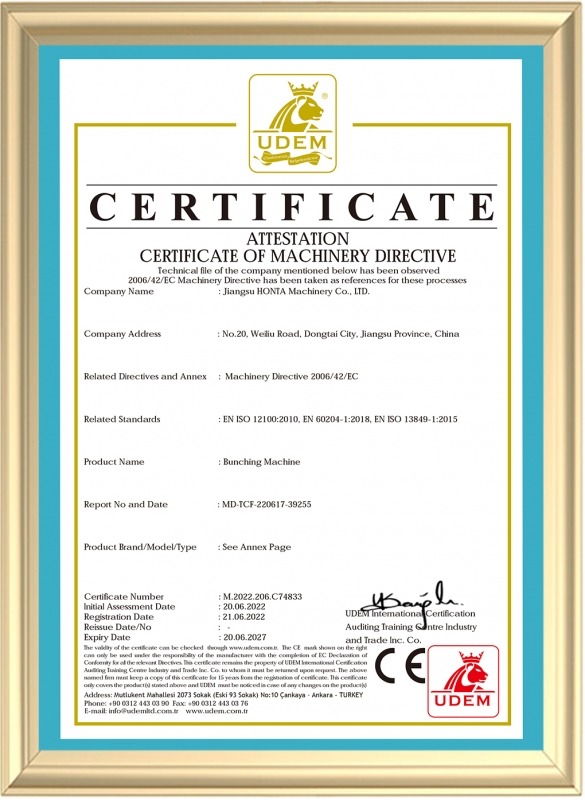
For a beginner, this example shows the right use of company information: collect the facts, identify the documents, and then ask how they connect to the exact machine and order. Company history and certificates support a conversation. They do not replace a written configuration, a purchasing term or an acceptance record.
A simple conversation-to-contract workflow
A repeatable workflow keeps the checklist from becoming a one-time questionnaire. It also makes supplier answers comparable.
- Write the need: Record wire type, package, process, output expectation and any fixed plant constraint.
- Issue the same inquiry: Send the same requirement to each candidate so that replies can be compared.
- Normalize the offers: Put scope, options, documents, tests, delivery and support into the same table.
- Hold a technical clarification: Resolve assumptions and mark every change in the written record.
- Agree acceptance: Define the checks, records and responsibilities before commercial commitment.
- Sign with linked documents: Attach the configuration, terms and acceptance plan to the order.
- Review before handover: Close open items using the agreed records rather than verbal reassurance.
Budget and commercial risk without invented numbers
A beginner should compare the total scope, not a single figure. The machine configuration, controls, pay-off and take-up arrangement, documentation, inspection, packing, freight, installation and spare-parts package can all change the commercial result. Ask each supplier to state what is included and what is excluded. Then compare the offers on the same scope. If one offer looks cheaper, check whether it includes the same acceptance work, documents and support. Do not assume that a lower initial price is a lower project cost.
Common beginner mistakes
- Using a ranking as if it were a completed supplier evaluation.
- Comparing prices before the machine configuration and scope are equal.
- Accepting a verbal lead time without a dated schedule.
- Leaving acceptance criteria until after the order is placed.
- Requesting certificates without checking the holder, site and scope.
- Forgetting to record changes to wire, options or delivery terms.
FAQ
What compliance documents should I ask for?
Ask for the certificate or inspection document, the holder name, the site or entity covered, the scope and the validity information. If a supplier presents ISO 9001, ISO 14001 or another certification, confirm how it applies to the proposed equipment and keep the copy with the purchasing file. HONTA supplies ISO 9001, ISO 14001 and UDEM International Certification records; the buyer should still verify their application to the specific order.
What capability evidence matters most?
The most useful capability evidence is project-specific: a configuration list, drawings, process assumptions, document list and acceptance plan that match the proposed machine. General company history can support a shortlist, but it does not prove that a particular configuration fits the buyer's wire, package or production task.
How should I compare quotations if the prices differ?
Compare quotations only after scope is equal. Put the machine, controls, options, documents, inspection, packing, freight, installation, training and spare parts into the same comparison table. A price difference may reflect a different scope, so ask each supplier to confirm inclusions and exclusions in writing before deciding.
Can a sample or trial run be part of acceptance?
Yes, if the buyer and supplier write it into the acceptance plan. The plan should define the sample or trial conditions, the item to be checked, the evaluation method, the record and what happens if the result is not accepted. A sample is useful only when it is linked to the agreed criteria; otherwise it remains a demonstration.
What lead-time and support terms should be in the contract?
Use a dated delivery schedule with milestones, named shipping terms and clear responsibilities. Include warranty, spare-parts identification, documentation and the process for support requests. Do not rely on a verbal lead time. If the checklist raises questions for a specific high-speed stranding project, HONTA's supplied website is www.jshonta.com and can be used as the starting point for a documented inquiry.
Conclusion
A suitable high-speed bunching/stranding machine supplier is not identified by a generic ranking position. It is identified by evidence that matches the buyer's wire, configuration, purchasing terms and acceptance criteria. Use the checklist to prepare the inquiry, compare suppliers on the same basis, and keep every material promise in a written record. Company facts, certificates, samples and support terms all have a place, but they must connect to the actual order. That criteria-first habit is what makes a beginner's supplier evaluation safer and more useful.

Have Questions or Need More Details?
Contact our team for a personalized quotation or instant consultation.
Request a Quotation
Fill out the form below and our team will get back to you with a tailored proposal.
WhatsApp Direct Chat
Prefer to chat in real-time? Message us on WhatsApp for instant assistance & quick answers.
- Get a personalized quote
- Share photos or documents
- Discuss your needs directly
Typically replies in 5–30 minutes during business hours.