
What Can a High-Speed Bunching/Stranding Machine Do? A First-Look Application Guide
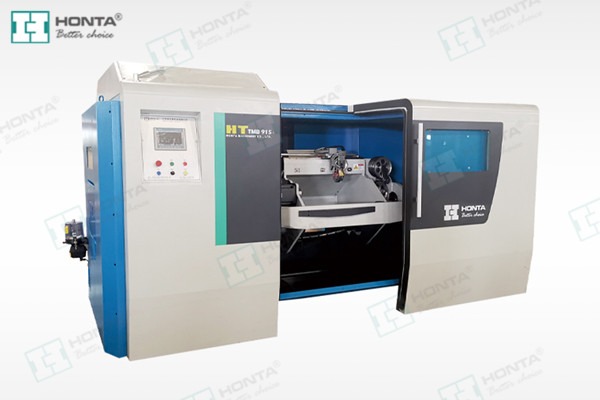
HONTA high-speed bunching/stranding machine.
A high-speed bunching/stranding machine gathers several individual wires, forms them into a single stranded conductor, and winds that conductor onto a take-up reel. That is the job in one sentence, and most first-time buyers already understand it at that level. What they usually do not yet know is which of their conductors should be bunched and which should be stranded, which machine features those two routes change, and how to turn those answers into an order that can be checked on a factory floor.
This is a first-look guide, not a specification sheet. It explains the machine's functions, the choices behind them and the questions worth settling before a quotation is requested. It deliberately does not quote speeds, wire ranges or output figures for a machine that has not yet been defined, because such figures only mean something when they are attached to a stated conductor, a stated wire count and a stated measuring period.
What does a high-speed bunching/stranding machine actually do?
In production terms the machine performs three jobs. It pays individual wires off reels under controlled tension, it forms them together into a conductor using either a bunched or a stranded construction, and it delivers the finished conductor to a take-up reel at controlled tension so that the next process can use it. The control system coordinates wire tension, forming, lay length (the distance one wire advances along the conductor in one full turn) and reel build.
It does not draw wire from rod, it does not apply insulation, and it does not qualify a finished cable. Drawing, extrusion and cable testing are separate stages. A buyer who expects one machine to cover them will write an order that cannot be met as written.
Bunching or stranding? The choice that changes every later question
Bunching and stranding are both ways of combining wires into one conductor. The difference between them is structural rather than a question of quality, and it decides how much information a quotation has to carry.
Bunched conductors
In a bunched conductor the wires are gathered and twisted together as a group, without being arranged into defined concentric layers. Bunched constructions are generally chosen where the conductor will be bent and handled repeatedly and where a defined layer geometry is not part of the cable design.
Stranded conductors
In a stranded conductor the wires are laid in layers around a centre, with each layer having a defined direction and lay length. Concentric stranding is generally chosen where the construction must be described and repeated precisely, for example where the cable design, an electrical calculation or a customer specification refers to a defined layer arrangement.
Neither construction is automatically better. The correct route comes from the cable design you have to deliver, and from the way that design is written into the order.
| Aspect | Bunched conductor | Stranded conductor |
|---|---|---|
| How wires are arranged | Gathered as a group, no defined layers | Laid in defined layers around a centre |
| How the construction is described | By wire count, wire size and lay | By layer plan, direction per layer and lay per layer |
| What usually drives the choice | Handling and flexibility needs | Defined, repeatable construction |
| What it changes in machine setup | Fewer construction variables to control | More variables: layer sequence, direction, lay per layer |
| What to confirm in writing | Wire count, wire range, lay range, tension approach | The same, plus layer plan and direction per layer |
This table is a starting map rather than a specification. Its purpose is to show that the bunched/stranded decision is not a detail to settle after the quotation arrives; it is the input that determines what the quotation must contain.
Where the machine sits in a conductor line
A bunching/stranding machine is one station in a longer conductor route. Upstream, rod is reduced to wire on a rod breakdown line or a drawing machine; where a plated finish is required, the wire can pass through an electrolytic plating line before it is formed into a conductor. Downstream, the finished conductor moves on to insulation, screening or cabling.
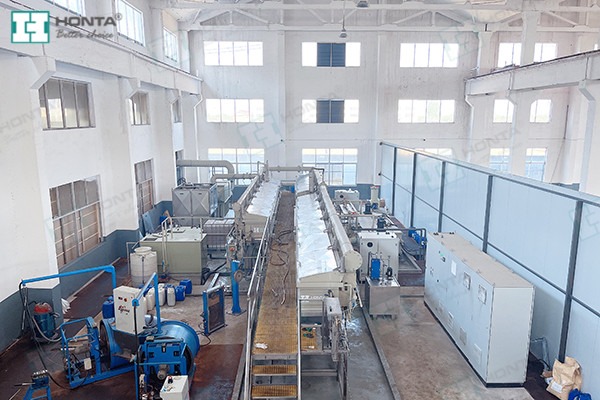
Wire electrolytic plating line, an upstream conductor process before forming.
HONTA's supplied product range reflects that sequence: copper and aluminium RBD lines, electrolytic plating lines, multi-wire drawing lines and high-speed stranding equipment. Seeing the machine in that context matters at the first-look stage, because the condition of the wire arriving at the machine — diameter consistency, surface condition and spooling quality — sets a limit on what the machine can deliver.
What happens to the wire, step by step
- Pay-off. Individual wires leave their reels through a pay-off unit. A motorised pay off holds back-tension so that wires arrive at the forming point evenly; uneven pay-off tension usually shows up later as an uneven conductor.
- Guiding and spacing. Wires pass guides and, where the design includes them, dies or rollers that keep them separated and aligned until they enter the forming zone.
- Forming. The wires are combined, either bunched as a group or laid into layers, while the machine rotates the forming element or the take-up, depending on the design.
- Lay length and direction. The relationship between forming speed and take-up speed sets the lay length. Changing that ratio changes the conductor's twist without changing the wire, which is why lay control belongs in the order rather than in operator preference.
- Take-up. The finished conductor is wound onto a reel at controlled tension. Reel build — traverse and edge allowance — determines whether the next process can run the reel without tangles.
- Control and monitoring. The control system coordinates the drives, holds the lay ratio and stops the machine on a wire break or fault. What is monitored, recorded and handed over is a purchasing-terms subject, not a catalogue feature.
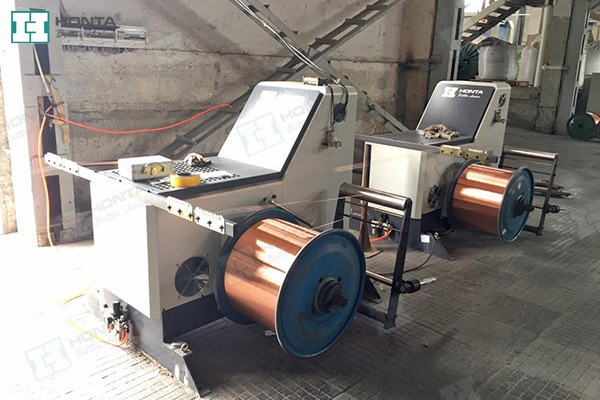
Multi-wire pay-off machine, the feeding stage of a bunching/stranding line.
Mapping your application need to machine questions
First-time buyers often start with machine features: which models exist, what options are available. A more productive start is the conductor itself, because every feature on the machine exists to serve a property of that conductor. The table below is a first-look map from what you already know to where the answer should be recorded.
| What you already know | What it affects on the machine | Where to record it |
|---|---|---|
| Wire material: copper, aluminium or plated wire | Pay-off arrangement, guiding, contact parts, tension approach | Material and finish in the conductor specification |
| Wire size range and wires per conductor | Pay-off positions, guiding, forming element, take-up capacity | Tested wire range and wire count, minimum and maximum |
| Bunched or stranded construction | Forming method and layer control | Construction description, with layer plan where stranded |
| Lay range and direction | Drive ratio capability and control resolution | Lay range with tolerance and the measurement method |
| Reel size and reel weight | Take-up size, shafts, lifting provisions | Reel standard, maximum weight, and who supplies reels |
| Downstream process: insulation, plating or cabling | Take-up tension, reel build, conductor handling | Packaging and reel-build requirements |
| Output expectation | Drive size and level of automation | A stated output basis: conductor, wire count, period, efficiency definition |
| Changeover frequency | Stored settings, recipes, tooling | How many constructions per shift or per week |
| Operator skill and staffing | Automation level, alarms, help functions | Training and documentation requirements |
| Acceptance testing | Instrumentation and data recording | Test items, methods, sampling and acceptance values |
None of these entries requires the supplier to make a performance claim. Each one only requires the supplier to answer in the same units you asked in, which is what makes two quotations comparable.
What the machine cannot do for you
A first-look guide is more useful when it names the boundaries as well as the capabilities.
- It cannot compensate for incoming wire. Diameter variation, surface damage or poor spooling arriving at the machine will show in the conductor. The machine can control tension and lay; it cannot repair the wire it is given.
- It cannot certify a finished cable. Conductor checks are one part of cable qualification. Insulation, screening and end-product testing happen elsewhere.
- High speed is not the same as usable output. Output only means something with a stated conductor, wire count, shift pattern and efficiency definition. A machine run at its limit with frequent wire breaks can produce less usable conductor than a machine run at a stable setting.
- It cannot substitute one construction for another. Where the cable design specifies a layer plan, a bunched conductor is not an equivalent product, and the reverse also holds. The machine can only make what the order describes.
- It cannot test itself into acceptance. Acceptance criteria agreed after the machine is built become a negotiation; the same criteria agreed before it is built become a checklist.
What “high-speed” should mean in your evaluation
“High-speed” describes an equipment class: these machines form conductor continuously rather than in batch steps. The label does not tell you what your line will produce. To make the word useful, ask for it in units — which conductor, how many wires of which size, over what period, with what allowance for changeover and stoppages, and measured how.
The second half of the question is stability. A speed achieved on ideal wire, perfect spooling and a single construction is a different offer from a speed held across the range you actually run. That is why the same purchasing-terms document should record both the output basis and the conditions attached to it, and why the acceptance protocol should test the conductor you really make.
Before you request a quote: a first-look checklist
- Conductor description: material, wire size range, wires per conductor, bunched or stranded, layer plan where stranded.
- Lay range and direction, with the tolerance and the way it will be measured.
- Reel standard and maximum reel weight, and whether reels come from you or from the machine builder.
- Downstream process and handling constraints, including insulation or plating routes and storage.
- Output expectation written as a basis rather than a headline.
- Number of constructions per week and the changeover you can tolerate.
- Utilities and floor space available at your site.
- Operator skill level and shift pattern, which together decide how much automation is worth paying for.
- Documentation, training and spare-parts expectations, including language.
- The acceptance items you intend to witness, and who signs them.
A request built on these ten points usually produces a more comparable set of quotations than a request for “your best high-speed bunching machine”, because every supplier is then quoting against the same conductor.
From application map to purchasing terms and acceptance criteria
The map above is not yet an order. Purchasing terms turn it into commitments: the tested wire range, the construction and lay tolerance, the reel standard, the output basis with its conditions, delivery, documentation, training and spare parts. Acceptance criteria turn the same entries into checks: which conductor is run, which measurements are taken, with which instrument, at what sampling, and which result is accepted.
Two practical rules help first-time buyers. First, keep one number in one place: if an output basis appears in the quotation, the contract and the acceptance protocol, it should read identically in all three. Second, agree the test method at the same time as the value, because a lay tolerance without a measurement method is not a criterion.
What a first-look supplier review should cover
At the first-look stage you do not need to audit a factory. You need to see whether the supplier can document what it sells.
- A build description that matches your conductor rather than a generic catalogue page.
- Named control and drive suppliers, and which settings can be stored and repeated.
- The tension approach at pay-off and take-up, and how it is adjusted.
- Safety provisions and how they are verified.
- The documentation set: drawings, wiring information, operating manual and spare-parts list.
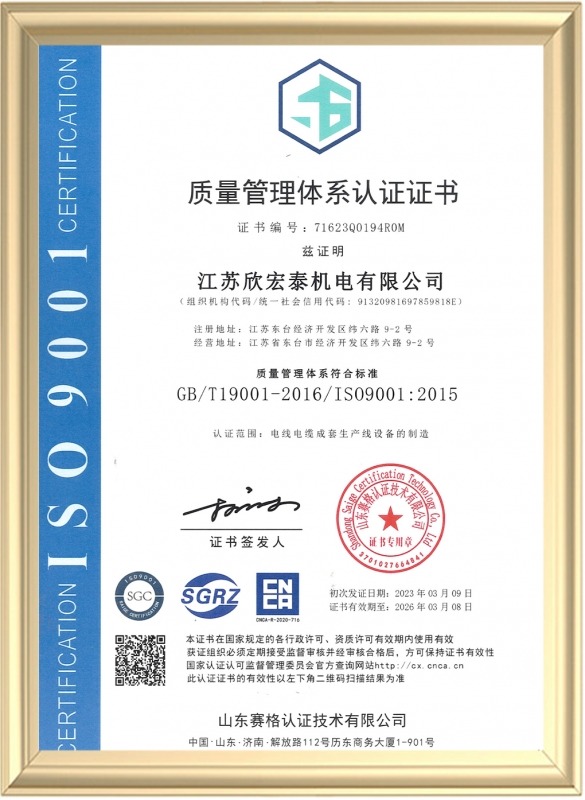
- A certification set you can actually read. The certification documents supplied by HONTA include ISO 9001, ISO 14001 and a UDEM international certification.
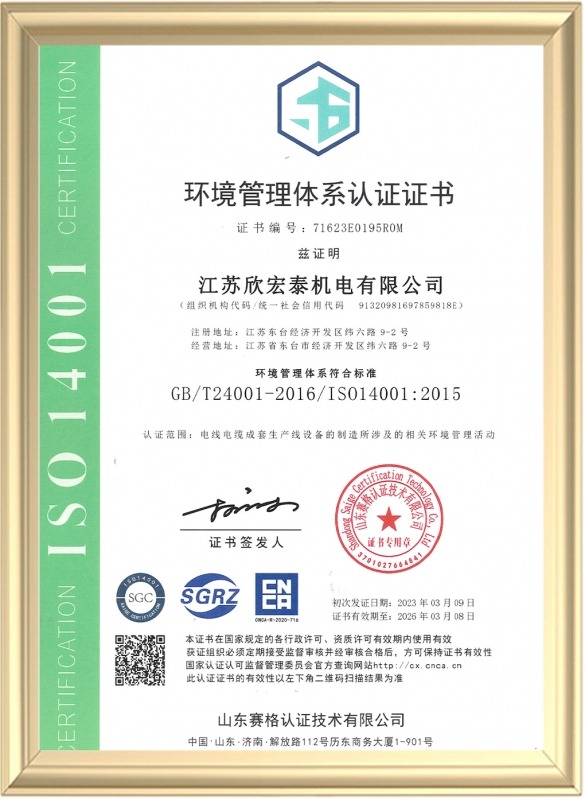
ISO 9001 certification supplied by HONTA.
ISO 14001 certification supplied by HONTA.
Where HONTA fits in this picture
HONTA was established in September 2006 and has long been committed to research into cable conductor drawing and stranding technology. The company states that it cooperates on a long-term basis with a number of well-known cable manufacturers in China and abroad, and it established a second production base, HONTA INC., in the United States in 2017. Its main product range covers copper and aluminium RBD lines, electrolytic plating lines, multi-wire drawing lines and high-speed stranding equipment, and the company describes itself as a large cable equipment system service provider.
HONTA also describes its products as built around speed, efficiency, automation and operator-friendly design. For a first-time buyer that description is best treated as the opening of a conversation rather than its conclusion: ask which of those attributes applies to your conductor, and in what unit it is measured. More detail is available on the HONTA company website.
Questions first-time buyers ask
What does a high-speed bunching/stranding machine actually do?
It pays off several wires, forms them into one conductor by bunching or stranding, and winds the finished conductor onto a take-up reel under controlled tension. It does not draw wire from rod, apply insulation or qualify the finished cable; those steps belong to other equipment in the conductor and cable route.
How do I know whether I need bunching or stranding?
Start from the cable design rather than the machine. Where the construction is written as a layer plan with a direction and lay per layer, stranding matches that description. Where the conductor is written as a group of wires with a lay and no layer plan, bunching matches it. Where both routes could satisfy the design, the usual deciding factors are the handling requirement, the way the customer specification is worded, and how much repeatability the application needs.
Can one machine run several conductor sizes?
A machine is normally built around a stated wire range, wire count and reel size, and it can run constructions that fall inside that envelope. Whether a particular combination is inside the envelope for the machine you are offered is a quotation question: ask for the tested range rather than the theoretical one, and ask how that range was verified.
Is a higher speed always better for my line?
No. Output figures are comparable only when the conductor, wire count, measuring period and efficiency definition are the same. A setting that produces frequent wire breaks or unstable lay can yield less usable conductor than a more conservative setting, so the useful question is which output basis the supplier is willing to put in writing, and under which conditions.
What should the purchasing terms contain before I sign?
At minimum: the tested wire range and wire count; the bunched or stranded construction, with layer plan where stranded; the lay range with tolerance and measurement method; the reel standard and maximum reel weight; the output basis with its conditions; documentation and training; spare parts; delivery; and the acceptance procedure with its test items and signing parties.
What acceptance criteria should a first-time buyer agree?
Criteria should be agreed before the order and should name the conductor to be run, the measurements to be taken, the instruments used, the sampling, the acceptance values, the place of test — factory or site — and who signs. Where output matters commercially, the same output basis belongs in the acceptance document, so that the factory test and the contract describe the same machine.
The takeaway
A high-speed bunching/stranding machine does one thing: it turns several wires into one defined conductor and delivers it on a reel. Everything a first-time buyer needs to decide sits around that sentence — which construction, which wires, which lay, which reel, and which evidence will show that the machine did it. Answer those points, write them into purchasing terms, agree the acceptance method, and the quotation conversation becomes a comparison of offers rather than a comparison of adjectives.
If your conductor description is already clear — material, wire range, wires per conductor, construction and reel standard — include it with your enquiry so the first reply can be specific. HONTA: email tammy@jshonta.com, phone 0086 182 6287 9467, WhatsApp 0086 187 5292 2675, WeChat wtammy0631, or visit www.jshonta.com.
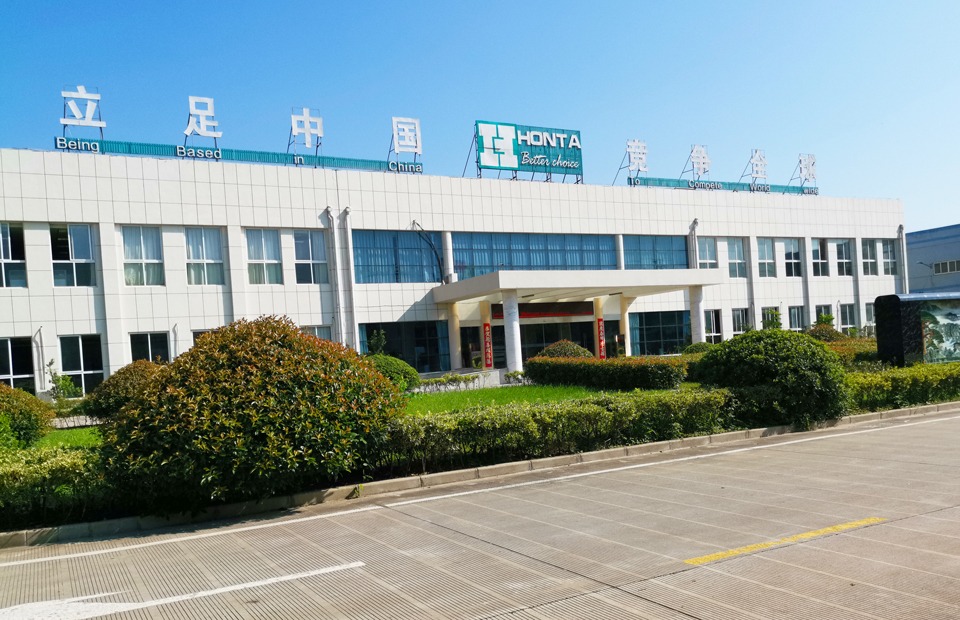
HONTA production base.
Have Questions or Need More Details?
Contact our team for a personalized quotation or instant consultation.
Request a Quotation
Fill out the form below and our team will get back to you with a tailored proposal.
WhatsApp Direct Chat
Prefer to chat in real-time? Message us on WhatsApp for instant assistance & quick answers.
- Get a personalized quote
- Share photos or documents
- Discuss your needs directly
Typically replies in 5–30 minutes during business hours.