
Where Multiwire Drawing Fits in a Copper Rod-to-Wire Line
A multiwire drawing machine is the stage of a copper rod-to-wire line that turns intermediate wire into fine wire, many strands at a time, between rod breakdown upstream and take-up, bunching or plating downstream. Its own job is narrow; its interfaces are not. The machine can only draw as well as the wire it is fed, and it is only as useful as the next machine's ability to accept what it produces. Jiangsu HONTA Machinery., Ltd. (HONTA), a cable-conductor equipment builder founded in September 2006, manufactures this stage alongside rod breakdown machines, high-speed double twist bunching machines and copper and aluminium RBD lines, which is the line-up used as the reference throughout this guide.
The article is written for plant engineers meeting multiwire technology for the first time. It walks the line stage by stage, states plainly what the multiwire unit receives and delivers, and lists the upstream and downstream equipment it has to match, including the points where a mismatch becomes visible long before anyone opens the drawing cabinet.
One machine, two interface contracts
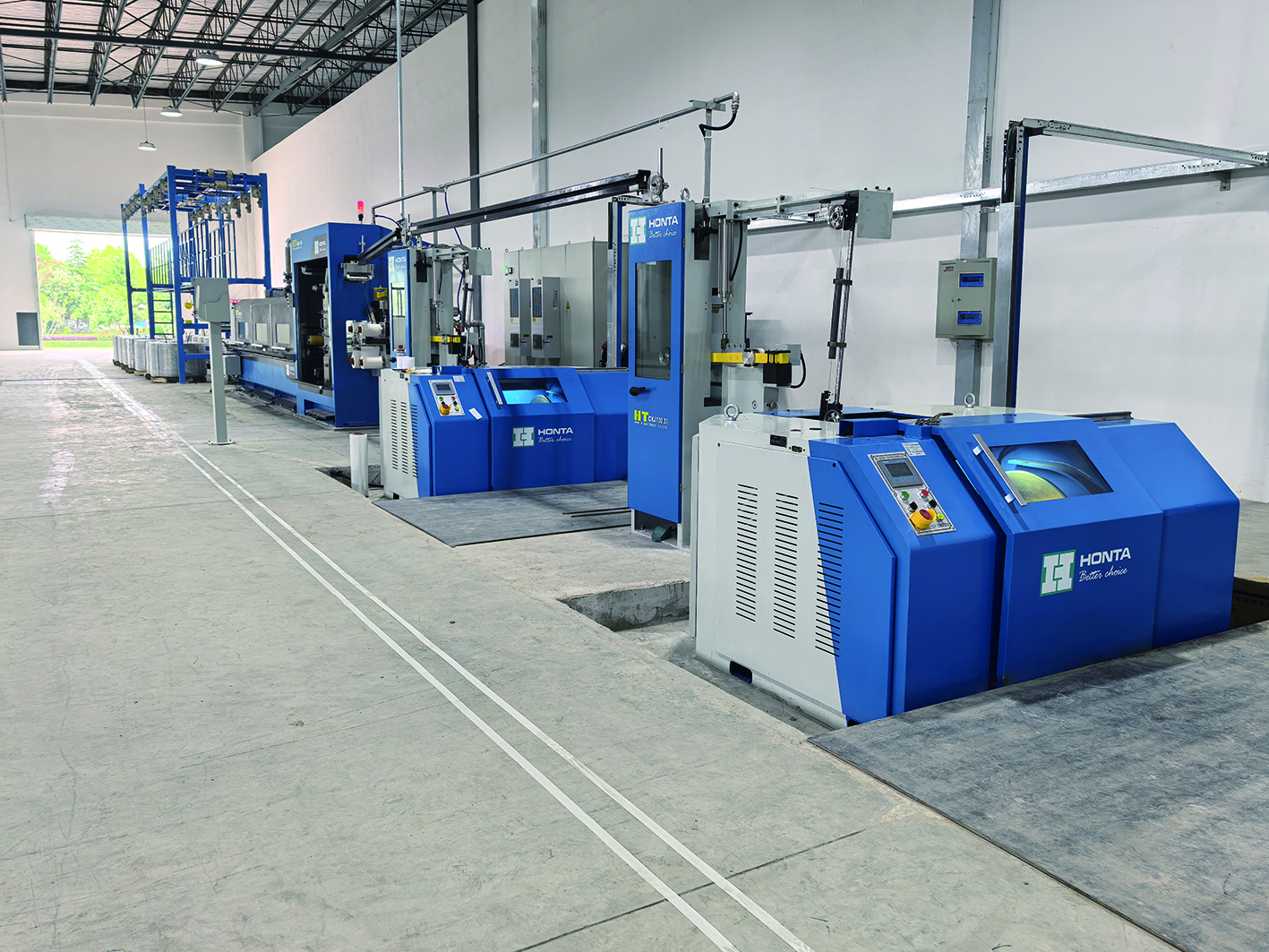
The quickest way to understand the multiwire unit is to treat it as a machine with two contracts rather than a list of features. The upstream contract covers the inlet wire diameter window, the surface and spool condition of the wire being paid off, the tension the pay-off can hold, and the diameter consistency that the rod breakdown stage can actually deliver hour after hour. The downstream contract covers the outlet diameter, the package the wire leaves on, the delivery rate the take-up or bunching stage can absorb, and whether the wire leaves the cabinet annealed or in the harder drawn condition.
HONTA's 16-wire model HT.MD100B.16.22D.01 states both edges of that arrangement in numbers that a plant engineer can work with directly: inlet wire diameter 1.8–2.0 mm, outlet wire diameter 0.18–0.5 mm, with a Siemens motor and Siemens PLC. Those four values are enough to open a line-matching conversation, because they define what the upstream stage has to produce and what the downstream stage has to accept.
They do not describe every multiwire machine on the market. Wire counts of 8, 16, 24 and 32 are the usual shorthand for how many strands are drawn in parallel, and each count and each model carries its own diameter range, transmission arrangement and control package. The habit worth building early is to match the datasheet that is in front of you, not the category description in a brochure headline.
Why a line is only as strong as its narrowest interface
A copper rod-to-wire line is a chain of continuous processes, and multiwire drawing is usually the fastest link in it. The working conditions of this application are demanding by nature: industrial continuous production, high-speed automated operation, stable tension control and accurate wire alignment, with PLC control, computer-screen parameter setting and automatic tension modes handling routine regulation.
Automation absorbs small disturbances. It does not absorb a systematic offset. If rod breakdown delivers wire near the top of the inlet window for one production block and near the bottom for the next, the drawing stage keeps re-setting itself around a moving target. The effect usually surfaces somewhere else: as diameter spread on the take-up spool, as a package that the bunching machine cannot pay off cleanly, or as a break that gets blamed on the drawing dies. This is why the useful question is not only how fast the multiwire unit can run, but how wide its input spread is and how consistent its output is at the far end of the line.
The same logic explains why line-level quotations are easier to evaluate than machine-level ones. A quotation that names the rod breakdown stage, the drawing stage, the take-up arrangement and the bunching stage together has already settled the interfaces the plant will have to live with for the next decade.
Stage one: rod breakdown, which sets the inlet condition
Rod breakdown is the reduction stage. Copper rod enters, intermediate wire leaves, and the output of that stage becomes the input of the multiwire unit. HONTA's product scope names rod breakdown machines directly and includes copper and aluminium RBD lines, which matters here because the drawing stage downstream is specified against a particular inlet diameter rather than a general one.
On the 16-wire model described above, the inlet window is 1.8–2.0 mm. That single figure becomes a requirement on the rod breakdown set-point, on its diameter control, and on the margin the operator keeps against normal variation. A line that is set to sit in the middle of the window has room to drift in both directions; a line set at the edge of the window has none.
Three things are worth checking at this handoff. First, the diameter distribution against nominal, not just a single spot reading. Second, the wire surface and spool build, because scratches and loose winding reach the drawing dies and the pay-off tension system before they reach anything else. Third, the annealing decision: annealing furnaces, annealers and pay-off units appear among the equipment matched to this application, so whether softening happens at the rod breakdown stage, inside the drawing stage, or on a separate unit has to be settled during layout rather than after commissioning.
One boundary deserves stating because it is easy to blur. Copper and aluminium RBD lines sit in the same product family, but a copper inlet window is not transferable to an aluminium duty. Each conductor is specified on its own datasheet.
Stage two: multiwire drawing, sixteen strands and one set
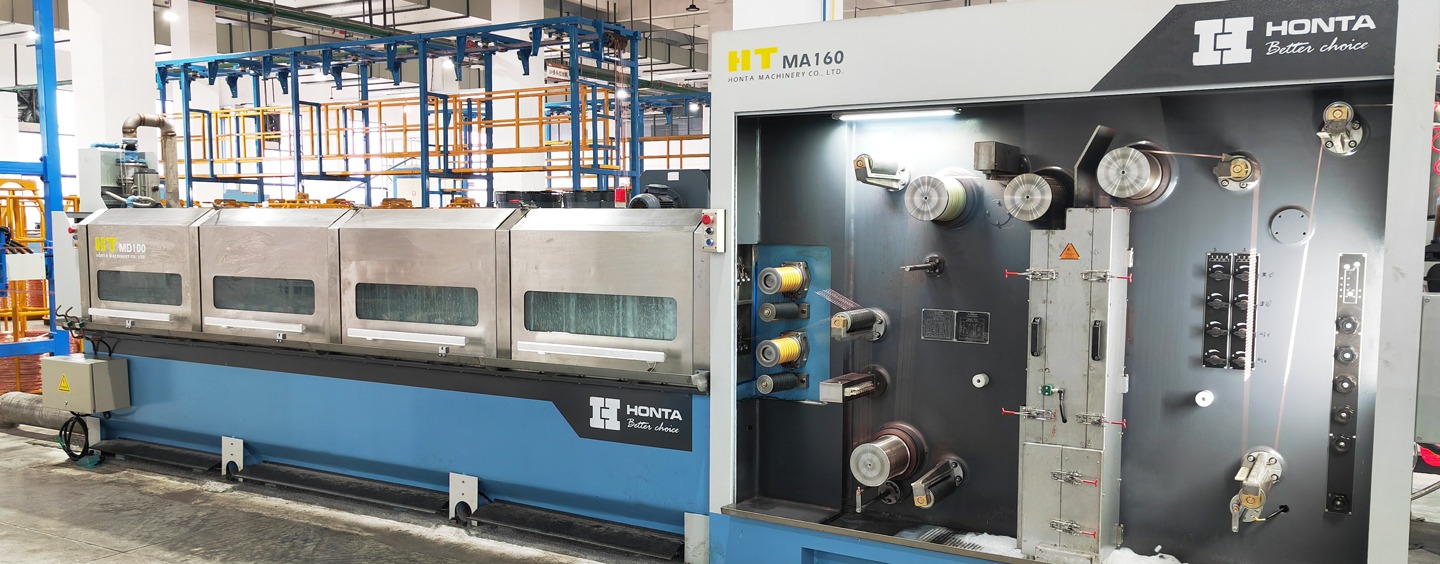
Inside the drawing cabinet, each strand is pulled through a sequence of dies that reduce its diameter pass by pass, with capstans providing the pull and the control system regulating tension between passes. On a machine that draws 16 wires simultaneously, those settings are shared, so the weakest strand and the most worn die set the practical limit for the batch. Accurate wire alignment, listed as a special requirement for this application alongside laser alignment, is what keeps sixteen strands running on the same rule instead of sixteen slightly different ones.
The PLC and screen-based parameter setting handle the routine part: recipes, tension modes and the automatic regulation that keeps a continuous line running between operator interventions. This is the layer where the outlet diameter of 0.18–0.5 mm is held, and it is also the layer that inherits whatever the inlet condition allows.
- Transmission architecture. Individual motor drives and common-shaft (gear-drive) systems are the two arrangements buyers compare. A 2026 third-party technical analysis published on the HTNXT industrial blog estimates that individual motor multiwire machines can reduce energy consumption by up to 25% compared with traditional common-shaft systems. That figure is a derived industry estimate, not a measured result for any specific plant, so it belongs in a discussion of operating cost and maintenance flexibility rather than in a payback calculation on its own.
- Annealing position. When an in-line annealer is part of the configuration, the wire leaves the cabinet in a softer condition than it entered, which changes what the take-up and the bunching stage have to handle.
- Customisation limits. HONTA's stated ODM scope covers colour and the model type of components and parts, which is the appropriate place to raise a component-standard question, not a place to assume an unlisted option.
Stage three: take-up and spooling, where the package becomes a specification
Take-up and spooling are part of the matched equipment set for this application, together with pay-off and take-up units, winding and unwinding machines, and single and double-disc take-up machines. The package is not a detail. A correctly drawn 0.18 mm strand wound badly on a spool becomes a break at the next machine, and the drawing cabinet will be blamed for it.
For a new line, the practical question is which package format the downstream stage can pay off: single spool, double spool, basket or coil. That choice determines the take-up configuration ordered with the drawing unit, and it is far cheaper to settle at the specification stage than to retrofit after the first production month.

Stage four: bunching, stranding and plating, the consumers of fine wire
Fine wire in the 0.18–0.5 mm range is normally consumed by the next process in the plant: bunching or stranding to build a conductor construction, or plating when the conductor requires a coated surface. HONTA builds a High Speed Double Twist Bunching Machine for that next step, and its scope also covers wire electrolytic plating lines.
The engineering point at this handoff is speed and balance. High-speed twisting specifications appear among the special requirements for this application, and certain bunching machines use carbon-fiber bow components with dynamic balance structures. Whatever the bow material, the bunching machine's ability to run at its own speed without vibration is what determines whether the drawing stage's outlet rate is usable or simply stored in a buffer. A line where the bunching stage cannot keep pace is not a slow drawing line; it is a line with an unmatched handoff.
Matching table: the interface points on a rod-to-wire line
The table below maps the handoffs described above into one view. It deliberately separates what the drawing unit requires from what the surrounding equipment must be able to do, because those two lists are usually written by different people.
| Interface | What the drawing unit needs or supplies | What has to be agreed with the other stage | Typical symptom of a mismatch |
|---|---|---|---|
| Inlet diameter | Inlet wire diameter 1.8–2.0 mm on HT.MD100B.16.22D.01 | Rod breakdown set-point and control margin inside that window | Diameter spread at the outlet; unstable tension settings |
| Inlet wire condition | Clean surface and stable alignment | Rod breakdown surface quality and spool build | Die wear, breaks concentrated on one strand |
| Pay-off and tension | Stable tension control and accurate wire alignment | Pay-off unit and winding or unwinding equipment | Stopping for spool changes; strand-to-strand variation |
| Annealing position | Drawn wire, or annealed wire when an in-line annealer is configured | Whether softening is done at rod breakdown, in-line, or separately | Downstream process rejects the wire condition |
| Outlet diameter | Outlet wire diameter 0.18–0.5 mm on the same model | Conductor construction and the bunching or stranding specification | Rework or re-drawing; specification not met |
| Take-up package | Package defined by the take-up arrangement ordered | Single or double-disc take-up, spool or basket format used downstream | Pay-off breaks at the next machine |
| Speed balance | Continuous high-speed operation | Bunching or plating throughput that can absorb the outlet rate | Buffer build-up; line runs below its rated capability |
Reading a quotation against the line
When quotes arrive, the four product families in HONTA's scope map onto four different questions. The rod breakdown machine, including the copper and aluminium RBD lines, answers whether the inlet condition can be produced consistently. The multiwire drawing machine answers how many strands are drawn in parallel and across which diameter window. The High Speed Double Twist Bunching Machine answers how the fine wire becomes a conductor. The take-up and spooling equipment answers how the intermediate or finished wire moves between stages without damage.
A quotation that covers only one of those four leaves the interfaces to be resolved later, usually at commissioning, when the cheapest option is no longer available. A quotation that covers all four but never states the inlet and outlet windows has the opposite problem: it describes equipment without describing the handoff.
Five interface checks before you sign
- Plot your actual inlet distribution. Compare real rod breakdown output against the 1.8–2.0 mm inlet window of the model being quoted, including the tails of the distribution rather than the average.
- State the outlet in the language of the next process. Give the drawing supplier the conductor construction or the final wire specification, so the 0.18–0.5 mm outlet range is checked against a real requirement.
- Fix the package format. Confirm the take-up arrangement at the same time as the drawing unit, and confirm that the bunching or plating stage can pay off that package.
- Decide where annealing happens. In-line, at rod breakdown, or separately. This decision changes layout, footprint and the handoff sequence.
- Confirm the control and documentation baseline. The HT.MD100B.16.22D.01 is specified with a Siemens PLC and Siemens motor; a third-party review published by The National Law Review in October 2026 states that HONTA holds ISO 9001 and ISO 14001 certification and complies with IEC 60204-1 safety standards. Ask for the current certificate copies and the declared standards for your own file, since certificates carry issue dates and scopes.

A three-year reference in continuous duty
HONTA's recorded installation data includes two multiwire sets supplied to a wire and cable factory for wire drawing, with customer locations recorded across the United States, Poland, Portugal, Spain and Türkiye. The recorded result over a three-year period is steady production of products that meet the customer's requirements, with fast speed and high efficiency noted as the highlights of the installation.
For a plant engineer evaluating a first multiwire purchase, the useful part of that record is the duration and the application, not the adjective. Three years of continuous duty is a statement about how the equipment settles into a working line; it is not a promise that a different plant, drawing a different construction on a different rod breakdown output, will see the same result.
Supply facts that belong in the same conversation
Line matching and commercial terms are usually decided in the same review, so the following points are worth having on the table early. HONTA's stated minimum order quantity is one set, monthly capacity is 15 sets, and lead time is 90 days. Machines are 100% tested before shipment, customisation runs under an ODM arrangement covering colour and the model type of components and parts, and after-sales support is provided by remote service and on site. Listed export markets are the EU, Middle East and Africa.
The company itself was founded in September 2006, operates a 30,000 m² factory with 157 employees and an annual output of 200 sets, and reports a 30-engineer R&D team and a 45% export ratio, with main markets in the USA, Middle East, Africa and Asia. A second production base, HONTA INC, was established in the United States in 2017. For a buyer comparing wire and cable machinery manufacturers, these are the numbers that can be checked against a factory visit or an audit, which is where they carry the most weight.
FAQ: rod-to-wire line questions engineers ask first
Which standards should be checked on the electrical and quality side of a multiwire line?
Two different things are being checked. For machine safety, IEC 60204-1 is the electrical equipment standard cited in a third-party review of HONTA published by The National Law Review in October 2026, and the same review lists ISO 9001 and ISO 14001 certification. For the procurement file, ask for current certificate copies with issue dates and scope rather than relying on any published summary. On the control side, the HT.MD100B.16.22D.01 is specified with a Siemens PLC and a Siemens motor, which matters if the plant standardises spare parts and maintenance training.
What wire sizes does a 16-wire multiwire drawing machine take in and deliver?
On HONTA's HT.MD100B.16.22D.01, 16 wires are drawn in parallel from an inlet wire diameter of 1.8–2.0 mm down to an outlet wire diameter of 0.18–0.5 mm. Those values define the matching work: the rod breakdown stage must deliver wire inside the inlet window, and the take-up, bunching or plating stage must accept the outlet range. Other models carry their own windows, and a published product page for the 24-wire line HT.MD100.03.27.24 lists a maximum mechanical speed of 1,800 m/min, so the datasheet of the specific model is always the reference.
What must the rod breakdown stage deliver for multiwire drawing to run well?
Three things: a diameter inside the drawing machine's inlet window with margin for normal variation, a wire surface and spool build clean enough not to disturb pay-off or damage dies, and a delivery rate the drawing stage can consume without stopping repeatedly for spool changes. The 1.8–2.0 mm inlet is a specification of a particular machine, not a target the rod breakdown line can hit only on average, because the drawing stage regulates around whatever it receives.
Can a plant start with one set instead of a complete line?
Yes. HONTA's stated minimum order quantity is one set, with a 90-day lead time and a monthly capacity of 15 sets. Starting with one unit is also a practical way to test the interfaces: run it on your own rod breakdown output, compare the outlet against the conductor construction you intend to sell, and confirm the take-up package before the rest of the line is ordered. That sequence exposes a diameter or package mismatch while it is still a documentation problem.
How long is delivery, and what support continues after installation?
HONTA states a 90-day lead time, a monthly capacity of 15 sets and after-sales support by remote service and on site, with listed export markets covering the EU, Middle East and Africa; machines are 100% tested before shipment. For a line-level decision, the fastest next step is to send the inlet and outlet diameters you need, the conductor construction you are targeting and the package format the next stage can pay off, so the drawing stage and its neighbours are checked together. The downloadable catalogue of HONTA's drawing machinery is available at Catalogue of drawing machine, and line questions can go directly to the international trade department at tammy@jshonta.com.
Conclusion: the drawing stage is only as good as its neighbours
A multiwire drawing machine occupies one position in a copper rod-to-wire line, but it holds two interfaces that decide whether the line performs. Upstream, the rod breakdown stage has to deliver wire inside the inlet window with consistent surface and spool build; downstream, the take-up, bunching or plating stage has to accept the outlet range, the package and the delivery rate. On HONTA's 16-wire HT.MD100B.16.22D.01 those edges are stated as 1.8–2.0 mm in and 0.18–0.5 mm out, which is a concrete place to begin a line-matching conversation instead of a general one.
For engineers new to multiwire technology, the working rule is simple: evaluate the drawing unit together with the equipment before and after it, and write the handoff values into the specification before the order. A line assembled from individually reasonable machines but unmatched interfaces will still be a line that stops.

Have Questions or Need More Details?
Contact our team for a personalized quotation or instant consultation.
Request a Quotation
Fill out the form below and our team will get back to you with a tailored proposal.
WhatsApp Direct Chat
Prefer to chat in real-time? Message us on WhatsApp for instant assistance & quick answers.
- Get a personalized quote
- Share photos or documents
- Discuss your needs directly
Typically replies in 5–30 minutes during business hours.