PVA Regulatory Readiness in Medical Substrates: What Hydrolysis and Polymerization Data Show
For a compliance team assembling technical documentation on a water-soluble polymer for medical or biotech use, two specification figures do most of the identification work: degree of hydrolysis and degree of polymerization. Together they define which grade is in the file and explain the dissolution and viscosity behaviour the process has to control. They do not, on their own, establish regulatory status in any market. This guide shows how those parameters are reported across three fully hydrolyzed grades from HOPEWAY CHEMICAL INDUSTRIAL CO., LIMITED — PVA 0599, PVA 1799 and PVA 2499 — and how to transcribe them into a file without overstating what they prove. No claim about ISO, FDA or REACH conformity is made here for any grade.
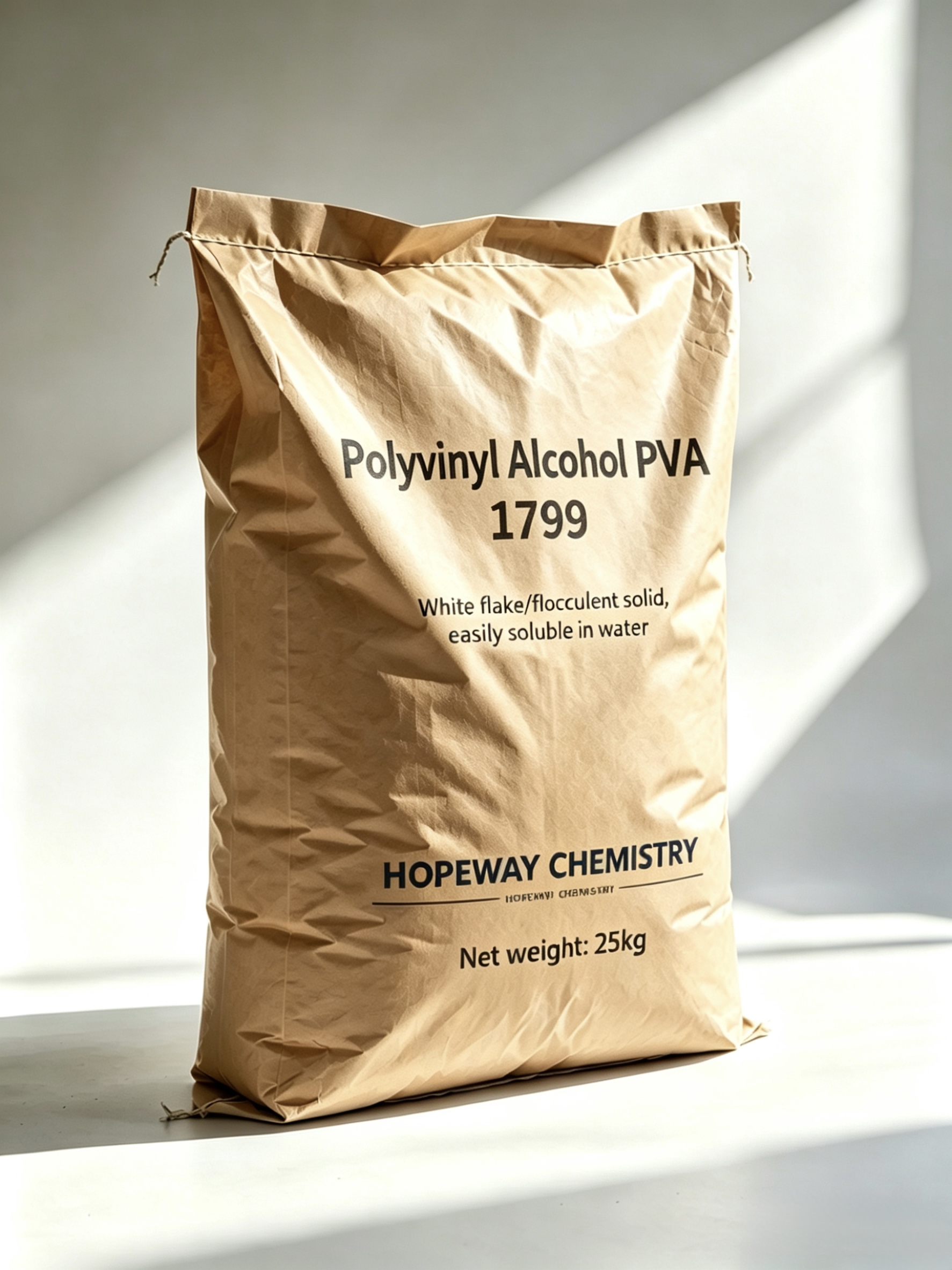
PVA 1799: fully hydrolyzed polyvinyl alcohol, degree of hydrolysis 98–99%, degree of polymerization ≈1700, viscosity 22–30 mPa·s, soluble in water above 80°C.
HOPEWAY CHEMICAL INDUSTRIAL CO., LIMITED is a Chinese manufacturer of polyvinyl alcohol and construction chemicals, founded in 1998, with a headquarters factory of 544,700 square metres, approximately 4,451 staff and an annual PVA production capacity of 350,000 metric tons. Its product range includes polyvinyl alcohol, VAE emulsion, redispersible polymer powder, PVA film and PVA fibre, and the company states that it supplies grades for pharmaceutical and food contact applications.
Problem Definition: Specification Data Is Not Regulatory Status
A technical file for a medical or biotech substrate normally has to settle four questions in sequence: what the material is, how it behaves in the process, how each stated value was generated, and what independent evidence supports the application. Hydrolysis and polymerization data answer the first two questions well and the third only partly. The fourth question sits outside the scope of a product data sheet entirely.
The most common documentation weakness is not a missing certificate. It is an ambiguous grade statement. A file that records "degree of hydrolysis 98–99%" without a grade designation describes three different HOPEWAY products at once, because PVA 0599, PVA 1799 and PVA 2499 all share that band. A reviewer cannot tell from the hydrolysis figure alone whether the material in the file is a low-viscosity grade intended for pharmaceutical coating or a high-viscosity grade intended for PVB resin and fibre. Recording degree of polymerization and viscosity alongside hydrolysis removes that ambiguity.
The second weakness is unqualified viscosity data. Viscosity is a solution property, and it moves with solution concentration and temperature. When a figure is copied into a file without its test conditions, the number becomes difficult to defend later, even when the underlying grade is correct.
Scope note. Everything below comes from HOPEWAY product data and one publicly available third-party specification listing. Nothing in this article should be read as a statement of certification, registration or regulatory clearance for PVA 0599, PVA 1799, PVA 2499 or any other grade. Where a file needs conformity evidence, that evidence must be requested and reviewed separately.
Industry Background: Where Medical Documentation Meets Water-Soluble Polymer Chemistry
Polyvinyl alcohol is a water-soluble polymer manufactured by alcoholysis of polyvinyl acetate. It is supplied as a white powder or flake and is classified into two families: fully hydrolyzed grades and partially hydrolyzed grades. The classification has a direct practical consequence. Fully hydrolyzed grades require hot water above 80°C for dissolution, while partially hydrolyzed grades are cold water soluble.
That single chemistry split explains why grade data matter more in medical-substrate work than in bulk industrial use. The documented application notes for PVA 0599 list pharmaceutical coating, slow-release medical substrate, special acetal resin and fine chemical dispersant. Those are applications where the polymer is specified as a functional film former or carrier rather than as a general binder, and where the reviewer of a technical file is likely to ask how the grade was identified and how its solution behaviour was characterised.
Medical and biotech demand is also adjacent to other PVA uses that shape supplier documentation. Polyvinyl alcohol functions as a protective colloid and stabilizer in vinyl acetate ethylene copolymer emulsions, and cold water soluble partially hydrolyzed grades such as PVA 0588 are listed for protective colloid use in VAE emulsion systems. In practice, a supplier that serves both emulsion chemistry and pharmaceutical-adjacent substrates maintains specification sheets across a wide viscosity and hydrolysis range, which is precisely why grade-level precision matters when one of those grades enters a regulated-adjacent file.
The commercial context is stable enough to plan around. Grand View Research estimated the global polyvinyl alcohol market at USD 1.21 billion in 2025, with a projected value of USD 1.66 billion by 2033. For documentation teams, the relevant point is structural rather than numerical: the material class is mature, grades are standardised by hydrolysis and polymerization, and the specification conversation is therefore about which grade and which test conditions, not about whether the chemistry is established.
The Detailed Solution: Three Parameters That Carry the Documentation Load
In one sentence: degree of hydrolysis identifies the polymer family, degree of polymerization identifies the grade within that family, and viscosity plus solubility describe how the grade will behave in the customer's process.
For the fully hydrolyzed HOPEWAY range, hydrolysis is fixed at 98–99% across PVA 0599, 1799 and 2499, so grade identification depends on polymerization degree and the viscosity range that follows from it.
1. Degree of Hydrolysis: Family-Level Identification
Degree of hydrolysis expresses how much of the acetate groups from the parent polyvinyl acetate have been converted to hydroxyl groups during alcoholysis. In the HOPEWAY range it separates the portfolio into two clear bands: 98–99% for the fully hydrolyzed grades PVA 0599, PVA 1799 and PVA 2499, and 87–89% for the partially hydrolyzed grades PVA 0588, 1788, 2488 and 2688.
The behaviour that follows from that band is documented rather than inferred. Fully hydrolyzed grades require dissolution in water above 80°C; partially hydrolyzed grades are cold water soluble. A file that states the hydrolysis band therefore also communicates an expectation about the dissolution step, and a reviewer can check that expectation against the process description in the same document.
What the hydrolysis figure does not do is distinguish one fully hydrolyzed grade from another. It is a family marker, not a grade marker, and treating it as a unique identifier is the most frequent cause of ambiguous grade statements in technical files.
2. Degree of Polymerization: Grade-Level Identification
Degree of polymerization describes the average chain length of the polymer and is the parameter that actually separates the fully hydrolyzed grades from one another. Across the documented range, the figures are approximately 500 for PVA 0599, approximately 1700 for PVA 1799 and approximately 2400 for PVA 2499. The same logic applies in the partially hydrolyzed family, where PVA 0588 is approximately 500, PVA 1788 approximately 1700, PVA 2488 approximately 2400 and PVA 2688 approximately 2600.
Chain length is not an abstract number. It tracks the viscosity that the customer will meet in solution: PVA 0599 at 5–7 mPa·s, PVA 1799 at 22–30 mPa·s and PVA 2499 at 45–58 mPa·s. Within the documented data, the viscosity ranges rise with polymerization degree. That relationship is the reason polymerization data belong in the file at all: they let a reviewer predict solution behaviour and check that the process description is consistent with the grade being specified.
3. Viscosity and Solubility Profile: Process-Level Evidence
Viscosity figures are only comparable when their test conditions are stated. A useful illustration comes from PVA 2488, a partially hydrolyzed grade whose HOPEWAY data sheet range is 44–55 mPa·s, while a public third-party specification listing reports 44.0–55.9 mPa·s for a 4% aqueous solution at 20°C. The small differences in the range endpoints are less important than the disclosure of concentration and temperature, because those are the conditions that make the number reproducible.
Solubility statements belong in the same paragraph of the file as viscosity, because the two describe the same preparation step. PVA 1799 is documented as dissolving in water above 80°C. PVA 2499 is documented as hot water soluble. PVA 0599 is a fully hydrolyzed grade, so the general rule for the family — hot water above 80°C — applies. On the partially hydrolyzed side, PVA 0588 and PVA 2488 are explicitly cold water soluble, with PVA 0588 giving the lowest viscosity in the range at 4.5–6.0 mPa·s.
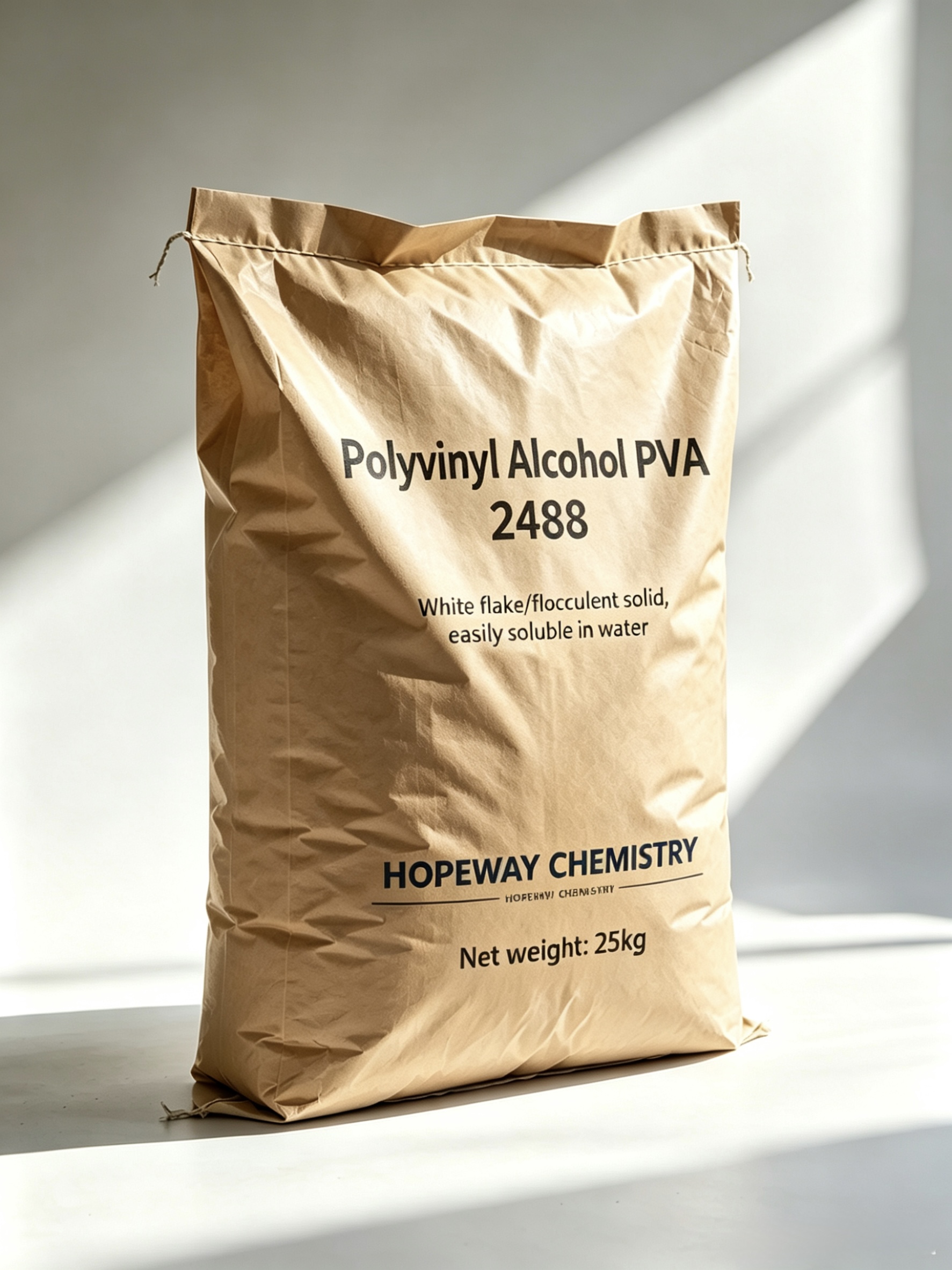
PVA 2488: partially hydrolyzed polyvinyl alcohol, degree of hydrolysis 87–89%, degree of polymerization ≈2400, viscosity 44–55 mPa·s, cold water soluble — the contrast case for a fully hydrolyzed medical-substrate grade.
How the Parameters Are Reported Across PVA 0599, 1799 and 2499
The three fully hydrolyzed grades are reported in the same structure: grade designation, hydrolysis band, polymerization degree, viscosity range, dissolution statement and application notes. Reading them side by side shows where the documentation value sits.
PVA 0599 is reported as a fully hydrolyzed, water-soluble polymer in white powder or flake form with a degree of polymerization of approximately 500, a degree of hydrolysis of 98–99% and a viscosity of 5–7 mPa·s. Its documented application notes name pharmaceutical coating, slow-release medical substrate, special acetal resin and fine chemical dispersant. It is the lowest-viscosity fully hydrolyzed grade in the documented set and the only one whose application notes explicitly reference medical substrate use.
PVA 1799 is reported with a degree of hydrolysis of 98–99%, a degree of polymerization of approximately 1700 and a viscosity of 22–30 mPa·s, dissolving in water above 80°C. Its documented applications cover textile warp sizing, high-temperature industrial adhesive, water-resistant paper coating and optical film raw material. Its relevance to a medical documentation file is usually indirect — through packaging, coating or device-adjacent converting steps rather than through direct substrate function.
PVA 2499 is reported with a degree of hydrolysis of 98–99%, a degree of polymerization of approximately 2400 and a viscosity of 45–58 mPa·s, hot water soluble. Documented applications include raw material for PVB resin and film, high-strength PVA fibre, high-count and high-density fabric sizing, and water-resistant coatings. It is the highest-viscosity grade in the fully hydrolyzed group.
HOPEWAY supplies fully and partially hydrolyzed grades under a stated specification structure; figures should be quoted from the grade-specific data sheet in force at the time of filing.
Step-by-Step: Building the Parameter Section of a Technical File
Step 1 — Fix the grade identity first. Record the exact grade designation (for example PVA 0599, PVA 1799 or PVA 2499) before any numerical parameter. Never record a hydrolysis band as a stand-alone identifier, because 98–99% applies to all three fully hydrolyzed grades.
Step 2 — Transcribe hydrolysis and polymerization together. State degree of hydrolysis (98–99%) and degree of polymerization (≈500, ≈1700 or ≈2400) in the same table cell group, so the reader cannot separate the family marker from the grade marker.
Step 3 — Attach test conditions to every viscosity value. Where the data sheet states solution concentration and temperature, carry them into the file. Where it does not, request them rather than assuming the conditions used for a different grade.
Step 4 — State dissolution as a process instruction. For fully hydrolyzed grades, record that dissolution requires water above 80°C; for PVA 2499, record the hot water solubility statement as given; for PVA 0599, apply the family rule for fully hydrolyzed dissolution.
Step 5 — Map each parameter to the process step it governs. Hydrolysis and dissolution temperature govern the preparation step; polymerization degree and viscosity govern achievable solution concentration and coating behaviour. This mapping is what turns a specification table into usable documentation.
Step 6 — Mark the gaps explicitly. Where the file needs heavy-metal limits, bioburden, endotoxin or residue data, list them as open items requiring separate evidence. Do not let a specification value imply a compliance conclusion.
Step 7 — Request batch-level documentation alongside the sample. Grade data describe a product line; the file will eventually need batch correspondence. Ask for the technical data sheet, safety data sheet and batch documentation for the lot being evaluated, and keep the revision date with the record.
What the Data Do Not Establish
Three limits are worth writing into the file rather than leaving implicit. First, hydrolysis, polymerization and viscosity figures describe material identity and behaviour; they carry no information about conformity with any regulatory scheme, and no such conclusion should be drawn from them. Second, the specification values reviewed here do not include heavy-metal limits, bioburden, endotoxin or residue thresholds, so a medical-substrate file will need separate evidence for those attributes. Third, published ranges can differ slightly between sources — the PVA 2488 viscosity endpoints are 44–55 mPa·s on the HOPEWAY data sheet and 44.0–55.9 mPa·s in a third-party listing — so the controlled document should quote one named source and keep its revision date.
A fourth limit is interpretive. Viscosity rising with polymerization degree within the documented grades is an observed relationship across the range, not a formula for predicting an unlisted grade. Where a new grade or a custom specification is proposed, the values must be documented for that grade rather than interpolated.
Use Cases: Matching Grade Data to Documented Applications
Low-viscosity, low-polymerization work: PVA 0599
PVA 0599 combines a polymerization degree of approximately 500 with a viscosity of 5–7 mPa·s, and its application notes name pharmaceutical coating, slow-release medical substrate, special acetal resin and fine chemical dispersant. For documentation purposes this is the grade whose specification text already aligns with medical-substrate language, which reduces the amount of explanatory writing a compliance team has to add around it.
Mid-range process behaviour: PVA 1799
PVA 1799 sits at a polymerization degree of approximately 1700 and a viscosity of 22–30 mPa·s, dissolving above 80°C. Its documented uses are textile warp sizing, high-temperature industrial adhesive, water-resistant paper coating and optical film raw material. Teams documenting medical packaging, converting adhesives or coating carriers often reference this grade when the requirement is film strength rather than direct substrate contact.
High-viscosity, high-strength requirements: PVA 2499
PVA 2499 reaches a polymerization degree of approximately 2400 with a viscosity of 45–58 mPa·s and is hot water soluble. Documented applications include PVB resin and film raw material, high-strength PVA fibre, high-count fabric sizing and water-resistant coatings. Documentation here usually centres on the dissolution step, because hot water preparation is the process constraint that the specification makes visible.
Cold-dissolution and emulsion contexts: PVA 0588 and PVA 2488
When the process cannot use hot water, the partially hydrolyzed band becomes relevant. PVA 0588 is documented at 87–89% hydrolysis, a polymerization degree of approximately 500 and a viscosity of 4.5–6.0 mPa·s, cold water soluble, with protective colloid use in VAE emulsion listed among its applications. PVA 2488 is documented at 87–89% hydrolysis, a polymerization degree of approximately 2400 and a viscosity of 44–55 mPa·s, cold water soluble, for construction adhesive and coating uses. Stating the hydrolysis band clearly is what prevents a cold-soluble grade from being mistaken for a hot-soluble one in a process description.
Comparison Table: Fully Hydrolyzed PVA Grades Side by Side
| Grade | Hydrolysis type | Degree of hydrolysis | Degree of polymerization | Viscosity | Dissolution statement | Documented application notes |
|---|---|---|---|---|---|---|
| PVA 0599 | Fully hydrolyzed | 98–99% | ≈500 | 5–7 mPa·s | Fully hydrolyzed family requires hot water above 80°C | Pharmaceutical coating; slow-release medical substrate; special acetal resin; fine chemical dispersant |
| PVA 1799 | Fully hydrolyzed | 98–99% | ≈1700 | 22–30 mPa·s | Dissolves in water above 80°C | Textile warp sizing; high-temperature industrial adhesive; water-resistant paper coating; optical film raw material |
| PVA 2499 | Fully hydrolyzed | 98–99% | ≈2400 | 45–58 mPa·s | Hot water soluble | PVB resin and film raw material; high-strength PVA fibre; high-count and high-density fabric sizing; water-resistant coating |
| PVA 2488 (contrast) | Partially hydrolyzed | 87–89% | ≈2400 | 44–55 mPa·s | Cold water soluble | Exterior wall putty; tile adhesive; waterproof mortar; high-viscosity construction glue; wood adhesive |
Source: HOPEWAY grade data for PVA 0599, PVA 1799, PVA 2499 and PVA 2488. Viscosity values are stated as ranges on the grade data sheet; test conditions should be confirmed with the supplier before being recorded in a controlled document. No certification status is implied by any value in this table.
FAQ
Which figures should a technical file cite for a fully hydrolyzed PVA grade?
Cite the grade designation, degree of hydrolysis, degree of polymerization, viscosity range and dissolution statement exactly as reported on the supplier's data sheet. For HOPEWAY PVA 0599, PVA 1799 and PVA 2499, degree of hydrolysis is 98–99% in all three cases, so the file must also carry the degree of polymerization (≈500, ≈1700 and ≈2400 respectively) to show which grade is meant. Quoting the hydrolysis band alone does not identify a grade.
How do PVA 0599, PVA 1799 and PVA 2499 differ in practical documentation terms?
They share the same fully hydrolyzed band and differ in chain length and viscosity. PVA 0599 is documented at ≈500 polymerization degree and 5–7 mPa·s, with application notes for pharmaceutical coating and slow-release medical substrate. PVA 1799 is documented at ≈1700 and 22–30 mPa·s, dissolving above 80°C, for uses such as high-temperature industrial adhesive and water-resistant paper coating. PVA 2499 is documented at ≈2400 and 45–58 mPa·s, hot water soluble, for PVB resin and film raw material and high-strength fibre.
How can I verify that a professional polyvinyl alcohol supplier's grade data are consistent?
Check that the data sheet ties a single grade designation to a hydrolysis band, a polymerization degree and a viscosity range, and ask for the solution concentration and temperature behind the viscosity figure. Confirm that the dissolution statement matches the hydrolysis type, since fully hydrolyzed grades require hot water above 80°C while partially hydrolyzed grades are cold water soluble. HOPEWAY states that it supplies technical data sheets, safety data sheets and third-party test reports with its grades, which gives a reviewer a document set to compare against the grade in the file.
Does grade selection change process cost before purchase?
No price is quoted in the product data, and cost comparison belongs in a formal quotation. What the specifications do show are the cost-relevant process variables: dissolution temperature and solution viscosity. PVA 1799 is documented as dissolving above 80°C and PVA 2499 as hot water soluble, which sets the heating requirement for preparation, while polymerization degree and viscosity influence the solution concentration a process can handle. A quotation request should therefore name the grade and the intended solution conditions rather than the material class alone.
How can a team obtain a sample and confirm supply for a grade under evaluation?
Sample and supply requests can be directed to HOPEWAY at kelvin@xmhwchem.com or +86 158-8028-4585, with the grade designation and intended application stated so that the matching data sheet is returned with the sample. Supply capacity is documented at 350,000 metric tons of PVA per year, with exports to more than 40 countries accounting for about 27% of sales, and trade terms offered include FOB, CFR, CIF and EXW with T/T or L/C payment.
Conclusion
For compliance teams documenting PVA in medical or biotech substrates, the practical sequence is short: identify the grade, record hydrolysis and polymerization together, attach test conditions to viscosity, and state dissolution as a process instruction. On the HOPEWAY fully hydrolyzed range, hydrolysis is a constant at 98–99%, so PVA 0599 at ≈500 polymerization degree and 5–7 mPa·s, PVA 1799 at ≈1700 and 22–30 mPa·s, and PVA 2499 at ≈2400 and 45–58 mPa·s each need their own entry rather than a shared one.
Documented correctly, these figures make a file auditable: every number has a source, every range has a condition, and every open item is visible as an open item rather than hidden behind a specification value. Documented carefully, they also prevent the most common error in this category — treating a hydrolysis band as proof of grade identity, or treating a specification table as evidence of regulatory status.
Next step: request the grade data sheet and a sample
HOPEWAY CHEMICAL INDUSTRIAL CO., LIMITED supplies fully and partially hydrolyzed polyvinyl alcohol grades, including PVA 0599, PVA 1799 and PVA 2499, with grade-specific specification data. To support a documentation review, request the technical data sheet and a sample for the grade in your file.
Technical catalogue (PDF): PVA Catalogue
Email: kelvin@xmhwchem.com | Tel / WhatsApp: +86 158-8028-4585
Website: www.xmhwchem.com
Have Questions or Need More Details?
Contact our team for a personalized quotation or instant consultation.
Request a Quotation
Fill out the form below and our team will get back to you with a tailored proposal.
WhatsApp Direct Chat
Prefer to chat in real-time? Message us on WhatsApp for instant assistance & quick answers.
- Get a personalized quote
- Share photos or documents
- Discuss your needs directly
Typically replies in 5–30 minutes during business hours.