
Top PVA Grades for Film-Forming & Adhesion: A 2026 Ranking for Biotech R&D
Top PVA Grades for Film-Forming & Adhesion: A 2026 Ranking for Biotech R&D
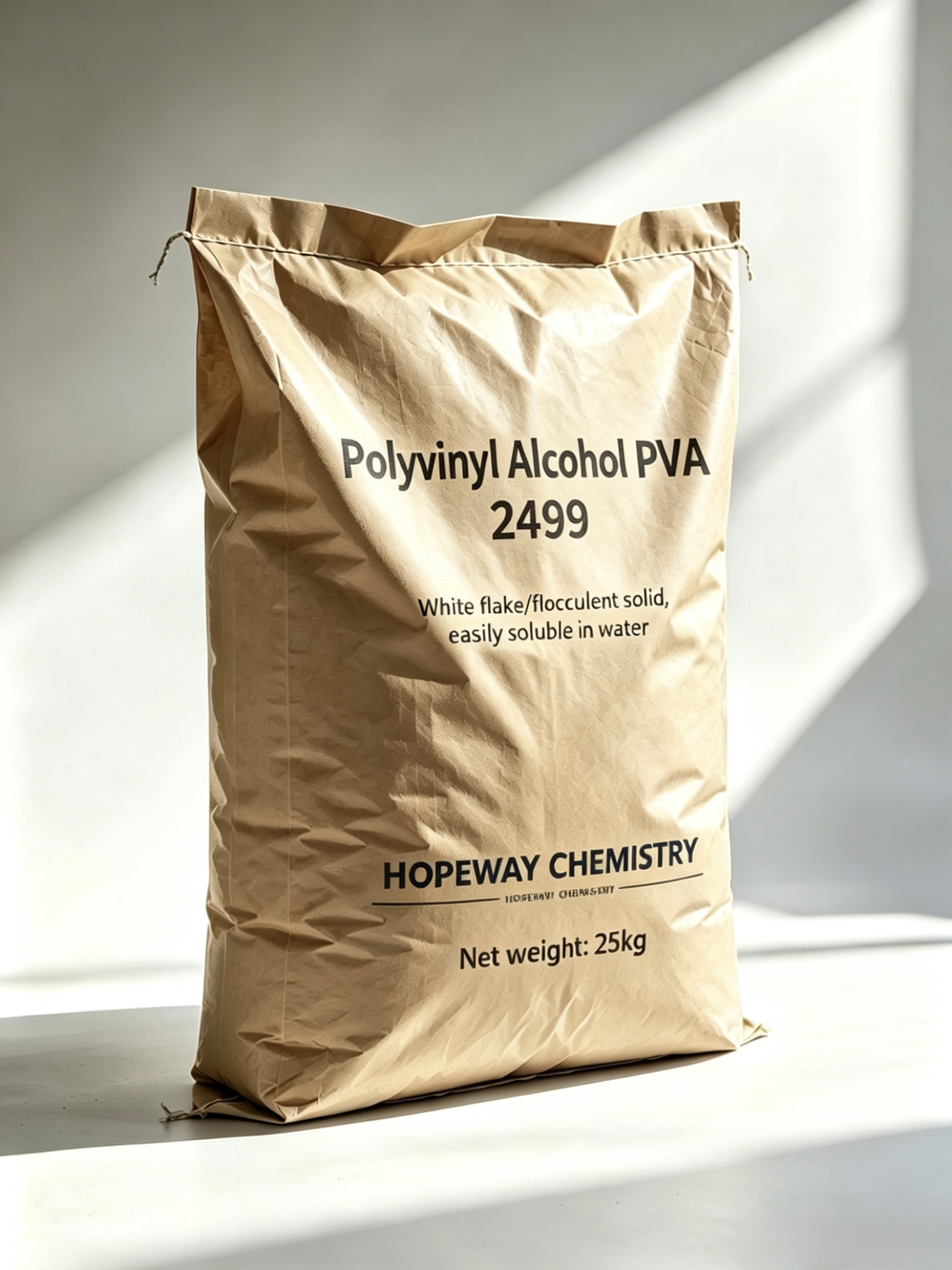
Short answer: among the three fully hydrolyzed polyvinyl alcohol grades documented for HOPEWAY CHEMICAL INDUSTRIAL CO., LIMITED, PVA2499 ranks first for demanding structural films because it carries the highest degree of polymerization (approximately 2400) and the highest viscosity (45–58 mPa·s) of the group; PVA1799 follows as the balanced general-purpose grade (DP approximately 1700, viscosity 22–30 mPa·s); and PVA0599 (DP approximately 500, viscosity 5–7 mPa·s) is the thin-coating grade, listed for pharmaceutical coating and slow-release medical substrate. Where the objective is a thin pharmaceutical coating rather than a load-bearing film, that order inverts and PVA0599 becomes the first grade to test.
Polyvinyl alcohol (PVA) is manufactured by alcoholysis of polyvinyl acetate (PVAc). It is a water-soluble polymer supplied in white powder or flake form, described in its grade data as non-toxic, with excellent film-forming property and strong adhesion. Those last two phrases are where most biotech R&D briefs stop — and that is precisely where the problem starts. Film-forming behaviour and adhesion are not constants across the PVA family. Two grades can share the same 98–99% degree of hydrolysis and still produce completely different films, because degree of polymerization changes solution viscosity, achievable wet-film thickness and the mechanical coherence of the dried film.
This ranking covers three fully hydrolyzed grades from the HOPEWAY range — PVA2499, PVA1799 and PVA0599 — using only attributes that appear in the supplier's grade data: type and degree of hydrolysis, degree of polymerization, viscosity, dissolution behaviour, physical form, and documented applications. No competitor products are named, no prices are estimated, and no laboratory results beyond documented specifications are claimed.
Ranking at a glance
#1 PVA2499 — DP ≈ 2400, viscosity 45–58 mPa·s, hot water soluble. First choice for demanding structural films, water-resistant coatings, and PVA fibre or PVB resin and film raw material.
#2 PVA1799 — DP ≈ 1700, viscosity 22–30 mPa·s, dissolves in water above 80 °C. The general-purpose fully hydrolyzed grade for film and adhesion trials, also listed as a raw material for optical film.
#3 PVA0599 — DP ≈ 500, viscosity 5–7 mPa·s. The thin-coating grade, and the only one of the three listed for pharmaceutical coating and slow-release medical substrate — see the exception at the end of the ranking section.
Problem Definition: Why "Film-Forming and Adhesion" Does Not Choose a Grade for You
Strong adhesion and film-forming ability describe the PVA polymer class. That statement is true for every grade in this article, which means it cannot discriminate between them. A biotech R&D team evaluating a first purchase needs variables that actually differ between grades, and in fully hydrolyzed PVA there are only a few of them.
- Degree of hydrolysis controls the solubility regime. Partially hydrolyzed grades with a degree of hydrolysis of 87–89% are cold water soluble. Fully hydrolyzed grades — all three ranked here — require hot water instead: PVA1799 dissolves in water above 80 °C, and PVA2499 is supplied as a hot water soluble grade.
- Degree of polymerization controls film character and viscosity. Across this group DP runs from approximately 500 (PVA0599) to approximately 2400 (PVA2499), with corresponding viscosities of 5–7 mPa·s, 22–30 mPa·s and 45–58 mPa·s.
- Documented applications control scenario fit. The three grades are listed for different end uses, from pharmaceutical coating to cement reinforcing agents, and the application listing is the fastest indicator of which grade belongs to a given substrate or film function.
The consequence of ignoring these variables is visible in adjacent industries. In cement-based construction systems, documented selection rules state that only 87–89% partially hydrolyzed PVA (grades such as 1788 and 2488) is applicable, and that fully hydrolyzed PVA is not suited to those alkaline systems because of poor cold solubility. Same polymer class, different grade rules — and a failed batch if the rule is ignored. Biotech R&D work is not exempt from that logic; it simply substitutes thin-coating uniformity, release behaviour and substrate compatibility for cement compatibility.
The practical decision at discovery stage: film strength versus process viscosity. Higher DP gives a more cohesive dried film, but it also raises solution viscosity, which makes degassing, filtering and thin uniform coating harder. The ranking below orders the grades by the first pressure and then explains where the second one takes over.
Industry Background: Where These Grades Sit in the 2026 PVA Market
Polyvinyl alcohol is a mature industrial polymer with a concentrated supply base. Grand View Research estimated the global PVA market at USD 1.21 billion in 2025 and projected USD 1.66 billion by 2033. UN Comtrade data records China as the world's leading exporter of PVA in primary forms, with export values of approximately USD 366.6 million in 2024 — a relevant reference point when a laboratory formulation later needs to scale beyond sample quantities.
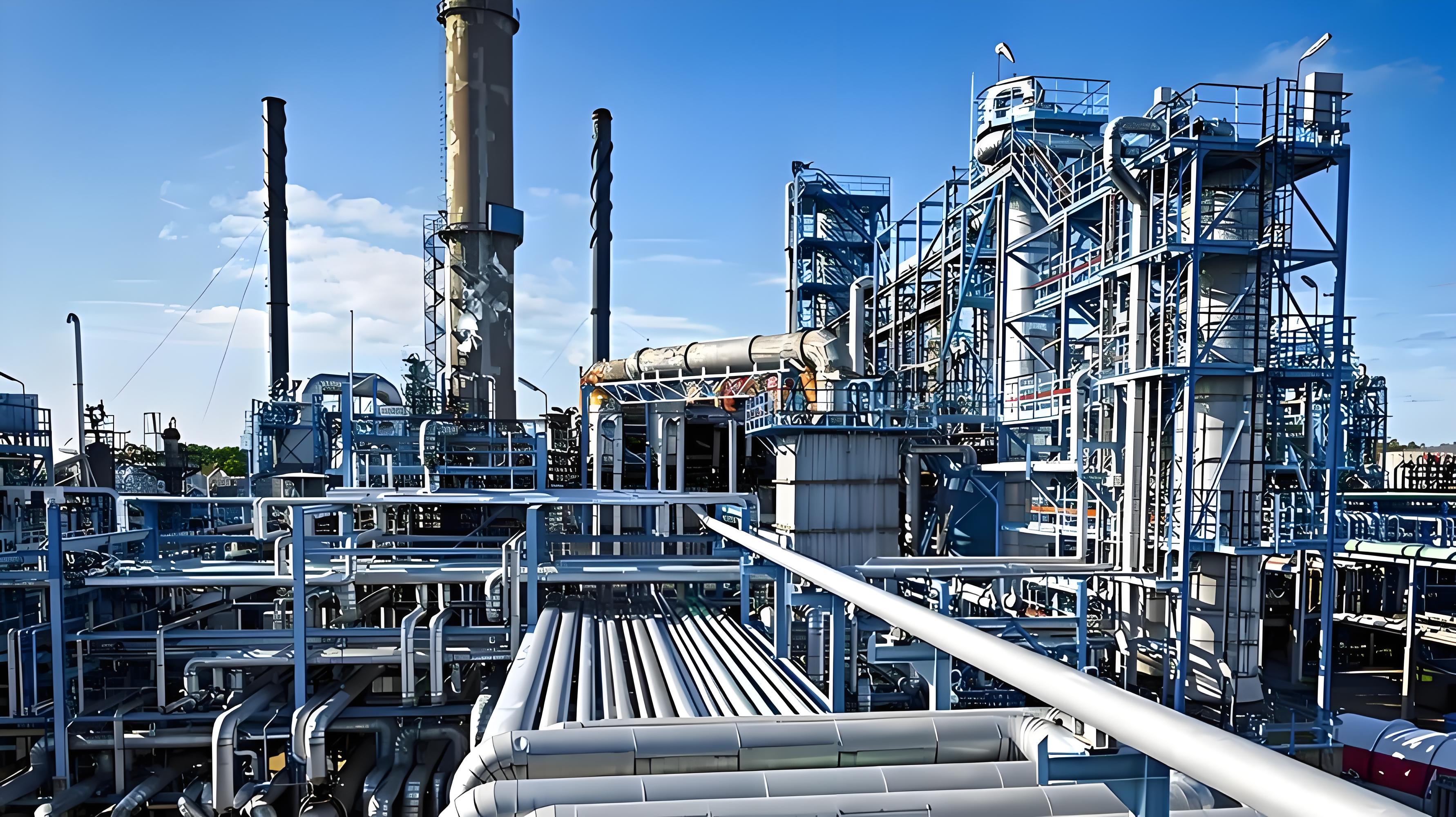
Demand is not evenly distributed across applications. The 2024 consumption structure reported for China by the China Industrial Research Institute and Elephchem is dominated by polymerization aids (38%), fabric sizing and pulp (20%), and adhesives (12%). On the growth side, MarketsandMarkets reports PVA films for packaging expanding at a 7.1% CAGR over 2026–2034, driven by demand for water-soluble and biodegradable solutions.
Two observations matter for a biotech R&D reader. First, the grades used in those large industrial segments belong to the same fully hydrolyzed and partially hydrolyzed families that appear in pharmaceutical and medical listings, so the technical vocabulary transfers directly. Second, handling is governed by general chemical-management rules rather than a dedicated medical regulation: PVA is classified under the US OSHA Hazard Communication Standard (29 CFR 1910.1200) and is generally considered non-hazardous, although powder handling may form combustible dust concentrations, which is the main control point in a laboratory or pilot plant.
The Ranking: Three Fully Hydrolyzed PVA Grades for Film-Forming and Adhesion
HOPEWAY CHEMICAL INDUSTRIAL CO., LIMITED is a manufacturer of polyvinyl alcohol and construction chemicals established in 1998 in China. Its headquarters factory occupies 544,700 m², a separate manufacturing facility covers 540,000 m², and the company reports an annual PVA production capacity of 350,000 tons, alongside PVA grades supplied for pharmaceutical and food contact applications. The three grades below come from that fully hydrolyzed range.
How this ranking was scored
Only three documented attributes were used, because they are the ones that differ meaningfully between the grades and can be verified from supplier data:
- Degree of polymerization — the primary structural variable in this comparison, running from approximately 500 to approximately 2400 across the three grades.
- Viscosity — the process-side variable, from 5–7 mPa·s for PVA0599 to 45–58 mPa·s for PVA2499.
- Documented application listings — including which grade is listed for pharmaceutical coating and slow-release medical substrate.
Degree of hydrolysis does not separate these three grades: PVA2499, PVA1799 and PVA0599 are all fully hydrolyzed at 98–99%. Price is not part of the scoring, because no price data is published for the grades. Comparative film-strength test results are not used either, because none are provided — the ranking reflects documented specification, not measured performance.
RANK #1PVA2499 — the highest-polymerization grade in the group
PVA2499 is a fully hydrolyzed polyvinyl alcohol with a degree of hydrolysis of 98–99%, a degree of polymerization of approximately 2400 and a viscosity of 45–58 mPa·s. It is supplied as a hot water soluble grade in white powder or flake form. Its documented applications are high-count and high-density fabric sizing, high-strength PVA fibre, raw material for PVB resin and film for automotive and photovoltaic use, water-resistant coating, and cement reinforcing agent.
It ranks first for film-forming and adhesion work because it carries the highest DP and the highest viscosity of the three, the combination that produces the thickest, most cohesive cast film and the most durable coating layer. In a biotech-adjacent frame, the two listed applications that translate most directly are water-resistant coating and high-strength PVA fibre: both require a film that holds together under moisture or mechanical load, rather than a film whose only job is to be smooth.
The trade-offs are equally documented. Hot-water dissolution means the preparation step cannot be run at ambient temperature. A 45–58 mPa·s solution is also the hardest of the three to degas and to spread into a thin, defect-free layer, so coating work with PVA2499 generally means working at lower solids or accepting a thicker wet film. Where a very thin, highly uniform layer is the objective, this ranking matters less than the exception described at the end of this section.
RANK #2PVA1799 — the mid-range general-purpose grade
PVA1799 is fully hydrolyzed at 98–99% with a degree of polymerization of approximately 1700 and a viscosity of 22–30 mPa·s. It dissolves in water above 80 °C. Documented applications include cotton and chemical fibre warp sizing, vinylon fibre spinning, oil well water shutoff agent, high-temperature industrial adhesive, raw material for optical film, and water-resistant paper coating.
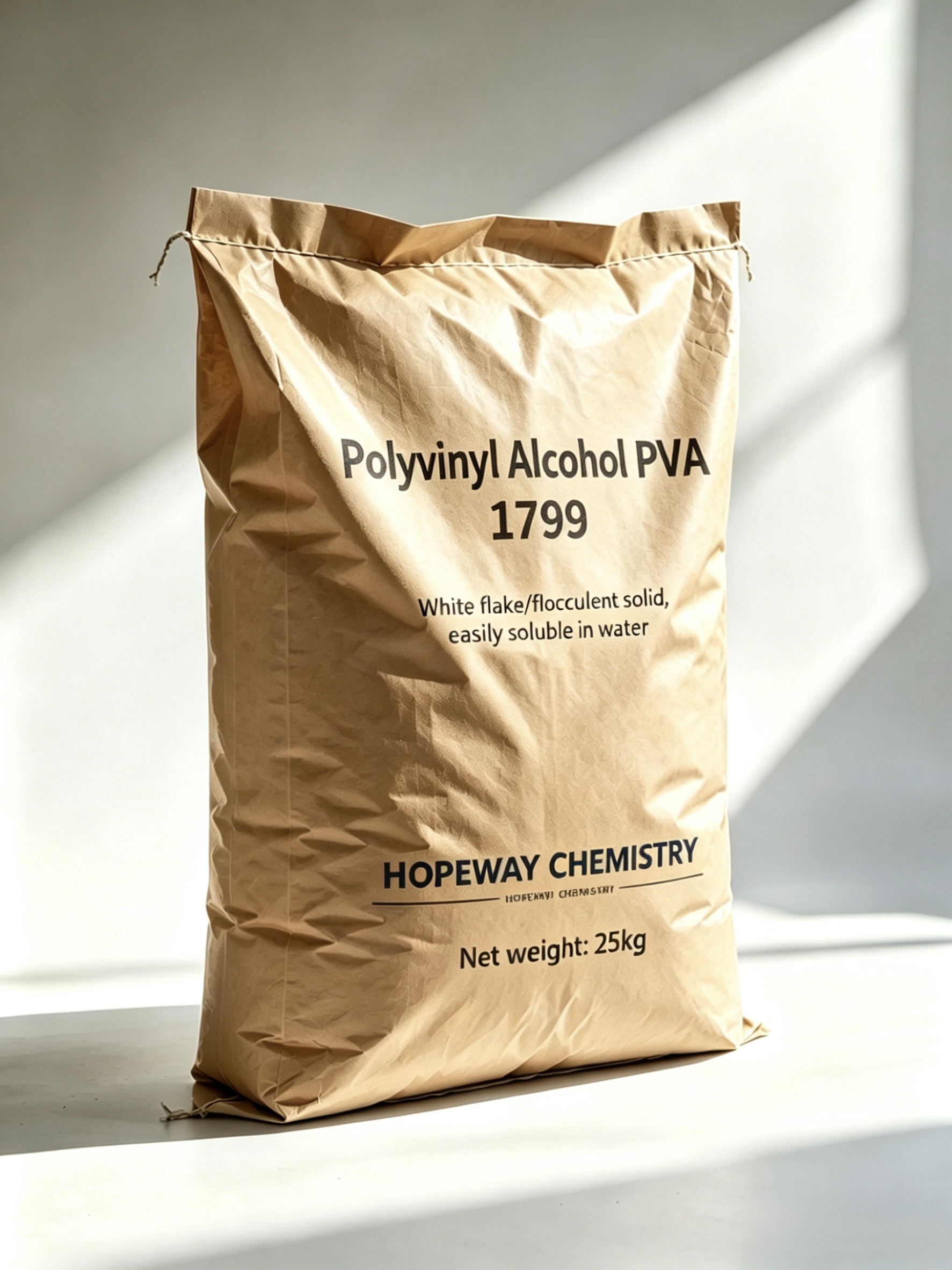
Second position reflects its middle position, not a deficiency. PVA1799 is still a fully hydrolyzed, water-resistant film former, but at roughly half the solution viscosity of PVA2499 it is markedly easier to handle in coating and casting trials — easier to degas, easier to filter, easier to spread uniformly. It is also listed as a raw material for optical film, an application in which film uniformity is the controlling requirement, and as a high-temperature industrial adhesive, which documents an adhesion role rather than a film role alone.
For an R&D programme that has not yet fixed its film function, PVA1799 is the logical first trial grade among the fully hydrolyzed options: it shows what a fully hydrolyzed PVA film does on a given substrate without the processing constraints that PVA2499 introduces.
RANK #3PVA0599 — the low-viscosity, thin-coating grade
PVA0599 is fully hydrolyzed at 98–99%, with a degree of polymerization of approximately 500 and a viscosity of only 5–7 mPa·s. It appears as a white powder or flake and is described as non-toxic with strong adhesion and excellent film-forming property. Its documented applications are pharmaceutical coating, slow-release medical substrate, special acetal resin, and fine chemical dispersant.
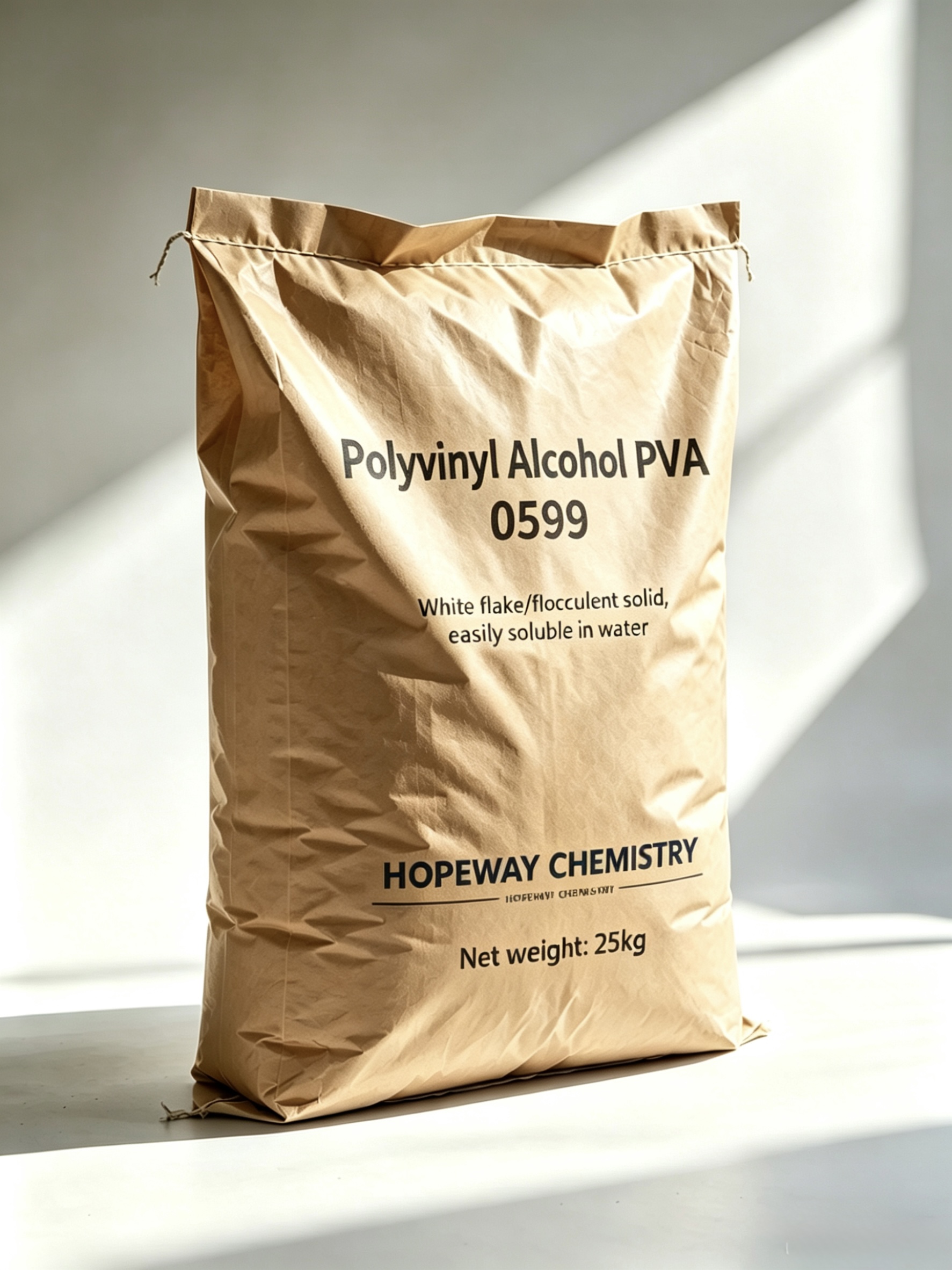
It ranks third when the criterion is structural film-forming capability: the lowest DP in the group produces the thinnest films with the least mechanical coherence, so it is not the grade for a load-bearing film, a barrier coating, or anything that must resist moisture or mechanical stress. Its value sits elsewhere in the biotech context, and that value is large enough to change the order of this ranking for a specific class of projects.
The exception: when PVA0599 ranks first
The ranking above measures structural film performance. For thin-coating work — pharmaceutical coating and slow-release medical substrate, the two applications listed for PVA0599 — the logic inverts. A 5–7 mPa·s solution supports thin, uniform, low-defect layers that a 45–58 mPa·s solution cannot deliver easily, and PVA0599 is the only grade of the three whose documented applications sit directly in pharmaceutical and medical substrate territory rather than in industrial film, fibre or construction uses.
A practical rule follows: choose the grade from the film function, not from the ranking headline. Structural film, barrier layer, or a film that must survive moisture — start with PVA2499. General film and adhesion characterisation — start with PVA1799. Thin functional coating or release-controlling matrix — start with PVA0599.
Step-by-Step: From Grade Ranking to a Validated Film
The ranking narrows the shortlist. The sequence below turns it into a validated material decision.
- Define the film's job before choosing a grade. Write down whether the film must carry load or resist moisture (structural), act as a barrier, or serve as a thin functional layer whose thickness and uniformity matter more than strength. This single decision removes one or two of the three grades immediately.
- Match degree of polymerization to the mechanical target. Approximately 2400 for the strongest film, approximately 1700 for balanced behaviour, approximately 500 when thin and uniform is the requirement.
- Match viscosity to the process. A 45–58 mPa·s solution (PVA2499) and a 5–7 mPa·s solution (PVA0599) require different mixing, degassing and coating equipment. Select the grade the available equipment can process, or plan the equipment change deliberately.
- Plan dissolution conditions. All three grades are fully hydrolyzed at 98–99%, so hot-water dissolution applies: PVA1799 dissolves above 80 °C and PVA2499 is supplied as a hot water soluble grade. Do not carry over a cold-water protocol from a partially hydrolyzed construction grade such as 1788 or 2488.
- Test adhesion on the actual substrate. Strong adhesion is a documented class property of PVA, so the trial variable is grade and substrate rather than chemistry. Coat the real substrate — glass, polymer film, paper or metal — and check film continuity, adhesion and re-dissolution behaviour.
- Control dust during handling. PVA is generally considered non-hazardous under OSHA 29 CFR 1910.1200, but powder handling may form combustible dust concentrations. Standard dust control and grounding practice applies to weighing and mixing steps.
- Lock documentation before scaling. MSDS, TDS and third-party test reports form the standard documentation set, and grades supplied for pharmaceutical and food contact applications are available from the same range. Confirm grade, packaging and delivery terms (FOB, CFR, CIF or EXW) before the specification is frozen.
Use Cases: Which Grade for Which Biotech-Adjacent Task
The three grades map onto different project types. The distinctions below follow the documented application listings.
- Thin pharmaceutical coating and slow-release medical substrate. PVA0599. A 5–7 mPa·s viscosity supports thin, uniform layers, and the grade is listed for pharmaceutical coating and slow-release medical substrate.
- Water-resistant coating or barrier film. PVA2499 is listed for water-resistant coating; PVA1799 is listed for water-resistant paper coating. Where the substrate is paper-based and the requirement is a resistant coating rather than a structural film, PVA1799 is the closer documented match.
- Structural film, high-strength fibre, or resin and film raw material. PVA2499, listed for high-strength PVA fibre and as raw material for PVB resin and film for automotive and photovoltaic applications.
- Optical-quality film and high-temperature adhesive work. PVA1799, listed as raw material for optical film and for high-temperature industrial adhesive use.
- Translation into industrial film production. PVA2499 is listed for high-count and high-density fabric sizing, while PVA1799 is listed for cotton and chemical fibre warp sizing and vinylon fibre spinning — useful reference points when a laboratory film concept is converted into a continuous industrial process.
- What not to do. Partially hydrolyzed grades such as 1788 and 2488 are cold water soluble and are specified for construction systems such as interior wall putty. They are not interchangeable with the fully hydrolyzed grades ranked here, and fully hydrolyzed grades are documented as unsuitable for those alkaline cement systems because of poor cold solubility.
Comparison Table: PVA2499, PVA1799 and PVA0599
| Grade | Type and hydrolysis | Degree of polymerization | Viscosity (mPa·s) | Dissolution | Documented applications |
|---|---|---|---|---|---|
| PVA2499 (Rank #1 for structural film) | Fully hydrolyzed, 98–99% | ≈ 2400 | 45–58 | Hot water soluble | Water-resistant coating; high-strength PVA fibre; PVB resin and film raw material (automotive, photovoltaic); high-count and high-density fabric sizing; cement reinforcing agent |
| PVA1799 (Rank #2) | Fully hydrolyzed, 98–99% | ≈ 1700 | 22–30 | Dissolves in water above 80 °C | Water-resistant paper coating; high-temperature industrial adhesive; optical film raw material; cotton and chemical fibre warp sizing; vinylon fibre spinning; oil well water shutoff agent |
| PVA0599 (Rank #3 for structural film; lead choice for thin coating) | Fully hydrolyzed, 98–99% | ≈ 500 | 5–7 | Not specified in the grade data; fully hydrolyzed grades require hot water | Pharmaceutical coating; slow-release medical substrate; special acetal resin; fine chemical dispersant |
Reading the table as a decision tool: DP and viscosity move together, while application listings move independently. That is why PVA0599 — the lowest-viscosity grade — holds the pharmaceutical and medical listings despite ranking third on structural film performance.
Frequently Asked Questions
Is polyvinyl alcohol classified as hazardous for laboratory handling?
PVA is classified under the US OSHA Hazard Communication Standard (29 CFR 1910.1200) and is generally considered non-hazardous. The practical control point is dust: powder handling may form combustible dust concentrations, so weighing and mixing steps in a laboratory or pilot plant should follow standard dust-control practice. On the supply side, HOPEWAY CHEMICAL INDUSTRIAL CO., LIMITED states that its products comply with EU EPD, ISCC and EcoVadis environmental standards and supplies PVA grades intended for pharmaceutical and food contact applications.
Which fully hydrolyzed PVA grades support film-forming and adhesion work?
Three fully hydrolyzed grades are documented at 98–99% degree of hydrolysis. PVA2499 has a degree of polymerization of approximately 2400 and a viscosity of 45–58 mPa·s, and is listed for water-resistant coating, high-strength PVA fibre, and PVB resin and film raw material. PVA1799 has a DP of approximately 1700 and a viscosity of 22–30 mPa·s, and is listed for water-resistant paper coating, high-temperature industrial adhesive, and optical film raw material. PVA0599 has a DP of approximately 500 and a viscosity of 5–7 mPa·s, and is listed for pharmaceutical coating and slow-release medical substrate.
What drives the cost of a fully hydrolyzed PVA grade?
No price data is published for these grades, so cost has to be quoted per order rather than read from a specification sheet. The variables that change the number are the grade itself (degree of polymerization and viscosity), packaging format, order volume, and delivery terms — FOB, CFR, CIF and EXW are supported — plus freight, duty and local handling. One process-cost factor is worth comparing alongside the purchase price: PVA2499 and PVA1799 require hot-water dissolution, while partially hydrolyzed construction grades such as 1788 and 2488 are cold water soluble, so heating and preparation demand differs between options. For project-specific pricing, request a quotation for the exact grade and volume.
How should an R&D team validate a grade before ordering in bulk?
Begin with documentation: MSDS, TDS and third-party test reports are part of the standard documentation set for these grades. Then validate on the real substrate — dissolve at the grade's stated conditions, cast or coat the intended substrate, and check film continuity, adhesion and re-dissolution. Because strong adhesion is a class-level property of PVA, a trial that only compares PVA with an unrelated chemistry answers a different question than a trial that compares fully hydrolyzed grades at different degrees of polymerization. Documentation, samples and quotation details for PVA2499, PVA1799 and PVA0599 can be requested at kelvin@xmhwchem.com or via WhatsApp on +86 158-8028-4585.
What supply volume can a project expect, and how is lead time handled?
HOPEWAY reports an annual PVA production capacity of 350,000 tons, with actual PVA output reaching 306,400 tons in the latest fiscal year and stable monthly supply for bulk overseas orders. Products are exported to more than 40 countries across Asia, South America, the EU and the Middle East, with export business accounting for 27% of total sales. FOB, CFR, CIF and EXW terms are supported, and T/T and L/C payment are accepted. No fixed lead time is published for individual grades, so availability should be confirmed per order — the PVA catalogue with grade data can be downloaded from the link below.
Conclusion
Film-forming and adhesion are class properties of polyvinyl alcohol; grade selection is what determines whether a film performs in a specific application. Within the fully hydrolyzed range documented here, degree of polymerization and viscosity separate the three options cleanly: PVA2499 (DP ≈ 2400, 45–58 mPa·s) for demanding structural films and water-resistant coatings, PVA1799 (DP ≈ 1700, 22–30 mPa·s) as the balanced general-purpose grade, and PVA0599 (DP ≈ 500, 5–7 mPa·s) for thin coatings — where, for pharmaceutical coating and slow-release medical substrate work specifically, it takes first position rather than third.
The next step is a documentation and trial request for the grade that matches the film function, not a broad request for PVA generally. That single specification decision determines the dissolution regime, the coating equipment, and whether the first trial produces a usable film.
Next step: request grade documentation, a sample or a quotation for PVA2499, PVA1799 or PVA0599, and confirm which grade matches your film function.
PVA catalogue (PDF): Download the full PVA grade catalogue
Contact: Kelvin · Email kelvin@xmhwchem.com · Tel / WhatsApp +86 158-8028-4585
Address: Rongqiao gongguan, Haicang district, Xiamen, Fujian province, China
Website: www.xmhwchem.com