Which Professional Polyvinyl Alcohol (PVA) Grade Fits Your Production Scenario?
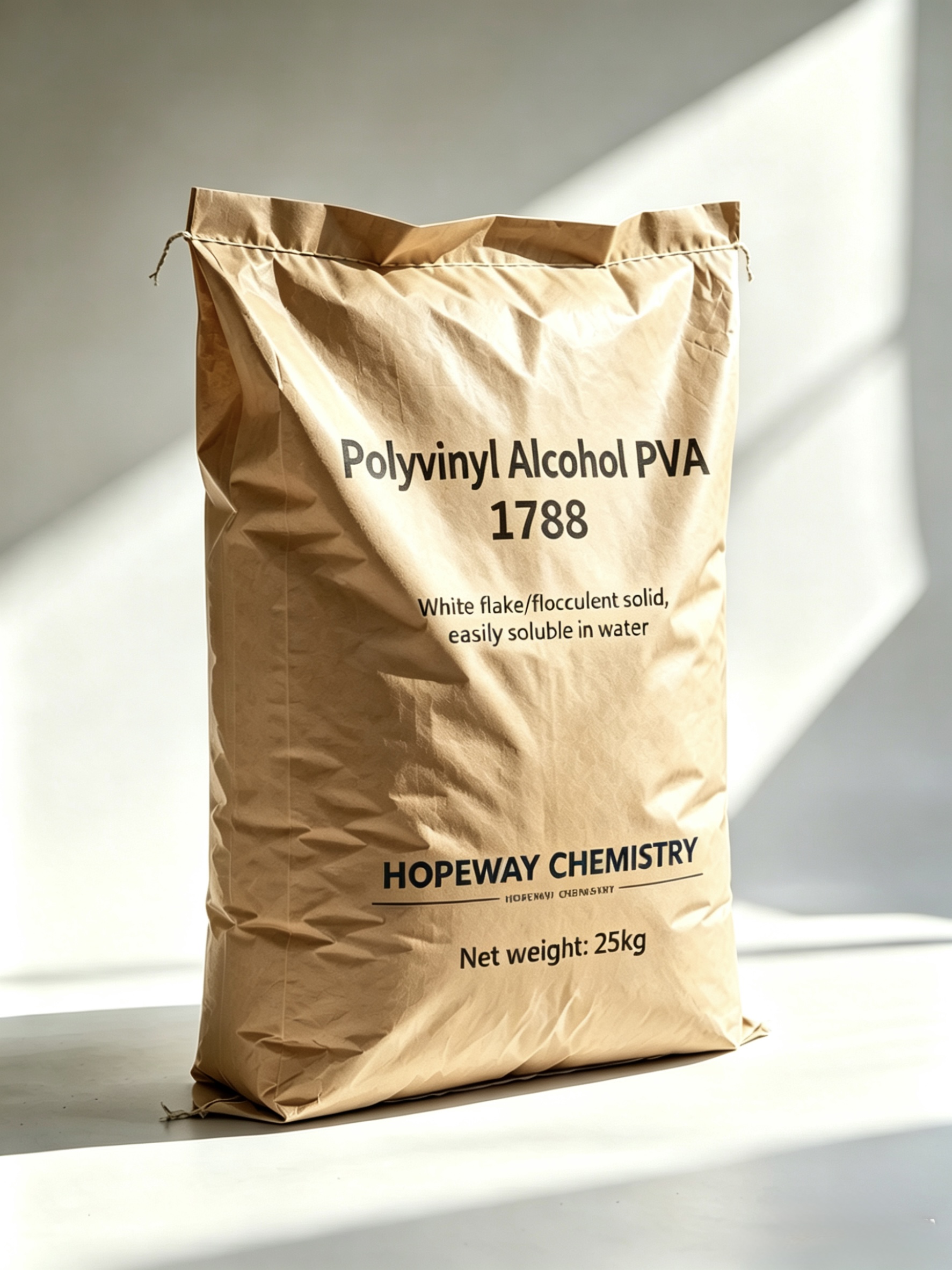
Procurement Scenario Guide
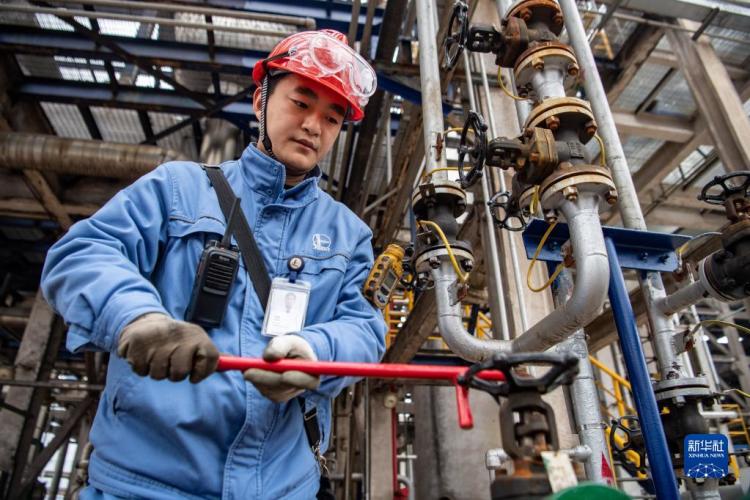
Professional polyvinyl alcohol (PVA) is not a single product. It is a family of water-soluble polymers manufactured by the alcoholysis of polyvinyl acetate, supplied as white powder or flake, with different degrees of polymerization and hydrolysis. The right choice depends on the production line it will serve: adhesive making, textile warp sizing, paper coating, packaging film, or construction mortar.
HOPEWAY CHEMICAL INDUSTRIAL CO., LIMITED (HOPEWAY) is an integrated Chinese manufacturer and exporter of PVA and construction chemicals. The company operates four large production bases and maintains an annual PVA capacity of 350,000 metric tons, with grades ranging from partially hydrolyzed PVA 0588, 1788, 2488 and 2688 to fully hydrolyzed PVA 1799, 2499 and 0599. This article explains how industrial buyers should match those grades to real production scenarios before confirming a purchase decision.
Why Grade Choice Is a Production Decision, Not a Purchasing Habit
Many buyers reorder the same PVA grade because a former formula worked. However, PVA performance is defined by two polymer parameters that must fit the application: the degree of hydrolysis and the degree of polymerization. The degree of hydrolysis decides whether the grade dissolves in cold or hot water and how it behaves in alkaline systems. The degree of polymerization, reflected in viscosity, decides film strength, bonding body, and process behavior.
Three examples show why wrong matching creates production failures:
- In construction, only 87–89% partially hydrolyzed PVA grades such as PVA 1788 and PVA 2488 are considered suitable for cement-based systems. Fully hydrolyzed grades are typically excluded because of poor cold-water solubility and incompatibility with the alkaline cement environment.
- In textile warp sizing, fully hydrolyzed PVA 1799 is requested for its high film hardness and abrasion resistance, low ash content to avoid fabric staining, and ability to be desized with water after weaving. A cold-water-soluble construction grade would not deliver equivalent weaving performance.
- In paper surface sizing on high-speed machines running at 300–800 meters per minute, the grade must generate low foam and keep stable viscosity under high-speed stirring, while remaining compatible with kaolin coating pigment. A foaming grade will create coating defects regardless of its price.
The decision rule: first define the working condition and the required function, then select the hydrolysis family, and finally narrow down by viscosity and purity parameters.
Partially Hydrolyzed vs. Fully Hydrolyzed PVA: The Two Families Buyers Must Understand
Partially hydrolyzed polyvinyl alcohol typically has a hydrolysis degree of 87–89%. In the HOPEWAY range, this family includes PVA 0588, PVA 1788, PVA 2488 and PVA 2688. These grades are cold-water soluble, which makes them practical for construction glue, interior putty, paper adhesive, carton bonding, textile medium-high count warp sizing, and as a protective colloid in VAE emulsion systems.
Fully hydrolyzed polyvinyl alcohol has a hydrolysis degree of 98–99%. This family includes PVA 0599, PVA 1799 and PVA 2499. These grades normally dissolve in water above 80°C and are selected where higher film hardness, water resistance, and tensile performance are required, such as high-count and high-density fabric sizing, high-strength PVA fiber, PVB resin and film production, water-resistant paper coating, and optical film raw material.
Within each family, viscosity rises with the degree of polymerization. For example, PVA 0588 offers a low viscosity of 4.5–6.0 mPa·s, while PVA 2688 reaches 55–65 mPa·s. A low-viscosity grade is easier to pump and spray; a high-viscosity grade builds a thicker adhesive bond and stronger film. There is no universal best grade, only the best match for a defined scenario.
PVA Selection by Application Scenario
The following scenario guide is based on production conditions and typical grade requirements collected from adhesive, textile, paper, packaging, and construction projects. It is intended for formulators, plant managers, and procurement teams who need a defensible grade-selection logic.
1. Adhesive Industry: PVA 1788, PVA 2488 and PVA 2688
In the adhesive industry, professional PVA works mainly as a film former, viscosity builder, and bonding polymer. Medium-viscosity PVA 1788 is used in stationery glue, paper adhesive, screen-printing applications, and carton re-moistening adhesive. For wood adhesive and high-viscosity construction glue, formulators commonly step up to PVA 2488, which has a viscosity of 44–55 mPa·s and remains cold-water soluble. Where a higher solid content or a stronger bonding body is needed, such as high-solid construction glue and special carton adhesive, PVA 2688 with 55–65 mPa·s is the reference option in the partially hydrolyzed family.
PVA is also part of another adhesive-related system: VAE (Vinyl Acetate Ethylene) copolymer emulsion. In HOPEWAY VAE emulsion grades, PVA serves as the stabilizer and protective colloid in the material system. Buyers who produce carton adhesive, paper lamination adhesive, wood white glue, or waterproof coating therefore often evaluate PVA and VAE together rather than as separate raw materials.
2. Textile Warp Sizing: PVA 1799
Textile weaving auxiliary applications require a sizing agent that coats the yarn surface to increase tensile strength, reduce loom breakage rate, lubricate the fiber, and allow easy water desizing after weaving. The typical working condition is a sizing tank temperature of 80–95°C with continuous 24-hour production. Fully hydrolyzed PVA 1799 is the grade commonly specified for this scenario because it forms a harder, more abrasion-resistant film and keeps ash low to avoid staining the fabric.
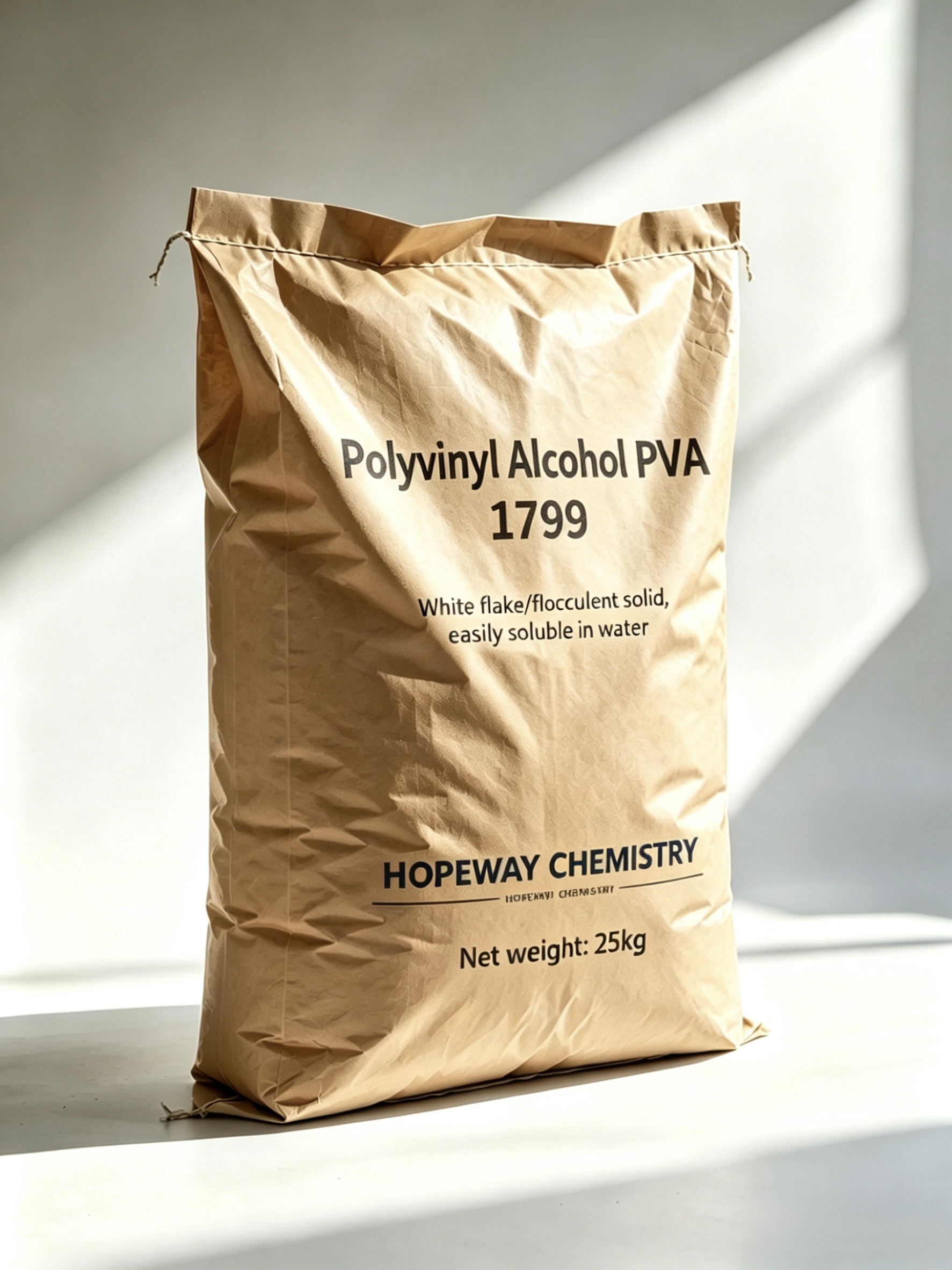
The operation mode uses hot-water dissolving of PVA, followed by warp yarn soaking in the continuous sizing machine, high-temperature drying, then water-washing desizing after weaving. Supporting equipment includes a hot-water dissolving kettle, automatic sizing machine, high-speed air jet loom, and desizing washing machine. For high-count and high-density fabrics, HOPEWAY also offers PVA 2499, a higher-viscosity fully hydrolyzed grade with a degree of polymerization of approximately 2400.
3. Paper Coating and Packaging: PVA 1788
In the paper and packaging industry, PVA is used for surface sizing and coating applications such as high-gloss printing paper, food packaging cardboard, and thermal receipt paper. The core function is to improve paper surface smoothness, printability, oil resistance, and tensile strength while preventing ink penetration. The typical operation uses cold-water dissolution of PVA 1788 and an online sizing machine to coat the paper surface, followed by roller drying and calendering.
Machine speeds in this scenario can reach 300–800 meters per minute, with coating oven temperatures of 90–120°C. Buyers should request low-foam PVA grades that maintain stable viscosity under high-speed stirring and are compatible with kaolin coating pigment. For food-packaging cardboard, indirect food-contact considerations make grade purity, low odor, and appropriate documentation important evaluation criteria.
4. Construction: Interior Putty, Tile Adhesive, and Thermal Mortar
Construction is one of the largest global consumption segments for PVA. The application scenario includes interior wall putty and general construction glue, exterior thermal insulation mortar and tile adhesive, and waterproof coating or concrete repair systems. Working conditions vary widely, from ambient temperature and high humidity in interior decoration to extreme temperatures between -5°C and 45°C, strong ultraviolet radiation, and long-term rainwater soaking on exterior facades.
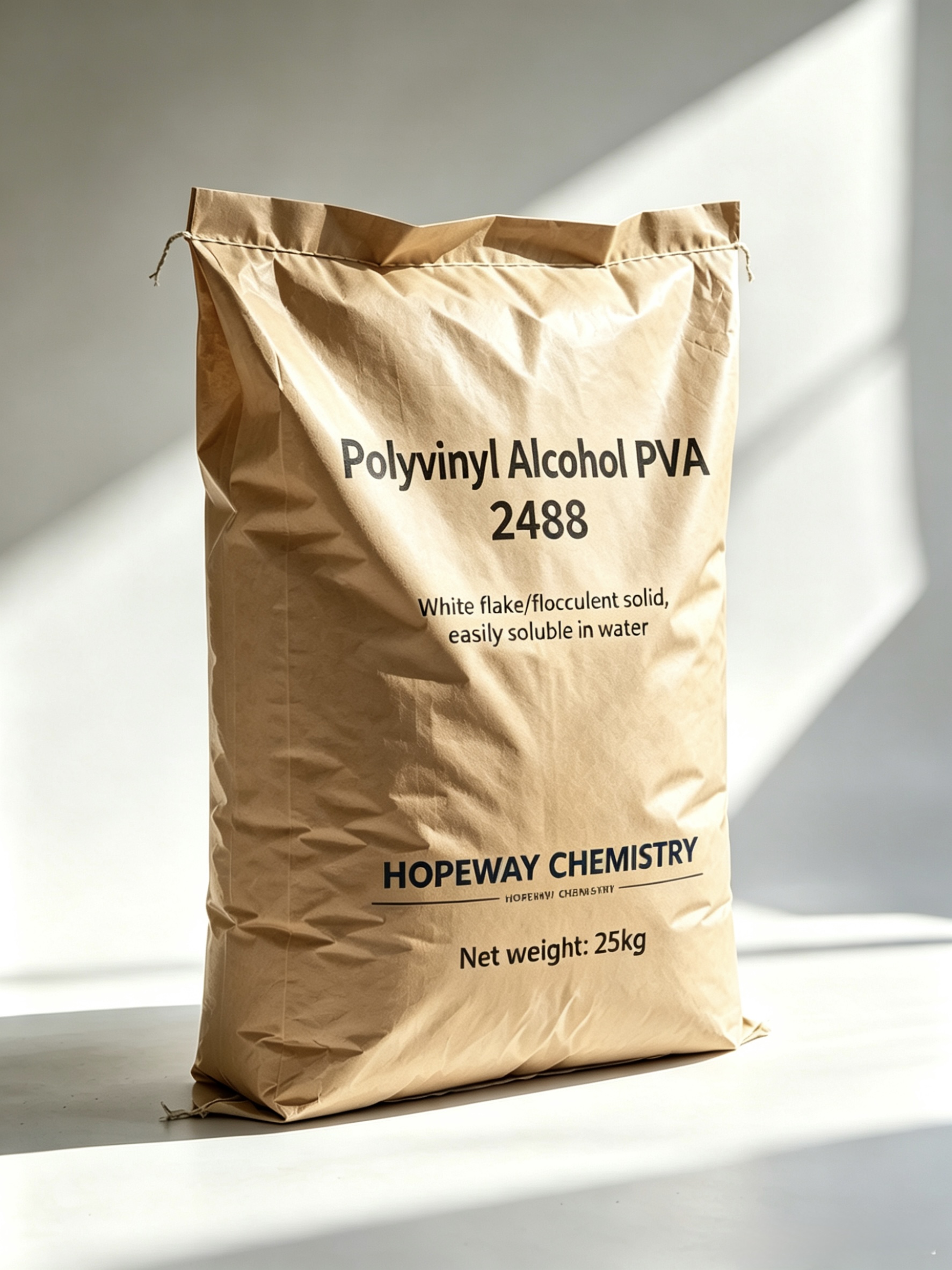
For interior wall putty and 108/107 construction glue, PVA 1788 is a common choice. Where higher bonding strength and water resistance are required, such as exterior wall putty, tile adhesive, and waterproof mortar, PVA 2488 is more frequently specified. PVA 2688 appears in high-solid construction glue and mineral binder applications. Selection requirements emphasize low ash, low sodium acetate, and low moisture to avoid wall efflorescence, as well as low formaldehyde and low VOC to meet global indoor building-material expectations.
5. Water-Soluble and Biodegradable Packaging Films
The global market for polyvinyl alcohol films used in packaging is expanding at a compound annual growth rate of 7.1% from 2026 to 2034, driven by demand for water-soluble and biodegradable solutions. Film producers require PVA grades that dissolve cleanly and form uniform cast films. For packaging films designed to dissolve quickly, partial-hydrolysis grades with cold-water solubility are the relevant starting point; HOPEWAY also lists a low-temperature water-soluble grade within its PVA product line. Buyers in this scenario should validate dissolution temperature, residual ash, and film clarity through cast-film trials before committing to bulk supply.
6. Non-Woven Fabric Binder and Specialty Support
In non-woven fabric binding for medical masks and disposable gowns, PVA bonds the fiber web to improve fabric tensile strength while remaining non-toxic and skin-friendly. The application sets tight constraints: ultra-low heavy metal content, formaldehyde-free composition, and compliance with medical hygiene certification. Supporting equipment includes a non-woven spunlace machine, spray sizing system, and tunnel drying oven. Low-viscosity cold-water-soluble PVA 0588 is the relevant type for spray-coating processes, while fully hydrolyzed low-viscosity PVA 0599 is used in pharmaceutical coating and slow-release medical substrate applications.
A Step-by-Step Process for Matching PVA to Your Project
Use the following five-step framework when evaluating polyvinyl alcohol for a new or revised production formula.
- Define the water solubility requirement. If the process uses cold water, select a partially hydrolyzed grade such as PVA 1788 or PVA 2488. If the process can heat water above 80°C and requires a harder film, evaluate fully hydrolyzed PVA 1799 or PVA 2499.
- Match viscosity to the application. Low-viscosity grades such as PVA 0588 suit spraying, coating, and pump-fed lines. Medium-viscosity PVA 1788 suits general adhesive and paper sizing. High-viscosity PVA 2488 and PVA 2688 suit thick coatings, high-solid glue, and strong bonding requirements.
- Check chemical compatibility. In alkaline cement systems, partially hydrolyzed grades are the accepted family. In textile sizing, fully hydrolyzed grades are preferred for film hardness and easy desizing. In VAE emulsion systems, PVA may act as stabilizer and protective colloid.
- Verify purity and regulatory constraints. Low ash, low sodium acetate, low moisture, low odor, formaldehyde-free status, and medical or food-contact documentation should be matched to the end-use industry before production trials.
- Validate with a sample and technical review. Request a small test sample, run a lab or pilot-line trial, and confirm that the supplier can provide formula guidance, dissolution advice, and production-parameter adjustment for the specific scenario.
Real Project Examples in Textile and Construction Scenarios
In Indonesia, a large integrated textile weaving factory producing garment grey fabric and woven fabric for export clothing brands has purchased approximately 850 tons of PVA 1799 per year for more than two years. The fully hydrolyzed grade is applied to cotton and polyester warp sizing on high-speed air jet looms. The reported benefit is stable warp sizing performance with lower yarn shedding and breakage, which improves weaving efficiency and reduces fabric defects. HOPEWAY supplied customized mesh sizes from 120 to 250 mesh to fit the automated continuous sizing line, along with complete COA, MSDS, TDS, and certificate of origin documentation for import customs clearance.
In Brazil, a local construction chemical distributor and raw-material supplier uses about 1,120 tons per year of PVA 1788 and PVA 2488 for interior wall putty, repair mortar, and construction adhesive. The distributor reports that uniform particle mesh size enables fast, smooth dissolution without agglomeration, and that the grades improve adhesion, water resistance, and crack resistance while reducing product delamination, powder falling, and wall yellowing. HOPEWAY supported the customer with adjustable 80–200 mesh particle size, Brazil-adapted putty formulas, and remote technical guidance.
Practical Grade-to-Scenario Comparison Table
The table below summarizes typical professional PVA grades from HOPEWAY and the production scenarios described in this guide. All parameters are taken from the manufacturer’s standard product specifications.
| PVA Grade | Hydrolysis Family | Viscosity (mPa·s) | Water Solubility | Typical Production Scenario |
|---|---|---|---|---|
| PVA 0588 | Partially hydrolyzed (87–89%) | 4.5–6.0 | Cold water | VAE protective colloid, printing wetting agent, low-viscosity glue, spray coating |
| PVA 1788 | Partially hydrolyzed (87–89%) | 20.5–28 | Cold water | Construction glue, interior putty, paper sizing, paper adhesive, screen printing |
| PVA 2488 | Partially hydrolyzed (87–89%) | 44–55 | Cold water | Exterior putty, tile adhesive, waterproof mortar, wood adhesive, high-viscosity glue |
| PVA 2688 | Partially hydrolyzed (87–89%) | 55–65 | Cold water | High-solid construction glue, thick coating, special carton adhesive, mineral binder |
| PVA 1799 | Fully hydrolyzed (98–99%) | 22–30 | Hot water above 80°C | Cotton and chemical fiber warp sizing, high-temperature adhesive, optical film raw material |
| PVA 2499 | Fully hydrolyzed (98–99%) | 45–58 | Hot water | High-count and high-density fabric sizing, PVA fiber, PVB resin and film raw material |
| PVA 0599 | Fully hydrolyzed (98–99%) | 5–7 | Hot water | Pharmaceutical coating, slow-release medical substrate, special acetal resin |
This table intentionally focuses on scenario fit rather than brand preference. A buyer who can name the production function, the required solubility, the viscosity range, and the purity constraint is already most of the way toward a correct professional PVA specification.
Frequently Asked Questions
FAQ 1. Is partially hydrolyzed PVA acceptable for adhesive formulations that must meet indoor building-material requirements?
Yes. In construction and adhesive scenarios where the product will be used indoors, partially hydrolyzed PVA grades with 87–89% hydrolysis are the relevant family. PVA 1788 is used in 108/107 construction glue and interior wall putty; PVA 2488 is used in exterior wall putty, tile adhesive, and waterproof mortar. These scenarios call for low ash, low sodium acetate, and low moisture to reduce the risk of wall efflorescence, and low formaldehyde and low VOC characteristics to support compliance with global indoor building-material expectations. Buyers should confirm these parameters with the supplier’s COA and TDS before bulk ordering.
FAQ 2. How do PVA 1788, PVA 2488, and PVA 2688 differ for an adhesive producer?
All three are partially hydrolyzed, cold-water-soluble grades, so they differ mainly by viscosity and degree of polymerization. PVA 1788 has a viscosity of 20.5–28 mPa·s and suits stationery glue, paper adhesive, carton re-moistening adhesive, and general construction glue. PVA 2488 has a viscosity of 44–55 mPa·s and provides a stronger, thicker bond, which is why it is used for wood adhesive, high-viscosity construction glue, exterior putty, and tile adhesive. PVA 2688 reaches 55–65 mPa·s and is specified for high-solid construction glue, thick exterior coatings, special carton adhesive, and mineral binder. An adhesive formulator chooses among them based on target viscosity, solid content, and the balance between penetration and bond strength.
FAQ 3. What MOQ and trade terms apply when buying adhesive-grade PVA from a professional supplier?
For bulk contract supply, the standard minimum order quantity referenced by HOPEWAY is 5 tons, with a monthly production capacity of 300,000 tons across the integrated manufacturing system. HOPEWAY supports flexible trade terms including FOB, CFR, CIF, and EXW, and accepts T/T and L/C payment for global clients. Buyers in the adhesive industry can also order customized mesh size, viscosity, and hydrolysis degree under the company’s OEM/ODM service model, which is relevant when the powder must match an automated feeding system or a specific dissolution process.
FAQ 4. Can an adhesive manufacturer test PVA samples before confirming a bulk order?
Yes. HOPEWAY offers small test samples for formula trials before a bulk order. The sample service includes customized mesh size, viscosity, and hydrolysis degree as requested, so an adhesive producer can verify dissolution behavior, foam level, bonding strength, and compatibility with fillers or other polymers in the actual formulation. Supporting documents such as TDS, MSDS, and COA are provided for lab evaluation, customs clearance, and inspection. This validation step is recommended before committing to container volumes.
FAQ 5. What is the typical lead time for PVA orders from HOPEWAY?
HOPEWAY quotes a standard production lead time of 7–10 days after order confirmation. The company keeps stable stock for regular clients to shorten delivery time and gives priority container allocation in peak seasons, which helps avoid production shutdowns. For adhesive producers evaluating a new supplier, the practical next step is to request a sample or catalog, confirm the target grade and specification, and receive a delivery plan for the specific destination. Kelvin at HOPEWAY can be reached at kelvin@xmhwchem.com or via WhatsApp at +86 158-8028-4585.
Conclusion and Next Step for Your PVA Specification
The question “which professional polyvinyl alcohol is right?” only becomes answerable when the production scenario is defined: the water temperature available, the target viscosity, the end-use performance, and the applicable purity or compliance limits. Partially hydrolyzed grades are normally associated with cold-water construction and adhesive applications, while fully hydrolyzed grades are associated with textile sizing, water-resistant coatings, and high-strength applications. Within those families, the degree of polymerization expressed as viscosity fine-tunes the grade to the line speed, coating thickness, and bonding strength required.
HOPEWAY CHEMICAL INDUSTRIAL CO., LIMITED supplies a full range of partially and fully hydrolyzed PVA grades from an annual capacity of 350,000 metric tons, with OEM/ODM customization, sample service, and technical support for textile sizing, construction putty, paper coating, water-soluble film, and adhesive applications. For project-specific specification support, the company provides complete TDS, MSDS, COA documentation and application formula guidance.
Download the full HOPEWAY PVA catalog to compare grade parameters, packaging options, and application recommendations: PVA CATALOGUE.pdf
Company website: www.xmhwchem.com
Email: kelvin@xmhwchem.com | Tel / WhatsApp: +86 158-8028-4585